In this guide
💡 The Short Version: Our judgement, not a ranking: pick Seoul for three to four days of Joseon royal palaces (₩1,000–₩3,000, free in Hanbok), Gwangjang Market and late-night Korean BBQ, jjimjilbang bathhouses, Bukchon Hanok Village and a mandatory guided trip to the DMZ (from ₩66,738). Pick Tokyo for four to five days of contrasting urban wards (Asakusa, Ueno, Shibuya, Shinjuku), teamLab Planets (from ¥3,800), Shibuya Sky (¥2,700–¥3,400), concierge sushi counters and rail day trips to Mount Fuji, Hakone or Kamakura. Seoul is cheaper at the ticket booth and runs later at night; Tokyo is easier to navigate on Google Maps and has a deeper rail network. With eight to ten days, do both: direct flights take 2 hours 15 to 2 hours 40 minutes, with Gimpo–Haneda the fastest city-to-city link. Or book a tour: the Seoul DMZ tour with North Korean defector Q&Aad is from ₩66,738, and Tokyo’s Asakusa and Senso-ji walking tourad is from ¥2,000 (GetYourGuide).
⚠️ Download Naver Map and book Huwon 6 days ahead for Seoul; book teamLab and Ghibli weeks ahead for Tokyo. In Seoul, Google Maps gives no turn-by-turn walking directions, the Huwon Secret Garden at Changdeokgung opens online exactly 6 days ahead at 10:00 KST and sells out in minutes, foreign arrivals must submit the online e-Arrival Card within 3 days before landing, and palace closed days alternate between Monday and Tuesday. In Tokyo, teamLab Planets sells nothing at the door, the Ghibli Museum releases monthly slots on the 10th of the prior month via Lawson Ticket, and Mondays shut Shinjuku Gyoen, the Tokyo National Museum and the Imperial Palace East Gardens.
Seoul and Tokyo side by side
Prices are each operator’s adult rate in local currency: South Korean won (₩) in Seoul and Japanese yen (¥) in Tokyo. Each row links to the city’s own guide for full operational rules.
| Seoul | Tokyo | |
|---|---|---|
| What to book & advance window | Huwon Secret Garden ₩5,000 (+₩3,000 palace; opens exactly 6 days ahead at 10:00 KST, English tours 4/day); Gyeongbokgung ₩3,000 at gate (free in Hanbok); N Seoul Tower ₩29,000; Lotte World ₩62,000; DMZ tours (licensed tour legally mandatory, from ₩66,738) | teamLab Planets from ¥3,800 (timed online only); Shibuya Sky ¥2,700 before 15:00 / ¥3,400 after (2 weeks ahead); Ghibli Museum ¥1,000 (10th of prior month on Lawson Ticket); Tokyo Disney 2 months ahead at 14:00 JST; Skytree from ¥1,800 online |
| Closed days | Mondays: Changdeokgung, Huwon Secret Garden, Deoksugung, Changgyeonggung. Tuesdays: Gyeongbokgung, Jongmyo Shrine. National Museum of Korea opens daily (free). Public holidays shift closures to the next working day | Mondays: Imperial Palace East Gardens (also Fridays), Shinjuku Gyoen, Tokyo National Museum, Edo-Tokyo Museum. Tuesdays: Ghibli Museum (most weeks). Wide shutdowns from 28 Dec |
| City pass verdict | Discover Seoul Pass (₩50,000/24h, ₩70,000/48h, ₩90,000/72h) covers 50+ sights including Lotte World, N Seoul Tower, palaces, Hanbok and one-way AREX Express; pays well if you combine Lotte World + tower + AREX. Climate Card (₩5,000/1d to ₩20,000/7d + ₩3,000 card) beats T-money from 4+ central Seoul rides/day | 72-hour Tokyo Subway Ticket (¥2,000) covers Tokyo Metro and Toei lines (not JR); pays back easily on metro-heavy days. Japan Rail Pass (¥50,000/7d) never pays for Tokyo alone |
| Public transport | T-money (₩4,000–₩5,000 card, cash reload) works nationwide; base subway ride ₩1,550 with free/discounted 30-min bus transfers. Climate Card excludes Shinbundang Line and Gyeonggi suburbs. Use Naver Map or KakaoMap | Suica or Pasmo (¥500 refundable deposit) or mobile IC card across JR, Tokyo Metro, Toei and buses. Contactless bank cards work at metro gates, not JR. Google Maps works fully |
| Airport to centre | Incheon (ICN): AREX Express non-stop to Seoul Station 43 min (₩13,000); AREX All-Stop 59 min (₩4,750 from T1); Airport Limousine buses 6001/6002/6015. Gimpo (GMP) is 20–30 min by subway | Haneda (HND): Monorail to Hamamatsucho ¥520, Keikyu to Shinagawa ~15 min. Narita (NRT): Skyliner to Ueno 41 min (¥2,580); Narita Express to Tokyo Station (¥3,140) |
| Tourist tax & entry rules | No separate municipal hotel tourist tax. Visa-free 90 days (Canada 180). e-Arrival Card mandatory within 3 days before arrival (from 1 Jan 2026); 22 countries K-ETA exempt through 31 Dec 2026 (check 2027 extensions); see Seoul entry rules | Hotel tax ¥100–¥200/night (rooms ¥10,000+). Visa-free 90 days for UK, US, Canada, Australia, EU; complete Visit Japan Web before flying; see Tokyo entry rules |
| Price level & currency | South Korean won (₩). Lower sight admissions and subway fares; credit cards accepted almost everywhere (except T-money reloads and some market stalls). Zero tipping | Japanese yen (¥). Higher headline attraction tickets; strong cashless progress, though small ramen counters and shrines still require cash. Zero tipping |
| How many days | 3 to 4 days; see 3 days in Seoul | 4 to 5 days; see 3 days in Tokyo and 5 days in Tokyo |
| Best day trips | DMZ, Suwon Hwaseong Fortress, Nami Island & Garden of Morning Calm (ITX ₩6,900), Bukhansan National Park, Everland, Incheon & Songdo | Mount Fuji, Hakone (¥7,100 Freepass), Kamakura (¥2,080 return JR), Nikko, Kawagoe, Yokohama |
| Best season & weather | October (high 18 °C, dry, maple foliage) & April (18 °C, cherry blossoms); Jul–Aug monsoon (Jangma, 30–35 °C); winter plunges to -6 to -15 °C; spring yellow dust (Hwangsa) | Mar–May & Oct–Nov; normal full cherry blossom 31 Mar; Aug high 31.3 °C; Sep–Oct wettest (225–235 mm); milder winter than Seoul |
Winter separates the two climates sharply: Tokyo’s Pacific winter stays cool and mostly dry, whereas Seoul’s Siberian winds regularly push January nights down to -6 °C to -15 °C — making heated ondol floors and indoor jjimjilbang bathhouses a core winter draw.
Book a tour instead
A guided tour is legally mandatory for the DMZ in Seoul and removes menu-ordering friction in Seoul’s markets and Tokyo’s tiny Shinjuku izakayas. Prices are GetYourGuide’s lowest “from” rates for one adult in each city’s currency.
| City | From | Tour |
|---|---|---|
| Seoul | ₩66,738 | DMZ tour with North Korean defector Q&Aad, 7–9 hours, 4.9 stars from 23,879 reviews, transport and military clearance included |
| Seoul | ₩32,909 | Lotte World Tower Seoul Sky Observatory ticketad, 1 day, 4.7 stars from 703 reviews |
| Seoul | ₩125,778 | Gwangjang Market and evening food tour (GYG food tourad), 3 hours, 4.9 stars from 546 reviews |
| Seoul | ₩10,000 | Hanbok rental near Anguk for palace entryad, 1 hour, 4.6 stars from 1,045 reviews |
| Tokyo | ¥2,000 | Asakusa and Senso-ji walking tourad, 2 hours, 4.9 stars from 1,100 reviews |
| Tokyo | ¥13,200 | Shinjuku food and izakaya tourad, 13 dishes at 4 eateries, 3 hours, 4.8 stars from 4,035 reviews |
| Tokyo | ¥7,800 | Mount Fuji day trip to Oishi Park and Oshino Hakkaiad, 10 hours, 4.8 stars from 6,916 reviews |
| Tokyo | ¥12,532 | Nikko World Heritage full-day tripad, 10.5 hours, 4.6 stars from 2,604 reviews |
For independent visits inside both cities, palace and shrine entries remain cheap at the gate: Gyeongbokgung is ₩3,000, Senso-ji and Meiji Jingu are free, and Seoul’s National Museum of Korea is free.
Which city for whom
Each verdict below builds directly on the figures in the table.
A first visit: Tokyo for breadth and ease of navigation, Seoul for pace and value
Pick Tokyo if this is your first trip to East Asia and you have four to five days. Google Maps handles every walking turn and rail transfer accurately, the contrast between historic Asakusa, forested Meiji Jingu, high-rise Shinjuku and bayfront Odaiba gives huge range, and day trips to Mount Fuji or Kamakura are simple.
Pick Seoul if you have three to four days and want a sharper, faster-paced city with five royal palaces right in the centre, mountain hiking trails inside the city limits (Bukhansan, Seoul City Wall), late-night food markets and the geopolitical weight of the DMZ.
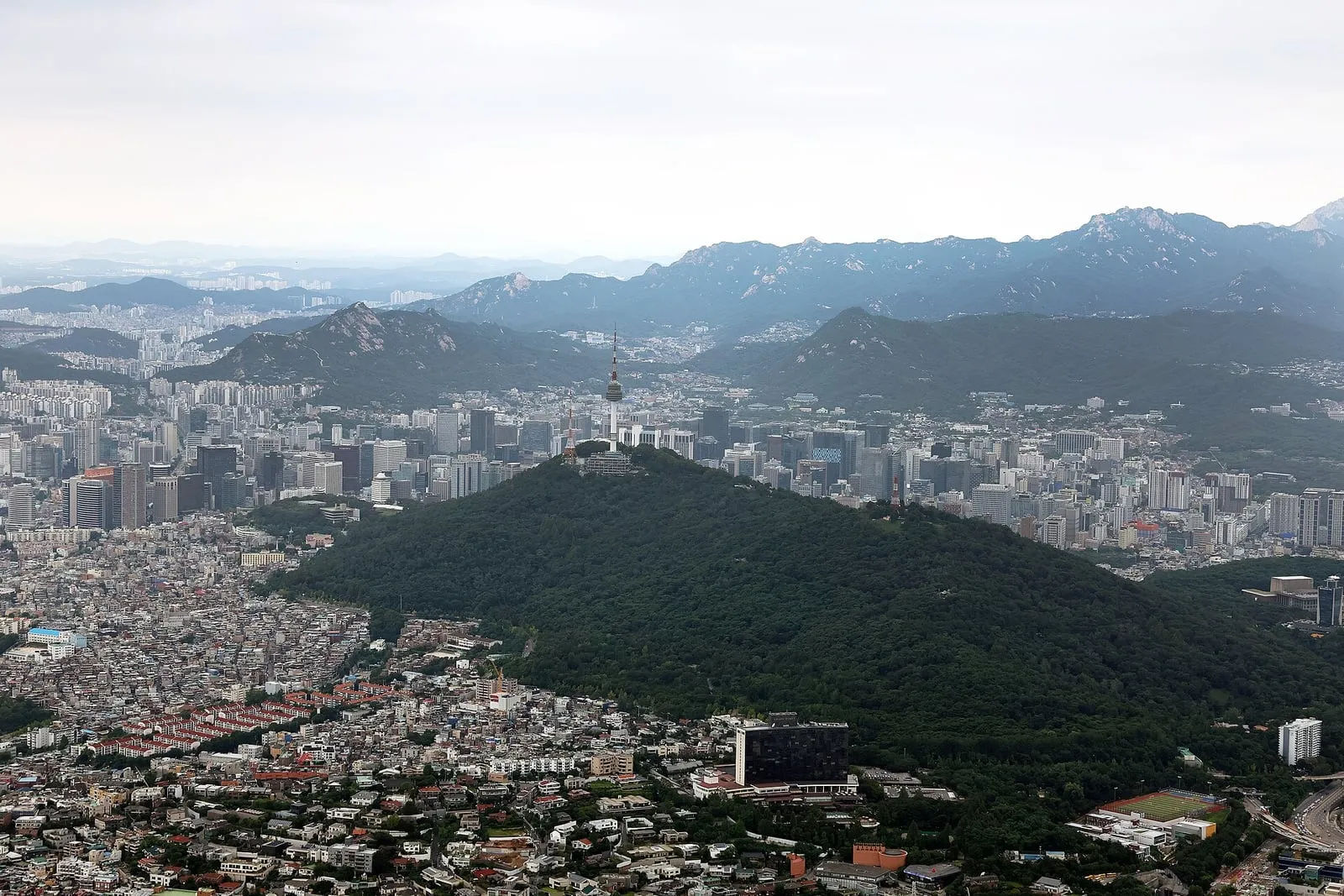
N Seoul Tower and central Seoul from above. Photo: Republic of Korea, Wikimedia Commons, CC BY-SA 2.0.
A long weekend (3 to 4 days): Seoul
Seoul compresses better into three or four days. Its historic core — Gyeongbokgung, Changdeokgung, Bukchon Hanok Village and Insadong, Gwangjang Market and Myeongdong — sits in a compact northern cluster, and staggered palace closures mean you never lose a full day to Mondays or Tuesdays. Tokyo’s sheer geographic sprawl rewards at least four to five days before you feel you have covered both its eastern and western halves.
Food and drink: Seoul for late-night BBQ and street markets, Tokyo for craft precision
Seoul is the stronger late-night, communal eating city: table-grilled Korean BBQ (note that many BBQ houses require a two-portion minimum, making food tours useful for solo diners), bindaetteok and knife-cut noodles at Gwangjang Market, Myeongdong Night Market and 24-hour convenience store ramyeon (where to eat in Seoul).
Tokyo excels at single-dish craft and solo-friendly counter dining: ticket-machine ramen (Fuunji from ¥1,000), tempura, tonkatsu, yakitori and concierge-booked omakase sushi (where to eat in Tokyo). Neither city has a tipping culture.
Sights and culture: Seoul for living royal palaces and modern history, Tokyo for museums and pop culture
Seoul puts five Joseon dynasty palaces directly inside the modern centre alongside the free National Museum of Korea, Dongdaemun Design Plaza, COEX Starfield Library, jjimjilbang bathhouses and the DMZ.
Tokyo counters with digital art (teamLab Planets), animation (Ghibli Museum, Akihabara), sumo, kabuki and high-altitude city decks (Shibuya Sky, Skytree, Tokyo Tower).
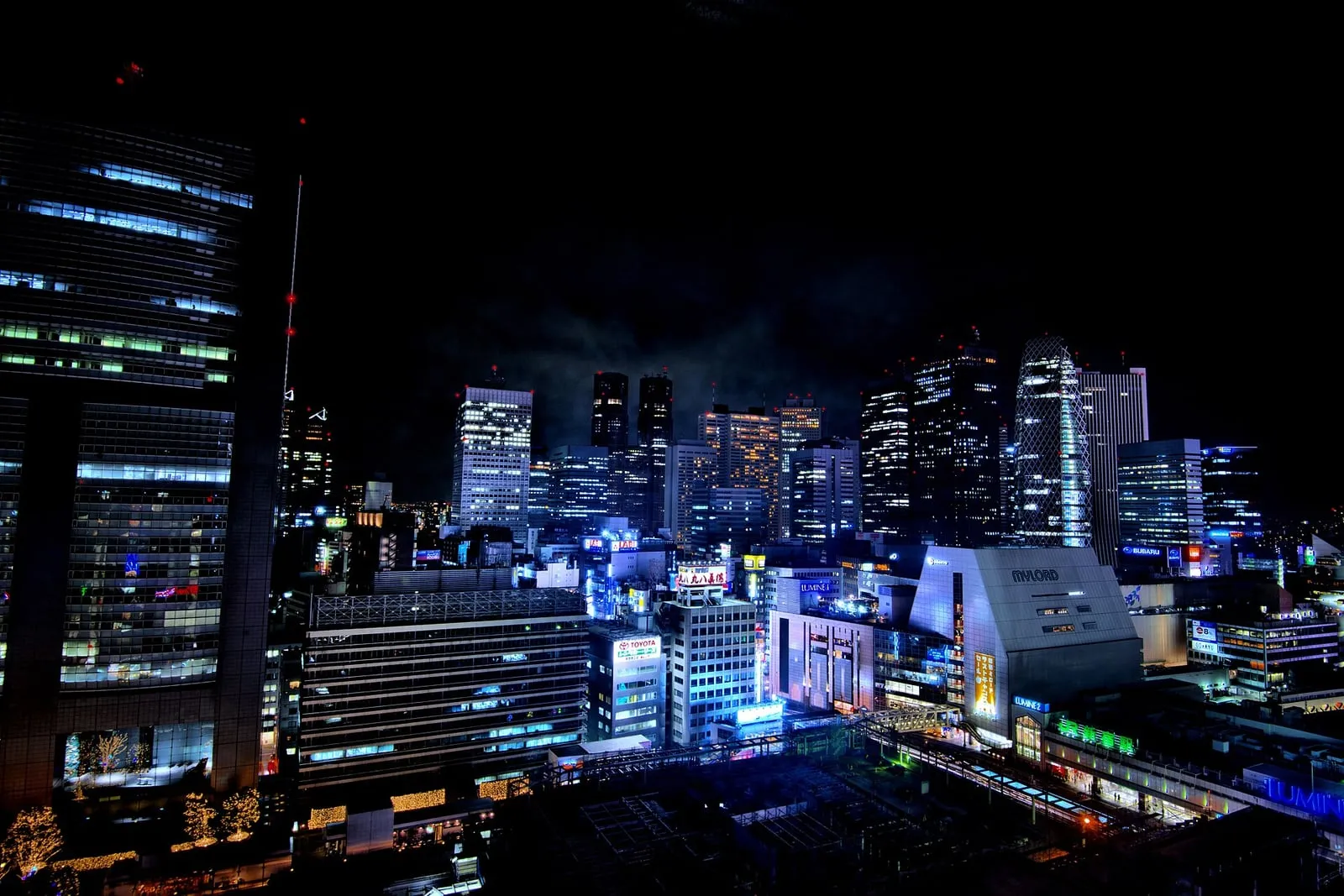
Shinjuku Station South Entrance and towers at night, Tokyo. Photo: 康 复 (calvision) from Tokyo, Japan, Wikimedia Commons, CC0.
A tight budget: Seoul clearly
Seoul is cheaper across the core tourist bill:
- Sights (two paid headline sights per city): Gyeongbokgung (₩3,000) plus Changdeokgung with Huwon Secret Garden (₩8,000) total ₩11,000 in Seoul (and the National Museum of Korea is free), whereas teamLab Planets (¥3,800) plus Shibuya Sky (¥2,700–¥3,400) total ¥6,500–¥7,200 in Tokyo.
- Transit: Seoul’s base subway ride is ₩1,550 with free bus transfers, and the 3-day Climate Card is ₩10,000 (+₩3,000 card), plus AREX All-Stop from Incheon is ₩4,750.
- Accommodation tax: Seoul levies no separate municipal hotel tax, whereas Tokyo adds ¥100–¥200 per night.
Families and couples: Tokyo for theme parks, split for couples
For families, Tokyo wins on headline attractions (Tokyo Disney, Ghibli Museum, teamLab Planets, Harry Potter Studio Tour), while Seoul answers with Lotte World (₩62,000, included on the Discover Seoul Pass), Everland and free palace entry for under-19s (Seoul with kids).
For couples, choose Seoul for Hanbok walks through Changdeokgung’s Huwon Secret Garden, evening cable-car views from N Seoul Tower and Han River sunset picnics; choose Tokyo for quiet lantern walks in Yanaka, concierge sushi counters and an overnight Hakone hot-spring escape.
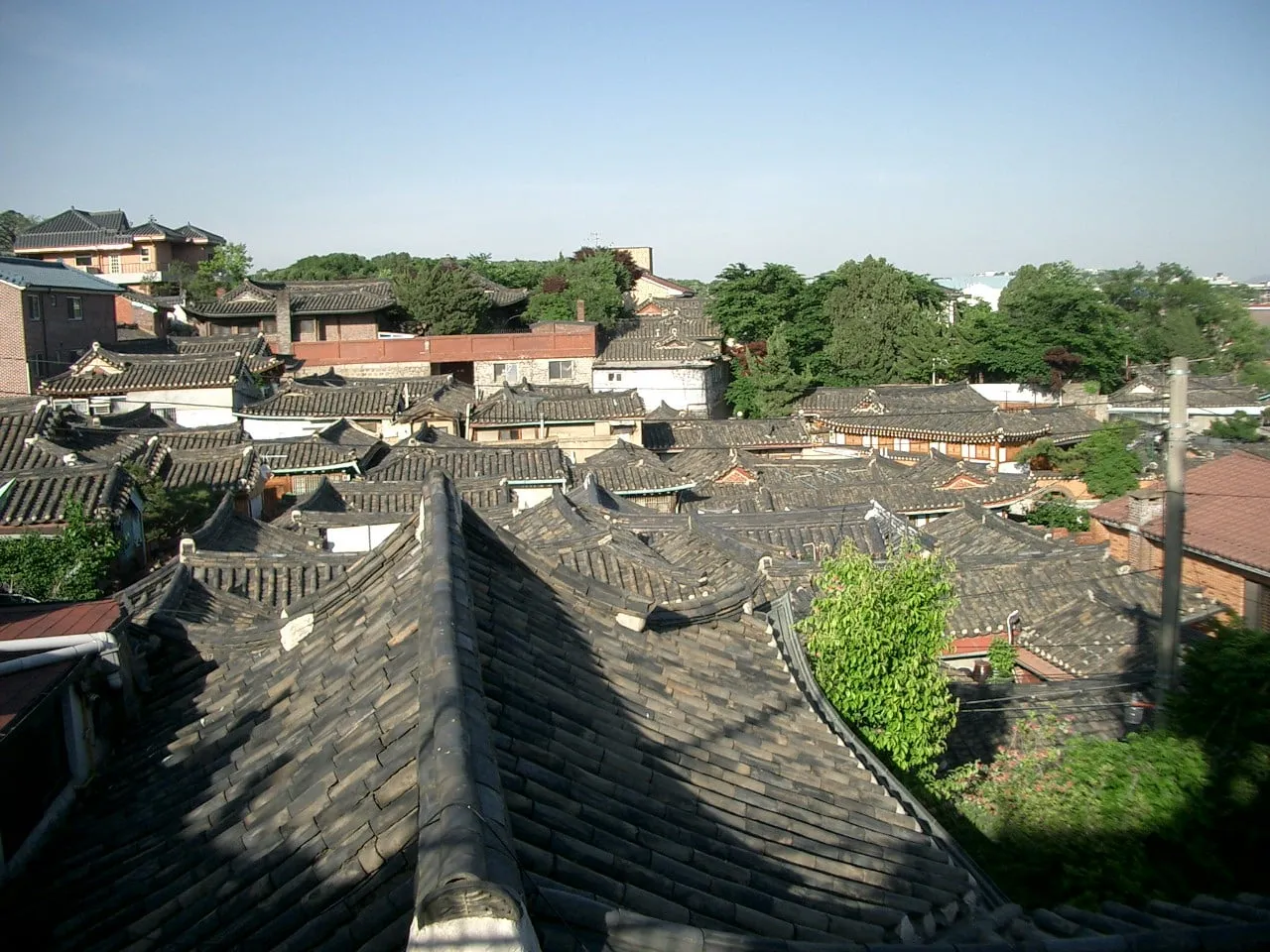
Traditional hanok rooftops in Bukchon, Seoul. Photo: Fred Ojardias, Wikimedia Commons, CC BY 2.0.
Doing both: flights, the order and where to stay
Seoul and Tokyo are separated by a short hop across the Sea of Japan, making an 8- to 10-day twin-city trip straightforward.
| Airport pair | Flight time | City-centre transfer at each end |
|---|---|---|
| Seoul Gimpo (GMP) ↔ Tokyo Haneda (HND) | About 2 hours 15 minutes | 20–30 min subway in Seoul; 15 min Keikyu to Shinagawa in Tokyo — the fastest door-to-door pairing |
| Seoul Incheon (ICN) ↔ Tokyo Narita (NRT) | About 2 hours 30 to 2 hours 40 minutes | 43 min AREX Express (₩13,000) in Seoul; 41 min Skyliner (¥2,580) in Tokyo — most low-cost carriers use this pair |
Check entry forms in both directions: complete South Korea’s e-Arrival Card within 3 days before flying into Seoul (see Seoul entry rules), and Visit Japan Web before flying into Tokyo (see Tokyo entry rules).
Which order: for 9 days, do Seoul first (4 days), then Tokyo (5 days), flying open-jaw into Incheon and home from Haneda or Narita. Starting in Seoul lets you adjust to the time zone in a compact palace-and-market city before stepping up to Tokyo’s scale — and if you land in Tokyo on a Tuesday or Wednesday, you avoid Tokyo’s Monday museum and garden closures.
Where to stay: in Seoul, stay in Myeongdong for direct airport limousine buses and central subway access, Hongdae for nightlife and AREX All-Stop direct access, or Insadong/Jongno to walk to the palaces (where to stay in Seoul, hotels in Myeongdong and Hongdae). In Tokyo, stay in Shinjuku or Shibuya for western transit and dining, or near Tokyo Station/Shinagawa for rapid Haneda and Shinkansen links (where to stay in Tokyo).
For full booking tables, see Seoul and Tokyo. Comparing other Asian trips? Read Tokyo vs Kyoto, Tokyo vs Osaka, Singapore vs Hong Kong and best Asian cities for a first trip.
Common questions
Is Seoul or Tokyo better for a first trip to East Asia?
Pick Tokyo for a first trip of four to five days if you want the easiest transit navigation (Google Maps works fully for walking and trains), extreme variety across contrasting wards and Mount Fuji or Kamakura day trips. Pick Seoul for three to four days if you want lower sight and hotel costs, late-night dining and street markets, royal palaces at ₩1,000 to ₩3,000 and the DMZ.
Is Seoul cheaper than Tokyo?
Yes on sight entries and daily transit. Seoul's royal palaces cost ₩1,000 to ₩3,000 (free in traditional Hanbok), the National Museum of Korea is free, a T-money subway ride starts at ₩1,550 and a 3-day unlimited Climate Card is ₩10,000 plus ₩3,000 for the card. In Tokyo, teamLab Planets starts at ¥3,800, Shibuya Sky is ¥2,700 to ¥3,400 and the 72-hour Subway Ticket is ¥2,000 (excluding JR).
Does Google Maps work in Seoul and Tokyo?
In Tokyo, Google Maps gives full turn-by-turn walking and live rail directions. In Seoul, Google Maps shows places and transit lines but does not give turn-by-turn walking or driving directions — download Naver Map or KakaoMap before landing.
Do I need an arrival card or visa for Seoul and Tokyo?
Both are visa-free for 90 days for UK, US, Australian and most EU passports (Canada gets 180 days in South Korea, 90 in Japan). For South Korea, foreign arrivals must submit the online e-Arrival Card (e-arrivalcard.go.kr) within 3 days before arrival (22 countries including the UK, US, Canada and Australia are K-ETA exempt through 31 December 2026; check 2027 extensions). For Japan, complete Visit Japan Web before departure for QR customs and immigration clearance.
Which days are palaces and museums closed in Seoul and Tokyo?
Seoul staggers its palaces so at least one is always open: Gyeongbokgung and Jongmyo Shrine close on Tuesdays, while Changdeokgung (with the Huwon Secret Garden), Deoksugung and Changgyeonggung close on Mondays. In Tokyo, Mondays close the Imperial Palace East Gardens (also Fridays), Shinjuku Gyoen, the Tokyo National Museum and the Edo-Tokyo Museum, and Tuesdays close the Ghibli Museum.
How long is the flight between Seoul and Tokyo?
Direct flights between Seoul (Incheon or Gimpo) and Tokyo (Haneda or Narita) take roughly 2 hours 15 minutes to 2 hours 40 minutes, with dozens of daily departures. Gimpo to Haneda is the fastest city-centre-to-city-centre pairing.