In this guide
💡 The Short Version: Travel from Seoul Station to Suwon Station in 30 minutes on the ITX-Saemaeul train (₩4,800 on Korail) or 60 minutes on Seoul Metro Line 1 (₩2,000). From Suwon Station, take local bus 11 or 13 to Janganmun Gate. Walking the 5.74 km UNESCO fortress wall is free under the Suwon Cultural Foundation, taking 2 to 3 hours. Tour the restored Hwaseong Haenggung Palace (₩1,500 on swcf.or.kr) and catch the free 11:00 martial arts demonstration. At sunset, ascend 150 metres in the tethered Flying Suwon helium balloon (₩20,000 via swcf.or.kr) by the East Gate. Suwon is one of the easiest cultural excursions featured in our guide to Day trips from Seoul. Or book ahead: a guided Suwon Fortress day tour on GetYourGuidead{rel=“sponsored nofollow noopener”} includes air-conditioned return coach transport and historical commentary along the ramparts.
The fortress and its UNESCO history
Suwon Hwaseong Fortress was commissioned in 1794 by King Jeongjo, the 22nd monarch of the Joseon Dynasty, and completed in 1796. The king constructed the fortified city to honour his deceased father, Prince Sado (who had been tragically executed by being locked in a rice chest by his own father, King Yeongjo), and moved his father’s royal tomb to Mount Hwasan in Suwon. Jeongjo envisioned making Suwon a self-sufficient political, commercial, and military capital.
The fortress was designated a UNESCO World Heritage site in 1997 because of its architectural ingenuity:
- Scientific construction: Designed by visionary Joseon scholar Jeong Yak-yong, the fortress merged Eastern stonemasonry with Western architectural principles translated from European treatises.
- The Geojunggi crane: Jeong invented the Geojunggi, a sophisticated pulley and lever hoisting machine that drastically reduced construction labour, completing the massive stone perimeter in just two and a half years.
- The Uigwe royal records: A detailed 10-volume construction manual called the Hwaseong Seongyeok Uigwe documented every gate dimension, brick recipe, tool drawing, and worker payment, enabling architectural historians to restore damaged sections with exact precision following the Korean War.
Walking the 5.74 km wall circuit
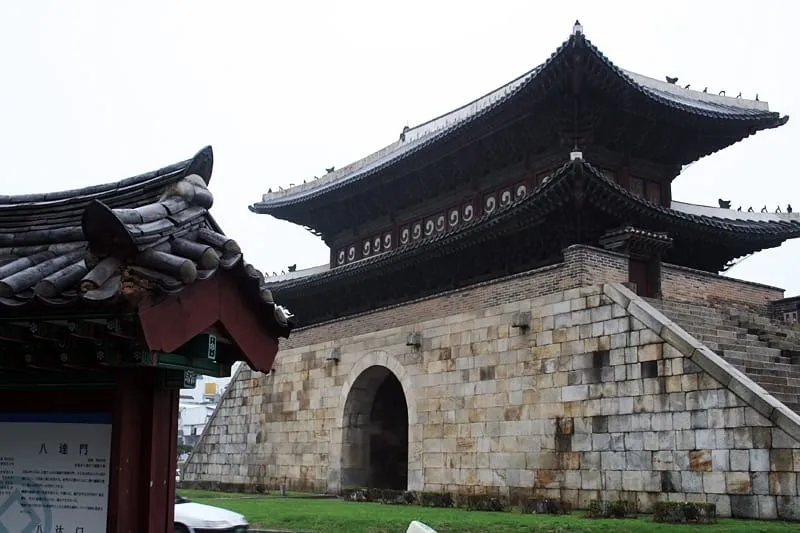
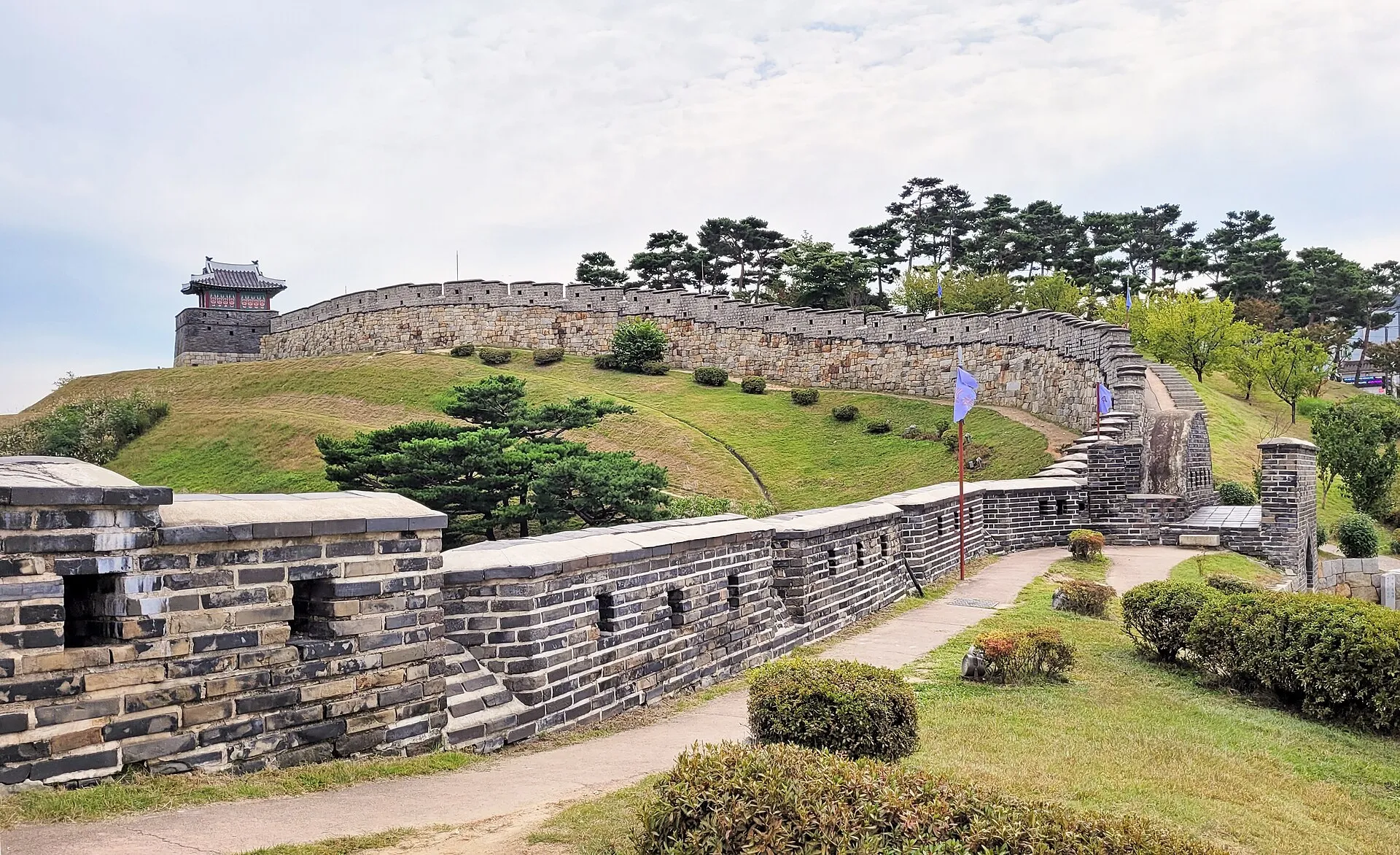
The ramparts run continuously for 5,744 metres, incorporating four grand cardinal gates, observation towers (gongsimdon), hidden secret doors (ammun), and sentry pavilions.
| Landmark | Sector | Architectural feature |
|---|---|---|
| Janganmun | North Gate | South Korea’s largest castle gate; features a semi-circular outer brick barbican (ongseong) to trap attacking cavalry |
| Paldalmun | South Gate | Sits in the middle of an urban roundabout surrounded by traditional markets |
| Changnyongmun | East Gate | Broad grassy lawns ideal for kite flying; mooring site for the Flying Suwon balloon |
| Hwaseomun | West Gate | Preserves its original 1796 stone structure and connects directly to the Seobuk Gongsimdon brick watchtower |
| Hwahongmun | North Floodgate | Seven granite drainage arches spanning the Suwoncheon stream, topped by a graceful pavilion |
| Banghwasuryujeong | North-East Pavilion | Perched atop an artificial rocky bluff overlooking the willow-fringed Yongyeon lotus pond |
Recommended walking itinerary
- Start at Janganmun (North Gate): Enter the wall path through the brick barbican. Walk east along the ramparts toward the North Floodgate (Hwahongmun).
- Rest at Banghwasuryujeong: Step out of the walls briefly to admire the reflection of this wooden pavilion in the Yongyeon pond.
- Continue to Changnyongmun (East Gate): The wall crosses expansive rolling lawns. Here, visitors can try traditional Korean archery (gukgung) at the Yeonmudae training ground (₩2,000 for 10 arrows) or ascend in the Flying Suwon balloon.
- Ascend Paldalsan (West Section): The trail climbs stone staircases up the forested slopes of Mount Paldalsan to reach Seonjangdae, the western command post at 128 metres altitude, offering a panoramic view of the entire city.
- Descend to Hwaseong Haenggung: Descend the marked trail down the eastern slope directly into the palace complex courtyard.
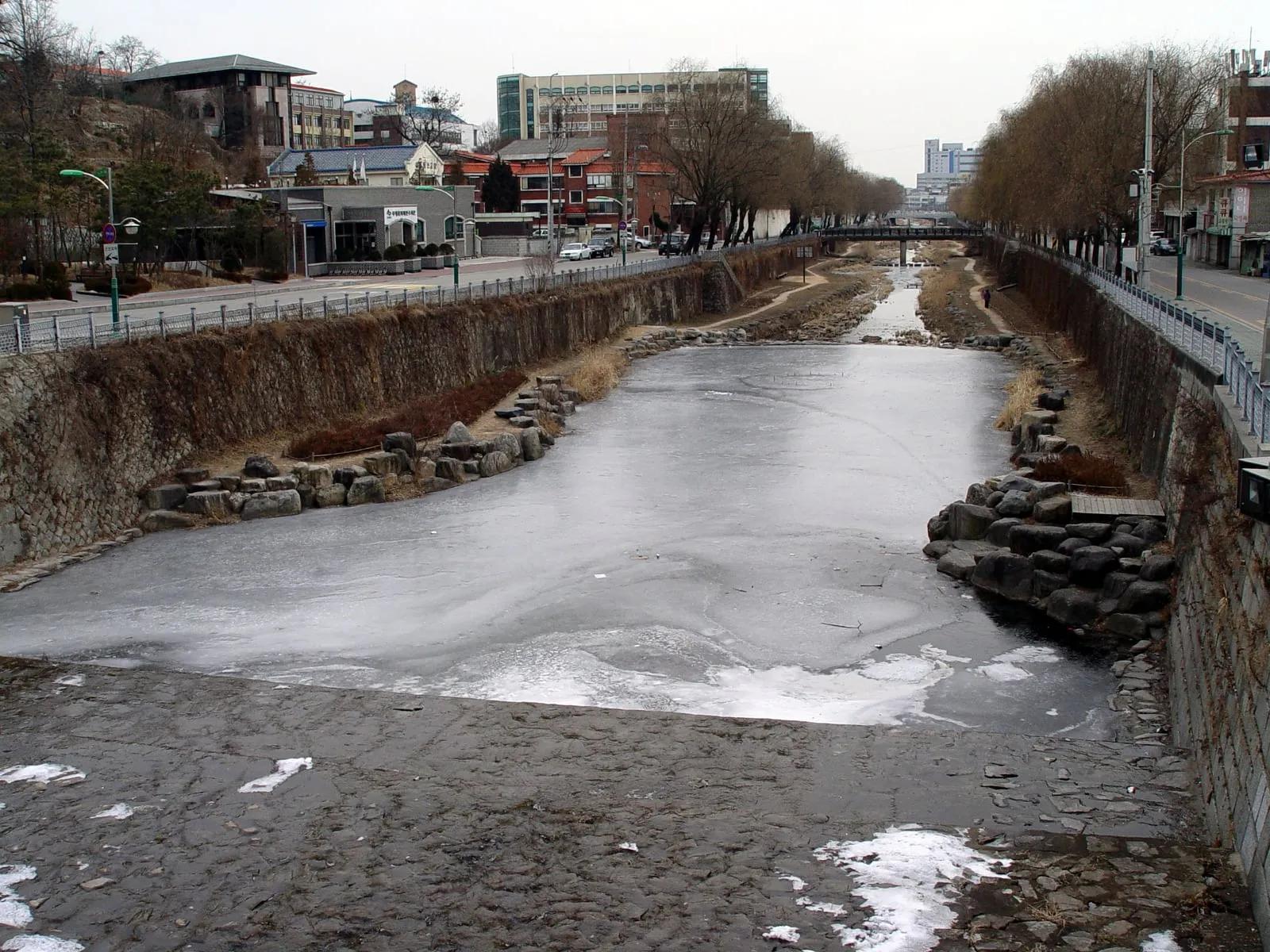
The Suwoncheon stream through Suwon in winter. Photo: Jpbarrass, Wikimedia Commons, Public domain.
Hwaseong Haenggung Palace
Situated at the eastern foot of Mount Paldalsan, Hwaseong Haenggung was the largest royal temporary palace (haenggung) of the Joseon Dynasty. King Jeongjo stayed here during his frequent royal processions from Seoul to visit his father’s tomb and held grand banquets to celebrate his mother Lady Hyegyeong’s 60th birthday.
- Admission: ₩1,500 for adults, ₩1,000 for youths, and ₩700 for children. Free for visitors wearing hanbok.
- Hours: 09:00 to 18:00 daily (last admission 17:30).
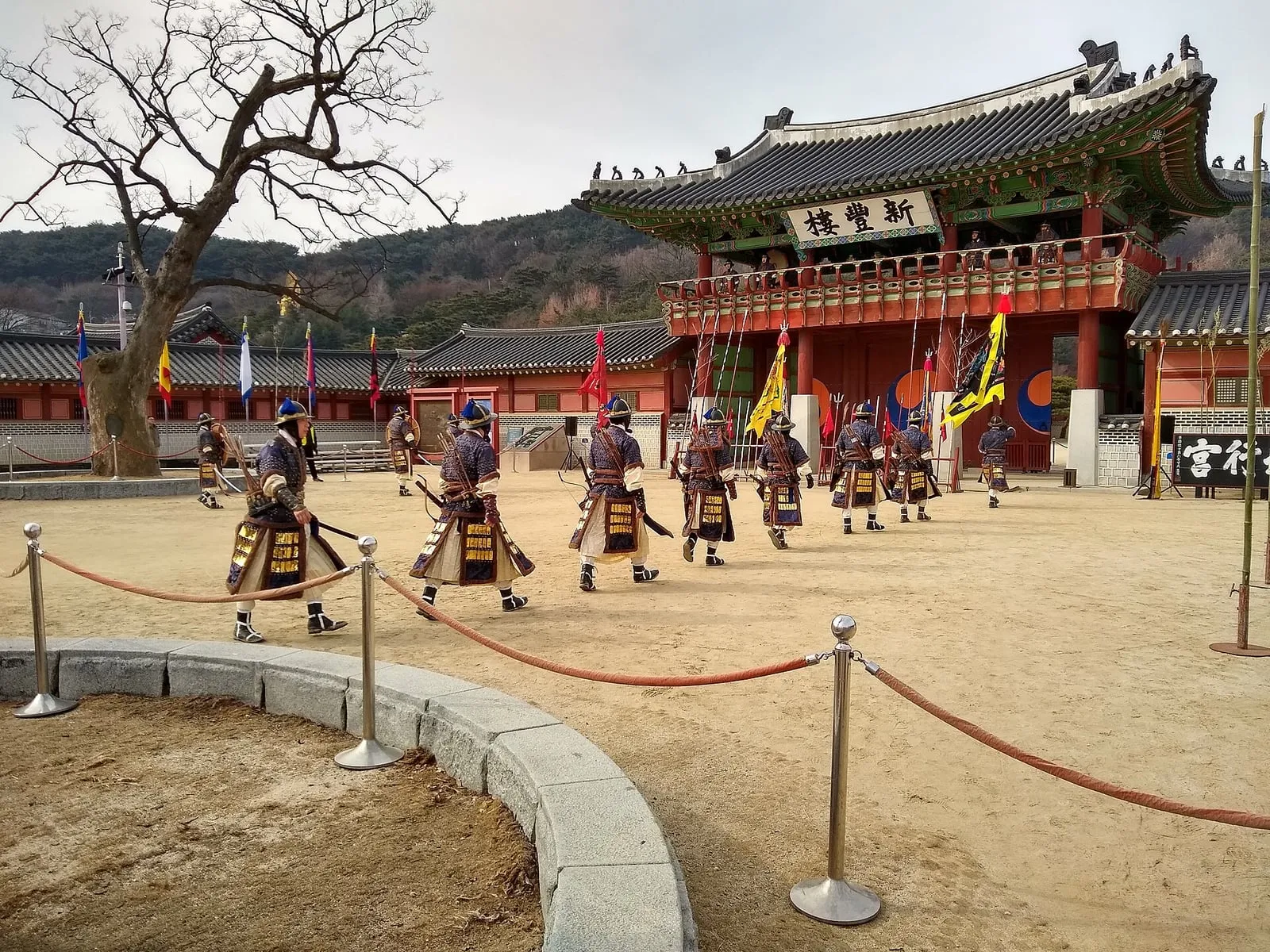
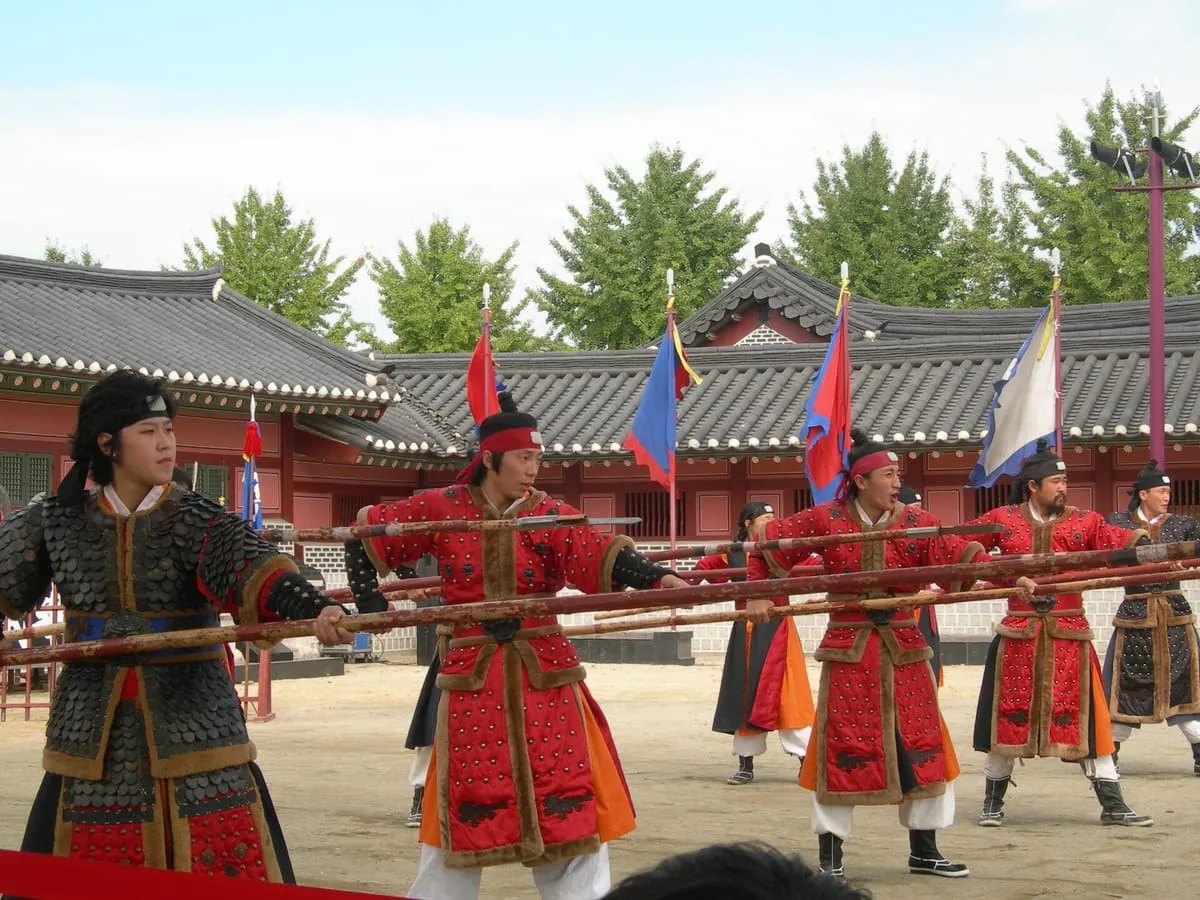
- Muye 24 Gi Demonstration: Tuesdays through Sundays at 11:00 in front of the Sinpungnu palace gate. Demonstrators clad in Joseon armour perform 24 classical Korean martial art techniques using two-handed long swords, spears, shields, and composite bows.
- Night Tours: During summer and autumn months, the palace stays open until 21:30 for illuminated evening walks (Haenggung Dalbit Yaeng).
Guided tours to Suwon Fortress
Suwon is easily reached independently on Subway Line 1, but guided day tours eliminate navigating local city buses between the fortress gates and the expansive Korean Folk Village.
From Seoul: Day Trip to UNESCO Suwon Hwaseong Fortress
From ₩70,918 · 4.9 stars from 147 reviews · 4 - 8 hours · fortress & Korean folk village
From Seoul: Suwon Hwaseong Fortress Tourad: A full-day guided tour exploring the 18th-century defensive ramparts, water gates, and Haenggung temporary palace, followed by a cultural walk through the Korean Folk Village.
Seoul: Suwon Hwaseong Fortress & Folk Village Day Tour
From ₩70,972 · 4.6 stars from 255 reviews · 9 - 11 hours · Joseon architecture & history
Seoul: Suwon Hwaseong Fortress & Folk Village or Starfieldad: Covers King Jeongjo’s visionary fortress fortifications with live commentary, including air-conditioned coach travel from Seoul.
From Seoul: Evening Tour to Hwaseong Fortress UNESCO Site
From ₩94,102 · 4.9 stars from 102 reviews · 4 hours · illuminated fortress walls
From Seoul: Suwon Hwaseong Fortress Night Tourad: An evening tour designed for photography, walking the illuminated ramparts and battlements of Hwaseong Fortress after dark.
Official ticket or tour: the prices side by side
Independent transit versus guided options.
| Option | Official admission | Tour cost | What it covers |
|---|---|---|---|
| Independent subway Line 1 (round-trip) | ₩4,300 + ₩1,500 palace = ₩5,800 | — | Commuter train, walking the free fortress ramparts, Haenggung Palace |
| Independent KTX bullet train | ₩16,800 return + local transport | — | Fast 30-minute train from Seoul Station; local bus to Janganmun |
| Suwon Fortress & Korean Folk Village tour | Admissions included | From ₩70,972 | Coach transport, guided fortress walk, and folk village entry |
| Evening fortress illumination tour | Admissions included | From ₩94,102 | Night photography along illuminated stone parapets and gates |
Flying Suwon: the helium balloon
Moored on the grass fields outside Changnyongmun (East Gate), Flying Suwon is a tethered helium passenger balloon.
- The experience: The balloon basket accommodates up to 20 passengers, ascending smoothly along a heavy steel ground cable to an altitude of 150 metres. The flight lasts roughly 10 to 15 minutes, allowing a 360-degree aerial view of the stone battlements snaking across the hills and modern downtown Suwon.
- Ticket prices: ₩20,000 for adults (19 and over), ₩17,000 for youths (13 to 18), and ₩15,000 for children (under 12).
- Hours: Operates Monday to Friday from 12:30 to 21:30; weekends and holidays from 11:00 to 22:00.
- Weather rules: Flights are cancelled immediately during wind speeds exceeding 13 m/s or heavy rain. Evening flights around sunset provide striking views as the fortress walls illuminate with floodlights.
How to get to Suwon from Seoul
1. Korail ITX-Saemaeul train (Fastest)
Board an ITX-Saemaeul or Mugunghwa train at Seoul Station or Yongsan Station.
- Travel time: 30 minutes.
- Fare: ₩4,800 for ITX-Saemaeul; ₩8,400 for KTX.
- Booking: Purchase tickets at Korail station ticket kiosks or online via the Korail English website.
2. Seoul Subway Line 1 (Cheapest)
Take Subway Line 1 (dark blue) from central Seoul stations (Seoul Station, City Hall, Jongno 3-ga) directly to Suwon Station.
- Travel time: Roughly 60 minutes.
- Fare: ₩2,000 paid with T-money card. Look for express trains (geup-haeng) to save 15 minutes.
3. Suwon Station to the Fortress Gates
Suwon Hwaseong Fortress sits approximately 2.5 km north-east of Suwon Station:
- By Bus: Walk out of Suwon Station Exit 4 to the central bus stops. Board Bus 11, 13, 35, or 36 and ride 10 to 12 minutes to the Janganmun Gate stop (Janganmun, Buksumun) for ₩1,450.
- By Taxi: A local taxi from Suwon Station to Janganmun takes 8 to 10 minutes and costs approximately ₩5,500 to ₩7,000.
For further travel ideas across the Seoul metropolitan area, read our overview of the top Day trips from Seoul.
Common questions
How much does it cost to enter Suwon Hwaseong Fortress?
Walking the 5.74 km fortress wall perimeter is free of charge. Admission to the restored Hwaseong Haenggung temporary palace costs ₩1,500 for adults, ₩1,000 for youths aged 13 to 18, and ₩700 for children aged 7 to 12. Visitors wearing traditional Korean hanbok enter the palace free.
How long does it take to walk the fortress wall?
The complete 5.74 km fortress wall loop takes approximately 2 to 3 hours at an easy walking pace. The northern and eastern sections along Janganmun and Changnyongmun are mostly level, while the western section ascends Paldalsan hill via stone staircases.
What is the fastest way from Seoul to Suwon?
The fastest method is the Korail ITX-Saemaeul train from Seoul Station or Yongsan Station to Suwon Station, taking 30 minutes for ₩4,800, or the KTX bullet train taking 30 minutes for ₩8,400. Alternatively, standard Seoul Metro Line 1 takes about 60 minutes from Seoul Station for ₩2,000.
What is Flying Suwon and how much does it cost?
Flying Suwon is a tethered helium passenger balloon moored near Changnyongmun (East Gate). It ascends vertically to a height of 150 metres, providing panoramic aerial views over the entire fortress perimeter and Suwon city. Tickets cost ₩20,000 for adults, ₩17,000 for youths, and ₩15,000 for children.
When are the royal martial arts demonstrations held?
The Suwon City Martial Arts Team performs the traditional 'Muye 24 Gi' martial arts demonstration in front of Sinpungnu, the main gate of Hwaseong Haenggung Palace, Tuesday to Sunday at 11:00 (weather permitting). The 30-minute demonstration is completely free to watch.