In this guide
💡 The Short Version: Known as “Little Edo” (Koedo), Kawagoe in Saitama Prefecture is reached in just 30 minutes from Ikebukuro Station via the Tobu Tojo Line for ¥490 each way. Tobu’s Kawagoe Discount Pass costs ¥710 (covering return train fares and shop discounts), while the Premium Pass (¥1,200) adds unlimited rides on regional buses and the Koedo Loop Bus. Seibu Railway runs direct trains from Seibu-Shinjuku Station to Hon-Kawagoe (50 minutes, ¥600 express or ¥1,800 for the limited express round-trip pass). The preserved clay warehouse street, the historic Toki no Kane bell tower, Kitain Temple, and candy alleys are all easily walkable. Check closed days carefully: Honmaru Goten closes on Mondays. Or book a tour: travellers wanting private guided interpretation of Edo-era trade routes can book the Day Tour from Tokyo: Experience Kawagoe and Edo Japanad (from ¥21,000, 6 hours). All prices are in Japanese yen (¥).
Travel routes and train comparisons
Kawagoe is positioned approximately 40 kilometres northwest of central Tokyo. The city has three central railway stations: Hon-Kawagoe Station (Seibu line, closest to the historic merchant district), Kawagoeshi Station (Tobu line), and Kawagoe Station (joint JR and Tobu terminal).
| Route | Departure terminal | Destination station | Travel time | Single fare | Discount pass available |
|---|---|---|---|---|---|
| Tobu Tojo Line (Express) | Ikebukuro Station | Kawagoe / Kawagoeshi | 30–33 minutes | ¥490 | Tobu Kawagoe Discount Pass (¥710 / ¥1,200) |
| Seibu Shinjuku Line (Express) | Seibu-Shinjuku Station | Hon-Kawagoe | 50–55 minutes | ¥600 | Seibu 1-Day Pass (¥1,000) |
| Seibu Koedo Limited Express | Seibu-Shinjuku Station | Hon-Kawagoe | 44 minutes | ¥1,200 | Seibu Kawagoe Access Ticket (¥1,800 return) |
| JR Saikyo / Kawagoe Line | Shinjuku / Shibuya | Kawagoe | 55–60 minutes | ¥810 | Covered by Japan Rail Pass |
- Taking the Tobu Tojo Line from Ikebukuro: The fastest and most frequent route. Rapid (Kaisoku) and Express (Kyuko) trains depart every few minutes from the Tobu concourse at Ikebukuro Station. No seat reservation or limited express supplement is required; you can board directly with a Pasmo or Suica IC card.
- Taking the Seibu Shinjuku Line: Ideal if you are based in Shinjuku. Note that the Seibu-Shinjuku station terminal is situated about 300 metres north of JR Shinjuku Station (near Kabukicho). The Koedo limited express provides guaranteed forward-facing reserved seats.
- JR Saikyo Line: Practical if using a nationwide JR Pass or JR Tokyo Wide Pass, though journey times are longer than the private lines. Direct through-trains run from Shinjuku, Shibuya, and Omiya to Kawagoe Station.
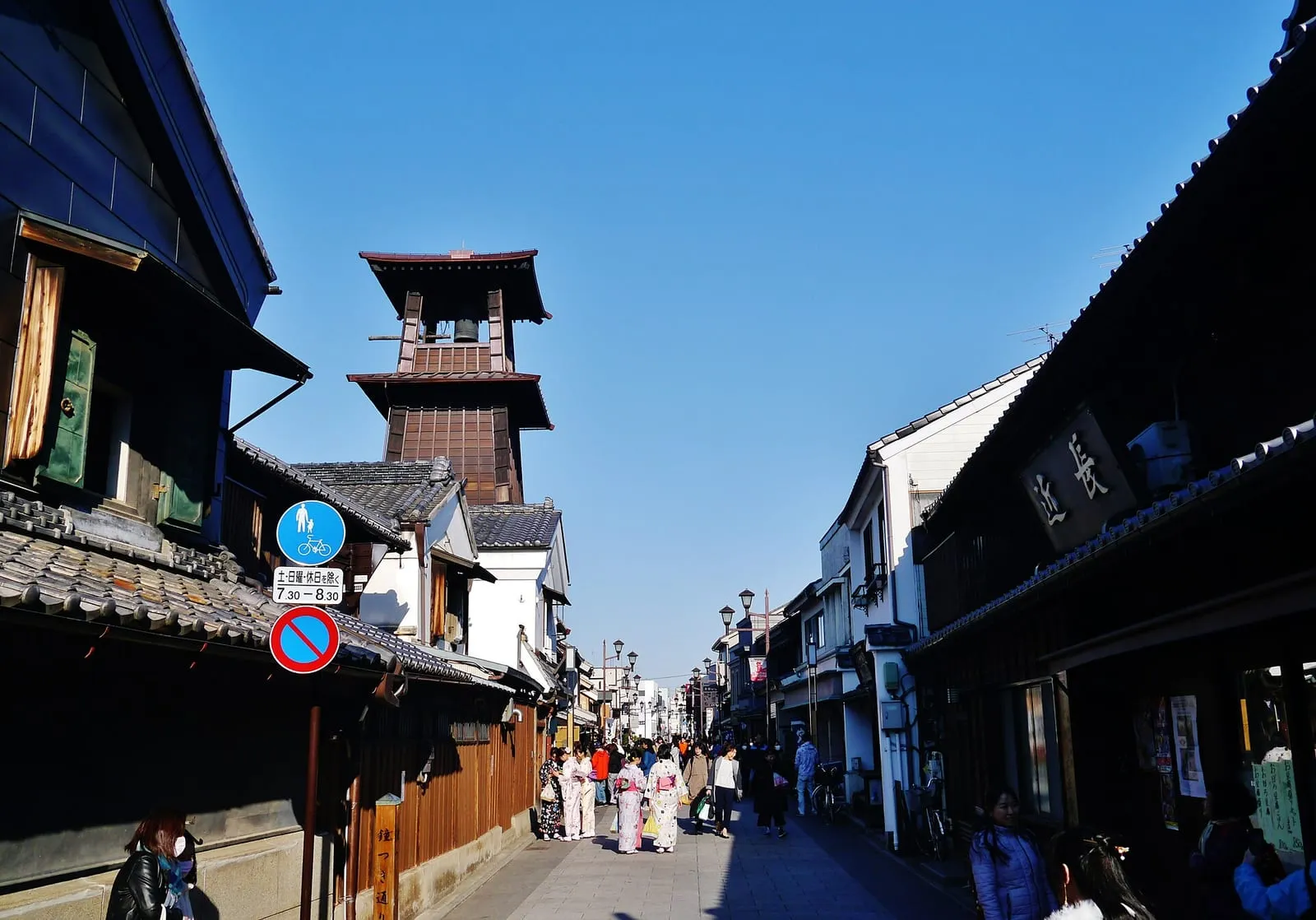
The historic Toki no Kane wooden bell tower rising over Kawagoe. Photo: Zairon, Wikimedia Commons, CC BY-SA 4.0.
Tourist discount passes
Both private railway companies sell dedicated tourist excursion tickets:
- Tobu Kawagoe Discount Pass (¥710 adults, ¥370 children): Covers round-trip travel between Ikebukuro and Kawagoe or Kawagoeshi Station, plus designated retail discounts at participating souvenir shops and restaurants. Available as a digital voucher via Tobu Railway or at the Tobu Ikebukuro station ticket office.
- Tobu Kawagoe Discount Pass Premium (¥1,200 adults, ¥600 children): Includes the return Ikebukuro train fare, unlimited train rides between Kawagoe and Kawagoeshi stations, and unlimited boardings on all local Tobu buses within Kawagoe, including the retro Koedo Loop Bus connecting the stations to Kitain and the warehouse quarter.
- Seibu Kawagoe Access Ticket (¥1,800 adults, ¥700 children): Valid for one calendar day. Bundles a round-trip ticket between Seibu-Shinjuku or Takadanobaba and Hon-Kawagoe on the Koedo limited express, including seat reservation supplements in both directions.
Top historic sights in Little Edo
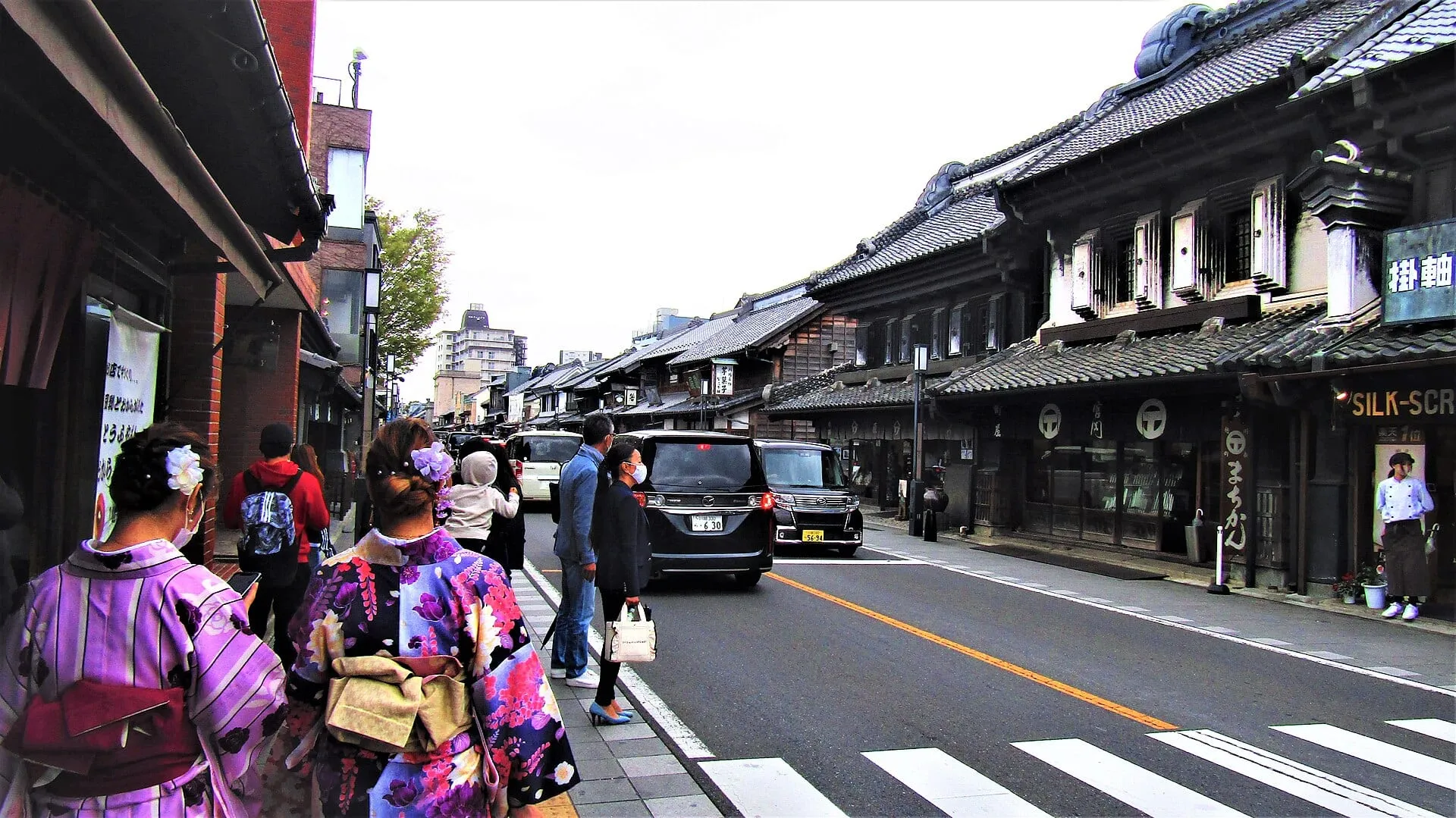
During the Tokugawa shogunate, Kawagoe flourished as an essential trading port supplying timber, agricultural produce, and textiles to the shogun’s capital along the Shingashi River. Today, the town preserves five centuries of architectural styles.
1. Kurazukuri Warehouse District (Ichibangai)
The primary historic avenue extends for roughly 500 metres along Ichibangai street. Following a catastrophic fire in March 1893 that destroyed over a third of the town, Kawagoe’s wealthy merchants rebuilt their shops in the traditional kurazukuri style—fire-resistant structures framed with heavy timber and encased in multiple layers of mud and black plaster up to thirty centimetres thick.
- Architectural features: The buildings feature monumental double-eaved roofs, charcoal-black polished plaster (kuro-shikkui), and heavy iron-plated sliding shutters designed to seal against smoke and embers.
- Specialty shopping: Today the warehouses house traditional sweet potato confectionery boutiques, craft knife sharpeners, soy sauce breweries, and eel (unagi) restaurants such as Ogagiku (founded in 1807).
2. Toki no Kane (The Bell of Time)
Rising 16 metres above the tile rooflines of Kanetsuki-dori, Toki no Kane is Kawagoe’s defining civic landmark.
- Originally erected in the early 1600s by feudal lord Sakai Tadakatsu to keep time for samurai and townspeople, the current three-storey wooden tower was reconstructed in 1894 immediately following the Great Fire.
- The bell chimes mechanically four times every day: at 06:00, 12:00, 15:00, and 18:00, recognized by Japan’s Ministry of the Environment as one of the country’s “100 Soundscapes of Japan to Be Preserved”.
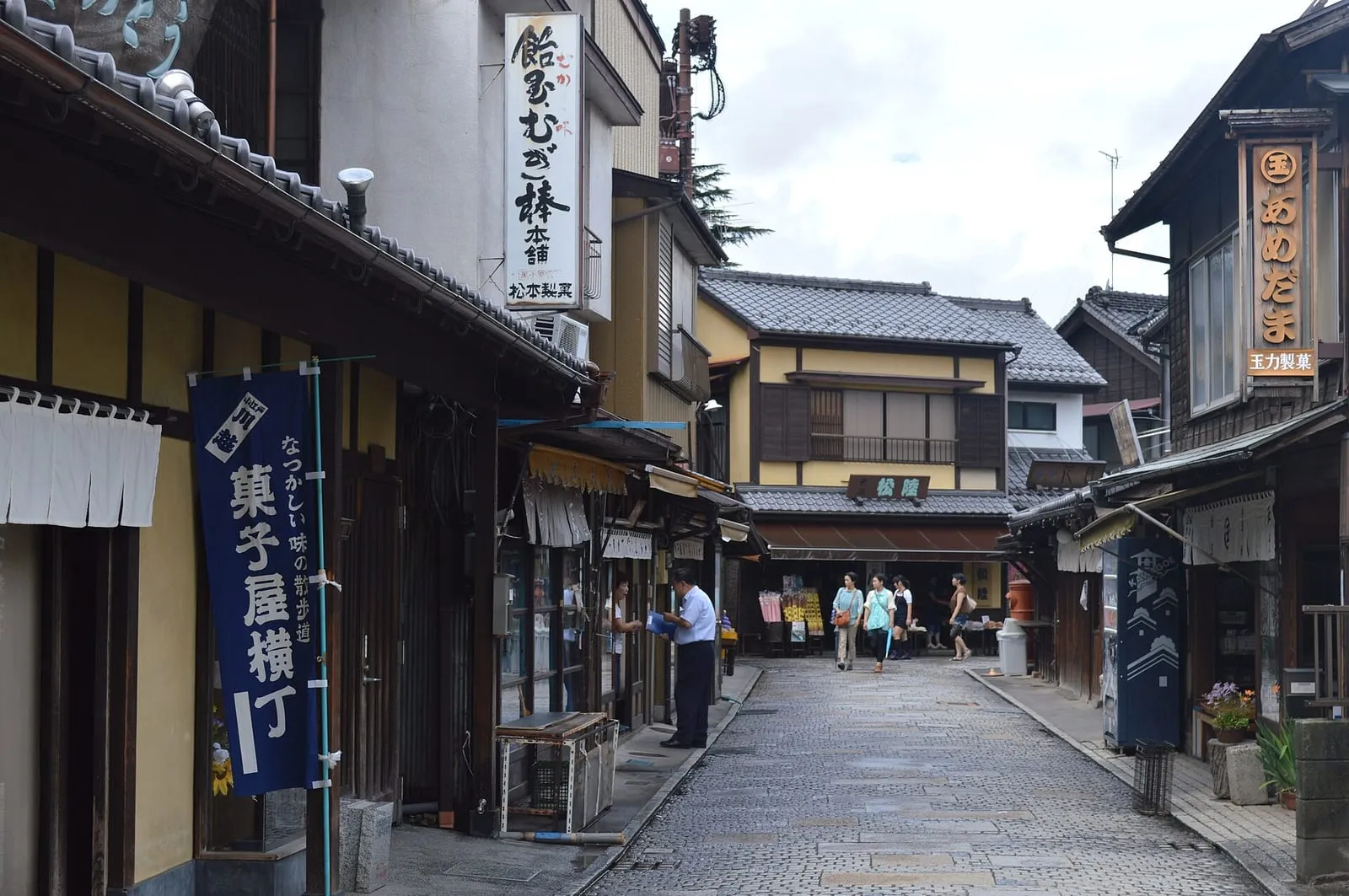
Stone-paved sweet shops along Kashiya Yokocho in Kawagoe. Photo: At by At, Wikimedia Commons, CC BY-SA 3.0.
3. Kashiya Yokocho (Penny Candy Lane)
Located a few blocks northwest of the Bell Tower, Kashiya Yokocho is a nostalgic cobblestone alley lined with traditional sweet shops.
- Following the 1923 Great Kanto Earthquake, which flattened Tokyo’s confectionery manufacturing quarters, Kawagoe stepped in to supply the capital with traditional dagashi (penny candies). By the early Showa era, more than 70 confectionery workshops operated here.
- Roughly twenty shops continue the craft today, selling giant meter-long puffed barley sticks (fugashi), hand-pulled hard candies, sweet potato chips, and purple sweet potato soft-serve ice cream. Most shops operate from 10:00 to 17:00 and close on Mondays or Wednesdays.
4. Kitain Temple
Situated fifteen minutes’ walk southeast of Hon-Kawagoe Station, Kitain is an ancient Tendai Buddhist temple founded in 830 AD.
- Surviving structures of Edo Castle: After a fire destroyed Kitain in 1638, the third Tokugawa shogun, Iemitsu, ordered the dismantling and relocation of multiple structural halls from Tokyo’s Edo Castle to Kitain. Because Edo Castle itself was subsequently destroyed by fires, earthquakes, and wartime bombings, Kitain’s Kyakuden (Reception Hall) and Shoin (Dressing Hall) are the only surviving palace rooms of the original Edo Castle anywhere in Japan. Visitors can view the room where Shogun Iemitsu was born and the dressing quarters of his wet nurse, Lady Kasuga.
- Gohyaku Rakan: A secluded courtyard housing 540 distinct stone statues representing the disciples of Buddha. Carved between 1782 and 1825, no two statues share the same posture or facial expression—some laugh, some weep, while others whisper, stroke animals, or drink sake.
- Admission: ¥400 for adults, covering the Edo Castle halls, garden courtyards, and Gohyaku Rakan. Open 09:00 to 16:30 (closing at 16:00 from late November through February).
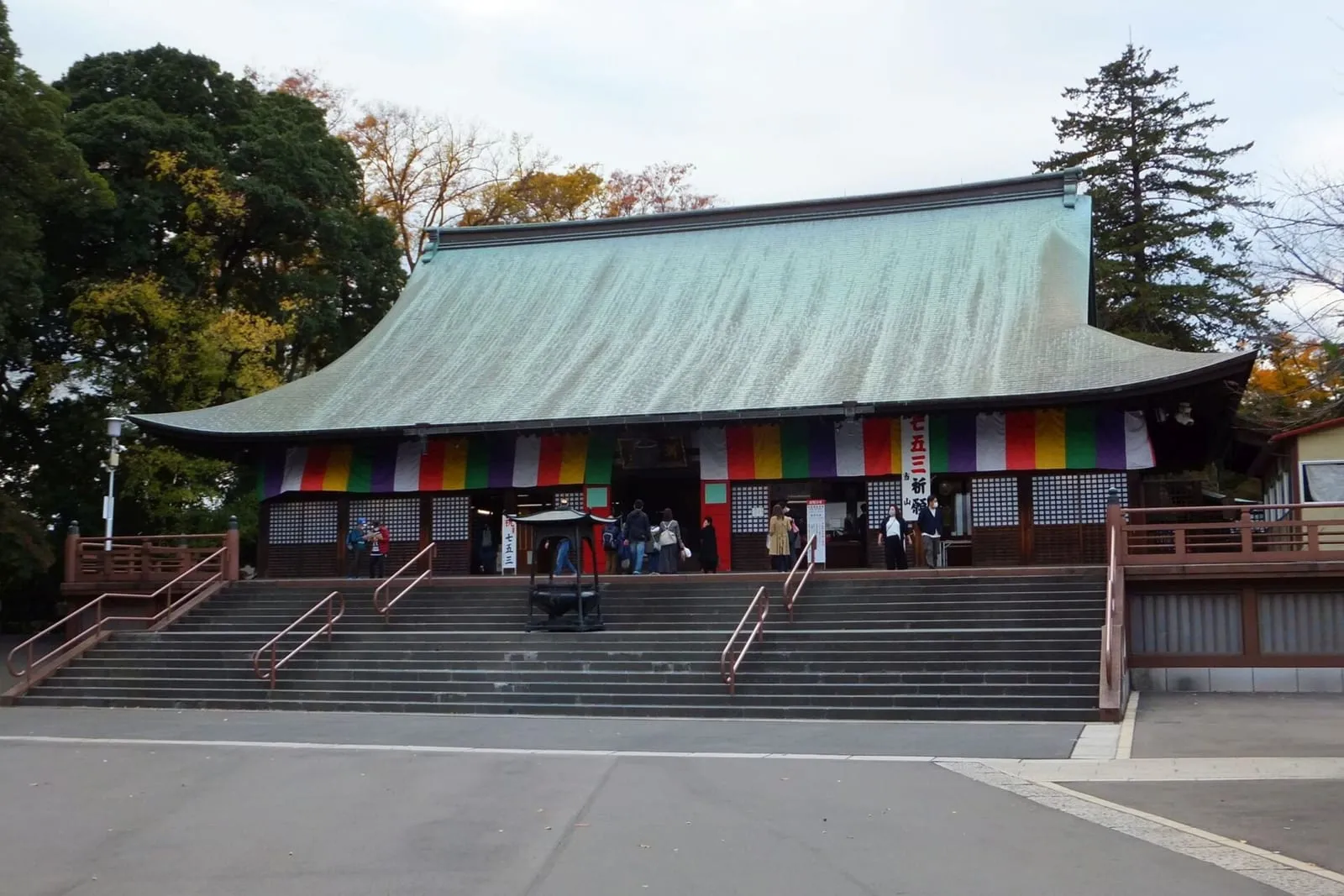
The main hall and temple grounds of Kitain in Kawagoe. Photo: tak1701d, Wikimedia Commons, CC BY-SA 3.0.
5. Kawagoe Castle Honmaru Goten
Constructed in 1848, the Honmaru Goten is the only surviving palace structure of Kawagoe Castle, and one of only two remaining castle palace buildings (goten) in all of eastern Japan (alongside Kochi Castle).
- Visitors remove shoes to explore spacious tatami council chambers, wide wooden corridors with views of Japanese courtyard gardens, and lifelike mannequin displays of feudal clan elders deliberating shogunate decrees.
- Admission is ¥100 for adults. Open 09:00 to 17:00 (last entry 16:30). Closed on Mondays (or the following Tuesday if Monday is a national holiday) and the fourth Friday of each month.
Guided excursions and regional tours
While Kawagoe is straightforward to visit independently by train, guided tours provide private transport and deeper cultural interpretation.
Day Tour from Tokyo: Experience Kawagoe and Edo Japan
From ¥21,000 · 4.1 stars from 7 reviews · 6 hours
The Day Tour from Tokyo: Experience Kawagoe and Edo Japanad connects central Tokyo to Little Edo. A dedicated guide leads your group through the Kurazukuri district, decodes the Edo Castle history at Kitain Temple, and navigates the local food stalls in Kashiya Yokocho.
Kawagoe’s Little Edo: Explore the Heart of Traditional Japan
From ¥33,999 · 4.6 stars from 8 reviews · 7 hours
The Kawagoe’s Little Edo: Explore the Heart of Traditional Japanad provides an immersive private walking itinerary tailored to culinary and architectural traditions, including tea ceremonies and visits to local sake breweries.
From Tokyo: Kawagoe and Chichibu Day Trip with English Guide
From ¥22,000 · 4.5 stars · 10 hours
The From Tokyo: Kawagoe and Chichibu Day Trip with English Guidead combines morning explorations of Kawagoe’s clay warehouse lanes with an afternoon mountain excursion into the forested Chichibu region of western Saitama Prefecture.
Where to go next
Because Kawagoe is situated just 30 minutes northwest of Ikebukuro, it easily pairs with late afternoon shopping or dining in western Tokyo hubs like Shinjuku and Shibuya.
To compare Kawagoe with other regional day trips, read our comprehensive overview of day trips from Tokyo. If you prefer coastal samurai history and giant Buddha statues, see our Kamakura day trip guide; if you are interested in modern port architecture and Chinatown, visit Yokohama.
For subway passes and suburban rail line connections, consult our guide to Tokyo public transport, and discover all top attractions on the Tokyo hub.
Common questions
How do you travel from Tokyo to Kawagoe?
The fastest and most economical route is the Tobu Tojo Line from Ikebukuro Station to Kawagoe or Kawagoeshi Station (approximately 30 minutes on rapid or express services, ¥490 one-way). Alternatively, the Seibu Shinjuku Line connects Seibu-Shinjuku Station to Hon-Kawagoe Station in 45 minutes on the Koedo Limited Express (¥1,200) or 55 minutes on local expresses (¥600).
Which rail discount pass should you buy for Kawagoe?
The standard Tobu Kawagoe Discount Pass costs ¥710 for adults and ¥370 for children, covering a discounted return journey from Ikebukuro plus retail discounts. The Tobu Kawagoe Discount Pass Premium (¥1,200) adds unlimited rides on Tobu local buses and the Koedo Loop Bus. If travelling from Shinjuku, the Seibu Kawagoe Access Ticket (¥1,800) includes a reserved seat on the Koedo limited express.
Why is Kawagoe called 'Little Edo' (Koedo)?
During the Edo period, Kawagoe served as a crucial military and supply outpost for the Tokugawa shogunate along the Shingashi River. Following a devastating fire in 1893, local merchants rebuilt their storefronts using fireproof timber-and-clay warehouse architecture (kurazukuri), preserving traditional streetscapes that vanished from Tokyo during 20th-century modernization.
What are the opening hours and closed days in Kawagoe?
Honmaru Goten castle palace is closed on Mondays (or Tuesday if Monday is a national holiday) and the fourth Friday of each month. Kitain Temple is open daily from 09:00 to 16:30 (closing at 16:00 from late November through February). Many confectionery shops in Kashiya Yokocho close on Mondays or Wednesdays.
When does the Toki no Kane bell chime?
The wooden bell tower chimes automatically four times each day: at 06:00, 12:00, 15:00, and 18:00. The mechanical chimes ring for roughly three minutes.