In this guide
💡 The Short Version: This day trip pairs South Korea’s late-19th-century treaty port history with its most ambitious 21st-century smart eco-city. Ride Seoul Metro Line 1 direct to Incheon Station (approx 70 minutes, ₩2,000) to explore Incheon Chinatown, the birthplace of Jjajangmyeon (black bean noodles) in 1884. Visit the Jjajangmyeon Museum (₩1,000), colourful Songwol-dong Fairytale Village, and the Open Port heritage quarter. In the afternoon, transfer via the Suin-Bundang Line to futuristic Songdo Central Park to ride seawater water taxis (₩4,000), view the curving Tri-bowl, and take in panoramic skyline vistas from the free 33rd-floor G-Tower observation deck. For more excursions beyond the capital, consult our full guide to day trips from Seoul.
Day trip timetable at a glance
This timetable connects historic Incheon Port in the morning with modern Songdo smart city in the afternoon, returning to Seoul by evening.
Day Trip Route Sequence:
- 08:45–10:00: Seoul Station to Incheon Station terminus (Line 1, 70 mins)
- 10:15–12:30: Incheon Chinatown paifang gates, mural streets, and Jjajangmyeon Museum
- 12:30–13:30: Lunch featuring original Jjajangmyeon along Bukseong-dong
- 13:30–14:30: Songwol-dong Fairytale Village and Open Port heritage warehouses
- 14:30–15:15: Subway transfer to Songdo Central Park (Suin-Bundang to Incheon Line 1, 35 mins)
- 15:15–17:30: Songdo Central Park seawater canal, water taxis, and free 33rd-floor G-Tower deck
- 17:30–18:45: NC Cube Canal Walk shopping and dinner
- 18:45–20:00: Return journey to central Seoul via red express bus or subway
| Time of day | Location & activity | Duration | Transport / Logistics | Key details & costs |
|---|---|---|---|---|
| 08:45–10:00 | Train journey from Seoul to Incheon | 70–75 mins | Seoul Subway Line 1 direct to Incheon Station terminus | Fare approx ₩2,000 on T-money; board at Seoul, City Hall, or Yongsan Station. |
| 10:00–12:30 | Incheon Chinatown & Jjajangmyeon Museum | 2.5 hours | On foot from Incheon Station Exit 1 | Museum entry ₩1,000; walk through historic red paifang gates and Samgukji mural alley. |
| 12:30–13:30 | Lunch: Original Jjajangmyeon feast | 1 hour | Chinatown restaurant strip (Bukseong-dong) | Traditional black bean noodles approx 8,000–₩12,000; try Gonghwachun or Xin. |
| 13:30–14:30 | Songwol-dong Fairytale Village & Open Port | 1 hour | On foot adjoining Chinatown | Free street art exploration; preserved Japanese colonial brick banks and art warehouses. |
| 14:30–15:15 | Subway transfer from Incheon to Songdo | 35–40 mins | Suin-Bundang Line to Woninjae, transfer to Incheon Line 1 | Transit transfer covered by integrated fare (approx ₩1,500). |
| 15:15–17:30 | Songdo Central Park & G-Tower Observatory | 2.25 hours | Central Park Station (Incheon Line 1, Exit 3 or 4) | Free G-Tower 33rd-floor deck; seawater canal water taxi (₩4,000); architectural Tri-bowl. |
| 17:30–18:45 | NC Cube Canal Walk shopping & dinner | 1.25 hours | 10 minutes’ walk from Central Park | Pedestrian European-style canal promenade with seasonal shopping pavilions and dinner cafes. |
| 18:45–20:00 | Return journey from Songdo to central Seoul | 60–75 mins | Red express bus M6405 to Gangnam, or subway via Bupyeong | Express bus approx ₩3,000 (60 mins to Gangnam); or Incheon Line 1 transfer. |
Part 1: Incheon Chinatown and Open Port history
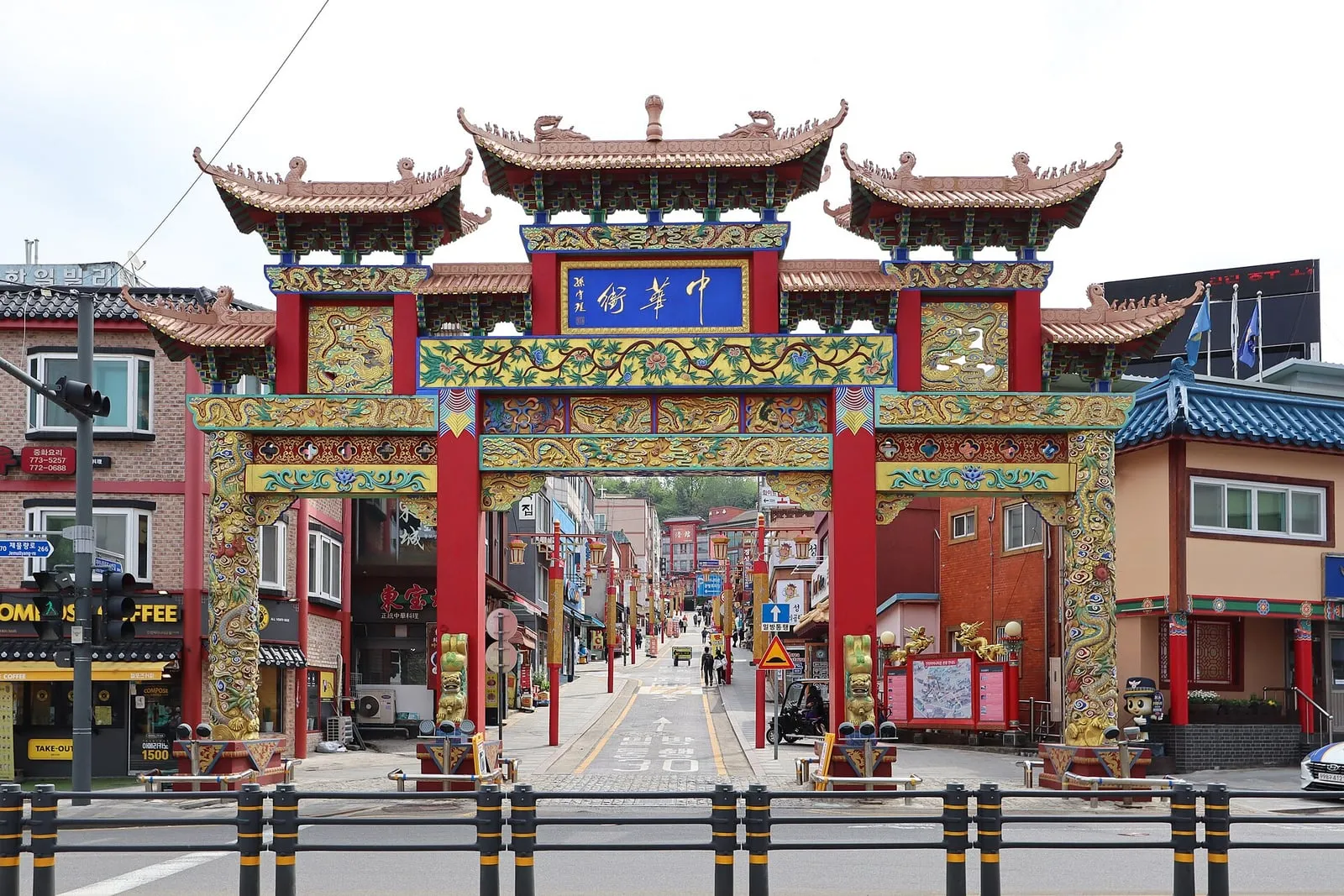
Exit 1 of Incheon Station opens directly opposite the ornate first paifang gate (Zhonghwamun), marking the entrance to the oldest and only official Chinatown in South Korea.
Incheon Historical Precinct Layout:
- Incheon Station: Terminus of Subway Line 1 and Suin-Bundang Line, directly facing the red Zhonghwamun Gate
- Chinatown Main Street (Bukseong-dong): Location of the Jjajangmyeon Museum (former Gonghwachun building), tea houses, and dumpling stalls
- Songwol-dong Fairytale Village (West): Street murals and fairy-tale installations
- Open Port Modern Heritage Street (South): 1880s foreign concessions, former Japanese bank buildings, and Incheon Art Platform warehouses
Origins of Korean Jjajangmyeon
In 1883, the Joseon court opened the port of Jemulpo (modern Incheon) to international commerce. A year later in 1884, an extraterritorial Chinese settlement was formally established on this hillside for Qing dynasty merchants and dockers from Shandong province.
To feed Chinese port labourers quickly, local cooks adapted their native northern Chinese zhajiangmian (fried bean paste noodles) by simmering dark fermented soybean paste with pork and sweet onions. Over decades, this evolved into South Korea’s popular comfort dish: Jjajangmyeon.
- Jjajangmyeon Museum: Housed within the original brick building of Gonghwachun, the restaurant that first commercialised the dish in 1905. Two floors of interactive exhibits showcase life-sized dining dioramas, antique noodle-delivery metal boxes (cheolbagang), and the culinary evolution of the dish through the 20th century. Admission costs ₩1,000 (closed Mondays).
- Where to Eat Lunch: Settle into a traditional dining room along Bukseong-dong:
- Gonghwachun: Located on the main Chinatown incline, serving rich, hearty traditional black bean noodles (approx ₩10,000) topped with sweet stir-fried squid and pork.
- Xin: Renowned for Baek-jjajang (white black-bean noodles, approx ₩11,000), a historic style made with fermented white soybeans, minced meat, and sweet cucumber instead of caramelised dark sauce.
- Complete the meal with a platter of crispy tangsuyuk (sweet and sour deep-fried pork, 20,000–₩25,000).
Paifang gates, murals and Jayu Park
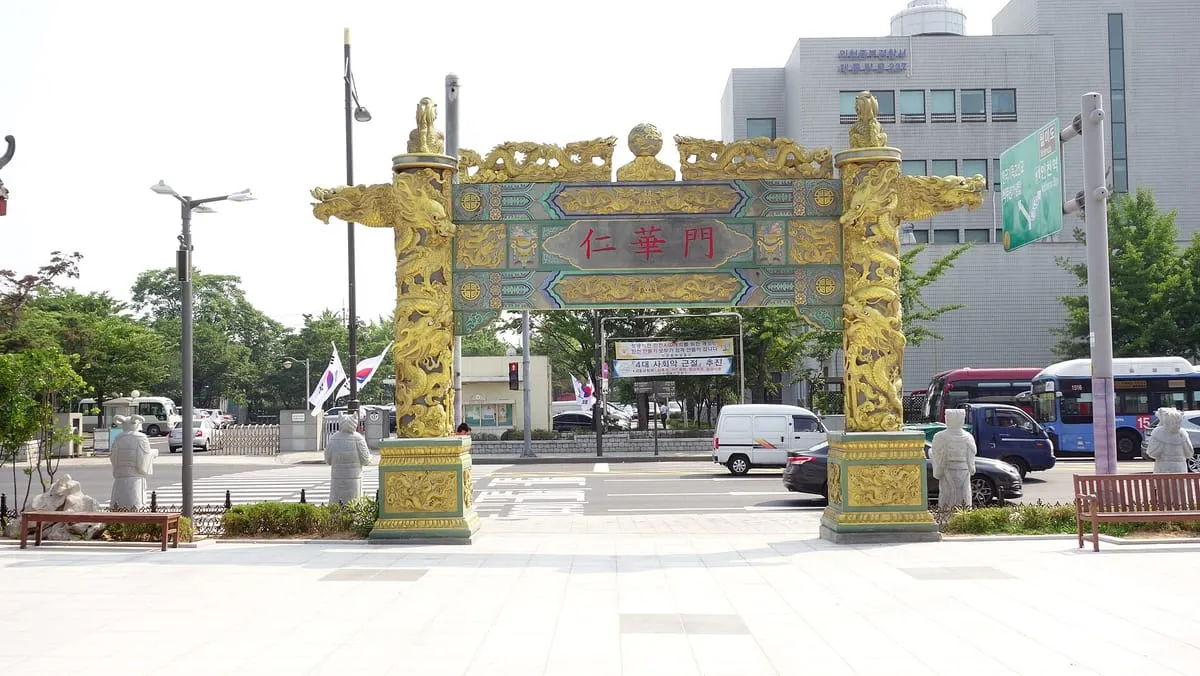
The district features four monumental red ceremonial gates (paifang): Zhonghwamun (facing the station), Inhwamun, Seollinmun (leading into the upper park), and Han-Jungmun.
Climb the hillside staircase adorned with the Samgukji Mural Street, a 135-metre stone wall lined with hand-painted tile mosaics illustrating key scenes from the ancient Chinese classic Romance of the Three Kingdoms. At the summit of the hill sits Jayu (Freedom) Park, South Korea’s first Western-style public park, which features a monumental bronze statue of General Douglas MacArthur commemorating the pivotal 1950 Incheon Amphibious Landing.
Songwol-dong Fairytale Village
Immediately west of Chinatown lies Songwol-dong Fairytale Village. In 2013, the local municipality revitalised an ageing residential neighbourhood by transforming walls, staircases, and utility poles into colourful three-dimensional street art installations.
Visitors can wander freely through cobblestone alleys painted with scenes from international fairytales and Korean folk stories: Pinocchio, Cinderella’s pumpkin carriage, Snow White, Alice in Wonderland, and Dorothy’s Yellow Brick Road. There is no admission fee.
Open Port Modern Architecture Street
Just south of Chinatown along Sinpo-ro sits the Incheon Open Port Modern Architecture Street. This precinct preserves late 19th-century stone, brick, and timber commercial architecture from the Japanese, Russian, British, and German concessions:
- Former Japanese First Bank of Incheon: A Renaissance-style stone edifice built in 1899, now operating as the Open Port Museum (₩500).
- Incheon Art Platform: A complex of 13 restored red-brick harbour warehouses dating from the 1930s and 1940s, now operating as contemporary art studios, creative residency exhibition halls, and coffee houses.
Or book a tour: explore Incheon’s coastal landmarks on arrival or departure with a Private Incheon Airport Transfer to Seoul with Scenic Stopsad (from ₩122,742).
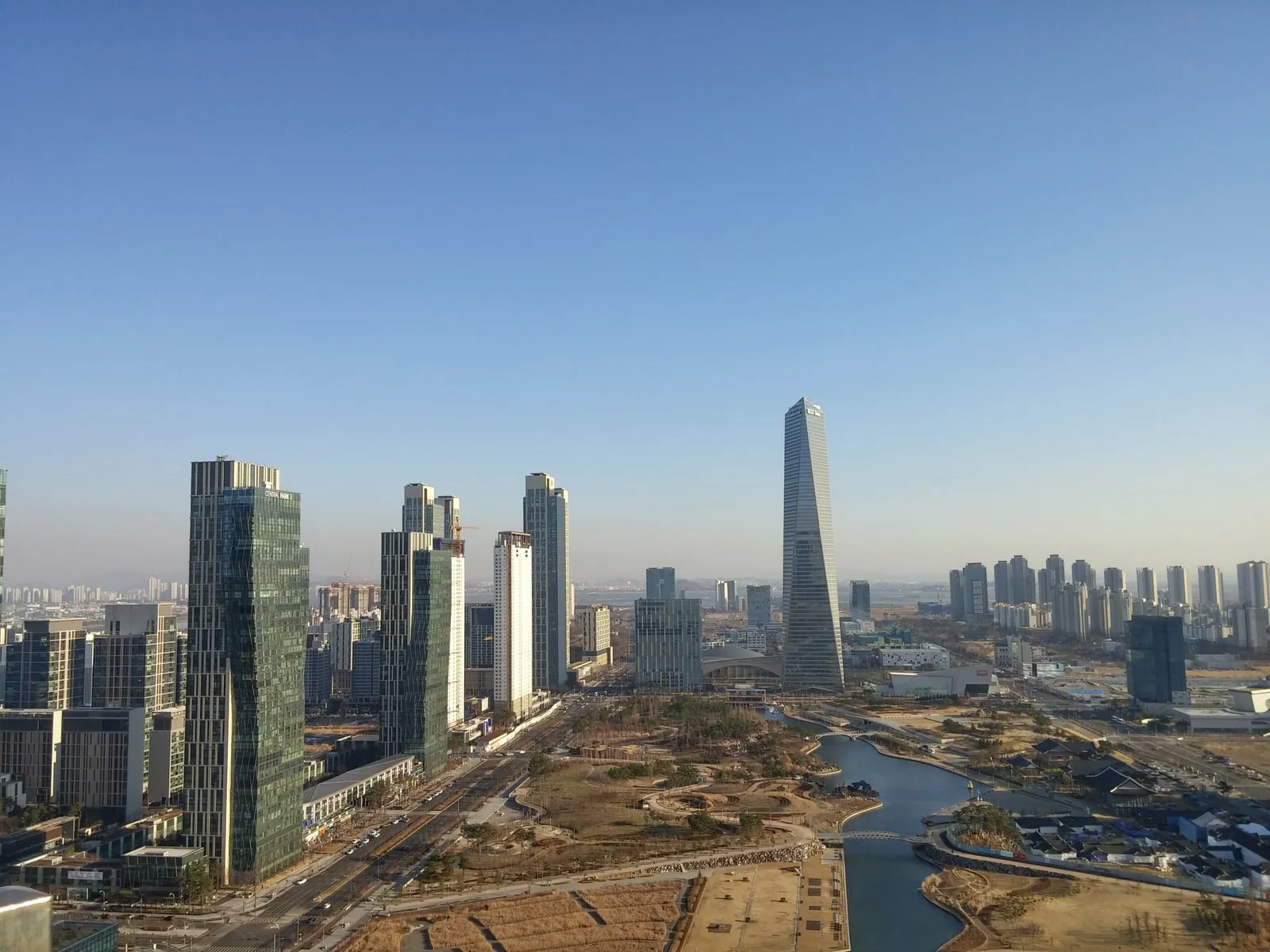
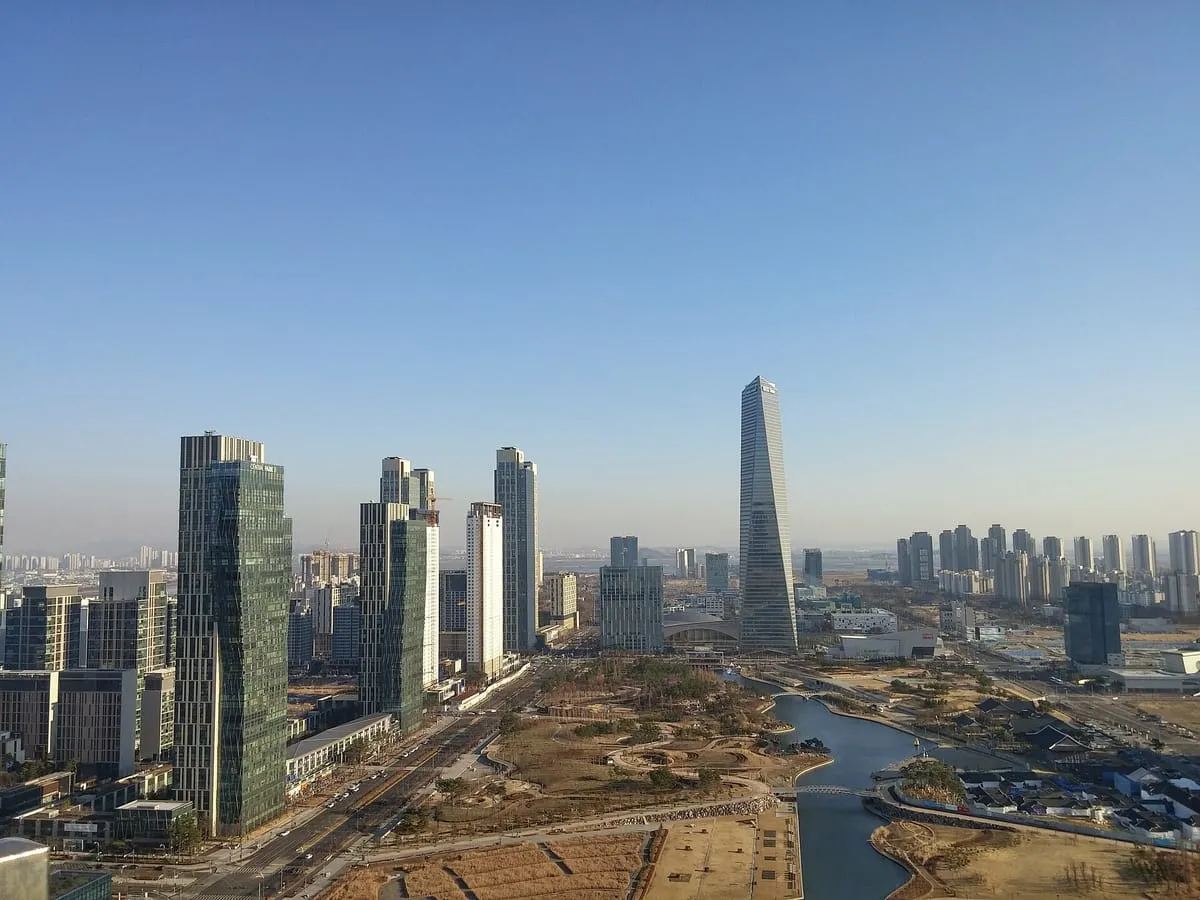
Songdo’s towers beside the Central Park waterway. Photo: Fleetham, Wikimedia Commons, CC BY-SA 4.0.
Part 2: Songdo Central Park: Korea’s futuristic smart city
After exploring the 19th-century port heritage of Incheon, take the subway south to experience its polar opposite: the master-planned smart city of Songdo International Business District.
Songdo Central Park Key Sights Layout:
- G-Tower (North): 33rd-floor IFEZ observation lounge with free panoramic views
- Central Waterway: 1.8-kilometre seawater canal with electric water taxis and boat rentals
- Tri-bowl Pavilion (West): Asymmetrical curved concrete architectural landmark
- Songdo Hanok Village (East): Traditional wooden pavilions and restaurants bordering the canal
- NC Cube Canal Walk (Northwest): 800-metre European-style canal pedestrian shopping promenade
Built upon 1,500 acres of reclaimed tidal flats along the Yellow Sea, Songdo was conceived as an international sustainable eco-city, featuring pneumatically sealed underground rubbish disposal systems, extensive bicycle paths, and energy-efficient architecture.
Incheon transfers and sightseeing tours
Incheon is reached independently on Subway Line 1 or the Suin-Bundang Line. Travellers stopping over on layovers often prefer private door-to-door vehicle transfers.
Incheon Airport: Private Transfer to/from Seoul with Scenic Stops
From ₩127,000 · 4.8 stars from 1,330 reviews · 1.5 hours · private vehicle transfer
Seoul: Private Transfer To/From Incheon Airportad: Private airport transfer service with optional scenic stops in Songdo Central Park or Incheon Chinatown en route to central Seoul.
Seoul: Highlights of Seoul Full-Day Tour
From ₩80,464 · 4.9 stars from 910 reviews · 8 - 8.5 hours · city highlights
Seoul: Highlights of Seoul Full-Day Tourad: Full-day guided city sightseeing with air-conditioned transport and lunch.
Seoul: City Highlights Palace Tour
From ₩87,283 · 4.9 stars from 1,100 reviews · 4 hours · palace architecture
Seoul: Half-Day City Highlights & Palace Tour with Hanbokad: Morning guided walk covering royal Joseon dynasty palace heritage.
Seawater canal and water taxi rides
At the centre of the district lies Songdo Central Park, South Korea’s first urban park designed with a man-made seawater canal fed by purified water pumped directly from the Yellow Sea:
- Water Taxis (Michuhol): These electric canal boats cruise a scenic 1.8-kilometre loop along the canal from the West Boat House to the East Boat House, offering water-level views of Songdo’s asymmetrical glass skyscrapers. Tickets cost ₩4,000 for adults and ₩2,000 for children (runs every 30 minutes).
- Boat Rentals: Families and couples can rent electric solar boats, kayaks, and foot-pedal boats from the East Boat House (approx 35,000–₩38,000 for 30 minutes).
- Wildlife Islands: Keep an eye out for Rabbit Island and the shore-bound Deer Garden, where visitors can watch Korean spotted deer grazing beneath willow trees.
G-Tower 33rd-floor observation deck
For the best vantage point in Incheon, walk to the northern edge of the park to G-Tower, headquarters of the UN Green Climate Fund and the Incheon Free Economic Zone (IFEZ) Authority.
Take the high-speed lift directly to the 33rd Floor IFEZ Observation Lounge. Entry is completely free of charge. Floor-to-ceiling glass windows provide an extraordinary 360-degree panorama over Songdo Central Park, the winding seawater canal, the towering 305-metre Posco Tower, the mudflats of the Yellow Sea, and the 21.3-kilometre Incheon Grand Bridge stretching across the sea toward Incheon International Airport.
- Hours: Tuesday to Friday 10:00–21:00, Saturday and Sunday 10:00–16:00 (closed Mondays).
The Tri-bowl architectural pavilion
Rising beside the water at Central Park Station (Exit 3), the Tri-bowl is a distinctive architectural monument. Designed by iArc Architects, this fluid structure consists of three curved, bowl-shaped concrete pods that emerge from a shallow reflecting pool, reversing conventional structural logic by making the roof wider than the base. Symbolising the sky, the ocean, and the land of Incheon, it houses a multimedia art exhibition space and an outdoor concert amphitheatre.
Songdo Hanok Village
Situated along the eastern bank of the seawater canal, the Songdo Hanok Village presents an intentional cultural contrast: a cluster of traditional wooden pavilions and curved tile roofs standing beneath high-rise glass residential towers. The village houses traditional Korean restaurants, tea lounges (such as Hollys Coffee Hanok branch), and the luxurious Gyeongwonjae Ambassador Incheon hotel.
NC Cube Canal Walk
Located 10 minutes’ walk northwest of Central Park, NC Cube Canal Walk is an open-air European-style pedestrian retail promenade. Stretches of boutiques, lifestyle shops, and dining terraces line both sides of an 800-metre central water canal, divided into four themed zones: Spring, Summer, Autumn, and Winter. It is an ideal spot to stop for coffee or dinner before heading back to Seoul.
Transport: complete step-by-step connections
The entire day trip can be executed affordably using South Korea’s integrated transit network.
| Journey leg | Route | Transit mode and transfers | Travel time | Typical fare (T-money) |
|---|---|---|---|---|
| Leg 1 (Morning) | Seoul to Incheon Chinatown | Seoul Subway Line 1 (Dark Blue) direct to Incheon Station terminus | 70–75 mins | ~₩2,000 |
| Leg 2 (Midday) | Chinatown to Songdo Central Park | Suin-Bundang Line from Incheon to Woninjae (15 mins); transfer to Incheon Line 1 to Central Park Station (12 mins) | 35–40 mins | ~₩1,500 (integrated transfer) |
| Leg 3 (Evening) | Songdo to Gangnam | Red Express Bus M6405 from Central Park Station direct to Gangnam Station | 60 mins | ~₩3,000 |
| Leg 3 (Evening alternative) | Songdo to Central Seoul | Incheon Line 1 to Bupyeong Station (25 mins); transfer to Line 1 Express train to Yongsan or Seoul Station (35 mins) | 60–70 mins | ~₩2,200 |
Practical tips for the day trip
- T-money Card: Ensure your T-money card has at least ₩10,000 loaded before leaving central Seoul to cover all subway and bus legs smoothly.
- Luggage Storage: Incheon Station maintains digital luggage lockers inside the station concourse beside Exit 1 if you are heading onward to Incheon International Airport.
- Timing: Leave Seoul by 08:45 to arrive in Chinatown by 10:00, which gives you ample time to tour the museum and alleys before lunchtime restaurant queues form at 12:00.
For additional day trip ideas around the capital, browse our master guide to day trips from Seoul, or consult our Seoul public transport guide and 3-day Seoul itinerary.
Common questions
How do you travel from central Seoul to Incheon Chinatown by subway?
Board Seoul Subway Line 1 (Dark Blue) bound for Incheon Station, which is the western terminus of the line. The journey takes approximately 70 minutes from Seoul Station and costs ₩2,000 using a reloadable T-money card.
What is Incheon Chinatown famous for?
Founded in 1884, Incheon Chinatown is South Korea's only official Chinatown and the historic birthplace of Jjajangmyeon (black bean noodles), originally cooked for dock labourers at the port. It features the Jjajangmyeon Museum, red paifang gates, and Songwol-dong Fairytale Village.
How do you travel between Incheon Chinatown and Songdo Central Park?
From Incheon Station, take the Suin-Bundang Line to Woninjae Station (15 minutes), then transfer to Incheon Subway Line 1 heading south to Central Park Station (12 minutes). The complete cross-town transfer takes roughly 35 minutes and costs approximately ₩1,500.
Is admission to the G-Tower observation deck in Songdo free?
Yes. The 33rd-floor IFEZ (Incheon Free Economic Zone) Observation Lounge inside G-Tower is completely free to enter on weekdays and weekends, offering 360-degree views across Songdo Central Park, the Yellow Sea, and the Incheon Grand Bridge.