One of 2 self-guided walks in Seoul. See every walk.
In this guide
💡 The Short Version: Start at Seoul Metro Anguk Station (Exit 2) and finish at Insadong Ssamzigil: a 3.2-kilometre self-guided walk taking 3 to 4.5 hours including museum and temple visits. Visit between 10:00 and 17:00 daily: the residential core of Bukchon (the Red Zone along Bukchon-ro 11-gil) enforces a strict visitor curfew with entry prohibited before 10:00 and after 17:00 (carrying a ₩100,000 fine; there is no Sunday ban). Entry to Bukchon alleys, Baek In-je House, Jogyesa Temple, and Ssamzigil is free; MMCA Seoul charges ₩2,000 to ₩4,000. Cover shoulders and knees at Jogyesa Temple and remove shoes before stepping into prayer halls.
⚠️ Strict residential curfew warning. The Jongno-gu district office enforces visitor access restrictions in the residential core of Bukchon (the Red Zone along Bukchon-ro 11-gil). Visiting hours are restricted daily to 10:00 to 17:00, with an overnight curfew from 17:00 to 10:00 the following morning. There is no Sunday ban, but municipal wardens patrol the zone and issue fines up to ₩100,000 for non-residents entering outside permitted hours.
The route
Map of the walk numbered stops in walking order
Open the whole route in Google Maps - all seven stops in walking order on your phone.
The historic quarter north of Jongno preserves hundreds of traditional Korean timber-and-tile houses (hanok) that once housed Joseon dynasty aristocrats (yangban) and royal officials. Positioned between Gyeongbokgung Palace to the west and Changdeokgung Palace to the east, the walk links hillside heritage alleys with contemporary art institutions and traditional teahouses.
The route climbs approximately 35 metres of elevation from Anguk Station to the crest of Bukchon ridge before descending stepped stone passages into the Samcheong-dong valley. All prices are in won.
| Stop | Entry (adult) | Open | Route highlights |
|---|---|---|---|
| 1. Anguk Station | Free | Daily 05:30 to 24:00 | Seoul Subway Line 3 transit hub and gateway to the northern palace quarter |
| 2. Bukchon Hanok Village | Free | Daily 10:00 to 17:00 | Preserved residential hanok alleyways overlooking modern downtown Seoul |
| 3. Baek In-je House | Free | Tue–Sun 09:00 to 18:00 (closed Mon) | 1913 aristocratic residence blending Joseon architecture with timber styling |
| 4. Samcheong-dong | Free | Daily 24 hours (shops 11:00 to 20:00) | Street of contemporary art galleries, fashion boutiques, and teahouses |
| 5. MMCA Seoul | 2,000–₩4,000 | Mon/Tue/Thu/Fri/Sun 10:00–18:00, Wed/Sat to 21:00 | National Museum of Modern and Contemporary Art housed across historic buildings |
| 6. Jogyesa Temple | Free | Grounds 24 hours (halls 04:00 to 21:00) | Chief temple of the Jogye Order of Korean Buddhism with ancient pagoda and giant Buddhas |
| 7. Insadong Ssamzigil | Free | Daily 10:30 to 20:30 | Four-storey open spiral courtyard showcasing traditional crafts, paper art, and calligraphy |
1. Anguk Station
Free · daily 05:30 to 24:00 · Jongno-gu, Seoul (Subway Line 3)
Arrive via Seoul Subway Line 3 at Anguk Station. Take Exit 2 and walk north along Bukchon-ro. The wide pavement leads past bakeries, hanbok rental shops, and information booths staffed by volunteer guides in red jackets who distribute walking maps.
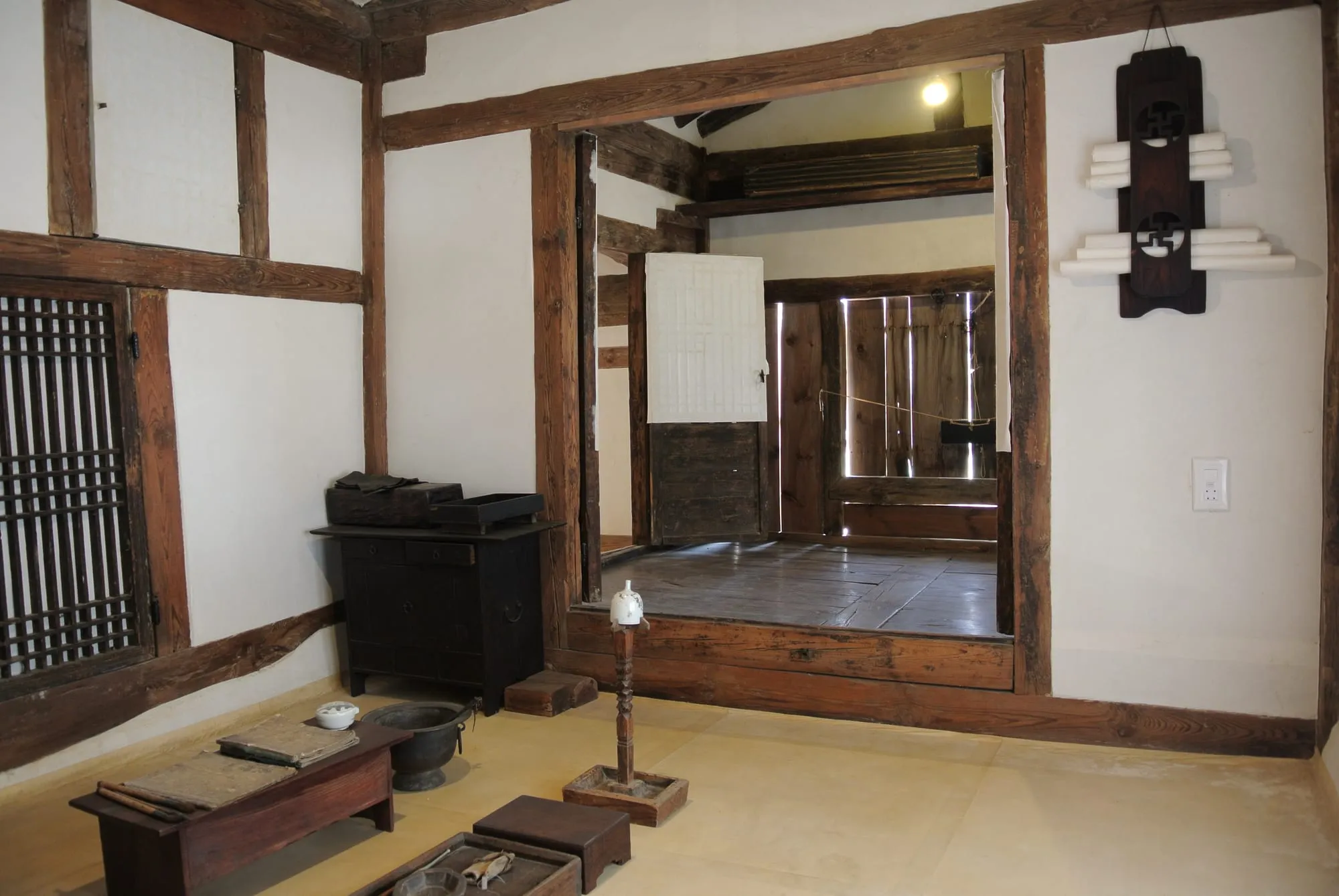
Before starting the climb into the residential alleys, pick up an area map from the Bukchon Traditional Culture Centre (located off Bukchon-ro 4-gil), where restored hanok rooms explain the underfloor heating (ondol) and wooden floorboard (daecheong-maru) ventilation systems that define traditional Korean architecture.
2. Bukchon Hanok Village
Free · Daily 10:00 to 17:00 (Red Zone curfew 17:00 to 10:00 next morning) · Bukchon-ro 11-gil, Gahoe-dong
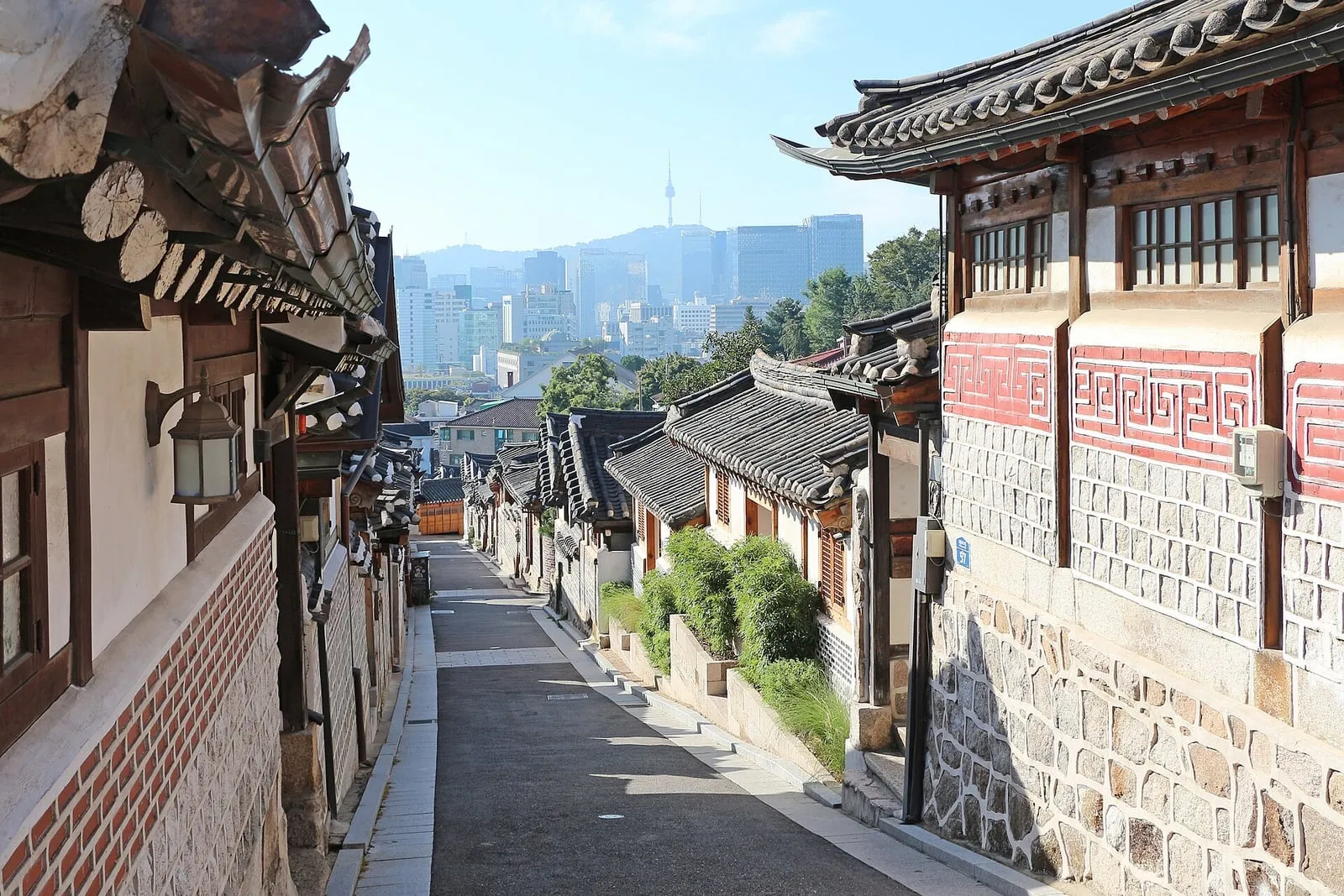
Continue north along Bukchon-ro and turn left into Bukchon-ro 11-gil. This uphill lane represents the most famous vista in Bukchon: rows of grey-tiled roofs, timber gates (daemun), and brickwork foundations rising towards the crest of the hill. At the summit, turn around to frame the wooden eaves against the distant high-rises of central Seoul and the peak of Namsan Mountain topped by N Seoul Tower.
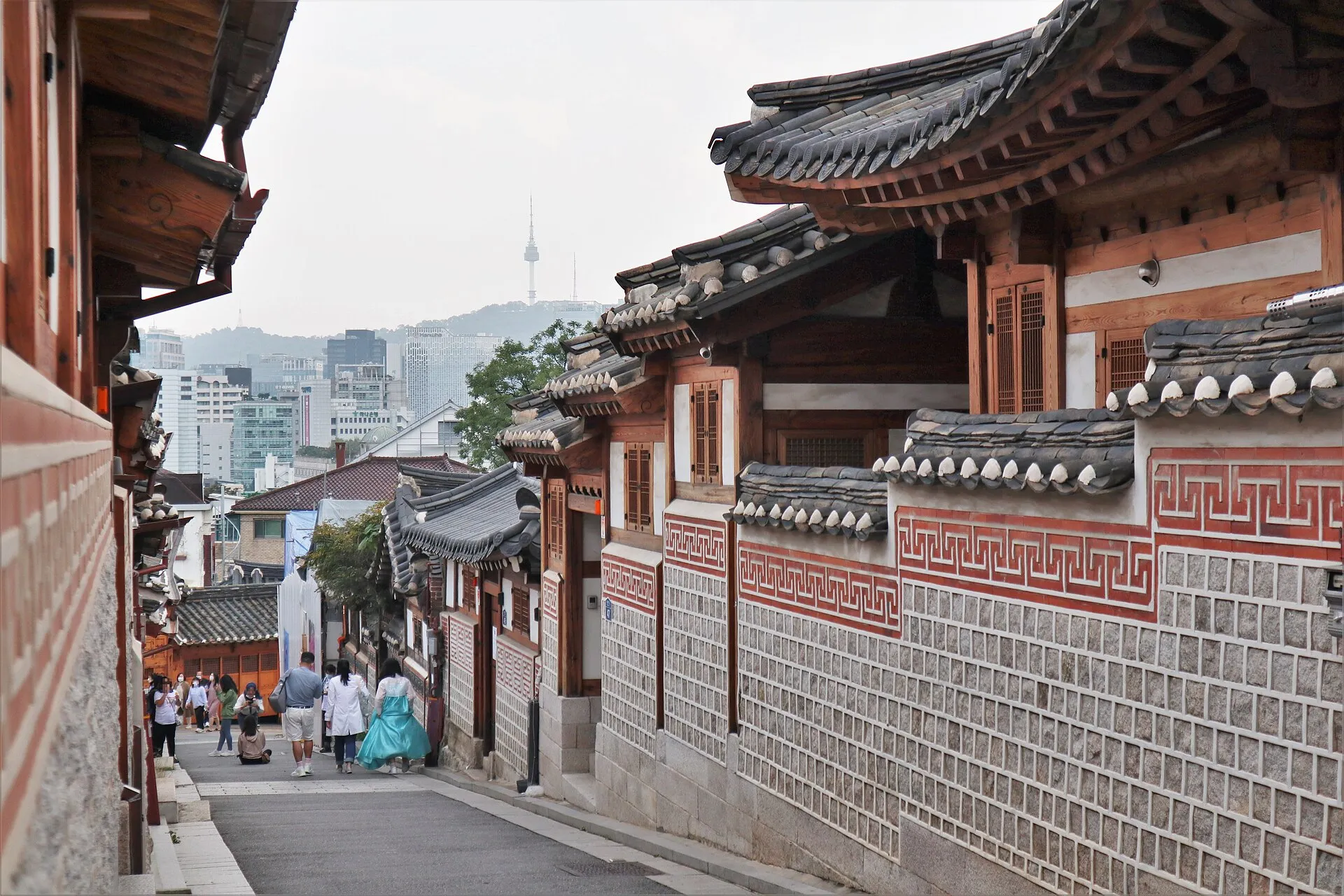
A Bukchon lane with N Seoul Tower beyond the rooftops. Photo: S h y numis, Wikimedia Commons, CC BY-SA 4.0.
Because this neighbourhood remains an active residential community, visitors must observe strict quiet-zone regulations. Speak in hushed tones, refrain from running or shouting, do not peer into private courtyards or ring doorbells, and take all litter away with you. Municipal wardens patrol the street in yellow vests to enforce the 10:00 to 17:00 visiting window. Access outside these hours carries a fine of up to ₩100,000. There is no Sunday ban, but the daily 10:00 to 17:00 visiting hours apply every day of the week.
3. Baek In-je House
Free · Tue–Sun 09:00 to 18:00 (closed Mondays; last entry 17:30) · 16 Bukchon-ro 7-gil, Gahoe-dong
From Bukchon-ro 11-gil, loop southwards via Bukchon-ro 9-gil to reach the entrance of Baek In-je House. Built in 1913 during the Japanese colonial period, this estate is one of the larger preserved hanok complexes in Seoul, designated as a City Tangible Cultural Heritage property.
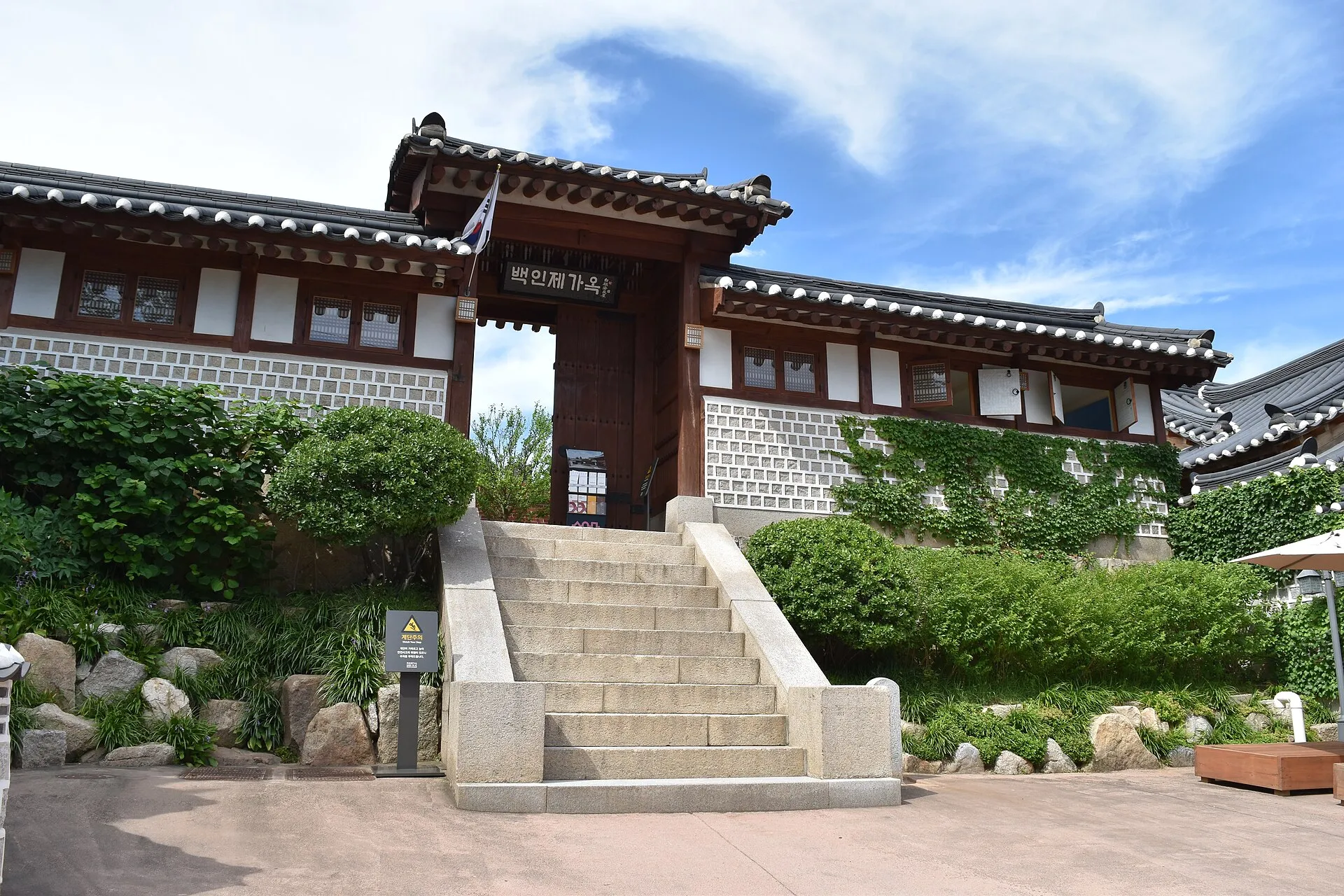
The gate of Baek In-je House. Photo: Jjw, Wikimedia Commons, CC BY-SA 4.0.
Unlike conventional Joseon hanok where the men’s quarters (sarangchae) and women’s quarters (anchechae) were separated by high internal walls, Baek In-je House connected both structures via indoor corridors. The residence incorporates black brick foundations, Japanese-style tatami rooms, glass window panes, and gardens planted with aged pines and ginkgo trees. Entry is free. Visitors may walk through the grounds without booking, though guided interior tours can be reserved in advance through the Seoul Public Information reservation portal.
4. Samcheong-dong
Free · daily 24 hours (commercial establishments 11:00 to 20:00) · Samcheong-ro, Jongno-gu
From Baek In-je House, follow the stone staircases leading down the western slope of the ridge into Samcheong-dong. The stairs bring you out on Samcheong-ro, a road running parallel to the eastern stone perimeter wall of Gyeongbokgung Palace.
Samcheong-dong blends traditional wooden shophouses with modern concrete architecture. The street is known for independent art galleries, ceramic studios, teahouses serving iced omija (five-flavour berry) tea and jujube tea, and cafes. Stop at a neighbourhood teahouse or sample traditional hotteok (brown sugar syrup pancakes) from local street stalls before continuing south along the tree-lined pavement towards the museum quarter.
5. MMCA Seoul
2,000–₩4,000 · Mon/Tue/Thu/Fri/Sun 10:00 to 18:00, Wed/Sat 10:00 to 21:00 · 30 Samcheong-ro, Sogyeok-dong
Walking south on Samcheong-ro brings you to the National Museum of Modern and Contemporary Art (MMCA Seoul), located opposite the eastern gate of Gyeongbokgung. The museum campus opened in 2013, incorporating the former Defence Security Command headquarters and Joseon-era royal genealogies office (Jongchinbu) into a complex designed around sunken central courtyards.
The museum hosts rotating exhibitions of 20th-century and 21st-century Korean and international art, multimedia installations, and outdoor sculpture. General admission is between ₩2,000 and ₩4,000 (admission is free for visitors aged 24 and under, as well as on Wednesday and Saturday evenings from 18:00 to 21:00). A ticket is also included on the Discover Seoul Pass. Allow 60 to 90 minutes to explore the galleries and central courtyard.
Guided walking tours
Navigating Bukchon’s residential lanes requires strict adherence to designated tourist visiting hours (10:00 to 17:00). A guided walk provides historical context without trespassing into private residential zones.
Seoul: Bukchon Tour with Local Storyteller and Crafts
From ₩70,000 · 5 stars from 6 reviews · 2 hours · hanok heritage & crafts
Bukchon Hanok Village: A Storytelling Walk with a Nativead: A 2-hour guided walking tour of Bukchon Hanok Village led by a local resident storyteller, explaining traditional architecture and residential customs.
Seoul: Small Group History Walking Tour to Palaces & More
From ₩120,014 · 4.8 stars from 198 reviews · 3 hours · expert historian guide
Seoul: Gyeongbok Palace and Bukchon Hanok Walking Tourad: Connects the royal palaces with the preserved alleys of Bukchon and the artisan shops of Insadong on a 3-hour walk.
Seoul: Hanbok Rental near Bukchon Hanok Village
From ₩10,000 · 4.6 stars from 1,030 reviews · 1 hour - 1 day · traditional dress rental
Seoul: Hanbok Rental with Gyeongbokgung Palace Entryad: Rent traditional Hanbok attire near Anguk Station to wear while strolling through Bukchon Hanok Village.
Official ticket or tour: the prices side by side
Walking options compared.
| Option | Official admission | Tour cost | What it covers |
|---|---|---|---|
| Independent walking | Free | — | Self-guided stroll; respect residential curfew (10:00–17:00) |
| Hanbok costume rental | Free palace entry wearing Hanbok | From ₩10,000 | Traditional dress hire (2–4 hours) for photographs in alleys |
| Bukchon storyteller walking tour | Tour fee only | From ₩70,000 | 2-hour licensed guide walk covering Joseon architecture and customs |
| History walking tour (Palaces & Bukchon) | Tour fee only | From ₩120,014 | 3-hour guided walk linking royal history with residential hanok lanes |
6. Jogyesa Temple
Free · grounds open 24 hours (prayer halls 04:00 to 21:00) · 55 Ujeongguk-ro, Gyeonji-dong
Walk south from MMCA along Samcheong-ro, cross the boulevard of Yulgok-ro, and proceed south along Ujeongguk-ro to reach Jogyesa Temple. Founded in 1910, Jogyesa is the chief administrative temple of the Jogye Order, the largest school of Seon (Zen) Buddhism in South Korea. Located in downtown Jongno, it serves as a central place of worship for the city.
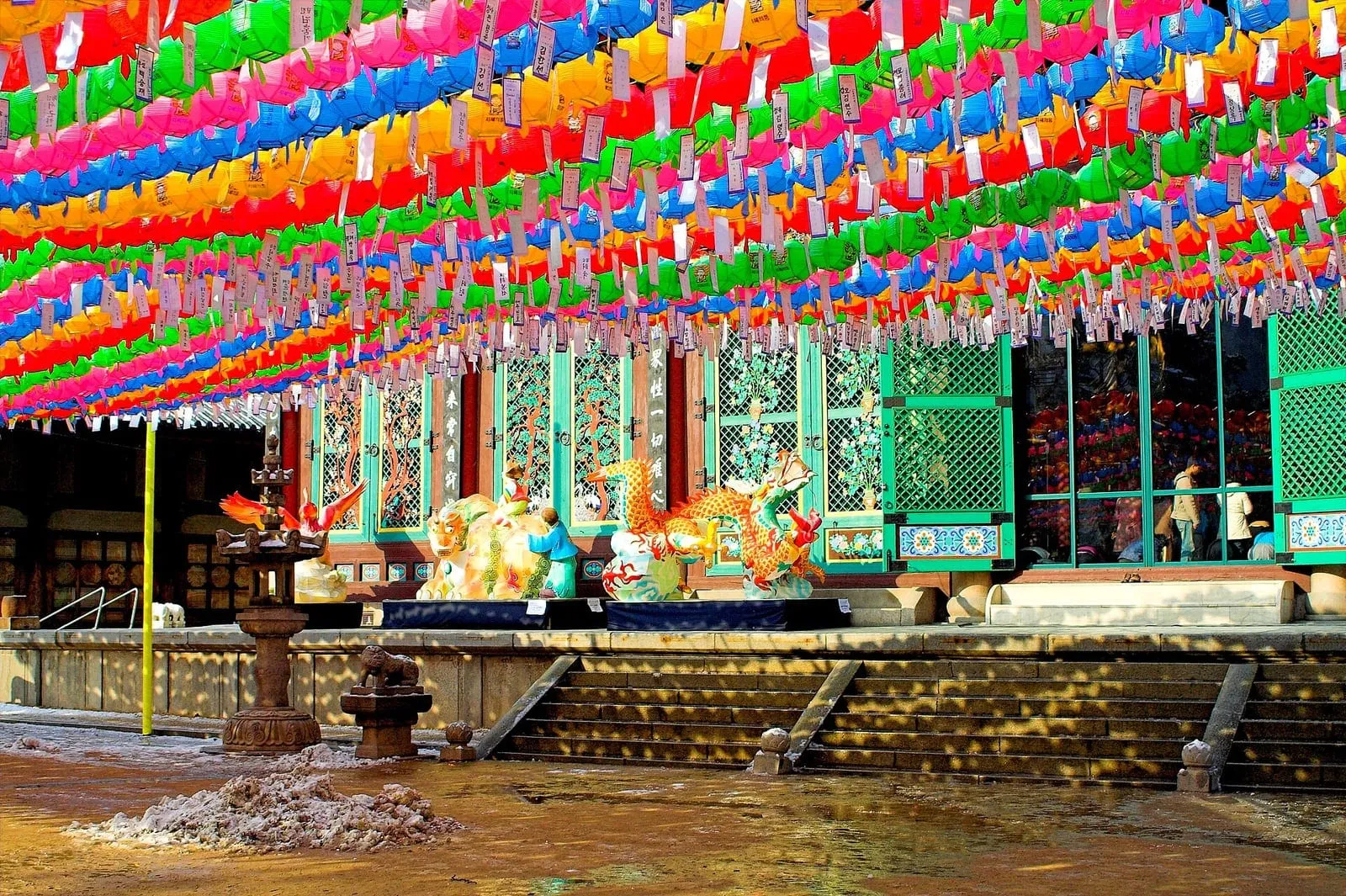
Lotus lanterns over the courtyard at Jogyesa. Photo: parrhesiastes, Wikimedia Commons, CC BY 2.0.
The temple courtyard is shaded by a 450-year-old Chinese scholar tree and a 500-year-old white pine tree. Above the courtyard hangs an overhead canopy of colourful paper lotus lanterns bearing prayers. The main wooden prayer hall, Daeungjeon, features carved wooden lattice doors and houses three large golden Buddha statues: Amitabha, Sakyamuni, and Bhaisajyaguru.
Visitors are welcome to enter the hall to observe monks chanting or pay respects. Modest attire covering shoulders and knees is mandatory. Remove your shoes and place them in the external shoe racks before stepping across the raised wooden threshold, and walk quietly around the perimeter behind seated worshippers.
7. Insadong Ssamzigil
Free · daily 10:30 to 20:30 · 44 Insadong-gil, Jongno-gu
From Jogyesa, cross back across Ujeongguk-ro eastward via Insadong 5-gil to enter Insadong-gil, Seoul’s historic art and antique thoroughfare. Walk north along the pedestrian street to arrive at Ssamzigil, an open-air retail complex completed in 2004.
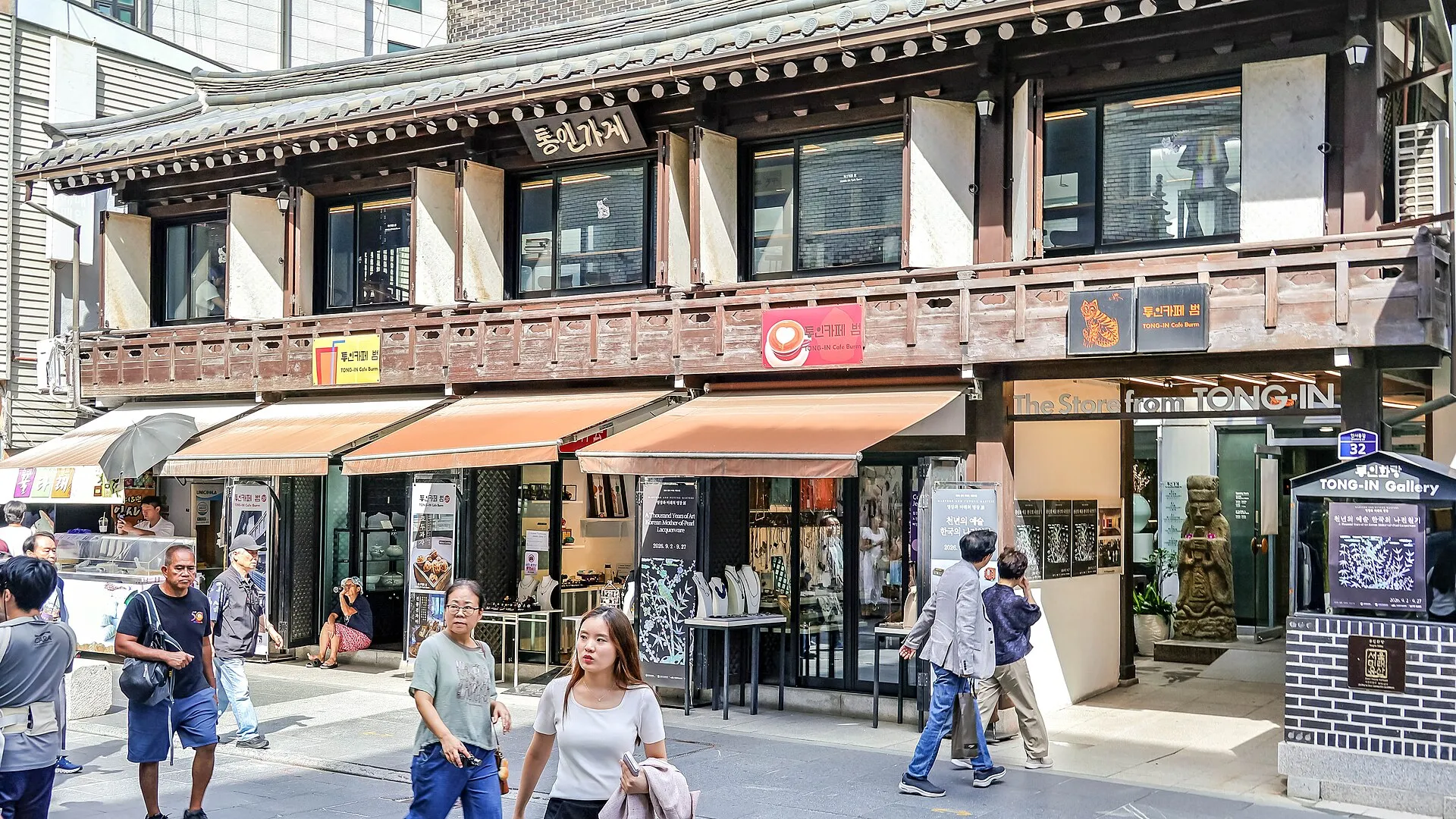
Insadong-gil, the street that leads to Ssamzigil. Photo: Dr. Thomas Liptak, Wikimedia Commons, CC BY-SA 4.0.
Ssamzigil is designed around a continuous 500-metre spiralling walkway that slopes gently upwards across four storeys around a central open-air courtyard. The complex houses more than 70 workshops, craft shops, and artist boutiques selling handmade Korean mulberry paper (hanji), traditional ceramics, woodblock prints, hand-carved stone name stamps (dojang), and textiles.
The rooftop garden at the fourth level offers views across the tiled roofs of Insadong. Finish the walk by descending into the ground-floor courtyard to sample poop bread (ddong-bbang, red-bean filled waffle cakes, ₩2,000) or stroll along the adjoining alleys of Insadong for a meal of traditional temple food or dumplings. For dining ideas across the area, consult our guide to where to eat in Seoul.
Planning your walk
Best day and time to visit
The best schedule for this route is Tuesday to Saturday morning, arriving at Anguk Station at 09:30. This timing allows you to enter Bukchon right at 10:00 as the daily permitted visiting window opens, before larger tour groups arrive.
Note that Baek In-je House is closed on Mondays. Visiting Bukchon Hanok Village is permitted on Sundays during standard 10:00 to 17:00 visiting hours. If you complete the walk on a Wednesday or Saturday, MMCA Seoul remains open until 21:00 with free admission after 18:00.
Getting to the start and returning
- Starting point: Anguk Station on Seoul Subway Line 3 (Exit 2). You can reach Anguk from Myeongdong (Line 4 to Chungmuro, transfer to Line 3) or Hongdae (Line 2 to Euljiro 3-ga, transfer to Line 3). Pay transit fares using a T-money transit card or the Climate Card (see our public transport in Seoul guide).
- Finishing point: Insadong Ssamzigil is located 300 metres south of Seoul Metro Anguk Station (Line 3, Exit 6) and 400 metres north of Jongno 3-ga Station (interchange for Lines 1, 3, and 5), providing direct rail routes across the city.
Onward walks
For a scenic route exploring Seoul’s medieval fortifications and sunset viewpoints, continue with the Seoul City Wall and Naksan Park walk, starting two stops east along Subway Line 1 at Dongdaemun Station.
Common questions
What are the visiting curfew hours for Bukchon Hanok Village?
Visiting hours in the Bukchon-ro 11-gil residential core ('Red Zone') are restricted daily to 10:00 to 17:00 (with an overnight curfew from 17:00 to 10:00 the following morning). There is no Sunday ban, but municipal wardens enforce the curfew daily, with fines up to ₩100,000 for visitors entering outside permitted hours.
How long does this walk take?
The walking route covers 3.2 kilometres from Anguk Station to Insadong Ssamzigil. Walking time is roughly 50 minutes, but touring Baek In-je House, browsing galleries along Samcheong-dong, seeing MMCA Seoul, visiting Jogyesa Temple, and exploring Ssamzigil takes 3 to 4.5 hours.
What does it cost to enter the sights on this walk?
Walking through Bukchon Hanok Village, Samcheong-dong, Jogyesa Temple, and Insadong Ssamzigil is free. Entry to Baek In-je House is free (closed Mondays). MMCA Seoul charges ₩2,000 to ₩4,000 depending on current exhibitions.
What is the dress code for Jogyesa Temple?
Shoulders and knees must be covered. Sleeveless tops, short skirts, and revealing clothing are prohibited inside prayer halls. Remove shoes before stepping onto the wooden floorboards of the main Dharma hall (Daeungjeon), and maintain quiet voices.
Is the route suitable for prams or wheelchairs?
The Bukchon residential alleys feature steep inclines and stone stairways descending into Samcheong-dong that are not wheelchair or pram accessible. Insadong-gil and Jogyesa Temple are flat and paved.