In this guide
💡 The Short Version: Or book ahead: reserved Hanbok rental on Klookad{rel=“sponsored nofollow noopener”} secures your fitting time in advance. Day 1: historic Jongno, starting with Hanbok rental near Anguk, the 10:00 changing of the guard at Gyeongbokgung Palace (₩3,000 on royal.khs.go.kr or free in Hanbok), the traditional tile-roofed lanes of Bukchon Hanok Village, teahouses in Insadong, the lantern courtyard at Jogyesa Temple, and an evening street food dinner at Gwangjang Market. Day 2: central skyline and modern design, ascending Namsan Mountain to N Seoul Tower (₩29,000 on nseoultower.co.kr observatory), sampling street snacks and dumplings in Myeongdong, and catching sunset and night markets at Dongdaemun Design Plaza (DDP). Day 3: south and west Seoul, browsing the towering shelves of Starfield Library at COEX Mall, touring ancient Bongeunsa Temple, admiring national treasures at the National Museum of Korea (free), and finishing with live busking and Korean BBQ in Hongdae. Read our companion guide to public transport in Seoul to set up your transit card before starting.
The 72-hour itinerary at a glance
Seoul spans over 600 square kilometres across the Han River. Grouping sights geographically around the rapid-transit network prevents spending hours travelling across town.
| Day | Morning | Afternoon | Evening | Key transport & admissions |
|---|---|---|---|---|
| 1 | Hanbok rental & Gyeongbokgung Palace guard change (10:00) | Bukchon Hanok Village & Insadong traditional tea houses | Jogyesa Temple, Cheonggyecheon Stream & Gwangjang Market | Subway Line 3 & Line 1; Palace ₩3,000 (free in Hanbok); Hanbok rental approx 15,000–₩25,000 |
| 2 | Namsan Mountain ascent & N Seoul Tower observatory | Myeongdong shopping & street food lunch | Dongdaemun Design Plaza (DDP) architecture & fashion night markets | Namsan shuttle bus 01A/01B (₩1,500) or the cable car; Tower observatory ₩29,000 |
| 3 | Starfield Library at COEX Mall & Bongeunsa Temple | National Museum of Korea or K-Star Road Gangnam | Hongdae youth arts street, live busking & Korean BBQ dinner | Subway Line 9, Line 4 & Line 2; Museum permanent collection free; BBQ dinner approx 18,000–₩25,000 per person |
What to book before you go
Most cultural landmarks in Seoul do not require months of advance planning, but certain activities benefit from early scheduling.
| Attraction | Booking window | Admission price | Operating days & hours | Details |
|---|---|---|---|---|
| Gyeongbokgung Palace | Buy on arrival at gate | ₩3,000 (free wearing Hanbok) | Nov–Feb 09:00–17:00; Mar–May & Sep–Oct 09:00–18:00; Jun–Aug 09:00–18:30 (closed Tue) | Guard change ceremonies occur daily at 10:00 and 14:00 at Gwanghwamun Gate |
| Hanbok Rental (Anguk / Gyeongbokgung) | Book 1–3 days ahead for weekends | Approx ₩15,000 to ₩25,000 (2–4 hrs) | 09:00 to 19:00 daily | Wearing full traditional dress grants free entry to all Seoul royal palaces |
| N Seoul Tower Observatory | Buy online or at counter | ₩29,000 adult | 10:00 to 22:30 (23:00 weekends and holidays) | Clear evening slots provide sunset views across the Han River basin |
| National Museum of Korea | Walk-in access | Free permanent collection | 09:30 to 17:30 daily (until 21:00 Wed & Sat; last entry 30 min before close) | Special temporary exhibitions require separate paid tickets |
| Lotte World / Seoul Sky | 1–5 days ahead online | ₩31,000 (Seoul Sky) | 10:30 to 22:00 daily | Optional day 3 alternative for panoramic views from southern Seoul |
Day 1: Royal heritage and ancient alleys
The opening 24 hours explore the historic heart of northern Seoul (Jongno-gu), where Joseon dynasty palaces sit against the granite crags of Mount Bugaksan.
| Time | Stop | Activity |
|---|---|---|
| 09:00 | Hanbok Rental (Anguk) | Rent traditional Korean costume near Anguk Station |
| 10:00 | Gyeongbokgung Palace | Watch Royal Guard Changing Ceremony at Gwanghwamun Gate and tour throne halls |
| 11:30 | Bukchon Hanok Village | Explore preserved residential hanok alleys (Bukchon-ro 11-gil) |
| 13:30 | Insadong | Lunch and traditional tea houses along Insadong-gil |
| 15:00 | Jogyesa Temple | Buddhist temple halls and lantern courtyard |
| 16:30 | Cheonggyecheon Stream | Waterside pedestrian stroll to Jongno 5-ga |
| 18:00 | Gwangjang Market | Street food dinner (bindaetteok, mayak gimbap, kalguksu) |
[!IMPORTANT] Palace Closed Days and Day 1 / Day 2 Swap: Gyeongbokgung is closed on Tuesdays, and Changdeokgung is closed on Mondays. If your Day 1 falls on a Tuesday, swap Day 1 and Day 2 of this itinerary so that you visit Gyeongbokgung on Day 2. Alternatively, visit Deoksugung Palace, which is open on Tuesdays (09:00 to 21:00).
Morning: Hanbok hire and Gyeongbokgung Palace
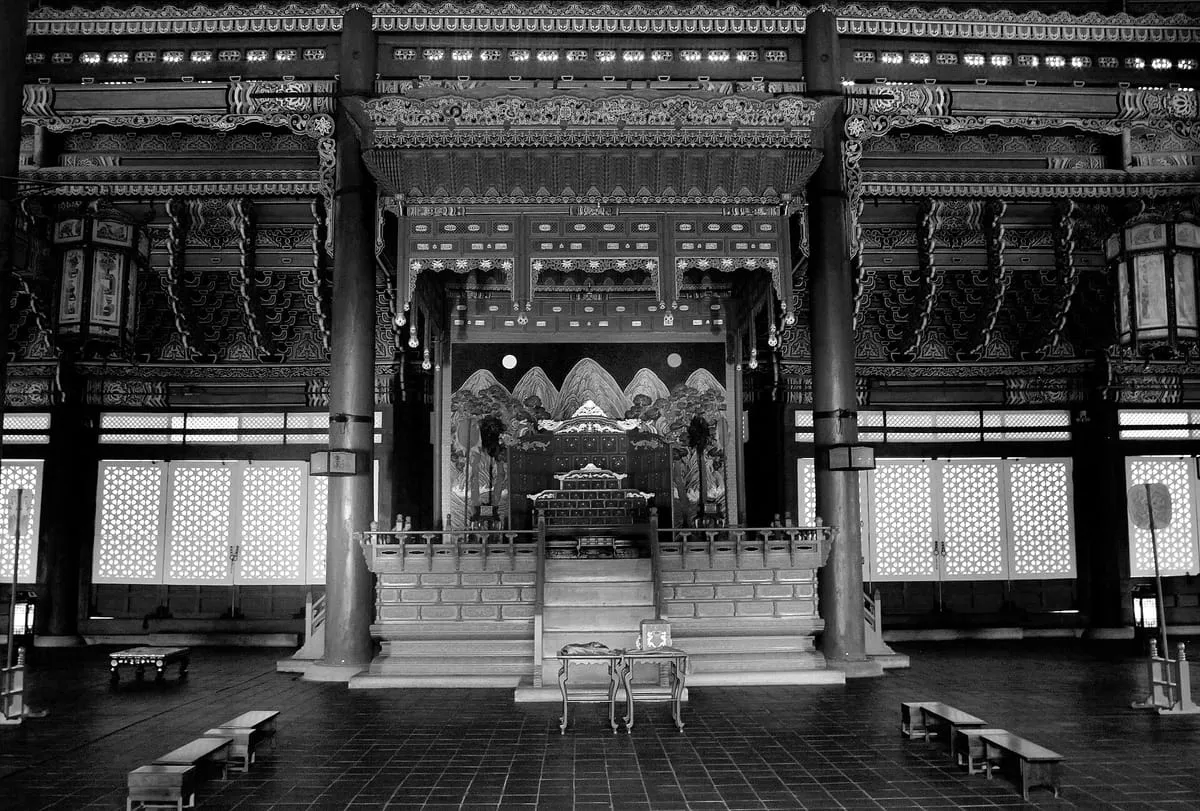
Begin at 09:00 near Anguk Station (Subway Line 3, Exit 1 or 2) or Gyeongbokgung Station (Subway Line 3, Exit 5). Numerous rental boutiques line the streets, offering traditional Korean hanbok attire including skirts (chima), jackets (jeogori), hair braiding, and accessories. Rental packages typically cost ₩15,000 to ₩25,000 for two to four hours. Wearing a complete Hanbok waives the standard ₩3,000 admission charge at all municipal Joseon palaces.
Walk west to Gwanghwamun Gate, the main entrance of Gyeongbokgung Palace. At 10:00 precisely, the Royal Guard Changing Ceremony (Sumunjang) takes place in front of the gate. Guards in colourful robes beat drums and carry historic banners, reenacting royal protocols established in 1469. A second ceremony runs at 14:00, with public guard training demonstrations at 11:00 and 13:00.
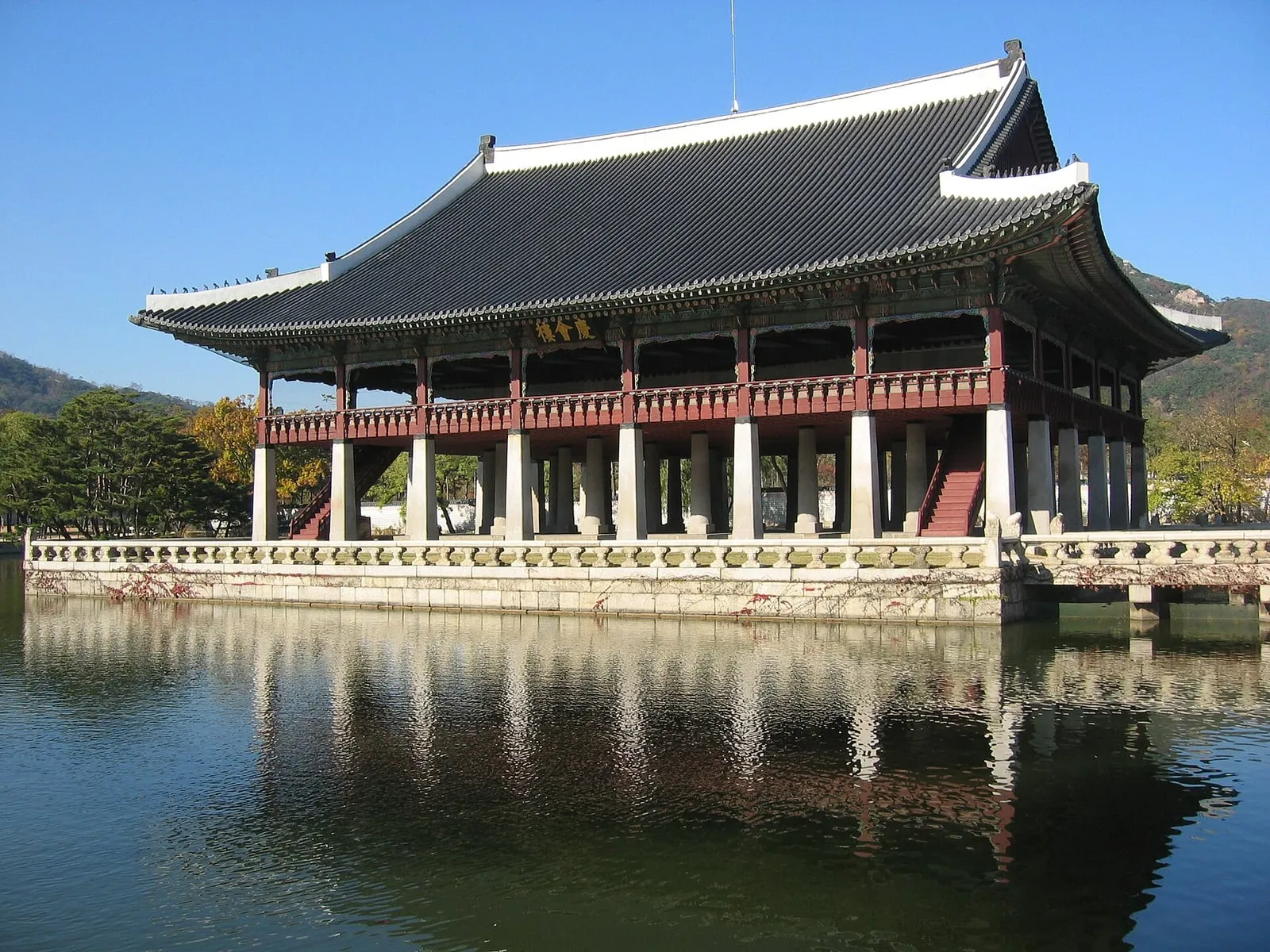
Step through Gwanghwamun into the central courtyard facing Geunjeongjeon, the wooden throne hall where kings presided over royal audiences. Behind it lies Gyeonghoeru, a two-storey royal banquet pavilion raised on 48 stone pillars over an artificial lotus pond. Continue north to Hyangwonjeong, a hexagonal pavilion perched on an islet linked by a timber bridge.
Logistics: Gyeongbokgung Palace opens at 09:00 and closes between 17:00 and 18:30 depending on the season (Nov–Feb close at 17:00, last entry 16:00; Mar–May and Sep–Oct close at 18:00; Jun–Aug close at 18:30). It is closed every Tuesday. Standard adult entry is ₩3,000; visitors under 19 and over 65 enter free.
Guided tours and day trip options
Navigating Seoul’s sprawling districts independently is simple via the subway, but joining an organised tour on your first day eliminates transit stress and gives structured historical context.
Seoul: Highlights of Seoul Full-Day Tour
From ₩80,464 · 4.9 stars from 910 reviews · 8 - 8.5 hours · all-inclusive coach tour
Seoul: Highlights of Seoul Full-Day Tourad: Covers Gyeongbokgung Palace, Jogyesa Temple, the Blue House, Insadong, and traditional markets with an English-speaking guide and lunch included.
Seoul: City Highlights Palace Tour with Optional Hanbok
From ₩87,283 · 4.9 stars from 1,100 reviews · 4 hours · guided royal palace walk
Seoul: Half-Day City Highlights & Palace Tour with Hanbokad: Morning or full-day walking tour focusing on royal Joseon dynasty palace architecture and court politics.
Seoul: DMZ Tour + North Korean Defector Q&A
From ₩68,190 · 4.9 stars from 23,549 reviews · 7 - 9 hours · 3rd Tunnel & border history
Seoul: DMZ Tour + North Korean Defector Q&Aad: The definitive Korean border excursion, including military clearance, the Third Infiltration Tunnel, and a live defector interview.
Seoul: Nami Island & Morning Calm Day Tour
From ₩73,754 · 4.7 stars from 1,356 reviews · 10 - 12 hours · nature & scenic day trip
Seoul: Nami Island and Garden of Morning Calm with Optional Railbikead: Popular full-day countryside excursion to Nami Island and the Garden of Morning Calm with round-trip coach transport.
Official ticket or tour: the prices side by side
Independent 3-day itinerary versus guided options.
| Option | Official admission | Tour cost | What it covers |
|---|---|---|---|
| Independent 3-day itinerary | ~₩24,000 core admissions + transit | — | Self-guided travel using T-money cards on Seoul Metropolitan Subway |
| Day 1 palace guided tour | Admissions included | From ₩87,283 | Morning guided walk decoding Gyeongbokgung Palace and royal history |
| Full-day city highlights coach tour | Admissions & lunch included | From ₩80,464 | Full-day coach sightseeing covering palaces, temples, and markets |
| Optional Day 3 DMZ excursion | Military clearance included | From ₩61,371 | Third Tunnel, Dora Observatory, and North Korean defector briefing |
Late morning: Bukchon Hanok Village
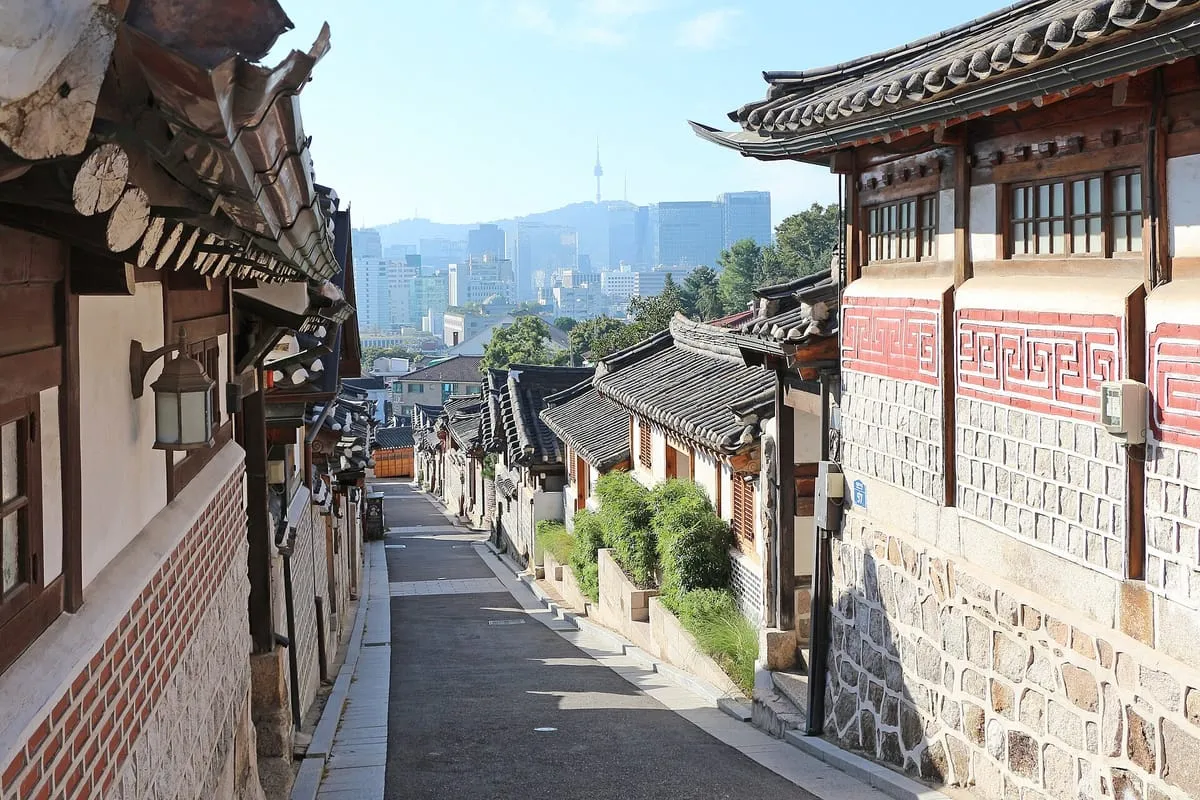
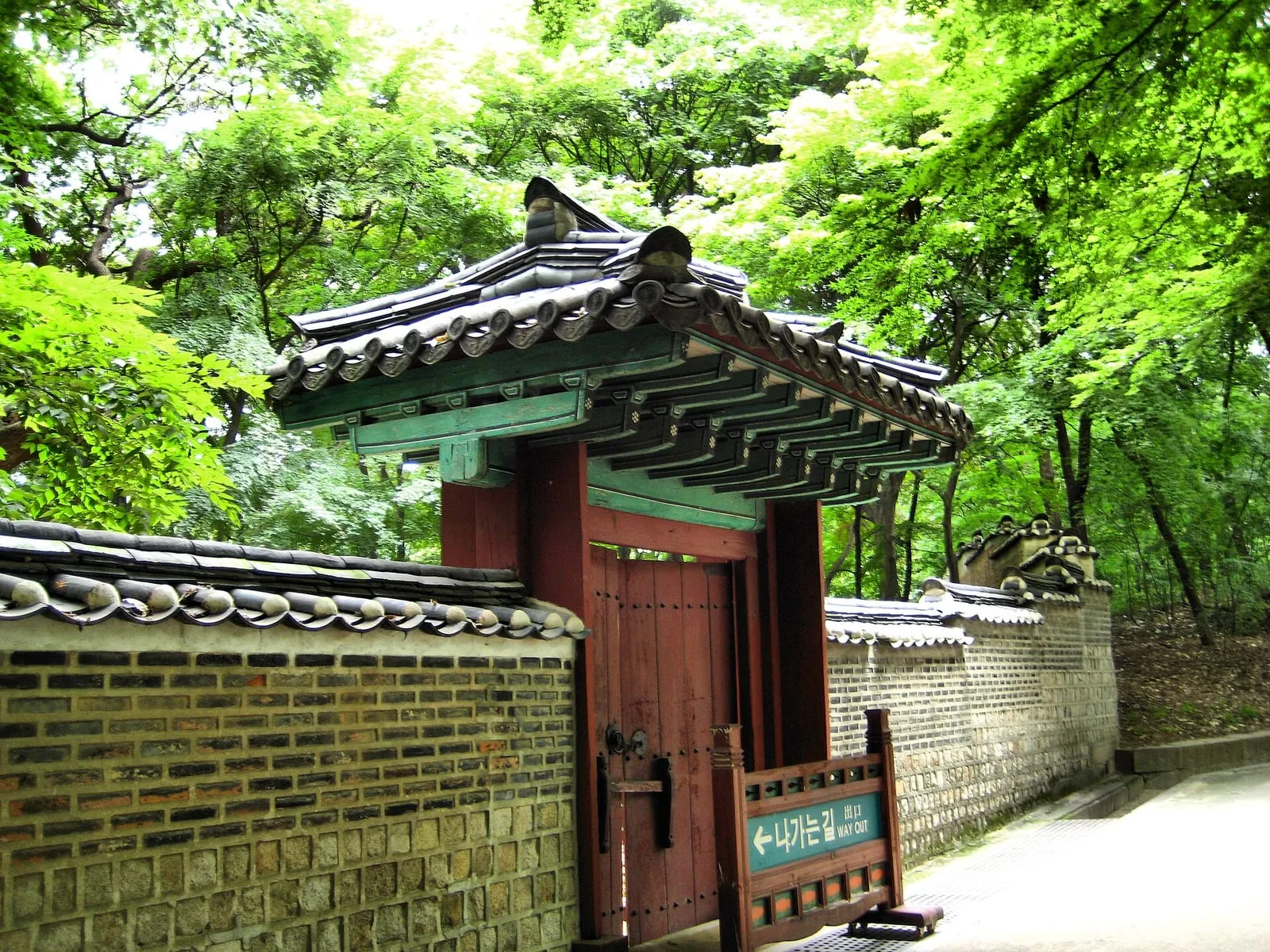
Exit Gyeongbokgung’s eastern gate and walk 10 minutes up the slope into Bukchon Hanok Village. This hillside district features hundreds of traditional wooden, tile-roofed residences (hanok) that housed high-ranking Joseon government officials and royal family members.
The most famous photography viewpoint is along Bukchon-ro 11-gil, looking downhill between curving grey-tiled rooflines toward modern downtown towers in the distance. Bukchon remains an active residential area.
[!WARNING] Visiting hours in the Bukchon-ro 11-gil “Red Zone” are restricted daily to 10:00 to 17:00 (curfew from 17:00 to 10:00 the following morning). There is no Sunday ban, but visitors outside permitted hours face a ₩100,000 municipal fine for trespass. Maintain low voices, refrain from running or shouting, and do not peer into private courtyards.
Drop into the Baek In-je House (free entry, closed Mondays), an aristocratic 1920s hanok with gardens and timber verandas.
Lunch: Insadong traditional tea houses and mandu
Descend south across Yulgok-ro into Insadong-gil, Seoul’s historic art and artisan street. For lunch, choose between hand-rolled knife-cut noodles (kalguksu) or dumplings (mandu) at Insadong 항아리수제비 (hangari sujebi), or sit down for a meal of grilled fish and banchan side dishes at an alleyway hanjeongsik tavern (approx ₩12,000 to ₩18,000).
After eating, visit a quiet courtyard teahouse such as Shin Old Tea House or Moon Bird Does Only Think of the Moon. Sip warm omija-cha (five-flavour berry tea), insam-cha (ginseng tea), or roasted barley tea served alongside sweet rice cakes (tteok) and sesame crackers (teas approx ₩7,000 to ₩9,000). Explore Ssamzigil, a four-storey spiral courtyard housing independent craft makers, ceramicists, and Korean paper artists.
Afternoon: Jogyesa Temple and Cheonggyecheon Stream
From Insadong, walk five minutes west to Jogyesa Temple (free admission), the chief administrative temple of the Jogye Order of Korean Buddhism. In the main hall (Daeungjeon), three gilded statues of the historical Buddha, Amitabha, and Bhaisajyaguru sit beneath an intricate ceiling. The courtyard is shaded by a 450-year-old white pine tree (baeksong) and adorned with colourful lotus lanterns hanging in geometric canopies.
Continue south along Ujeongguk-ro for 10 minutes to reach Cheonggye Plaza, the western source of Cheonggyecheon Stream. This restored 11-kilometre canal runs below street level through downtown Seoul. Walk down the stone stairs to the waterside footpath, where stepping stones allow you to cross between banks.
Evening: Street food feast at Gwangjang Market
Follow the stream eastward for 1.5 kilometres (a 20-minute waterside stroll) until you reach Gwangjang Market, located at Jongno 5-ga Station (Subway Line 1, Exit 7 or 8). Established in 1905, Gwangjang is South Korea’s oldest functioning market.
Head straight to the central intersection where benches surround griddles and pots. Sample items stall by stall:
- Bindaetteok (₩5,000): Savoury, golden pancakes made from stone-ground mung beans fried in soybean oil, served with pickled onions in soy sauce.
- Mayak Gimbap (₩3,000): Bite-sized rice rolls filled with carrot, spinach, and yellow pickled radish, brushed with sesame oil and dipped in hot mustard.
- Kalguksu (6,000–₩7,000): Fresh wheat noodles cut by hand from rolled dough and boiled in hot anchovy broth with sliced squash.
- Yukhoe (₩19,000): Fresh seasoned raw beef tartare topped with raw egg yolk and crisp slices of Korean pear, served in the dedicated Yukhoe Alley.
Pair your meal with a bowl of chilled makgeolli (sparkling unfiltered rice wine, 3,000–₩4,000). The food stalls operate daily until 22:00 or 23:00.
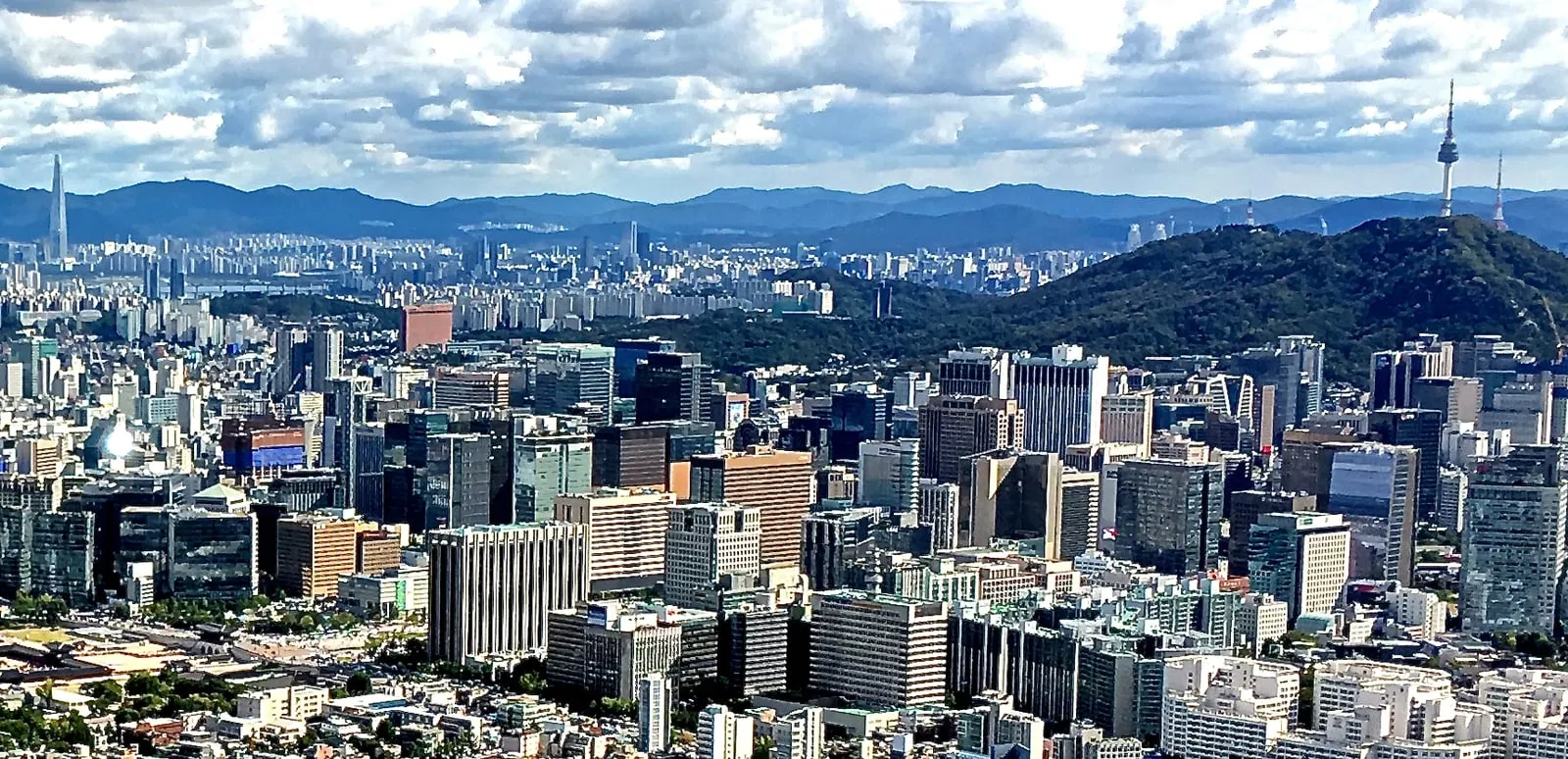
Central Seoul from the air, with Lotte World Tower on the left and N Seoul Tower on Namsan at right. Photo: Arturbraun, Wikimedia Commons, CC BY-SA 4.0.
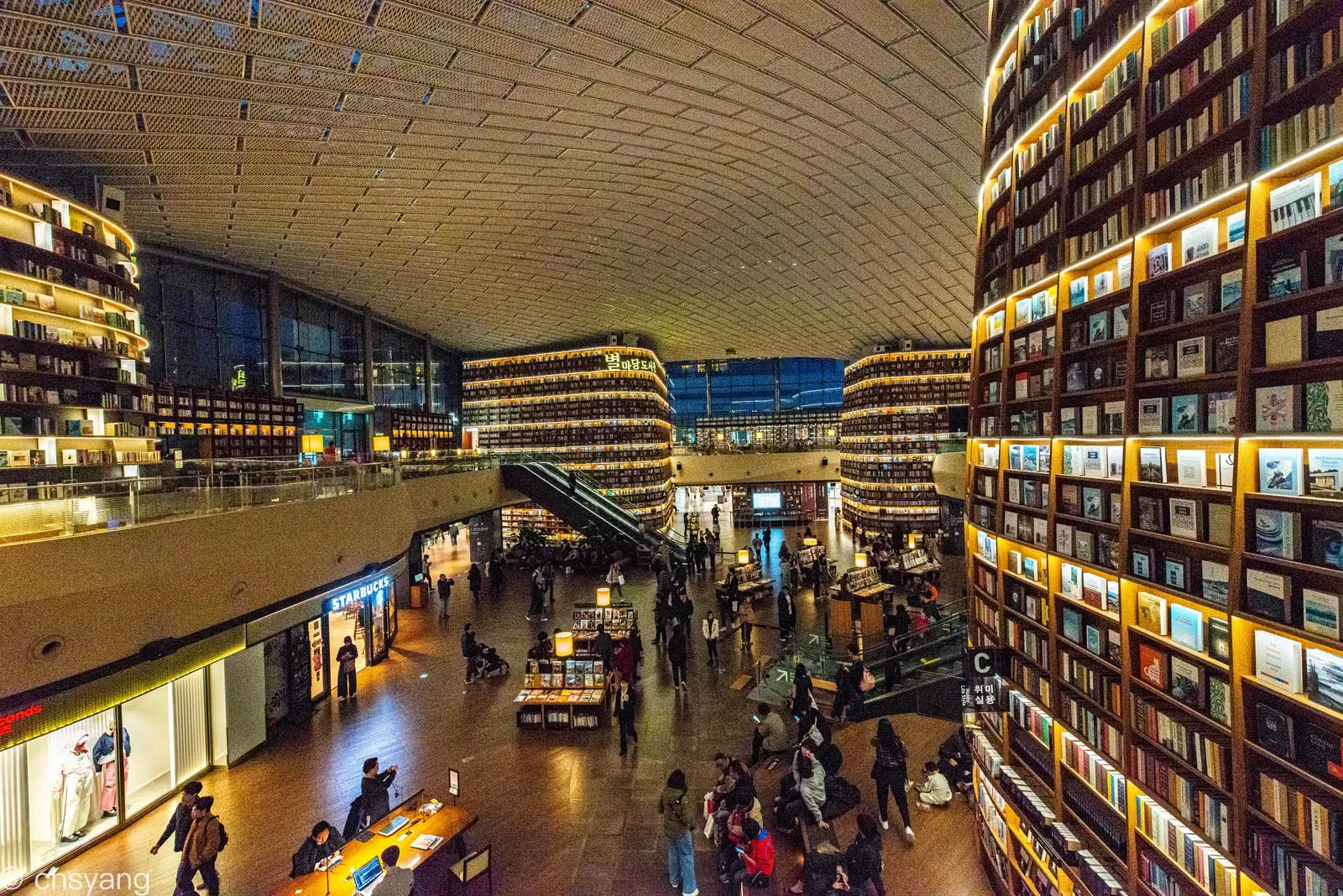
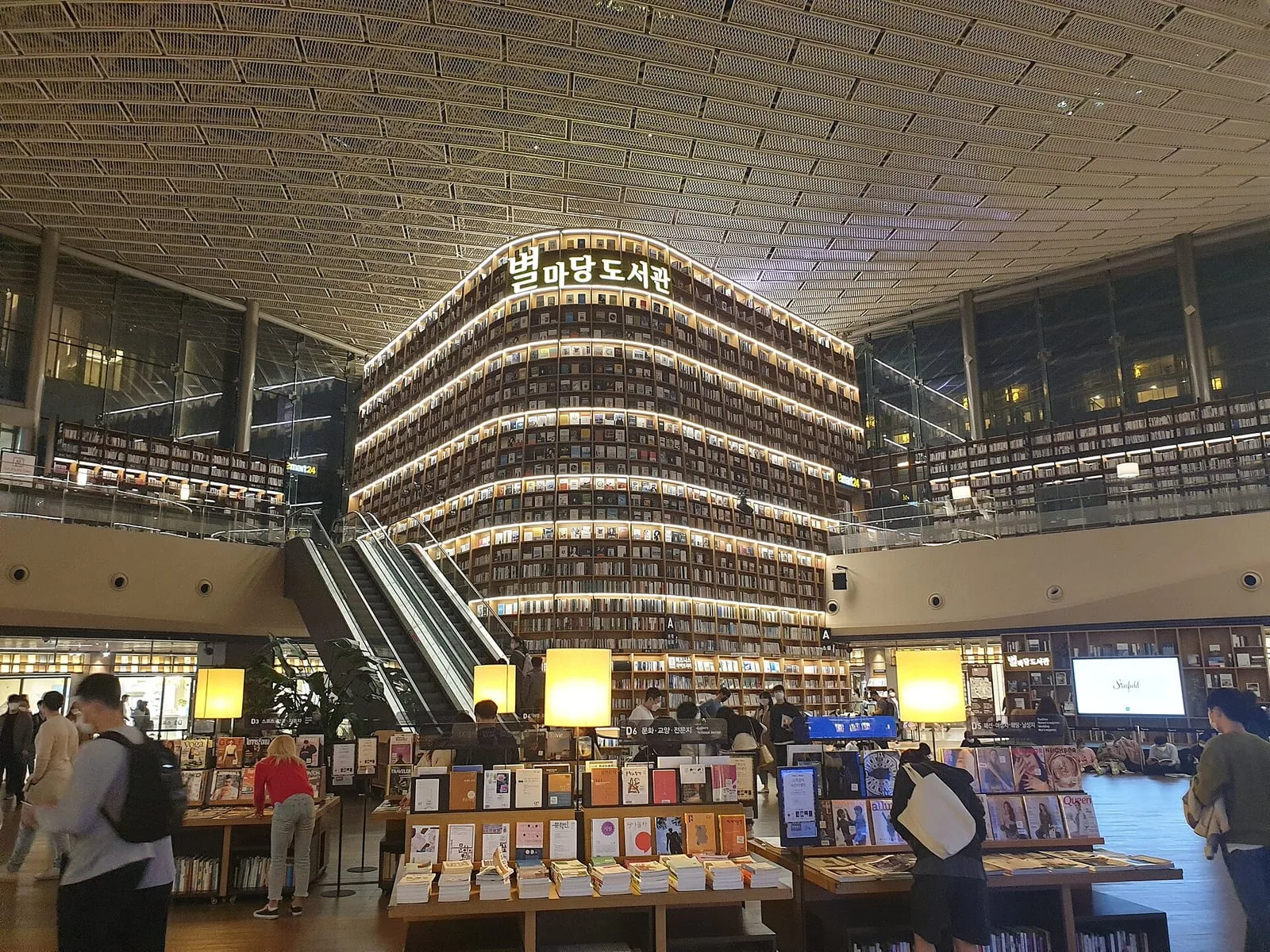
The bookshelf atrium of Starfield Library in COEX Mall. Photo: chsyang, Wikimedia Commons, Public domain.
Day 2: Viewpoints, shopping and design
Day two connects central Seoul’s mountain panoramas with the retail centre, culminating at Dongdaemun Design Plaza.
| Time | Stop | Activity |
|---|---|---|
| 09:30 | Namsan Mountain | Ascend via shuttle bus 01A/01B or Namsan Cable Car |
| 10:30 | N Seoul Tower | Indoor observatory deck and Love Locks plaza |
| 12:30 | Cable Car Descent | Descend towards Myeongdong Station |
| 14:30 | Myeongdong | Lunch at Myeongdong Kyoja and Korean skincare shopping |
| 17:30 | Dongdaemun Design Plaza | Architecture walk around Zaha Hadid’s DDP complex |
| 20:00 | Fashion Night Markets | Browse Doota, Migliore and late-night wholesale alleys |
Morning: Namsan Mountain and N Seoul Tower
Start at 09:30 heading toward Namsan Mountain, the 243-metre forested peak rising in the centre of Seoul. You have two primary ways to reach the summit:
- Namsan Circular Shuttle Bus (01A or 01B): Board at Chungmuro Station (Lines 3 & 4, Exit 2) or Dongguk University Station (Line 3, Exit 6). Buses run about every 9 minutes and cost ₩1,500 on a transport card (no cash). This is the fastest, most economical route.
- Namsan Cable Car: Reached by walking 10 minutes uphill from Myeongdong Station (Line 4, Exit 3) to the Namsan Ormi outdoor inclined lift. The cable car costs ₩15,000 for a return ticket.
At the summit plaza, forested walking paths provide vistas across the Han River to Gangnam and north toward Bukhansan. Colourful locks cling by the thousands to the outdoor observation terraces.
Purchase an admission ticket (₩29,000 adult) to ascend the N Seoul Tower observatory. The high-speed lift reaches the indoor deck at 480 metres above sea level, providing floor-to-ceiling 360-degree glass views across the metropolis.
Afternoon: Myeongdong shopping and street food
Descend via the cable car or shuttle bus to Myeongdong (Subway Line 4, Myeongdong Station, or Line 2, Euljiro 1-ga Station). Myeongdong is Seoul’s retail centre, known for cosmetics flagships, fashion boutiques, and street snacks.
Head to Myeongdong Kyoja, a long-running restaurant operating since 1966 on Myeongdong 10-gil. Order the kalguksu (handmade chicken broth noodles with minced meat and wontons, ₩11,000) or mandu (steamed pork and leek dumplings, ₩12,000).
Spend the early afternoon exploring Korean beauty stores along the pedestrian streets: Olive Young, Innisfree, Laneige, and Nature Republic. Foreign visitors carrying a passport can claim instant tax refunds at checkout counters on purchases exceeding ₩15,000.
From 15:00 onwards, street vendors wheel carts into the main cross-streets. Sample sweet hotteok (brown sugar and seed pancakes, ₩2,000), grilled cheese lobster tails (₩15,000), skewered chicken tteok-kkochi (₩4,000), and egg bread (gyeran-ppang, ₩2,500).
Evening: Dongdaemun Design Plaza (DDP) and night wholesale markets
Take Subway Line 2 or Line 4 from Myeongdong directly to Dongdaemun History & Culture Park Station (Line 2, 4, 5 interchange, Exits 1 & 2).
Emerge directly into Oullim Square at Dongdaemun Design Plaza (DDP). Designed by architect Zaha Hadid, this structure features 45,133 distinct curving aluminium panels and sweeping fluid indoor ramps with no visible straight columns.
Arrive before dusk to explore the Design Lab and walk the gentle exterior grass-covered roof park. As night falls, the building transforms with soft blue and silver architectural illumination. If visiting during late autumn or winter, you may catch the Seoul Light Festival, when the 222-metre curving facade becomes an immense digital projection screen.
Across the street lies Dongdaemun Fashion Town. Walk through retail fashion malls such as Doota (open until 24:00) and Migliore. After 20:00, the wholesale district behind DDP (including apM Place, apM Luxe, and Designer Club) operates. Wholesalers, couriers, and international buyers fill the pavements until 05:00. Grab a late supper of spicy stir-fried rice cakes (tteokbokki) and crispy fish cakes (eomuk) from the street carts on Jangchungdan-ro.
Day 3: Modern Gangnam, culture and K-wave
The final day crosses the Han River into southern Seoul’s commercial corridor before winding down in the student enclave of Hongdae.
| Time | Stop | Activity |
|---|---|---|
| 09:30 | Starfield COEX Mall | Browse Starfield Library atrium |
| 11:30 | Bongeunsa Temple | Classical Buddhist shrines and 23-metre stone Buddha |
| 14:00 | National Museum of Korea | Pensive Bodhisattvas and Silla Gold Crown (free entry) |
| 16:30 | Hongdae | Independent boutiques and cafes along Hongik University streets |
| 18:00 | Hongdae Busking | Live street performances along Eoulmadang-ro |
| 19:30 | Korean BBQ Dinner | Tabletop grilled samgyeopsal feast |
Morning: Starfield Library and Bongeunsa Temple
Take Subway Line 2 to Samseong Station (Exits 5 & 6) or Line 9 to Bongeunsa Station (Exits 1 & 7). Walk directly into Starfield COEX Mall, the underground shopping centre.
At the centre of the mall sits Starfield Library (Byeolmadang Doseogwan). Free and open to all visitors daily from 10:30 to 22:00, this soaring two-storey open atrium features three 13-metre-tall wooden bookshelves holding more than 50,000 books and magazines. Escalators rising beside the book towers offer a distinctive perspective.
Walk out of COEX Mall at street level via Exit 1 or 2 of Bongeunsa Station and cross the avenue to Bongeunsa Temple. Founded in 794 AD during the Silla Kingdom, this Buddhist sanctuary offers a notable visual contrast: classical timber shrines and incense smoke framed by modern glass high-rises. Climb the stone steps to view the Maitreya Buddha, a 23-metre stone statue standing in contemplation. Entry to the temple grounds is free daily from 05:00 to 22:00.
Afternoon: National Museum of Korea or K-Star Road
For the afternoon, choose between national history or contemporary pop culture:
- Option A (Culture): National Museum of Korea. Take Line 9 from Bongeunsa to Dongjak, transferring to Line 4 to Ichon Station (Exit 2 connects directly via an underground walkway). The National Museum of Korea displays over 12,000 historical artefacts across three floors. Entry to the permanent collection is free (open 09:30 to 17:30, and until 21:00 on Wednesdays and Saturdays; last entry 30 minutes before close). Do not miss the Room of Quiet Contemplation on the second floor, which displays two national treasure Pensive Bodhisattvas cast in bronze during the sixth and seventh centuries.
- Option B (K-Wave): K-Star Road and Apgujeong Rodeo. Walk 15 minutes north from Bongeunsa or take the Suin-Bundang Line to Apgujeong Rodeo Station (Exit 2). Stroll along K-Star Road to spot large painted GangnamDol bear statues representing K-pop groups like BTS, EXO, and Super Junior, followed by boutique browsing in Cheongdam-dong.
Evening: Street busking and Korean BBQ in Hongdae
Conclude your 72 hours in western Seoul’s Hongdae neighbourhood (Subway Line 2, AREX, or Gyeongui-Jungang Line to Hongik University Station, Exit 8 or 9). Surrounding Hongik University, this district is the hub of Korean indie music, youth culture, fashion, and dining.
Walk along Hongdae Walking Street (Eoulmadang-ro) from 17:30 onwards. Every evening, student dance crews and indie singers set up amplifiers in designated outdoor performance squares. Crowds gather to watch K-pop choreography, hip-hop cyphers, and acoustic ballads.
For your final dinner, settle into a traditional tabletop Korean BBQ restaurant along the Hongdae grill strip:
- Order Samgyeopsal (thick-cut fresh pork belly, approx 16,000–₩18,000 per 150g portion) or Dwaeji Galbi (marinated pork ribs, 17,000–₩19,000).
- The meats sizzle on an inset grill. Snip the cooked pork with table shears, wrap each piece in fresh perilla leaves or lettuce with a dab of fermented soybean paste (ssamjang), grilled garlic, and kimchi.
- Complete the meal with a bowl of soybean paste stew (doenjang-jjigae) and a cold beer or bottle of soju (₩5,000).
After dinner, explore Hongdae’s late-night vintage shops, self-service photobooths (Life Four Cuts, ₩4,000), and dessert cafes serving shaved milk-ice bingsu.
3-Day Seoul transport logistics
Navigating Seoul efficiently requires using the subway and bus networks. The underground rail network is clean, air-conditioned, and fully signposted in English.
Main itinerary subway line connections
- Line 3 (Orange): Links Gyeongbokgung, Anguk (Bukchon Hanok Village), Jongno 3-ga, Chungmuro (transfer to Namsan shuttle), and south to Express Bus Terminal and Sinsa.
- Line 1 (Dark Blue): Links Seoul Station, City Hall, Jongno 3-ga, and Jongno 5-ga (Gwangjang Market).
- Line 4 (Light Blue): Connects Myeongdong, Seoul Station, Dongdaemun History & Culture Park (DDP), and Ichon (National Museum of Korea).
- Line 2 (Green Circle): Rings the city, connecting Hongik University (Hongdae), City Hall, Euljiro, Dongdaemun (DDP), and Samseong (Starfield COEX Mall).
- Line 9 (Gold): Connects Gimpo Airport across southern Seoul to Bongeunsa (COEX) with rapid Express trains.
Transit tickets and passes
- T-money Card: Purchase a reloadable card for ₩4,000 to ₩5,000 at any convenience store (CU, GS25, 7-Eleven) or subway station ticket vending machine. Top it up using cash won banknotes at ticket machines. Single subway trips start at ₩1,550 for journeys up to 10 km (₩1,650 for single cash tickets), with free transfers between subway lines and city buses within 30 minutes.
- Climate Card (Gihu Donghaeng Card): Visitors can purchase a ₩3,000 physical card and load a 1-day (₩5,000), 2-day (₩8,000), 3-day (₩10,000), 5-day (₩15,000), or 7-day (₩20,000) tourist pass for unlimited travel across the Seoul Seoul Metro subway network and municipal buses (excluding airport trains and red suburban express buses).
- Navigation Apps: Google Maps in South Korea shows places, reviews and public transport routes, but not turn-by-turn walking directions; Google has said it plans to add them and has given no launch date. Download Naver Map or KakaoMap before departure. Both apps provide accurate English-language transit routing, pedestrian navigation, subway carriage transfer numbers, and real-time train arrivals.
Where to stay for this 3-day itinerary
Choosing an accommodation base near an interchange station on Subway Line 2 or Line 4 minimises transfer times across all three days.
- Myeongdong: Central location within walking distance of Namsan, Cheonggyecheon, and royal palaces, with direct airport limousine bus connections. See our curated guide to hotels in Myeongdong and Hongdae.
- Hongdae: Best for independent travellers and couples wanting direct access to cafes and late-night dining on the AREX airport line.
- Insadong and Jongno: Cultural setting surrounded by art galleries, teahouses, and historic palace walls, well situated for walking directly to day one attractions.
For a comprehensive neighbourhood breakdown, read our detailed guide on where to stay in Seoul. If you have extra days, explore our recommendations for day trips from Seoul, including excursions to Incheon Chinatown and Songdo or the DMZ border zone.
Common questions
Is 3 days enough time to visit Seoul?
Three full days covers Seoul's primary landmarks: the royal palaces and Bukchon hanok alleys in Jongno, the central viewpoints of Namsan and Dongdaemun Design Plaza, modern shopping at COEX Mall in Gangnam, and the evening nightlife of Hongdae.
How much do sightseeing admissions cost for this 3-day Seoul itinerary?
Gyeongbokgung Palace costs ₩3,000 (free if wearing full traditional Hanbok), the N Seoul Tower observatory costs ₩29,000, and Starfield Library, Bongeunsa Temple, and Cheonggyecheon Stream are free.
Which attractions should be reserved before arriving in Seoul?
Advance booking is recommended for the Changdeokgung Secret Garden tour if substituting for Gyeongbokgung on a Tuesday, and popular weekend Hanbok rentals near Anguk Station. Most core sights, including Gyeongbokgung and N Seoul Tower, sell entry tickets on arrival at official ticket windows.
How do you travel between attractions in Seoul?
The Seoul Metropolitan Subway system connects every neighbourhood in this itinerary. Base rides cost ₩1,550 for the first 10 km when using a reloadable T-money card or the Climate Card (₩1,650 for single cash tickets), providing fast transfers and avoiding road congestion.