In this guide
💡 The Short Version: Operating daily from 16:00 to 23:00 under Jung-gu District Office rules, the pedestrianised thoroughfares of Myeongdong transform into Seoul’s most famous evening street food bazaar. Standout specialities range from sweet Korean Egg Bread (Gyeran-bbang, 2,000–₩3,000) and crispy brown sugar pancakes (Hotteok, ₩2,000–₩2,500) to Tornado potatoes (₩3,000–₩4,000) and grilled cheese lobster tails (₩15,000–₩18,000). While portable card readers are increasingly common, carrying ₩10,000 to ₩20,000 in small cash banknotes ensures smooth transactions. Prices run 30% to 50% above traditional markets, reflecting prime central convenience.
Overview and operating schedule
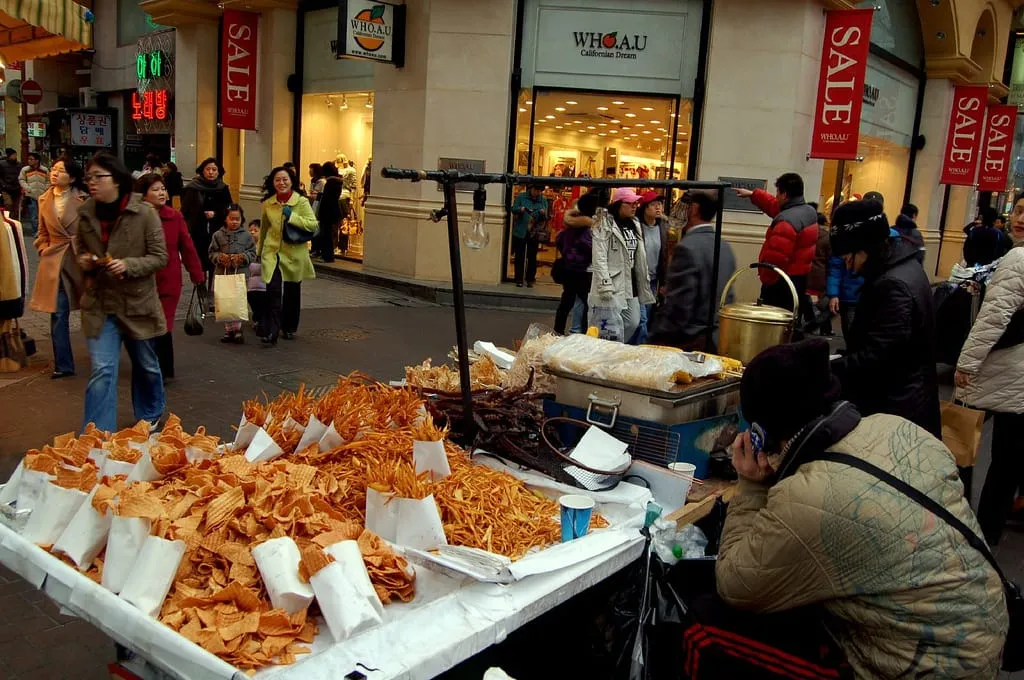
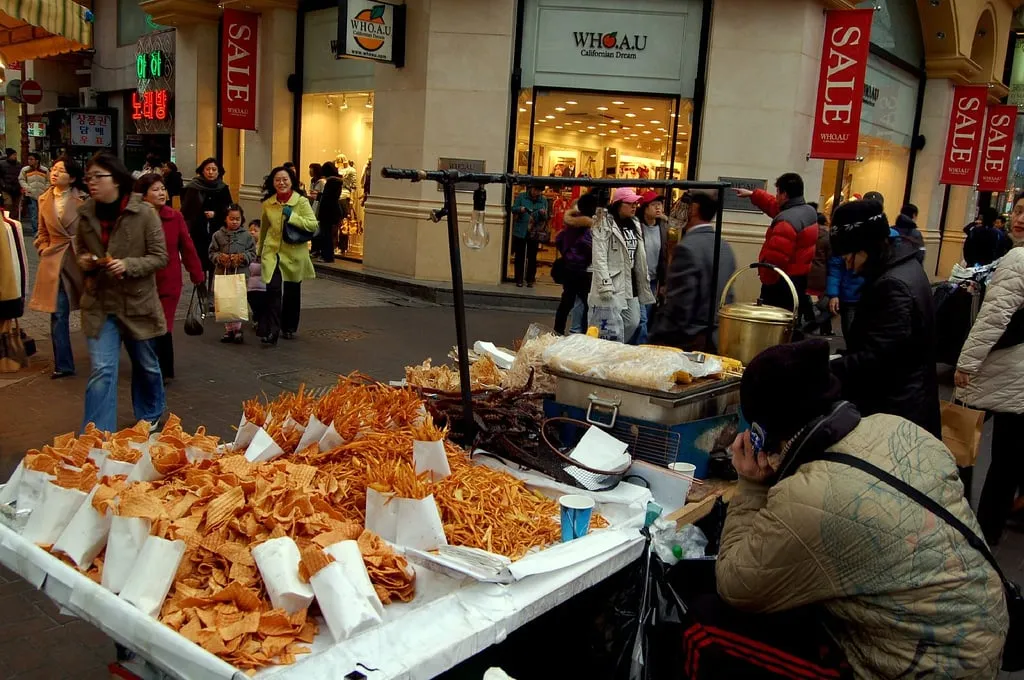
Myeongdong is renowned globally as Seoul’s primary fashion and cosmetics retail district, with multi-level flagship stores lining narrow streets. Every afternoon at around 16:00, as delivery trucks depart, dozens of licensed mobile food wagons (pojangmacha) roll out into the centre of Myeongdong-gil and its cross streets.
By 17:30, the neon signs of beauty emporiums illuminate a continuous 500-metre corridor of open grills, deep fryers, and blowtorches. The night market operates 365 days a year, regardless of season, though trading is busiest on clear Friday and Saturday evenings.
| Street snack | Typical price | Flavour profile | Preparation style and serving notes |
|---|---|---|---|
| Gyeran-bbang (Egg bread) | ₩2,000 to ₩3,000 | Sweet and savoury | Oval waffle-like vanilla batter baked with a whole fresh egg inside |
| Hotteok (Sweet pancake) | ₩2,000 to ₩2,500 | Sweet, nutty, and spiced | Pan-fried yeast dough stuffed with brown sugar, cinnamon, and crushed peanuts |
| Tornado potato (Hweori Gamja) | ₩3,000 to ₩4,000 | Savoury and crisp | Spiral-cut whole potato skewered on a 30-cm timber rod, dusted in cheese or chilli powder |
| Tanghulu (Candied fruit) | ₩4,000 to ₩5,000 | Tart and sugary crunch | Skewered fresh strawberries or grapes encased in a paper-thin, glassy sugar glaze |
| Strawberry Daifuku | ₩3,000 to ₩3,500 | Fruity and chewy | Ripe Korean strawberry wrapped in smooth sweet red bean paste and soft mochi rice cake |
| Grilled cheese lobster tail | ₩15,000 to ₩18,000 | Rich, creamy, and smoky | Halved lobster tail grilled over flame, smothered in shredded mozzarella and torched |
| Eomuk (Fishcake skewers) | ₩1,500 to ₩2,000 | Savoury umami broth | Folded ribbon fishcake on wooden skewers simmered in hot anchovy-kelp soup |
| Cheese Tteok-kkochi | ₩4,000 to ₩5,000 | Chewy and savoury | Alternating rice cake cylinders and mozzarella cheese blocks griddled on skewers with condensed milk |
Essential sweet and savoury street snacks
1. Gyeran-bbang (Korean egg bread)
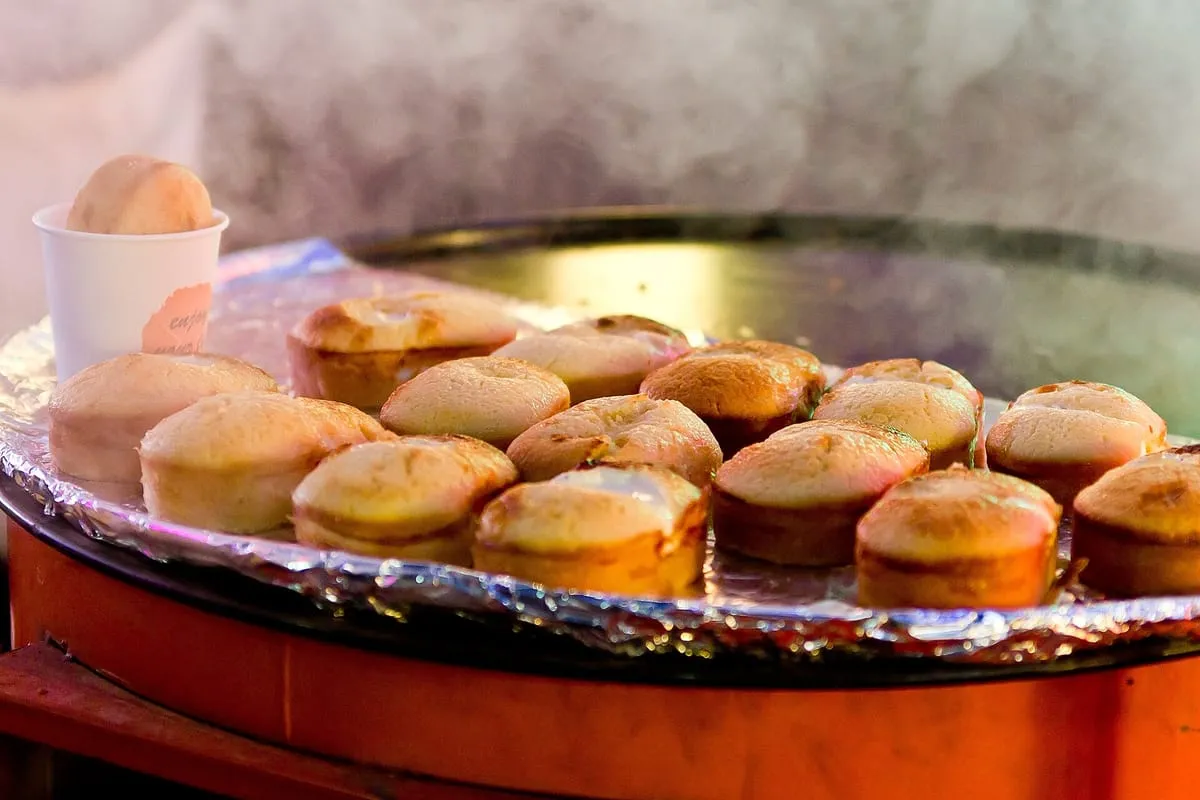
Gyeran-bbang is a traditional winter street food staple found across South Korea, but nowhere is it more reliably available than in Myeongdong. Vendors use custom double-sided iron moulds resembling oblong muffin tins.
A sweet, golden batter scented with vanilla and butter is poured into the hot moulds, after which a whole fresh raw egg is cracked directly into each individual compartment. The moulds are clamped shut and baked until the bread puffs into a golden cake with a cooked, custardy yolk in the centre. Some vendors garnish the top with sunflower seeds, parsley, or a strip of bacon and cheddar cheese. Eaten hot from a paper cup, it delivers a balance of savoury egg yolk and sweet fluffy sponge.
2. Hotteok (Crisp brown sugar pancakes)
These griddled yeast-dough pancakes are cooked fresh before your eyes. The cook pinches a ball of elastic fermented wheat and glutinous rice dough, indents the centre with a thumb, packs it with a generous tablespoon of dark brown sugar, cinnamon powder, and chopped roasted peanuts or sunflower seeds, and pinches the dough shut.
Dropped onto a flat-top griddle swimming in oil, the dough is flattened into a thin disk using a circular stainless-steel hand press (ho-tteok nurugae). As it fries to a golden crunch, the internal sugar melts into a molten, spiced syrup. Tear a corner off the protective paper cup and allow it to cool slightly before taking a bite to avoid burning your tongue on the hot syrup.
3. Tornado potatoes (Hweori Gamja)
Invented in Seoul in the early 2000s, tornado potatoes have become an international street food icon. A whole peeled potato is impaled on a 30-centimetre wooden skewer and passed through a specialised rotary spiral slicer that cuts the potato into one continuous, undulating accordion ribbon.
The potato is stretched along the length of the skewer and plunged into a deep fryer until golden and crisp like potato crisps. Once drained, the vendor rolls the hot skewer through seasoning trays: choose from powdered cheddar cheese, sweet onion, sour cream, or spicy barbecue chilli. A luxury variation incorporates a hot dog sausage threaded through the centre of the potato spiral.
4. Grilled cheese lobster tails
The most photogenic luxury street food in Myeongdong is the grilled lobster cart. Whole spiny lobster tails are split down the centre, placed shell-down over a flat griddle, and brushed with sweet garlic butter.
Once the meat turns opaque, the cook blankets the lobster in a mountain of shredded mozzarella cheese and blasts the top with a high-powered propane blowtorch. The cheese bubbles and caramelises into a smoky, golden crust, finished with a zig-zag of sweet mayonnaise and dried parsley. While expensive for street food (₩15,000 to ₩18,000), it remains a fraction of the cost of sit-down seafood restaurants.
5. Tanghulu and Strawberry Daifuku
Seoul’s fruit desserts highlight Korea’s exceptional winter strawberry crops:
- Tanghulu: Originating from northern China, skewered fresh strawberries, Shine Muscat green grapes, and mandarin oranges are dipped into boiling sugar syrup. The sugar cools into a paper-thin, glassy candy shell that shatters cleanly between your teeth before releasing cold, tart fruit juices.
- Strawberry Daifuku: Japanese-style sweet rice cakes featuring a giant ripe Nonsan strawberry encased in sweet red bean paste (anko) and enveloped in chewy white glutinous rice cake (mochi), cut in half to showcase the vivid red centre.
6. Eomuk (Fishcake skewers in broth)
For a fast, savoury warmer on cool evenings, look for the metal steaming carts lined with rows of wooden skewers threaded with pleated fishcake ribbons (eomuk or odeng). The fishcakes simmer continuously in a deep stainless-steel trough of broth made from dried anchovies, kelp (dashima), white radish, and leeks.
Walk up to the counter, grab a skewer directly from the broth, and eat it standing up. Beside the pot are stacks of small paper cups and soup ladles: scoop out a cup of hot broth to sip between bites at no extra charge. When finished, hand your wooden sticks to the vendor to calculate your total (typically ₩1,500 to ₩2,000 per skewer).
Cash vs card advice and pricing reality
Payment methods
- Cash is fastest: While approximately 60% of Myeongdong food carts now carry portable wireless payment terminals that accept international Visa and Mastercard, signal dropouts and foreign card authorization lag can cause delays during crowded evening rushes.
- Banknotes: Keep ₩10,000 to ₩30,000 in your wallet in 1,000, 5,000, and ₩10,000 notes. Cash enables instant transactions and keeps queues moving briskly.
- T-money: Like Gwangjang Market, the T-money transport card cannot be used to pay street carts.
Pricing comparison
Street food in Myeongdong is deliberately tailored to domestic and international visitors. Expect prices to be roughly 30% to 50% higher than traditional neighbourhood markets:
- A hotteok that costs ₩1,500 in Namdaemun or Sinchon costs ₩2,000 to ₩2,500 in Myeongdong.
- Fried dumplings that cost ₩5,000 for a plate of eight at Gwangjang Market cost ₩6,000 to ₩7,000 for four in Myeongdong.
However, Myeongdong offers the densest concentration of trendy, visually playful snacks gathered along one compact pedestrian zone. For everyday sit-down dining nearby, consult our guide to where to eat in Seoul or experience local barbecue in our best Korean BBQ in Seoul guide.
Guided evening food tours
Myeongdong’s pedestrian street food market opens for trade at dusk. Joining a guided tour pairs street cart specialities with neighbourhood history and night skyline views.
Seoul: Namdaemun & Myeongdong Food Tour with 10 Tastings
From ₩177,294 · 4.8 stars from 10 reviews · 3 hours · 10 street food tastings
Seoul: Food Tour with 11+ Tastings in the Heart of the Cityad: A 3-hour evening food crawl through Namdaemun Market and Myeongdong, sampling 10 street food staples including hotteok, mandu, and skewered specialities.
Seoul: N Seoul Tower & Myeongdong Evening Tour
From ₩139,000 · 5 stars from 8 reviews · 4 hours · tower views & night market
Seoul: N Seoul Tower & Myeongdong Night Tourad: Combines sunset views from the N Seoul Tower observatory deck with an evening walking tour through Myeongdong night market.
Moonlight Seoul Night Tour: Cheonggyecheon & Markets
From ₩80,464 · 4.9 stars from 345 reviews · 5 hours · illuminated city landmarks
Seoul Han River Night Ferry: 63 Building & Gwangjang Marketad: Explores downtown Seoul by night, taking in street food stalls, Cheonggyecheon Stream, and illuminated modern architecture.
Official ticket or tour: the prices side by side
Independent grazing versus guided evening tours.
| Option | Official admission | Tour cost | What it covers |
|---|---|---|---|
| Independent street cart grazing | ₩15,000–₩30,000 | — | Cash or card purchases at mobile street carts along pedestrian lanes |
| Guided food and market tour | 8+ tastings included | From ₩131,157 | 3-hour guided tasting walk through Seoul’s markets |
| Myeongdong & N Seoul Tower evening tour | Admissions included | From ₩139,000 | Observatory entry, evening mountain transport, and market walk |
Practical logistics
Subway access
- Seoul Metro Myeongdong Station (Line 4): Exits 6 and 7 lead directly onto the main north-south pedestrian spine of Myeongdong 8-gil.
- Euljiro 1-ga Station (Line 2): Exits 5 and 6 place you at the northern perimeter, adjacent to the Lotte Department Store and underground shopping arcade.
- Transit fares can be paid using standard single-journey tokens, T-money, or the Climate Card (see public transport in Seoul).
Handling rubbish
Korea maintains a strict domestic recycling policy, and street bins are virtually non-existent along pedestrian footpaths. Do not discard wooden skewers or paper trays on street corners or shop doorsteps.
- Each food wagon keeps a waste bag or cardboard box fastened to the side of the cart.
- Dispose of your empty cups and skewers directly with the vendor where you made your purchase before walking to the next cart.
Common questions
What time does Myeongdong night market open and close?
Food carts begin rolling into position at roughly 16:00 every afternoon. Trading peaks between 18:00 and 21:30, with vendors packing up between 22:30 and 23:00 seven nights a week.
Do Myeongdong street food vendors accept credit cards?
Many prominent vendors now carry wireless card readers or QR terminals, but small cash banknotes in Korean won remain the fastest and most reliable payment method. Carrying ₩15,000 to ₩30,000 in 1,000, 5,000, and ₩10,000 notes avoids terminal delays.
Is Myeongdong street food more expensive than other markets?
Yes. Food in Myeongdong is priced roughly 30% to 50% higher than traditional markets like Gwangjang or Namdaemun due to central shopping district rents and prime tourism positioning, but offers unmatched density of modern and viral street food concepts.
Are there rubbish bins in Myeongdong?
Public street bins are scarce throughout Seoul. Each food cart provides a dedicated cardboard rubbish bin or plastic bag hanging beside the counter for used skewers, cups, and napkins. Hand your waste back to the vendor where you purchased your snack.
How do you reach Myeongdong night market by subway?
Take Seoul Subway Line 4 to Myeongdong Station and take Exit 6 or 7, which brings you directly into the main pedestrianised shopping avenue. Alternatively, take Subway Line 2 to Euljiro 1-ga Station (Exit 5 or 6) and walk three minutes south.