In this guide
💡 The Short Version: The most efficient way to explore Hakone independently is with the Hakone Freepass (¥7,100 for adults for 2 days from Shinjuku), which includes your return Odakyu train fare and unlimited rides on eight regional transport networks (scenic trains, cable cars, ropeways, buses, and pirate sightseeing boats). Upgrading to the Romancecar limited express (80 minutes to Hakone-Yumoto, reserved seats only) adds ¥1,200 each way, bringing the total round-trip cost to ¥9,500. The classic day loop circles through Gora, the volcanic crater of Owakudani, Lake Ashi, and the lakeside torii gate of Hakone Shrine. Or book a tour: travellers wanting to combine Hakone with Mount Fuji’s 5th Station can reserve the full-day Tokyo: Mt Fuji Tour, Hakone Ropeway, Owakudani, Lake Ashiad (from ¥8,640, 4.6 stars from 8,581 reviews) with coach transport. All prices are in Japanese yen (¥).
The Hakone Freepass and Romancecar pricing
Located within Fuji-Hakone-Izu National Park in Kanagawa Prefecture, Hakone is Japan’s most famous geothermal mountain retreat. Travel within the caldera relies on transport networks owned by Odakyu Electric Railway and its subsidiary, the Hakone Tozan Group.
The Hakone Freepass is an all-inclusive regional transport ticket that eliminates the need to buy individual tickets at each transfer point.
| Ticket type | Validity | Adult price | Child price (6–11) | Coverage details |
|---|---|---|---|---|
| Hakone Freepass from Shinjuku | 2 days | ¥7,100 | ¥1,600 | Discounted round trip from Shinjuku to Odawara + unlimited Hakone transit |
| Hakone Freepass from Shinjuku | 3 days | ¥7,500 | ¥1,850 | Extends the full Shinjuku package for a third calendar day |
| Hakone Freepass from Odawara | 2 days | ¥6,000 | ¥1,500 | For travellers using Shinkansen with JR Pass to Odawara |
| Romancecar Reserved Surcharge | One-way | ¥1,200 | ¥600 | Supplement for limited express train (Shinjuku to Hakone-Yumoto) |
| Fuji Hakone Pass | 3 days | ¥11,100 | ¥3,600 | Combined transit across both Hakone and the Mount Fuji Five Lakes |
- Transport networks covered: The Freepass provides unlimited rides on:
- Hakone Tozan Railway (Odawara – Hakone-Yumoto – Gora).
- Hakone Tozan Cable Car (Gora – Sounzan funicular).
- Hakone Ropeway (Sounzan – Owakudani – Togendai cable car).
- Hakone Sightseeing Cruise (pirate ships on Lake Ashi between Togendai, Moto-Hakone, and Hakone-machi).
- Hakone Tozan Buses (throughout the national park).
- Kanko Shisetsu-Meguri Tourist Buses (serving museums in Sengokuhara).
- Tokai Bus lines (in designated regional sectors).
- Odakyu Highway Buses (between Togendai and Gotemba).
- Facility discounts: Showing the physical or digital pass secures discounted admission (typically 10% to 20% off) at approximately 70 regional museums, onsen bathhouses, and ropeways, including the Hakone Open-Air Museum and Pola Museum of Art.
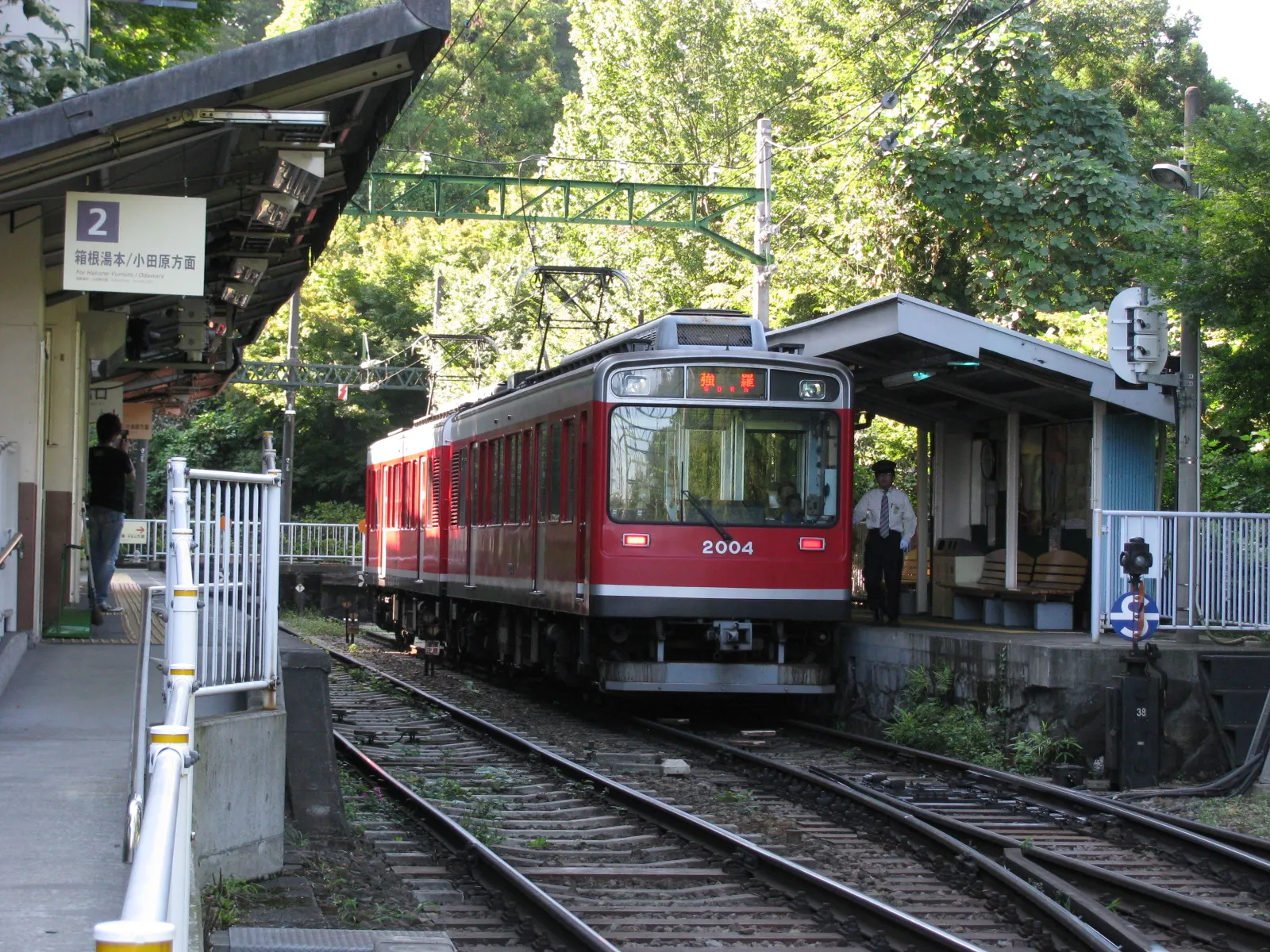
The Hakone Tozan switchback railway train ascending through the mountain forest. Photo: Aimaimyi, Wikimedia Commons, CC BY-SA 3.0.
The classic Hakone round-trip loop
To experience Hakone’s natural landscapes and cultural heritage in a single day, follow the classic circular route in a clockwise or anti-clockwise direction:
Step 1: Shinjuku to Hakone-Yumoto (Romancecar)
Board the Odakyu Romancecar limited express from Shinjuku Station around 07:30 or 08:00. The train glides southwest past the Tanzawa mountains, arriving at Hakone-Yumoto Station in 80 minutes. Hakone-Yumoto is the gateway resort town, filled with souvenir shops selling hot onsen manju sweet buns.
Step 2: Hakone-Yumoto to Gora (Hakone Tozan Railway)
Cross the platform to board the historic Hakone Tozan Railway, Japan’s oldest mountain railway. Opened in 1919, the red carriages climb 445 vertical metres over 15 kilometres, tackling extreme 80-per-mil (8%) gradients. To scale the sheer valley walls without cogs, the train executes three sequential switchbacks (degiridori), where the driver and conductor switch ends of the train. The ride to Gora Station takes roughly 40 minutes.
Step 3: Gora to Sounzan (Hakone Tozan Cable Car)
At Gora, transfer directly to the Hakone Tozan Cable Car funicular. The cable-drawn cars climb straight up the slope for 1.2 kilometres, rising 214 metres in 10 minutes past steep residential alleys to Sounzan terminus.
Step 4: Sounzan to Owakudani (Hakone Ropeway)
Transfer onto the large 18-passenger gondolas of the Hakone Ropeway. As the cable car crests the mountain ridge, the ground drops away into the dramatic, barren volcanic caldera of Owakudani (“Great Boiling Valley”). Sulphurous plumes of white steam billow from fissures in the rocky earth below.
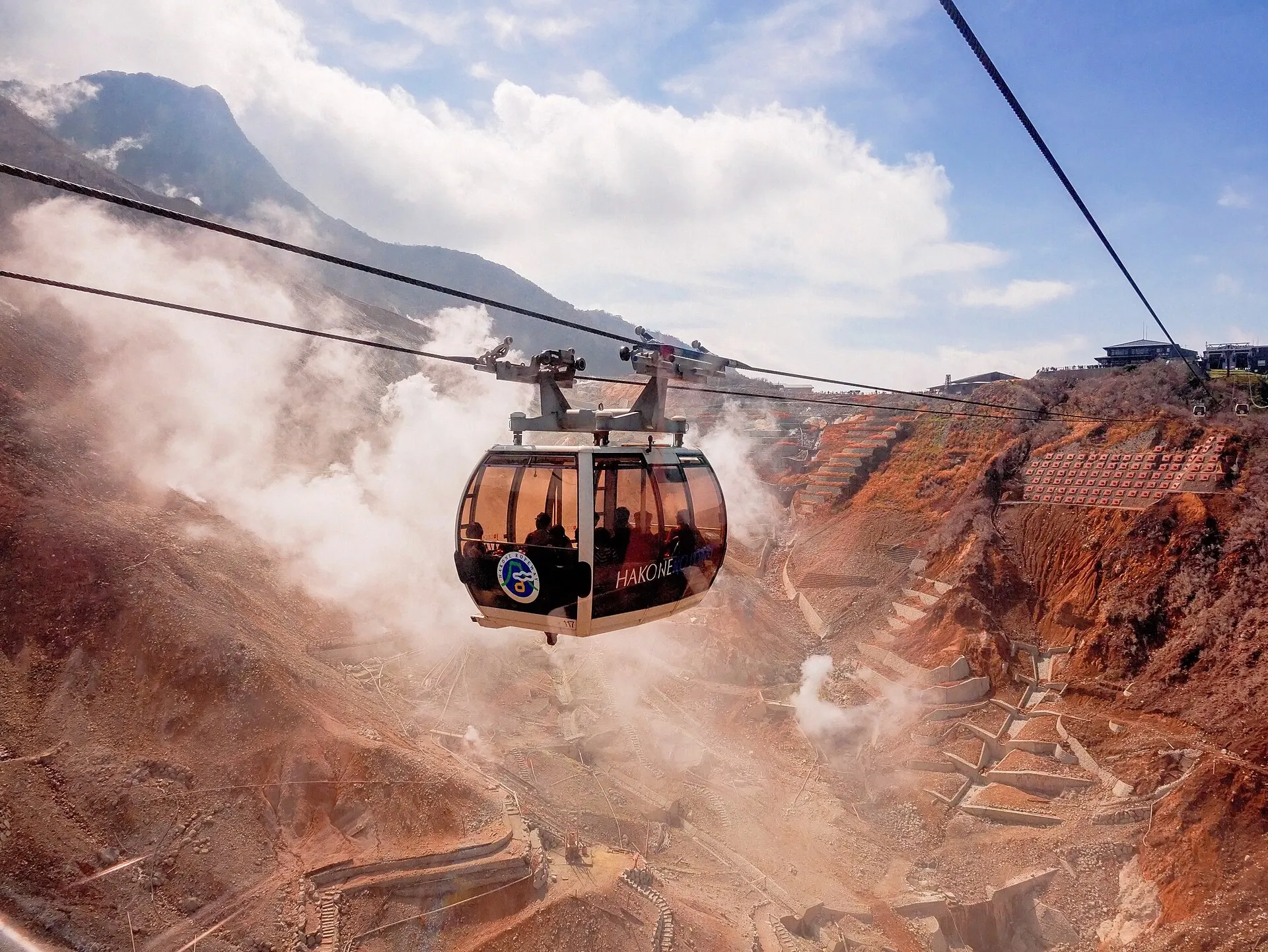
The Hakone Ropeway soaring above the steaming volcanic vents of Owakudani. Photo: TLV and more, Wikimedia Commons, CC BY 2.0.
Step 5: Exploring Owakudani
Step off at Owakudani Station (1,044 metres above sea level). The viewing terraces offer dramatic vistas of active volcanic vents and, on clear days, a commanding view of Mount Fuji to the northwest.
- The Black Eggs (Kuro-tamago): Purchase a bag of famous black eggs (¥500 for four). Fresh chicken eggs are submerged into natural geothermal pools rich in sulphur and iron; the iron adheres to the porous eggshells and reacts with hydrogen sulphide to create a pitch-black coating. According to local legend, eating one black egg adds seven years to your life.
- Health warning: Volcanic gases (hydrogen sulphide and sulphur dioxide) drift across the walking paths. Visitors with asthma, bronchitis, respiratory illness, or heart conditions should avoid prolonged outdoor exposure and stay inside the station building.
Step 6: Owakudani to Togendai (Hakone Ropeway)
Re-board the ropeway for the 15-minute descent down to Togendai Port on the northern shore of Lake Ashi (Ashinoko). On clear days, the ride provides uninterrupted views of Mount Fuji framed above the caldera waters.
Step 7: Lake Ashi Sightseeing Cruise
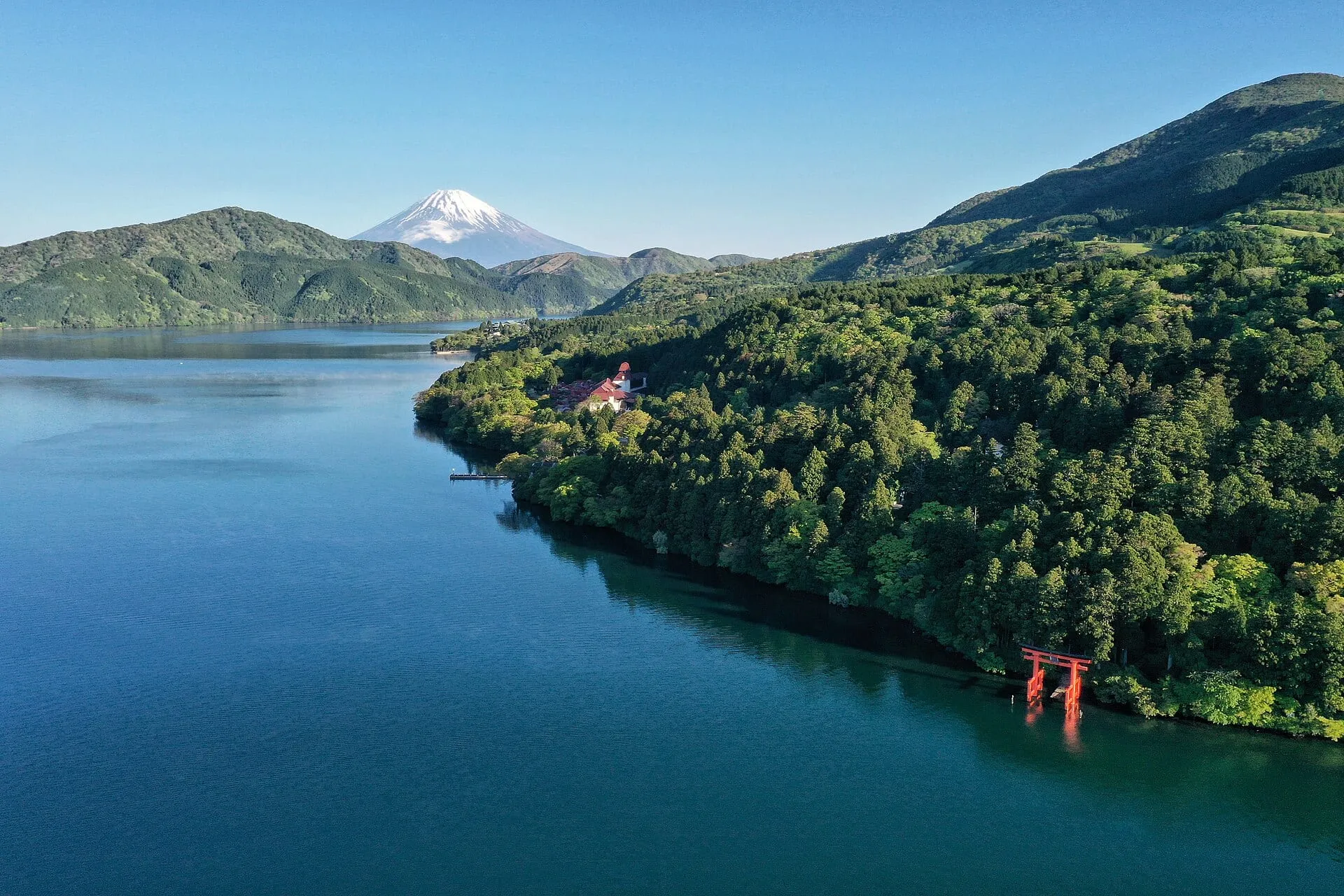
At Togendai, board the Hakone Sightseeing Cruise, operated by three ornate, multi-decked replica European pirate vessels (Queen Ashinoko, Royal II, and Victory). The 30-minute cruise glides across the deep volcanic caldera lake to Moto-Hakone Port, offering views of Mount Fuji reflected in the water and the red torii gate of Hakone Shrine rising from the shoreline.
Step 8: Hakone Shrine and the Cedar Avenue
Disembark at Moto-Hakone and walk ten minutes along the lake path through towering cryptomeria forest to Hakone Shrine (Hakone Jinja), founded in 757 AD. Descend the stone steps to the water’s edge to view the celebrated Torii of Peace (Heiwa no Torii), a vermilion gate standing directly in the lake. A short walk south leads to the Old Tokaido Highway, where a preserved 500-metre section is lined with 400-year-old cedar trees planted during the Edo shogunate.
Step 9: Return to Hakone-Yumoto and Tokyo
From Moto-Hakone bus terminal, board the Hakone Tozan Bus (Line H or Line R express). The bus descends the mountain highway through the switchbacks back to Hakone-Yumoto Station in about 35 to 40 minutes. At Hakone-Yumoto, connect to your reserved evening Romancecar back to Shinjuku.
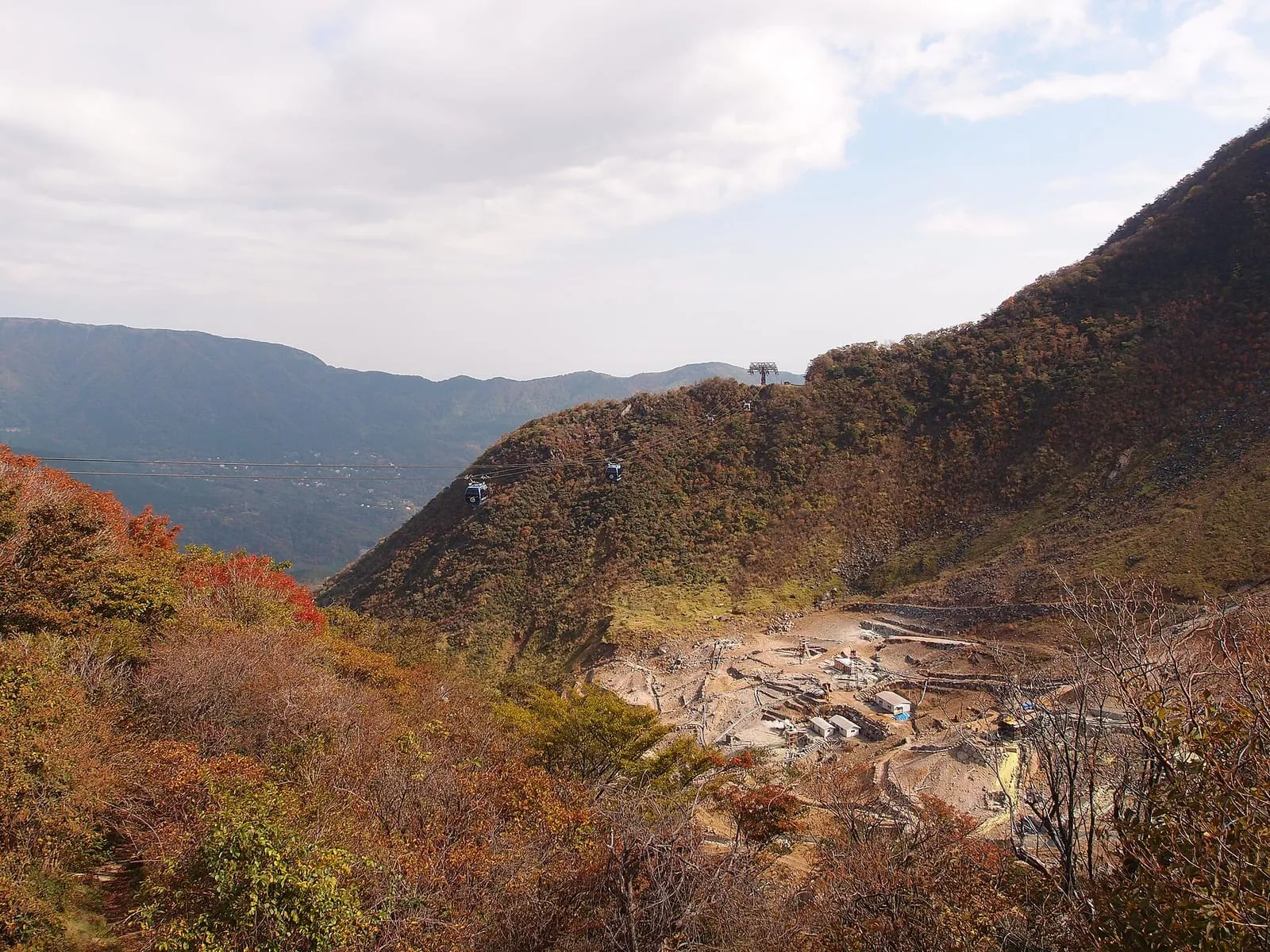
Active sulphur steam vents and mineral deposits at Owakudani. Photo: Guilhem Vellut, Wikimedia Commons, CC BY 2.0.
Hot springs and cultural museums
If you prefer art or relaxation to completing the full loop, Hakone offers acclaimed cultural facilities easily reached via Tozan buses:
- Hakone Open-Air Museum (Chokoku no Mori): Japan’s first open-air art museum, set across 70,000 square metres of landscaped mountain gardens. Features over 120 monumental sculptures by Henry Moore, Rodin, and Miro, alongside a dedicated indoor Picasso Pavilion housing over 300 ceramics and paintings, and the Symphonic Sculpture stained-glass tower.
- Pola Museum of Art: Located in Sengokuhara forest, this striking subterranean glass building houses an exceptional collection of European Impressionist masterpieces by Monet, Renoir, and Cezanne alongside modern Japanese oil paintings.
- Traditional Onsen Bathing: For day visitors seeking authentic hot springs, Tenzan Tohji-kyo in the Sukumo river valley offers outdoor stone baths (rotenburo) set amidst cedar trees (¥1,400 adult admission; note that Tenzan accepts single visitors with discreet tattoos, but restricts groups). Hakone Yuryo, accessible via free shuttle bus from Hakone-Yumoto Station, offers extensive public baths and private rental rooms.
Comparing travel options
| Option | Cost | Transport covered | Best for |
|---|---|---|---|
| Independent Freepass + Romancecar | ¥9,500 | Odakyu return + 8 local transport modes | Independent travellers wanting full control of their schedule |
| Fuji & Hakone Coach Day Tour | From ¥8,640 | Tokyo coach, Fuji 5th Station, Ropeway, Cruise | Seeing both Mount Fuji and Hakone in a single 10-hour day |
| Fuji & Hakone Tour + Shinkansen Return | From ¥18,160 | Coach out, Fuji & Hakone sights, Bullet train back | Experiencing the Shinkansen ride back to Tokyo Station |
Popular Hakone tours and packages
Booking a pass voucher or joint tour guarantees transport coordination across multiple modes:
Hakone: Train Pass with Unlimited Rides & Activity Discounts
¥7,100 · 4.4 stars from 196 reviews · 2 days
The Hakone: Train Pass with Unlimited Rides & Activity Discountsad provides the official 2-day Odakyu Hakone Freepass departing from Shinjuku. It grants complete flexibility to navigate the loop independently with digital redemption.
Tokyo: Mt Fuji Tour, Hakone Ropeway, Owakudani, Lake Ashi
From ¥8,640 · 4.6 stars from 8,581 reviews · 10 hours
The Tokyo: Mt Fuji Tour, Hakone Ropeway, Owakudani, Lake Ashiad is the most booked regional package from Tokyo. It ascends Mount Fuji’s 5th Station in the morning, drives across to Hakone for an afternoon Lake Ashi pirate boat cruise, and rides the Hakone Ropeway over Owakudani before returning to Tokyo by coach.
From Tokyo: Mt Fuji & Hakone Tour w/ Return by Bullet Train
From ¥18,160 · 4.2 stars from 1,803 reviews · 10 to 11 hours
The From Tokyo: Mt Fuji & Hakone Tour w/ Return by Bullet Trainad provides coach sightseeing through Mount Fuji and Hakone, transferring passengers to Odawara Station in the late afternoon for a high-speed Tokaido Shinkansen bullet train journey back to Tokyo Station in just 35 minutes, avoiding highway traffic jams.
Where to go next
To compare Hakone with other regional excursions, read our complete guide to day trips from Tokyo. If you prefer focusing purely on volcano viewpoints and lakes, consult our dedicated Mount Fuji day trip guide.
To explore samurai coastal shrines, see our Kamakura day trip guide. For regional rail pass evaluations and subway ticket advice, read Japan Rail Pass worth it and Tokyo public transport, and discover all essential capital bookings on the Tokyo hub.
Common questions
How do you travel from Tokyo to Hakone?
The most direct route is the Odakyu Railway from Shinjuku. The Romancecar limited express reaches Hakone-Yumoto Station in approximately 80 minutes, requiring a reserved seat surcharge of ¥1,200 each way on top of the base fare or Hakone Freepass. Standard commuter express trains take about 110 minutes with a change at Odawara.
How much is the Hakone Freepass?
The 2-day Hakone Freepass departing from Shinjuku costs ¥7,100 for adults and ¥1,600 for children (ages 6 to 11). A 3-day pass costs ¥7,500 for adults and ¥1,850 for children. It covers the discounted round-trip train journey from Shinjuku to Odawara and unlimited travel across eight distinct transport networks within the Hakone region.
Can you complete the classic Hakone loop in one day?
Yes. Departing Shinjuku by 08:00 on the Romancecar gives you sufficient time to complete the full circuit: mountain switchback train to Gora, funicular cable car to Sounzan, ropeway over Owakudani, sightseeing pirate ship across Lake Ashi to Moto-Hakone, a walk to Hakone Shrine, and a mountain bus back to Hakone-Yumoto.
What are the black eggs at Owakudani?
Known as kuro-tamago, these are regular chicken eggs boiled in the natural sulphuric mineral hot springs of the Owakudani volcanic valley. Chemical reactions turn the eggshells black while leaving the interior normal. Local folklore holds that eating one adds seven years to your life.
Does the Japan Rail Pass cover travel to Hakone?
Only partially. The JR Pass covers the Tokaido Shinkansen bullet train from Tokyo Station or Shinagawa to Odawara Station (35 minutes). From Odawara, you must purchase the Hakone Freepass from Odawara (¥6,000 for 2 days) or pay individual fares on the private Odakyu and Hakone Tozan lines.