In this guide
💡 The Short Version: Our judgement, not a ranking: pick Vienna for three to four days of Habsburg palaces (Schönbrunn at €42 for the Palace Ticket, the Hofburg), major painting collections (Klimt at the Upper Belvedere for €23, Bruegel at the Kunsthistorisches Museum for €22 online) and State Opera standing places from €13 to €18. Pick Prague for two to three days on foot in a compact medieval centre where Prague Castle’s Main circuit costs 450 CZK for two days, beer halls cost a fraction of Viennese dining rooms and almost nothing requires booking weeks ahead. On cost, Czechia sits at 74.1 against Austria’s 110.0 on Eurostat’s 2024 price level index for restaurants and hotels (EU27 = 100). With six or seven days, do both: direct ÖBB railjet and RegioJet trains connect Wien Hauptbahnhof and Praha hlavní nádraží in 4 hours. Or book a tour: the Schönbrunn Palace and gardens guided tourad is from €57 in Vienna, and the Prague Castle guided tour with entryad is from €52 in Prague (GetYourGuide).
⚠️ Vienna demands timed-slot bookings and has a disrupted airport rail link; Prague demands cashless-app discipline and Saturday planning. In Vienna, Schönbrunn Palace, the Kunsthistorisches Museum (timed slots only since 8 September 2026), the Imperial Treasury (closed Tuesdays) and the Upper Belvedere all require booked entry times, and the S-Bahn trunk line through central Vienna is closed from 7 September 2026 to the end of October 2027, turning the City Airport Train (CAT) into a bus. In Prague, the Jewish Museum (600 CZK) shuts every Saturday, the Clementinum releases e-tickets on Mondays for the following two weeks, and Austria enforces border controls on the Czech border until 15 March 2027.
Vienna and Prague side by side
Prices are each operator’s adult rate in local currency: euros (€) in Vienna and Czech koruna (CZK) in Prague. Each row links to the city’s own guide for the full operational detail.
| Vienna | Prague | |
|---|---|---|
| What to book & advance window | Schönbrunn Palace €42 Palace Ticket (€30 State Apartments), fixed slot; Kunsthistorisches Museum €22 online (€24 on site), timed slot mandatory; Imperial Treasury €16 online, timed slot; Upper Belvedere €23, timed slot; Spanish Riding School performances open 12 months ahead (€29–€245); State Opera standing €13–€18 on the day only | Prague Castle Main circuit 450 CZK (valid two days, buy at gate or online); Jewish Museum 600 CZK (five synagogues + Old Jewish Cemetery); Old Town Hall 350 CZK + 100 CZK lift (half price 09:00–10:00); Clementinum 380 CZK (e-tickets released Mondays for two weeks ahead) |
| Closed days | Tuesdays: Imperial Treasury, Leopold Museum, Natural History Museum. Mondays: Belvedere 21, Secession, Prunksaal (Oct–May except Dec 2026). Sundays: retail shops shut all year; Naschmarkt stalls shut | Saturdays: Prague Jewish Museum (synagogues and cemetery) and Jewish holidays. Mondays: several National Gallery sites. Prague Castle and Old Town Hall open daily |
| City pass verdict | Vienna City Card (€19/24h, €31/48h, €37/72h) saves only €2 to €9 over 72h and costs more over 24h; KHM (€23) and Treasury (€17) are dearer on the card than online. Vienna Pass starts at €109/day and falls short on four big sights (€107.90) | Prague Visitor Pass (2,700 CZK/48h, 3,300 CZK/72h, 3,900 CZK/120h) covers 70+ sights, transport and Airport Express, but breaks even only at ~5 expensive sights in 48h or 7 in 72h; a standard 4-sight trip costs less without it |
| Public transport | Wiener Linien: single €3.20 (80 min), 24h €9.70, 7-day €25.20 digital / €28.90 paper. No 48h or 72h tickets since 1 Jan 2026. U-Bahn runs all night Fri/Sat. Validate before boarding | DPP: no tap-in bank card on metro/tram; buy in PID Lítačka app or machines. 90 min 46 CZK app (50 CZK paper), 24h 140 CZK, 72h 340 CZK (includes Petřín funicular, reopened 22 Sep 2026). Metro stops around midnight |
| Airport to centre | Vienna Airport (VIE): ÖBB railjet/IC 15 min or REX 7 20 min to Hauptbahnhof for €5.50; CAT runs as a bus to Wien Mitte (21 min, €14.90) until 31 Oct 2027; Airport Bus €11; Taxi 40100 fixed €42 | Václav Havel Airport (PRG): Trolleybus 59 + metro A takes ~35 min on one 90-min ticket (46–50 CZK); Airport Express bus to main station is 200 CZK |
| Tourist tax & entry rules | Ortstaxe is 5% of room rate (excl. VAT/breakfast) to 30 June 2027, rising to 8% from 1 July 2027. Schengen 90/180; EES running in full since 10 Apr 2026; ETIAS not yet required; border checks with Czechia to 15 Mar 2027 | Flat 50 CZK per person per night; under-18s exempt. Schengen 90/180; EES running in full since 10 Apr 2026; ETIAS not yet required; carry passport on cross-border trains |
| Price level & currency | Euro (€). Eurostat 2024 restaurants & hotels index: 110.0 (EU27 = 100) | Czech koruna (CZK). Eurostat 2024 restaurants & hotels index: 74.1 (EU27 = 100) |
| How many days | 3 to 4 days; see 3 days in Vienna | 2 to 3 days; see 3 days in Prague and Prague in one day |
| Best day trips | Bratislava (56 min train), Wachau Valley (~1 hr to Melk), Salzburg (2h 25m), Budapest (2h 24m–2h 58m), Hallstatt | Kutná Hora (51–56 min train), Karlštejn Castle, Český Krumlov, Terezín, Dresden |
| Best season & weather | May and September (highs 20.7–21.1 °C); July warmest at 26.4 °C; May wettest at 78.9 mm; Christmas markets from 6 Nov 2026 (most shut 23 Dec) | May, June and September (highs 24.4–26.5 °C Jun–Aug); June wettest at 68.6 mm; Christmas markets 28 Nov 2026 to 6 Jan 2027 |
December divides the two cities cleanly on dates. Vienna’s earliest Christmas markets open on 6 November 2026 (Schönbrunn and Stephansplatz) and 13 November (Rathausplatz, Spittelberg, Am Hof), but six central markets close on 23 December, leaving only Schönbrunn and the Prater running through to 6 January 2027. Prague’s main Christmas markets on Old Town Square and Wenceslas Square open later, on 28 November 2026, and stay open daily until 6 January 2027. Both cities get roughly 8 hours of daylight in mid-December.
Entry rules: Both Austria and Czechia sit inside the Schengen Area (90 days in any 180-day period for visa-exempt visitors); the EU Entry/Exit System (EES) has been running in full since 10 April 2026, while ETIAS is not yet required and has no confirmed start date. See the entry tables on the Vienna and Prague hubs.
Book a tour instead
A guided tour bundles the entry slot and local commentary into one purchase; day trips add return transport. Prices below are GetYourGuide’s lowest “from” rates for one adult in euros.
| City | From | Tour |
|---|---|---|
| Vienna | €57 | Schönbrunn Palace and gardens guided tourad ( from ), 2 hours, palace admission included |
| Vienna | €24 | Vienna city-centre highlights walking tourad ( from ), 2 hours |
| Vienna | €65 | Naschmarkt food tasting tourad ( from ), 2½ hours |
| Vienna | €135 | Bratislava and Budapest full-day guided tripad ( from ), 13 hours, small group |
| Prague | €52 | Prague Castle tour with local guide and entry ticketad ( from ), 2½ hours |
| Prague | €66 | Jewish Quarter walking tour with admissionad ( from ), 2½ hours |
| Prague | €72 | Kutná Hora day trip with the Bone Chapelad ( from ), return train and timed ossuary entry |
| Prague | €18 | 50-minute Vltava evening river cruisead ( from ) |
For independent visits, official tickets always beat guided bundles on price: Schönbrunn’s Palace Ticket is €42 direct at imperialtickets.com, Prague Castle’s Main circuit is 450 CZK at the gate, and the Jewish Museum in Prague is 600 CZK.
Which city for whom
Each verdict below is grounded in the prices, opening hours and logistics in the table.
A first visit: Prague for ease on foot, Vienna for grand museums and palaces
Pick Prague if you want a straightforward first European city break with minimal pre-trip administration. The Prague Castle hilltop complex (St Vitus Cathedral, Old Royal Palace, Golden Lane, 450 CZK valid for two days), Charles Bridge, Old Town Square and the Jewish Quarter all link together on foot along the Royal Route walk. You can arrive on a Thursday evening without a single pre-booked museum slot and still enter every major sight except the Clementinum.
Pick Vienna if you are willing to schedule timed slots in advance for a heavier cultural programme. The Habsburg sights are split across four separate ticket sellers — Schönbrunn (€42), the Sisi Museum (€15, reopening with its new route on 19 November 2026), the Imperial Treasury (€16) and the Spanish Riding School — and the Ringstrasse and Schönbrunn sit well apart, requiring the U-Bahn or trams. The reward is a depth of imperial interiors and Old Master galleries that Prague does not match.
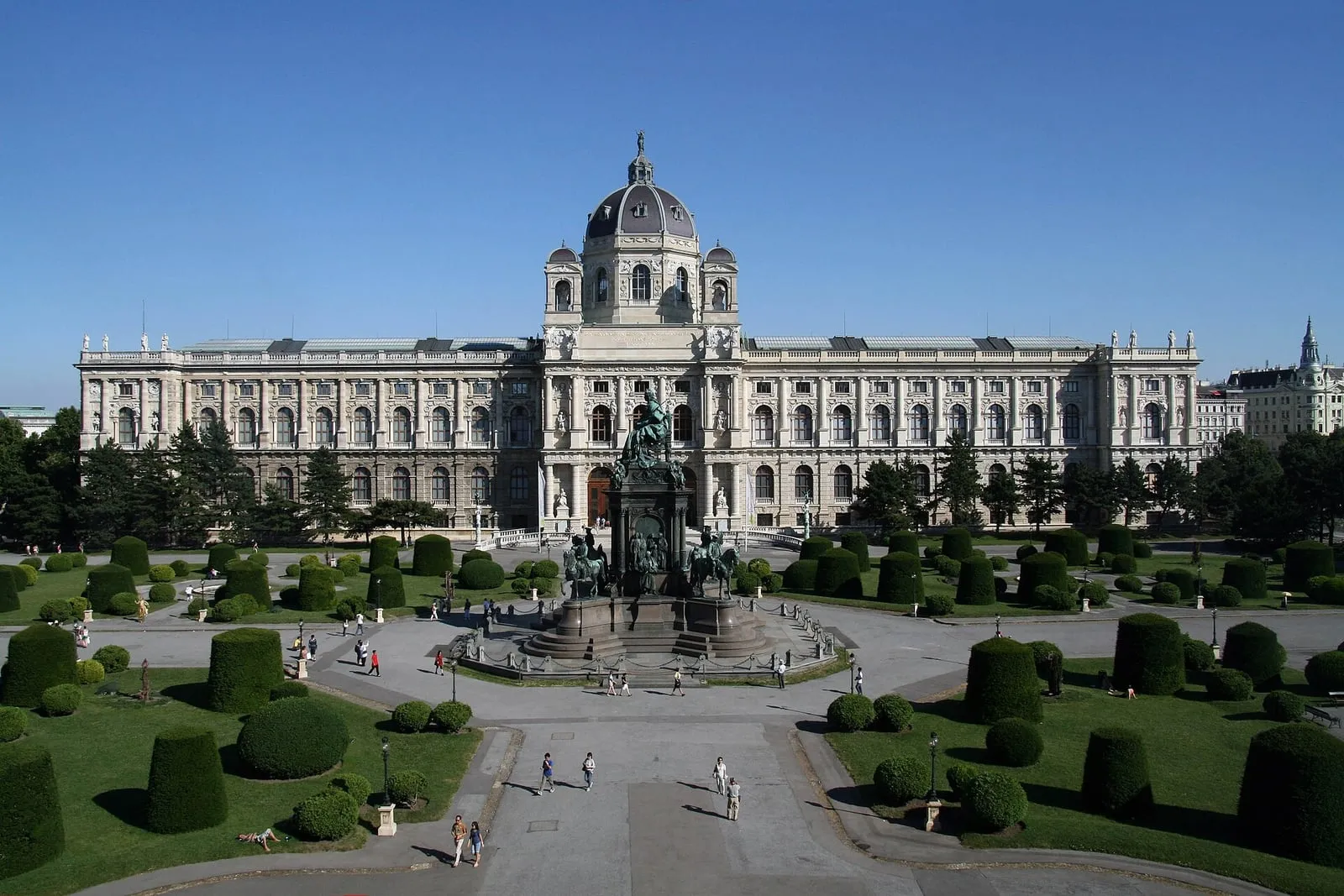
The Kunsthistorisches Museum on Maria-Theresien-Platz, Vienna. Photo: Manfred Werner - Tsui, Wikimedia Commons, CC BY-SA 3.0.
A long weekend (2 to 3 days): Prague
Prague fits a Friday-to-Sunday stay more cleanly than Vienna. First, airport-to-centre transfer is fast and cheap (35 minutes by Trolleybus 59 and metro A on a 46–50 CZK ticket). Second, Vienna shuts its retail shops every Sunday, its Naschmarkt stalls every Sunday, and limits St Stephen’s Cathedral sightseeing on Sunday mornings until 13:00. In Prague, the only weekend closure trap is the Jewish Museum on Saturday; put the Jewish Quarter on Friday or Sunday, and Castle Hill and Old Town on Saturday, and nothing is lost.
Food and drink: Vienna for fine dining and coffee houses, Prague for beer halls and value
Vienna wins at the top end and for café culture; Prague wins for casual pubs, beer and everyday value. Vienna holds 17 Michelin-starred restaurants — including two three-star houses, Steirereck im Stadtpark and Amador — alongside heritage schnitzel dining rooms (Figlmüller, Meissl & Schadn, Plachutta) and UNESCO-listed Viennese coffee houses plus hillside Heurigen wine taverns (where to eat in Vienna). Expect a Melange coffee at Café Sacher to run €7.50 and starred dinner deposits up to €100 per person.
Prague is built around tank-poured Pilsner, roast pork knuckle, svíčková and traditional Czech pubs (where to eat in Prague). Beer culture is formalised at the Pilsner Urquell Experience (579 CZK at the door, 521 CZK on GetYourGuide) and in beer spas (from 1,932 CZK). Note that Prague banned organised night pub crawls in October 2024, so groups plan their own pub route rather than joining a street-touted crawl.
Sights and culture: Vienna for art and music, Prague for medieval streetscapes
Vienna is the stronger museum and concert city. Between the Kunsthistorisches Museum (Bruegel, Rubens, Vermeer), the Upper Belvedere (Klimt’s The Kiss), the Albertina, the Leopold Museum and the Vienna State Opera (435 standing places sold on the day for €13 to €18), art and music lovers can fill four full days indoors. Under-19s enter Vienna’s major federal museums free of charge.
Prague delivers unbroken Gothic, Renaissance and Baroque streetscapes across Staré Město and Malá Strana, plus the Charles Bridge towers (250 CZK single, 340 CZK combined) and classical concerts in church halls and Lobkowicz Palace. Its paid interiors are smaller in scale than Vienna’s, which leaves more of the day for walking viewpoints such as Petřín Hill and Vyšehrad (free grounds all year).
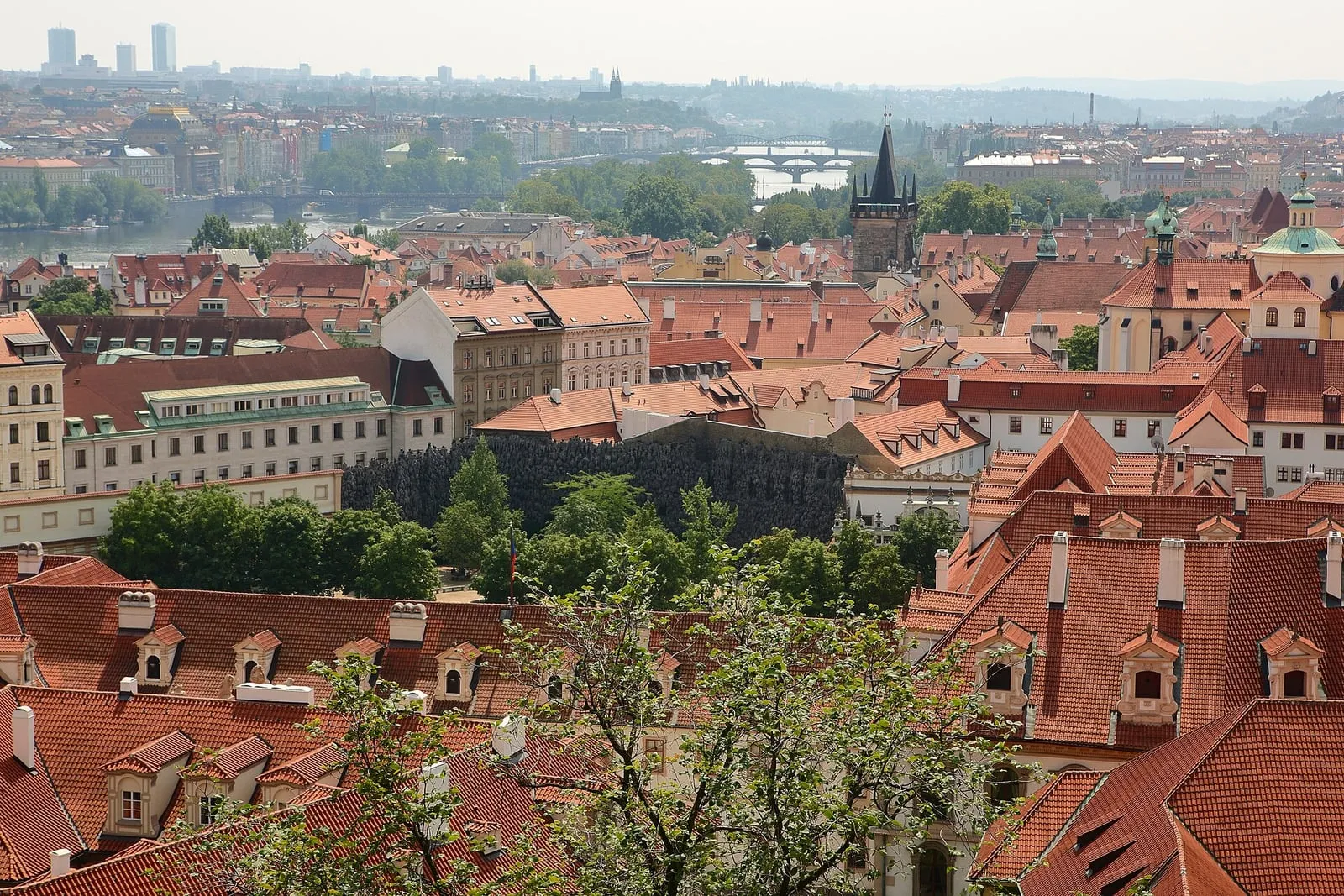
Malá Strana rooftops and the Vltava bridges seen from Prague Castle. Photo: Stefan Wloch, Wikimedia Commons, CC BY-SA 2.0.
A tight budget: Prague by a wide margin
Prague, decisively. Eurostat’s 2024 price level index for restaurants and hotels puts Czechia at 74.1 versus Austria’s 110.0 — a 36-point gap that shows up on every line of a trip budget. Look at the fixed visitor costs in each city’s local currency:
- Airport transfer: 46–50 CZK on Prague’s Trolleybus 59 + metro A versus €5.50 on Vienna’s REX 7 train or €14.90 on the CAT bus.
- Public transport: 140 CZK for 24 hours and 340 CZK for 72 hours in Prague versus €9.70 for 24 hours and €25.20 (7-day digital, as 48h/72h tickets no longer exist) in Vienna.
- Tourist tax: a flat 50 CZK per night in Prague versus 5% of the room price in Vienna (rising to 8% on 1 July 2027).
- Three flagship entries: Prague Castle Main circuit (450 CZK) + Old Town Hall (350 CZK) + Jewish Museum (600 CZK) total 1,400 CZK, whereas Schönbrunn Palace Ticket (€42) + Kunsthistorisches Museum (€22 online) + Upper Belvedere (€23) total €87.
Families and couples: Vienna for families with teens and opera couples, Prague for younger children and twilight walks
For families with teenagers, Vienna narrows the budget gap because under-19s enter the Kunsthistorisches Museum, Belvedere, Albertina, Natural History Museum and Imperial Treasury free, under-15s ride Wiener Linien free on Sundays and Vienna school holidays, and the Prater amusement park and Riesenrad (€14.50–€17) add outdoor space. For families with children under 10, Prague is easier to pace on foot, with the reopened Petřín funicular (free with a 24h/72h pass) and Mirror Maze (family ticket 500 CZK).
For couples, choose Vienna for an evening at the State Opera or Musikverein followed by a traditional coffee house or winter ball (Vienna ball season); choose Prague for twilight walks across Charles Bridge, Vltava river cruises (from €18 on GetYourGuide) and candlelit Malá Strana cellars.
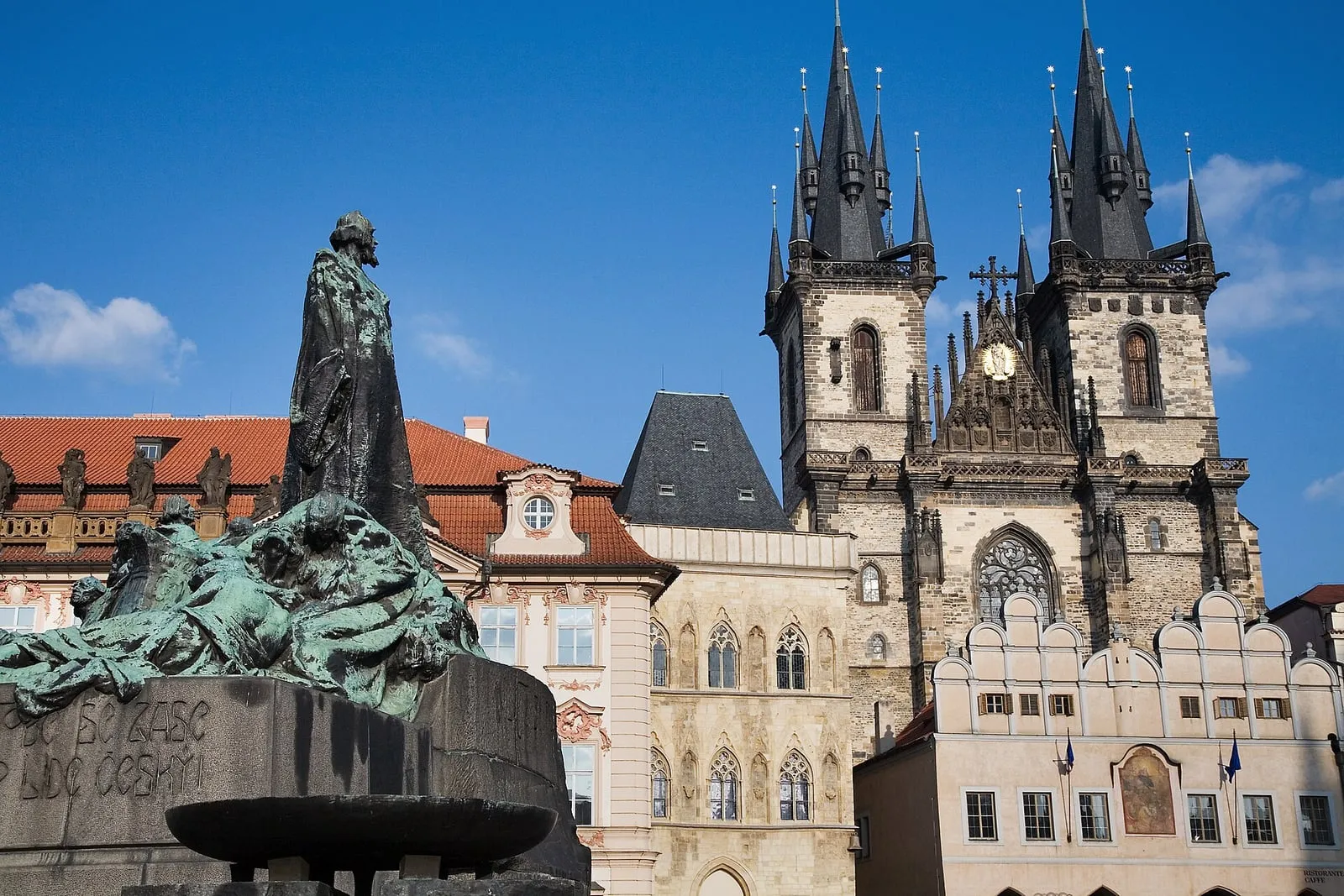
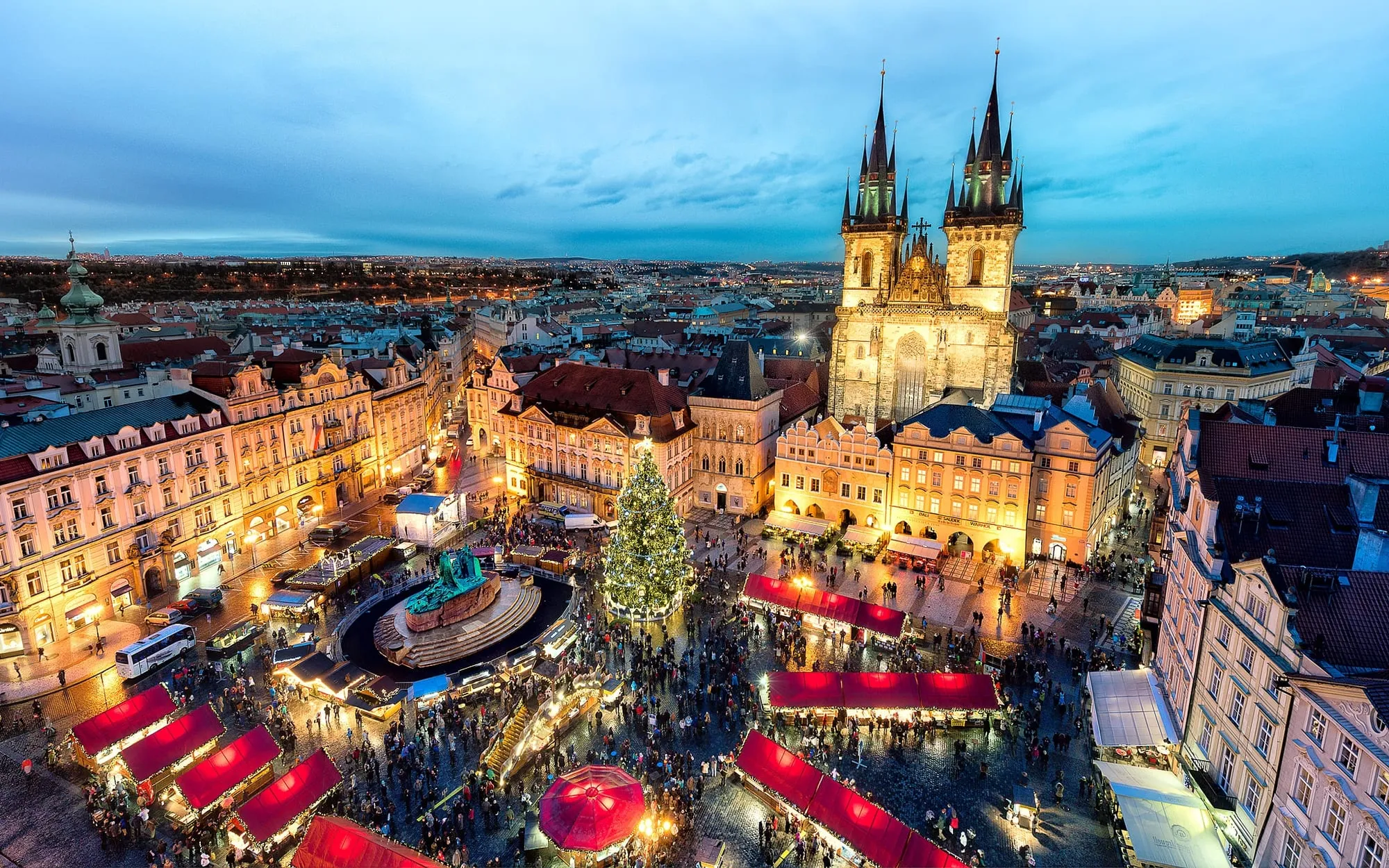
Old Town Square and Týn Church, Prague. Photo: Jorge Royan, Wikimedia Commons, CC BY-SA 3.0.
Doing both: the train, the order and where to stay
Combining Vienna and Prague in a single 6- or 7-day trip is straightforward by rail, and flying open-jaw (into Prague, out of Vienna, or the reverse) saves four hours of backtracking.
| Operator | Route | Journey time | Frequency | Advance fares |
|---|---|---|---|---|
| ÖBB railjet / ČD | Wien Hauptbahnhof ↔ Praha hlavní nádraží | About 4 hours | Every 2 hours | From ~€15–€20 (Sparschiene / Včasná jízdenka) |
| RegioJet | Wien Hauptbahnhof ↔ Praha hlavní nádraží | About 4 hours 5 minutes | 4 trains daily | From ~€15–€20 |
Book at oebb.at, cd.cz or regiojet.com several weeks ahead; walk-up flexible fares climb steeply. Because Austria maintains border controls on the Czech border until 15 March 2027, keep your passport (or EU national ID card) handy on the train rather than buried in overhead luggage.
Which order: Prague first (2 to 3 days), then Vienna (3 to 4 days). Prague’s compact streets and low-booking rhythm make an easy landing after a flight, and travelling south into Vienna on a Tuesday lets you bypass Vienna’s Tuesday museum closures (Imperial Treasury, Leopold, Natural History) while still arriving in time for an evening walk on the Ringstrasse or a Wednesday–Friday museum run.
Where to stay: in Prague, base yourself in the Old Town (Staré Město) or Malá Strana so every major sight is walkable (where to stay in Prague, hotels near Old Town Square). In Vienna, stay in the Innere Stadt inside the Ring for walking access to St Stephen’s Cathedral, the Hofburg and the Opera (where to stay in Vienna, hotels near St Stephen’s Cathedral), or near Wien Hauptbahnhof on the U1 if you want a five-minute walk to your morning train to Prague.
For full booking tables, see Vienna and Prague. Comparing other Central European pairings? Read Vienna vs Budapest, Prague vs Budapest, Bratislava vs Vienna and where to go each month.
Common questions
Is Vienna or Prague better for a first visit to Central Europe?
Pick Prague for two or three days on foot with minimal advance booking, because Prague Castle, Charles Bridge, the Old Town Hall and the Jewish Quarter sit close together and only the Clementinum requires an advance slot. Pick Vienna for three or four days built around imperial palaces, major painting collections and classical music, where Schönbrunn, the Kunsthistorisches Museum, the Imperial Treasury and the Upper Belvedere all require timed slots.
How much cheaper is Prague than Vienna?
Substantially cheaper on accommodation, food and transport. Eurostat's 2024 price level index for restaurants and hotels (EU27 = 100) puts Czechia at 74.1 against Austria at 110.0, a gap of roughly a third. A 24-hour transport ticket is 140 CZK in Prague against €9.70 in Vienna, and Prague's tourist tax is a flat 50 CZK per person per night against Vienna's 5% of the room price (rising to 8% on 1 July 2027).
How long is the train from Vienna to Prague?
Direct ÖBB railjet and Czech Railways (ČD) trains run every two hours from Wien Hauptbahnhof to Praha hlavní nádraží in about 4 hours, and RegioJet runs direct trains in about 4 hours 5 minutes. Advance fares on ÖBB Sparschiene and RegioJet start around €15 to €20 each way when booked weeks ahead.
Which days are sights closed in Vienna and Prague?
In Vienna, Tuesdays shut the Imperial Treasury, the Leopold Museum and the Natural History Museum, while Mondays shut Belvedere 21, the Secession and the Prunksaal (October to May, except December 2026). In Prague, Saturdays shut the Jewish Museum synagogues and Old Jewish Cemetery, and Mondays shut several National Gallery buildings; Prague Castle opens daily.
How many days do you need in Vienna and in Prague?
Three days in Vienna and two to three days in Prague. With six or seven days, combine both by direct train and fly into one airport and out of the other to avoid doubling back.
Do I need a passport on the train between Vienna and Prague?
Yes. Austria operates internal border controls on its Czech land border until 15 March 2027, so carry a valid passport (or national ID card for EU citizens) on every cross-border train or coach.