In this guide
💡 The Short Version: Our judgement, not a ranking: pick Rome for three to four days of monumental scale—the Colosseum, Roman Forum, Vatican Museums and Borghese Gallery—backed by cheap metro rides (€1.50, capped at €8.50/day) and neighbourhood trattorias. Pick Venice for two to three days in a car-free lagoon city anchored by St Mark’s Basilica, the Doge’s Palace, the Grand Canal and Murano and Burano, accepting higher hotel rates and €9.50 single vaporetto fares (€25 for 24 hours). Headline entries cost almost the same, so water transport and island dining separate the bills. With six or seven nights, do both: the direct Frecciarossa links Roma Termini and Venezia Santa Lucia in 3 hours 51 to 3 hours 56 minutes. Or book a tour: in Rome, the Colosseum, Forum and Palatine tourad is from €49 and the Vatican Museums and Sistine Chapel tourad from €64; in Venice, the Doge’s Palace, New Prisons and Basilica tourad is from €42 and the Murano, Burano and Torcello boat tourad from €25.
⚠️ Named timed slots and bag bans catch unprepared visitors in both cities. In Rome, Colosseum tickets open 30 days ahead in your name (photo ID checked at the gate), the Vatican Museums close on Sundays (apart from the last Sunday of the month) and enforce a strict shoulder-and-knee dress code, and the Borghese Gallery admits nobody without a booking and shuts on Mondays. In Venice, St Mark’s Basilica sells named timed slots from 90 days ahead, opens only at 14:00 on Sundays, and refuses all wheeled suitcases and bags over 40 × 30 × 20 cm; the Doge’s Palace is €5 cheaper when booked 30+ days ahead (€30 instead of €35).
Rome and Venice side by side
All entry fares are operators’ adult rates in euros. Each link leads to the dedicated guide on this site.
| Rome | Venice | |
|---|---|---|
| What to book & advance window | Colosseum, Forum and Palatine 30 days ahead (€18 named ticket + ID; €24 underground/arena); Vatican Museums €25 online; Borghese Gallery €16 + €2 fee (compulsory booking); Pantheon €7 (named slot); Castel Sant’Angelo €18; Trevi Fountain basin €2 | St Mark’s Basilica 90 days ahead (€10 basic named slot, €20 with Pala d’Oro or Museum, €30 all three); Campanile €15; Doge’s Palace €35 (€30 online 30+ days ahead; Secret Itineraries €40); Accademia €20; Peggy Guggenheim €17 |
| Closed days | Sunday: Vatican Museums (except last Sunday of month, free 09:00–14:00). Monday: Borghese Gallery, Castel Sant’Angelo, House of Augustus, Ostia Antica. 25 Dec & 1 Jan: Colosseum, Borghese, Pompeii | Monday: Accademia, Ca’ Pesaro, Palazzo Mocenigo, Rialto fish market, Biennale. Tuesday: Peggy Guggenheim, Ca’ Rezzonico, Palazzo Grassi, Fortuny. Saturday: Jewish Ghetto. Sunday: Basilica opens 14:00; free churches shut |
| City pass verdict | Roma Pass €38 (48h), €62.90 (72h). Breaks even at roughly four paid sights over three days, but excludes the Vatican Museums and Pantheon | Venice Museum Pass €50 (12 civic museums, 6 months). Covers Doge’s Palace (€35), breaks even with Ca’ Rezzonico (€15), wins on a third museum—but excludes St Mark’s Basilica, Campanile, Accademia and Peggy Guggenheim |
| Public transport | BIT single €1.50 (100 mins, one metro ride); 24h €8.50; 48h €15; 72h €22. Tap&Go contactless bank card capped at €8.50/day | ACTV vaporetto single €9.50 (75 mins); 24h €25, 48h €35, 72h €45, 7 days €65 (contactless accepted; excludes Alilaguna). Gondola fixed €90/boat by day (€110 night) for up to 5 |
| Airport to centre | Fiumicino: Leonardo Express €14 (32 mins to Termini); FL1 regional €8 to Trastevere/Ostiense; fixed taxi €55. Ciampino: Airlink €2.70; fixed taxi €40 | Marco Polo: ATVO coach €12 single / €20 return (~20 mins to Piazzale Roma); ACTV Aerobus €10; Alilaguna boat €18; fixed land taxi €40 to Piazzale Roma. Treviso: ATVO €14 (~40 mins) |
| Tourist tax | Per adult/night (up to 10 nights): €6 at 3-star, €7.50 at 4-star, €10 at 5-star, €3.50 at hostels | Historic centre per person/night (up to 5 nights; under-10s exempt, 10–16 half): €3.50 at 3-star, €4.50 at 4-star, €5 at 5-star (30% less in Mestre). Separate from day-tripper access fee |
| Price level & fixed costs | Better everyday value. Three flagship entries total €61 (Colosseum €18, Vatican Museums €25, Borghese Gallery €18), city transit caps at €8.50/day, and trattoria dining stays competitive | Higher room rates and water transit. Three flagship entries total €60 (St Mark’s Basilica €10, Campanile €15, Doge’s Palace €35, or €55 booking Doge’s Palace 30+ days ahead), and 3-star tourist tax is €2.50/night lower, but vaporetto passes cost €25/day |
| How many days | 3 to 4 days (3 days in Rome, Rome in one or two days) | 2 to 3 days (3 days in Venice, Venice in one or two days) |
| Best day trips | Pompeii (1h 13m to Naples + local train), Florence (1h 36m), Ostia Antica (26 mins), Orvieto (€10.10 train), Tivoli, Amalfi Coast | Murano, Burano and Torcello (€25 vaporetto day pass), Padua (26–28 mins from €5), Verona (1h 12m), Prosecco Hills, Dolomites |
| Best season & weather | May, June & September (highs 23–27°C); Jul–Aug 30–31°C; Oct–Nov wettest; Colosseum last admission drops to 15:30 in winter | April to June & September to October (highs 17.6–26.4°C); Jul–Aug 28.6–29°C with no acqua alta; Oct–Mar brings high-water tides (MOSE raised 49 times in 2025–26) |
In winter, Rome stays milder and avoids lagoon fog and high water (acqua alta in Venice), though Venice’s Carnival (23 January to 9 February 2027) draws huge winter crowds and triples room rates. In summer, both cities run hot and busy; Venice’s lagoon breeze trims 2°C off Rome’s peak afternoons, while Rome’s rooftop pool hotels give relief after midday ruins.
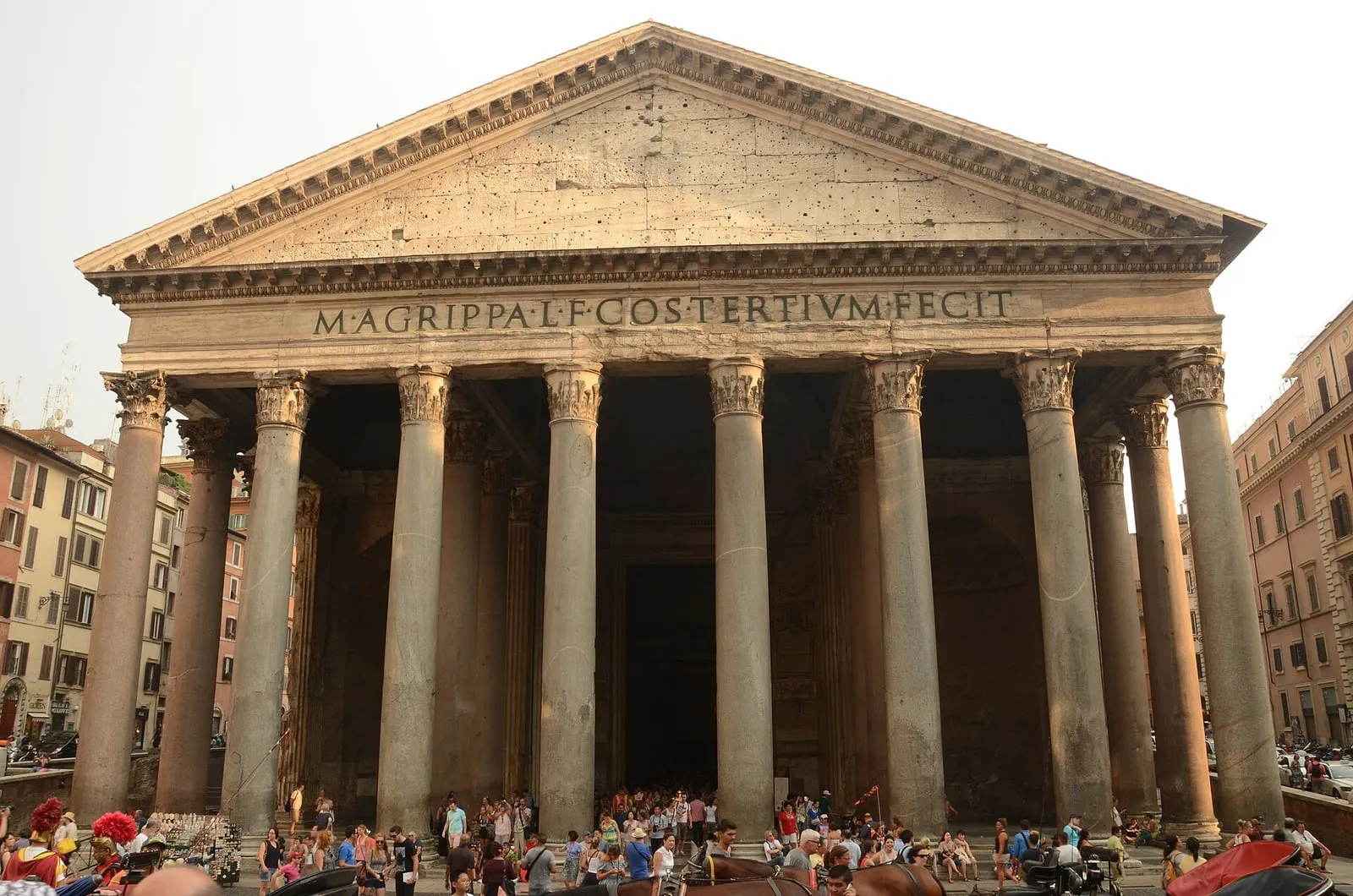
The Pantheon overlooking Piazza della Rotonda in central Rome. Photo: Steven Lek, Wikimedia Commons, CC BY-SA 4.0.
Book a tour instead
Guided tours bundle timed entry with an expert guide—especially handy for the Colosseum, Vatican Museums and Doge’s Palace—or handle full-day coaches to Pompeii and the Dolomites. Prices are GetYourGuide’s lowest adult “from” fares in euros.
| City | From | Tour |
|---|---|---|
| Rome | €49 | Colosseum, Roman Forum and Palatine Hill guided tourad ( from ) with entry |
| Rome | €64 | Vatican Museums, Sistine Chapel and Basilica tourad ( from ) with entry |
| Rome | €44 | Trastevere and Campo de’ Fiori street-food walkad ( from ) |
| Rome | €68 | Pompeii and Vesuvius coach day trip from Romead ( from ) |
| Venice | €42 | Doge’s Palace, New Prisons and St Mark’s Basilica guided tourad ( from ) with entry |
| Venice | €25 | Murano, Burano and Torcello half-day boat tourad ( from ) |
| Venice | €24 | Venice city highlights walking tour with a local guidead ( from ), 2 hours |
| Venice | €125 | Dolomites and Lake Braies day trip from Venicead ( from ), 9 hours |
If you prefer exploring without a guide and official slots are available, buy direct: €18 for the Colosseum, €25 for the Vatican Museums, €10 for St Mark’s Basilica and €30 for the Doge’s Palace (booked 30+ days ahead).
Which city for whom
Each pick below is grounded in the ticket rules, transit fares and pacing of each city.
A first visit: Rome for four days or more, Venice for two or three
Rome is the deeper anchor for a first Italian trip of four days or longer: the Colosseum and Forum, the Vatican Museums and St Peter’s, and the Borghese Gallery each justify a dedicated day, leaving room for Ostia Antica or Pompeii. Choose Venice if you only have two or three days and want an unmistakable setting removed from modern traffic—walking from Santa Lucia through Cannaregio to the Rialto and San Marco, plus an afternoon out on the lagoon.
A long weekend (2 to 3 days): Venice
Venice fits a two- or three-night break more comfortably than Rome. The Marco Polo ATVO coach takes 20 minutes to Piazzale Roma, the island is compact enough to cross on foot in 45 minutes, and St Mark’s Basilica, the Doge’s Palace, the Rialto and Murano/Burano slot cleanly into Venice in one or two days or 3 days in Venice. In Rome, squeezing the Colosseum, Vatican and historic centre into 48 hours leaves little breathing space, and a Sunday stay cuts out the Vatican Museums altogether.
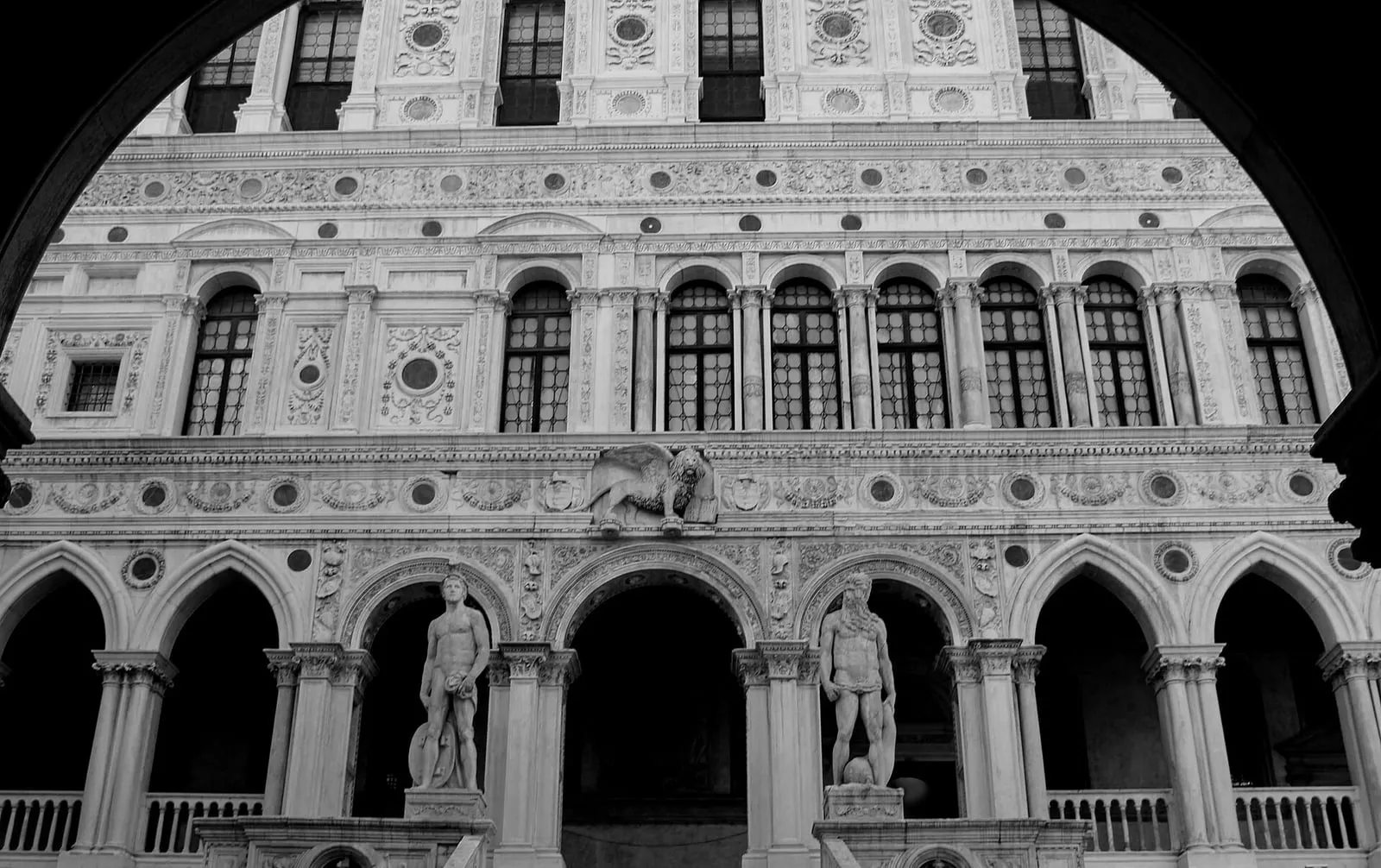
The inner courtyard of the Doge’s Palace in Venice. Photo: GattoCeliaco, Wikimedia Commons, CC BY-SA 4.0.
Food and drink: Rome by a clear margin
Rome. Rome is a large working capital with a fierce neighbourhood trattoria culture: Flavio al Velavevodetto, Armando al Pantheon, Hosteria Grappolo d’Oro, Salumeria Roscioli and Da Enzo al 29 anchor the Rome food guide, and pizza al taglio, supplì and espresso bars keep lunch under €10. Venice excels at small plates and prosecco in standing-room cicchetti and bacari—a spritz and three cicchetti in Cannaregio or San Polo make an economical lunch—but sit-down seafood dinners are pricier and Venice has zero Michelin Bib Gourmands (where to eat in Venice, Venice food tours).
Art, history and sights: Rome for breadth, Venice for intact atmosphere
Rome spans 2,700 years in one city—imperial ruins, early Christian basilicas, Renaissance frescoes in the Sistine Chapel and Baroque sculptures by Bernini at the Borghese Gallery and Piazza Navona (Rome’s historic centre walk). Venice is narrower in era but visually unified: Byzantine mosaics at St Mark’s, Gothic palazzi lining the Grand Canal, Venetian Renaissance canvases by Titian, Veronese and Tintoretto (at the Accademia, Frari and San Rocco), and modern art at the Peggy Guggenheim and Venice Biennale.
A tight budget: Rome
Rome. Although headline tickets match and Venice’s 3-star tourist tax is lower (€3.50 vs €6), Rome wins on every recurring daily cost: €1.50 metro/bus rides capped at €8.50/day against €9.50 single vaporetto tickets (€25 for 24 hours), a €2.70 airport transfer from Ciampino (or €8 FL1 train from Fiumicino) against €10–€18 from Marco Polo, far more mid-range hotel stock, and cheaper sit-down meals. To keep Venice affordable, stay in Mestre (30% lower tourist tax, 10–13 minutes by train to Santa Lucia), walk instead of riding the vaporetto and visit the free former Chorus churches Monday to Saturday (free things to do in Venice).
Families and couples: Rome for families, Venice for couples
For families, Rome is easier with young children and pushchairs—no 400+ stepped canal bridges to carry a stroller over, open ruins at the Forum and Palatine where kids can roam, and easy pizza-by-the-slice stops. For couples, Venice wins once evening settles: stay inside the historic centre so you experience San Marco, Dorsoduro and the Grand Canal after the day-trippers depart (best city breaks for couples).
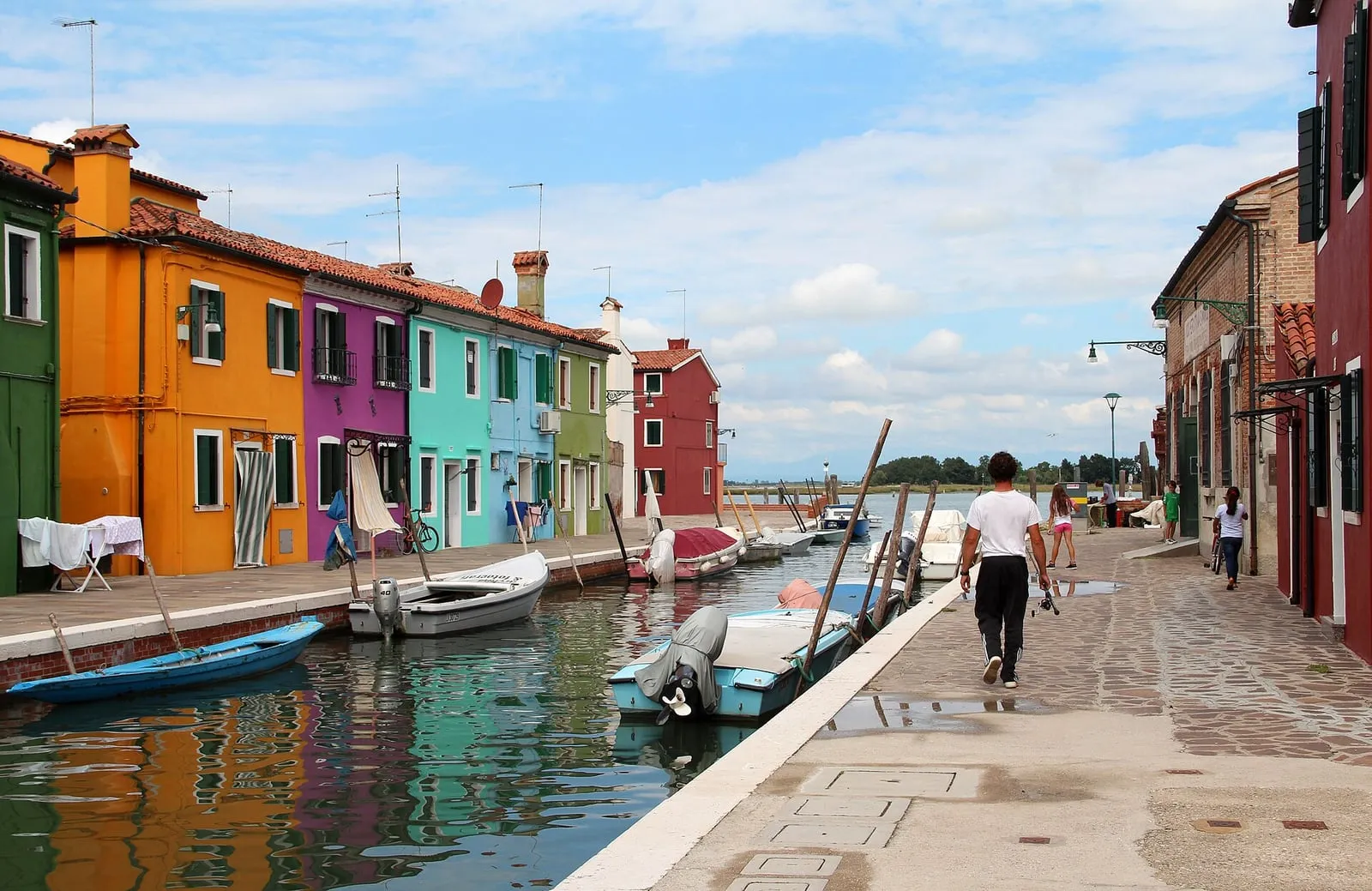
Painted houses along a canal on Burano. Photo: Jean-Pol GRANDMONT, Wikimedia Commons, CC BY 4.0.
Doing both: the train, order and where to stay
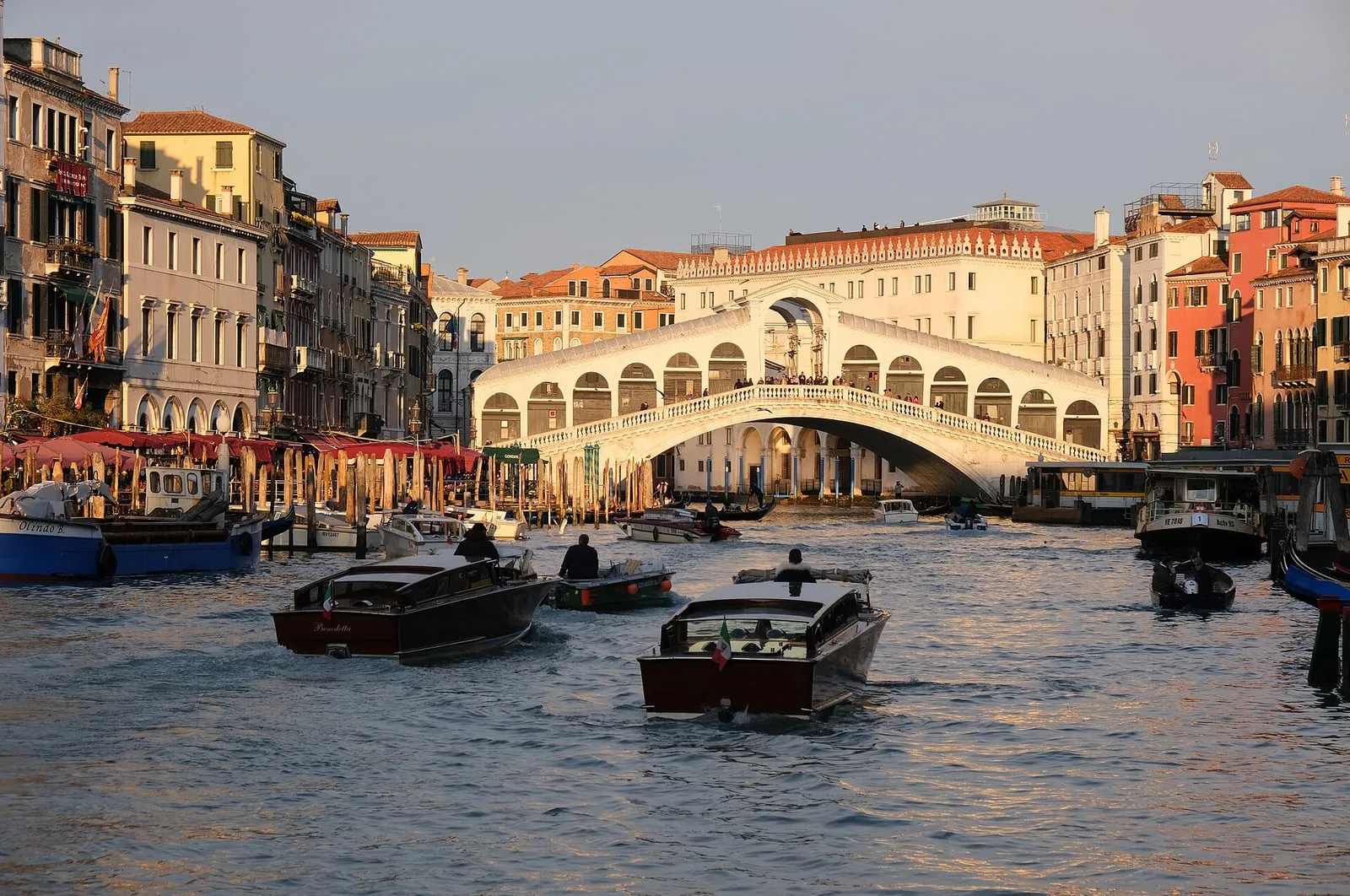
Direct Trenitalia Frecciarossa (and Italo) high-speed trains connect Roma Termini and Venezia Santa Lucia in 3 hours 51 minutes to 3 hours 56 minutes, running roughly hourly throughout the day via Florence and Bologna. Even though the rail leg is nearly four hours, it still beats flying once you factor in Fiumicino/Marco Polo transfers and security—and you arrive directly on the Grand Canal.
- Which city first: Start in Venice for two or three nights and ride south to Rome for three or four nights, flying home from Fiumicino (which has far more long-haul and European frequencies than Marco Polo). If you have eight or nine nights, break the rail journey with two nights in Florence halfway (Rome vs Florence, Venice vs Florence).
- Best transfer day: Ride the train on a Sunday or Monday. Moving from Venice to Rome on a Sunday morning avoids St Mark’s Basilica’s 14:00 Sunday opening and Rome’s Sunday Vatican Museums closure (leaving Monday morning clear for the Vatican in Rome). Moving on a Monday skips Rome’s Borghese Gallery and Venice’s Accademia closures.
- How many nights: Allow 6 to 7 nights minimum (four in Rome, two or three in Venice).
Where to stay: In Rome, choose Centro Storico or Monti to walk to the Colosseum, Prati for early Vatican slots (hotels near the Vatican), or near Termini for direct access to the Venice Frecciarossa and airport trains (where to stay in Rome, hotels near Termini). In Venice, stay in San Marco or Castello for St Mark’s Square, or Cannaregio (closest to Santa Lucia station, with fewer bridges to cross with luggage) and Dorsoduro (where to stay in Venice, hotels near St Mark’s Square).
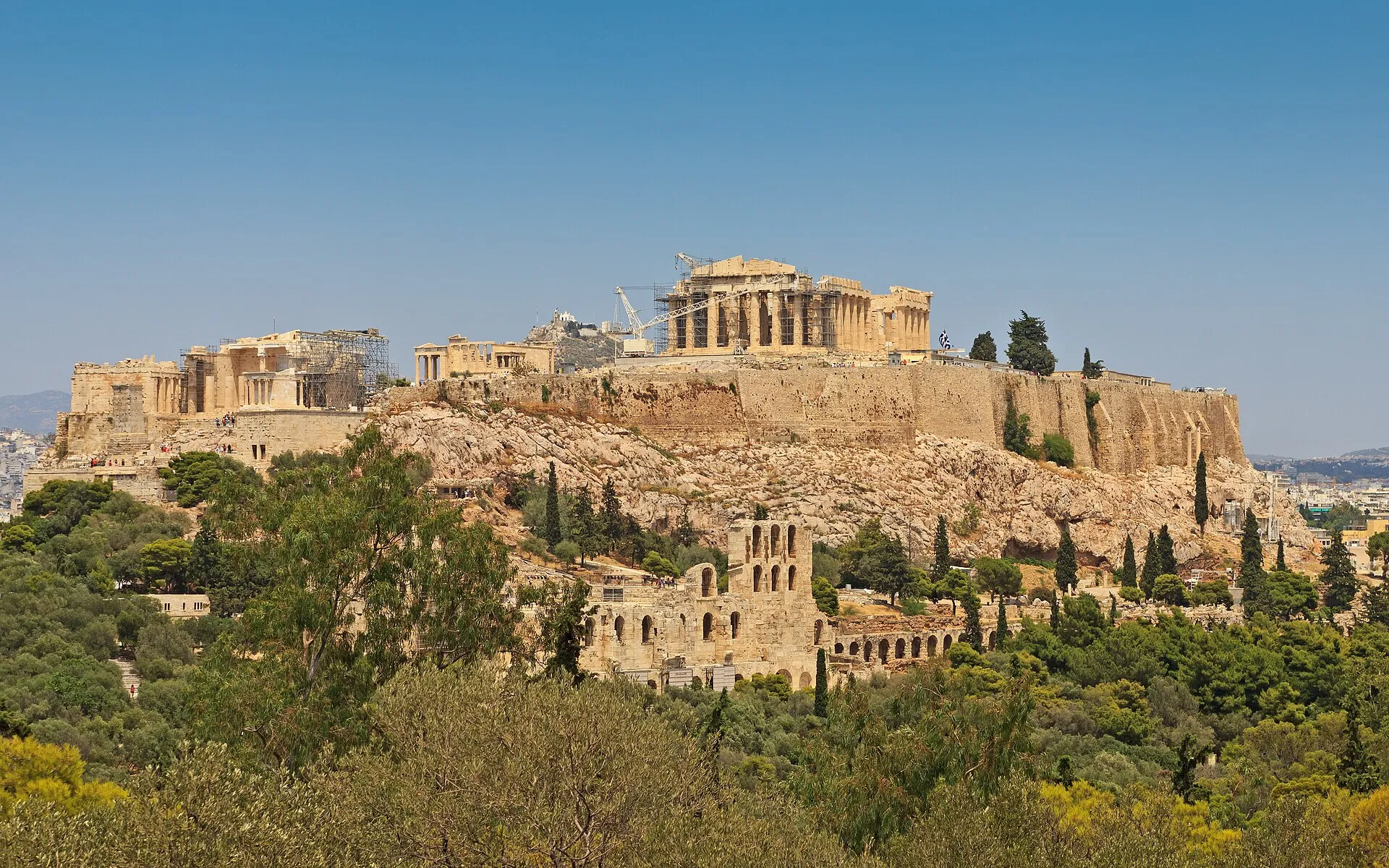
For full ticket calendars and closures, see Rome and Venice; for a classical Mediterranean comparison instead of two Italian cities, see Athens vs Rome.
Common questions
Is Rome or Venice better for a first trip to Italy?
Pick Rome if you have four days or more and want classical ruins, the Vatican and a living capital with cheaper everyday dining. Pick Venice if you have two or three days and want a car-free lagoon city where the architecture, canals and outer islands are the headline experience.
Is Rome or Venice more expensive?
Venice is more expensive day to day. Headline museum entries are almost identical and Venice's 3-star tourist tax is lower (€3.50 vs €6), but Venice's vaporetto is €9.50 a ride (€25 for 24 hours) against Rome's €1.50 BIT ticket (€8.50 daily cap), and central Venice hotels and restaurants carry a steep island premium.
How long is the train between Rome and Venice?
Direct Trenitalia Frecciarossa trains run from Roma Termini to Venezia Santa Lucia in 3 hours 51 minutes to 3 hours 56 minutes, passing through Florence and Bologna. Flying rarely saves door-to-door time once airport transfers are added.
Which closed days catch visitors out in Rome and Venice?
In Rome, Sundays shut the Vatican Museums (except the last Sunday of the month, which is free and crowded) and Mondays shut the Borghese Gallery, Castel Sant'Angelo and Ostia Antica. In Venice, Mondays shut the Accademia and Ca' Pesaro, Tuesdays shut the Peggy Guggenheim Collection and Ca' Rezzonico, Saturdays shut the Jewish Ghetto, and Sundays delay St Mark's Basilica until 14:00.
Can you do Rome and Venice in one week?
Yes: allow four nights in Rome and two or three nights in Venice, linked by the 3 hour 55 minute Frecciarossa. Fly into one city and out of the other on an open-jaw ticket so you do not spend another four hours backtracking.
Do overnight visitors pay the Venice access fee?
No. Overnight guests staying inside Venice's municipality are exempt from the access fee (though they must register their exemption and pay the hotel tourist tax of €1 to €5 per night). The 2027 access fee applies to day-trippers over 14 on 72 listed dates between 26 March and 15 August.