In this guide
💡 The Short Version: Our judgement, not a ranking: pick Venice for two to three days of car-free canals, St Mark’s Basilica, the Doge’s Palace and lagoon islands (Murano, Burano and Torcello), where wandering the backstreets costs nothing once you step off the €9.50 vaporetto. Pick Florence for two to three days of concentrated Renaissance art—Michelangelo’s David at the Accademia, Botticelli at the Uffizi and Brunelleschi’s dome—plus easy regional trains to Pisa and Siena and a €2.00 airport tram. Florence costs more in headline museum tickets, while Venice costs more in water transport (€25 per 24h vaporetto pass vs €0 on foot in Florence). With five or six nights, do both: the direct Frecciarossa links Venezia Santa Lucia and Firenze Santa Maria Novella in 2 hours 13 minutes. Or book a tour: in Venice, the Doge’s Palace, New Prisons and Basilica tourad is from €42 and the Murano, Burano and Torcello boat tourad from €25; in Florence, the Uffizi Gallery small-group tourad is from €67 and the Pisa, Siena and San Gimignano day tripad from €49.
⚠️ Plan around opposite closed days and strict bag/ID rules. In Florence, Mondays close the Uffizi, Accademia, Palazzo Pitti, Bargello and Medici Chapels, and the dome admits visitors only at a booked slot with photo ID. In Venice, the Doge’s Palace opens daily, but Mondays close the Gallerie dell’Accademia and Ca’ Pesaro, Tuesdays close the Peggy Guggenheim Collection and Ca’ Rezzonico, Sundays push St Mark’s Basilica opening back to 14:00, and bags over 40 × 30 × 20 cm or any wheeled case are refused at the Basilica. Also note that Venice’s Ca’ d’Oro is closed for restoration until spring 2027 and the T Fondaco dei Tedeschi rooftop terrace is closed.
Venice and Florence side by side
All entry fares are operators’ adult rates in euros. Each link leads to the detailed guide on this site.
| Venice | Florence | |
|---|---|---|
| What to book & advance window | St Mark’s Basilica 90 days ahead (€10 basic named slot, €20 with Pala d’Oro or Museum, €30 all three); Campanile €15; Doge’s Palace €35 (€30 online 30+ days ahead; Secret Itineraries €40); Accademia €20; Peggy Guggenheim €17 | Accademia (David) €20 + €4 booking fee; Uffizi €29 booked / €25 on the day (Afternoon from 16:00: €20 booked / €16 on the day); Duomo dome €30 Brunelleschi Pass (booked slot + photo ID); Palazzo Vecchio €19 booked; Vasari Corridor €47 with Uffizi |
| Closed days | Monday: Accademia, Ca’ Pesaro, Palazzo Mocenigo, Rialto fish market, Biennale. Tuesday: Peggy Guggenheim, Ca’ Rezzonico, Palazzo Grassi, Fortuny. Saturday: Jewish Ghetto. Sunday: Basilica opens 14:00, free churches shut | Monday: Uffizi, Accademia, Palazzo Pitti, Bargello, Medici Chapels (Boboli shuts first and last Monday). Thursday: Palazzo Vecchio & Arnolfo Tower close 14:00. Sunday: Cathedral shut; dome opens 12:45 |
| City pass verdict | Venice Museum Pass €50 (12 civic museums, 6 months). Covers Doge’s Palace (€35) and Correr, ties with Ca’ Rezzonico (€15), wins on a third civic museum—but excludes St Mark’s Basilica, Campanile, Accademia and Peggy Guggenheim | Firenze Card €85 for 72 consecutive hours. Excludes the Duomo complex, loses €13 on Uffizi + Accademia + Palazzo Vecchio (€72 separately), and pays back only on a dense three-day museum schedule (saves €58.50 on heavy use); avoid starting on a Friday |
| Public transport | ACTV vaporetto single €9.50 (75 mins); 24h €25, 48h €35, 72h €45, 7 days €65 (contactless tap works; excludes Alilaguna). Gondola fixed at €90/boat by day (€110 night) for up to 5; traghetto €2 | Bus/tram single €2.00 (90 mins); 10 journeys €18.20; no 24-hour ticket. Historic centre is flat and compact—most visitors walk everywhere |
| Airport to centre | Marco Polo: ATVO coach €12 single / €20 return (~20 mins to Piazzale Roma); ACTV Aerobus €10; Alilaguna boat €18; fixed land taxi €40 to Piazzale Roma. Treviso: ATVO €14 (~40 mins) | Florence Airport: T2 tram €2.00 (~20 mins to Santa Maria Novella, every 5 mins); fixed taxi €28 (€32 night). Pisa Airport: PisaMover + train from €16.30 (1h 8m–1h 46m) |
| Tourist tax | Historic centre per person/night (up to 5 nights; under-10s exempt, 10–16 half; Jan 30% less): €3.50 at 3-star, €4.50 at 4-star, €5 at 5-star (30% less in Mestre). Separate from day-tripper access fee | Per person/night (up to 7 nights; under-12s exempt): €6 at 3-star, €7 at 4-star, €8 at 5-star, €4 at hostels |
| Price level & fixed costs | Higher on hotels and water transit. Three flagship entries total €60 (St Mark’s Basilica €10, Campanile €15, Doge’s Palace €35, or €55 booking Doge’s Palace 30+ days ahead), and former Chorus churches are free Mon–Sat, while a 24h vaporetto pass costs €25 | Higher on museum tickets (€83 for Accademia €24, Uffizi €29 booked and Brunelleschi Pass €30) and 3-star tourist tax (€6 vs €3.50), but €0 urban transit on foot and a €2.00 airport tram keep recurring costs lower |
| How many days | 2 to 3 days (3 days in Venice, Venice in one or two days) | 2 to 3 days (3 days in Florence, Florence in one or two days) |
| Best day trips | Murano, Burano and Torcello (€25 vaporetto day pass), Padua (26–28 mins from €5), Verona (1h 12m), Prosecco Hills, Dolomites | Pisa (51 mins from €9.80), Siena (1h 28m), San Gimignano, Chianti wine country, Cinque Terre, Bologna (37 mins) |
| Best season & weather | April to June & September to October (highs 17.6–26.4°C); Jul–Aug 28.6–29°C with no acqua alta; Oct–Mar is acqua alta season (MOSE barrier raised 49 times in 2025–26). Architecture Biennale runs 8 May–21 Nov 2027 | April to May & September to October (highs 20–25°C); Jul–Aug hot and airless in the Arno basin (32°C average); November wettest (118 mm) |
Venice’s calendar has major event spikes to check before booking hotels: Carnival runs 23 January to 9 February 2027, the Festa del Redentore falls on 17 July 2027, and the Architecture Biennale runs 8 May to 21 November 2027 (Venice Biennale 2027). Florence stays steadier across spring and autumn, with its Santa Croce Christmas market running 14 November to 20 December 2026.
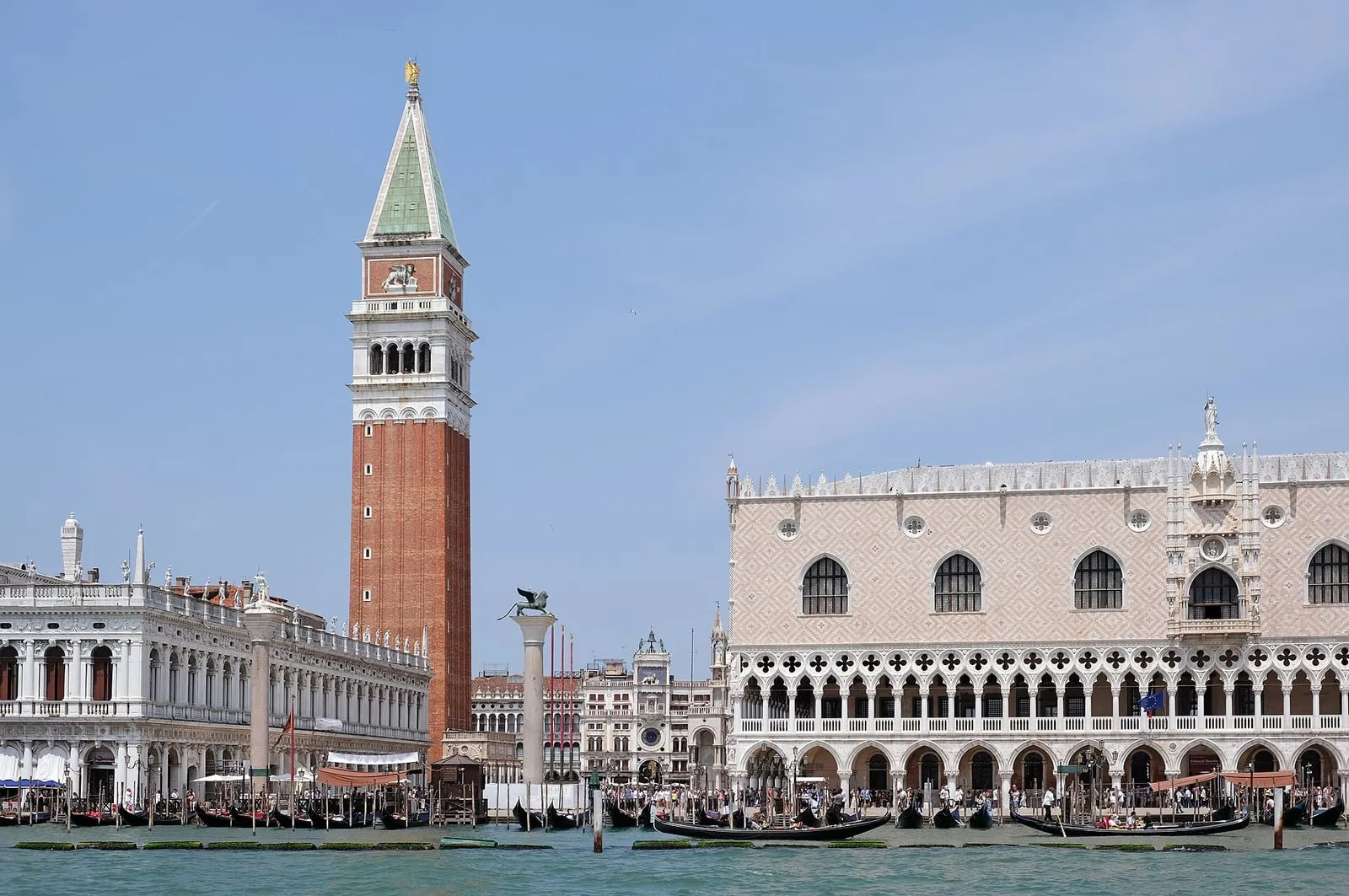
The Campanile, Piazzetta San Marco and the Doge’s Palace from the lagoon. Photo: kallerna, Wikimedia Commons, CC BY-SA 4.0.
Book a tour instead
Guided tours bundle skip-the-line entry with commentary, or handle multi-stop logistics where trains do not reach (the Dolomites, Prosecco Hills and Chianti). Prices are GetYourGuide’s lowest adult “from” fares in euros.
| City | From | Tour |
|---|---|---|
| Venice | €42 | Doge’s Palace, New Prisons and St Mark’s Basilica guided tourad ( from ) with entry |
| Venice | €25 | Murano, Burano and Torcello half-day boat tourad ( from ) |
| Venice | €24 | Venice city highlights walking tour with a local guidead ( from ), 2 hours |
| Venice | €125 | Dolomites and Lake Braies day trip from Venicead ( from ), 9 hours |
| Florence | €67 | Uffizi Gallery small-group guided tourad ( from ) with entry, 1½ hours |
| Florence | €21 | Florence highlights walking tourad ( from ), 1½ hours (no museum ticket) |
| Florence | €49 | Pisa, Siena and San Gimignano day trip with lunchad ( from ), 12 hours |
| Florence | €50 | Chianti half-day wine tour from Florencead ( from ), 5–6½ hours |
Buying direct is cheaper whenever official slots remain: St Mark’s Basilica is €10, the Doge’s Palace €30 (30+ days ahead), the Accademia €24 and the Uffizi €29 (or €16 on the day from 16:00).
Which city for whom
Each verdict below is backed by the figures in the comparison table.
A first visit: Florence for art and Tuscany, Venice for urban spectacle
Pick Florence if you want a classic Italian art-and-food trip where major Renaissance works sit ten minutes apart on foot and you can bolt on Pisa or Siena by direct regional train. Pick Venice if seeing a city built entirely on water—riding vaporetto Line 1 down the Grand Canal, crossing the Rialto at dawn and taking Line 12 out to Burano—matters more to you than standing in portrait galleries.
A long weekend (2 to 3 days): Venice if travelling Friday to Monday, Florence for Friday to Sunday
Check your exact days of the week. On a Friday-to-Sunday weekend, Florence runs smoothly: you avoid Monday’s sweeping state-museum shutdown, step off the €2.00 T2 tram in 20 minutes and walk between the Duomo, Accademia and Uffizi without buying a transport pass. If your break includes a Monday, Venice is easier to schedule: the Doge’s Palace, St Mark’s Basilica, Correr Museum, Peggy Guggenheim Collection, Ca’ Rezzonico, Frari and San Rocco are all open on Mondays.
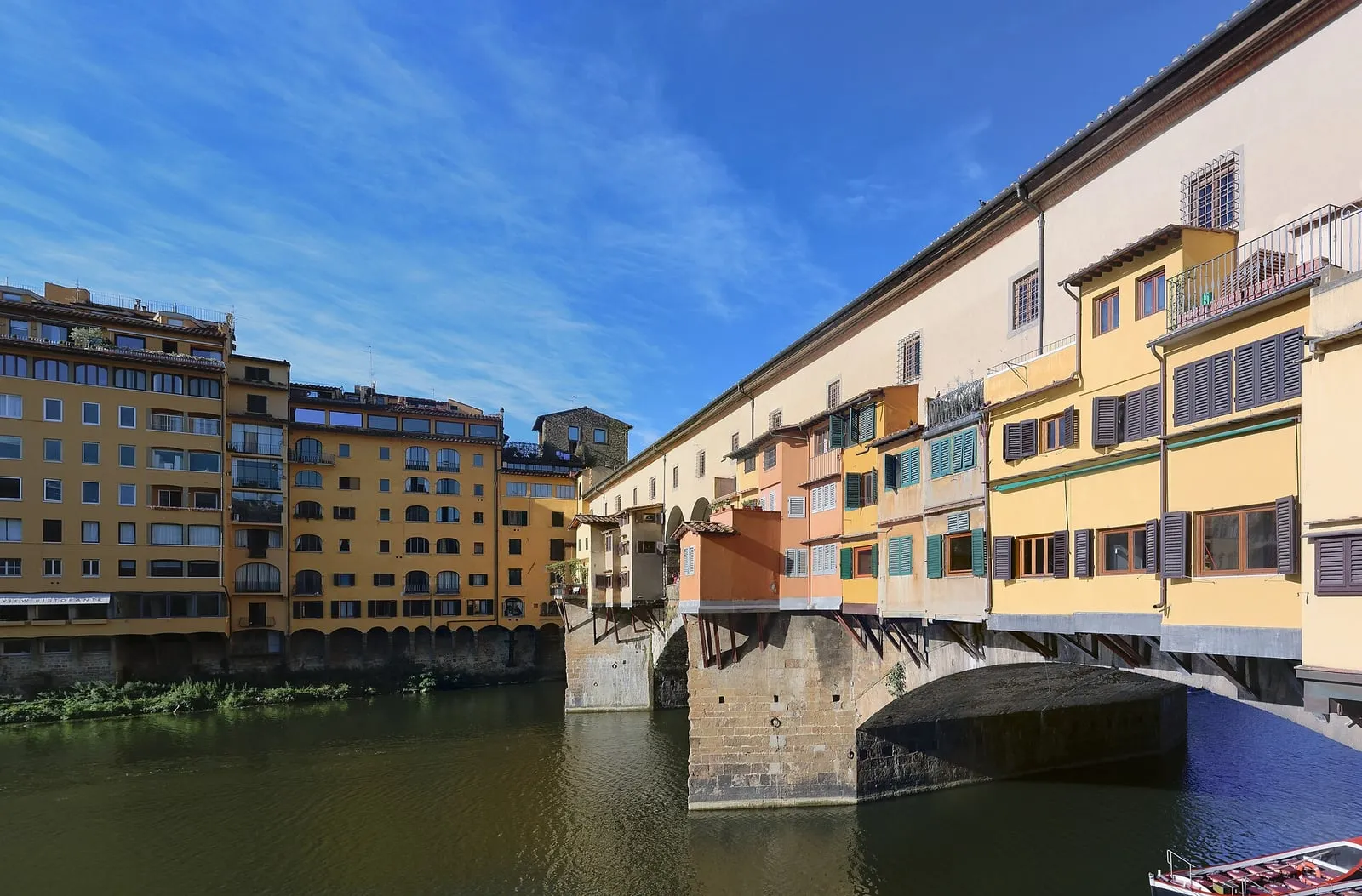
Ponte Vecchio spanning the Arno in central Florence. Photo: Ingo Mehling, Wikimedia Commons, CC BY-SA 4.0.
Food and drink: Florence wins on trattorias and value
Florence. Florence holds a three-Michelin-star dining room (Enoteca Pinchiorri) plus five Michelin Bib Gourmand trattorias—Trattoria Cibrèo, L’Ortone, Il Latini, Zeb and Da Burde—alongside affordable lampredotto and schiacciata counters (where to eat in Florence, Florence street food, bistecca alla fiorentina). Venice has fine dining (Glam Enrico Bartolini and Oro hold two Michelin stars) and its distinctive standing-room cicchetti and bacari wine bars, especially in Cannaregio and near the Rialto, but Michelin lists zero Bib Gourmands in Venice and sit-down restaurants around San Marco charge steep mark-ups for uneven cooking (where to eat in Venice).
Art, history and sights: Florence for sculpture and Renaissance painting, Venice for Byzantine and Venetian masters
Florence carries the heavier single-city art roster—Michelangelo’s David, Botticelli, Leonardo, Raphael, Fra Angelico, the Medici Chapels and Brunelleschi’s engineering—concentrated in a square kilometre (Florence’s museums). Venice answers with Byzantine gold mosaics in St Mark’s Basilica, Tintoretto’s vast cycle at the Scuola Grande di San Rocco (€12, no pass accepted), Titian at the Frari (€8), the Gallerie dell’Accademia (€20) and 20th-century art at the Peggy Guggenheim Collection (€17), plus the former Chorus churches that are free Monday to Saturday (Venice churches).
A tight budget: Florence, unless you walk everywhere in Venice
Florence is easier to keep under budget on a two- or three-day stay. Although Florence’s top three tickets and 3-star tourist tax (€6 vs €3.50) are higher, Florence eliminates transport spending completely—€2.00 on the T2 tram from the airport and €0 inside the centre—and offers cheaper everyday dining. In Venice, adding a 48-hour vaporetto pass (€35), the ATVO airport coach (€20 return) and higher island hotel rates quickly overtakes Florence’s ticket gap unless you stay in Mestre (10–13 minutes by train from Santa Lucia, with 30% lower tourist tax) and walk the island on foot.
Families and couples: Florence for families, Venice for couples
For families, Florence is far easier with pushchairs—flat streets, fewer stairs than Venice’s hundreds of stepped canal bridges, no risk of small children wandering near unguarded water edges, and plenty of gelato stops. For couples, Venice edges ahead after 18:00, when day-trippers leave, the back canals of Dorsoduro and Cannaregio empty out, and evening bacari crawls or a dusk vaporetto down the Grand Canal create a calmer atmosphere.
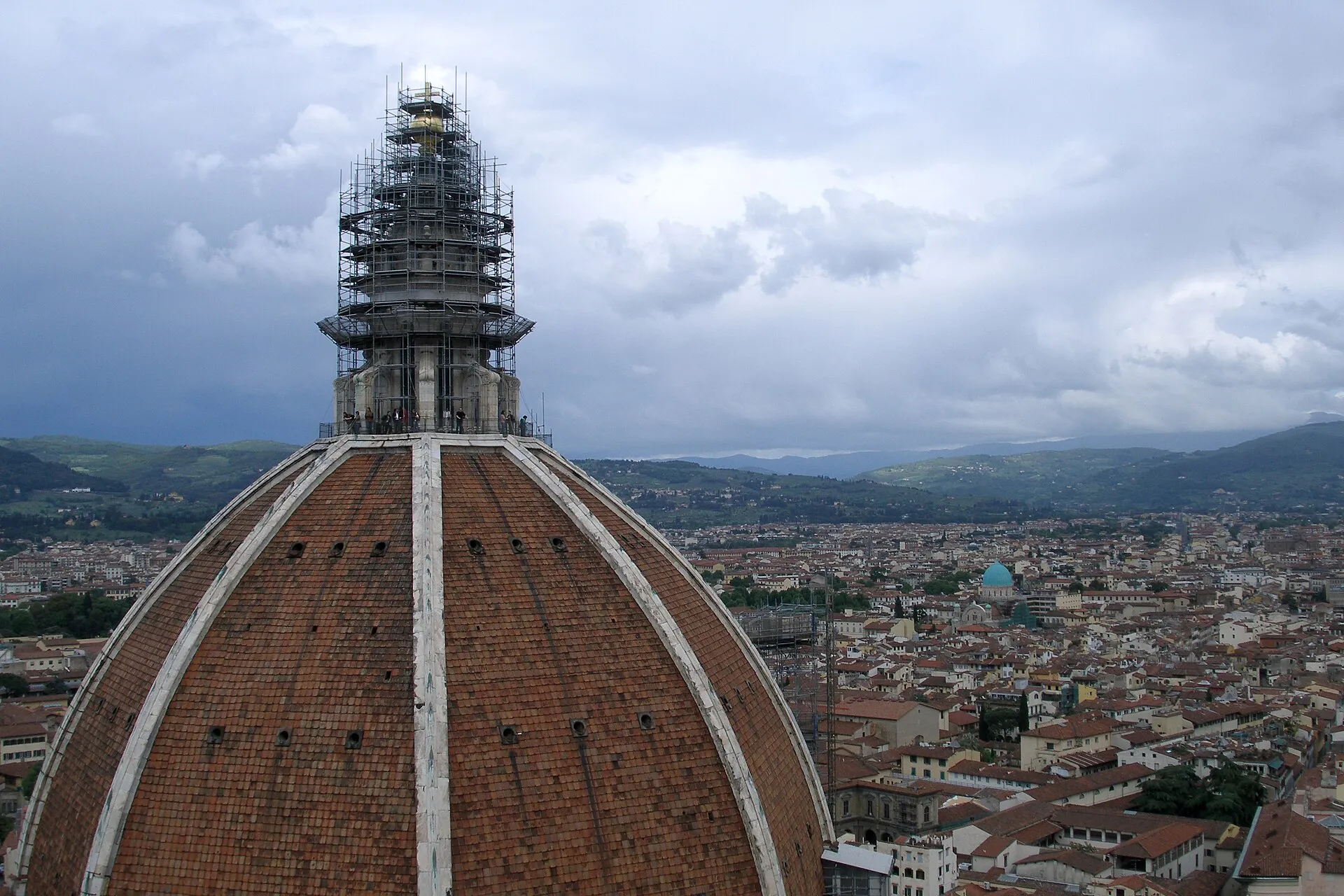
Brunelleschi’s dome above Florence’s rooftops. Photo: Vyacheslav Argenberg, Wikimedia Commons, CC BY 4.0.
Doing both: the train, order and where to stay
Venice and Florence sit on Italy’s main north–south high-speed corridor. Direct Trenitalia Frecciarossa (and rival Italo) trains connect Venezia Santa Lucia—right on the Grand Canal—with Firenze Santa Maria Novella in the heart of Florence in 2 hours 13 minutes, with Trenitalia second-class return fares from €95.80 (around €47.90 each way booked in advance; day trips from Florence, day trips from Venice). Because both stations drop you directly into the historic centre, rail beats flying or driving hands down.
- Which city first: Start in Venice for two or three nights and ride south to Florence for two or three nights (or continue another 1 hour 36 minutes to Rome). Landing at Marco Polo and departing from Florence or Pisa avoids doubling back—and starting in Venice gets the water-transfer logistics with luggage out of the way early.
- Best transfer day: Ride the train on a Monday. Florence’s Uffizi, Accademia, Palazzo Pitti and Medici Chapels are shut on Mondays, whereas Venice’s Doge’s Palace and St Mark’s Basilica are open in the morning before you board an afternoon Frecciarossa south.
- Luggage tip in Venice: If you stay overnight in Venice, pick a hotel within one bridge of a vaporetto stop or Santa Lucia station so you are not hauling cases up steep steps; remember wheeled suitcases are banned inside St Mark’s Basilica.
Where to stay: In Venice, San Marco and Castello put you 210 to 820 m from St Mark’s Square, while Dorsoduro and Cannaregio stay quieter and cheaper 0.6 to 1.6 km away (where to stay in Venice, hotels near St Mark’s Square). In Florence, stay inside the historic centre within 55 to 540 m of the Duomo, or across the Arno in Oltrarno for quieter evening streets (where to stay in Florence, hotels near the Duomo).
For the full booking rules in each city, see Venice and Florence; if you are choosing between Italy’s other classic pairs, read Rome vs Florence and Rome vs Venice.
Common questions
Is Venice or Florence better for a first trip to Italy?
Pick Florence if paintings, sculpture and Renaissance architecture top your list—the Accademia, the Uffizi and Brunelleschi's dome sit a short walk apart, and Tuscany's hill towns are under 90 minutes away. Pick Venice if you want a car-free lagoon city where the urban fabric, Grand Canal, St Mark's Basilica and outer islands of Murano and Burano are the main attraction.
Is Venice or Florence cheaper?
Both are in Italy, so restaurant price levels are similar, though Venice's water transport and St Mark's-area prices push daily spending higher. A single vaporetto ride in Venice is €9.50 (€25 for 24 hours) against €2.00 for a Florence bus or tram, and Venice's airport ATVO coach is €12 against €2.00 for Florence's T2 tram, while Florence costs more in headline museum tickets.
Do I have to pay the Venice access fee?
No fee is payable outside the listed peak dates, and overnight guests staying in Venice are exempt (though they still register and pay the hotel tourist tax). The Comune has announced 72 access-fee days in 2027 between 26 March and 15 August (08:30 to 16:30) for day-trippers over 14, with final rates confirmed by 31 December 2026.
Which closed days catch visitors out in Venice and Florence?
In Florence, Mondays close the Uffizi, Accademia, Palazzo Pitti, Bargello and Medici Chapels, while Thursdays close Palazzo Vecchio at 14:00. In Venice, Mondays close the Accademia, Ca' Pesaro and the Rialto fish market; Tuesdays close the Peggy Guggenheim Collection, Ca' Rezzonico and Palazzo Grassi; Saturdays close the Jewish Ghetto; and Sundays delay St Mark's Basilica opening until 14:00.
How long is the train from Venice to Florence?
The Trenitalia Frecciarossa runs direct from Venezia Santa Lucia to Firenze Santa Maria Novella in 2 hours 13 minutes, with second-class return fares from €95.80 (around €47.90 each way when booked ahead).
How many days do you need in Venice and Florence?
Two to three days in each city. With five or six nights in northern and central Italy, combine both by high-speed train.