In this guide
💡 The Short Version: Our judgement, not a ranking: pick Athens for two to three days of classical Greek ruins—the Acropolis, Acropolis Museum and Ancient Agora—backed by €4.10 24-hour transport, low-cost taverna dining (Eurostat 86.4) and easy ferry hops to Aegina or Hydra. Pick Rome for three to four days of deeper urban variety, pairing the Colosseum, Roman Forum and Pantheon with the Vatican Museums and Borghese Gallery. Athens now costs slightly more on flagship archaeological tickets since its combined pass ended in March 2025, but wins back the difference on hotels, food and transit. With seven or eight nights, do both via a 2-hour direct flight. Or book a tour: in Athens, the Acropolis and Acropolis Museum small-group tourad is from €39 and the Acropolis and Ancient Agora tour with entriesad from €95; in Rome, the Colosseum, Forum and Palatine tourad is from €49 and the Vatican Museums and Sistine Chapel tourad from €64.
⚠️ Plan around Athens’s midday heat closures and Rome’s named-ticket windows. In Athens, summer heatwaves above 40°C have forced the Acropolis and open-air sites to close from 12:00 or 13:00 to 17:00 in June and July—book the 08:00 slot in summer, and note that from 1 November to 31 March smaller sites shut at 15:00 and the Acropolis at 17:00. In Rome, Colosseum tickets open 30 days ahead in your name with ID checked at the gate, the Vatican Museums shut on Sundays (except the last Sunday of the month), and the Borghese Gallery admits nobody without a reservation and closes on Mondays.
Athens and Rome side by side
All entry fares are operators’ adult rates in euros. Each link leads to the dedicated guide on this site.
| Athens | Rome | |
|---|---|---|
| What to book & advance window | Acropolis €30 timed slot (20,000/day cap; no combined ticket); Acropolis Museum €20 (separate ticket, open to 22:00 Fri); Ancient Agora €20; National Archaeological Museum €20; Temple of Olympian Zeus €20; Panathenaic Stadium €12 | Colosseum, Forum and Palatine 30 days ahead (€18 named ticket + ID; €24 underground/arena); Vatican Museums €25 online; Borghese Gallery €16 + €2 fee (compulsory booking); Pantheon €7 (named slot); Castel Sant’Angelo €18; Trevi Fountain basin €2 |
| Closed days | Tuesday: Cycladic & Byzantine museums shut; National Archaeological Museum opens 13:00. Winter (Nov–Mar): smaller archaeological sites close 15:00, Acropolis 17:00. State sites free 1st & 3rd Sunday Nov–Mar. Orthodox Easter Sunday (2 May 2027): state sites shut | Sunday: Vatican Museums (except last Sunday of month, free 09:00–14:00). Monday: Borghese Gallery, Castel Sant’Angelo, House of Augustus, Ostia Antica. First Sunday of month: state sites free (queues, no Colosseum booking). 25 Dec & 1 Jan: Colosseum, Borghese, Pompeii shut |
| City pass verdict | No official Athens pass. Private Turbopass Athens City Pass starts at €78.90 (adds hop-on bus and smaller private museums) and Flex Pass from €59.90—rarely beats separate tickets (€70 for Acropolis + Museum + Agora) or winter free Sundays | Roma Pass €38 (48h), €62.90 (72h). Breaks even around four paid sights in three days, but excludes the Vatican Museums and Pantheon, so most visitors buy individual tickets |
| Public transport | 90-minute single €1.20; 24h €4.10; 5-day €8.20; 3-day tourist ticket with return airport link €20. Historic core around Plaka, Syntagma and Acropolis is walkable | BIT single €1.50 (100 mins, one metro ride); 24h €8.50; 48h €15; 72h €22. Contactless Tap&Go capped at €8.50/day |
| Airport to centre | Metro Line 3 €9 (~40 mins to Syntagma, every 36 mins); X95 express bus €5.50 (~60 mins, 24/7); fixed taxi €50 day / €65 night (since 18 Sep 2026) | Fiumicino: Leonardo Express €14 (32 mins to Termini); FL1 regional €8; fixed taxi €55. Ciampino: Airlink €2.70; fixed taxi €40 |
| Tourist tax | Climate resilience fee per room/night (not per person): Apr–Oct €2 (1–2*), €5 (3)**, €10 (4), €15 (5*); Nov–Mar €0.50 / €1.50 / €3 / €4 | Per person/night (up to 10 nights): €6 at 3-star, €7.50 at 4-star, €10 at 5-star, €3.50 at hostels |
| Price level & fixed costs | Greece Eurostat 2024 restaurants & hotels index 86.4 (EU = 100); climate fee is per room (€2.50/person in a 3-star double in summer, €0.75 in winter). Three flagship entries (Acropolis €30, Acropolis Museum €20, Ancient Agora €20) total €70 | Higher 3-star tourist tax (€12/night for a couple vs €5 in Athens summer) and €8.50 daily transit cap. Three flagship entries (Colosseum €18, Vatican Museums €25, Borghese Gallery €18) total €61 |
| How many days | 2 to 3 days (Athens in one or two days) | 3 to 4 days (3 days in Rome, Rome in one or two days) |
| Best day trips | Aegina (€12 ferry, 1h 10m), Cape Sounion (2h KTEL bus), Delphi (2½h bus), Mycenae, Epidaurus & Nafplio, Meteora (14h tour or overnight) | Pompeii (1h 13m to Naples + local train), Florence (1h 36m), Ostia Antica (26 mins), Orvieto (€10.10 train), Tivoli, Amalfi Coast |
| Best season & weather | April to early June & late September to October (highs 19.6–29.2°C); Jul–Aug scorching at 32.2°C average with 40°C+ heatwaves; mild winter with free Sundays Nov–Mar | May, June & September (highs 23–27°C); Jul–Aug 30–31°C; October and November wettest; Colosseum last admission 15:30 in winter |
Note the non-EU under-25 rule in Athens: EU citizens up to 25 enter state sites free, whereas visitors aged 18 to 25 from the UK, US, Canada and Australia pay full adult price (€30 at the Acropolis), with a €10 reduced ticket available only at the Acropolis Museum desk.
Entry rules: Both Greece and Italy sit inside the Schengen Area (90 days in any 180-day period for visa-exempt visitors); the EU Entry/Exit System (EES) has been running in full since 10 April 2026, while ETIAS is not yet required and has no confirmed start date. See the entry tables on the Athens and Rome hubs.
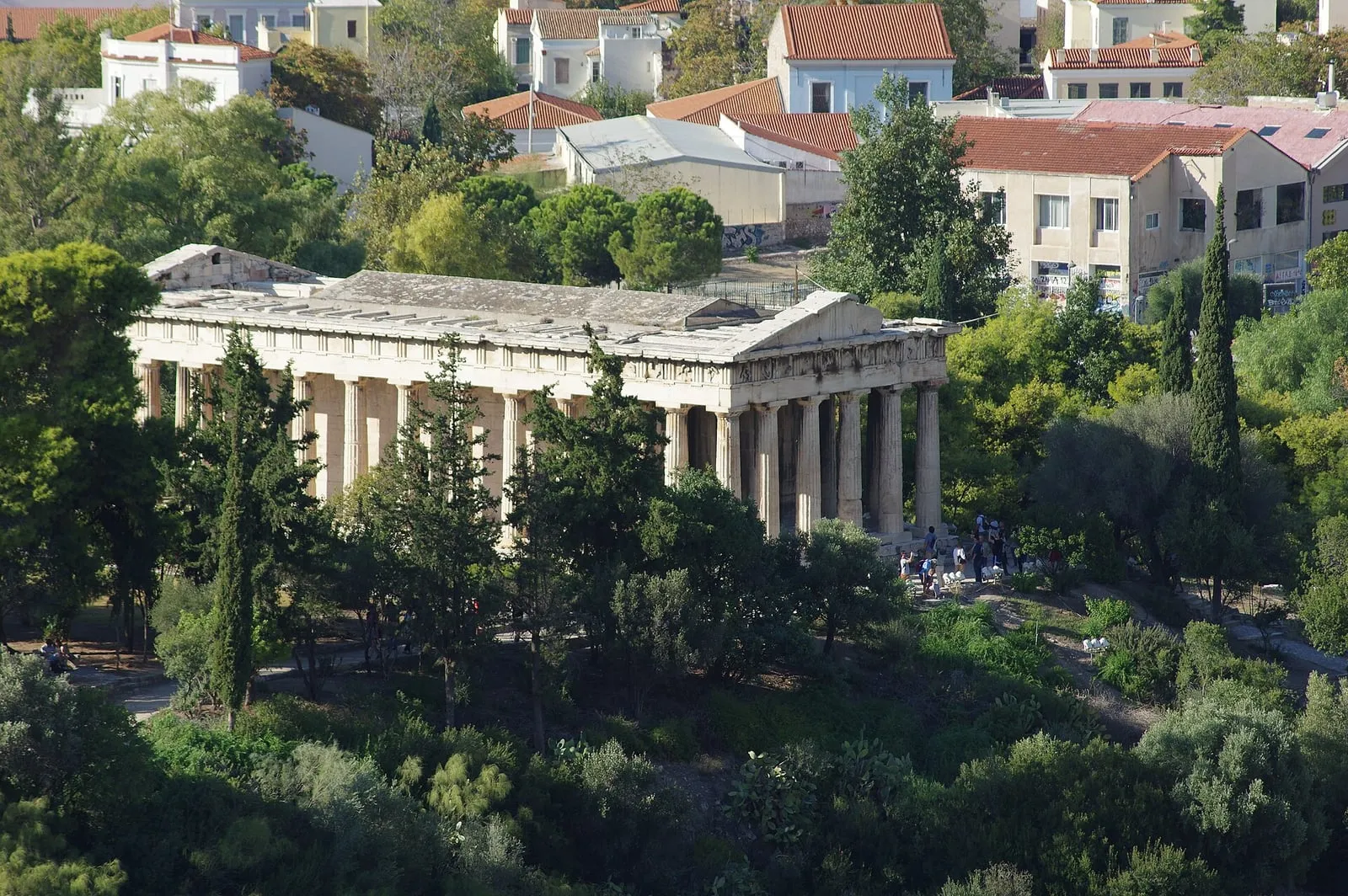
The Temple of Hephaestus in Athens. Photo: Berthold Werner, Wikimedia Commons, CC BY-SA 3.0.
Book a tour instead
Entry-only resellers charge €6 extra on Athens state tickets (€36 vs €30 for the Acropolis), so buy direct for self-guided visits and use tours specifically for an archaeologist guide or overland day trips where rail does not go. Prices are GetYourGuide’s lowest adult “from” fares in euros.
| City | From | Tour |
|---|---|---|
| Athens | €29 | Acropolis small-group guided tourad ( from ; entry ticket extra) |
| Athens | €39 | Acropolis and Acropolis Museum small-group tourad ( from ) |
| Athens | €95 | Acropolis and Ancient Agora guided tour with entrancesad ( from ), 4 hours |
| Athens | €24 | Mycenae, Epidaurus and Nafplio full-day tour from Athensad ( from ), 11 hours |
| Athens | €18 | Cape Sounion and Temple of Poseidon sunset half-day tripad ( from ), 5½ hours |
| Rome | €49 | Colosseum, Roman Forum and Palatine Hill guided tourad ( from ) with entry |
| Rome | €64 | Vatican Museums, Sistine Chapel and Basilica tourad ( from ) with entry |
| Rome | €68 | Pompeii and Vesuvius coach day trip from Romead ( from ) |
Which city for whom
Each verdict below is grounded in the figures and logistics above.
A first visit: Rome for a full city break, Athens as a 2-day opener before the islands
Rome sustains four or five days on its own without repeating itself: imperial ruins, the Vatican, Renaissance churches, Baroque fountains and neighbourhood walks (Rome’s historic centre walk) fill every hour. Athens is at its best as a punchy two-day cultural stop—Acropolis, Acropolis Museum, Ancient Agora, Plaka and Anafiotika (Plaka and Anafiotika, Acropolis and Plaka walk)—before catching a ferry from Piraeus to the Cyclades or Saronic islands, or adding a day trip to Delphi.
A long weekend (2 to 3 days): Athens
Athens fits a 48- to 72-hour break cleanly. The Acropolis, Acropolis Museum, Ancient Agora, Roman Agora, Plaka, Monastiraki and Syntagma Square sit within a 1.5 km radius, and Friday’s 22:00 late opening at the Acropolis Museum lets you see the Parthenon Marbles after sunset without losing daylight hours. A Friday-to-Sunday trip to Athens also avoids Tuesday’s museum closures—whereas a weekend in Rome loses the Vatican Museums on Sunday.
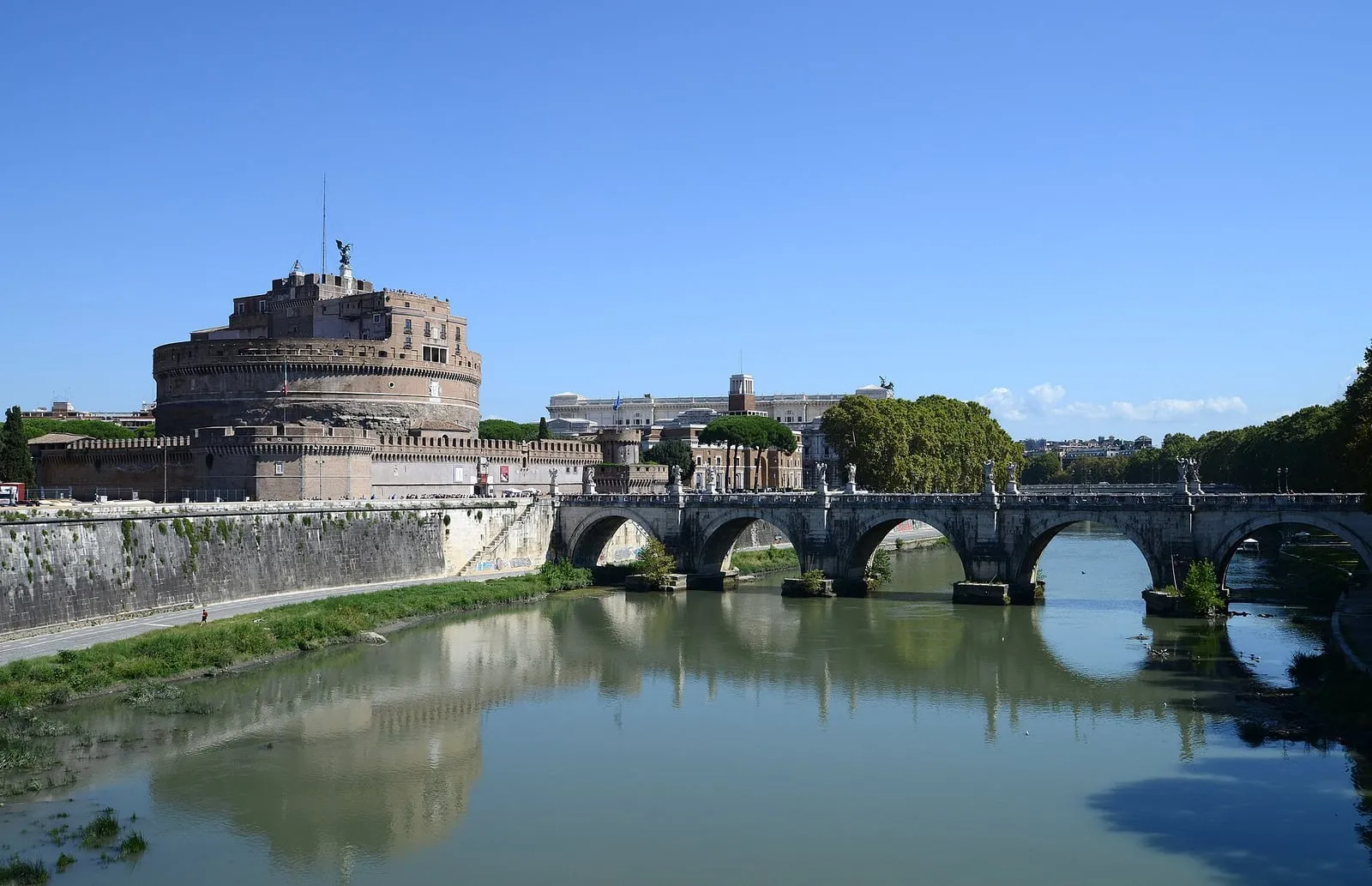
Castel Sant’Angelo across the Tiber. Photo: Alvesgaspar, Wikimedia Commons, CC BY-SA 4.0.
Food and drink: Rome for sit-down trattorias, Athens for street food and value
Rome has deeper sit-down dining variety across trattorias, wine bars and bakeries (Rome food guide), while Athens delivers stronger street-food and mezze value. In Athens, where to eat in Athens and best souvlaki in Athens point to Kostas, Lefteris o Politis, Karamanlidika tou Fani, Ouzeri tou Laki and Varvakios Central Market—souvlaki wraps cost a few euros, and Athens rooftop bars look straight onto the lit Parthenon.
Art, history and sights: Rome for continuity, Athens for classical Greece
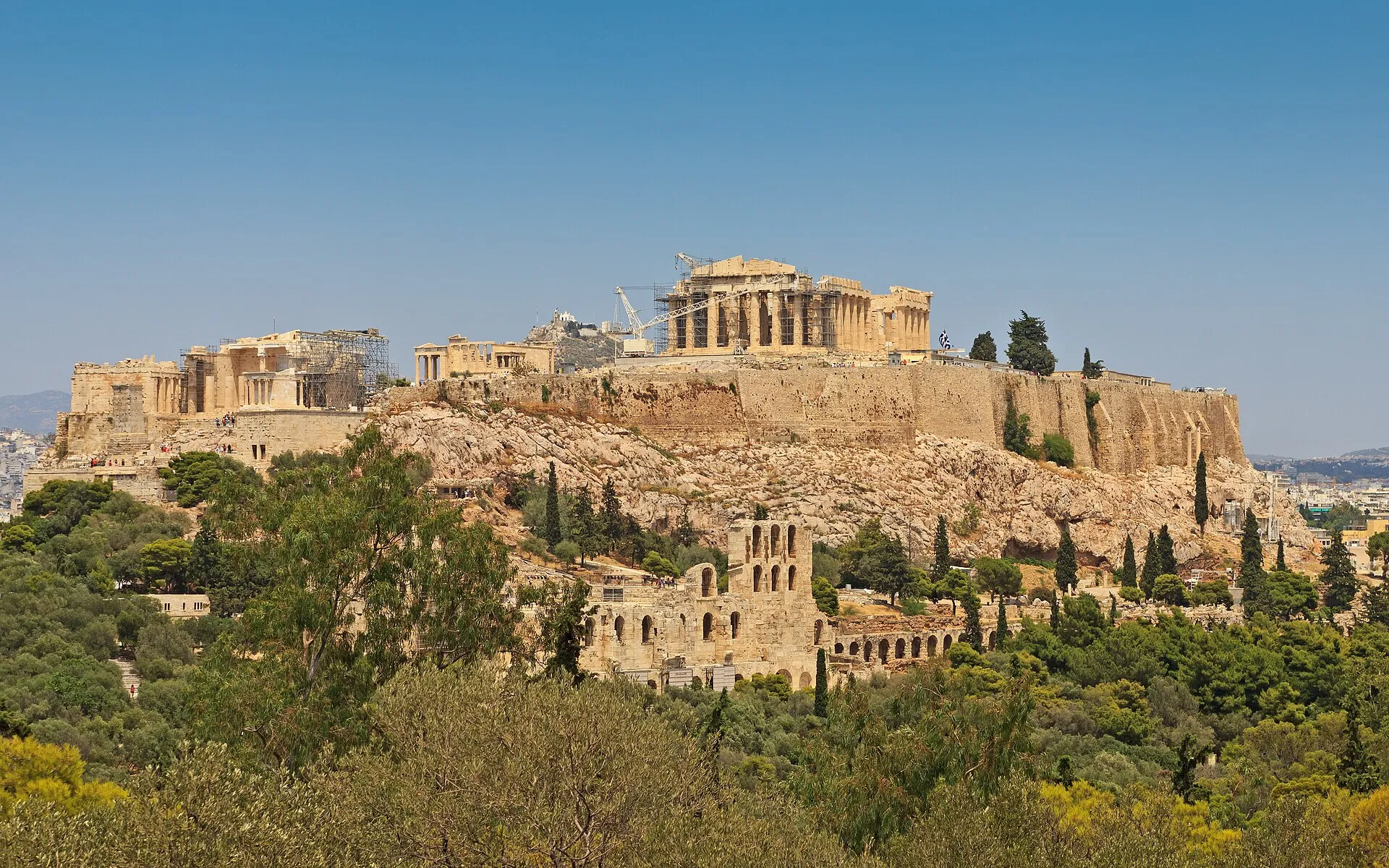
Pick Rome if you want 2,700 years of continuous architectural layering—Roman concrete domes, medieval mosaics, Michelangelo’s Sistine Chapel and Bernini’s sculptures all inside one walk. Pick Athens if 5th-century BC classical antiquity is your focus: the Parthenon, Erechtheion, Temple of Hephaestus, Acropolis Museum and National Archaeological Museum (housing the Mask of Agamemnon and Antikythera mechanism) hold the world’s finest Greek collections, plus free sunset hills at Philopappos, the Pnyx and Areopagus (best views in Athens).
A tight budget: Athens (especially November to March)
Athens. Even after Greece abolished its combined ticket, Athens remains cheaper on everyday running costs: €4.10 for 24 hours of public transport (€8.20 for five days) vs €8.50/day in Rome, a €5.50 24-hour airport bus (X95), lower hotel rates, a per-room climate fee (€5/room in summer and €1.50/room in winter at a 3-star, vs €12/night for a couple in Rome), and cheaper eating out. Visit between 1 November and 31 March on a first or third Sunday and the €30 Acropolis, €20 Agora and €20 National Archaeological Museum drop to €0 (free things to do in Athens).
Families and couples: Rome for families, Athens for sunset-and-sea couples
For families, Rome wins—especially with under-10s or pushchairs—thanks to flatter walks between piazzas, pizza al taglio for fussy eaters and fewer exposed marble-slip risks than the steep, polished rock of the Acropolis (which also prohibits pushchairs on the summit). For couples, Athens wins on golden-hour views—rooftop drinks facing the illuminated Parthenon, dusk at the Temple of Poseidon at Cape Sounion, and an easy €12 ferry to Aegina—while Rome counters with candlelit evenings in Trastevere and Monti.
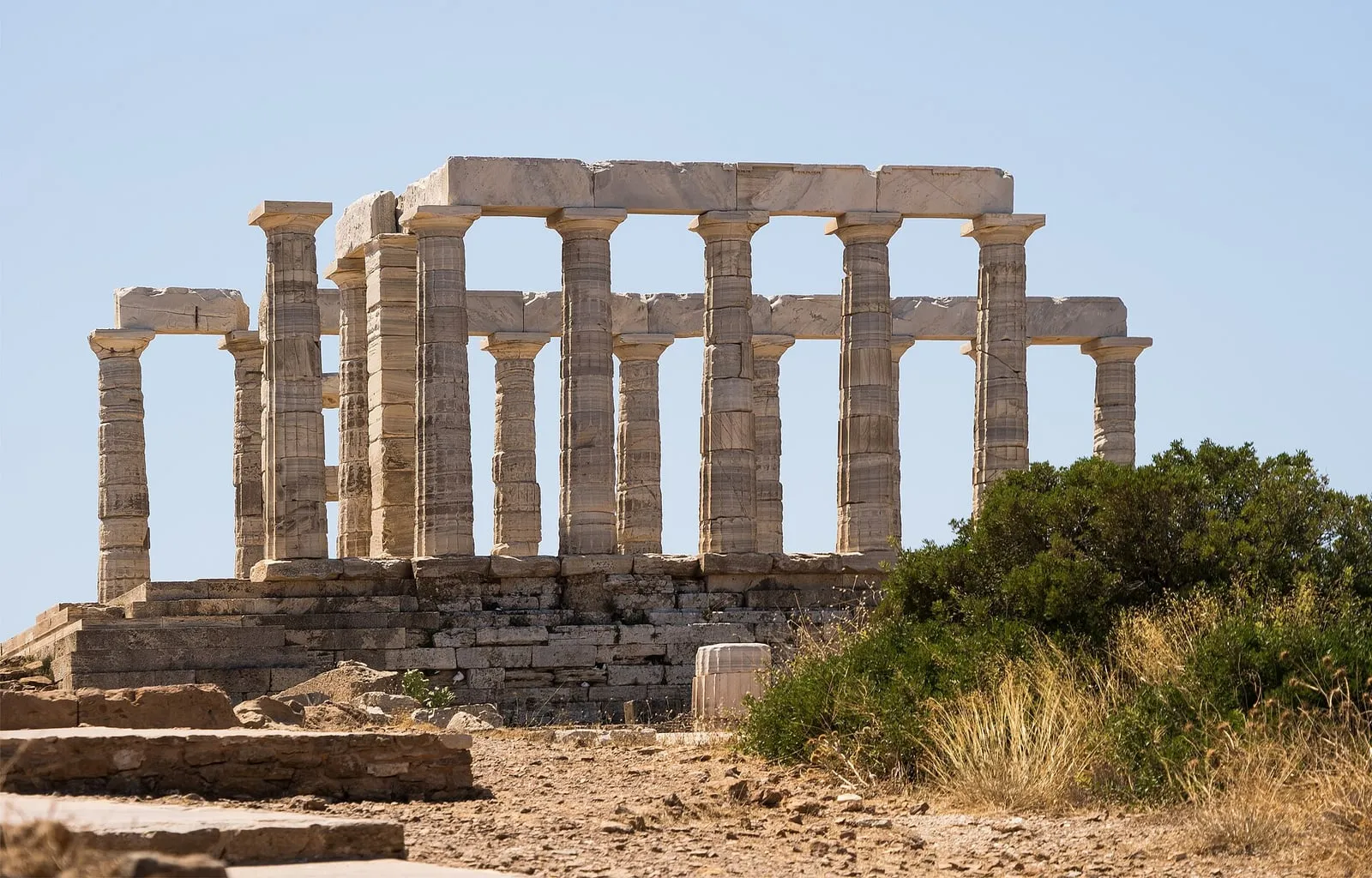
The Temple of Poseidon at Cape Sounion. Photo: Jebulon, Wikimedia Commons, CC0.
Doing both: flights, order and where to stay
Athens and Rome sit 1,050 km apart across the Ionian Sea, linked by frequent 2 hour 5 minute direct flights between Athens International (ATH) and Rome Fiumicino (FCO) on Aegean Airlines, ITA Airways, Ryanair and Sky Express. Both countries sit inside the Schengen area, so there is no passport-control queue between them once you have entered Europe.
- Which city first: Start in Athens (2 to 3 nights) and fly west to Rome (3 to 4 nights)—following classical history in chronological order from 5th-century BC Greece to Imperial and Renaissance Rome—or reverse it if you are finishing with Greek island ferries from Piraeus.
- Best transfer day: Fly on a Sunday or Monday. Flying out of Rome on a Sunday avoids the Vatican Museums’ Sunday closure; flying out of Athens on a Tuesday avoids its museum closures.
- How many nights: Allow 7 to 8 nights for both capitals (two or three in Athens, four in Rome), or 11 to 12 nights if you want to add a Greek island after Athens.
Where to stay: In Athens, stay in Plaka or Makrygianni and Koukaki beside the Acropolis Museum (0.37 to 0.98 km from the Acropolis; where to stay in Athens, hotels near the Acropolis), or near Syntagma for the direct X95 airport bus and Metro Line 3. In Rome, stay in the Centro Storico or Monti beside the Colosseum, Prati for the Vatican, or near Termini for the Leonardo Express to Fiumicino (where to stay in Rome, hotels near Termini).
For the full booking rules in each capital, see Athens and Rome; or compare Rome with its other classic rivals in Paris vs Rome and Rome vs Florence.
Common questions
Is Athens or Rome better for ancient history?
Pick Rome for volume and layered survival—the Colosseum, Roman Forum, Palatine Hill, Pantheon and Ostia Antica sit alongside Renaissance and Baroque masterpieces in the Vatican and Borghese Gallery. Pick Athens for classical Greek architecture at its source—the Parthenon, the Ancient Agora and the Acropolis Museum—which fit cleanly into two days before heading to Delphi, Cape Sounion or the Saronic islands.
Is Athens or Rome cheaper?
Everyday food, hotels and public transport are cheaper in Athens—Greece's Eurostat price level for restaurants and hotels is 86.4 (EU = 100), a 24-hour transport ticket is €4.10 (against €8.50 in Rome), and a 5-day ticket is €8.20. Archaeological entry tickets, however, now cost more in Athens since the multi-site combined ticket ended in March 2025.
Does Athens have a combined archaeological ticket?
No. Greece abolished the multi-site combined ticket after March 2025. Every state site is now priced individually—€30 for the Acropolis, €20 for the Ancient Agora, €20 for the National Archaeological Museum and €20 for the Temple of Olympian Zeus—and the Acropolis Museum (€20) has always been separate. From 1 November to 31 March, however, all state sites are free on the first and third Sunday of each month.
Which closed days and heat rules catch visitors out in Athens and Rome?
In Athens, midday heatwaves in June and July have repeatedly forced the Acropolis and open-air sites to close from 12:00 or 13:00 to 17:00; from 1 November to 31 March smaller sites shut at 15:00 and the Acropolis at 17:00; Tuesdays close the Cycladic and Byzantine museums and delay the National Archaeological Museum until 13:00. In Rome, Sundays close the Vatican Museums (except the last Sunday of the month) and Mondays close the Borghese Gallery, Castel Sant'Angelo and Ostia Antica.
How long is the flight between Athens and Rome?
Direct flights between Athens International Airport (ATH) and Rome Fiumicino (FCO) take about 2 hours 5 minutes on Aegean, ITA Airways, Ryanair and Sky Express. There is no practical direct train; the overland/ferry route via Bari or Ancona and Patras takes a full day and night.
How many days do you need in Athens and Rome?
Two full days in Athens (plus a third if you add Delphi, Cape Sounion or Aegina) and three to four days in Rome. With seven or eight nights, combine both via a 2-hour direct flight.