In this guide
💡 The Short Version: Japanese New Year (Oshogatsu) is Japan’s most important annual holiday. From 28 December to 3 January, much of the capital’s public infrastructure shuts down, including the Imperial Palace East Gardens (28 December to 3 January), Shinjuku Gyoen (29 December to 3 January), and the Ghibli Museum (27 to 31 December, plus 1 and 2 January). teamLab Planets and Tokyo Skytree remain open on 1 January, while Shibuya Sky is closed on 1 January. Midnight on 31 December brings the ringing of temple bells 108 times (Joya no Kane), followed by Hatsumode shrine pilgrimages from 1 to 3 January. Or book a tour: an unhurried guided full-day city tour with a localad covers central sights smoothly from ¥16,000.
Understanding Japanese New Year (Oshogatsu)
Unlike in Western capitals, where New Year’s Eve is marked by loud street parties, nightclub countdowns, and midnight fireworks, Japanese New Year (Oshogatsu) is fundamentally a solemn, reflective, and spiritual family holiday.
Tokyo during the year-end transition is characterised by quiet reverence. Millions of urban residents return to regional ancestral hometowns (kisei), leaving the city’s residential avenues peaceful and clear of traffic.
Key cultural customs during the New Year period include:
- Toshikoshi Soba (Year-Crossing Noodles): On the evening of 31 December (Omisoka), Japanese households eat hot bowls of buckwheat noodles. The easily severed noodles symbolise cleanly cutting off the misfortunes and hardships of the past year, while their elongated shape wishes for longevity.
- Joya no Kane (Ringing of the 108 Bells): At midnight on 31 December, Buddhist temples throughout Tokyo toll their colossal bronze bells (bonsho) exactly 108 times. In Buddhist philosophy, 108 represents the number of earthly passions and desires (bonno) that cause human suffering. Each strike purifies one passion, allowing worshippers to start the new year with a cleansed spirit.
- Hatsuhinode (First Sunrise): Watching the first dawn break over the horizon on 1 January is considered auspicious. Tokyo Skytree and coastal lookouts draw crowds eager to pray to the morning sun (Toshigami, the New Year deity) for good health.
- Hatsumode (First Shrine Visit): Between 1 and 3 January, virtually the entire population visits a Shinto shrine or Buddhist temple to toss a five-yen coin (go-en) into the wooden offertory box, clap twice, bow deeply, and draw paper fortunes (omikuji).
Sight closures and operating schedules: 28 December to 3 January
Because administrative offices, cultural foundations, and museums adhere to statutory holiday schedules, you must check dates carefully:
| Attraction | Status over Year-End & New Year | Operating Notes |
|---|---|---|
| Imperial Palace East Gardens | Closed 28 December to 3 January | Reopens 4 January. Inner grounds open 2 January for the Emperor’s Greeting. |
| Shinjuku Gyoen | Closed 29 December to 3 January | Reopens 4 January on standard winter schedule (9:00 to 16:00). |
| Rikugien & Koishikawa Korakuen | Closed 29 December to 1 January | Reopens 2 January at 9:00 (admission ¥300). |
| Tokyo National Museum | Closed 25 to 31 December; Open 1 January | Special opening on 1 January from 12:00 to 20:00; regular hours resume 2 January. |
| Ghibli Museum | Closed 27 to 31 December, plus 1 & 2 January | Reopens 3 January. No tickets sold on site; strictly Lawson Ticket in advance. |
| Edo-Tokyo Museum | Closed over year-end holidays | Closed through major structural renovation periods. |
| teamLab Planets | Open daily throughout New Year | Special holiday hours: 8:00 to 20:00 from 31 December to 2 January. |
| teamLab Borderless | Open daily throughout New Year | Extended hours until 22:00 over late December; advance timed tickets mandatory. |
| Tokyo Skytree | Open daily throughout New Year | Special ticketed sunrise session early on 1 January; normal entry from 8:00 to 22:00. |
| Shibuya Sky | Closed 1 January | Operates until 22:30 on 31 December; reopens 2 January at 10:00. |
| Tokyo Tower | Open daily throughout New Year | Main Deck open 9:00 to 22:30 daily; festive illumination shows at night. |
| Toyosu Market | Closed 31 December to 4 January | Wholesale fish auction galleries and restaurant rows shut down completely. |
The Tokyo Metropolitan Government publishes full administrative holiday timetables each December.
Experience Joya no Kane on New Year’s Eve (31 December)
Watching the ritual striking of temple bells at midnight is one of Tokyo’s most evocative cultural experiences. Public transit typically runs limited overnight subway and Yamanote train loops on 31 December to accommodate worshippers:
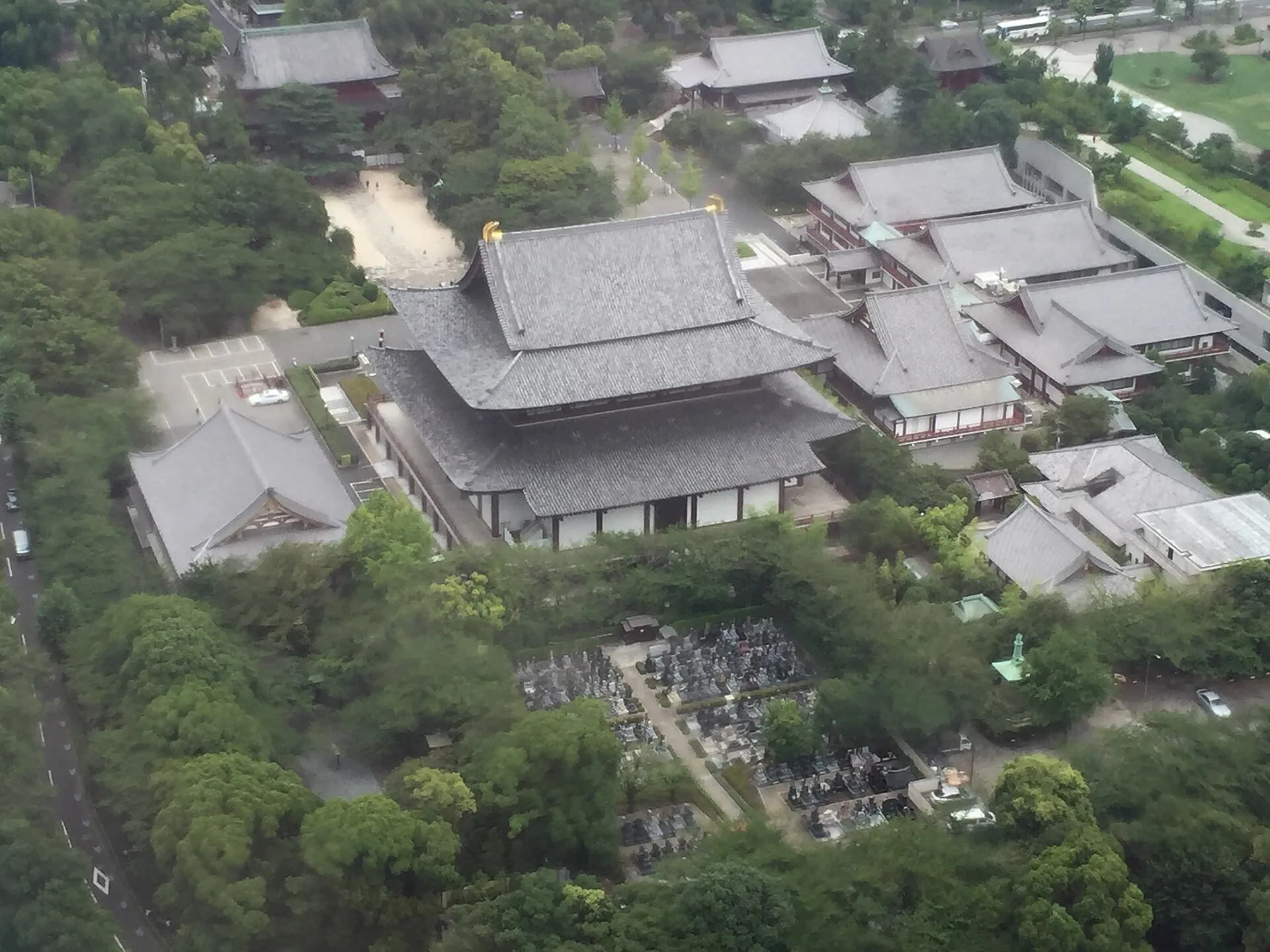
Zojoji’s main hall and grounds seen from Tokyo Tower. Photo: Kakidai, Wikimedia Commons, CC BY-SA 4.0.
- Zojoji Temple (Shiba, Minato): The head temple of the Jodo sect of Buddhism, founded in 1393. Zojoji sits directly at the foot of Tokyo Tower, with the tower as a backdrop as the ancient Daibonsho bell tolls 108 times against the illuminated orange tower. Thousands gather to buy lucky charms and drink sweet, warm fermented rice wine (amazake).
- Kanei-ji Temple (Ueno Park): Tokugawa family funerary temple renowned for its historic 16th-century bronze bell.
- Tsukiji Hongwanji (Tsukiji): Features an open ceremony where members of the general public can participate in bell-ringing by lottery.
Hatsumode: visiting Tokyo’s sacred shrines (1 to 3 January)
Between dawn on 1 January and the evening of 3 January, Tokyo’s shrines and temples welcome millions of pilgrims:
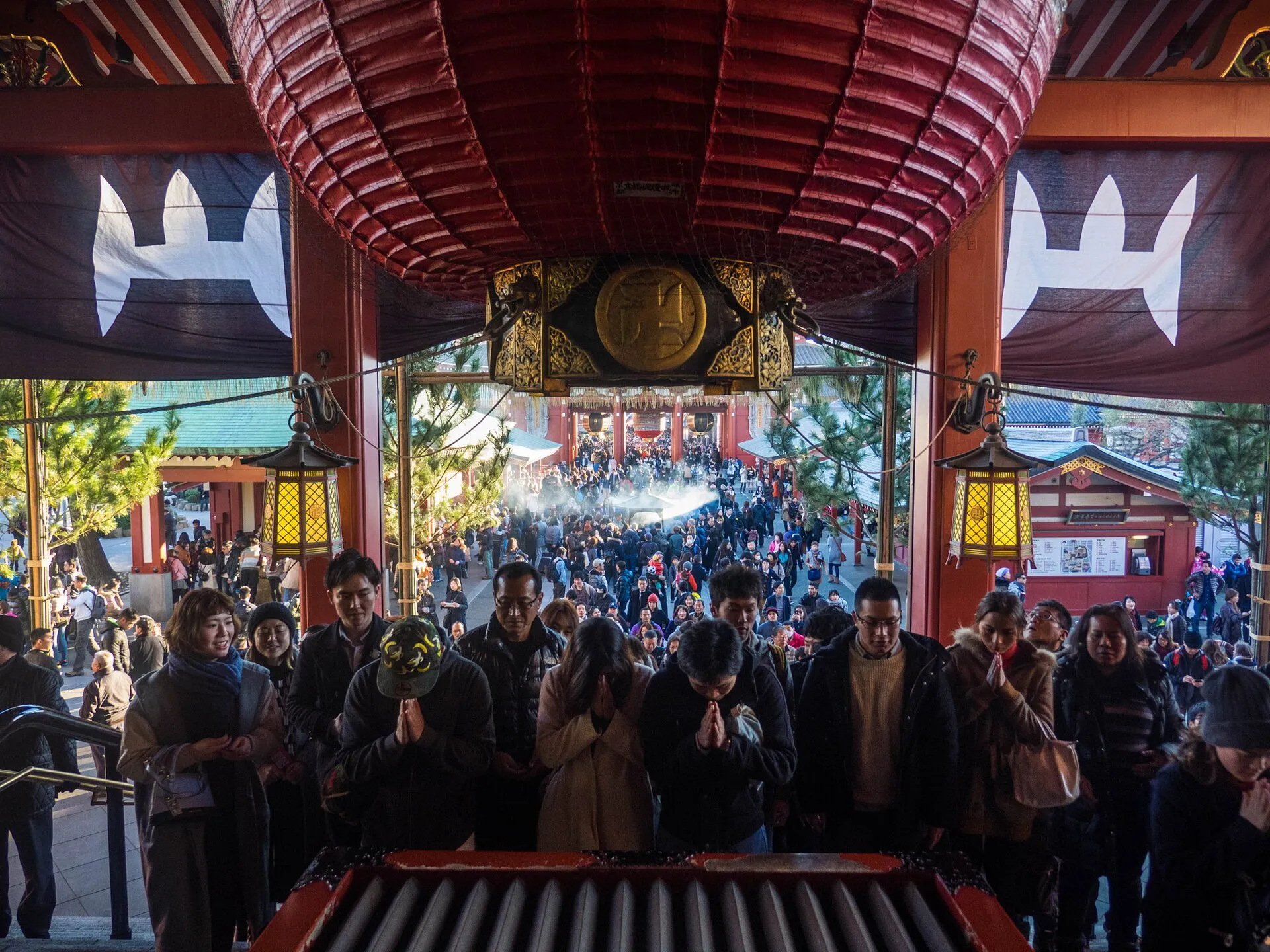
Dense crowds arriving for New Year hatsumode prayers at Senso-ji temple in Asakusa. Photo: Kakidai, Wikimedia Commons, CC BY-SA 4.0.
1. Meiji Jingu (Harajuku)
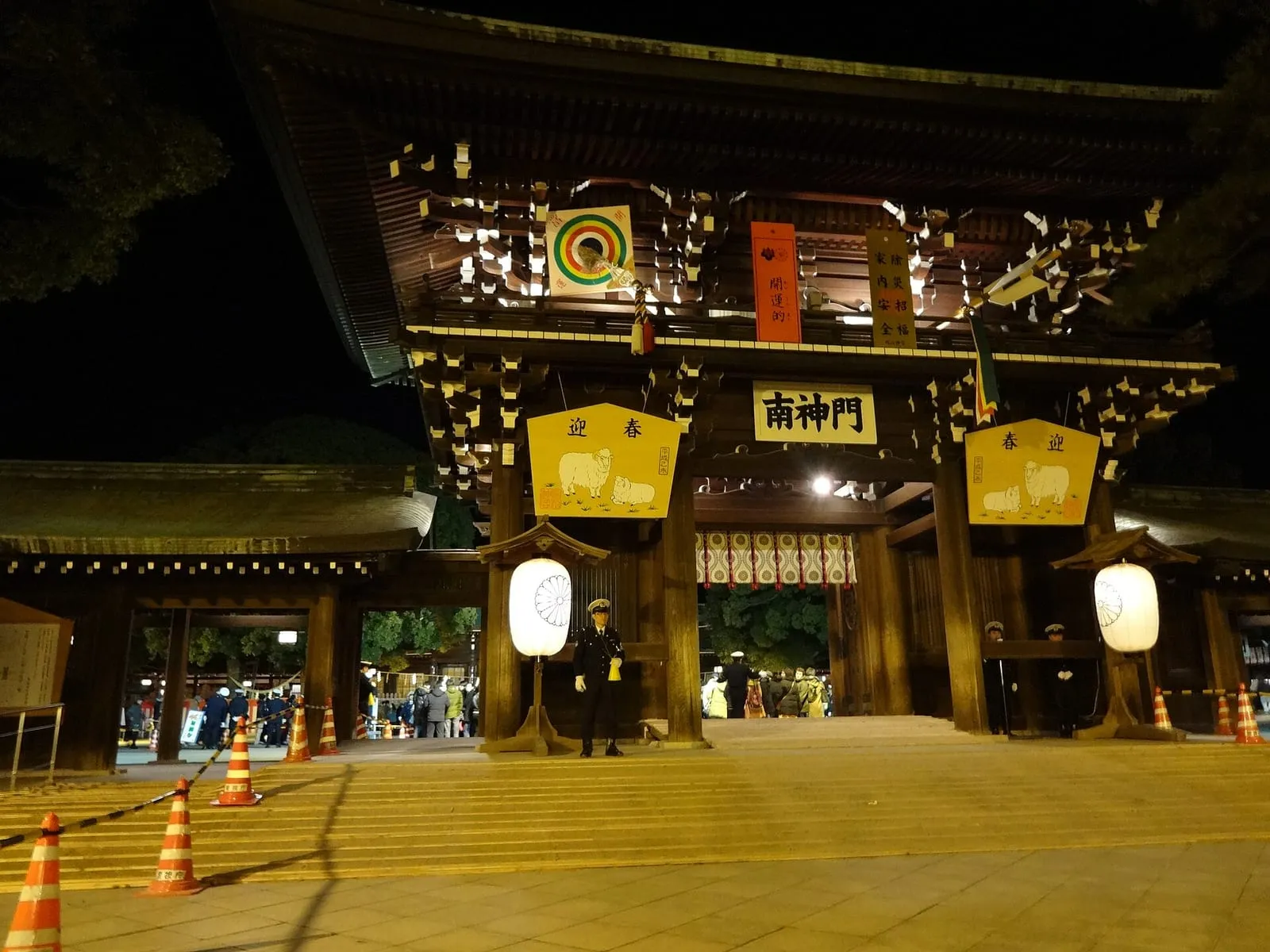
Gates open continuously from sunset on 31 December until 19:00 on 1 January; 6:40 to 18:30 on 2 & 3 January
With over 3.1 million visitors arriving across the first 72 hours of the year, Meiji Jingu is the most visited hatsumode site in Japan. Police officers manage one-way pedestrian flows along the broad gravel forest avenues.
At the main shrine courtyard, giant white tarps are stretched over wooden collection troughs to receive showers of tossed coins. Visitors purchase white wooden demon-breaking arrows (hamaya), wooden votive plaques (ema), and zodiac charms (eto) representing the animal of the upcoming year. Expect queues of 60 to 90 minutes during peak midday hours.
2. Senso-ji and Asakusa Shrine (Asakusa)
Grounds open 24/7 · Main hall open from midnight on 1 January
Senso-ji welcomes over 2.8 million pilgrims. Nakamise-dori is hung with festive red-and-white New Year decorations, pine branches (kadomatsu), and paper fans. Incense smoke billows from the colossal bronze burner (jokoro), which visitors wave over their bodies for health and wisdom before ascending the main hall steps.
3. Kanda Myojin (Akihabara / Ochanomizu)
A short walk from Akihabara, Kanda Myojin is Tokyo’s shrine for business success and technology. On 4 and 5 January, corporate executives in black suits flood the courtyard to pray for enterprise prosperity in the new business year, purchasing IT electronic safety charms for smartphones and hard drives.
The Emperor’s New Year greeting (2 January)
On 2 January, the Imperial Household Agency opens the inner grounds of the Tokyo Imperial Palace to the general public for the Emperor’s New Year Greeting (Shinnen Ippan Sanga). This is one of only two dates each year when the private palace grounds are accessible without advance permits (the other being the Emperor’s Birthday on 23 February).
- How it works: Visitors queue at the Main Gate (Nijubashi Bridge) between 9:30 and 14:10, passing through a security bag search and metal detector screening. Small paper Japanese national flags are distributed free of charge.
- The Balcony Appearances: The Emperor, Empress, and members of the Imperial Family appear on the bulletproof glass balcony of the Chowa-den Reception Hall five times during the day (typically at 10:10, 11:00, 11:50, 13:30, and 14:20). The Emperor delivers a brief address wishing peace and prosperity to the nation as the crowd waves flags and cheers “Banzai!”.
- Practical tip: Queues stretch across Kokyo Gaien plaza for hundreds of metres. Arrive by 8:30 to enter during the morning appearances, and leave large luggage at your hotel.
Shopping, department stores, and Fukubukuro (Lucky Bags)
The retail rhythm over New Year follows an established pattern:
- 1 January: Most department stores, brand boutiques, and independent shops are strictly closed. Convenience stores (7-Eleven, FamilyMart, Lawson) and drugstore chains (Matsumoto Kiyoshi) remain open 24/7. Major station food halls and casual restaurant chains operate normally.
- 2 January (Hatsu-uri – First Sales): Major department stores (such as Isetan in Shinjuku, Mitsukoshi in Ginza, and Shibuya Parco) open for the year’s first retail sales. Thousands line up from dawn to purchase Fukubukuro (“lucky mystery grab bags”)—sealed shopping bags sold at fixed prices (e.g. ¥5,000, ¥10,000, or ¥30,000) containing merchandise worth two to four times the retail price.
Guided tours over the holiday period
Booking an expert-guided tour during New Year takes the difficulty out of navigating holiday closures, closed ticket booths, and crowded shrine routes.
| Tour | Duration & Highlights | Why it works over New Year | Price |
|---|---|---|---|
| Best of Tokyo Full-Day City Tourad | 6 hours; Senso-ji, Meiji Jingu, Imperial Palace, Shibuya | Expert guide navigates holiday transit and hatsumode crowds | From ¥16,000 |
| Guided Asakusa & Senso-ji Walkad | 2 hours; Senso-ji temple and historic merchant alleys | Explains hatsumode shrine rituals, incense purification, and fortune drawing | From ¥2,000 |
| Shinjuku Food & Izakaya Crawlad | 3 hours; evening izakaya tasting across four venues | Guaranteed seating in heated dining spots when many local shops are closed | From ¥13,200 |
Best of Tokyo: Guided Full-Day City Tour with a Local
From ¥20,248 · 4.6 stars from 250 reviews · 6 hours · Small group
Best of Tokyo: Guided Full-Day City Tour with a Localad delivers an effortless holiday orientation, steering travellers safely through the lively hatsumode throngs at Senso-ji and Meiji Jingu while coordinating transport smoothly.
Tokyo: Asakusa and Sensoji Walking Tour
From ¥2,000 · 4.9 stars from 1,055 reviews · 2 hours · Budget-friendly walk
Tokyo: Asakusa and Sensoji Walking Tourad introduces visitors to the deep spiritual traditions of Edo-period Asakusa, decoding holiday blessings and temple architecture.
Tokyo: Shinjuku Food Tour (13 Dishes and 4 Eateries)
From ¥13,200 · 4.9 stars from 3,939 reviews · 3 hours · Evening food crawl
Tokyo: Shinjuku Food Tour (13 Dishes and 4 Eateries)ad provides guaranteed counter seating and authentic seasonal dining in Shinjuku during a holiday week when many independent restaurants are closed.
Summary advice for a New Year visit
- Lock in dining reservations: While convenience stores, ramen ticket bars, and department store dining floors remain open, upscale sushi and izakaya establishments close from 30 December to 3 January. Reserve holiday dinners weeks in advance.
- Carry sufficient physical cash: Although modern Japanese retail accepts Suica and credit cards, shrine stalls selling hot food, protective amulets (omamori), and fortune papers (omikuji) during hatsumode operate strictly on cash. Withdraw yen from 7-Eleven ATMs before 31 December.
- Plan outdoor walks for 1 January: Because shopping districts and major museums are closed on 1 January, make New Year’s Day an outdoor walking day: experience hatsumode at Meiji Jingu, walk through Yoyogi Park, and view evening skyline illuminations from Tokyo Skytree or Tokyo Tower.
Review full admission rules, opening hours, and advance booking windows for all 55 city sights on the Tokyo hub.
Common questions
What is closed in Tokyo during the New Year period?
From 29 December through 3 January, Tokyo undergoes significant holiday shutdowns: government offices, banks, postal facilities, small independent restaurants, and dental clinics are closed. Major closures include the Imperial Palace East Gardens (28 December to 3 January), Shinjuku Gyoen (29 December to 3 January), and the Ghibli Museum (27 to 31 December, and 1 to 2 January).
What attractions remain open in Tokyo on New Year's Day (1 January)?
Several premier modern sights operate on 1 January: teamLab Planets in Toyosu opens 8:00 to 20:00, Tokyo Skytree opens with special early-morning first-sunrise hours, the Tokyo National Museum opens from 12:00 to 20:00, and major Shinto shrines (Meiji Jingu) and Buddhist temples (Senso-ji) remain open around the clock for hatsumode prayers. Shibuya Sky is closed on 1 January.
What is hatsumode and when does it take place?
Hatsumode is the traditional first shrine or temple visit of the New Year, undertaken between 1 and 3 January to pray for health, prosperity, and fortune. Meiji Jingu receives over three million worshippers during the first three days of January, while Senso-ji in Asakusa draws over 2.5 million.
Can the public enter the Imperial Palace on New Year?
Yes. On 2 January, the Emperor's New Year Greeting (*Shinnen Ippan Sanga*) takes place. The inner grounds of the Imperial Palace—normally closed to the general public—open via the Main Gate (Nijubashi Bridge). The Imperial Family appears five times throughout the day on the balcony of the Chowa-den Hall to greet visitors.