In this guide
💡 The Short Version: Meiji Jingu is completely free to enter and open daily from sunrise to sunset, meaning gates close as early as 16:00 in December and 16:10 in November (extending to 18:30 in June). Allow at least 15 minutes to walk from the outer gates through the 70-hectare evergreen forest to reach the central wooden shrine halls. The nearest rail entrances are Harajuku Station on the JR Yamanote Line and Meiji-jingumae Station on the Tokyo Metro. Or book a tour: travellers wanting to understand Shinto spiritual cosmology and imperial history can reserve the Tokyo: Meiji Shrine Walking Tour — Shinto & Imperial Systemad (from ¥1,500, 4.9 stars from 667 reviews). All prices are in Japanese yen (¥).
Seasonal opening hours by month
Unlike Buddhist temples that maintain fixed operating hours, Meiji Jingu regulates its gates according to solar dawn and dusk. The massive wooden gates open at the first light of sunrise and close firmly when the sun drops below the horizon:
| Month | Gate opening | Gate closing | Daylight notes |
|---|---|---|---|
| January | 06:40 | 16:20 | Hatsumode crowds on 1–3 January (open all night on New Year’s Eve) |
| February | 06:20 | 16:50 | Plum blossoms begin in the inner gardens |
| March | 05:40 | 17:20 | Spring transition; morning ceremonies from 08:00 |
| April | 05:10 | 17:50 | Spring Grand Festival in late April |
| May | 05:00 | 18:10 | Extended daylight hours |
| June | 05:00 | 18:30 | Longest operating hours; iris garden in peak bloom |
| July | 05:00 | 18:20 | Summer morning visits avoid midday heat |
| August | 05:00 | 18:00 | Deep forest shade provides cooling canopy |
| September | 05:20 | 17:20 | Autumn transition |
| October | 05:40 | 16:40 | Autumn Grand Festival in late October |
| November | 06:10 | 16:10 | Shichi-Go-San festival celebrations for young children |
| December | 06:40 | 16:00 | Shortest operating days; winter dusk falls before 16:30 |
- Inner Garden (Gyoen) hours: 09:00 to 16:30 (extended to 17:00 in June; closing at 16:00 between November and February).
- Meiji Jingu Museum hours: 10:00 to 16:30 (last entry 16:00). Closed on Thursdays (except national holidays). Admission is ¥1,000 for adults.
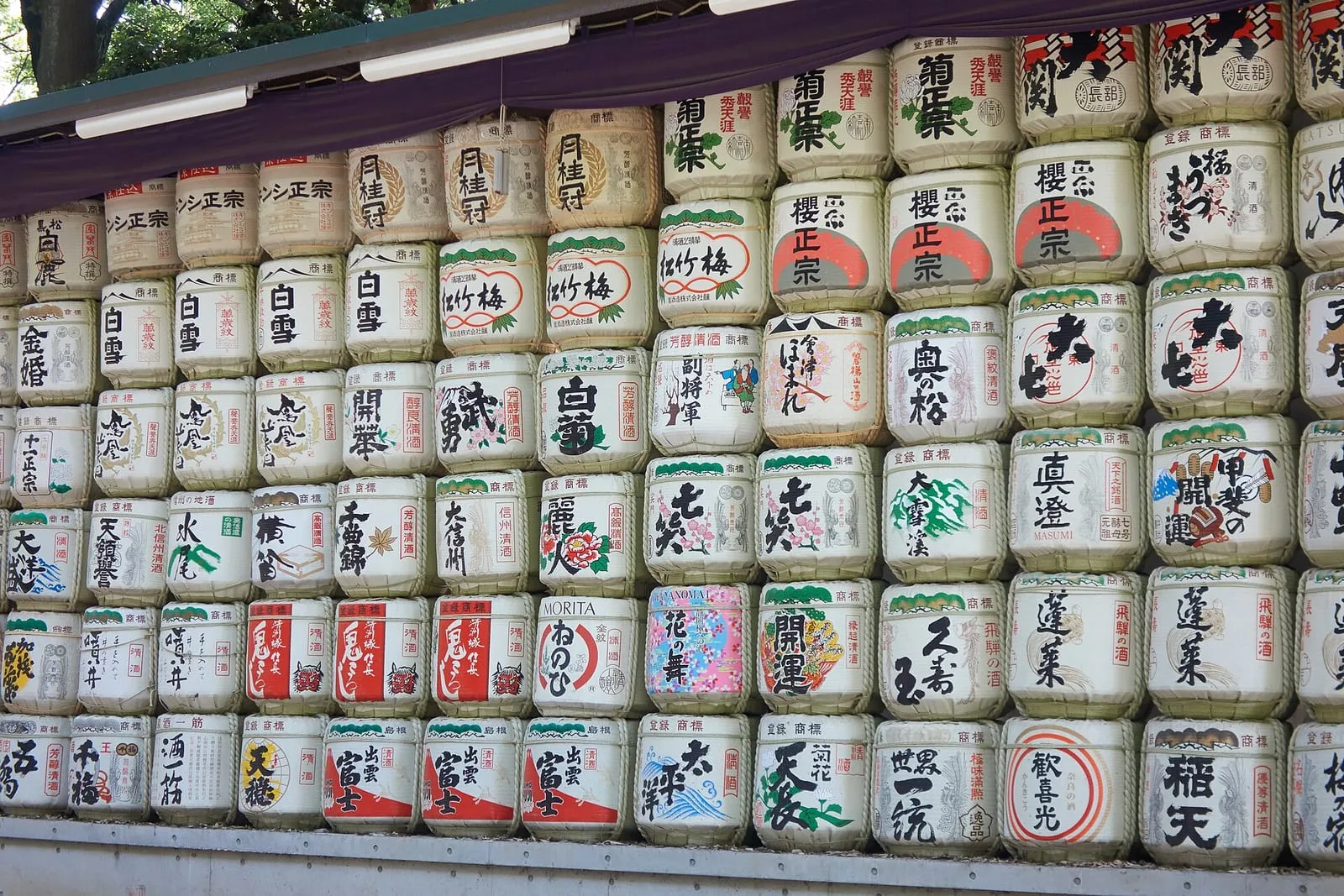
Tiers of decorative straw-bound sake barrels (kazaridaru) donated to Meiji Jingu. Photo: Celuici, Wikimedia Commons, CC BY-SA 3.0.
History: the sacred man-made forest
Meiji Jingu is dedicated to the divine souls (kami) of Emperor Meiji (1852–1912) and his consort, Empress Shoken (1849–1914). Emperor Meiji reigned during Japan’s pivotal transformation from an isolated feudal shogunate ruled by samurai into a modern industrialized constitutional nation.
Following their deaths, the Japanese Diet passed a resolution to construct a memorial shrine. The 70-hectare (170-acre) site in Yoyogi—formerly an imperial iris estate and military parade ground—was chosen in 1915:
- The 100-Year Ecological Masterplan: Rather than creating a formal Japanese garden or a Western park, a committee of Japan’s preeminent forestry scientists, led by Dr. Seiroku Honda and Dr. Takanori Hongo, designed a self-sustaining sacred forest (Chinju no Mori).
- 100,000 Donated Trees: Over 100,000 saplings representing 365 native species were donated by citizens from every prefecture of Japan, as well as Sakhalin, Taiwan, and Korea.
- Ecological Succession: The forest was planned in four distinct stages spanning a century. Conifers like red pine and cedar provided initial ground cover, which gradually gave way to broadleaf evergreens—chinquapin (shii), live oak (kashi), and camphor (kusu)—forming a dense, layered canopy that completely blocks metropolitan sound and wind.
- Zero Human Intervention: Under strict forestry guidelines, no trees in the forest are pruned, dead timber is never removed, and leaves that fall on the gravel paths are swept back into the undergrowth. The forest regenerates entirely naturally through its own nutrient cycle.
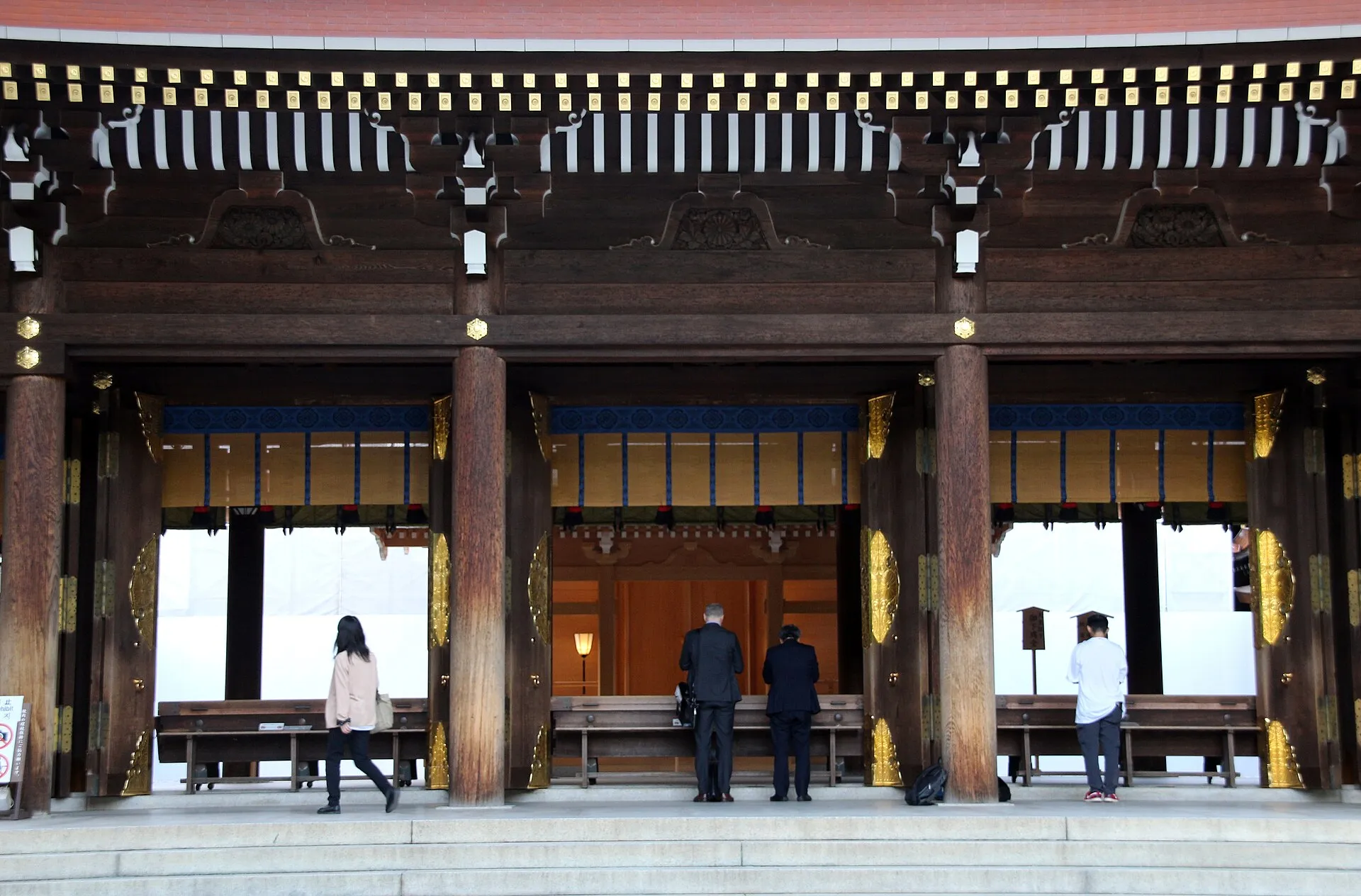
The copper-roofed sanctuary of the Honden main hall at Meiji Jingu. Photo: Hyppolyte de Saint-Rambert, Wikimedia Commons, CC BY-SA 4.0.
Step-by-step visitor etiquette
Shinto shrines are sacred spiritual domains demarcated by torii gates. Respectful behaviour follows established historical conventions:
1. Passing through the Torii
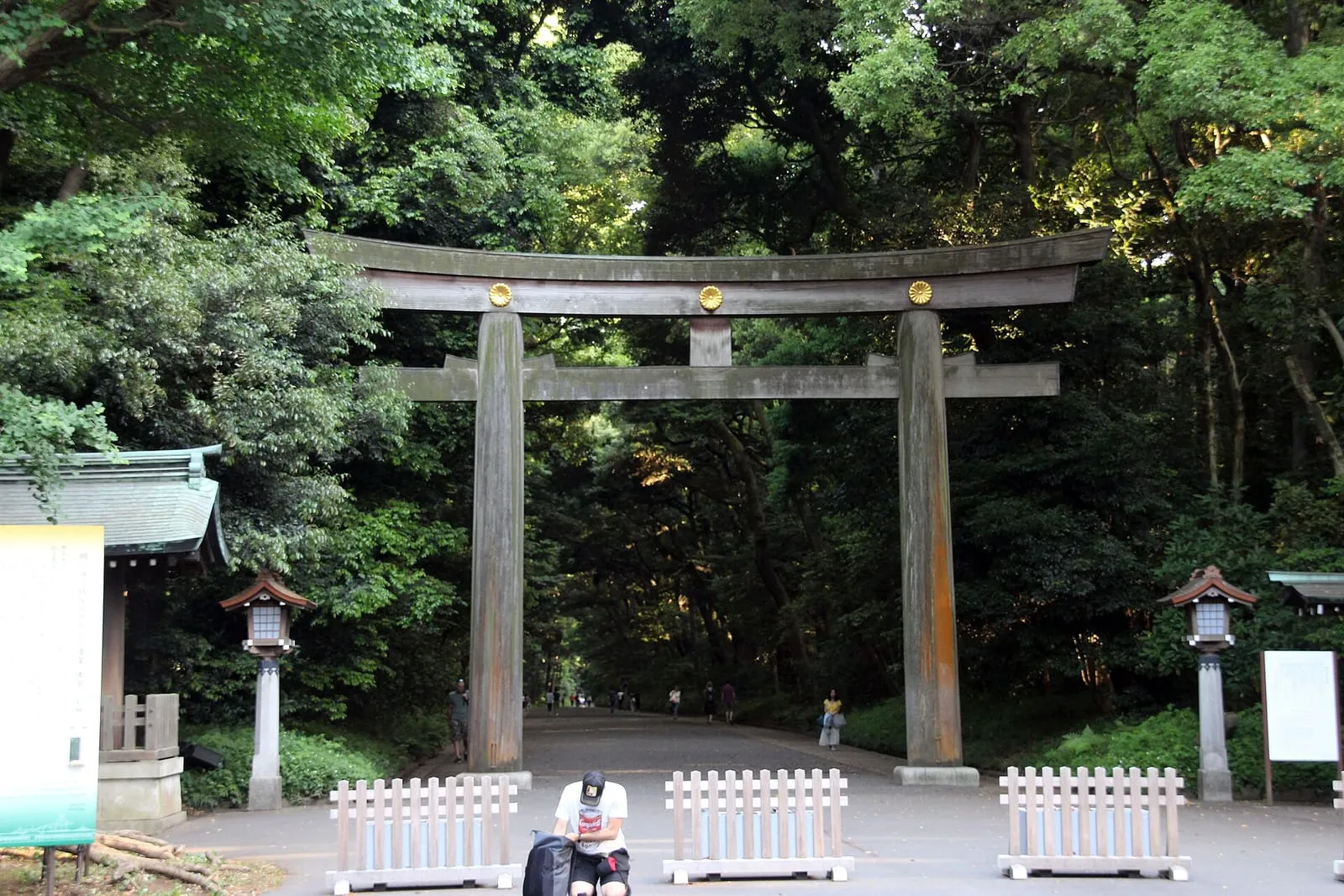
When arriving at the outer wooden torii gate, pause at the threshold and bow deeply once toward the shrine sanctuary before stepping through. When walking along the wide gravel paths, keep to the left or right edges; avoid walking directly down the center (seichu), which is considered the spiritual pathway of the deities.
2. The Sake and Wine Barrels
Along the south approach avenue, stop to view the famous parallel displays:
- Sake Barrels (Kazaridaru): Dozens of large cedar casks wrapped in woven straw and hand-painted with brewery crests, donated annually by the Meiji Jingu Nationwide Sake Brewers Association to honour the emperor.
- Burgundy Wine Barrels: Positioned directly opposite the sake barrels, these sixty oak hogsheads of French wine were donated by premier wineries in Burgundy, celebrating Emperor Meiji’s role in introducing Western diplomatic customs and dining culture to Japan.
3. Purification at the Temizuya Basin
Before entering the central shrine gates, stop at the stone water pavilion (temizuya) to perform symbolic ritual purification (misogi):
- Take the bamboo ladle in your right hand, scoop fresh water, and pour water over your left hand to rinse it.
- Switch the ladle to your left hand and rinse your right hand.
- Switch back to your right hand, pour water into your cupped left palm, and bring the water to your mouth to rinse discreetly (spit gently beside the drainage trough; never put the ladle directly to your mouth).
- Tilt the ladle vertically so the remaining water trickles down the handle to wash it for the next visitor.
- Place the ladle face-down on the rest. Never throw coins into the water basin.
4. Praying at the Main Altar (Ni-rei, Ni-hai, Ichi-rei)
At the main hall (Haiden), observe the standard Shinto sequence:
- Step up to the offertory box (saisenbako) and toss a coin gently through the wooden slats (a 5-yen coin is traditional, as the Japanese word go-en sounds identical to the word for good fortune or fate).
- If there is a hanging brass bell, ring it once to alert the kami to your presence.
- Bow deeply twice at a 90-degree angle (ni-rei).
- Bring your palms together in front of your chest, slide your right fingertips slightly below your left, and clap your hands sharply twice (ni-hai).
- Keep your hands pressed together at chest height and offer a silent personal prayer or reflection.
- Lower your hands and finish with one final deep 90-degree bow (ichi-rei).
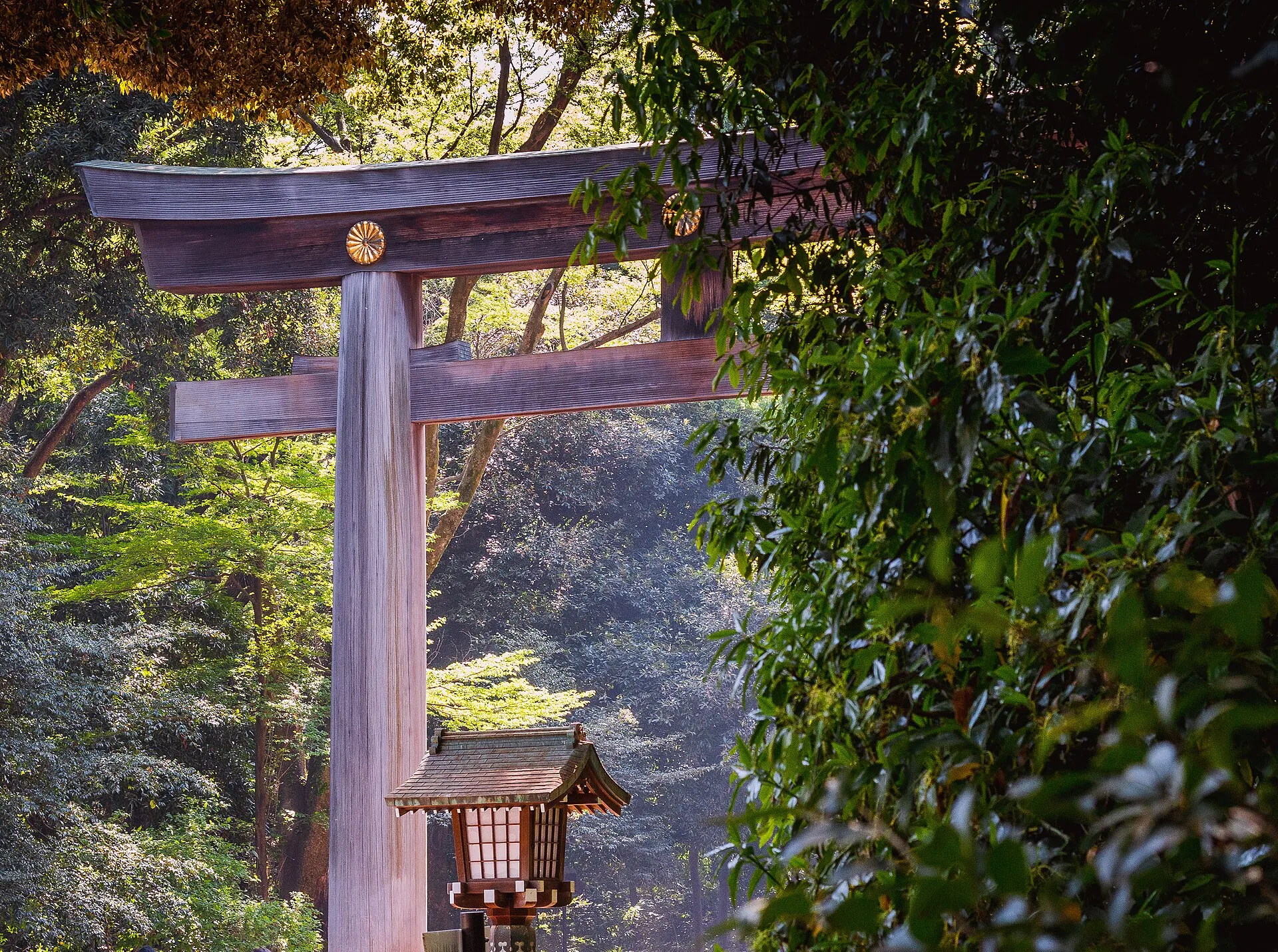
A wooden torii and stone lantern at Meiji Jingu. Photo: Ray in Manila, Wikimedia Commons, CC BY 2.0.
Key sites within the shrine precinct
- The Grand Torii (Otorii): Standing at the junction of the south and north approaches, this 12-metre-tall torii was built in 1975 using a 1,500-year-old Taiwanese cypress found at an elevation of 3,300 metres on Mount Daiton, replacing an earlier gate struck by lightning.
- Meoto Kusu (The Married Camphor Trees): Two massive camphor trees standing on the left side of the main courtyard, planted in 1920 and tethered together by a sacred rice-straw rope (shimenawa). They symbolize marital harmony, enduring love, and family safety.
- Ema Prayer Tablets: Beside the camphor trees, thousands of wooden votive tablets (ema) hang from circular wooden racks. Visitors purchase tablets for ¥500, inscribe prayers in dozens of world languages, and hang them to receive blessings from shrine priests during morning rituals.
- Kaguraden (Ceremonial Dance Hall): A spacious modern cedar hall completed in 1990 where formal Shinto prayers (kigan), business consecrations, and traditional sacred dances (kagura) are performed by shrine maidens (miko) dressed in white kimono and red divided skirts (hakama).
- The Inner Garden (Meiji Jingu Gyoen): A secluded Edo-period landscaped garden historically designed for Empress Shoken. It features a tea pavilion (Nan-un-tei), an expansive iris meadow holding 1,500 plants across 150 varieties that bloom brilliantly in June, and Kiyomasa’s Well (Kiyomasa no Ido), an ancient freshwater spring dug by samurai general Kato Kiyomasa. Entry is ¥500.
Guided tours of Meiji Jingu
Booking a walking tour provides deep insight into Shinto theology, imperial symbolism, and traditional craftsmanship:
Tokyo: Meiji Shrine Walking Tour — Shinto & Imperial System
From ¥1,500 · 4.9 stars from 667 reviews · 1.5 hours
The Tokyo: Meiji Shrine Walking Tour — Shinto & Imperial Systemad offers exceptional value. Led by an expert local guide, the walk decodes the design of the man-made forest, explains the historic alliance behind the Burgundy wine barrels, and demonstrates correct Shinto purification and prayer rituals at the main hall.
Tokyo: Meiji Jingu Shrine and Shinto Culture Walking Tour
From ¥1,500 · 4.9 stars from 444 reviews · 2 hours
The Tokyo: Meiji Jingu Shrine and Shinto Culture Walking Tourad focuses on cultural ceremonies, seasonal festivals, and the spiritual history of the Meiji Restoration, guiding visitors through the quietest trails of the forest.
Tokyo Pop Culture & Tradition Tour: Meiji Shrine to Harajuku
From ¥7,000 · 4.8 stars from 31 reviews · 2 hours
The Tokyo: Shinto & Pop Culture Tour, Meiji Shrine to Harajukuad bridges the serene world of Meiji Jingu with the avant-garde street styles and food stalls of neighbouring Takeshita Street.
Where to go next
Meiji Jingu is the natural starting anchor for a full day exploring western Tokyo. Continue directly from the shrine’s south gate into the fashion alleys of Harajuku and along our self-guided Meiji Jingu, Harajuku and Shibuya walk, which terminates at the Shibuya Crossing and Shibuya Sky.
To understand broader religious and social customs across Japan, consult our guide to Tokyo etiquette. For other major free landmarks in the capital, see our guide to free things to do in Tokyo.
In our 3-day Tokyo itinerary, Meiji Jingu opens Day Two. For transport connections to Harajuku and Yoyogi stations, see Tokyo public transport, and explore the Tokyo hub for complete trip planning.
Common questions
What is the entrance fee for Meiji Jingu?
Admission to Meiji Jingu and its 70-hectare forest grounds is completely free. The Inner Garden (Meiji Jingu Gyoen), famous for blooming irises in June and Kiyomasa's Well, has a separate maintenance admission fee of ¥500. The Meiji Jingu Museum costs ¥1,000 for adults.
What are the opening hours of Meiji Jingu?
The shrine gates open precisely at sunrise and close at sunset 365 days a year. Because opening times follow natural daylight, hours change every month: from 06:40 to 16:00 in December, 06:10 to 16:10 in November, 05:40 to 17:20 in March and September, and 05:00 to 18:30 in June.
How long does it take to walk from the entrance gate to the main shrine?
The gravel approach paths wind through the dense forest for roughly one kilometre. Walking from the Harajuku (South) gate or Yoyogi (North) gate to the central Honden sanctuary takes between 10 and 15 minutes at a relaxed pace.
Can you take photographs at Meiji Jingu?
Photography is permitted throughout the outer forest pathways, the torii gates, and the main courtyard. However, photography and video recording are strictly prohibited directly in front of the inner sanctuary altar where worshippers pray, and inside all ceremonial halls.
What is the proper etiquette when visiting Meiji Jingu?
Bow once when entering and exiting through each torii gate. Walk along the sides of the gravel paths rather than down the exact center, which is traditionally reserved for the kami spirits. Cleanse hands and mouth at the temizuya water basin before praying at the main altar (two bows, two claps, silent prayer, one final bow).