In this guide
💡 The Short Version: Tokyo’s autumn foliage arrives in late November and lingers into early December. Official thirty-year averages from the Japan Meteorological Agency mark 23 November for golden ginkgo (icho) and 28 November for fiery red Japanese maples (momiji). Top central viewing locations include the Meiji Jingu Gaien ginkgo avenue (free access), Rikugien Garden (¥300, famous for night illuminations), and Koishikawa Korakuen (¥300). Regional mountain slopes at Mount Takao and Nikko peak two to four weeks earlier. Or book a tour: a guided historic walk around the Imperial Palace groundsad starts from ¥1,000.
When Tokyo’s autumn leaves turn: the science and calendar
Autumn leaf viewing in Japan is known as momijigari (hunting red leaves) or koyo. While cherry blossoms sweep northward across Japan in spring, autumn colours travel southward from the subalpine heights of Hokkaido into lower elevations, arriving late in central Tokyo’s mild urban microclimate.
Foliage transformation is governed by autumn night temperatures:
- When daily minimum temperatures dip consistently below 8 °C, chlorophyll breakdown accelerates, revealing the brilliant yellow carotenoids of ginkgo leaves.
- When temperatures drop below 5 °C, anthocyanin synthesis triggers vivid scarlet and crimson pigmentation in Japanese maples (Acer palmatum).
The Japan Meteorological Agency (JMA) maintains standard benchmark observation trees at its central Tokyo monitoring station to measure official phenological dates for ginkgo yellowing (koyoo) and maple reddening (kooyo):
| Phenomenon | Benchmark Tree Variety | 30-Year JMA Normal (1991–2020) | Recent Record | Typical Prime Viewing Window |
|---|---|---|---|---|
| Ginkgo Yellowing | Ginkgo biloba (Icho) | 23 November | 22 to 26 November | Mid-November to early December |
| Maple Reddening | Acer palmatum (Irohamomiji) | 28 November | 23 to 30 November | Late November to mid-December |
Unlike cherry blossoms, which drop within a week of full bloom, autumn leaves remain colourful on branches for two to three weeks. In calm conditions, viewing extends comfortably well into the second week of December.
The finest autumn leaf spots in central Tokyo
Central Tokyo offers a harmonious blend of Edo-period feudal stroll gardens, grand public avenues, and expansive imperial parks.
| Location | Hours & Operating Schedule | Admission | Best Viewing Window | Distinctive Feature |
|---|---|---|---|---|
| Meiji Jingu Gaien (Icho Namiki) | Public street open 24/7 | Free access | Mid-November to early December | 300-metre avenue of 146 precisely manicured golden ginkgo trees. |
| Rikugien Garden | 9:00 to 17:00 (extended night entry until 20:30) | ¥300 general admission | Late November to early December | Japanese maples reflected in a central lake; evening lighting displays. |
| Koishikawa Korakuen | 9:00 to 17:00 (last admission 16:30) | ¥300 general admission | Late November to early December | Historic 1629 daimyo garden featuring red maples framing stone bridges. |
| Shinjuku Gyoen | 9:00 to 16:00 (gates close 16:30) | ¥500 adults | Late November to mid-December | Momijiyama (Maple Hill) and golden ginkgo trees set against city lawns. |
| Imperial Palace East Gardens | 9:00 to 16:00; closed Mondays & Fridays | Free admission | Late November to early December | Ninomaru Garden maples and Ninomaru Grove autumn foliage. |
| Mount Takao | Trails open 24/7; cable car 8:00 to 17:45 | Free park entry (cable car ¥490 one-way) | Mid-November to late November | Mountain slopes glowing scarlet, cable car through maple tunnels. |
1. Meiji Jingu Gaien Ginkgo Avenue (Icho Namiki)
Public avenue accessible 24/7 · Nearest stations: Aoyama-itchome or Gaienmae (Tokyo Metro)
Located in the outer precinct of Meiji Shrine in Aoyama, this 300-metre boulevard is Tokyo’s most celebrated autumn vista. Planted in 1923, four rows comprising 146 Japanese ginkgo trees (icho) are carefully pruned into sharp conical silhouettes.
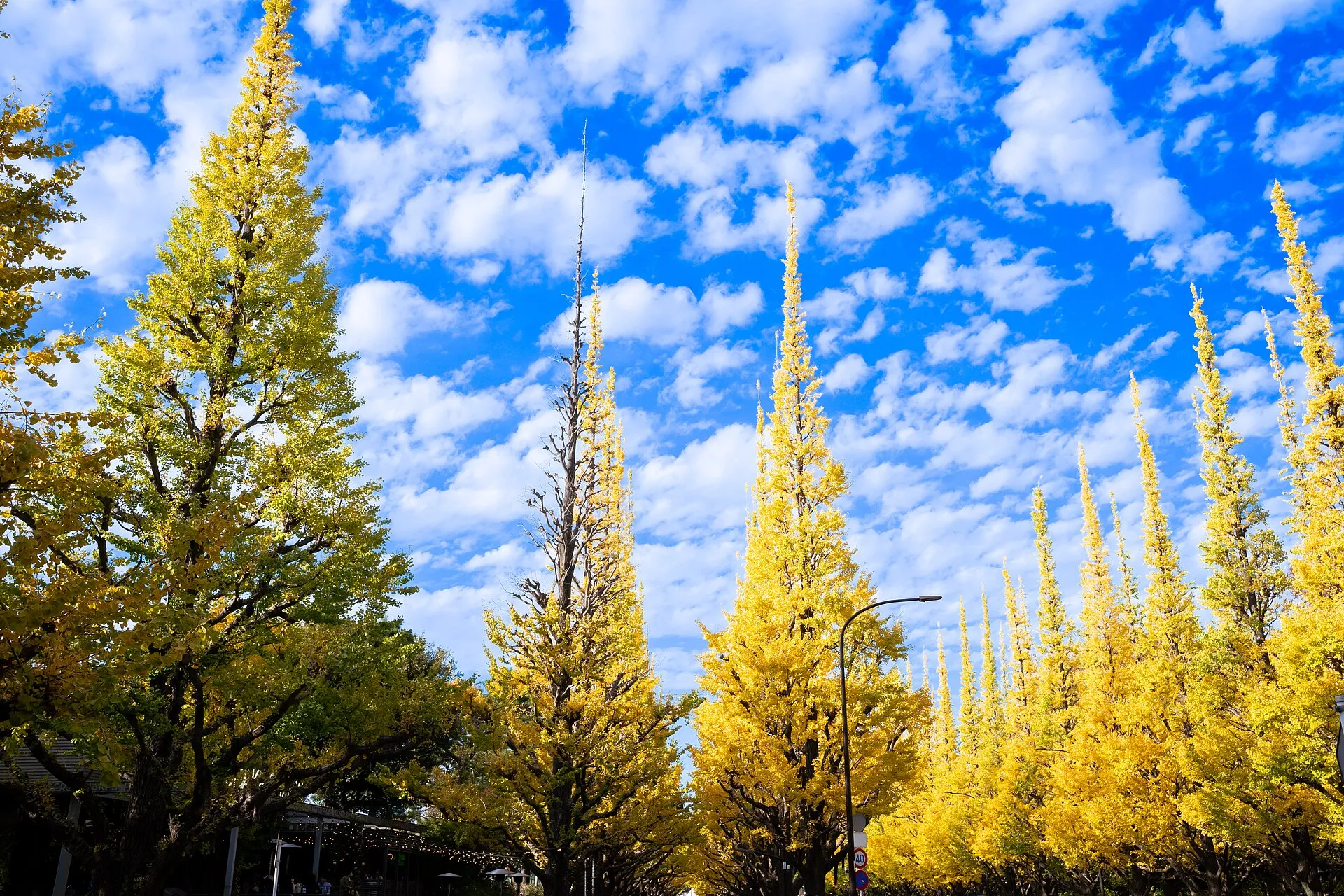
Golden ginkgo trees lining the grand avenue at Meiji Jingu Gaien in late autumn. Photo: Kakidai, Wikimedia Commons, CC BY-SA 4.0.
As November progresses, the leaves turn brilliant chrome yellow, eventually falling to create a continuous golden carpet across pedestrian footpaths. On autumn weekends, the avenue is pedestrianised, hosting street food stalls serving roasted sweet potatoes (yaki-imo) and hot tea. Stroll all the way down to the Meiji Memorial Picture Gallery at the northern terminus for symmetrical photos.
2. Rikugien Garden
Admission ¥300 · Open 9:00 to 17:00 (night lighting to 20:30) · Open daily in autumn
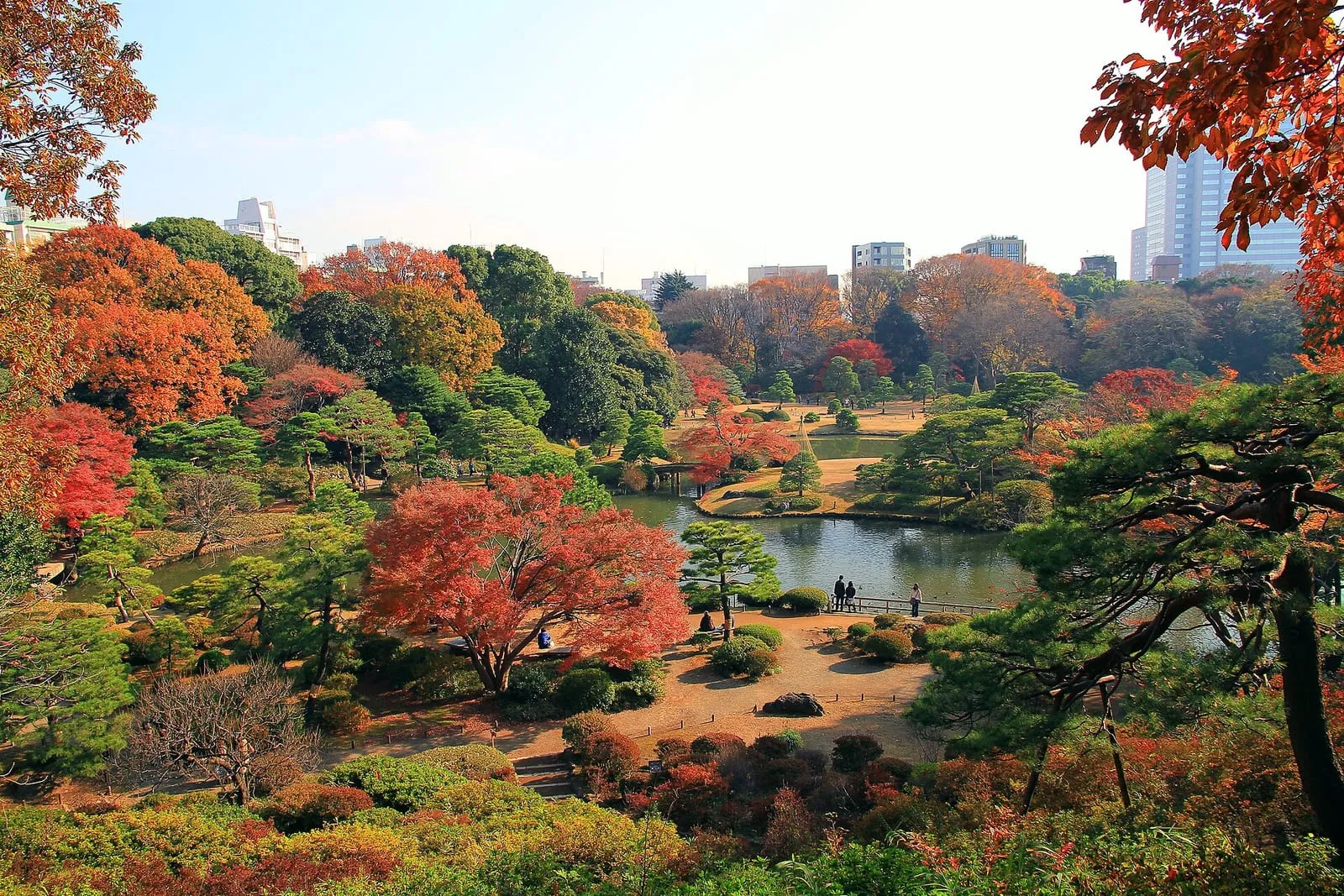
Constructed between 1695 and 1702 by Yanagisawa Yoshiyasu, a senior adviser to the fifth Tokugawa shogun, Rikugien is regarded as one of Tokyo’s most refined Edo stroll gardens. Over 400 Japanese maples and 560 ginkgos surround a large central pond (Sensui).
The garden is famous for its special evening autumn illumination event (Teien Yakan Tokubetsu Kansho). Soft floodlights illuminate crimson maple branches arching over stone lanterns and the thatched Tsutsuji-chaya teahouse, casting mirrored reflections across the dark water. Advanced online ticketing is recommended for weekend evening sessions via the Tokyo Metropolitan Park Association portal.
3. Koishikawa Korakuen
Admission ¥300 · Open 9:00 to 17:00 (last entry 16:30) · Open daily in autumn
Adjacent to the Tokyo Dome entertainment complex, Koishikawa Korakuen was laid out in 1629 by Tokugawa Yorifusa, the daimyo of Mito. The garden incorporates Chinese philosophical motifs into traditional Japanese landscape design.
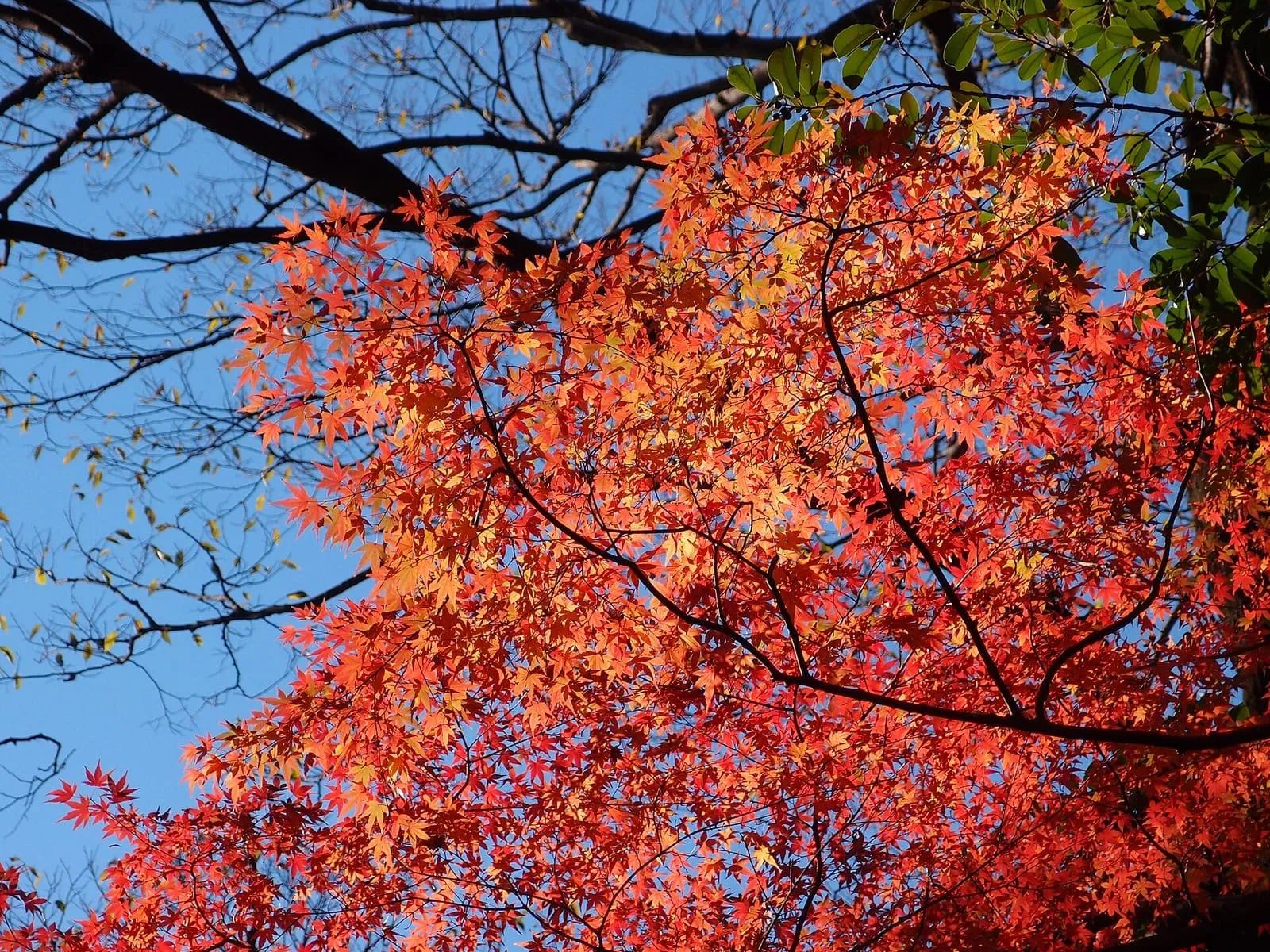
Bright red maple leaves framing stone garden features at Koishikawa Korakuen. Photo: Guilhem Vellut, Wikimedia Commons, CC BY 2.0.
In late November, groves of Japanese maples turn fiery scarlet along the Oi River (Oigawa) stone embankment, around the Engetsu-kyo (Full Moon Bridge), and beside the rustic Togetsukyo wooden crossing. The contrast between ancient wooden pavilions, mossy banks, and modern glass office towers in the background epitomises Tokyo’s urban duality.
4. Shinjuku Gyoen National Garden
Admission ¥500 · 9:00 to 16:00 (gates shut 16:30) · Closed Mondays
Shinjuku Gyoen offers extensive autumn displays across its 144 acres. The primary foliage viewing area is Momijiyama (Maple Hill), located near the Shinjuku Gate, where dense groves of Japanese maples frame gentle grassy hillocks.
In the Japanese garden sector, weeping willows and maples frame the historic wooden Taiwan Pavilion and quiet reflective waterways. Early November also brings the annual Chrysanthemum Exhibition (Kitsuka-ten), displaying prize-winning floral arrangements beneath open-sided wooden pavilions. Remember that Shinjuku Gyoen closes on Mondays; if Monday is a public holiday, it closes the following Tuesday.
5. Mount Takao (Takaosan)
Free mountain entry · Keio Line from Shinjuku: 50 minutes, ¥430 one-way
If you wish to experience autumn in an authentic mountain setting without traveling far from the capital, take the Keio Line express from Shinjuku Station to Takaosanguchi Station.
Mount Takao rises 599 metres above sea level and attracts over three million hikers annually. The mountain’s cable car (which ascends Japan’s steepest railway incline at 31 degrees) glides through a tunnel of fiery red maples. At the summit, observation platforms provide sweeping vistas of Mount Fuji framed by autumn boughs. Complete your hike by visiting the 8th-century Yakuo-in Buddhist temple and soaking in the open-air Keio Takaosan Onsen bathhouse beside the railway station.
Autumn leaf day trips from Tokyo
If your trip occurs earlier in autumn (late October to mid-November), mountain regions in nearby prefectures offer peak colour well before the city leaves turn:
- Nikko National Park (Late October to early November): Located 120 km north of Tokyo in Tochigi Prefecture, Nikko’s higher elevation causes leaves around Lake Chuzenji, Ryuzu Falls, and Kegon Falls to ignite in shades of burnt orange and vermilion by late October, moving down to Toshogu Shrine by early November.
- Hakone & Lake Ashi (Early to mid-November): The mountain slopes flanking the Hakone Ropeway, Owakudani, and the shores of Lake Ashi display rich autumn palettes two weeks before central Tokyo.
- Mount Fuji & Lake Kawaguchiko (Mid-November): The celebrated “Maple Corridor” (Momiji Kairo) along the northern shore of Lake Kawaguchiko features sixty centuries-old maple trees arching over a canal, with night illuminations and Mount Fuji reflected in the lake.
Guided autumn foliage tours
Joining a guided walking or day tour ensures comfortable transport to scenic viewpoints while eliminating the stress of train ticketing during busy autumn weekends.
| Tour | Duration & Destination | Best Autumn Feature | Price |
|---|---|---|---|
| Imperial Palace Historic Walking Tourad | 2 hours; central Tokyo | Ninomaru gardens, stone moats, and autumn foliage history | From ¥1,000 |
| Nikko World Heritage & Waterfalls Day Tripad | 10.5 hours; Tochigi mountains | Early foliage around Lake Chuzenji, Kegon Falls, and Toshogu | From ¥12,367 |
| Mount Takao Hike with Onsen & Feastad | 8 hours; mountain trail | Forested maple trails, summit Fuji vistas, and hot spring bath | From ¥14,000 |
Tokyo: Imperial Palace and Shogun Walking Tour
From ¥1,000 · 4.8 stars from 2,486 reviews · 2 hours · Historical palace walk
Tokyo: Imperial Palace and Shogun Walking Tourad guides visitors through the historic grounds of Edo Castle, detailing samurai intrigue and shogun defensive design while strolling past the autumn foliage of the outer palace moats.
Nikko World Heritage Day Trip with Kegon Falls & Lake Chuzenji
From ¥12,437 · 4.6 stars from 2,536 reviews · 10.5 hours · UNESCO autumn foliage
Nikko World Heritage Day Trip with Kegon Falls & Lake Chuzenjiad takes travellers into Tochigi’s mountainous autumn landscape, visiting the gold-leaf Toshogu Shrine and the thundering Kegon Falls during peak mountain foliage.
Tokyo: Mt Takao Tour with Ramen and Hot Spring
From ¥19,017 · 5.0 stars from 119 reviews · 8 hours · Mountain hiking & foliage
Tokyo: Mt Takao Tour with Ramen and Hot Springad pairs a scenic mountain hike beneath red maple canopies with hearty bowls of ramen and an authentic soak in an open-air natural onsen.
Practical autumn travel tips
- Layered clothing: Late November temperatures fluctuate between daytime highs of 16–18 °C and chilly evening lows of 7–9 °C. Wear versatile layers, including a light wool coat, scarf, and comfortable walking shoes.
- Early sunset: The sun sets early in Tokyo during late November (typically between 16:25 and 16:35). Garden gates close earlier than in summer; Shinjuku Gyoen and the Imperial Palace East Gardens close at 16:00 (last entry 15:30). Plan garden visits for morning or midday.
- Weekly closing days: Always check operating schedules: the Imperial Palace East Gardens close every Monday and Friday. Rikugien and Koishikawa Korakuen remain open seven days a week throughout the autumn foliage season.
For detailed closing days across all 55 city sights, consult the Tokyo hub. Explore full multi-day itineraries in our 3 days in Tokyo and 5 days in Tokyo planning guides.
Common questions
When do autumn leaves turn in Tokyo?
Tokyo's autumn foliage peaks between mid-November and early December. The Japan Meteorological Agency's sample trees in central Tokyo turn yellow (ginkgo) around 23 November and deep red (Japanese maple) around 28 November.
Where are the best spots to see autumn leaves in Tokyo?
The finest autumn spots are the golden ginkgo avenue at Meiji Jingu Gaien (Icho Namiki), the illuminated landscaped pond gardens of Rikugien and Koishikawa Korakuen (¥300 admission each), Shinjuku Gyoen's Japanese stroll garden (¥500), and Mount Takao's forested mountain trails.
Are Japanese gardens open on Mondays in autumn?
Rikugien and Koishikawa Korakuen remain open daily throughout autumn. In contrast, the Imperial Palace East Gardens are closed on Mondays and Fridays, and Shinjuku Gyoen is closed on Mondays (except during its special early November Chrysanthemum Exhibition).
Do Tokyo gardens light up autumn foliage at night?
Yes. Rikugien Garden stages a celebrated evening illumination event (*teien yakan tokubetsu kansho*), lighting Japanese maples and historic stone bridges around its central pond from sunset until 20:30.