In this guide
💡 The Short Version: The Imperial Palace East Gardens (Kokyo Higashi Gyoen) occupy the historic inner fortress of Edo Castle and are completely free to enter. However, they are strictly closed every Monday and Friday, as well as from 28 December to 3 January. Seasonal closing hours change throughout the year: during winter (1 November to the end of February), the grounds close at 16:00 (final entry at 15:30). Access is via Otemon, Hirakawa-mon, or Kitahanebashi-mon Gate, where staff perform routine bag inspections. Otemachi and Tokyo stations are the primary railway gateways. Or book a tour: travellers wanting to understand the samurai politics of the Tokugawa shogunate can join the Tokyo: Imperial Palace and Shogun Walking Tourad (from ¥1,000, 4.8 stars from 2,486 reviews) for an expert historical orientation. All prices are in Japanese yen (¥).
Seasonal opening hours and closure rules
Maintained by the Imperial Household Agency (Kunaicho), the 21-hectare (52-acre) East Gardens encompass the historic Honmaru (main defense keep) and Ninomaru (second compound) of Edo Castle. The gardens were opened to the general public in 1968.
Because the Imperial Household Agency maintains security protocols around the adjacent residential palace grounds, operational hours are strictly regulated by season:
| Season | Calendar dates | Opening time | Closing time | Final admission |
|---|---|---|---|---|
| Winter | 1 November to 28 February | 09:00 | 16:00 | 15:30 |
| Early Spring | 1 March to 14 April | 09:00 | 17:00 | 16:30 |
| Spring & Summer | 15 April to 31 August | 09:00 | 18:00 | 17:30 |
| Early Autumn | 1 September to 30 September | 09:00 | 17:00 | 16:30 |
| Mid Autumn | 1 October to 31 October | 09:00 | 16:30 | 16:00 |
- Weekly closed days: The gardens are closed every Monday and Friday.
- Holiday exception rules: If a Monday or Friday is a Japanese national public holiday (such as Autumn Equinox or Culture Day), the gardens open to the public on that holiday, and the mandatory closure shifts to the subsequent non-holiday weekday (typically Tuesday).
- Annual holiday closure: The grounds close completely from 28 December through 3 January for the New Year holiday period.
- Imperial Court ceremonies: The gardens occasionally close without extended advance notice for state functions, such as ambassador credential presentations or visits by foreign heads of state.
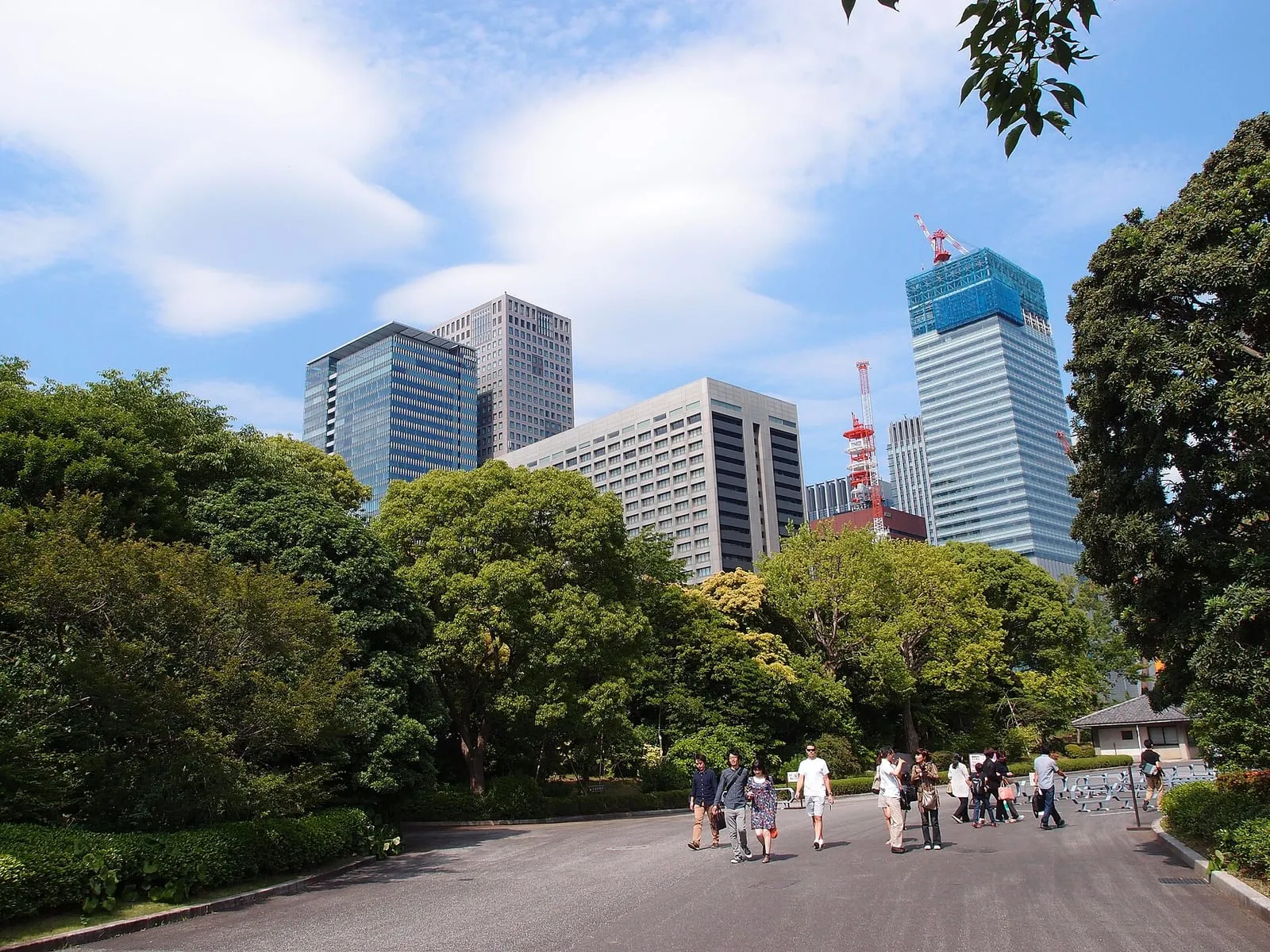
The open manicured lawns of the Honmaru enclosure at the Imperial Palace East Gardens. Photo: Guilhem Vellut, Wikimedia Commons, CC BY 2.0.
The three access gates and entry procedures
Entry to the East Gardens is completely free. There are no paper tickets or automated turnstiles, but all visitors must enter through one of three designated security gates:
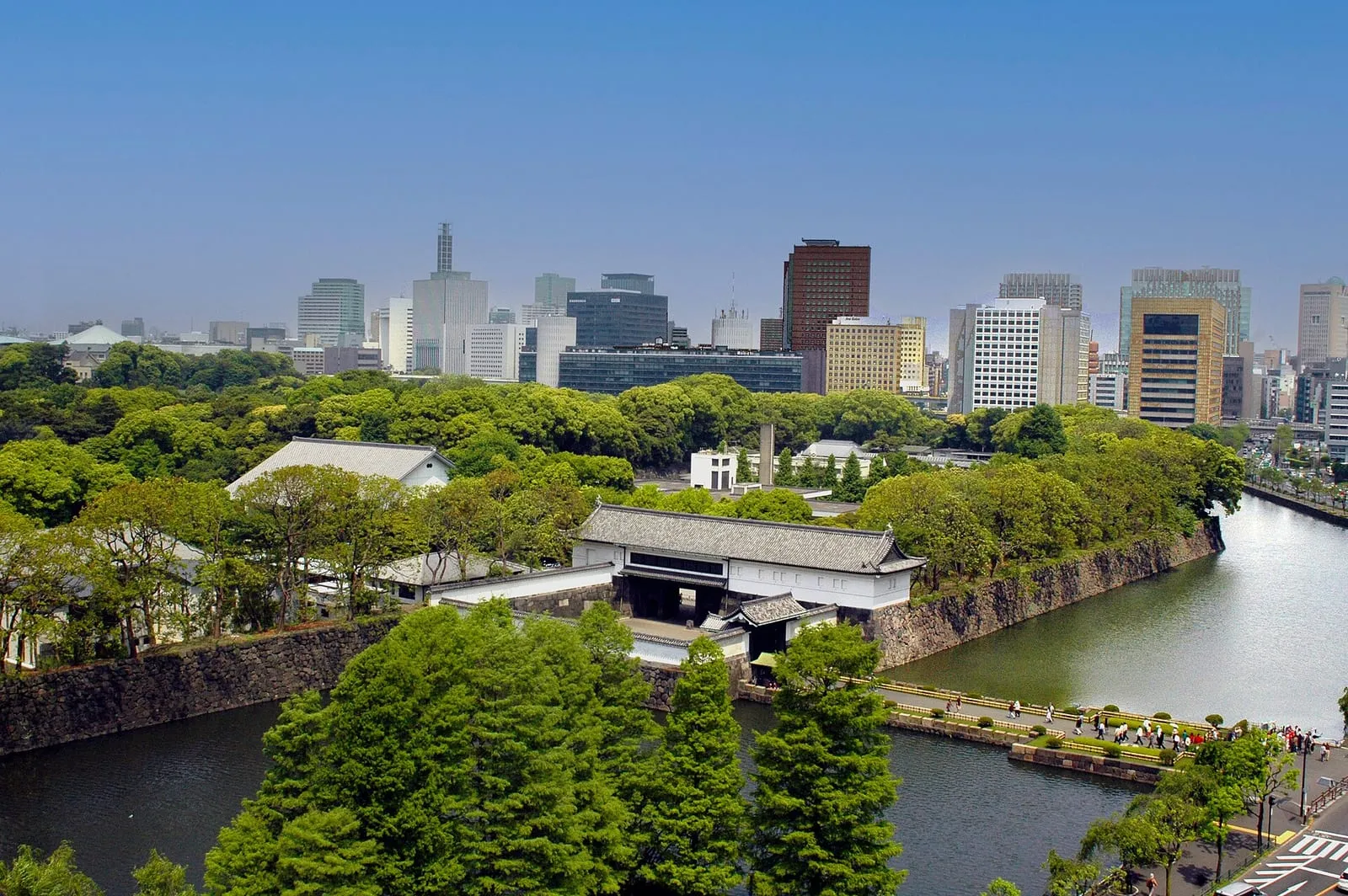
- Otemon Gate (Great Hand Gate): The primary ceremonial entrance to Edo Castle. Positioned on the east side across a wide stone bridge over the outer moat, it features the massive outer Watariyagura-mon timber defense gatehouse. It is the most convenient entrance for travellers walking from Otemachi Station (Tokyo Metro Chiyoda, Marunouchi, Tozai, Hanzomon, and Toei Mita lines, Exit C13a, 5 minutes) or Tokyo Station (Marunouchi North Exit, 10 minutes).
- Hirakawa-mon Gate: Located at the northeast corner of the grounds. Historically used by high-ranking maidens of the shogun’s private harem (O-oku) and for discrete departures from the castle. Positioned 5 minutes from Takebashi Station on the Tokyo Metro Tozai Line (Exit 1a).
- Kitahanebashi-mon Gate (Northern Drawbridge Gate): Positioned along the northern perimeter moat. This gate connects the East Gardens directly across the road to Kitanomaru Park, home to the Nippon Budokan arena and the National Museum of Modern Art, Tokyo (MOMAT).
Entry procedures and visitor regulations
- Bag inspection: Visitors must open all rucksacks, handbags, and camera cases for visual inspection by palace security guards at the gatehouse.
- Prohibited items: Alcohol, drones, unmanned aerial vehicles, sports equipment (footballs, frisbees, bicycles, skateboards), pets (except certified guide dogs), and camping equipment are strictly prohibited.
- Smoking and litter: The entire palace precinct is strictly non-smoking, and there are no rubbish bins in the gardens; visitors must carry out all personal litter.
Top sights within the East Gardens
The gardens are divided into three historically distinct sections corresponding to the feudal layout of the Tokugawa shogunate:
1. The Honmaru (Main Enclosure)
The Honmaru was the political and administrative nerve centre of feudal Japan from 1603 to 1867, housing the shogun’s audience chambers, government ministries, and the private living quarters of the shogun’s family.
- The Tenshudai (Castle Keep Base): The imposing granite foundation platform of the former five-storey main castle tower (Tenshu). Built from massive interlocking megaliths without mortar, the original keep rose 58 metres into the sky, making it the tallest castle keep in Japanese history. It burned to the ground in the Great Meireki Fire of 1657. Instead of rebuilding the keep, Shogun Tokugawa Ietsuna chose to divert state funds toward rebuilding the residential quarters of Edo. Visitors can climb a stone ramp to the top of the platform for panoramic views across the gardens and the Marunouchi commercial skyline.
- Matsu no Oroka (The Great Pine Corridor): A stone marker designates the site of the long covered corridor adorned with painted sliding screens of pine trees. In March 1701, Lord Asano Naganori of Ako drew his short sword and wounded master of protocol Kira Yoshinaka following an insult. Drawing a blade within Edo Castle was an offence punishable by immediate ritual suicide (seppuku), setting off the celebrated real-world revenge of the Forty-Seven Ronin.
- Tokagakudo (Peach Blossom Music Hall): An octagonal concert hall completed in 1966 to commemorate the 60th birthday of Empress Kojun, decorated with mosaic porcelain tiles depicting pine, bamboo, and plum blossoms.
2. The Ninomaru (Second Enclosure)
Located below the Honmaru plateau, the Ninomaru was designed as a tranquil residential retreat and garden.
- The Stroll Garden (Kaiyushiki Teien): A traditional walking garden reconstructed in 1968 based on historical architectural drawings from the era of the ninth shogun, Tokugawa Ieshige. It features winding pebble pathways, wooden footbridges, and ponds stocked with hirenaga nishikigoi (long-finned carp developed through crossbreeding Japanese koi with Indonesian carp).
- The Prefectural Grove: A curated botanical grove containing 260 indigenous trees representing 30 distinct species donated by all 47 prefectures of Japan.
- Suwa no Chaya: A charming traditional cedar teahouse originally built in 1912 within the Fukiage garden of the palace, relocated to the Ninomaru in 1968.
3. The Sannomaru (Third Enclosure) & The Guardhouses
- The Three Guardhouses: Near Otemon Gate stand three surviving wooden guardhouses: the Doshin Bansho (staffed by samurai guards checking visitor credentials), the Hyakunin Bansho (the “100-man guardhouse”, an elongated 45-metre timber barrack staffed by four shifts of twenty-five samurai guards and ninja inspectors), and the O-bansho (the final high-ranking checkpoint before entering the Honmaru).
- Museum of the Imperial Collections (Sannomaru Shozokan): Administered by the National Institutes for Cultural Heritage, this museum exhibits rare cultural treasures, calligraphy scrolls, lacquerware, and folding screen masterpieces presented to or inherited by the Imperial Family across centuries. Admission fees apply for special temporary exhibitions.
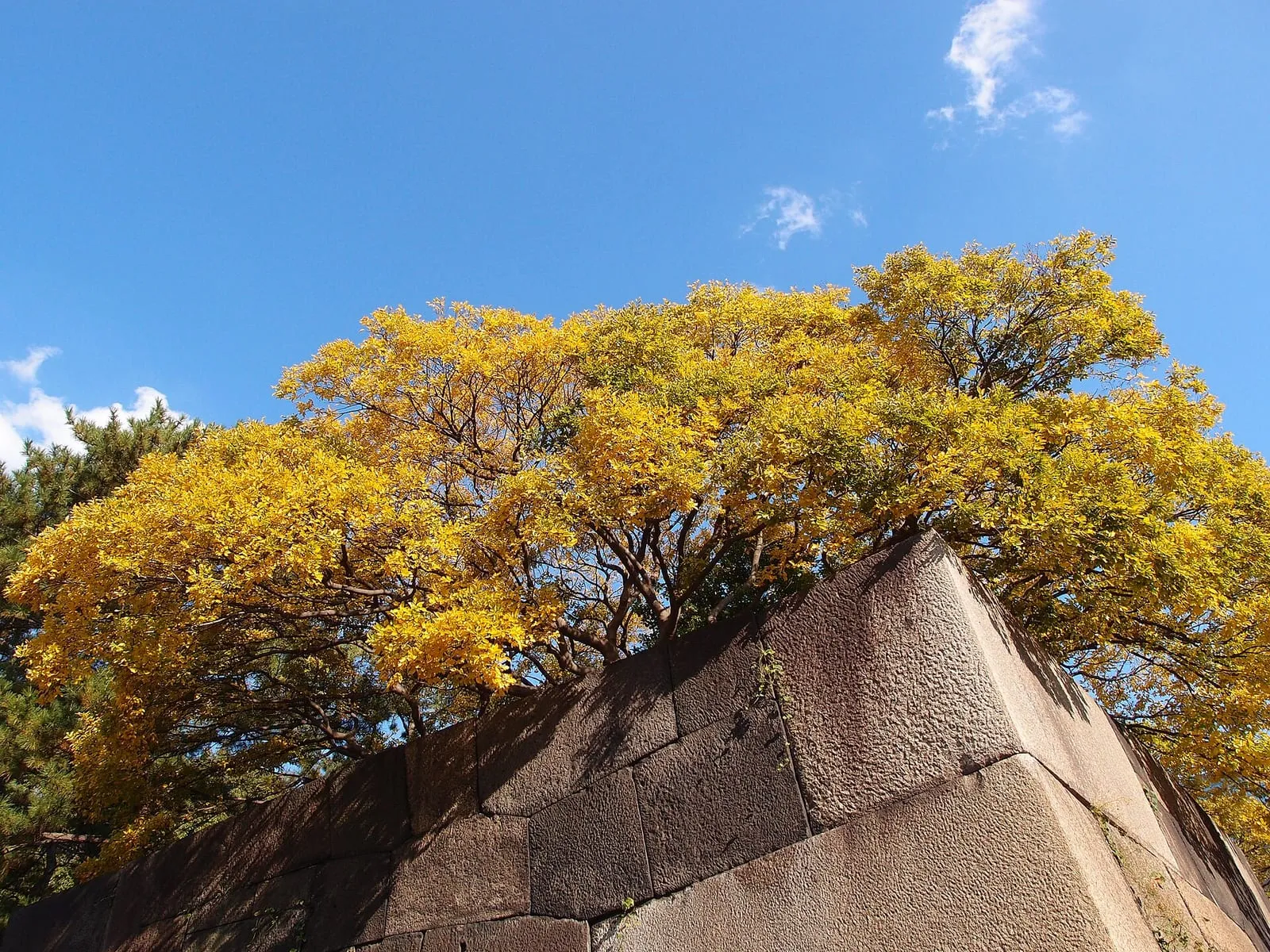
Autumn foliage over the colossal dry-stone defensive walls of Edo Castle. Photo: Guilhem Vellut, Wikimedia Commons, CC BY 2.0.
Comparing self-guided visits and palace walking tours
While entering the East Gardens independently is free, joining a small-group walking tour helps decipher the invisible architectural layers of Edo:
| Option | Cost | Duration | What is included | Best for |
|---|---|---|---|---|
| Independent Visit | Free | 1 to 2 hours | Free access to Honmaru, Ninomaru, and Tenshudai | Budget travellers wanting a peaceful stroll through gardens |
| Imperial Palace & Shogun Tour | From ¥1,000 | 2 hours | Guided walk covering Edo Castle history and Otemon gates | First-time visitors wanting historical background at low cost |
| In-Depth Japanese History Walk | From ¥6,000 | 2 hours | Extensive commentary on Meiji Restoration and shogunate politics | History enthusiasts seeking detailed political analysis |
Popular guided palace tours
Pre-booking an organized walking tour ensures you navigate the outer perimeter, moats, and gardens with a licensed historical guide:
Tokyo: Imperial Palace and Shogun Walking Tour
From ¥1,000 · 4.8 stars from 2,486 reviews · 2 hours
The Tokyo: Imperial Palace and Shogun Walking Tourad provides an exceptional value introduction to the grounds. The guide meets participants outside Tokyo Station, walks through the Kokyo Gaien outer plaza to view the famous Nijubashi double bridge, and leads the group into the East Gardens via Otemon Gate to examine the massive Tenshudai stone base and the 100-man guardhouse.
Tokyo: Imperial Palace A Walk Through Japanese History
From ¥6,000 · 4.9 stars from 1,964 reviews · 2 hours
The Tokyo: Imperial Palace A Walk Through Japanese Historyad explores the political transition from the Tokugawa samurai shogunate to the Meiji Emperor’s modern state in 1868, detailing how Tokyo transformed from feudal Edo into a modern capital.
Tokyo: Imperial Palace and Shogun Storytelling Walk
From ¥4,800 · 4.9 stars from 295 reviews · 2 hours
The Tokyo: Imperial Palace Walk with Shogun and Samurai Storiesad focuses on the legendary characters of the Edo period, detailing the dramatic sword incident of the Forty-Seven Ronin at the Pine Corridor and the architectural engineering behind the castle’s massive stone moats.
Where to go next
Because the East Gardens are positioned directly between Tokyo Station and Chiyoda’s business core, a morning garden visit pairs naturally with lunch or shopping in the Marunouchi or Ginza commercial quarters.
To coordinate museum openings and garden schedules across the city, consult our comprehensive guide to Tokyo’s museums and our curated list of free things to do in Tokyo. In our 3-day Tokyo itinerary, the East Gardens feature on Day Three alongside modern waterfront art.
For transit options to Otemachi and Tokyo stations, see our complete guide to Tokyo public transport, and discover all attraction bookings on the Tokyo hub.
Common questions
When are the Imperial Palace East Gardens closed?
The East Gardens are closed every Monday and every Friday throughout the year, from 28 December to 3 January for the New Year holidays, and during official Imperial Court ceremonies. If a Monday or Friday coincides with a national public holiday, the gardens open on that holiday and close on the following weekday instead (typically Tuesday).
What are the opening hours of the Imperial Palace East Gardens?
The gardens open daily at 09:00. Closing times vary seasonally: 16:00 from 1 November to the end of February (final admission 15:30); 17:00 in March, September, and the first half of April; 18:00 from 15 April to 31 August; and 16:30 in October. Admission ends 30 minutes before closing.
Is there an entrance fee for the East Gardens?
No. Admission to the Imperial Palace East Gardens is completely free. Visitors pass through a mandatory security bag inspection at one of the three access gates upon entry.
Which gates provide access to the East Gardens?
Visitors can enter through Otemon Gate (closest to Otemachi and Tokyo stations), Hirakawa-mon Gate (near Takebashi Station), and Kitahanebashi-mon Gate (connecting directly to Kitanomaru Park).
Can you see the Emperor or the Imperial Palace interior from the gardens?
No. The East Gardens occupy the site of the former Edo Castle inner compound. The modern Imperial Palace residence and agency administrative buildings are situated in the private western grounds, which are closed to the public except for pre-registered guided palace perimeter tours and twice-yearly public appearances (the Emperor's Birthday on 23 February and the New Year greeting on 2 January).