In this guide
💡 The Short Version: Tokyo’s winter illuminations (fuyu no irumineeshon) are among the world’s most elaborate public light installations, turning urban plazas into brilliant LED landscapes from early November through 25 December (with many continuing into February). Signature displays include the Keyakizaka avenue at Roppongi Hills (framing Tokyo Tower), the champagne-gold promenade of Marunouchi beside Tokyo Station, and the cosmic lawn at Tokyo Midtown. Christmas is not a public holiday in Japan, so all shops, observation decks, and transport networks operate normally. December evenings are crisp and dry (temperatures average 4 to 8 °C). Or book a tour: warm up on an evening Shinjuku food and izakaya crawlad from ¥13,200.
The cultural context: Christmas and winter illuminations in Japan
Unlike in Western nations, where Christmas is primarily an intimate family holiday centered on religious observance and home dinners, in Japan Christmas is celebrated as a modern, romantic, and commercial festival.
Christmas Eve is Japan’s premier romantic evening of the year, rivalling Valentine’s Day. Couples book candlelit dinners months ahead at French, Italian, and sushi restaurants, exchange delicate gifts, and stroll through elaborate citywide winter light installations known as fuyu no irumineeshon.
For families and friends, Christmas traditions center on two culinary fixtures:
- KFC Fried Chicken: Originating from a wildly successful 1974 marketing campaign titled “Kentucky for Christmas” (Kurisumasu ni wa Kentakkii), millions of Japanese households pre-order party barrels of fried chicken weeks in advance to collect on 24 December.
- Christmas Cake (Kurisumasu Keki): A light, fluffy sponge cake filled with whipped cream and fresh red strawberries, representing the red-and-white colours of the Japanese flag. Bakeries and department store basements (depachika) sell hundreds of thousands of cakes on 24 and 25 December.
Because Christmas is not a statutory public holiday, all museums, observation decks, restaurants, and train lines operate on full regular weekday schedules.
The major Tokyo illumination programmes
Tokyo’s corporate developers invest millions of pounds each winter to illuminate pedestrian thoroughfares, public gardens, and retail plazas with energy-efficient LED displays. All major public outdoor illuminations are free to enter.
| Event / District | 2026/2027 Dates | Location & Nearest Station | Operating Hours | Signature Feature |
|---|---|---|---|---|
| Roppongi Hills Keyakizaka | 5 November to 25 December 2026 | Roppongi Hills (Roppongi Station) | 17:00 to 23:00 | 800,000 blue and white LEDs lining Keyakizaka-dori, framing Tokyo Tower. German Christmas market in Oyane Plaza. |
| Tokyo Midtown Winter Lights | Mid-November to 25 December 2026 | Tokyo Midtown (Roppongi Station) | 17:00 to 23:00 | Expansive LED light field across Midtown Garden; outdoor ice-skating rink (Midtown Ice Rink). |
| Marunouchi Illumination | 12 November 2026 to mid-February 2027 | Marunouchi Naka-dori (Tokyo Station) | 16:00 to 23:00 (to 24:00 in Dec) | 1.2 km tree-lined boulevard draped in 1.2 million champagne-gold LEDs powered by green electricity. |
| Shibuya Blue Cave (Ao no Dokutsu) | Early December to 25 December 2026 | Koen-dori to Yoyogi Park (Shibuya Station) | 17:00 to 22:00 | 600,000 deep blue LEDs reflecting off glossy street sheeting to create an ethereal blue tunnel. |
| Yebisu Garden Place | Early November 2026 to mid-January 2027 | Yebisu Garden Place (Ebisu Station) | 16:00 to 23:00 | Colossal 5-metre Baccarat crystal chandelier featuring 8,500 crystal pieces and 250 lights. |
| Tokyo Skytree Town Dream Christmas | Early November to 25 December 2026 | Tokyo Skytree Town (Oshiage Station) | 16:00 to 24:00 | Festive lighting projections on the 634-metre tower; Christmas market and eight-metre tree. |
1. Roppongi Hills Keyakizaka and Christmas Hills
Keyakizaka-dori · 17:00 to 23:00 · Free access · Direct access from Roppongi Station (Exit 1C)
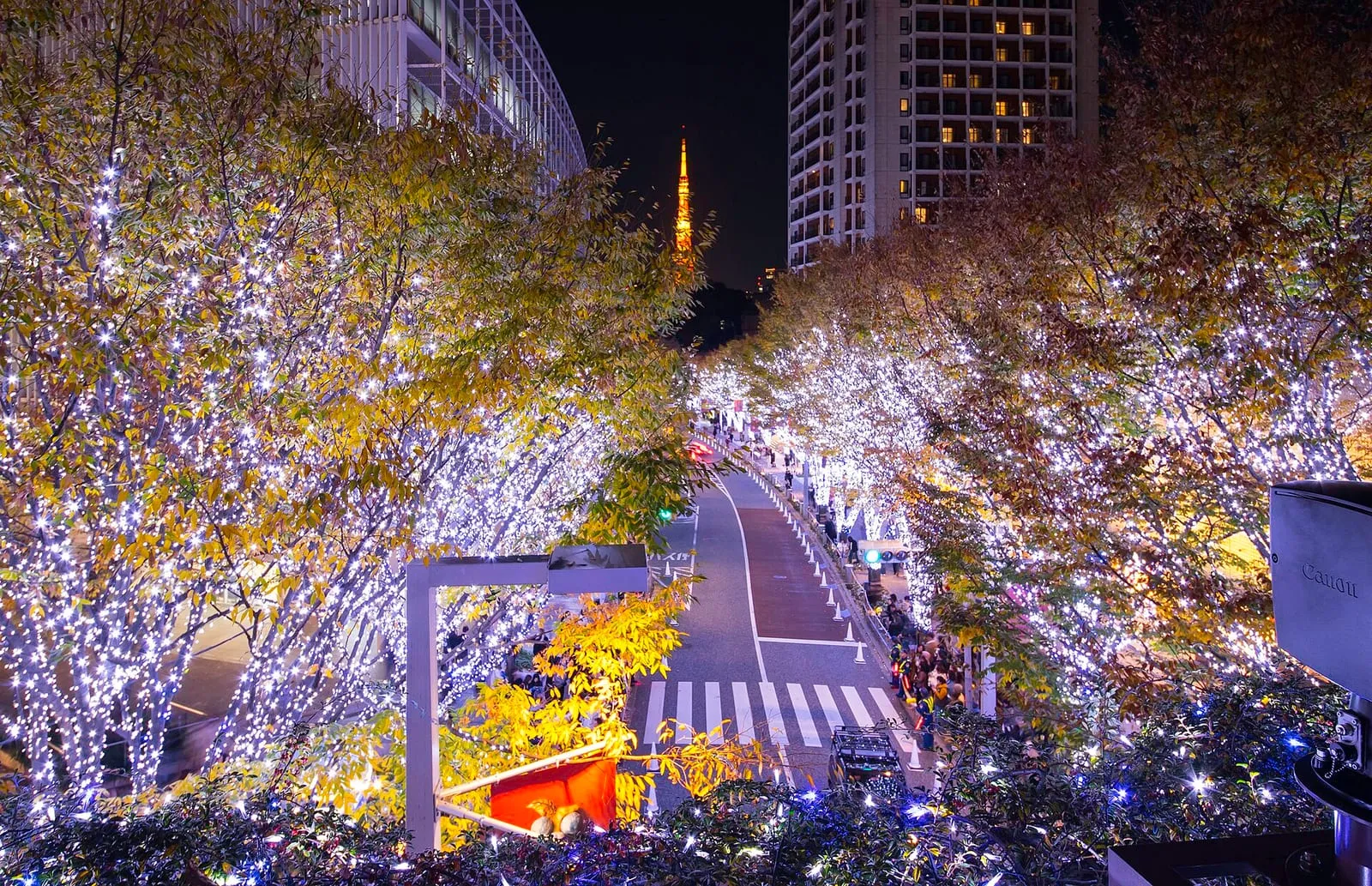
The Keyakizaka Illumination at Roppongi Hills is widely considered Tokyo’s most photogenic winter setting. Keyakizaka Street, a gentle 400-metre curved boulevard, is lined with 800,000 sparkling “Snow & Blue” LEDs draped over zelkova trees. The viewing bridge near the Tiffany & Co. boutique provides an aligned postcard composition: glowing silver-blue branches framing the warm orange glow of Tokyo Tower centered in the distance.
The wider “Christmas Hills” festival links five Mori Building urban developments:
- Roppongi Hills: Hosts an authentic German-style Christmas Market (Weihnachtsmarkt) inside the covered Oyane Plaza, offering mulled wine (glühwein), bratwurst, and handmade German wooden ornaments.
- Azabudai Hills: Central Tokyo’s newest architectural marvel features a massive Christmas market with festive food chalets beneath the soaring Mori JP Tower, home to teamLab Borderless.
- Toranomon Hills & Omotesando Hills: Architectural installations and luxury retail light displays.
2. Tokyo Midtown: Midtown Winter Lights
Midtown Garden · 17:00 to 23:00 · Free entry · Direct access from Roppongi Station (Exit 8)
Just a short walk across Roppongi from Roppongi Hills, Tokyo Midtown presents an entirely distinct aesthetic. The rear Midtown Garden features the celebrated “Promenade of Light”, where golden trees lead to a vast open lawn transformed into a cosmic field of blue and violet LEDs with dynamic sound-and-light choreography.
Tokyo Midtown also constructs Tokyo’s largest outdoor open-air ice-skating rink (Midtown Ice Rink), accommodating up to 200 skaters under night floodlights with rental skates provided (open from late November to late February).
3. Marunouchi Illumination and Bright Holiday
Marunouchi Naka-dori · 16:00 to 23:00 (until 24:00 in December) · Beside Tokyo Station
Directly outside the historic red-brick Marunouchi facade of Tokyo Station, the upscale Marunouchi commercial district stages the elegant Marunouchi Illumination.
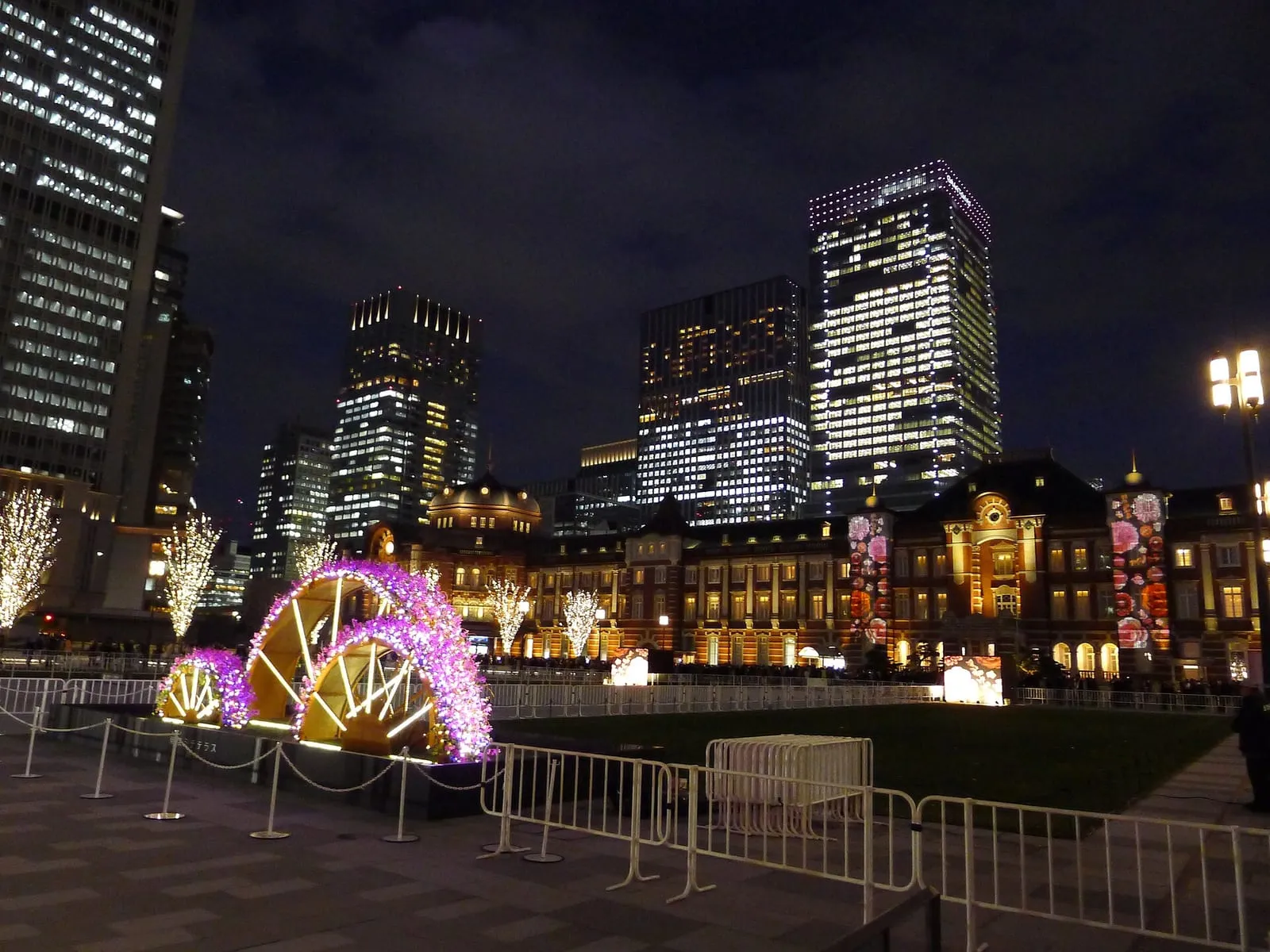
The Tokyo Station building and Marunouchi towers at night with illuminated decorations on the square in front. Photo: Indiana jo, Wikimedia Commons, CC BY-SA 4.0.
Marunouchi Naka-dori, a paved pedestrianised shopping avenue lined with international luxury boutiques and cafes, drapes approximately 360 street trees in more than 1.2 million signature “Champagne Gold” LEDs. The installation runs on 100 per cent green electricity generated from solar and wind power. Associated retail atriums inside the Marunouchi Building and Shin-Marunouchi Building host seasonal themed indoor displays (such as the Marunouchi Bright Holiday).
4. Shibuya Blue Cave (Ao no Dokutsu)
Koen-dori to Yoyogi Park Zelkova Avenue · 17:00 to 22:00 · Free admission
For an immersive colour experience, the Blue Cave begins on Shibuya Koen-dori and continues along the 800-metre pedestrian tree avenue into Yoyogi Park.
Over 600,000 pure sapphire-blue LEDs wrap the trunks and canopy of dozens of zelkova trees. High-gloss reflective sheets are laid across the central walking path, mirroring the blue light overhead and underfoot to create the sensation of floating inside an endless subterranean cavern. The installation draws massive crowds of young Tokyoites and couples throughout December.
5. Yebisu Garden Place: The Baccarat Eternal Lights
Central Square, Ebisu · 16:00 to 23:00 · Free access · 5 minutes via Ebisu Skywalk from JR Ebisu
Ebisu’s former brewery grounds showcase one of Tokyo’s most opulent traditional holiday displays: a five-metre-tall, three-metre-wide Baccarat crystal chandelier. Featuring 8,500 hand-cut crystal pieces and 250 individual light bulbs, the masterpiece is housed inside an illuminated glass display vitrine in the center of the European-style cobblestone plaza. Red carpet paths lead from the chandelier down to timber Christmas chalets selling hot raclette cheese and spiced cider.
Warm indoor winter experiences
When winter temperatures drop after sunset (December averages a brisk 3.8 °C low), combine outdoor illumination walks with warm indoor experiences:
- High-altitude observation decks: Winter brings the clearest atmospheric visibility of the entire year. Gaze out over Tokyo’s glowing nocturnal grid from Shibuya Sky (open until 22:30), Tokyo Skytree (open until 22:00), or Roppongi Hills Mori Tower (open until 22:00). Review all vantage points in our Tokyo observation decks guide.
- Magical Winter at Warner Bros. Studio Tour Tokyo: The Harry Potter Studio Tour in Nerima stages its annual “Hogwarts in the Snow” winter feature from mid-November to early January, coating the 1:24 scale Hogwarts Castle model in realistic artificial snow and serving festive seasonal British afternoon teas.
- Traditional public bathhouses (Sento): Nothing restores tired legs after an evening illumination walk like soaking in hot mineral baths. Public sento baths across Tokyo charge a statutory flat rate of ¥550 for adults: find top historic locations in onsen and sento in Tokyo.
Guided winter evening tours
Joining an evening guided food tour takes the chill out of winter sightseeing, providing access to heated izakayas and steaming hot-pot dishes without language barriers.
| Tour | Duration & Setting | Why it excels in winter | Price |
|---|---|---|---|
| Shinjuku Food Tour (13 Dishes across 4 Venues)ad | 3 hours; heated evening food crawl | Warm up with sizzling yakitori, hot dashi broths, and gyoza in hidden backstreets | From ¥13,200 |
| Shinjuku Local Bar & Izakaya Crawlad | 3 hours; Golden Gai & Omoide Yokocho | Intimate 6-seat heated bars, craft sake tasting, and lively social atmosphere | From ¥5,700 |
| Best of Tokyo Full-Day Tourad | 6 hours; central Tokyo highlights | Seamless daytime transit connecting to evening illumination walks | From ¥16,000 |
Tokyo: Shinjuku Food Tour (13 Dishes and 4 Eateries)
From ¥13,200 · 4.9 stars from 3,939 reviews · 3 hours · Evening food crawl
Tokyo: Shinjuku Food Tour (13 Dishes and 4 Eateries)ad provides a wonderful winter evening feast, ducking into four authentic, heated dining establishments across Shinjuku’s neon alleyways for seasonal delicacies and izakaya specialities.
Tokyo: Shinjuku Local Bar & Izakaya Crawl Tour
From ¥6,000 · 4.9 stars from 2,966 reviews · 3 hours · Nightlife walk
Tokyo: Shinjuku Local Bar & Izakaya Crawl Tourad guides travellers through the post-war alleys of Omoide Yokocho and Golden Gai, sampling warm sake and regional drinks with an English-speaking guide.
Best of Tokyo: Guided Full-Day City Tour with a Local
From ¥20,248 · 4.6 stars from 250 reviews · 6 hours · Small group
Best of Tokyo: Guided Full-Day City Tour with a Localad ensures seamless daytime exploration of Asakusa and Meiji Jingu, positioning you perfectly for winter illuminations at dusk.
Practical tips for winter illumination visits
- Optimal timing: Dusk arrives early in December (sunset is between 16:28 and 16:32 JST). The most dramatic photographs occur during the “blue hour” between 16:45 and 17:30, when the twilight sky glows deep cobalt against golden LED displays.
- Cold weather gear: Winter temperatures drop rapidly once the sun sets. Pack a windproof coat, gloves, a warm scarf, and purchase disposable chemical hand-warmer heat packs (kairo) from any convenience store for ¥50 to slip into your coat pockets.
- Preparing for year-end closures: Remember that while Christmas operates as normal business days, Tokyo undergoes a massive citywide closure from 29 December through 3 January for the New Year holiday. Check our detailed shutdown schedule in New Year in Tokyo.
Browse booking deadlines and ticket links for every observation deck and museum on our Tokyo hub.
Common questions
When do Christmas illuminations start in Tokyo?
Major winter illuminations in Tokyo open in early to mid-November and run through 25 December, with several prominent displays (such as Marunouchi and Tokyo Midtown) remaining illuminated until mid-February. Keyakizaka at Roppongi Hills typically switches on during the first week of November.
Where are the best Christmas light displays in Tokyo?
The top illumination spectacles are the Keyakizaka 'Snow and Blue' avenue at Roppongi Hills (framing Tokyo Tower), the champagne-gold tree-lined avenue along Marunouchi Naka-dori beside Tokyo Station, the cosmic LED garden at Tokyo Midtown, and the Shibuya Blue Cave (*Ao no Dokutsu*) near Yoyogi Park.
Is Christmas a public holiday in Japan?
No. Neither Christmas Eve (24 December) nor Christmas Day (25 December) is a statutory public holiday in Japan. Corporate offices, banks, retail shops, and public transport operate on standard weekday schedules. Sights and restaurants remain fully open.
How do people celebrate Christmas in Japan?
In Japan, Christmas Eve is celebrated primarily as a romantic date night for couples, featuring dinner reservations at upscale restaurants, viewing city illuminations, and sharing a traditional strawberry sponge 'Christmas cake' (*Kurisumasu keki*). Families famously celebrate with buckets of Kentucky Fried Chicken (KFC), a nationwide holiday custom established in 1974.