💡 The Short Version: Experiencing Kyoto’s greatest landmarks does not require large ticket budgets. Several of the city’s most renowned attractions—including Fushimi Inari Shrine, the Arashiyama Bamboo Grove, and Gion—are completely free and open to the public 24 hours a day. Or book a tour: the Gion Magical Night Walking Tourad provides affordable cultural storytelling through historic preservation quarters.
While entrance fees to major Buddhist temples like Kinkaku-ji (¥500) and Kiyomizu-dera (¥500) add up across a week-long stay, Kyoto has many free shrines, gardens, and historic walks. Because Shinto shrines operate as civic sacred spaces and many mountain trails double as municipal public rights of way, you can build entire days around major sights without paying admission.
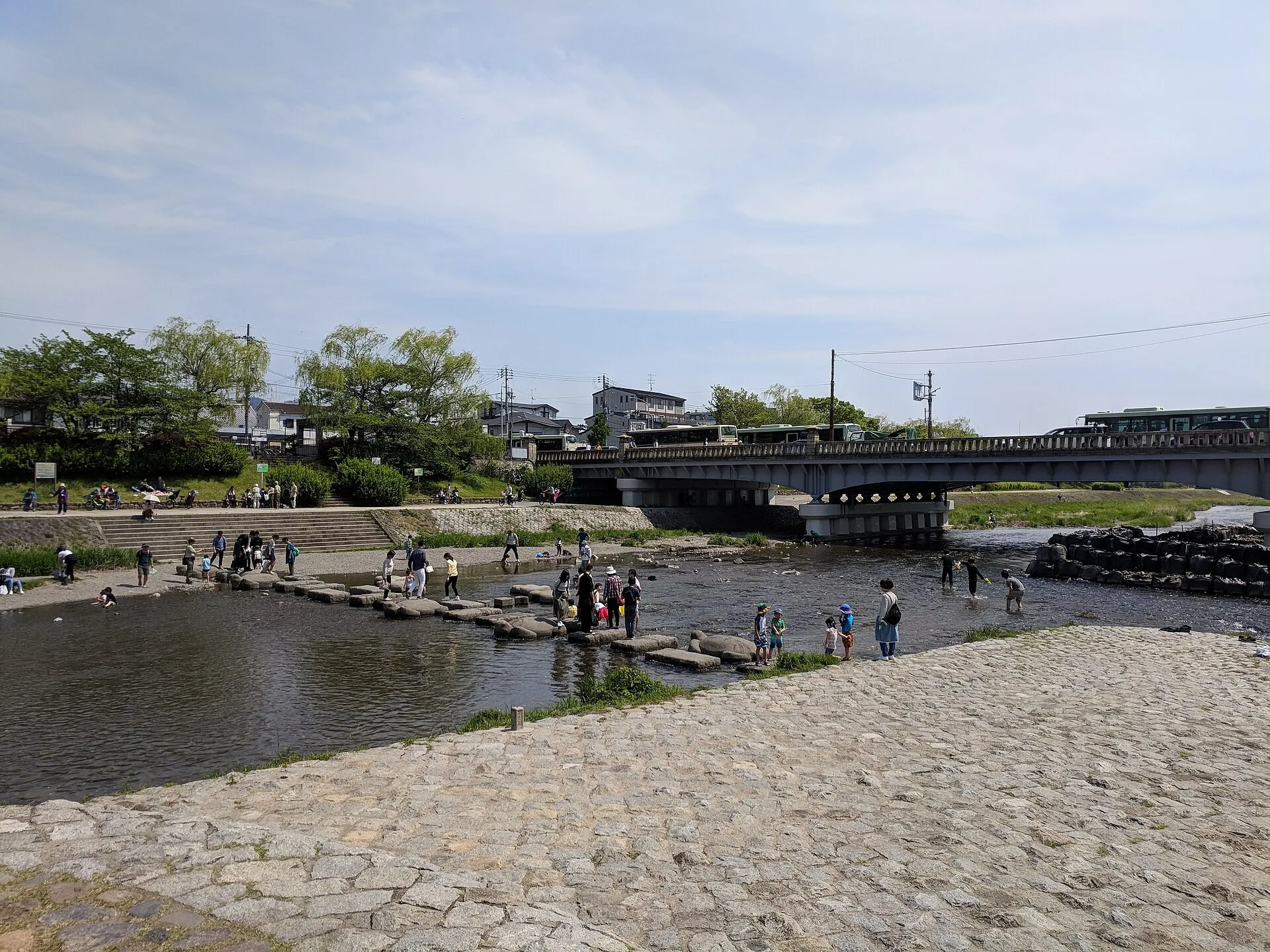 Pedestrians hopping across the turtle-shaped stepping stones in the shallow waters of the Kamo River. Photo: Grendelkhan, Wikimedia Commons, CC BY-SA 4.0.
Top free sights and walks in Kyoto
1. Fushimi Inari Taisha
Kyoto’s most photographed Shinto sanctuary charges no admission fee. Dedicated to Inari, the deity of rice, agriculture, and business prosperity, the shrine features thousands of vivid vermilion torii gates winding four kilometres up the wooded slopes of Mount Inari.
Because the mountain trails are open 24 hours a day with no entry gates or closing hours, visiting at dawn (before 07:00) or late at night under glowing stone lanterns allows you to experience the mystical forest pathways in complete solitude. Read our detailed route guide in the Fushimi Inari Shrine guide.
2. Arashiyama Bamboo Grove
The soaring emerald stalks of the Arashiyama Bamboo Grove form a pedestrian avenue connecting the northern gate of Tenryu-ji to the historic villa of Okochi Sanso. It is a public municipal right of way, completely free and open 24/7.
To hear the natural soundscape—the creaking of towering bamboo culms and rustling leaves named by the Ministry of the Environment as one of Japan’s “100 Soundscapes to be Preserved”—arrive between 06:30 and 07:30 before day-tripper crowds and rickshaws arrive. See logistics in our Arashiyama Bamboo Grove guide.
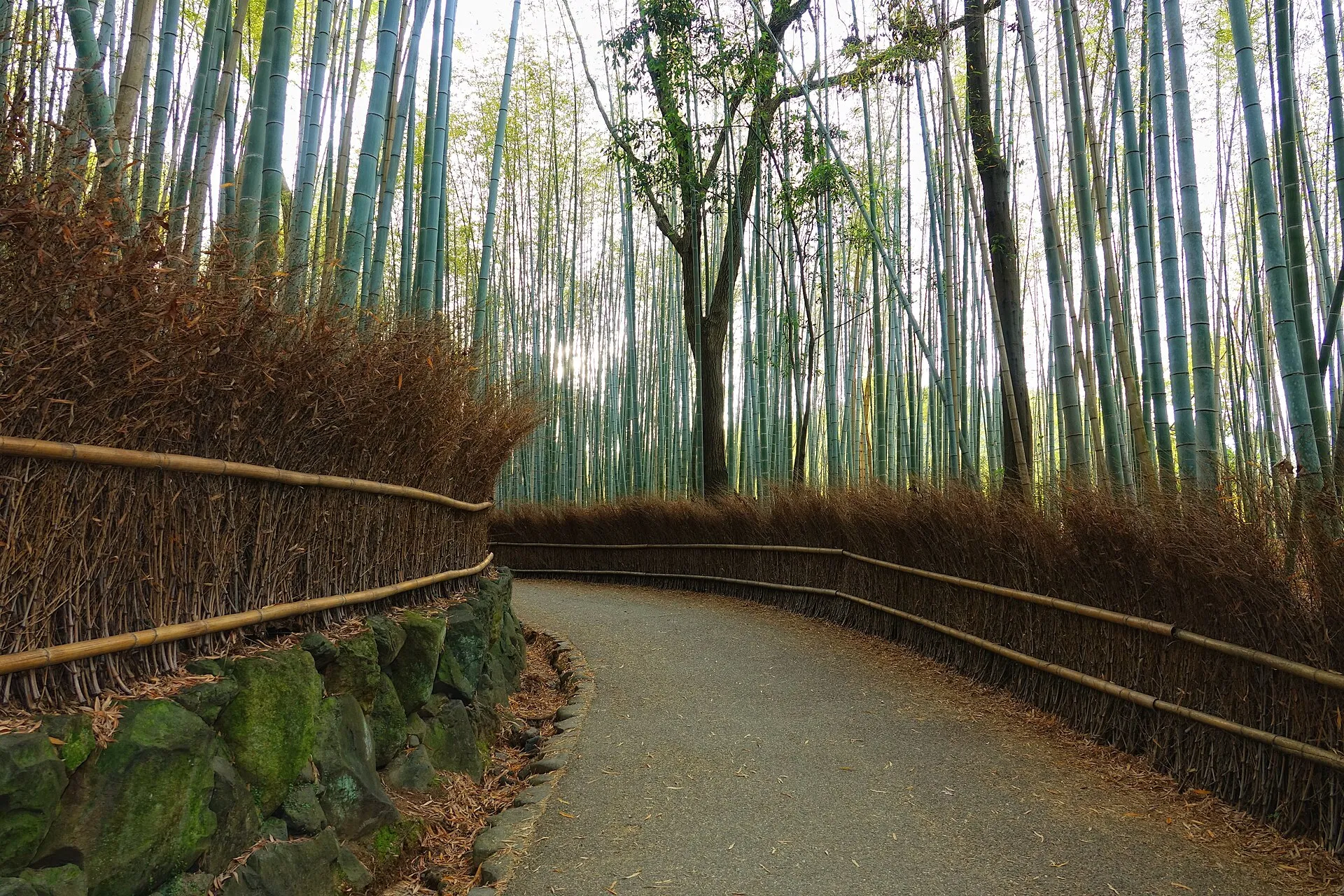 A quiet walking path winding through the towering green stalks of the Arashiyama Bamboo Grove. Photo: Bjørn Christian Tørrissen, Wikimedia Commons, CC BY-SA 4.0.
3. The Philosopher’s Path (Tetsugaku-no-Michi)
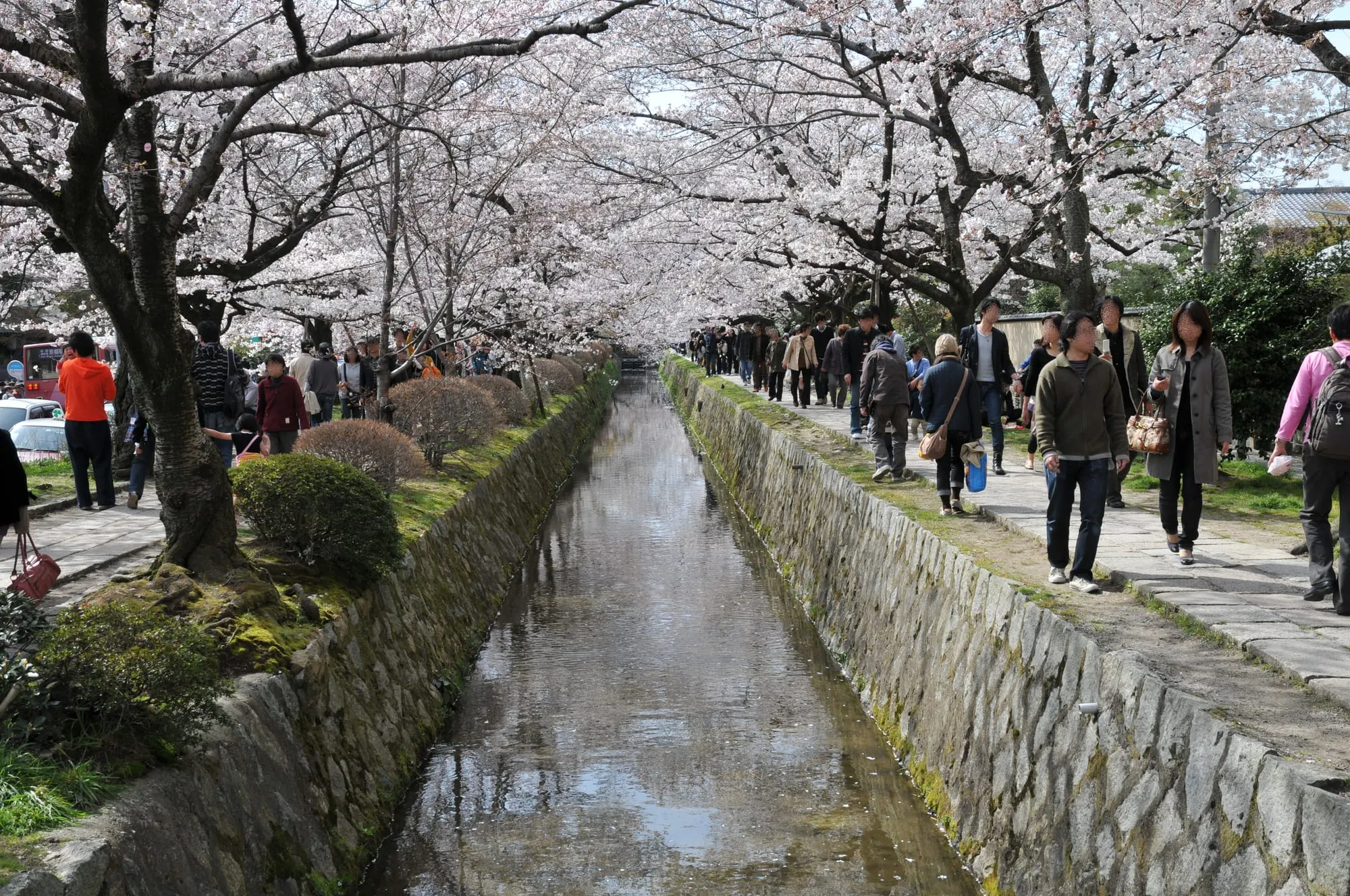
Stretching roughly two kilometres along a stone-lined canal in the eastern Higashiyama foothills between Ginkaku-ji and Nanzen-ji, this tree-shaded walking path is named after Kyoto University philosopher Nishida Kitaro (1870–1945), who paced the waterway during daily meditation.
The path is bordered by several hundred cherry trees that burst into delicate pink blossoms in early April and fiery red foliage in late November. Along the route, make a free detour into the grounds of Honen-in Temple: while the main sanctuary charges admission during rare special viewings, entering its rustic thatched gate and admiring its raked white sand mounds (byakusadan) is free year-round from 06:00 to 16:00.
4. Yasaka Shrine and Maruyama Park
Marking the eastern terminus of Shijo-dori in Gion, Yasaka Shrine is free to visit at any hour. At night, the central dance pavilion (Buden) is illuminated by hundreds of white paper lanterns, providing an atmospheric evening stroll.
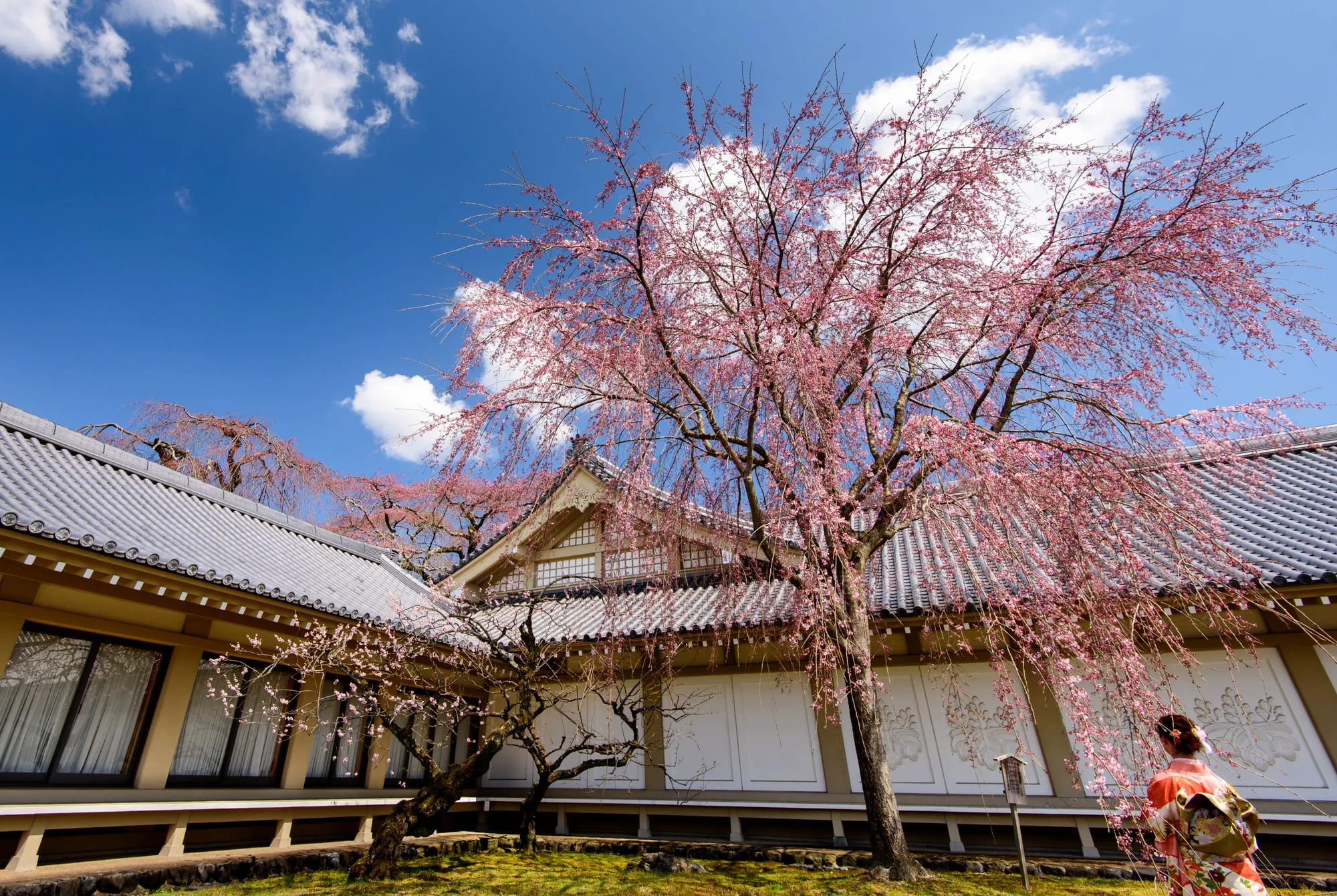
The rear of the shrine complex opens directly into Maruyama Park, Kyoto’s oldest municipal public park (established 1886). The park is famous for its towering weeping cherry tree (Gion Shidarezakura), which is dramatically floodlit each spring during hanami picnic season.
5. Kyoto Imperial Palace (Kyoto Gyoen)
The former residence of the Emperor of Japan until the capital moved to Tokyo in 1869, the Kyoto Imperial Palace is situated within the vast 65-hectare Kyoto Gyoen National Garden in central Kyoto.
While the surrounding gravel park—filled with mature pine trees, lawn groves, and weeping plum trees—is open 24/7, the interior walled palace complex itself is also completely free to enter. Visitors pass through a simple security bag check at the Seisho-mon Gate. You can walk the self-guided route through courtyards, viewing the Shishinden (Hall for State Ceremonies) and the Oikeniwa pond garden, or download the Imperial Household Agency’s free multi-language audio guide app.
- Palace hours: 09:00 to 16:30 (April to August), closing earlier in winter. Closed Mondays (or Tuesday if Monday is a national holiday).
6. Nanzen-ji Temple Grounds and Suirokaku Aqueduct
While ascending the upper gallery of Nanzen-ji’s massive two-storey wooden Sanmon Gate costs ¥600 and viewing the Hojo rock garden costs ¥600, walking through the pine-shaded temple grounds is completely free.
Tucked into the hillside behind the main hall stands Suirokaku, an impressive red-brick aqueduct constructed in 1890 as part of the Lake Biwa Canal project. Its Roman-style arches against the tranquil backdrop of Japanese forest make it one of the city’s most distinctive architectural sights.
7. Kamo River Promenade and Stepping Stones
The wide gravel paths along the banks of the Kamo River (Kamogawa) run uninterrupted through central Kyoto. A favourite local activity is crossing the river via concrete stepping stones shaped like turtles and birds, located at the Demachiyanagi delta where the Kamo and Takano rivers merge. Pack a bento from a supermarket and sit on the grassy embankment at sunset alongside Kyoto university students and families.
8. Kyoto Station Sky Garden and Grand Staircase
The ultra-modern glass-and-steel Kyoto Station building, designed by architect Hiroshi Hara, offers several free architectural viewpoints:
- Daikaidan (Grand Staircase): A sweeping 171-step outdoor staircase rising from the 4th to the 11th floor, illuminated nightly by 15,000 LED bulbs forming seasonal animations.
- Sky Garden & Rooftop Plaza: A panoramic open-air viewing deck on the 15th floor offering sweeping views across the Kyoto basin, from Kyoto Tower directly below to the Higashiyama hills, open daily from 06:00 to 23:00 for free.
- Skyway Tunnel: A glass-enclosed pedestrian catwalk suspended 45 metres above the station’s central concourse, open 10:00 to 22:00 for free.
Tours
Gion Magical Night Walking Tour & Geisha Culture
From ¥4,032 · 4.9 stars from 5,349 reviews · 100 minutes · Small-group evening tour Book on GetYourGuidead
An affordable walking tour that connects free sights around Gion, Yasaka Shrine, and the Shirakawa canal. Your guide shares historical stories, cultural context, and explains local etiquette so you avoid restricted private alleys.
Kyoto Hidden Gems E-Bike Tour Through Backstreets & Temples
From ¥13,500 · 4.9 stars from 328 reviews · 4 hours · Guided cycling tour Book on GetYourGuidead
A cycling adventure along the Kamo River paths and quiet residential lanes of eastern Kyoto. Takes in quiet hillside shrines, canal pathways, and scenic neighbourhoods difficult to cover on foot.
Arashiyama Bamboo Forest, Monkey Park & Temple Tour
From ¥6,300 · 4.9 stars from 745 reviews · 4 hours · Guided walking tour Book on GetYourGuidead
Combines the free Arashiyama Bamboo Grove with guided commentary through Tenryu-ji’s historic Zen landscape garden and the mountain hike up to Iwatayama Monkey Park.
Full-Day Kyoto Walking Tour: Iconic Landmarks & Nature
From ¥14,900 · 5.0 stars from 30 reviews · 8 hours · Active day tour Book on GetYourGuidead
A full-day guided walking experience tailored for active travellers. Combines Kyoto’s best free parks, river pathways, and outer forested districts with hillside temple paths, providing rich cultural context throughout.
Budget summary: Free sights vs paid attractions
| Sight | Admission cost | Opening hours | Best time to visit |
|---|---|---|---|
| Fushimi Inari Taisha | Free | Open 24/7 | Before 07:00 or after sunset |
| Arashiyama Bamboo Grove | Free | Open 24/7 | 06:30 to 07:30 |
| Philosopher’s Path & Honen-in grounds | Free | Path 24/7; grounds 06:00–16:00 | Early morning or late afternoon |
| Yasaka Shrine & Maruyama Park | Free | Open 24/7 | Dusk when lanterns are lit |
| Kyoto Imperial Palace (Kyoto Gyoen) | Free | 09:00–16:30 (closed Mondays) | Mid-morning on weekdays |
| Nanzen-ji grounds & Suirokaku aqueduct | Free | Grounds open 24/7 | 08:00 to 09:30 |
| Kyoto Station Sky Garden & Grand Staircase | Free | 06:00 to 23:00 | Sunset to late evening |
| Kinkaku-ji (Golden Pavilion) | ¥500 | 09:00 to 17:00 | 09:00 sharp or 16:00 |
| Kiyomizu-dera Main Hall & Stage | ¥500 | 06:00 to 18:00 | 06:00 at gate opening |
| Nijo Castle & Ninomaru Palace | ¥1,300 | 08:45 to 17:00 | 08:45 opening |
Pair these free outdoor walks with visits to Kyoto’s historic food streets in our Nishiki Market guide or learn how to navigate the city on a budget in our public transport guide.
Common questions
Are temples in Kyoto free to visit?
Most major Buddhist temples (such as Kiyomizu-dera and Kinkaku-ji) charge modest admission fees (usually 400 to 800 yen). Most Shinto shrines (like Fushimi Inari and Yasaka Shrine) are completely free.
Is the Arashiyama Bamboo Grove free?
Yes. The bamboo path is a public road and costs nothing to enter at any hour of the day or night.
What is the Philosopher's Path?
The Philosopher's Path is a free, picturesque 2-kilometre stone pedestrian trail following a cherry-tree-lined canal between Ginkaku-ji and Nanzen-ji in eastern Kyoto.