In this guide
💡 The Short Version: Nara is the classic heritage day trip from Kyoto, reachable in 35 to 45 minutes by train. Take the Kintetsu Line to Kintetsu-Nara Station (35 mins on Limited Express for ¥1,280, or 45 mins on Express for ¥720) to arrive right at the park gates, rather than JR Nara Station which sits 1.5 km west. Booking a Kintetsu Rail Passad{rel=“sponsored nofollow noopener”} covers all regular Kintetsu trains between Kyoto, Nara and Osaka. Todai-ji’s Great Buddha costs ¥800 in cash at the gate, and packs of deer crackers (shika-senbei) cost ¥200. Or book a tour: when you want to avoid midday crowds and learn the eighth-century Buddhist history with a guide, the Nara early morning tourad (from ¥9,000, 4.9 stars from 669 reviews) visits Todai-ji and the deer park before day-tripper crowds arrive.
Train routes from Kyoto to Nara
Two railway operators connect Kyoto Station to Nara. Both accept IC cards (ICOCA, Suica) at automatic ticket barriers.
| Route & service | Travel time | One-way fare | Notes |
|---|---|---|---|
| Kintetsu Limited Express | 35 mins | ¥1,280 | All seats reserved; departs hourly from Kyoto Station (Kintetsu platforms) |
| Kintetsu Express (Standard) | 45 mins | ¥720 | Commuter-style seating; no reservation required; arrives at Kintetsu-Nara |
| JR Miyakoji Rapid | 45 mins | ¥720 | Departs twice hourly (Platforms 8, 9, 10); fully covered by national JR Pass |
| JR Local Train | 70 mins | ¥720 | Stops at all intermediate stations including Inari; avoid for direct travel |
- Why Kintetsu is better for walkers: Kintetsu-Nara Station is an underground station exiting straight onto Noborioji-dori, just 5 minutes on foot from Kofuku-ji Temple and the western boundary of Nara Park. JR Nara Station is situated further west in the commercial town, requiring a 20-minute walk (or a short bus ride) to reach the park.
- Using rail passes: Travellers with an active Japan Rail Pass should take the JR Miyakoji Rapid to avoid additional fares. Independent travellers paying out of pocket should take Kintetsu for faster, more convenient park access. The Kintetsu Rail Passad{rel=“sponsored nofollow noopener”} offers unlimited travel on Kintetsu lines connecting Kyoto, Nara, and Osaka.
Guided tours from Kyoto to Nara
A guided day trip removes the friction of train transfers and provides deep insight into early Japanese Buddhism, shogunal politics, and ancient Shinto nature worship.
Nara early morning deer park and Todai-ji tour
From ¥9,000 · 4.9 stars from 669 reviews · 3½ to 4½ hours · small group
Nara Early Morning Tour (Kyoto or Osaka Departure Available)ad: meets early at Kyoto Station to arrive in Nara Park before midday school excursions and tour buses fill the Kasuga Taisha woodland paths. Includes guided entry to Todai-ji’s Daibutsuden hall, historic commentary, and deer cracker feeding.
Four headline sights coach excursion
From ¥9,200 · 4.3 stars from 1,876 reviews · 9 to 10 hours · air-conditioned coach
Osaka/Kyoto: Kinkaku-ji, Arashiyama, Fushimi Inari & Naraad: links Nara directly with Kyoto’s three major headline sights—the Golden Pavilion at Kinkaku-ji, the Arashiyama bamboo grove, and Fushimi Inari Shrine—on dedicated coach transport without changing trains.
Combined Nara and Uji traditional matcha bus tour
From ¥19,000 · 4.9 stars from 234 reviews · 8½ hours · tea tasting included
Kyoto: Nara & Traditional Matcha Experience Bus Tourad: pairs the Great Buddha and deer park of Nara with the riverside green tea plantations of Uji, including an authentic matcha grinding and tasting workshop.
Official ticket or tour: the costs side by side
Independent transit and admissions versus guided day tours.
| Option | Official admission | Tour price | What it covers |
|---|---|---|---|
| Independent visit (JR Miyakoji Rapid return) | ¥1,440 train + ¥800 Todai-ji = ¥2,240 | — | Self-guided train travel, Daibutsuden admission, park stroll |
| Independent visit (Kintetsu Limited Express return) | ¥2,560 train + ¥800 Todai-ji = ¥3,360 | — | Faster transit, reserved seats, 5-minute walk to park |
| Nara early morning guided tour | Admission included | From ¥9,000 | Early morning guided walk, Todai-ji admission, deer crackers |
| Kyoto & Nara 4-sight coach tour | Admissions included | From ¥9,200 | Nara deer park, Kinkaku-ji, Arashiyama, Fushimi Inari, coach travel |
| Nara & Uji matcha bus tour | Admissions included | From ¥19,000 | Todai-ji, Nara deer, Uji Byodoin Temple, matcha tea workshop |
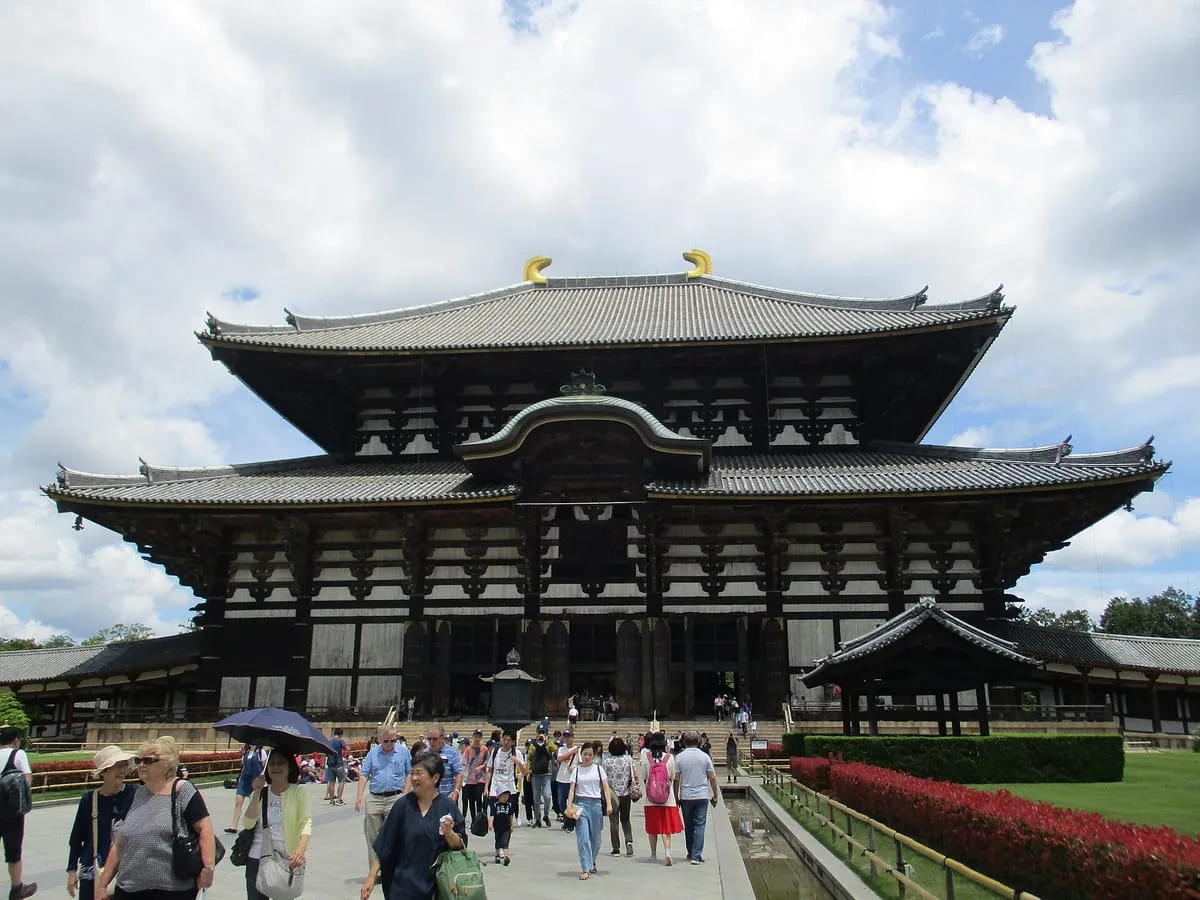
The Daibutsuden hall at Todai-ji Temple. Photo: JordyMeow, Wikimedia Commons, CC BY-SA 3.0.
What to see in Nara: complete walking itinerary
Nara (Heijo-kyo) served as Japan’s capital from 710 to 784 AD, an era when Buddhism was adopted as the official protector of the state. The primary sights form a compact 4-kilometre walking loop starting from Kintetsu-Nara Station:
1. Kofuku-ji Temple
Located just 5 minutes east of Kintetsu-Nara Station. Founded in 669 by the powerful Fujiwara clan, the temple features a magnificent 50-metre five-storey wooden pagoda (Gojunoto), the second-tallest in Japan. The exterior grounds are free to wander; the National Treasure Museum (admission ¥700) displays masterwork eighth-century Buddhist sculptures, including the famous three-faced, six-armed statue of Ashura.
2. The sacred sika deer of Nara Park
According to Shinto mythology, Takemikazuchi-no-Mikoto, the patron deity of Kasuga Taisha, arrived riding a sacred white deer from Kashima. Ever since, Nara’s deer have been protected by law as divine messengers. Today, over 1,200 wild deer graze freely across 500 hectares of manicured turf and ancient woods.
- Deer crackers (Shika-senbei): Buy official bundles of wheat-flour and rice-bran crackers (¥200 fixed price) from licensed roadside kiosks. The sales proceeds fund deer health monitoring and preservation.
- Bowing behaviour: Stand still, hold a cracker between thumb and forefinger, and bow your head slowly. Many deer will bow back several times in expectation. Once your crackers are gone, show open, empty hands to signal that feeding has finished.
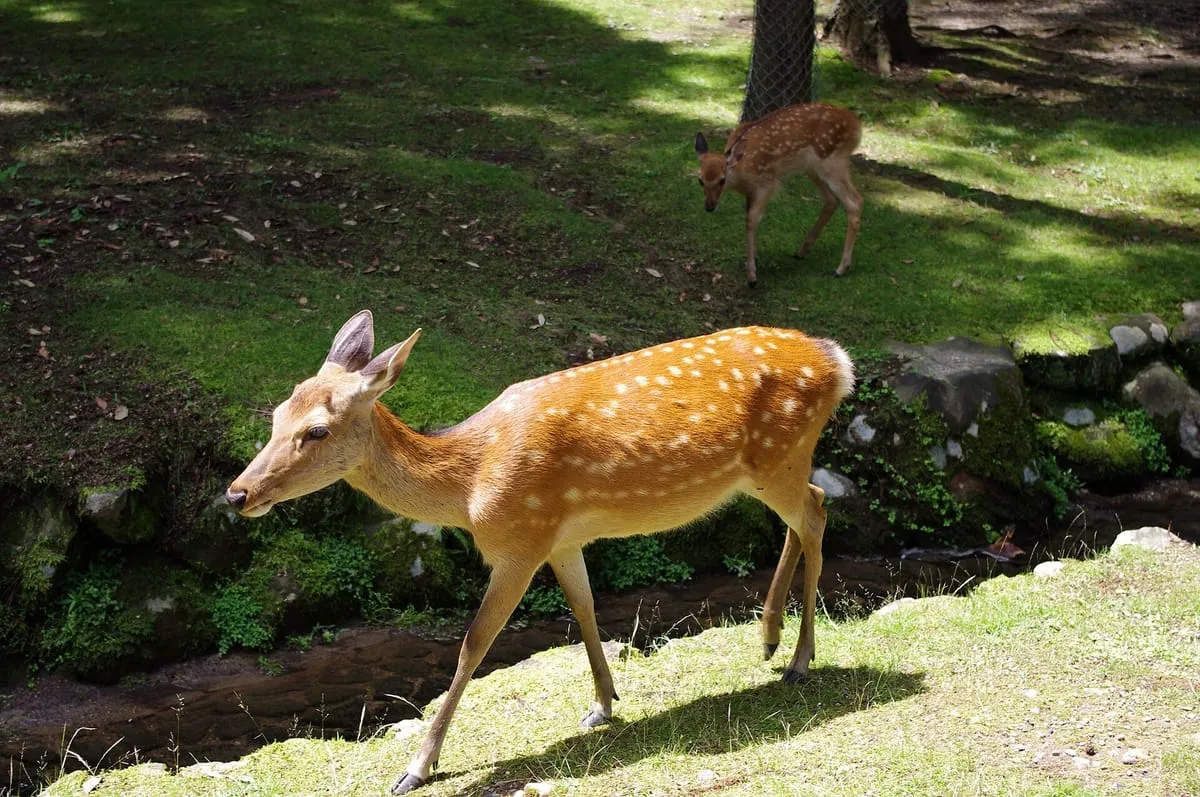
Wild sika deer on the lawns of Nara Park. Photo: Basile Morin, Wikimedia Commons, CC BY-SA 4.0.
3. Todai-ji Temple and the Great Buddha
Founded in 752 by Emperor Shomu, Todai-ji was built to unify the country under Buddhist spiritual protection.
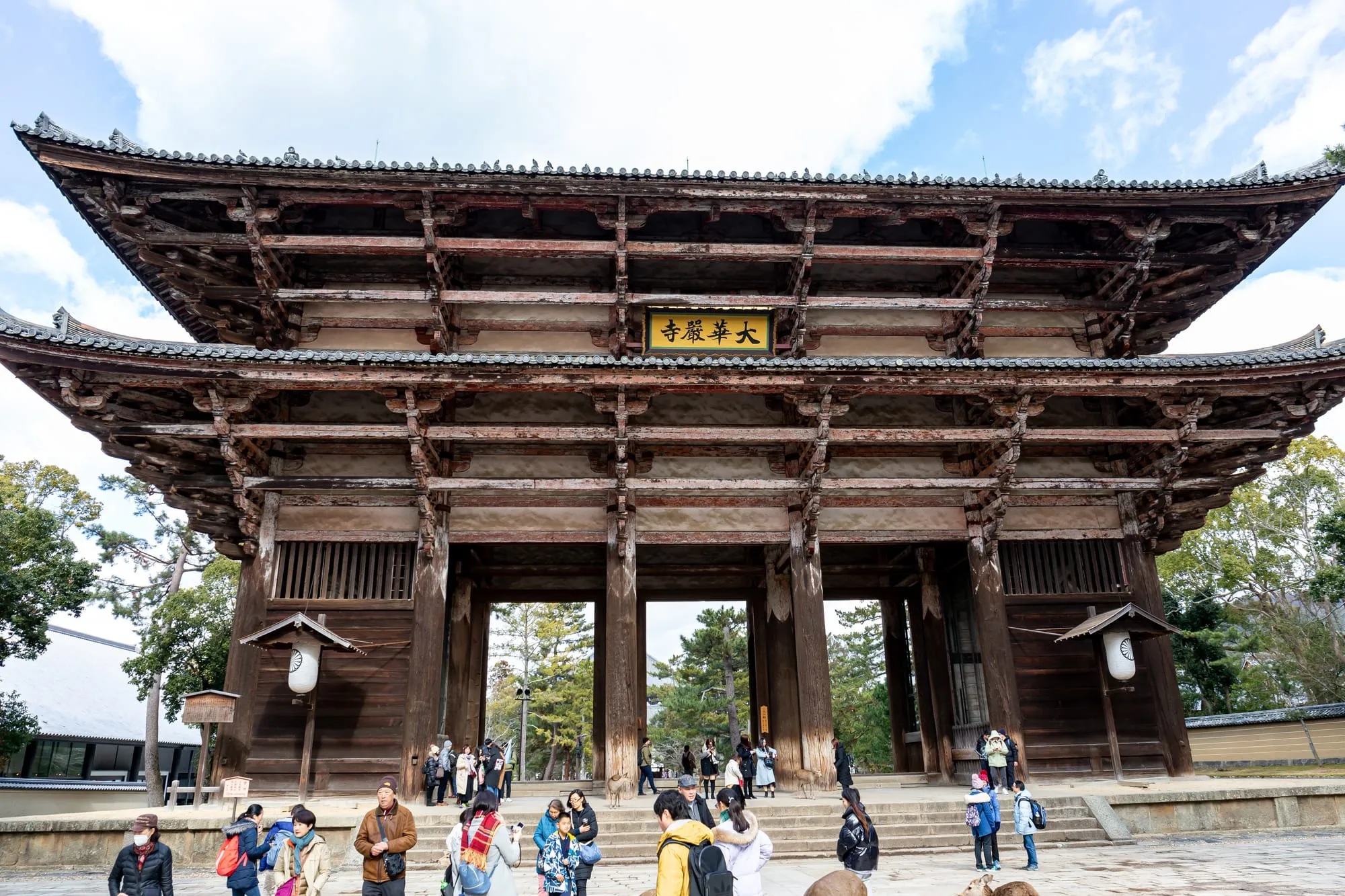
- Nandaimon Gate: The colossal wooden southern entrance gate is guarded by two 8-metre-tall wooden Nio guardian statues carved in 1203 by master sculptors Unkei and Kaikei, standing in fierce dynamic poses.
- The Daibutsuden (Great Buddha Hall): Measuring 57 metres wide and 49 metres high, this is one of the largest wooden buildings in the world. The hall houses the Daibutsu (Vairocana Buddha), a 15-metre-tall cast bronze Buddha containing 500 tonnes of metal.
- The Pillar of Enlightenment: In the rear right corner behind the Buddha stands a massive wooden pillar with a square opening through its base, built with the exact dimensions of the Daibutsu’s nostril. Squeezing through the opening is said to ensure good health and rebirth in paradise.
- Hours: 07:30 to 17:30 (April to October); 08:00 to 17:00 (November to March). Admission is ¥800 cash at the gate.
4. Nigatsu-do Hall
Follow the stone ramparts uphill east of Todai-ji to Nigatsu-do, a hillside sub-temple hall famous for the annual Omizutori fire-and-water purification rite held every March. The elevated wooden balcony is open 24 hours daily (admission free) and offers panoramic vistas looking west across the rooftops of Todai-ji towards Mount Ikoma. A small rest house beside the hall provides free hot green tea.
5. Kasuga Taisha Shrine
From Nigatsu-do, follow the woodland trail south through the ancient Kasuga Primeval Forest into the sanctuary of Kasuga Taisha. Over 2,000 moss-covered stone lanterns (ishidoro) line the approach paths through the trees, while 1,000 hanging bronze lanterns adorn the vermilion inner corridors (inner sanctuary admission ¥500; outer grounds free).
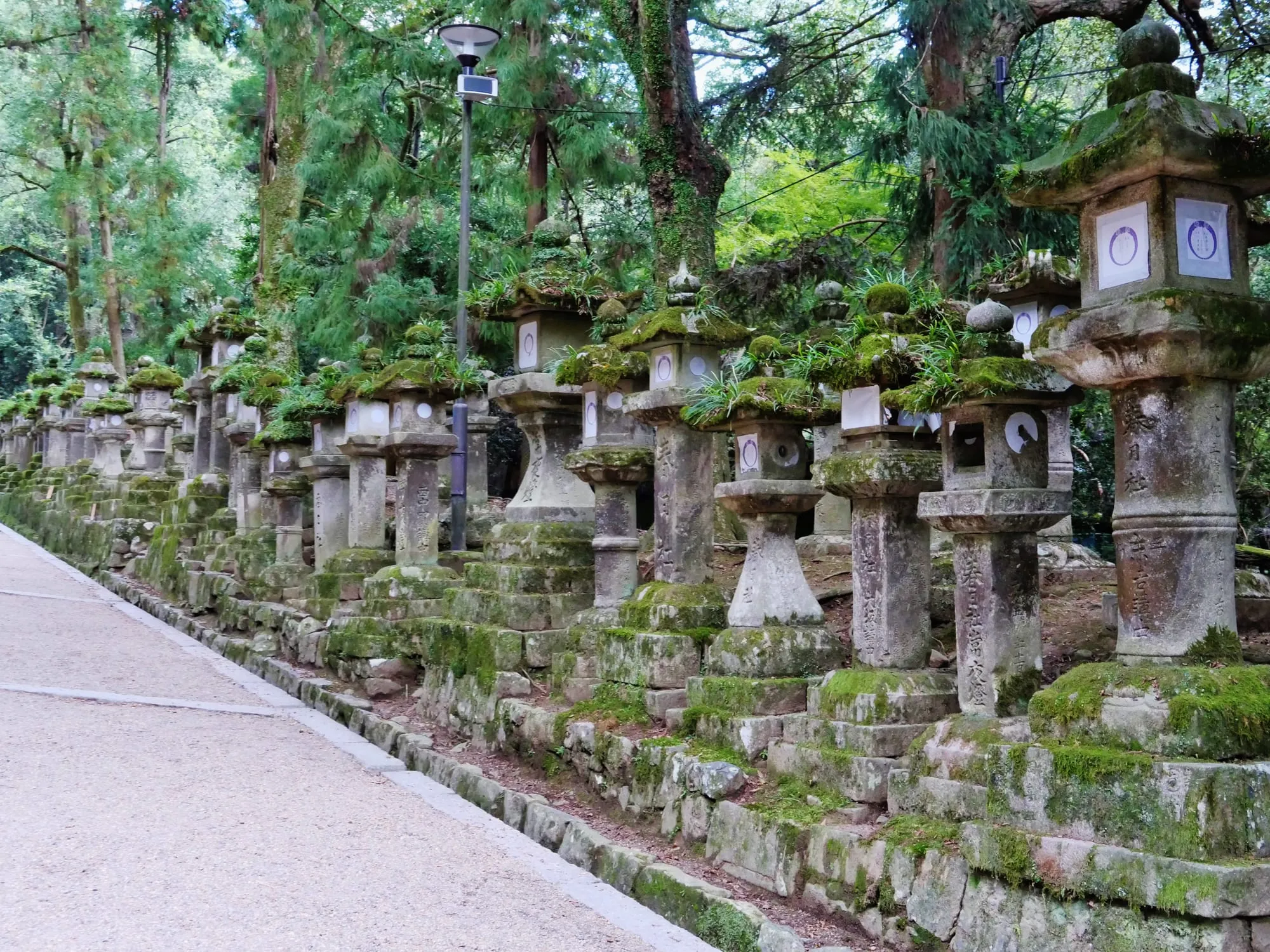
Stone lanterns at Kasuga Taisha. Photo: Zairon, Wikimedia Commons, CC BY 4.0.
6. Naramachi historic district
Before catching the train back to Kyoto, explore Naramachi, the preserved Edo-period merchant neighbourhood south of Sanjo-dori. Narrow lanes are flanked by traditional latticed machiya houses, craft sake breweries (such as Harushika Sake Brewery, where ¥500 buys a tasting of five seasonal sakes), and boutique cafes serving shaved ice (kakigori) and handmade mochi.
Practical tips for a smooth visit
- Food warnings with deer: Nara’s deer are wild animals with sharp senses of smell. Keep paper maps, train tickets, and plastic bags securely zipped inside your rucksack, as deer will readily chew and eat paper or plastic. Avoid feeding aggressive stags during the autumn rutting season (October and November).
- Luggage storage: If travelling between Kyoto and Osaka with luggage, coin lockers are available at both Kintetsu-Nara and JR Nara stations (¥500 to ¥900 depending on locker size). Kintetsu-Nara also has an official manned baggage storage counter on the underground concourse.
- Pairing with other day trips: Combine your day in Nara with an afternoon stop in Uji to sample green tea along the JR Nara Line, or review our full day trips from Kyoto guide for more regional excursions.
Common questions
How long does the train take from Kyoto to Nara?
The Kintetsu Limited Express takes 35 minutes directly to Kintetsu-Nara Station (¥1,280, reserved seat). The JR Miyakoji Rapid takes 45 minutes to JR Nara Station (¥720, covered by the JR Pass).
How much are tickets to Todai-ji Temple?
Admission to the Daibutsuden (Great Buddha Hall) is ¥800 for adults, junior high and high school students, and ¥400 for primary school children, payable in cash at the gate.
Are the deer in Nara Park safe to feed?
The deer are wild animals accustomed to humans. Buy official shika-senbei crackers (¥200). Bow gently and they will often bow their heads in return before taking the cracker. Avoid teasing them with food.
Which station is closer to Nara Park, JR or Kintetsu?
Kintetsu-Nara Station is significantly closer, opening directly onto the edge of Nara Park and Kofuku-ji (5 minutes on foot). JR Nara Station requires a 20-minute uphill walk along Sanjo-dori to reach the deer.