In this guide
💡 The Short Version: The mountain trail between Kurama and Kibune is one of Kyoto’s best day walks, reached in 31 minutes from Demachiyanagi on the Eizan Electric Railway. Hike uphill past Kurama-dera Temple, cross the cedar root ridge, and descend into the river gorge of Kibune for lunch. Or book a tour: the Kurama-Kibune Hiking Experiencead pairs you with an expert mountain guide who explains local folklore and Shugendo ascetic traditions.
Located in the forested Kitayama mountains north of Kyoto, the paired valleys of Kurama and Kibune offer an escape into cool cedar woods and ancient spiritual folklore. Linked by a 3.9-kilometre mountain trail that crosses Mount Kurama, this route ranks among the most rewarding outdoor day trips from Kyoto.
Hiking north through the pass takes you from the birthplace of Reiki and the legendary training grounds of samurai warrior Minamoto no Yoshitsune to a riverside Shinto sanctuary dedicated to the god of water. In summer, temperatures in the valley sit 5°C to 7°C below central Kyoto, making Kibune’s over-river dining platforms (kawadoko) a prized refuge from the city heat.
Route summary and trail profile
| Trail section | Distance | Terrain | Key sight |
|---|---|---|---|
| Kurama Station to Niomon Gate | 200 m | Paved street | Giant Tengu goblin mask outside station |
| Niomon Gate to Kurama-dera Main Hall | 1.1 km | Switchback stone steps | Yuki Shrine and cedar slopes |
| Main Hall to Kinomi-michi (Ridge) | 800 m | Dirt path and exposed cedar roots | Interlocking tree root trail |
| Ridge to West Gate (Kibune River) | 1.2 km | Downhill dirt path and wooden steps | Okunoin Mao-den sanctuary |
| West Gate to Kifune Shrine | 600 m | Paved riverside road | Lantern-flanked stone staircase |
| Kifune Shrine to Kibuneguchi Station | 2.0 km | Paved valley road (or bus) | River valley gorge and rapids |
The trail involves roughly 200 metres of vertical ascent from Kurama Station to the ridge, followed by a descent of 180 metres into Kibune. Walking time without long breaks is roughly 90 minutes; allow 2.5 to 3.5 hours to visit the temple halls, enjoy views across the Kitayama range, and wander Kibune village.
Tours
Kurama-Kibune Hiking Experience
From ¥26,400 · 5.0 stars from 7 reviews · 6 hours · Guided mountain walk Book on GetYourGuidead
A guided hike following the historic pilgrimage route over Mount Kurama. Includes an English-speaking guide who explains Tengu mountain folklore, Shugendo ascetic history, and the architecture of Kurama-dera and Kifune Shrine. Ideal for travellers who want deep cultural interpretation without worrying about navigation.
Kyoto Private Highlights Tour with Guide and Luxury Vehicle
From ¥68,000 · 4.6 stars from 480 reviews · 1 day · Private custom charter Book on GetYourGuidead
A fully customisable private car tour covering northern Kyoto and the Kitayama valleys. Your driver-guide navigates the narrow mountain roads directly to Kibune and Kurama before connecting to sights such as Kinkaku-ji. Designed for small groups or families who prefer direct door-to-door transport over trains and buses.
Full-Day Kyoto Walking Tour: Iconic Landmarks & Nature
From ¥14,900 · 5.0 stars from 30 reviews · 8 hours · Small-group walking tour Book on GetYourGuidead
A full-day guided walking experience tailored for active travellers. Combines Kyoto’s outer forested districts with hillside temple paths, providing cultural context and logistics support throughout the day.
Official trail costs or guided tour: the prices side by side
| Option | Adult price | Child price | What is included | Who it suits |
|---|---|---|---|---|
| Independent hike (train + admission) | ¥1,440 | ¥720 | Round-trip Eizan Railway, temple conservation fee | Independent walkers comfortable following waymarked mountain paths |
| Independent with Kurama Cable Car | ¥1,640 | ¥820 | Train fares, conservation fee, one-way cable car | Walkers wanting to bypass the first 150 vertical metres of steps |
| Guided Kurama-Kibune hike | ¥26,400 | ¥26,400 | Professional guide, trail route interpretation, shrine visit | Travellers seeking cultural and spiritual storytelling |
| Private vehicle mountain charter | ¥68,000 per group | Included | Private luxury car, custom itinerary, hotel pickup | Families or groups wanting flexible, comfortable transport |
How to get there from central Kyoto
The journey from central Kyoto takes roughly 40 to 50 minutes using the Keihan Main Line and the Eizan Electric Railway:
- Take the Keihan Main Line from Gion-Shijo or Sanjo Station north to the terminal at Demachiyanagi Station (5 minutes, ¥230).
- Transfer to the Eizan Kurama Line at Demachiyanagi. Trains depart every 15 to 20 minutes from platforms 2 and 3.
- Ride to Kurama Station (31 minutes; fares on the Eizan Electric Railway site). If possible, catch the Kirara scenic train, which features outward-facing panoramic picture windows along the maple-lined mountain tracks at no extra surcharge.
You can tap standard IC cards (ICOCA, Suica, Pasmo) at both Keihan and Eizan turnstiles. The Kansai Thru Pass covers the entire route; the JR Pass is not valid on either line.
When returning from Kibune, walk 25 minutes from Kifune Shrine down the gorge road to Kibuneguchi Station. From Kibuneguchi, Eizan trains run back to Demachiyanagi (28 minutes).
Step-by-step trail description
1. Kurama Station and Niomon Gate
Kurama Station welcomes hikers with a giant, red long-nosed Tengu goblin mask mounted directly outside the exit building. In Japanese mythology, Sojobo, the king of the Tengu, lived on Mount Kurama and taught swordsmanship to the legendary 12th-century warrior Minamoto no Yoshitsune.
Walk 200 metres up the village street to the grand wooden Niomon Gate. Pay the ¥500 mountain conservation fee (Aizan-ryo) at the booth. Beyond the gate, the path ascends through towering cedar groves via lantern-lined switchback steps. You will pass Yuki Shrine, famous for its ancient sacred cedar tree and the fiery Kurama Fire Festival (Kurama no Hi Matsuri) held every 22 October.
Hikers who want to save their knees can board the Kurama-dera Cable Car just inside the gate. It travels 207 metres up the slope to Tahoto pagoda in two minutes for a ¥200 donation, cutting off the steepest flight of steps.
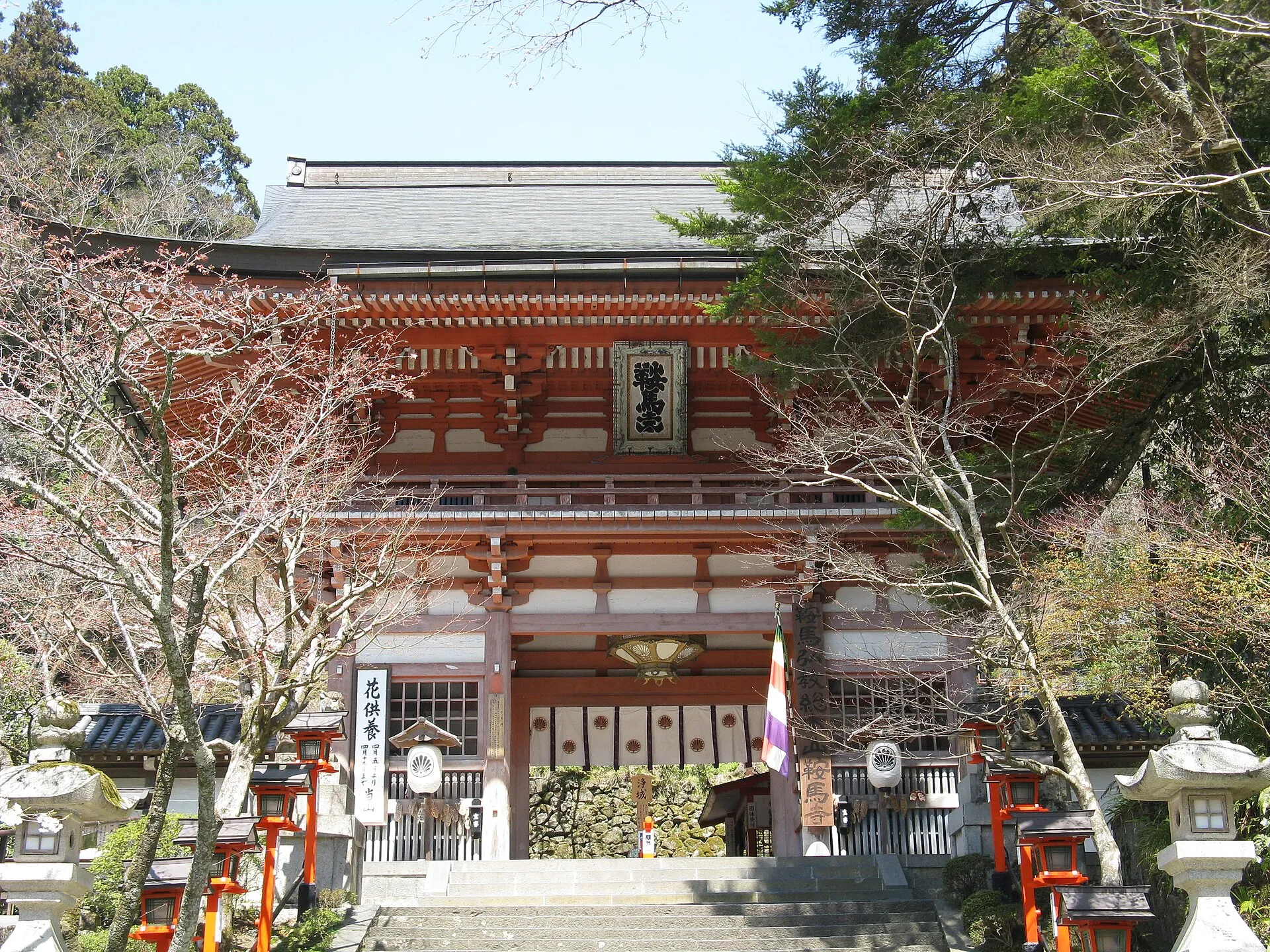 The main sanctuary of Kurama-dera Temple against Mount Kurama’s wooded slopes. Photo: KENPEI, Wikimedia Commons, CC BY-SA 3.0.
2. Kurama-dera Main Sanctuary
Perched 410 metres above sea level on the southern flank of Mount Kurama, Kurama-dera was founded in 770 by the monk Gantei. The temple belongs to the Kurama-kokyo sect, synthesising elements of Esoteric Buddhism and Shinto mountain worship into the veneration of Sonten—the supreme universal life force.
In the courtyard before the Hondo (Main Hall), visitors queue to stand inside the Kongo-sho, a six-pointed stone mandala embedded in the paving stones. Standing at the centre is believed to channel spiritual energy from the universe. Behind the hall, sweeping views open across the forested ridges of the Kitayama mountains. The temple grounds open daily from 09:00 to 16:30. The Reihoden (Treasure House) charges ¥200 admission and displays historic Buddhist statues, including a national treasure Bishamonten.
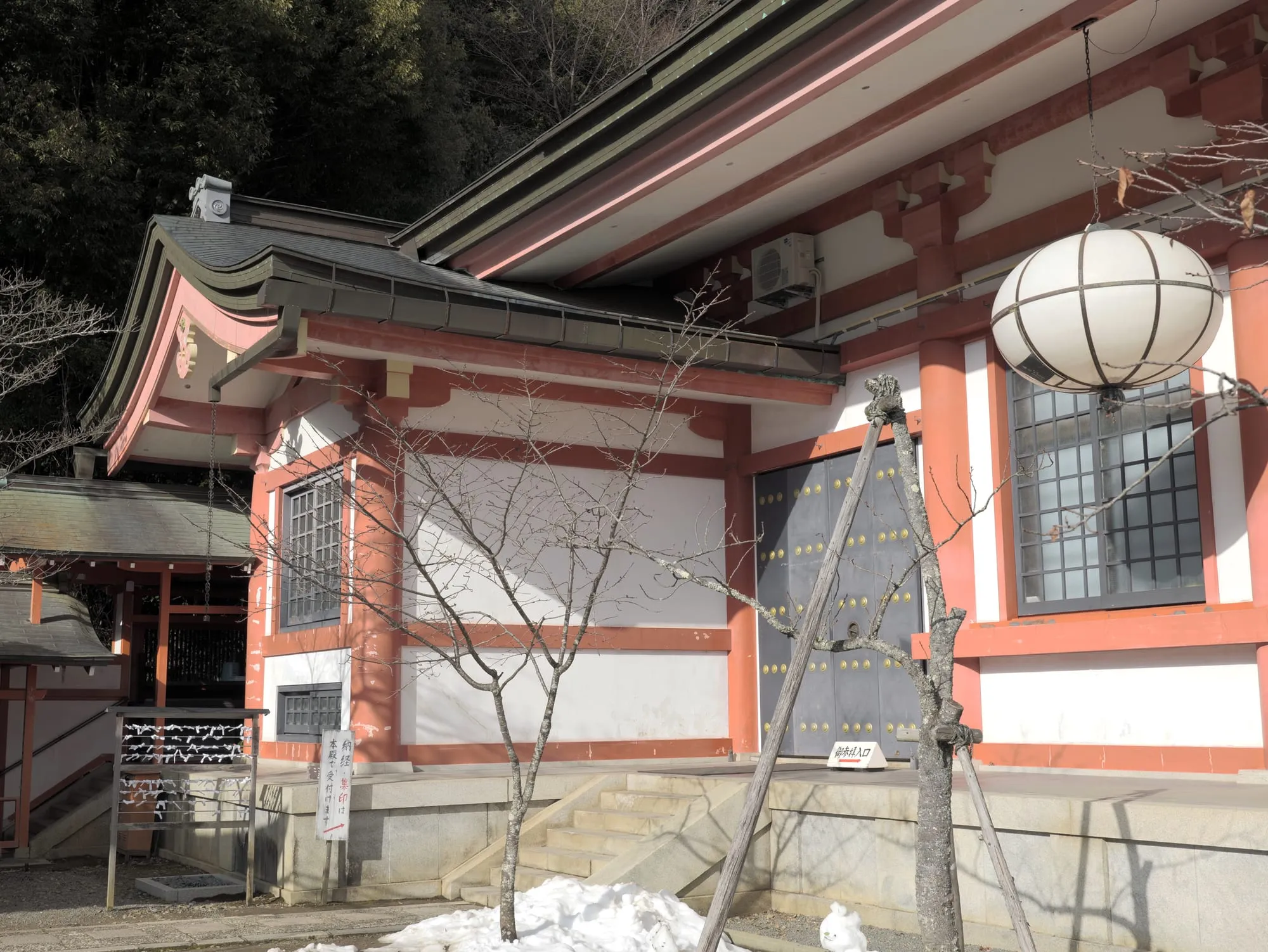
Kurama-dera. Photo: Hyppolyte de Saint-Rambert, Wikimedia Commons, CC BY 4.0.
3. The Ridge and Kinomi-michi
Leaving the main courtyard, pass through a wooden torii gate where the paved stone pathway gives way to an authentic mountain hiking trail. The path climbs through stands of cryptomeria cedar and Japanese cypress.
Near the crest of the ridge lies Kinomi-michi (The Path of Tree Roots). Because the underlying geological stratum consists of hard, impenetrable bedrock, the roots of the ancient cedar trees cannot penetrate deep into the ground. Instead, they sprawl horizontally across the forest floor in an intricate, gnarled wooden lattice. Hikers should step carefully between the roots to avoid tripping and to prevent damage to the trees.
Along this section stands the Mao-den (Sanctuary of the Great Demon King), where cosmic spirit Mao-son is said to have descended from Venus 6.5 million years ago according to temple theology.
4. Descending into Kibune and Kifune Shrine
Past the ridge, the trail descends steadily via a series of switchbacks and wooden steps through quiet woods. The sound of running water signals your arrival at the West Gate (Nishi-mon). Cross the bright vermilion bridge spanning the Kibune River to emerge directly onto Kibune’s narrow main road.
Turn right and walk 600 metres upstream along the river to reach Kifune Shrine. Dedicated to Takaokami no Kami, the deity of water and rainfall, the shrine has protected Kyoto’s water supply since antiquity. Farmers and sake brewers have prayed here for good harvests for over a millennium.
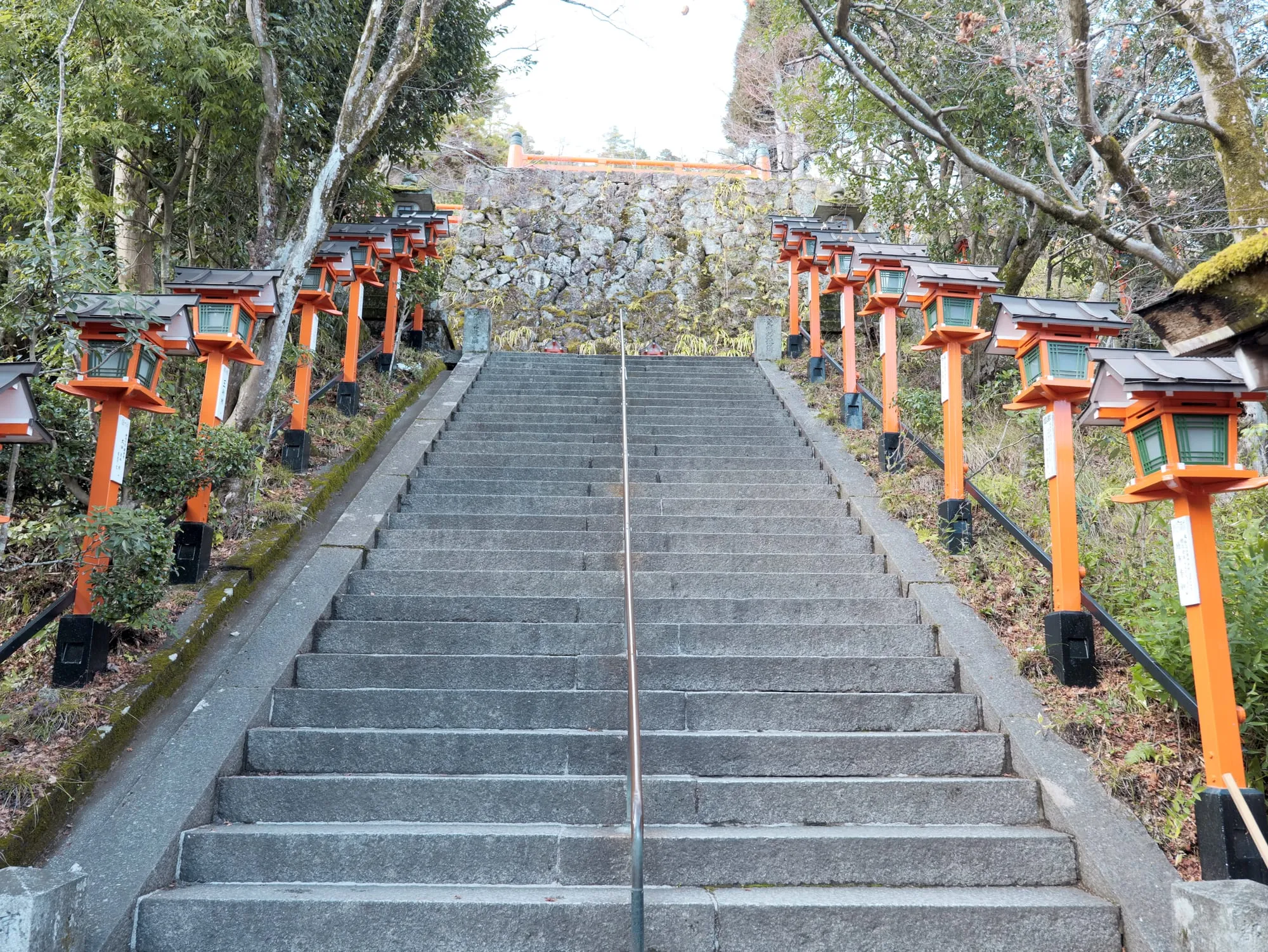
 The lantern-flanked stone staircase leading to Kifune Shrine. Photo: 663highland, Wikimedia Commons, CC BY 2.5.
The shrine’s main entrance features a celebrated stone stairway flanked by eighty vermilion wooden lanterns, surrounded by maple canopies that turn bright crimson each November. Kifune Shrine grounds remain open daily from 06:00 to 20:00 (May to November) or 06:00 to 18:00 (December to April); admission is free.
Be sure to try the Water Fortune (Mizu-ura mikuji, ¥200) at the shrine office. The fortune slips appear completely blank when purchased. Float the paper on the surface of the sacred mountain spring basin, and the Japanese kanji text revealing your fortune will emerge as the water soaks into the fibres. A printed QR code on the paper provides an English translation when scanned with a smartphone.
Kawadoko river dining in Kibune
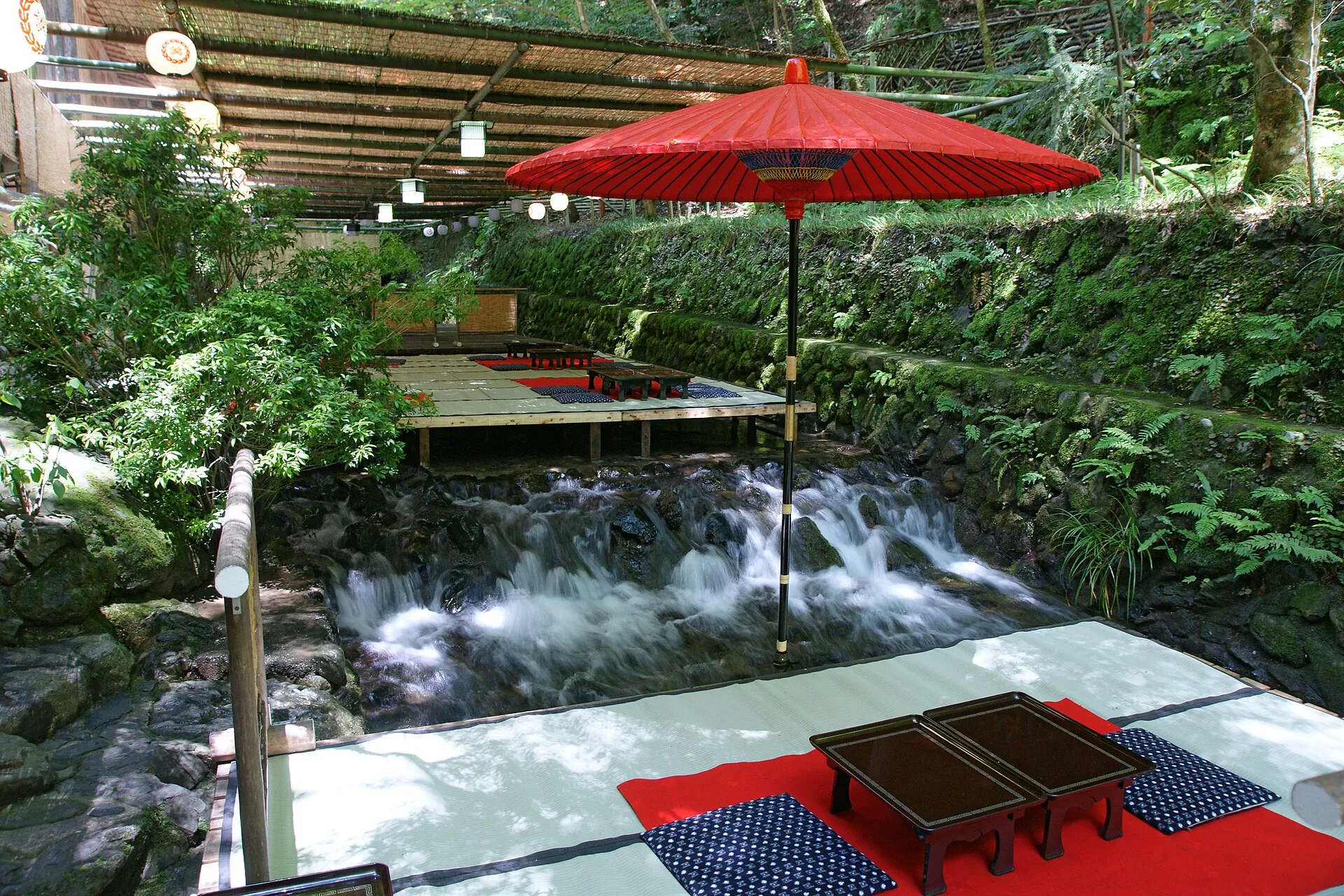
Between 1 May and 30 September each year, Kibune’s riverside ryokan and restaurants construct kawadoko—raised wooden dining platforms erected directly over the running waters of the river rapids. Sitting on tatami mats just inches above the cool mountain stream drops the ambient temperature significantly, creating Kyoto’s most memorable summer dining tradition.
Dining styles range widely:
- Flowing noodles (Nagashi somen) at Hirobun: The most popular budget experience. Cold somen noodles are flushed down a split bamboo flume in front of your seat; you catch them with chopsticks and dip them into soy-based tsuyu sauce. Hirobun charges roughly ¥2,000 per person. You must take a numbered ticket in person in the morning; waits can exceed two hours on summer weekends.
- Multi-course kaiseki lunches: Traditional ryokan such as Fujiya, Kibune Uohan, and Hiroya serve seasonal kaiseki featuring grilled sweetfish (ayu) fresh from local waters, Kyoto mountain vegetables, and chilled tofu. Multi-course lunches typically range from ¥8,000 to ¥15,000 per person; evening banquets start around ¥15,000 to ¥25,000 and require advance reservations.
Outside the summer kawadoko season, Kibune’s inns serve hot seasonal specialities inside traditional tatami dining rooms, including wild boar hotpot (botan nabe) during the snowy winter months.
Practical tips for hikers
- Footwear: Wear sturdy walking shoes or trail runners with decent traction. The downhill section toward Kibune can become slippery on wet dirt and damp tree roots after rain.
- Direction: Always hike from Kurama to Kibune rather than the reverse. The climb from Kurama spreads out over a longer distance and passes the main sights first, allowing you to finish your walk with food and relaxation in Kibune village.
- Seasons: The trail is open year-round. Late autumn (mid-to-late November) brings red maple colours, with evening lantern illuminations along the Eizan line’s “Maple Tunnel” between Ichihara and Ninose stations. Summer offers cool relief from Kyoto’s humidity.
- Combining with other sights: You can combine this half-day hike with an afternoon visit to nearby sights along the Keihan line, such as Gion or Pontocho.
Common questions
How long is the hike between Kurama and Kibune?
The trail is approximately 3.9 kilometres long, taking between 1.5 and 2.5 hours at a moderate walking pace including stops at temples and viewpoints.
Is the Kurama to Kibune hike difficult?
The hike is moderate. It begins with uphill stone steps to Kurama-dera Temple and over the mountain ridge, followed by a downhill dirt trail into Kibune. Sturdy walking shoes are required.
Which direction is better: Kurama to Kibune or Kibune to Kurama?
Hiking from Kurama to Kibune is recommended. The ascent from Kurama is more gradual and passes the main temple complex first, finishing with riverside restaurants in Kibune.