In this guide
💡 The Short Version: Nijo Castle is open daily from 08:45 to 17:00 (last gate entry 16:00, palace interior closes 16:10). The essential ticket covers the grounds and Ninomaru Palace interior for ¥1,300 (¥800 for grounds only). You can buy tickets at the gate or book ahead on the Nijo Castle and Ninomaru Palace Ticketad{rel=“sponsored nofollow noopener”} to enter directly through QR-code turnstiles. Ninomaru Palace interior closes on Tuesdays in January, July, August and December. Or book a tour: when you want an expert historian to decode the Kano School murals and the samurai politics of the 1867 shogunate surrender, the Nijo-jo Castle and Ninomaru Palace guided tourad (from ¥2,500, 4.7 stars from 1,294 reviews) meets inside the grounds.
The official tickets
Official admission rates from the Kyoto City Nijo Castle office (nijo-jocastle.city.kyoto.lg.jp). Tickets are sold at ticket windows and automatic ticket machines at the East Main Gate (Higashi Otemon), as well as via Webket online e-tickets.
| Ticket type | Adults | Junior high & high school | Primary school |
|---|---|---|---|
| Castle grounds only | ¥800 | ¥400 | ¥300 |
| Castle grounds + Ninomaru Palace interior | ¥1,300 | ¥400 | ¥300 |
| Audio guide rental (Japanese, English, French, Spanish, German, Chinese, Korean) | ¥600 | ¥600 | ¥600 |
| Annual passport | ¥3,100 | — | — |
- Grounds vs Palace: Never buy the grounds-only ticket if visiting for the first time. The Ninomaru Palace contains the famous nightingale floors, gold-leaf screens, and the Great Audience Hall; visiting the grounds alone misses the main historic attraction.
- Children’s rates: Primary pupils pay only ¥300 for both grounds and palace, and high school students pay ¥400. Children under 6 enter free.
- Payment methods: Ticket machines at the gate accept cash and major credit cards (Visa, Mastercard, JCB, Amex), as well as IC cards (ICOCA, Suica). Digital tickets purchased online through Klookad{rel=“sponsored nofollow noopener”} generate a barcode scanned directly at turnstiles.
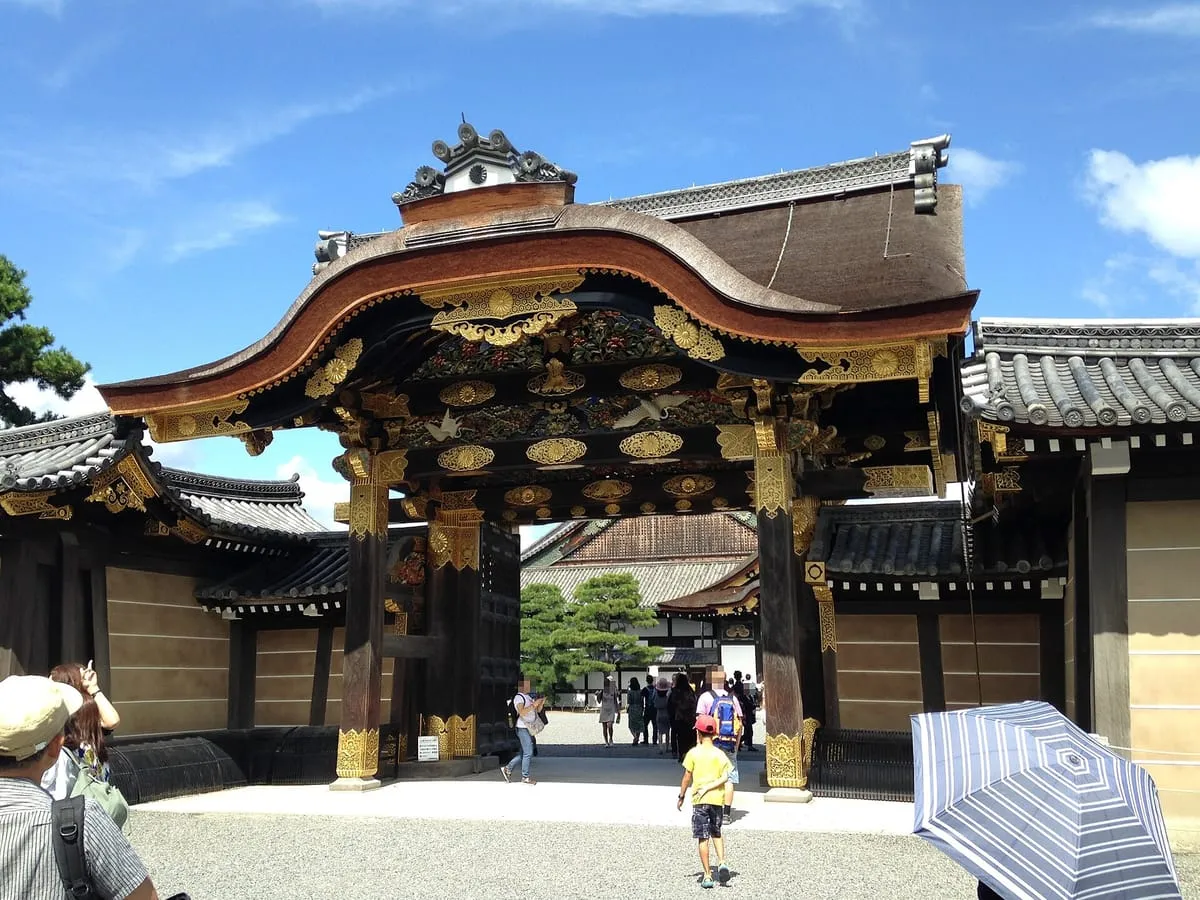
The Karamon Gate with four-way timber roof and gold-leaf carvings. Photo: 663highland, Wikimedia Commons, CC BY-SA 3.0.
Tours and guided palace walks
The historical significance of Nijo Castle—the site where the Tokugawa shogunate was inaugurated in 1603 and where it officially ended in 1867—is explained by a guide, who covers room hierarchies and its hidden architectural devices.
Nijo-jo Castle and Ninomaru Palace guided visit
From ¥2,500 · 4.7 stars from 1,294 reviews · 1 hour · licensed local guide
Kyoto: Nijo-jo Castle and Ninomaru Palace Guided Tourad: meets at the resting area inside the castle gate. An English-speaking licensed guide walks you through the Karamon Gate, explains the defensive acoustic mechanics of the nightingale corridors, and walks the Ninomaru stroll garden. The castle entry ticket is held separately.
Imperial Palace and Nijo Castle guided walking tour
From ¥5,698 · 4.6 stars from 667 reviews · 3 hours · two UNESCO landmarks
Kyoto: Imperial Palace & Nijo Castle Guided Walking Tourad: pairs the shogun’s residence at Nijo Castle with the Emperor’s imperial compound at the Kyoto Imperial Palace Park, contrasting samurai defensive architecture with courtly imperial minimalism.
Nijo Castle and Kyoto highlights bus tour
From ¥10,512 · 4.7 stars from 775 reviews · 11 hours · coach transport
Kyoto by Bus: Nijo, Bamboo Grove & Fushimi Inari (EN/ES)ad: covers Nijo Castle, the Arashiyama bamboo grove and Fushimi Inari Shrine on an air-conditioned coach with English and Spanish-speaking guides.
In-depth shogunate history walking tour
From ¥10,800 · 4.8 stars from 270 reviews · 3 hours · audio headsets included
Kyoto: Nijo Castle and Kyoto Imperial Palace Guided Tourad: provides wireless receiver headsets so you can hear the guide clearly across the large courtyard spaces, covering the palace interior, moat fortifications and Honmaru defensive keep.
Official ticket or tour: the prices side by side
Independent entry versus guided historical tours.
| Option | Official admission | Tour cost | What it covers |
|---|---|---|---|
| Official grounds + palace ticket | ¥1,300 | — | Ninomaru Palace, nightingale floors, all castle gardens |
| Castle ticket with audio guide | ¥1,300 + ¥600 = ¥1,900 | — | Entry plus multilingual audio receiver |
| Ninomaru Palace guided tour | ¥1,300 ticket | From ¥2,500 | 1-hour live commentary on samurai politics and murals |
| Imperial Palace & Nijo walking tour | Admissions included | From ¥5,698 | 3-hour guided walk covering both shogunal and imperial palaces |
| Full-day coach tour | Admissions included | From ¥10,512 | Nijo Castle, Arashiyama, Fushimi Inari, coach travel |
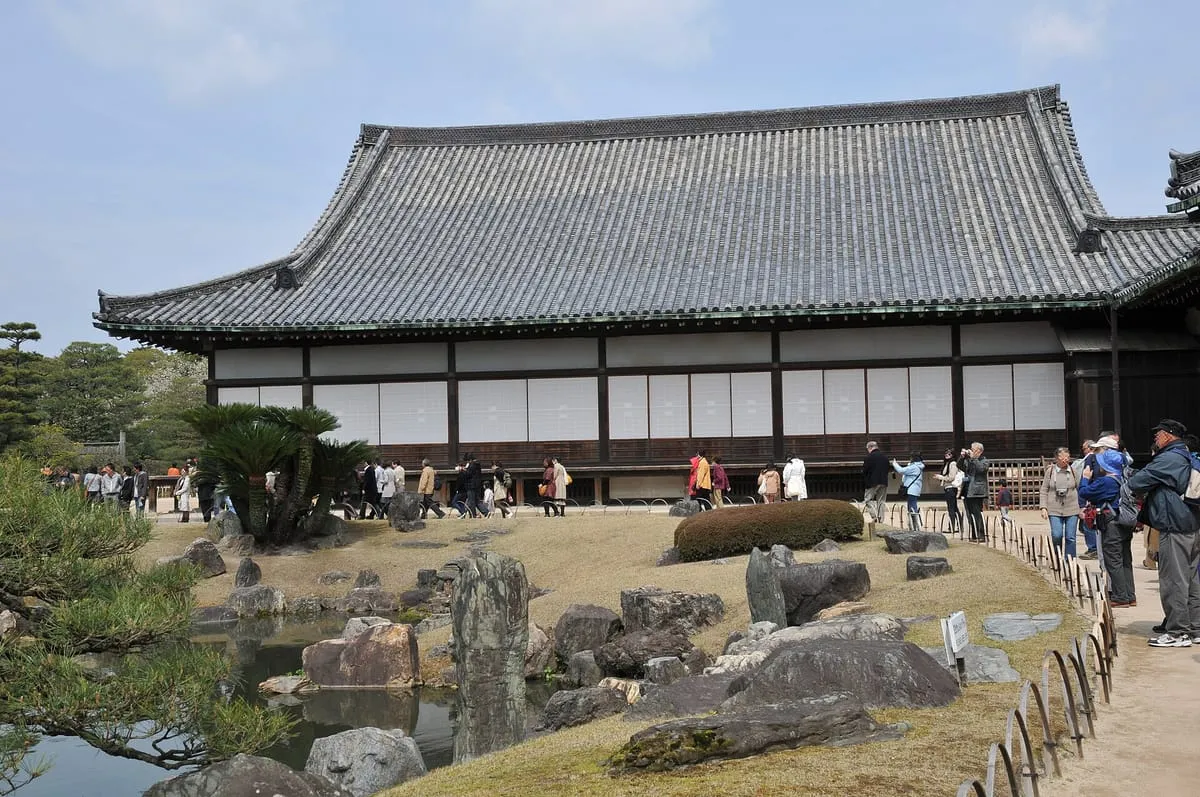
The wooden halls of Ninomaru Palace and its stroll garden. Photo: Moheen Reeyad, Wikimedia Commons, CC BY-SA 4.0.
What to see inside the fortifications
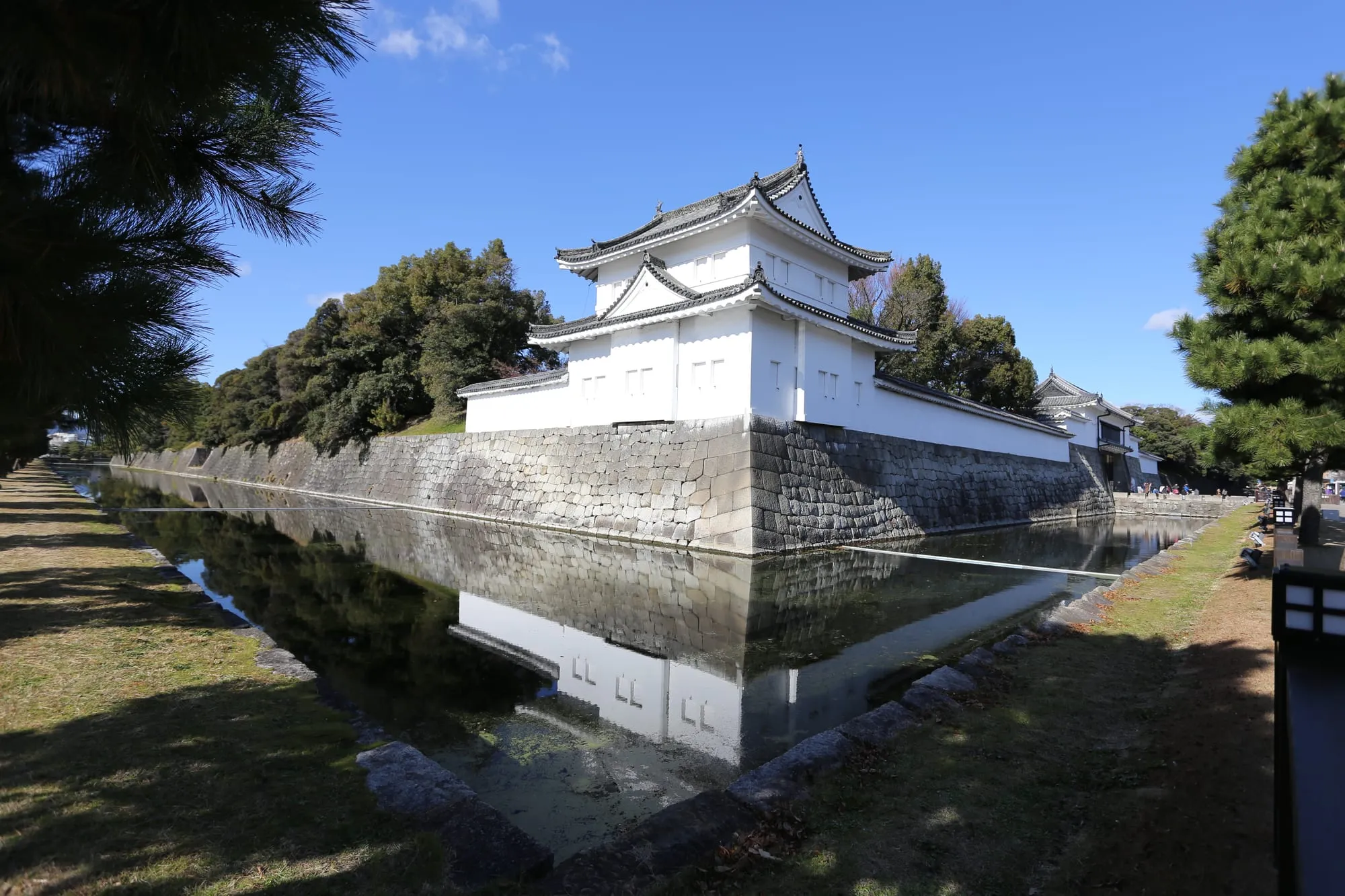
Built in 1603 by Tokugawa Ieyasu, Nijo Castle served as the official shogunal seat in western Japan. When Tokugawa visited Kyoto from Edo (Tokyo), he stayed here, while an appointed governor monitored the emperor’s court.
- Karamon Gate: A designated Important Cultural Property, this Chinese-style karahafu gateway features gold-leaf inlays and intricate relief carvings of dragons, cranes, and pine trees.
- Ninomaru Palace (Ninomaru Goten): Spanning 3,300 square metres across five connected buildings (Yanagi-no-ma, Wakamatsu-no-ma, Shiroshoin, Kuroshoin, and Ohiroma). Visitors remove their shoes at the entry vestibule and walk through the corridors in socks.
- Nightingale Floors (Uguisubari): Engineered as an early warning intrusion system, the floorboards rest on suspended metal clamps. When stepped on, the metal rubs against supporting spikes, generating a rhythmic chirping resembling singing Japanese bush warblers. It is mechanically impossible to cross without making noise.
- Kano School Murals: The walls and sliding fusuma doors are decorated with 17th-century paintings by Kano Tanyu and his workshop. In the outer waiting rooms, predatory tigers prowl against gold leaf to intimidate visiting feudal lords (daimyo); deeper in the private shogunal chambers, gentle weeping willows and cherry blossoms appear.
- The Ohiroma First and Second Rooms: The historic room where the 15th and final shogun, Tokugawa Yoshinobu, gathered his retainers in October 1867 to announce the return of governing authority to Emperor Meiji (the Taisei Hokan), ushering in the modernisation of Japan.
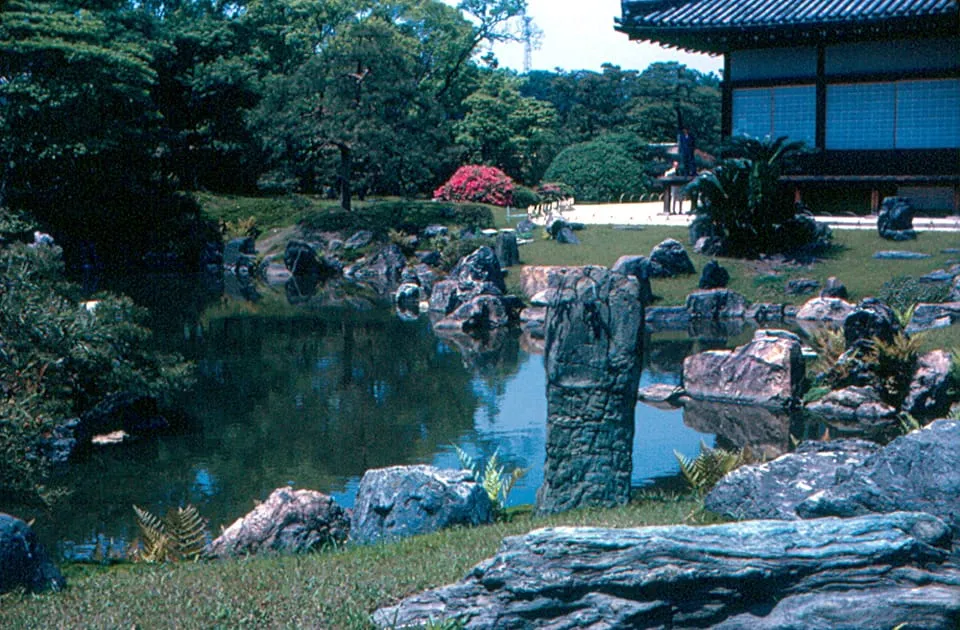
The Ninomaru stroll garden designed by Kobori Enshu. Photo: Roger W, Wikimedia Commons, CC BY-SA 2.0.
Castle gardens and grounds
- Ninomaru Garden: Designed by master tea designer Kobori Enshu for the imperial visit of Emperor Gomizunoo in 1626. It features a central pond with three stone islands—Horai-jima (Island of Eternal Youth), Tsuru-jima (Crane Island), and Kame-jima (Turtle Island)—flanked by jagged limestone boulders.
- Honmaru Palace and Moat: Protected by an inner moat filled with carp, the Honmaru was destroyed by fire in the 18th century and replaced in 1893 with a residential palace moved from the former Katsura Imperial Palace grounds. Following extensive seismic retrofitting, the Honmaru gardens and grounds are open for walks.
- Seiryu-en Garden: Constructed in 1965 along the northern ramparts, combining half-Western lawns with half-Japanese classical ponds, including two historical teahouses (Waraku-an and Koun-tei) used for diplomatic receptions and tea ceremonies.
Practical details and getting there
- Opening hours and last entry: Gates open at 08:45 and close at 17:00 (last admission strictly at 16:00). Ninomaru Palace entry closes at 16:10.
- Palace closure Tuesdays: The Ninomaru Palace interior shuts on Tuesdays in January, July, August and December (or Wednesday if Tuesday is a national holiday). If you visit on a closed Tuesday, you pay only the grounds admission fee of ¥800.
- Winter closure: The entire castle is closed from 29 to 31 December.
- Getting there:
- By Subway: Take the Tozai Subway Line to Nijojo-mae Station (Exit 1). The castle moat and entrance gate sit immediately across the street.
- From Kyoto Station: Board the Karasuma Subway Line north to Karasuma Oike Station, then change to the Tozai Line heading west for one stop to Nijojo-mae Station. The whole journey is ¥260 (Kyoto City Subway fares).
- By Bus: Kyoto City Bus routes 9, 50, and 101 stop directly at Nijojo-mae bus stop outside the main gate.
- Rules on the day: Shoes must be removed before stepping onto the Ninomaru Palace wooden walkways (wear socks; bare feet are discouraged on historic wood). Large backpacks must be carried on your front or left in lockers. Tripods and monopods are prohibited throughout castle grounds.
- Onward connections: From Nijojo-mae Station, take the Tozai Subway east to Kyoto Shiyakusho-mae to explore Nishiki Market or join an evening walk in Pontocho Alley.
Common questions
How much are tickets to Nijo Castle?
Standard castle grounds admission is ¥800 for adults, ¥400 for junior high and high school students, and ¥300 for primary school children. A combined ticket including Ninomaru Palace interior entry costs ¥1,300 for adults.
What are the nightingale floors in Nijo Castle?
The wooden corridor floors of Ninomaru Palace are constructed with metal clamps underneath that rub against iron nails whenever pressure is applied, producing a high-pitched chirping sound resembling bush warblers to alert guards against assassins.
When is Ninomaru Palace closed?
The palace interior is closed on Tuesdays in January, July, August and December (or the following Wednesday if Tuesday is a national holiday), and from 29 to 31 December. The castle grounds remain open on those Tuesdays.
Can you take photos inside Ninomaru Palace?
No. Photography and video recording are strictly prohibited inside the Ninomaru Palace to protect the historic Kano School gold-leaf wall paintings from light exposure. Photography is permitted throughout the castle gardens and grounds.