In this guide
💡 The Short Version: The best base depends on whether you want cheap direct trains or multi-stop coach days. For easy rail trips, Lisbon, Florence and Munich win: Lisbon reaches Sintra and Cascais for €5.10 return each; Florence connects Pisa (51 minutes, €19.60 return) and Siena (1 hour 28 minutes, €21.60 return); Munich’s €34 Bayern-Ticket (€44 for two) covers Bavaria and Salzburg. For places trains cannot reach, Reykjavik, Edinburgh and Dubrovnik are tour hubs: the Highlands, Iceland’s Golden Circle and cross-border trips to Mostar or Kotor work far better on a coach. The biggest trap is assuming DIY public transport is always cheaper or faster—in Dubrovnik, a Mostar tour (from €30) costs less than a one-way public bus (€33.59), and in Porto winter engineering works put buses on the Douro rail line. Or book a tour: the Pisa, Siena and San Gimignano day from Florencead is from €49, the Golden Circle full-day from Reykjavikad from €83, and the Mostar and Kravica Waterfall day from Dubrovnikad from €30 (GetYourGuide).
⚠️ Check the transfer count, the closing date and the border rule before you commit to DIY. Three mistakes ruin car-free day trips across Europe: attempting three-change routes on a tight winter timetable (Hallstatt from Salzburg takes a bus, a train and a ferry each way; Rothenburg from Munich takes six hours on trains), travelling in November when alpine sights shut for the season (the Eagle’s Nest closes after 8 November, Werfen ice cave on 1 November), and forgetting a passport for non-Schengen or border-checked crossings (Mostar, Kotor, Andorra, and the Germany–Austria border until 15 March 2027).
Fares are the rail and bus operators’ own published rates; tour prices are GetYourGuide’s lowest “from” prices per adult and move with the date.
Ten day-trip cities side by side
Every city below links to its dedicated hub guide (including entry rules: all nine Schengen hubs here operate the EU Entry/Exit System, running in full since 10 April 2026, while ETIAS is not yet required and has no start date; see Edinburgh for UK ETA rules). DIY costs are return public transport for one adult unless noted.
| City | Standout day trip | DIY cost vs Guided tour from | Duration | Deciding factor |
|---|---|---|---|---|
| Florence | Pisa, Siena & San Gimignano / Chianti | €19.60–€31.80 return train vs €49–€65 tour | 5–13 hours | Direct trains for Pisa and Siena; tours beat DIY for Chianti, Val d’Orcia and multi-stop Tuscany |
| Rome | Pompeii / Amalfi Coast / Tuscany hill towns | €37.80+ fast train + €20 entry vs €64–€89 tour | 9–15 hours | Fast trains win for Florence and Orvieto; coaches are essential for Amalfi Coast and Val d’Orcia |
| Barcelona | Montserrat / Girona & Figueres / Andorra | €28.80 train+rack railway vs €39–€98 tour | 6–12 hours | Dalí Museum shuts Mondays outside summer; Cadaqués and Andorra have no railway |
| Lisbon | Sintra / Óbidos, Nazaré, Batalha & Fátima | €5.10 return train vs €39 four-stop tour | 9–12 hours | €5.10 rail beats tours for Sintra and Cascais; a coach is the only way to combine four northern towns |
| Porto | Douro Valley / Braga & Guimarães | €7.20 return train vs €31–€50 tour | 6–10 hours | Douro rail has bus replacements from 3 Nov 2026 to 24 Mar 2027; Braga and Guimarães sit on separate lines |
| Edinburgh | Loch Ness & Glencoe / Stirling / St Andrews | GBP 10 Citylink (Glasgow); no rail to Glencoe vs GBP 35–58 tour | 8.5–12.5 hours | ScotRail peak fares abolished; Highlands bus takes 4h24 each way, making coach tours mandatory |
| Reykjavik | Golden Circle / South Coast / Snæfellsnes | No passenger rail (hire car + 1,700–3,650 ISK parking) vs €83–€133 tour | 7–11 hours | Guided coaches eliminate winter ice, gale winds and gravel/ash rental-car liability |
| Salzburg | Hallstatt / Eagle’s Nest / Hallein Salt Mine | Free local transit on Guest Mobility Ticket + €34.70–€49 entry vs €75–€85 tour | 4–5.5 hours | Hallstatt DIY needs bus, train and ferry; Eagle’s Nest and Werfen close in early November |
| Munich | Neuschwanstein / Salzburg / Rothenburg | €34 Bayern-Ticket (+ €23.50 castle) vs €79–€82 tour | 9–10.5 hours | Bayern-Ticket covers up to five people (€44 for two); Rothenburg is six hours round trip by train |
| Dubrovnik | Mostar / Kotor / Elaphiti Islands | €33.59–€37.59 one-way bus vs €25–€58 tour | 7.5–12 hours | Mostar has no same-day public bus return; tours cost less than return buses and handle border queues |
Italy: fast rail between cities, coach tours for hills and coast
Italy’s rail network splits day trips cleanly into two camps. Along the main lines, Frecciarossa high-speed trains and regional services are quick, frequent and cheap enough that a guided tour only adds commentary. The moment you leave the valley floors for wine estates, hill towns or cliffside coasts, bus connections thin out and small-group coaches take over.
Florence
Pisa 51 min (€19.60 return) · Siena 1h28 (€21.60 return) · Chianti & Val d’Orcia no train · tours from €49
Florence is the easiest rail base in southern Europe because Firenze Santa Maria Novella sits in the city centre and feeds direct regional lines across Tuscany. Pisa takes 51 minutes on the fast regional train (€9.80 each way; timed Leaning Tower entry is €20, no under-8s), Siena takes 1 hour 28 minutes hourly at :10 (€10.80 each way), and Lucca takes 1 hour 20 minutes (€8.90 each way). High-speed Frecciarossa trains even put Bologna (37 minutes, from €23.90 each way) and Venice (2 hours 13 minutes, from €47.90 each way) within a day’s reach.
Where DIY breaks down is multi-stop Tuscany and the wine hills. San Gimignano has no railway station—going alone requires a 1-hour-4-minute train to Poggibonsi plus a local bus—while Chianti and the Val d’Orcia (Montalcino, Pienza and Montepulciano) have no practical rail access at all. A 12- to 12.5-hour Pisa, Siena and San Gimignano coach tourad starts at €49 (4.6 stars from 12,182 reviews), linking three stops that would take two separate days by public transport. Half-day Chianti wine toursad start at €50 (5–6.5 hours, 4.5 stars from 11,919 reviews), and the 11.5-hour Val d’Orcia tour with tastingsad costs €74 (4.7 stars from 1,555 reviews). For the Cinque Terre, a 12- to 13-hour coach tourad starts from €65 (4.9 stars from 6,453 reviews), matching peak DIY costs (€31.80 return rail to La Spezia plus €17.30 to €35.00 for the Cinque Terre Treno park card) without train changes.
Verdict: Take the train yourself for Pisa, Siena, Lucca and Bologna; book a tour for Chianti, Val d’Orcia, or combining Siena and San Gimignano. See our full day trips from Florence, individual guides to Pisa, Siena, San Gimignano and the Cinque Terre, plus where to stay in Florence near Santa Maria Novella.
Rome
Florence 1h36 (from €23.90 each way) · Orvieto €10.10 · Pompeii tour from €68 · Amalfi tour from €64
From Roma Termini, high-speed trains put half of central and southern Italy in range. Florence is 1 hour 36 minutes by Frecciarossa (from €23.90 each way in advance, against €159 for a 14-hour coach tour), Orvieto is a €10.10 direct regional train (1 hour 22 minutes to 2 hours), Tivoli is €3 from Roma Tiburtina, and Ostia Antica is a €1.50 city train. Even Pompeii works DIY: take the Frecciarossa to Naples (1 hour 13 minutes, from €18.90 each way), change onto the Circumvesuviana commuter train to Pompei Scavi–Villa dei Misteri, and buy a named €20 Pompeii Express entry ticket in advance (note that the reserved-seat Campania Express tourist train has been suspended since 1 October 2026).
Coach tours earn their keep on three routes. First, Tuscany’s hill towns: there is no direct train from Rome even to Siena (3 hours 35 minutes with changes), so the 11- to 12-hour Tuscany and Montepulciano tourad (from €89, 4.7 stars from 3,543 reviews, including vineyard lunch and Brunello tasting) replaces a logistical headache. Second, the Amalfi Coast: DIY means a Frecciarossa to Salerno (1 hour 36 minutes, from €31.90 each way) plus seasonal ferries, whereas the 11- to 15-hour Amalfi and Positano coach dayad starts at €64 (4.5 stars from 4,173 reviews). Third, paired stops such as Orvieto and Civita di Bagnoregioad (from €89, 12 hours, 4.7 stars from 1,590 reviews) or a guided Pompeii coach dayad (from €68, 9–12 hours, 4.6 stars from 6,087 reviews) when you want entry and an archaeologist bundled together. Use a Monday or Sunday for day trips from Rome, when the Borghese Gallery and most Sunday Vatican openings are closed anyway.
Verdict: Book early Frecciarossa tickets for Florence and regional trains for Orvieto; take a coach tour for Tuscany and the Amalfi Coast. Read day trips from Rome, Pompeii, Amalfi Coast, Tuscany from Rome, Orvieto, Tivoli and where to stay in Rome.
Iberia: cheap coastal railways and multi-stop heritage loops
Spain and Portugal offer Europe’s cheapest commuter rail fares out of major capitals, making DIY beach and palace trips almost effortless. Guided tours step in when you want to chain inland hilltop villages, monasteries or cross-border valleys into a single 9- to 12-hour loop.
Barcelona
Sitges 31 min (€5.50) · Montserrat €28.80 return vs €39 tour · Girona & Figueres €39 tour · Andorra €98
Barcelona’s Rodalies commuter lines make coastal and Roman towns trivial on your own. Sitges has 71 weekday trains a day from Sants (31 to 37 minutes, €5.50 single), Tarragona has 33 trains a day (1 hour 9 minutes, €8.60 single), and the cava cellars of Sant Sadurní d’Anoia take 54 minutes (€5.50 single). Girona (1 hour 19 minutes, €12 single) and Figueres for the Dalí Theatre-Museum (1 hour 50 minutes, €17.10 single) share the R11 line—just never plan Figueres for a Monday outside July and August, when the Dalí museum is shut.
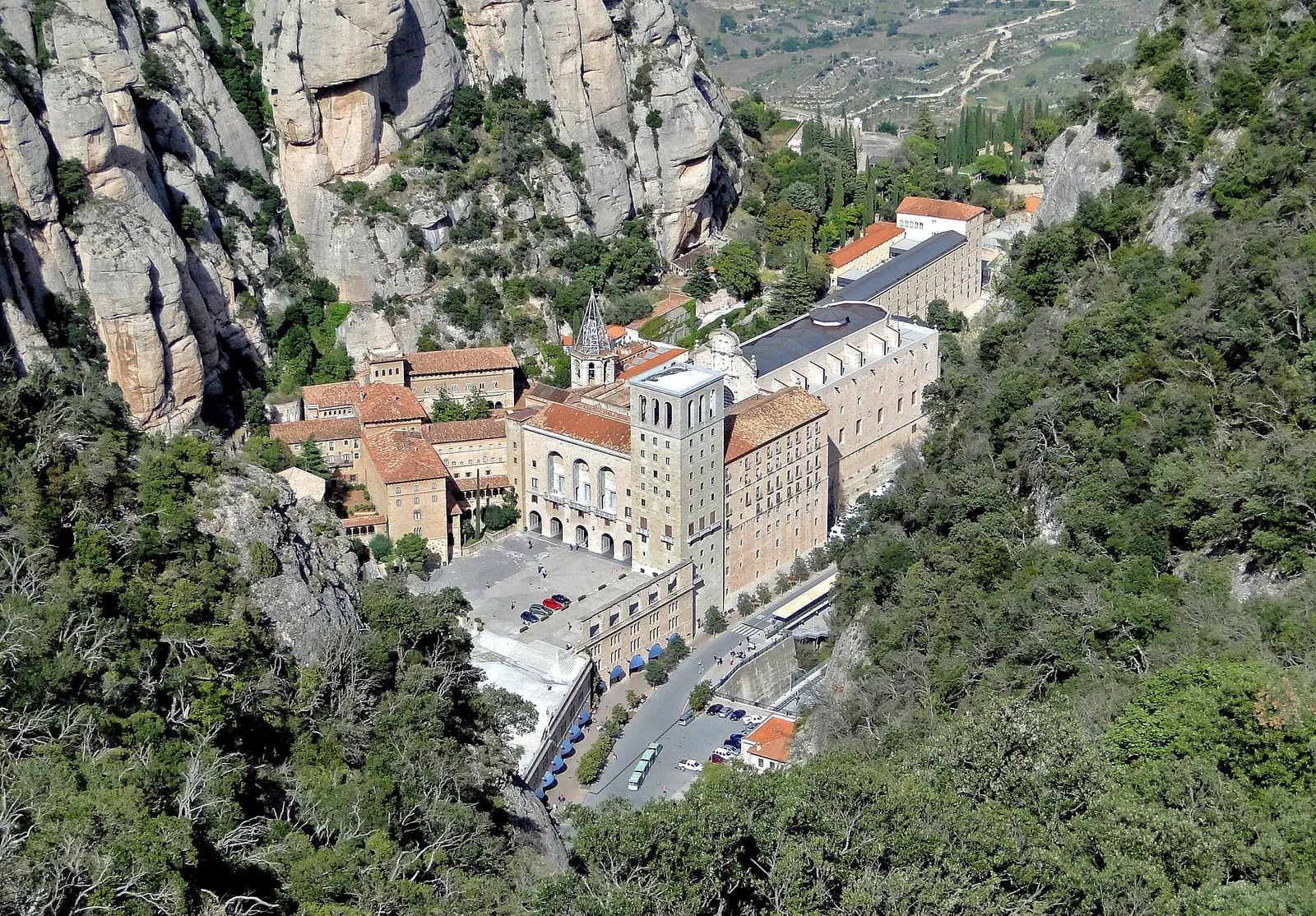
The abbey of Montserrat beneath its jagged rock peaks. Photo: Bernard Gagnon, Wikimedia Commons, CC BY-SA 3.0.
Three trips favour a guided tour. Montserrat is the narrowest price gap in Spain: the FGC R5 train from Plaça Espanya plus the rack railway return costs €28.80 (and non-EU visitors must also buy a timed basilica/Black Virgin ticket), whereas the Montserrat tour with cogwheel train and wineryad starts at €39 (6–9 hours, 4.7 stars from 7,313 reviews). For Girona, Figueres and Cadaqués, Cadaqués has no railway and public buses eat most of the day; the 11-hour three-stop tourad starts at €39 (4.7 stars from 2,457 reviews). Finally, Andorra has no railway at all, making the 12-hour Andorra, France and Spain tourad (from €98, 4.6 stars from 3,131 reviews, passport required) the practical car-free route.
Verdict: Go DIY for Sitges, Tarragona and cava country; book a tour for Cadaqués, the Costa Brava north of Blanes, Andorra, or Montserrat with a winery. See day trips from Barcelona, Montserrat, Girona and Figueres, Sitges, Costa Brava, Andorra and where to stay in Barcelona.
Lisbon
Sintra & Cascais €5.10 return each · Évora €25.50 return · four-stop northern tour €39 · Algarve €137
Nowhere in western Europe beats Lisbon’s rail value for headline sights. Both Sintra (40 minutes from Rossio) and Cascais (38 to 40 minutes from Cais do Sodré) cost €5.10 return on CP urban trains—and are included on the Lisboa Card. Even walled Évora in the Alentejo is an easy 1-hour-36-minute Intercidades train from Lisboa Oriente (€25.50 return, plus €7 for the Chapel of Bones). The catch in Sintra is Pena Palace’s strict timed entry (€20 Essential ticket) and local shuttle congestion; since July 2026 tour coaches must also stop outside Sintra’s historic centre.
Book a tour when you want to link four stops north of the capital—Fátima, Nazaré, Batalha Monastery and Óbidos—which require separate intercity buses on your own. The 9- to 10-hour small-group tour covering all fourad starts at €39 (4.9 stars from 2,111 reviews), while a Sintra small-group tour with tickets includedad runs from €68 (9 hours, 4.9 stars from 1,986 reviews) if you want Pena Palace, Cabo da Roca and Cascais in one day without juggling local buses. Avoid doing Porto as a day trip (over five hours on Alfa Pendular trains at €64.50 return); stay overnight instead. Likewise, the Algarve and Benagil Cave tourad (from €137, 11–12 hours, 4.8 stars from 1,287 reviews) is long enough that a night in Lagos is better if you have spare days.
Verdict: Take CP trains for Sintra, Cascais and Évora; book a tour for the Óbidos–Nazaré–Batalha–Fátima circuit. Check day trips from Lisbon, Sintra, Cascais, Évora, Óbidos and Nazaré, Algarve and where to stay in Lisbon.
Porto
Guimarães & Braga €3.60 each way · Aveiro €6.55 · Douro rail bus replacement Nov–Mar · Douro tour from €50
Porto’s northern CP rail network is remarkably cheap: Guimarães (1 hour 15 minutes) and Braga (1 hour 10 minutes) both cost €3.60 each way from São Bento or Campanhã, Aveiro is €6.55 on the Regional train, and Coimbra takes one hour by Alfa Pendular (€19.70). However, two practical quirks push many travellers onto tours. First, Braga and Guimarães sit on separate branch lines, so visiting both in one day DIY is impossible without backtracking to Porto; the 6- to 9-hour Braga and Guimarães tourad solves that from €31 (4.6 stars from 4,867 reviews).
Second, the Douro Valley rail line has a major winter disruption: from 3 November 2026 to 24 March 2027, CP suspends trains between Marco de Canaveses and Régua and runs replacement buses, delaying the earliest arrival in Pinhão to 11:31. During winter—and year-round if you want vineyard tastings without driving—the Douro Valley tour with boat cruise, wine tastings and lunchad (from €50, 7–10 hours, 4.7 stars from 23,984 reviews) is the clear winner. Likewise, Santiago de Compostela takes 4 hours 20 minutes each way by public bus (remember Spain is one hour ahead of Portugal), making the 10-hour guided tourad (from €79, 4.7 stars from 1,333 reviews) far more realistic.
Verdict: Use CP trains for single-town days in Guimarães, Braga, Aveiro or Coimbra; book a coach tour for the Douro Valley (especially in winter), Braga + Guimarães combined, or Santiago. See day trips from Porto, Douro Valley, Guimarães, Braga, Aveiro and where to stay in Porto.
Northern Europe: Highlands, volcanic loops and zero-hassle coaches
Once you head north to Scotland and Iceland, scenery replaces historic rail corridors. Both Edinburgh and Reykjavik have booming small-group coach industries because rural buses either do not exist or take half a day each way.
Edinburgh
Stirling 41 min · Glasgow GBP 10 bus return · Loch Ness & Glencoe bus 4h24 each way vs GBP 35–58 tour
Edinburgh splits cleanly between Lowland rail and Highland coaches. ScotRail abolished peak fares in September 2025 and froze all fares until 31 March 2027, making Lowland train days straightforward: Stirling is 41 to 49 minutes from Waverley (book Stirling Castle online at GBP 18.50, and use Historic Scotland’s car-free code GOOD25 for 25% off when arriving by train or bus), Glasgow is 47 minutes by train or a GBP 10 day return on Citylink 900, North Berwick is 35 minutes, and St Andrews is 53 minutes to Leuchars plus a short bus. Even Rosslyn Chapel is a simple 45- to 60-minute ride on Lothian bus 37 (GBP 12 timed entry).
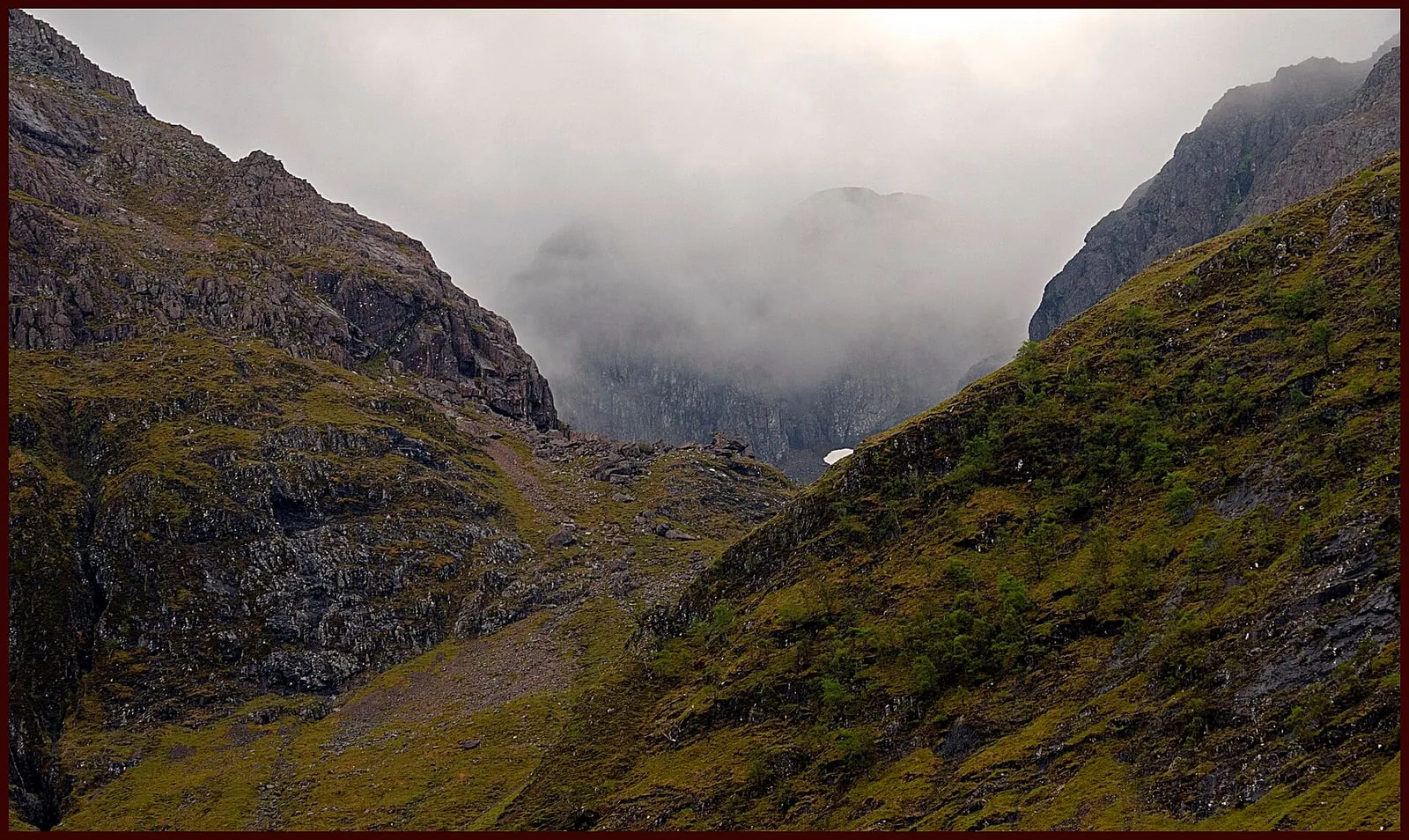
Misty mountain slopes in Glen Coe, Scottish Highlands. Photo: brian gillman, Wikimedia Commons, CC BY 3.0.
For the Highlands, DIY public transport collapses: the Citylink coach to Fort William alone takes 4 hours 24 minutes each way. Guided coach days solve the entire route—Loch Ness, Glencoe and the Highlandsad starts at GBP 58 (12.5 hours, 4.6 stars from 21,398 reviews; Rabbie’s small minibuses from GBP 69), while Loch Lomond and the Scottish Highlandsad (from GBP 35, 8.5 hours, 4.5 stars from 735 reviews) and St Andrews and Fife fishing villagesad (from GBP 51, 8.5 hours, 4.7 stars from 1,389 reviews) link stops that would take three bus changes alone. Watch out for entry fees: most Edinburgh coach tours exclude castle tickets (Stirling Castle, Urquhart Castle), so budget them on top. Do not attempt the Isle of Skye in a day—it needs a three-day tour (from GBP 180).
Verdict: Take ScotRail for Stirling, Glasgow and North Berwick; book a coach tour for Glen Coe, Loch Ness, Loch Lomond or Outlander filming locations. Read day trips from Edinburgh, Stirling Castle, St Andrews, Loch Ness and Glencoe and where to stay in Edinburgh.
Reykjavik
No passenger rail · Golden Circle tour from €83 · South Coast from €121 · Snæfellsnes from €133
Iceland has no trains, and Strætó rural buses are built for commuters rather than waterfall-hopping, so Reykjavik is the purest tour-led day-trip hub in Europe. Three paved routes cover the country’s geological highlights while returning you to your Reykjavik hotel every night: the Golden Circle (240 km loop: Þingvellir tectonic rift, Strokkur geyser, Gullfoss waterfall and Kerið crater), the South Coast to Vík (372 km round trip: Seljalandsfoss, Skógafoss, Sólheimajökull glacier and Reynisfjara black sand beach), and the Snæfellsnes Peninsula (450 km loop: Ytri Tunga seals, Arnarstapi cliffs and Kirkjufell).
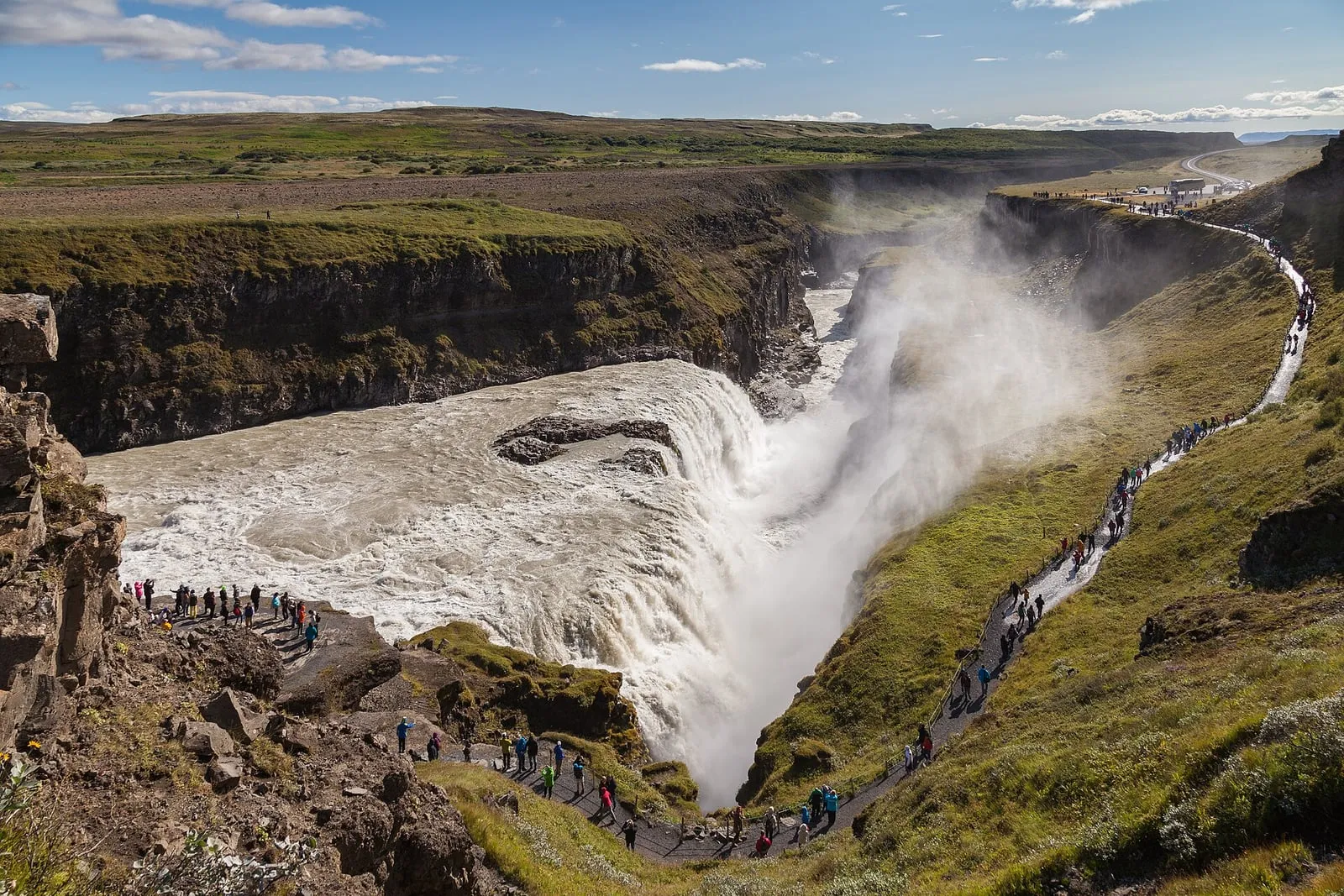
Gullfoss waterfall on Iceland’s Golden Circle. Photo: Diego Delso, Wikimedia Commons, CC BY-SA 4.0.
Between May and August, groups of three or four can save money by hiring a car (factoring in site parking fees of 1,700 ISK on the Golden Circle and about 3,650 ISK along the South Coast). From late October to April, however, daylight drops to four or five hours, black ice and 50-knot crosswinds are routine, and Icelandic car-hire policies exclude wind-blown door damage, gravel strikes and volcanic ash. Booking the Golden Circle Full-Day Tour with Kerid Craterad (from €83, 4.8 stars from 28,216 reviews, 7–8.5 hours), the South Coast Waterfalls, Black Sand & Glacier Tourad (from €121, 4.8 stars from 13,133 reviews, 10 hours) or the Snæfellsnes Peninsula Full-Day Tourad (from €133, 4.7 stars from 3,971 reviews, 11 hours) transfers all winter driving risk to professional coach drivers with studded tyres.
Verdict: Self-drive only in summer with three or more travellers; book guided tours for winter, solo travel, couples or glacier/ice-cave excursions. See day trips from Reykjavik, Golden Circle, South Coast, Snæfellsnes Peninsula and where to stay in Reykjavik.
The Alps and the Adriatic: passes, winter cut-offs and border queues
Central Europe and the Adriatic coast pack dramatic scenery into short distances, yet they hold the sharpest traps for car-free travellers: seasonal alpine closures, multi-leg lakeside connections, and non-Schengen border crossings where public buses cost more than organised tours.
Salzburg
Guest Mobility Ticket free for overnight guests · Berchtesgaden 49 min · Hallstatt 2h (3 legs) vs €85 tour
Salzburg sits right on the German border, giving you two countries’ worth of alpine sights within two hours. Overnight hotel guests receive the Guest Mobility Ticket, which makes regional trains to Hallein Salt Mine (19 to 24 minutes, mine €35) and Werfen (38 to 46 minutes) plus bus 150 to St Gilgen on the Wolfgangsee (42 minutes) completely free. Bus 840 from Engelbert-Weiß-Weg beside the Hauptbahnhof reaches Berchtesgaden in 49 to 55 minutes (carry your passport or EU ID—Germany operates border checks with Austria until 15 March 2027).
The trap in Salzburg is Hallstatt and autumn closures. Reaching Hallstatt independently requires bus 150X to Bad Ischl, the REX 70 train to Hallstatt station, and a lake ferry—about two hours each way, with the last return connections leaving around 19:00. Panorama Tours’ 5.5-hour Hallstatt half-day tourad (from €85 on GetYourGuide, 4.7 stars from 4,275 reviews; €80 direct on Panorama’s site) cuts straight to the village with 2.5 hours on the ground. Similarly, the Berchtesgaden and Königssee half-day tourad (from €75, 4 hours, 4.3 stars from 438 reviews) removes the bus-840-plus-local-bus transfer. Check the calendar before flying: the Eisriesenwelt ice cave, Schafbergbahn and Wolfgangsee ships shut on 1 November, Hohenwerfen Castle on 2 November, and the Eagle’s Nest after 8 November until mid-May.
Verdict: Ride free regional trains and buses for Hallein, St Gilgen and Berchtesgaden; book a tour for Hallstatt on a tight schedule. See day trips from Salzburg, Hallstatt, Eagle’s Nest and Berchtesgaden, Hallein Salt Mine and where to stay in Salzburg.
Munich
Bayern-Ticket €34 (€44 for two) · Neuschwanstein €57.50 DIY vs €79 tour · Rothenburg 6h rail vs €82 tour
Munich’s Bayern-Ticket (€34 for one adult, €44 for two, up to €74 for five, valid from 09:00 on weekdays and all day at weekends) makes it Germany’s best rail hub. On that single regional pass you can reach Salzburg (1 hour 55 minutes on the RE5—passport required), Regensburg (1 hour 23 minutes direct), Nuremberg (1 hour 51 minutes on the RE1), Prien for Herrenchiemsee Palace (1 hour 5 minutes plus €11.50 lake boat), and Garmisch-Partenkirchen for the Zugspitze (1 hour 23 minutes, then the cogwheel train and cable car at €70.50 to €78). Dachau is even cheaper on an €11.70 MVV day ticket (11 to 13 minutes by regional train, free entry).
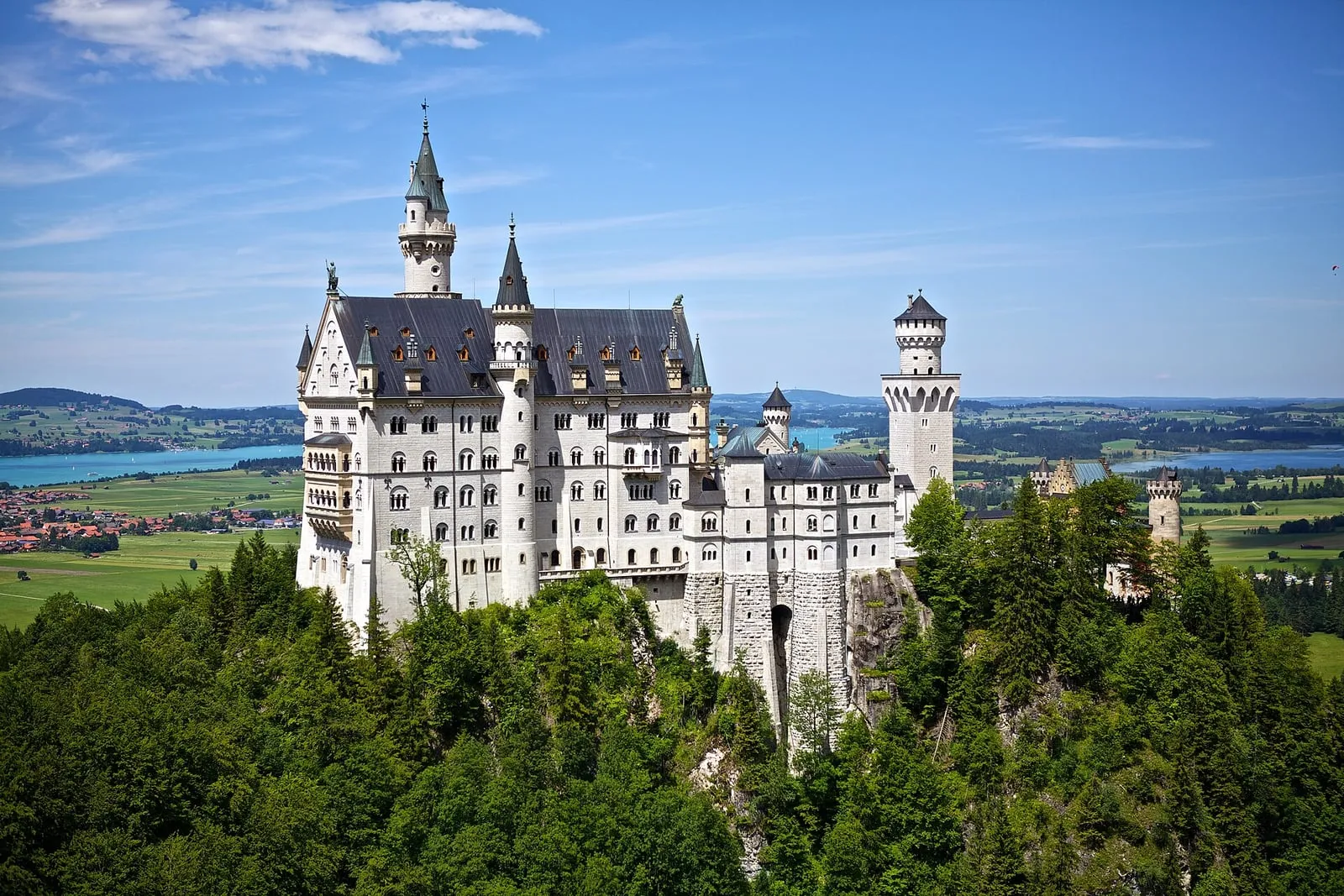
Neuschwanstein Castle above Hohenschwangau in Bavaria. Photo: cameralends, Wikimedia Commons, CC0.
Tours beat the train on three routes. Rothenburg ob der Tauber has no direct train and requires two or three changes taking about six hours round trip; the 10.5-hour Rothenburg and Romantic Road bus tourad (from €82, 4.5 stars from 2,598 reviews) saves the transfers and adds Harburg Castle. For Neuschwanstein, DIY costs €57.50 (€34 Bayern-Ticket + €21 timed castle ticket + €2.50 booking fee, with a change at Buchloe plus bus 73/78), while a guided Neuschwanstein Castle day trip by trainad (from €79, 10 hours, 4.7 stars from 4,457 reviews) handles logistics with a guide—though remember castle interior tickets are often collected or added on top. For the Zugspitze, a 9-hour guided tourad (from €125, 4.7 stars from 823 reviews) is only €13 to €20 above DIY rail and cable car (€104.50 to €112) and avoids November maintenance closures (closed 9 to 13, 16 to 20 and 23 to 26 November 2026).
Verdict: Buy a Bayern-Ticket for Salzburg, Nuremberg, Regensburg and Herrenchiemsee; book a guided tour for Rothenburg, Neuschwanstein or Berchtesgaden. Read day trips from Munich, Neuschwanstein, Salzburg from Munich, Nuremberg, Zugspitze and where to stay in Munich.
Dubrovnik
Lokrum €30 · Elaphiti ferry €3.40–€5.40 vs €25 cruise · Mostar bus €33.59 one way vs €30 tour · Kotor tour €58
Dubrovnik has no railway at all, so every day trip runs by ferry, Libertas bus or cross-border coach—and this is the clearest example in Europe of guided tours undercutting DIY public transport. Inside Croatia, public transport is cheap and effortless: Lokrum Island is a short official boat from the Old City Port (€30 return including nature reserve entry), Lopud in the Elaphiti Islands is €3.40 one way in winter (€5.40 from 29 May to 27 September) on Jadrolinija line 807, Cavtat is €4.00 on Libertas bus 10, and Ston is €6.40 on bus 15 (on Sundays take the 11:00 FlixBus instead).
Cross the border, however, and DIY falls apart. A one-way public bus from Dubrovnik bus station to Mostar in Bosnia and Herzegovina costs €33.59—and the last bus back leaves Mostar at 12:30, making a same-day public bus return impossible. Meanwhile, From Dubrovnik: Mostar and Kravica Waterfall Day Tripad starts at €30 (4.6 stars from 10,796 reviews, 11–12 hours), giving you return coach transport, hotel pickup, a guide and Kravica Waterfall for less than a single public bus ticket. Likewise, the public bus to Kotor in Montenegro is €37.59 each way (€75.18 return), whereas the 11-hour Montenegro Day Trip to Kotor and Perastad starts at €58 (4.4 stars from 5,941 reviews). On the water, if you want all three Elaphiti islands in one loop with drinks rather than timing a single Jadrolinija return, the Elaphite Islands cruisead starts at €25 (7.5–8 hours, 4.7 stars from 5,971 reviews). Bring your passport for Kotor and Mostar, and allow extra time for EU Entry/Exit System checks returning to Croatia.
Verdict: Take public ferries and Libertas buses for Lokrum, Lopud, Cavtat and Ston; always book a guided tour for Mostar and Kotor. See day trips from Dubrovnik, Lokrum, Elaphiti Islands, Kotor, Mostar and where to stay in Dubrovnik.
How to decide: DIY rail vs guided tour
Use this three-rule checklist before booking any excursion:
- One direct train under two hours = DIY. Pisa, Siena, Lucca, Florence (from Rome), Orvieto, Sitges, Tarragona, Sintra, Cascais, Évora, Guimarães, Braga, Stirling, Glasgow, Hallein, Regensburg and Salzburg (from Munich) all run on frequent direct trains. A tour only makes sense if you specifically want a guide or hotel pickup.
- Two or more transfers, or no railway = guided tour. Chianti, Val d’Orcia, Amalfi Coast from Rome, Cadaqués, Andorra, the Óbidos–Nazaré–Batalha–Fátima loop, Douro Valley in winter, the Scottish Highlands, Iceland’s Golden Circle and South Coast, Hallstatt on a tight timetable, and Rothenburg from Munich all lose hours to bus changes on your own.
- Cross-border bus > tour price = guided tour. In Dubrovnik, Mostar and Kotor tours beat the public bus fare outright while handling non-Schengen passport queues.
Other cities and other trips
If you want to build your break around guided eating instead of excursions, see best cities for food tours and cooking classes. For cities seen from the water, see best cities for boat tours and river cruises. For art and history passes, see museum city breaks, for two- or three-day trips long weekend city breaks, and for budget bases cheap city breaks in Europe. All comparison guides are gathered on Compare cities.
Common questions
Which European city is best for day trips without a car?
For rail variety, Florence and Munich lead: Florence puts Pisa (51 minutes, €19.60 return), Siena (1 hour 28 minutes, €21.60 return) and Bologna (37 minutes) on direct trains, while Munich's €34 Bayern-Ticket covers regional rail across Bavaria and into Salzburg. For cheap coastal and palace trains, Lisbon reaches Sintra and Cascais for €5.10 return each.
When is a guided coach tour actually cheaper or faster than public transport?
Where public transport requires multiple transfers, crosses a non-Schengen border or stops short of the sight. From Dubrovnik, a coach tour to Mostar and Kravica Waterfall starts at €30, less than a single €33.59 public bus ticket. From Florence, a 12- to 13-hour Cinque Terre coach tour from €65 matches peak DIY costs (€31.80 in train fares plus a €17.30 to €35.00 park card) while removing transfers. From Edinburgh, the Highlands need a tour because the Fort William bus alone takes 4 hours 24 minutes each way.
Which European day-trip cities require a passport for excursions?
Dubrovnik, Salzburg and Munich. From Dubrovnik, Kotor in Montenegro and Mostar in Bosnia and Herzegovina sit outside the Schengen area, with border controls both ways (the EU Entry/Exit System has been running in full since 10 April 2026; ETIAS is not yet required). Germany operates land-border checks with Austria until 15 March 2027, so carry a passport or EU national ID on the Salzburg–Berchtesgaden bus and the Munich–Salzburg train. From Barcelona, Andorra also requires a passport.
Can you visit Iceland's Golden Circle or South Coast without hiring a car?
Yes. Reykjavik has no passenger railways and rural public buses do not serve the main waterfalls or geysers cleanly in a day, so guided coaches are the standard car-free method. Golden Circle tours start from €83 (7 to 8.5 hours) and South Coast tours to Vík from €121 (10 hours) on GetYourGuide, eliminating winter ice driving and rental excess risk.
Which day trips close in winter and catch travellers out?
Salzburg and Munich have hard autumn cut-offs: the Eagle's Nest closes after 8 November until mid-May, Werfen's Eisriesenwelt ice cave closes on 1 November, and the Zugspitze shuts for three weeks of November maintenance. In Porto, CP suspends direct Douro Valley trains between Marco de Canaveses and Régua from 3 November 2026 to 24 March 2027, replacing them with buses.
Should I stay near the main railway station for a day-trip break?
In rail hubs such as Florence (Santa Maria Novella), Rome (Termini), Munich (Hauptbahnhof) and Edinburgh (Waverley), staying within 10 minutes' walk of the station saves 30 to 40 minutes every morning. In Lisbon, trains split between Rossio (Sintra), Cais do Sodré (Cascais) and Oriente (Évora and Porto), so central Baixa is the smartest base.