In this guide
💡 The Short Version: Japanese social etiquette is grounded in two fundamental cultural concepts: meiwaku (avoiding causing inconvenience or disturbance to others) and omotenashi (unconditional hospitality). On trains, keep phones on silent, never take voice calls, and wear backpacks on your front. Take shoes off at the sunken genkan entry of ryokans, temples, and homes, but never wear slippers on woven tatami mats. At Shinto shrines, follow the two bows, two claps, one bow ritual; at Buddhist temples, pray silently without clapping. Never stick chopsticks vertically into rice, never smoke on city sidewalks, and never tip. Cash and payment advice are detailed in money in Tokyo.
The core philosophy: consideration and social harmony
Foreign travellers frequently worry about committing cultural faux pas in Tokyo. In practice, Japanese people are remarkably gracious and accommodating toward international visitors (gaijin), recognizing that foreign travellers are unfamiliar with complex domestic traditions.
The single guiding principle behind Japanese manners is consideration for the shared public sphere (meiwaku o kakenai — “do not trouble others”). Whether it is keeping voice levels subdued on crowded trains, packing out your personal rubbish, or removing shoes before walking onto delicate rush mats, etiquette is designed to maintain cleanliness, mutual respect, and social peace.
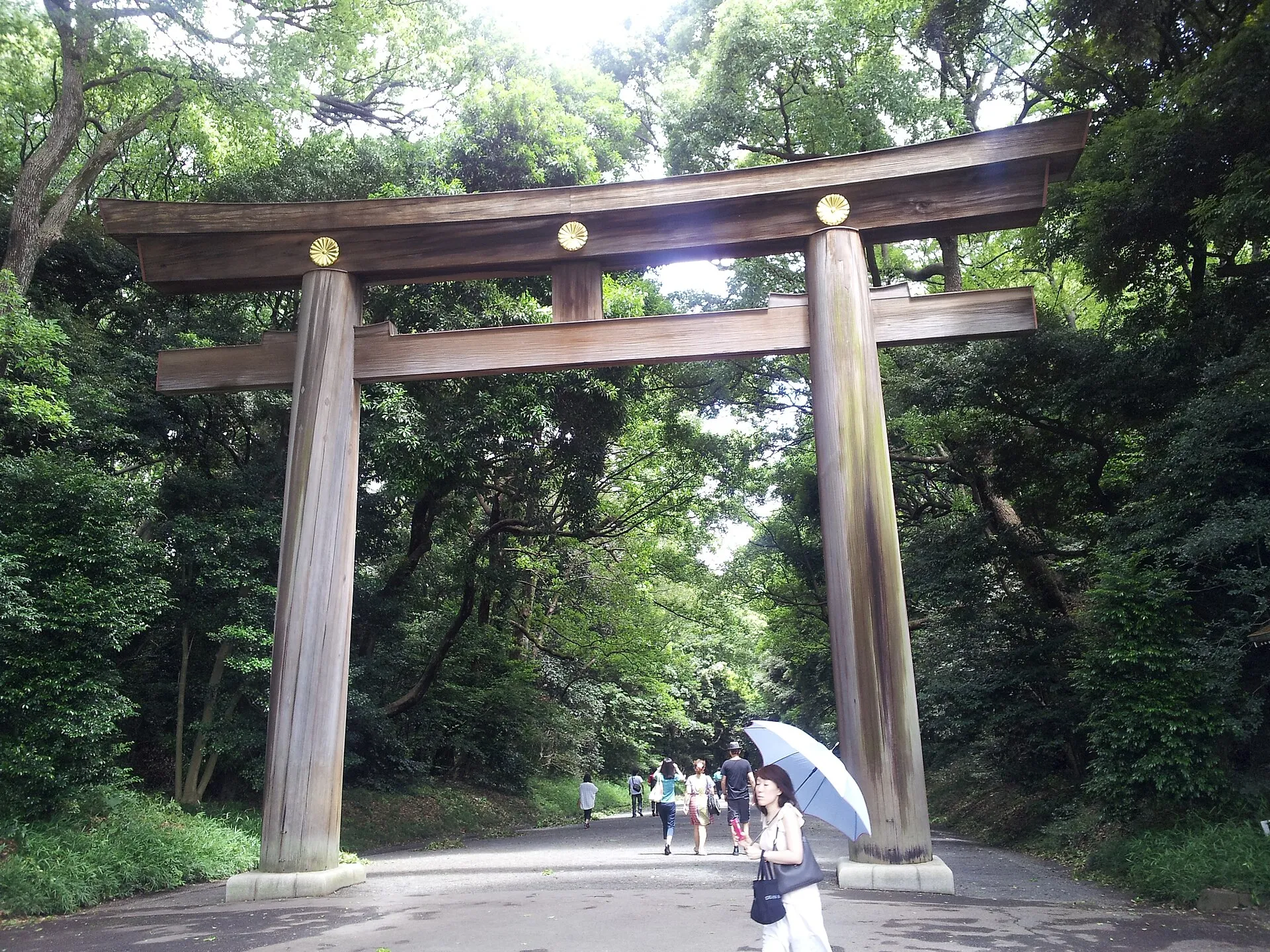
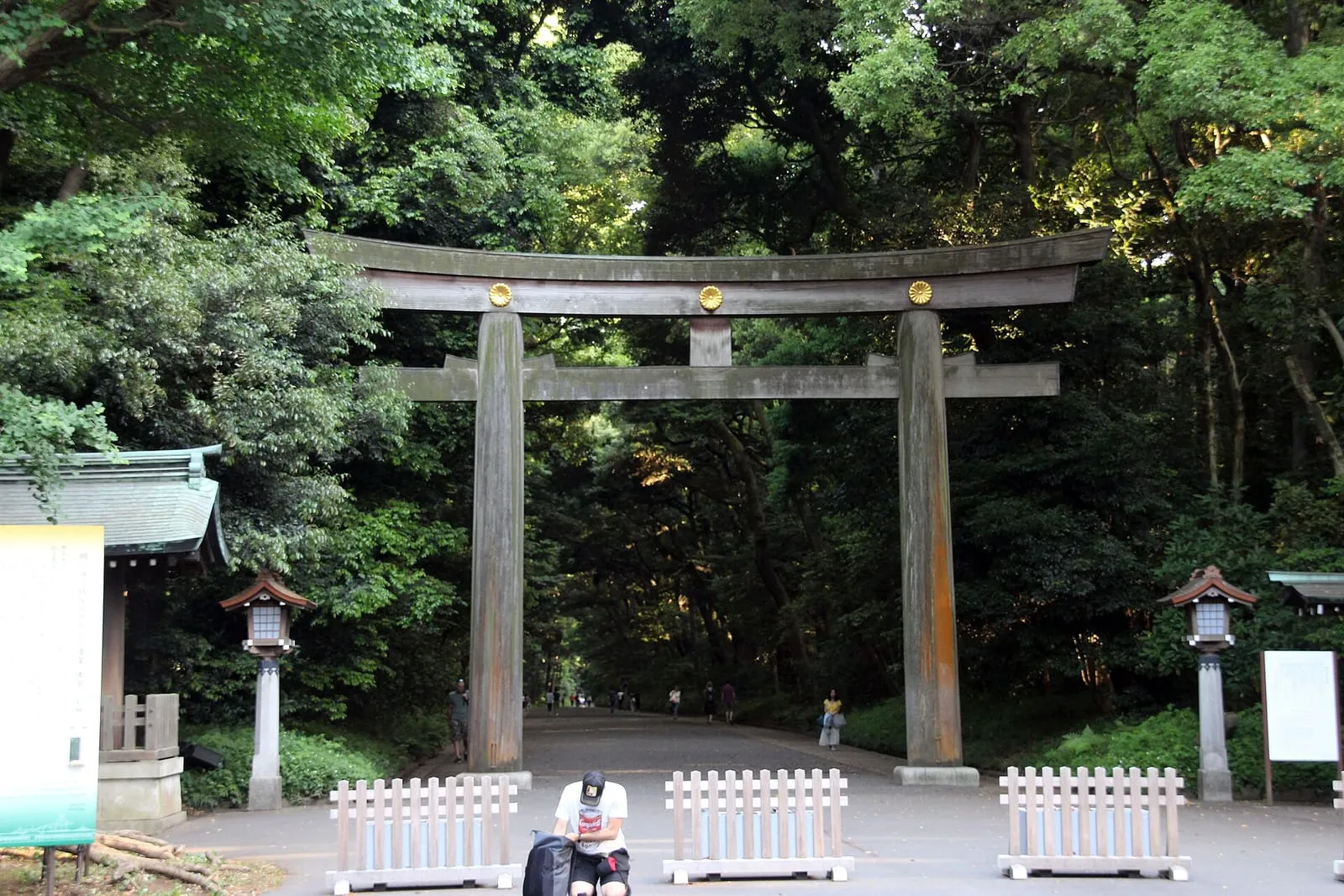
Colossal cypress torii gate standing at the forested entrance path to Meiji Jingu. Photo: Nightcrafter, Wikimedia Commons, CC BY-SA 4.0.
Public transit manners: trains and subways
Tokyo’s rail networks transport nearly 40 million passengers daily with extraordinary punctuality and calm. Observing commuter rules ensures seamless travel:
1. Mobile phone etiquette (“Manner Mode”)
- Set your smartphone to silent mode (universally referred to in Japan as Manner Mode / Mana Modo).
- Never make or receive voice telephone calls on trains, subways, or buses. Even answering a call and whispering “I’m on the train, I will call you back” is frowned upon. If an urgent call arrives, let it go to voicemail and reply by text.
- Always use headphones when listening to music, watching videos, or playing games, ensuring sound does not bleed into the carriage.
2. Conversational volume and spatial awareness
- Commuter carriages are quiet spaces. While talking with travel companions is permitted, speak in hushed, soft voices. Loud laughter, boisterous group banter, or shouting across aisles disrupts the collective environment.
- Backpack discipline: During busy daytime and rush-hour periods, take off large daypacks and hold them by your hand, set them on the overhead metal luggage racks (amidana), or wear them backwards across your chest. This prevents accidentally striking seated or standing passengers when turning.
3. Boarding queues and priority seating
- Railway platforms feature painted queue lines indicating where carriage doors open. Line up in neat single or double files behind the painted lines.
- Stand aside to let passengers disembark: Never push onto a train until all exiting passengers have cleared the doorway.
- Priority seats (Yusenseki): Marked by distinct fabric colours or window decals at the end of cars. These are reserved for elderly commuters, disabled passengers, pregnant women, and parents with small children. If the carriage is uncrowded, you may sit here, but yield your seat immediately if an eligible passenger boards.
4. Eating and drinking on trains
- On standard metropolitan commuter trains (such as the JR Yamanote Line, Tokyo Metro, and Toei Subway), eating food is considered bad manners. Sipping water or tea from a resealable bottle is acceptable, but avoid consuming snacks, pastries, or open drinks.
- Exception: Eating and drinking are completely normal and encouraged aboard long-distance Shinkansen bullet trains and limited express services (such as the Narita Express or Odakyu Romancecar), which are equipped with fold-down seatback tray tables designed for regional bento boxes (ekiben).
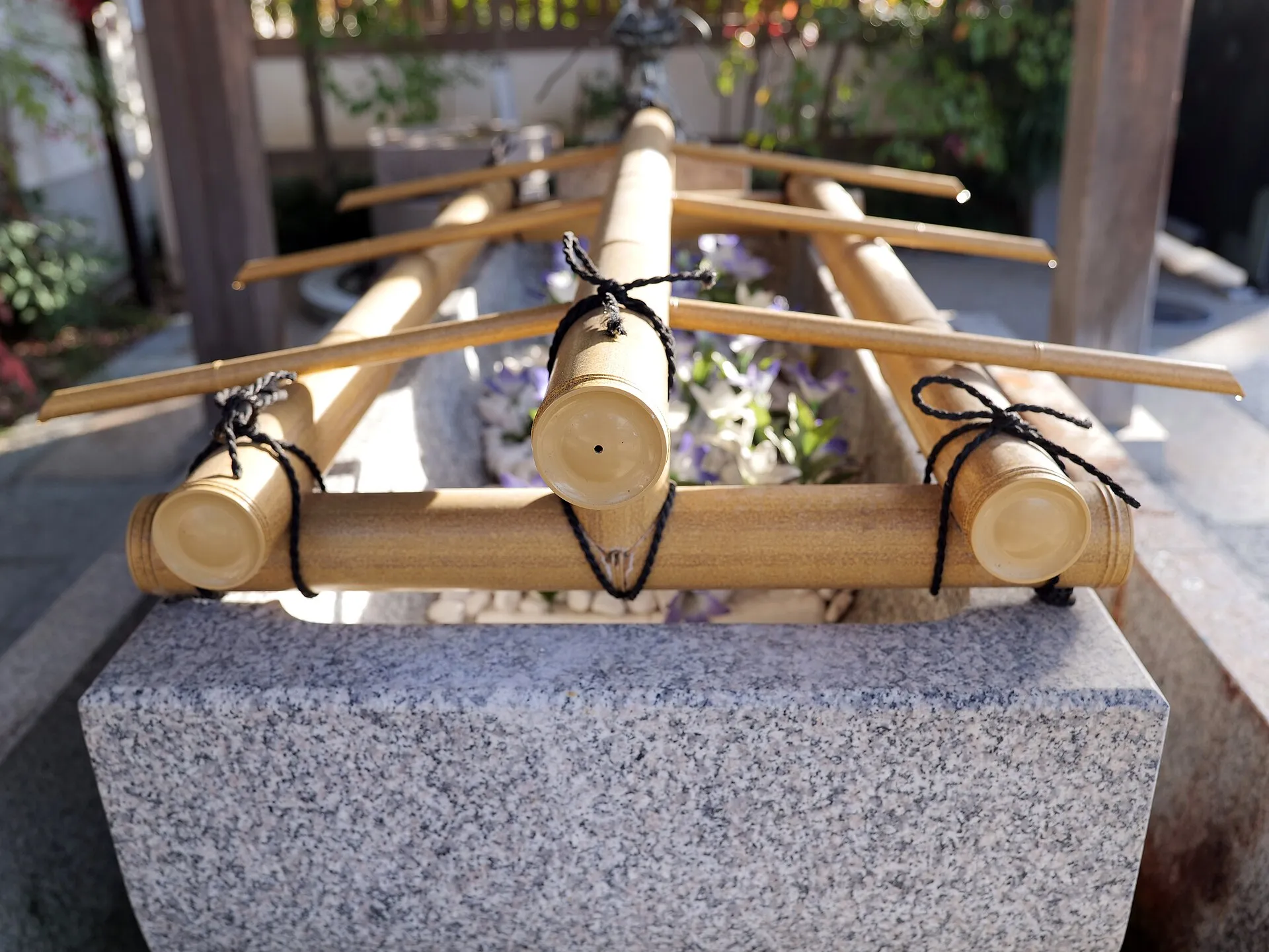
Wooden water ladles resting on bamboo racks at a shrine purification pavilion. Photo: Hyppolyte de Saint-Rambert, Wikimedia Commons, CC BY 4.0.
Footwear etiquette: the Genkan, slippers and tatami
In Japan, the boundary between the “dirty outside world” and the “clean domestic interior” is physically engineered into building architecture:
1. The sunken entrance (Genkan)
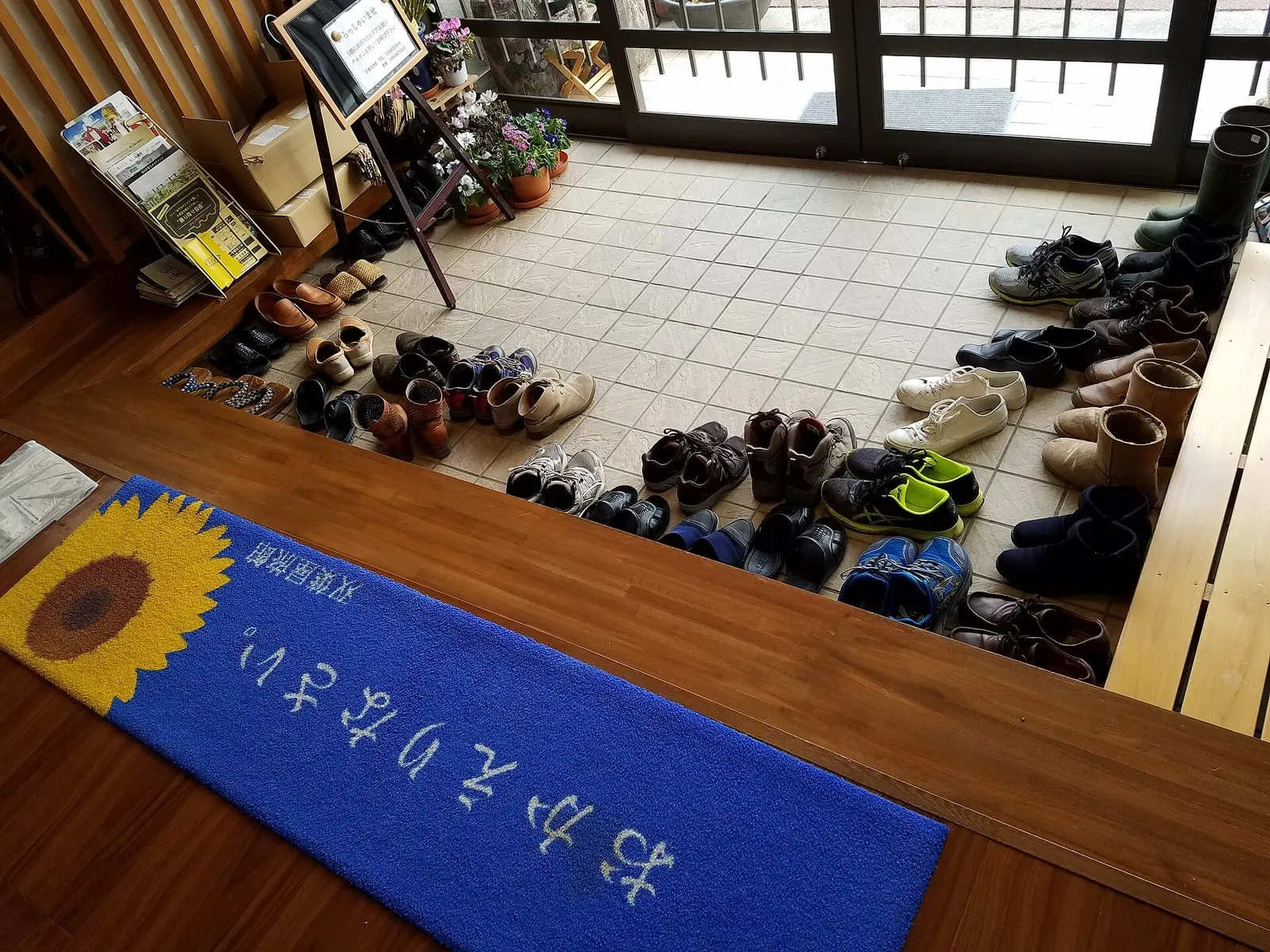
Private homes, traditional Japanese inns (ryokan), historic restaurants, martial arts dojos, and sento public bathhouses feature a sunken tiled or stone entrance hall called a genkan:
- Step onto the raised wooden floorboard while slipping out of your outdoor shoes.
- Crucial rule: Never allow your socks or bare feet to touch the lower stone floor where outdoor shoes rest.
- Turn your shoes around so the toes point toward the outside door, and place them neatly to the side or into the provided shoe cubby (getabako).
2. Slippers vs bare feet on tatami
- In ryokans and homes, slip into the guest slippers provided on the raised wooden floor.
- The Tatami Rule: Never, under any circumstances, wear slippers onto woven straw tatami mats. Tatami is handcrafted from delicate natural rush grass (igusa); hard slipper soles damage and fray the weave. Step out of your slippers at the edge of the tatami room and walk onto the mats in socks or bare feet.
- Packing Tip: Always wear clean, neat, hole-free socks when sightseeing in Tokyo, as you will remove your shoes multiple times daily at temples, castles, and fitting rooms.
3. The toilet slipper switch
Japanese ryokans and traditional homes provide dedicated toilet slippers (toire surippa) positioned just inside the bathroom door:
- Step out of your hallway house slippers at the bathroom threshold.
- Step into the toilet slippers while inside the washroom.
- The classic tourist mistake: Forgetting to switch back when exiting, walking back across the living room or restaurant in toilet slippers! Always leave the toilet slippers facing outward inside the bathroom door.
Shrines vs temples: how to visit and pray
Understanding whether you are standing in a Shinto shrine (jinja or jingu) or a Buddhist temple (otera or ji) dictates proper worship etiquette:
| Dimension | Shinto Shrine (Jinja) | Buddhist Temple (Otera) |
|---|---|---|
| Entrance landmark | Vermilion or wooden Torii gate | Multi-storey Sanmon gate with Nio guardian statues |
| Spiritual focus | Nature spirits and ancestral deities (Kami) | The historical Buddha and Bodhisattvas (Kannon, Amida) |
| Incense burner | Rare | Jokoro bronze incense burner in central courtyard |
| Water purification | Temizuya pavilion (purify hands and mouth) | Temizuya pavilion (purify hands and mouth) |
| Prayer sequence | 2 bows, 2 claps, 1 bow | Silent prayer with hands pressed together (NO clapping) |
| Prominent Tokyo examples | Meiji Jingu, Asakusa Shrine, Kanda Myojin | Senso-ji, Zojoji, Kanei-ji |
The water purification ritual (Temizuya / Chozuya)
Before approaching the main sanctuary of a shrine or major temple, stop at the stone water pavilion (temizuya):
- Hold the wooden ladle in your right hand, scoop fresh water from the basin, and pour roughly one-third over your left hand to rinse it.
- Switch the ladle to your left hand and rinse your right hand.
- Switch the ladle back to your right hand, pour a small amount of water into your cupped left hand, and use it to rinse your mouth. (Spit the water out discreetly into the drainage ditch beside the stone basin—never swallow it, and never put the ladle directly to your mouth).
- Rinse your left hand once more.
- Tilt the ladle vertically so the remaining water cascades down the wooden handle, washing it clean for the next worshipper. Rest the ladle face down on the rack.
How to pray at a Shinto shrine
When approaching the main worship hall (haiden) at shrines like Meiji Jingu:
- Toss a coin into the wooden slatted offertory box (saisen-bako). A ¥5 coin (go-en) is considered auspicious.
- If a hanging ceremonial rope and bronze bell are present, ring the bell with a firm downward pull to announce your presence to the kami.
- Bow deeply twice from the waist at a 90-degree angle.
- Bring your hands together in front of your chest, slide your right hand slightly lower than your left, and clap sharply twice.
- Keep your palms pressed together, close your eyes, and offer a silent personal prayer or reflection.
- Bow deeply once more to conclude the prayer.
How to pray at a Buddhist temple
When praying at temples like Senso-ji in Asakusa:
- Toss a coin into the wooden offertory box.
- Bow your head slightly, bring your palms together in front of your chest in the gassho gesture, and pray silently.
- Do not clap. Clapping is exclusively a Shinto practice; clapping at a Buddhist altar is considered a breach of ritual etiquette.
- Finish with a gentle bow.
[!WARNING] Photography bans: Photography and video recording are strictly prohibited inside the inner sanctuaries of both shrines and temples. Never point your camera lens directly into the sacred altar or prayer hall.
Dining and chopstick etiquette
Japanese dining culture places high value on mindfulness and aesthetic presentation:
Essential chopstick taboos
- Tsukitate-bashi (Vertical sticking): Never stick your chopsticks upright into a bowl of rice. This mimics the incense bowls offered to the deceased during Buddhist funeral ceremonies (makuragohan). Rest chopsticks on the ceramic chopstick rest (hashioki) or across the rim of your bowl.
- Hashi-watashi (Chopstick passing): Never pass food directly from your chopsticks to another person’s chopsticks. In Japanese cremation rituals, family members use ceremonial chopsticks to transfer remaining bone fragments into the burial urn. Passing food chopstick-to-chopstick evokes this funerary rite. If sharing, pick up the food and place it onto your companion’s small side plate (torizara).
- Neburi-bashi (Chopstick licking): Do not lick sauces off the ends of chopsticks or use them as toothpicks.
- Sashi-bashi (Spearing): Do not stab or spear food with a single chopstick; pick items up between both tips.
Table manners and expressions
- Before eating: Press your hands together and say Itadakimasu (“I humbly receive this food”), expressing gratitude to the ingredients, farmers, and chef.
- After finishing: Say Gochisosama-deshita (“Thank you for the wonderful meal”) to the host or chef upon leaving.
- Slurping noodles: When eating ramen, soba, or udon, slurping is polite and encouraged. It cools the hot noodles and carries the aromatic broth into your nasal passages to enhance flavour.
- Sushi dipping: When eating nigiri sushi, do not dunk the seasoned rice ball into your dish of soy sauce. The rice absorbs too much salt and falls apart into the dish. Turn the nigiri slightly on its side and dip only the fish topping (neta).
Street smoking and rubbish disposal
- Street smoking bans: Smoking while walking along public streets, pavements, or in municipal parks is strictly prohibited across central Tokyo (including Shibuya, Shinjuku, Chiyoda, and Ginza). Municipal patrols enforce instant cash fines of ¥2,000 to ¥20,000. Smoke exclusively inside marked glass-enclosed public smoking shelters (kitsuenjo), usually found near station exits.
- Where are the public rubbish bins? Tourists frequently discover that Tokyo has virtually no public trash cans on sidewalks. Following the 1995 Tokyo subway sarin attack, waste bins were removed for public security. Carry a small plastic bag in your daypack to pack out your personal trash until returning to your hotel room. The plastic receptacles positioned beside automated drink vending machines are strictly for empty beverage cans and plastic PET bottles—never insert food wrappers or coffee cups.
Guided cultural orientation tours
If you want an expert local guide to demonstrate Shinto purification rites, explain counter etiquette, and guide you through historic neighbourhoods, consider an immersive small-group tour:
Best of Tokyo: Guided Full-Day City Tour with a Local
From ¥20,248 · 4.6 stars from 250 reviews · 6 hours · Small group
Best of Tokyo: Guided Full-Day City Tour with a Localad explores Senso-ji, Meiji Jingu, the Imperial Palace, and Shibuya, with a licensed guide who explains temple rituals, commuter customs, and neighbourhood history.
Tokyo: Shinjuku Food Tour (13 Dishes and 4 Eateries)
From ¥13,200 · 4.9 stars from 3,939 reviews · 3 hours · Evening food crawl
Tokyo: Shinjuku Food Tour (13 Dishes and 4 Eateries)ad introduces guests to four authentic culinary venues, handling table charges, ordering customs, and chopstick etiquette with an English-speaking guide.
From Tokyo: Mt Fuji Day Trip to Oishi Park & Oshino Hakkai
From ¥7,800 · 4.8 stars from 6,302 reviews · 10 hours · Guided coach tour
From Tokyo: Mt Fuji Day Trip to Oishi Park & Oshino Hakkaiad combines scenic Mount Fuji viewing with visits to traditional thatched cottages at Oshino Hakkai.
Connecting etiquette and travel planning
- Public Bathhouse Customs: Learn about nude bathing, pre-wash stations, and tattoo rules in our Tokyo onsen and sento guide.
- Financial Etiquette: Learn why tipping is never done and how table charges (otoshi) work in money in Tokyo.
- Legal Guidelines: Review mandatory passport carriage, drug laws, and safety advice in is Tokyo safe?.
- Itinerary Planning: Cultural manners apply across all days of our 3 days in Tokyo and 5 days in Tokyo itineraries. Find all booking details on the Tokyo hub.
Common questions
What is the proper etiquette on Tokyo trains and subways?
Switch your mobile phone to silent ('Manner Mode') and refrain from talking on the phone. Keep conversations quiet, wear backpacks on your front or place them on overhead racks, line up behind platform queue markings, and allow arriving passengers to disembark before boarding.
When do you need to take off your shoes in Japan?
Remove outdoor shoes at the genkan (sunken entryway) of private homes, traditional ryokan inns, temple interiors, tea pavilions, and certain traditional restaurants. Never wear slippers on woven tatami straw mats.
How do you pray at a Shinto shrine versus a Buddhist temple?
At a Shinto shrine, toss a coin into the offertory box, bow twice, clap your hands twice, pray silently, and bow once (2 bows, 2 claps, 1 bow). At a Buddhist temple, toss a coin, bow once, and pray with hands pressed silently together without clapping.
Is slurping noodles considered rude in Japan?
No. Slurping ramen, udon, and soba noodles is culturally encouraged. Slurping cools the hot broth and aerates the buckwheat or wheat noodles to enhance aroma and flavour.
Do you tip taxi drivers or restaurant servers in Tokyo?
No. Tipping is completely absent from Japanese culture. Leaving extra cash on a table or rounding up a taxi fare is considered confusing or embarrassing to staff, who will often chase you down to return your change.