In this guide
💡 The Short Version: Shibuya Scramble Crossing is five pedestrian crossings converging on a single junction, stopping all vehicle traffic simultaneously every two minutes. It is free to walk across and best viewed from elevated vantage points: Shibuya Sky (¥2,700 before 15:00; ¥3,400 from 15:00) gives an open-air 360-degree panorama 229 metres above the street, the Shibuya Mark City elevated walkway provides free sheltered eye-level views, and Shibuya Hikarie’s 11th floor offers quiet indoor perspectives. From Shibuya Station, follow signs to the Hachiko Exit. Or book a tour: a guided walking tour of Shibuya’s backstreets including reserved Shibuya Sky admission starts from ¥14,557.
How Shibuya Scramble works
Shibuya Scramble Crossing (Shibuya Kosaten) is widely cited as the busiest pedestrian intersection on earth. Up to 3,000 people surge across the street simultaneously during a single 45-to-55-second pedestrian green signal during peak evening hours, and an estimated 250,000 to 500,000 pedestrians cross the tarmac every day.
The junction operates on an all-way pedestrian scramble system (pedestrian scramble or diagonal crossing). While standard vehicular traffic lights cycle through green and amber across ten vehicle lanes, all vehicular movement halts completely every two minutes. Green walking signals illuminate simultaneously across all five zebra crossings, prompting dense waves of commuters, shoppers, students, and tourists to advance directly towards each other from five different directions. Despite the apparent chaos, people instinctively weave through gaps without colliding.
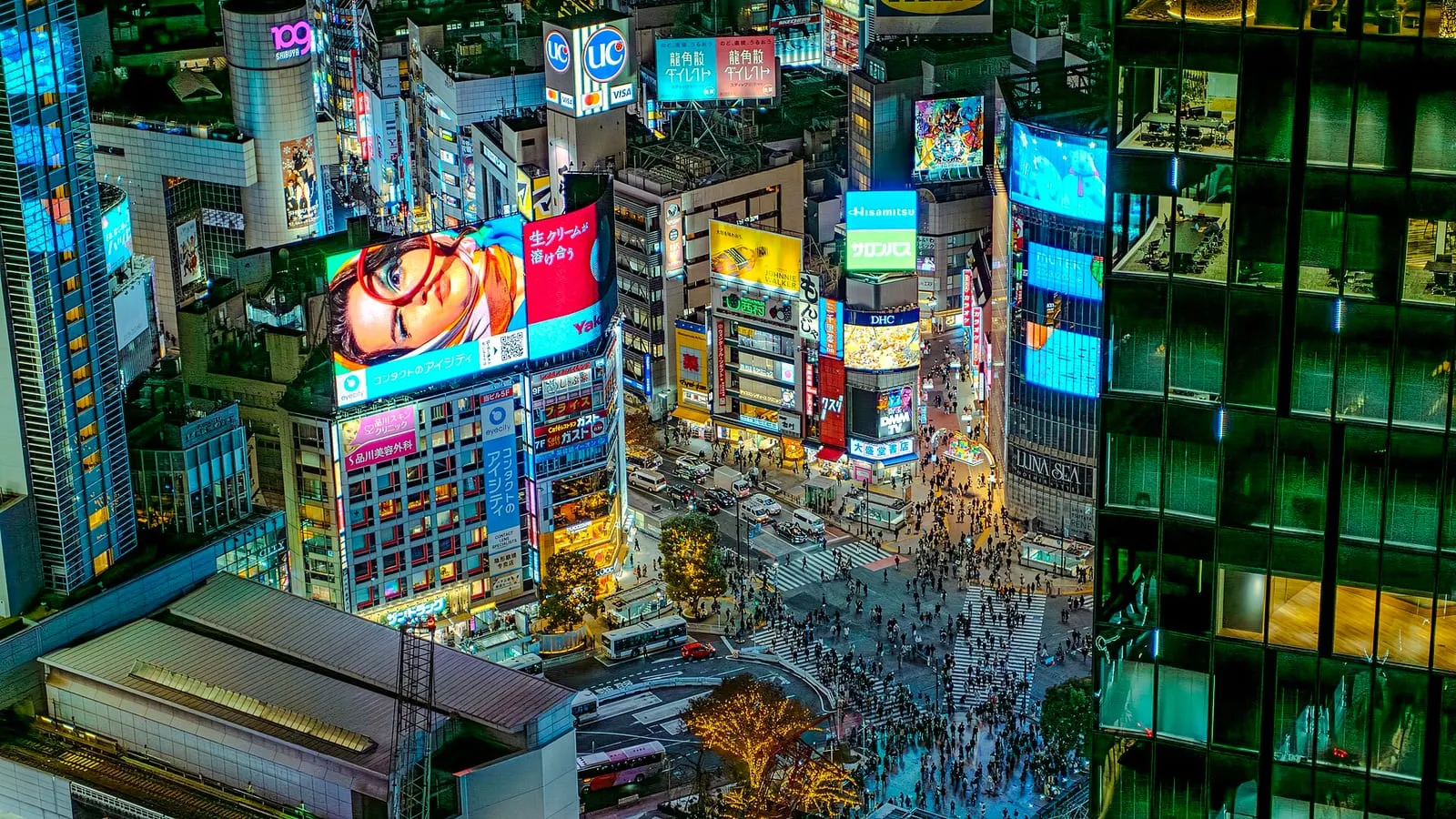
The intersection is framed by giant electronic advertising hoardings mounted on surrounding commercial facades—including the curved screens of the QFRONT building and the Shibuya 109-2 tower—broadcasting music videos, movie trailers, and animated advertisements synchronized with booming street loudspeakers.
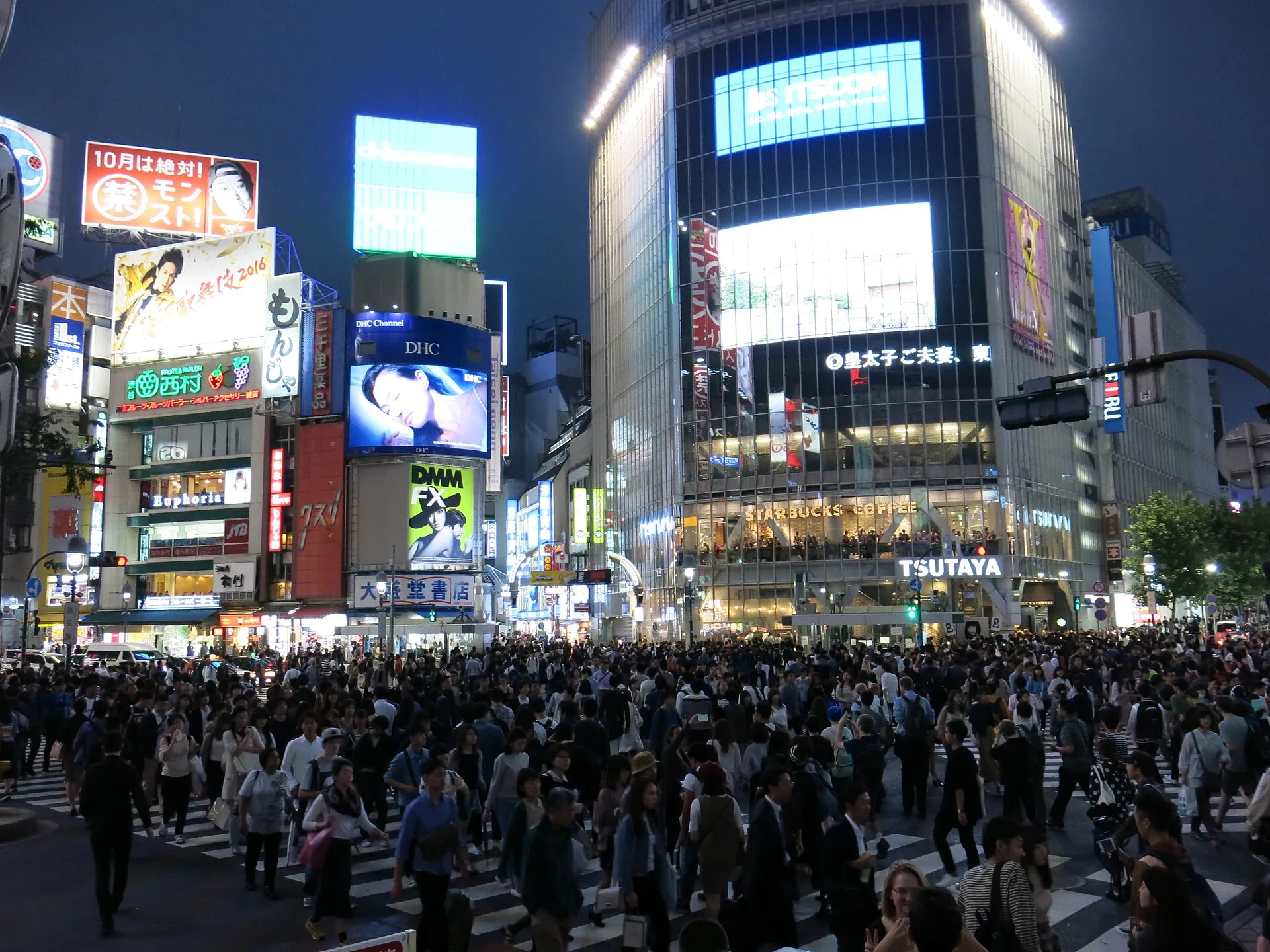
Commercial billboards and illuminated facades surrounding Shibuya Crossing at night. Photo: Filip Maljković, Wikimedia Commons, CC BY-SA 2.0.
Where to watch the crossing: paid and free viewpoints
While plunging into the sea of pedestrians is an essential Tokyo rite of passage, the geometric choreography of the scramble is best appreciated from elevated vantage points around the perimeter.
| Viewpoint | Cost | Elevation | Highlights |
|---|---|---|---|
| Shibuya Sky | ¥2,700 (before 15:00) ¥3,400 (from 15:00) | 229m (Rooftop / 47F) | Open-air 360° roof deck looking straight down onto the crossing |
| Shibuya Mark City Walkway | Free | 2nd Floor (Elevated skybridge) | Close-up eye-level view through glass; includes Taro Okamoto’s atomic mural |
| Shibuya Hikarie Sky Lobby | Free | 11th Floor | Quiet indoor lounge with expansive glass windows facing the crossing |
| Magnet by Shibuya 109 (Crossing View) | ¥1,500 (includes 1 drink) | 7th Floor / Rooftop | Direct unobstructed overlook facing QFRONT and the central junction |
| Shibuya Scramble Square Shunsai Cafe | Price of food / drink | 14th Floor | Floor-to-ceiling windows overlooking Shibuya Station rail lines and streets |
1. Shibuya Sky (Shibuya Scramble Square)
Perched atop the 47-storey Shibuya Scramble Square tower directly above the station, Shibuya Sky is Tokyo’s premier open-air rooftop observatory. From its glass-walled perimeter (Sky Edge), you look down vertically onto the ant-like flow of people surging across the zebra stripes.
Online timed tickets cost ¥2,700 for entry slots before 15:00 and ¥3,400 for sunset and evening slots (15:00 to 21:00) when booked in advance; same-day counter tickets cost ¥300 more and frequently sell out days ahead. Detailed booking windows and visiting strategies are covered in our Shibuya Sky ticket guide and Tokyo observation decks overview. Reserve directly via the official Shibuya Scramble Square ticket portal.
2. Shibuya Mark City 2F Walkway (Free)
The connecting pedestrian skybridge running between JR Shibuya Station’s Tamagawa Exit and the Shibuya Mark City shopping and hotel complex provides one of the best free vantage points in Tokyo. Large plate-glass windows face straight out across the scramble at second-storey height, offering a dramatic angle on oncoming pedestrian waves.
The corridor is also home to The Myth of Tomorrow (Asu no Shinwa), a monumental 30-metre-wide surrealist mural painted in Mexico between 1968 and 1969 by renowned Japanese artist Taro Okamoto. The artwork depicts the horror of nuclear detonation and was installed permanently in the station concourse in 2008. The walkway is open throughout rail operating hours (5:00 to 24:30) and costs nothing to access.
3. Shibuya Hikarie Sky Lobby (Free)
For a calm, sheltered vantage point away from tourist crowds, take the express elevator in the Shibuya Hikarie tower (Exit B5) up to the 11th floor. The Sky Lobby is a free public atrium serving the Tokyu Theatre Orb. Floor-to-ceiling panoramic glass windows look westward across the Shibuya rail viaducts and the scramble crossing below. Soft seating is available, making it an excellent resting spot during afternoon sightseeing.
4. Magnet by Shibuya 109 (Crossing View)
Located on the rooftop of Magnet by Shibuya 109 (the youth fashion mall directly opposite QFRONT), Crossing View is a dedicated observation platform projecting over the intersection. Admission is ¥1,500 (which includes a drink voucher at the 7th-floor Mag 7 food court). An automated overhead camera system mounted on the roof rail allows visitors to trigger high-angle souvenir photos of themselves with the scramble crossing directly below.
Hachiko: the faithful dog of Shibuya
Standing beneath the zelkova trees on the western plaza between the station and the crossing is the bronze statue of Hachiko, Tokyo’s most celebrated canine memorial and a universal meeting point.
Hachiko was a golden-brown Akita dog born in Odate, Akita Prefecture, in November 1923. In 1924, he was adopted by Hidesaburo Ueno, a professor in the agricultural department of Tokyo Imperial University (now the University of Tokyo). Every morning, Hachiko accompanied Professor Ueno to Shibuya Station to see him off to work, and every afternoon at 15:00, he returned to the station concourse to greet his master stepping off the commuter train.
On 21 May 1925, while delivering a lecture to his university students, Professor Ueno suffered a fatal cerebral haemorrhage and died suddenly without returning to the station. Hachiko was 18 months old. For the next nine years, nine months, and fifteen days, Hachiko returned to Shibuya Station every single day precisely at 15:00, waiting patiently on the station plaza through rain, snow, and summer heat for the master who never arrived.
Commuters and station staff initially chased the stray dog away, but in 1932, Hirokichi Saito, president of the Japanese Dog Preservation Society, published an article in the national newspaper Asahi Shimbun detailing Hachiko’s unyielding devotion. The story captivated the nation, turning Hachiko into a national symbol of family loyalty (chuken).
In April 1934, a bronze statue created by sculptor Ando Teru was unveiled on the station plaza with Hachiko himself present as guest of honour. During the Second World War, the bronze statue was melted down for munitions manufacture; however, in August 1948, Ando Teru’s son, Takeshi Ando, sculpted a replica statue using remaining plaster casts, which stands on the square today.
Hachiko died peacefully near Shibuya Station on 8 March 1935 at the age of 11. His pelt was preserved and remains on permanent display at the National Museum of Nature and Science in Ueno Park, while his cremated remains were interred beside Professor Ueno’s tomb at Aoyama Cemetery in Minato Ward. Today, Hachiko Square is often crowded with queues of visitors waiting for a photo; arrive before 9:00 for unobstructed pictures.
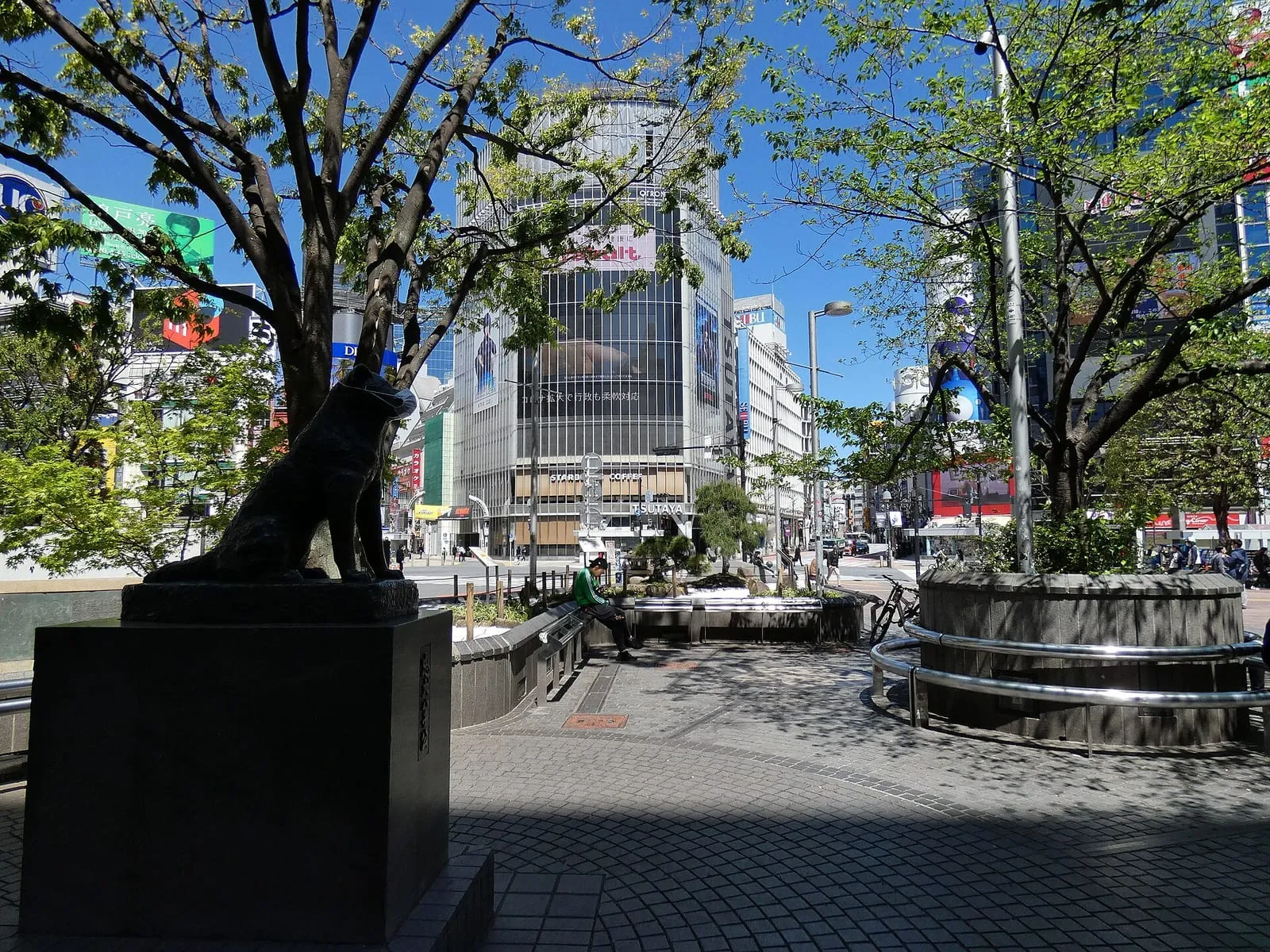
Hachiko Square and the station exit plaza facing Shibuya Crossing. Photo: Asanagi, Wikimedia Commons, CC0.
When to visit Shibuya Crossing
Because Shibuya Crossing is an active municipal road junction open 24 hours a day, timing completely changes the atmosphere:
- Friday and Saturday evenings (18:00 to 22:00): The busiest period of the week. Commuters heading home mix with diners, revellers, and weekend shoppers heading into Center-Gai. Billboards glow at peak intensity, and pedestrian volume reaches maximum capacity.
- Rainy days: A visual highlight. When rainfall starts across Tokyo, almost every pedestrian deploys an identical transparent vinyl umbrella purchased from nearby convenience stores. Seen from Shibuya Sky or the Mark City skybridge, the crossing transforms into an undulating mosaic of translucent plastic bubbles reflecting neon lights.
- Early morning (6:00 to 8:00): The quietest time. Street sweepers clean the tarmac, dawn light glints off commercial skyscrapers, and only a handful of early joggers and shift workers cross the junction. Ideal for architectural photography and unobstructed photos with the Hachiko statue.
- Halloween night (31 October): Historically the site of massive impromptu street parties. In recent years, Shibuya City Ward has enacted strict street alcohol bans and deployed heavy riot police cordons to disperse crowds and prevent overcrowding accidents; visitors should expect strict perimeter control around the crossing during late October.
Getting to Shibuya Crossing
Shibuya Station is Tokyo’s second-busiest transport hub, handling over 2.4 million passenger movements daily. Navigating the multilevel complex requires following dedicated overhead colour-coded signage:
- JR East Lines (Yamanote, Saikyo, Shonan-Shinjuku lines): Head down to the ground-floor concourse and follow signs to the Hachiko Exit (Hachiko-guchi). Walking out the automatic glass doors brings you directly into Hachiko Square, with the crossing immediately ahead.
- Tokyo Metro Ginza Line (Station G01): The terminal station platforms sit in an elevated concourse above the crossing. Follow signs down to the Hachiko Plaza.
- Tokyo Metro Hanzomon Line (Station Z01) & Fukutoshin Line (Station F16): Located underground. Follow the subterranean pedestrian passageways to Exit A8 (leads directly to Hachiko Square) or Exit A12 (surfaces directly outside Shibuya Scramble Square).
- Keio Inokashira Line: Terminus is on the 2nd floor of Shibuya Mark City, directly adjacent to the free glass walkway viewing gallery.
- Tokyu Toyoko Line & Den-en-toshi Line: Underground platforms connecting through to the Fukutoshin and Hanzomon lines; use Exits A8 or A12.
The standard JR Yamanote Line fare between Shinjuku and Shibuya is ¥150 (IC card ¥146; 7 minutes). The Tokyo Metro fare from Ginza or Omotesando is ¥180 (IC card ¥178). Route planners and station floor plans are available on the JR East station guide and Tokyo Metro official site.
Guided tours of Shibuya
Guided walking tours combine street-level navigation through Shibuya’s hidden alleyways with guaranteed timed entry to Shibuya Sky.
Shibuya Sky Sunset or Night View & Walking Tour
From ¥14,563 · 4.9 stars from 169 reviews · 2 hours · Admission ticket included
Tokyo: Shibuya Sky Sunset or Night View & Walking Tourad navigates the cultural landmarks of Shibuya before heading to the rooftop. The local guide leads participants through the historic alleyways of Shibuya Nonbei Yokocho (Drunkard’s Alley), details the underground subcultures of Center-Gai and Spain-zaka, explains the Hachiko memorial, and includes pre-booked express admission to the open-air Shibuya Sky observation deck timed for golden hour or night illumination.
Shibuya Sky Night View, Crossing & Local Vibe Tour
From ¥14,630 · 4.7 stars from 177 reviews · 2 hours · Small group
Tokyo: Shibuya Sky Night View, Crossing & Local Vibe Tourad focuses on Shibuya’s nightlife culture. The route winds through the shopping districts of Dogenzaka, stops at landmark street food stalls, demonstrates camera angles for capturing the scramble from the road, and concludes on the 47th floor of Shibuya Scramble Square.
Tokyo by Night: Shibuya Sky Views & Shinjuku Neon
From ¥13,600 · 4.9 stars from 22 reviews · 3 hours · Evening tour
Tokyo by Night: Shibuya Sky Views & Shinjuku Neonad connects Tokyo’s two most famous entertainment districts in a single guided evening. Starting with rooftop views over Shibuya Crossing from Shibuya Sky, the group takes the Yamanote Line north to Shinjuku to explore Omoide Yokocho and the neon corridors of Kabukicho.
Connecting walks and sights
Shibuya Crossing serves as an ideal anchor for neighbourhood walks across western Tokyo:
- Meiji Jingu to Shibuya Walk: Trace our step-by-step Meiji Jingu, Harajuku and Shibuya walk through the serene forest of Meiji Shrine, down Takeshita Street and Cat Street, finishing at Hachiko Square.
- Observation Decks Compared: Compare Shibuya Sky’s open-air deck with Tokyo Skytree, Tokyo Tower, and Roppongi Hills Mori Tower in our Tokyo observation decks overview.
- Shinjuku Night Walk: After exploring Shibuya, take the Yamanote Line three stops north to explore the contrasting nightlife of Golden Gai and Kabukicho in our Shinjuku night walk guide.
- Choosing Your Hotel Base: For help deciding whether to stay in Shibuya or neighbouring Shinjuku, read our neighbourhood showdown in Shinjuku or Shibuya and hotel booking advice in where to stay in Tokyo.
- Itinerary Planning: Shibuya Crossing forms the late afternoon highlight of Day 2 in our 3 days in Tokyo itinerary and is featured throughout our Tokyo in one or two days and 5 days in Tokyo guides.
Common questions
Where is the best view of Shibuya Crossing?
From above. Shibuya Sky on top of Shibuya Scramble Square provides panoramic rooftop views directly over the crossing (from ¥2,700 before 15:00, ¥3,400 from 15:00). For free indoor views, use the glass skybridge between Shibuya Station and Shibuya Mark City or the 11th-floor Sky Lobby in Shibuya Hikarie.
How do you get to Shibuya Crossing from Shibuya Station?
Follow station signage to the Hachiko Exit (ground level for JR lines) or underground subway Exits A8 and A12, which surface directly onto Hachiko Square beside the intersection.
What is the story behind the Hachiko statue?
The bronze statue honours an Akita dog named Hachiko who accompanied his owner, Professor Hidesaburo Ueno, to Shibuya Station every morning. After Ueno died unexpectedly in 1925, Hachiko faithfully returned to wait at the station every afternoon for nearly ten years.
Does it cost anything to walk across Shibuya Crossing?
No. Shibuya Crossing is an ordinary public municipal intersection and is completely free to cross.