One of 3 self-guided walks in Tokyo. See every walk.
In this guide
💡 The Short Version: This 5.2-kilometre walking route traces western Tokyo’s transition from ancient sacred tranquility to futuristic consumer design: starting amidst the 100,000 evergreen trees of Meiji Jingu, proceeding through the youth fashion storefronts of Takeshita Street, down the tree-lined designer boulevard of Omotesando and Cat Street, and finishing at the Shibuya Scramble Crossing and Shibuya Sky. The entire walk is free except for Shibuya Sky (¥2,700 before 15:00, ¥3,400 from 15:00). Meiji Jingu closes strictly at sunset (16:00 in December, 16:10 in November), making a morning start essential. Or book a tour: travellers wanting an expert cultural guide through the shrine and youth districts can join the Tokyo: Meiji Shrine Walking Tour — Shinto & Imperial Systemad (from ¥1,500, 4.9 stars from 667 reviews). All prices are in Japanese yen (¥).
Walking route summary and itinerary schedule
Western Tokyo provides one of the world’s most compelling urban contrasts: within fifteen minutes on foot, you move from an ancient-style evergreen Shinto forest where only crows and wind can be heard, into dense commercial canyons illuminated by giant neon screens and thousands of pedestrians.
Map of the walk numbered stops in walking order
Open the route in Google Maps — complete step-by-step pedestrian navigation linking all waypoints.
| Stop | Distance | Admission | Opening hours | Highlights |
|---|---|---|---|---|
| 1. Meiji Jingu | 0 km (Start) | Free | Sunrise to sunset (06:00–16:00 in winter) | 12 m cypress torii, wine barrels, camphor trees, Main Hall |
| 2. Takeshita Street | 1.8 km | Free | Shops typically 10:30–19:00 | Youth subculture, rolled crêpes, street fashion, purikura |
| 3. Omotesando & Cat Street | 2.6 km | Free | Public boulevard; shops from 11:00 | Zelkova tree avenue, Tadao Ando’s Omotesando Hills, boutique cafes |
| 4. Shibuya Crossing | 4.8 km | Free | Open 24/7 | Hachiko memorial statue, multi-directional pedestrian crossing |
| 5. Shibuya Sky | 5.2 km (Finish) | ¥2,700–¥3,400 | 10:00–22:30 (last entry 21:20) | 229 m open-air rooftop observation deck over Shibuya crossing |
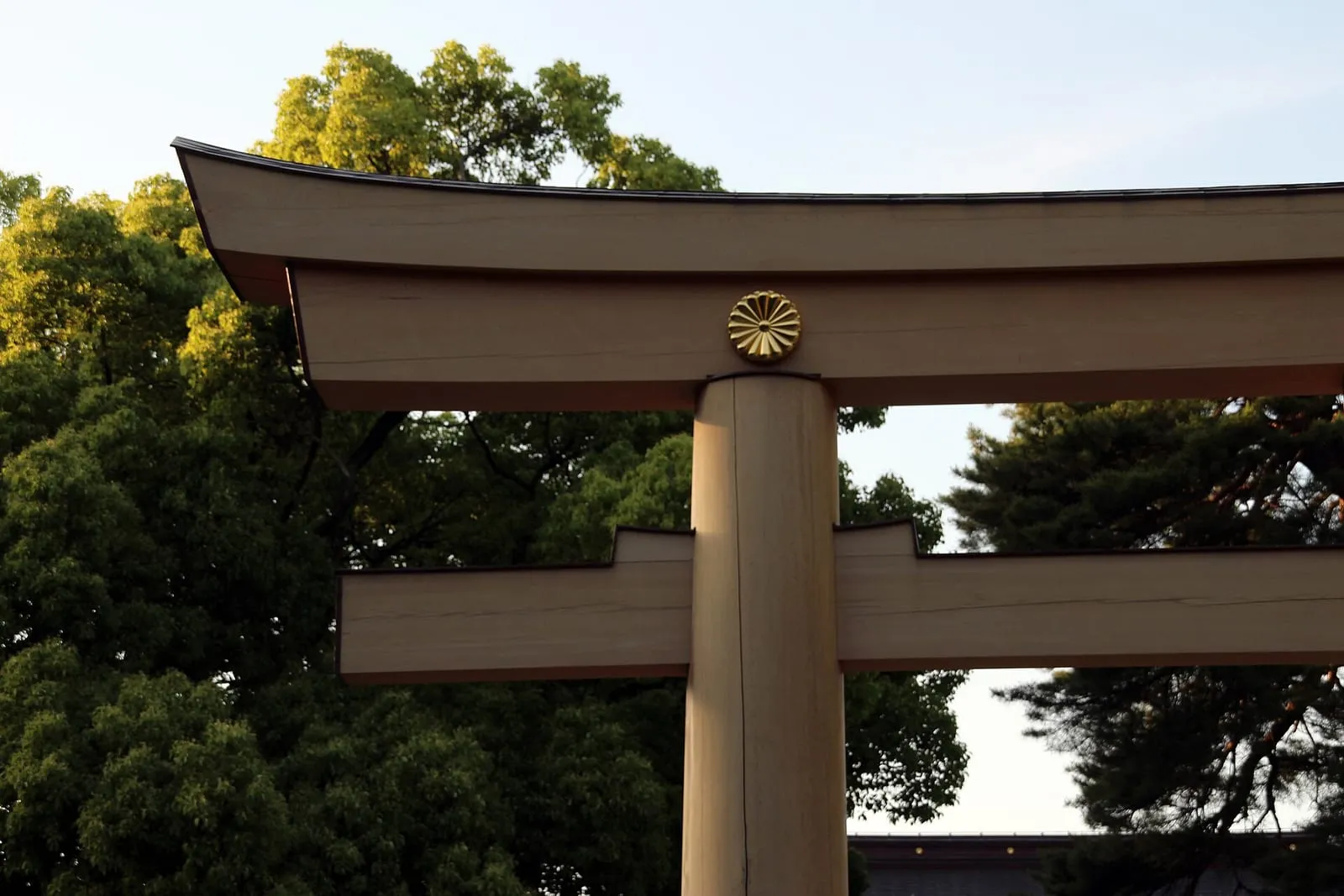
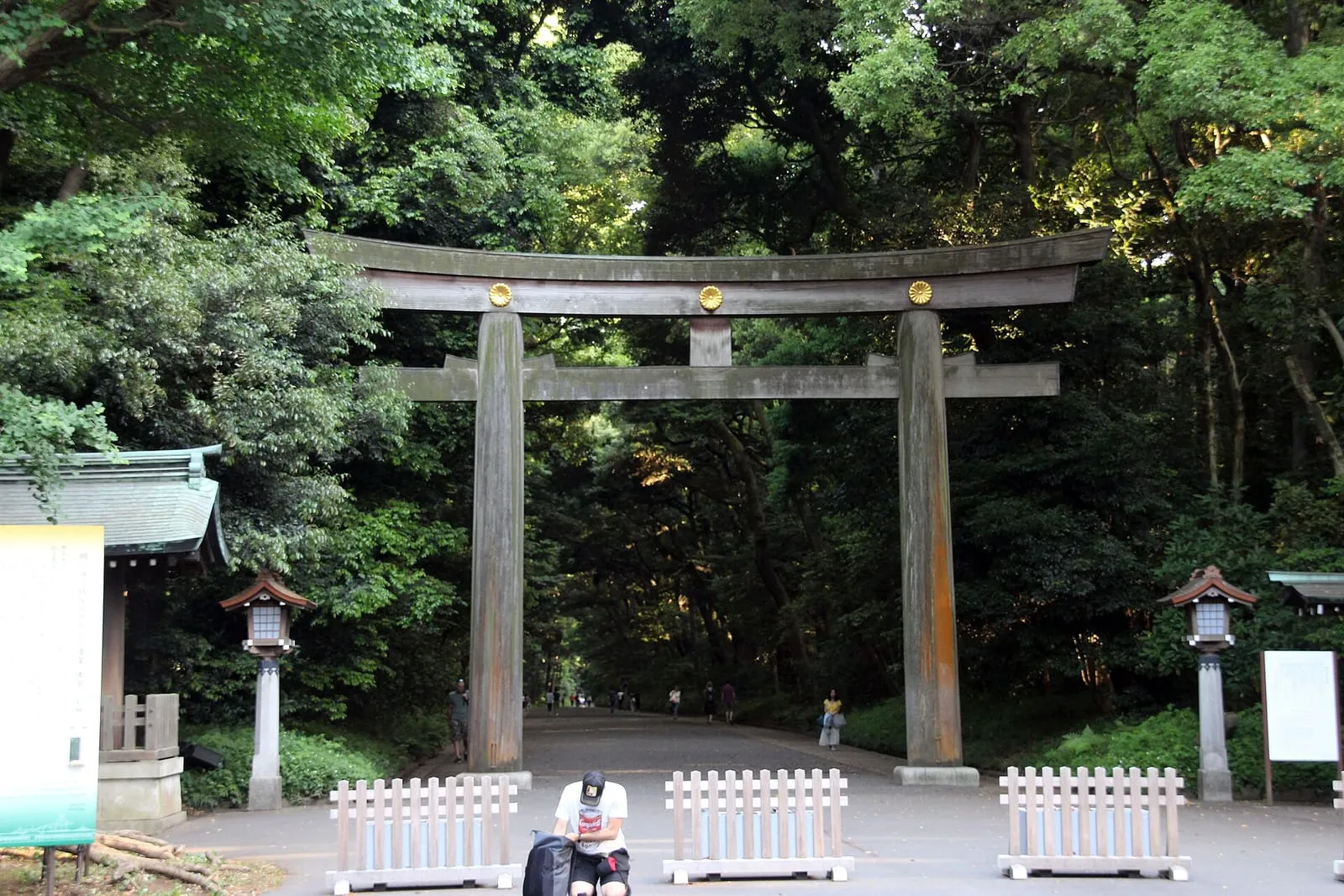
Massive timber torii gate at Meiji Jingu bearing the imperial chrysanthemum crest. Photo: Hyppolyte de Saint-Rambert, Wikimedia Commons, CC BY-SA 4.0.
Stop 1: Meiji Jingu Shrine and Sacred Forest
Start at Harajuku Station (JR Yamanote Line) or Meiji-jingumae Station (Tokyo Metro Chiyoda and Fukutoshin lines). Cross the wooden bridge over the railway tracks to enter the grounds of Meiji Jingu, Tokyo’s grandest Shinto shrine.
- The Man-Made Climax Forest: While it appears ancient, the 70-hectare forest was created artificially in 1920 to honour Emperor Meiji and Empress Shoken. Over 100,000 trees representing 365 species were donated by citizens from across Japan and planted according to an ecological masterplan designed to regenerate indefinitely without human pruning or maintenance.
- The Grand Torii: The gravel approach passes through an imposing 12-metre-tall torii gate, built from 1,500-year-old Taiwanese cypress (hinoki) timber with pillars over 1.2 metres in diameter.
- Offering Barrels: Along the central path stand decorative tiers of traditional sake barrels (kazaridaru) wrapped in straw rope, donated by Japanese sake brewers, directly opposite a wall of French oak wine barrels from Burgundy, reflecting Emperor Meiji’s role in modernizing Japan and adopting Western cultural elements.
- Inner Shrine Compound: Cleanse your hands and mouth at the granite temizuya pavilion, view the two sacred “husband-and-wife” camphor trees (Meoto Kusu) linked by Shinto straw rope (shimenawa), write a prayer wish on a wooden ema tablet, and observe the copper-roofed sanctuary of the Main Hall (Honden). Admission is free.
Stop 2: Takeshita Street (Takeshita-dori)
Exit the shrine’s south gate, cross back over Harajuku Station, and enter the electronic LED gate of Takeshita Street.
- Youth subculture capital: For four decades, this 350-metre narrow pedestrian street has served as Japan’s trendsetting launchpad for kawaii (cute) fashion, Decora styles, gothic lolita garments, and pop idol merchandise.
- Street food tradition: Harajuku’s signature culinary item is the thin-rolled French crêpe, pioneered by Marion Crêpes and Santa Monica Crêpes since 1976, stuffed with whipped cream, fresh strawberries, cheesecake slices, and chocolate drizzle. Other treats include towering multi-coloured spun cotton candy at Totti Candy Factory and Korean potato-crusted cheese hot dogs.
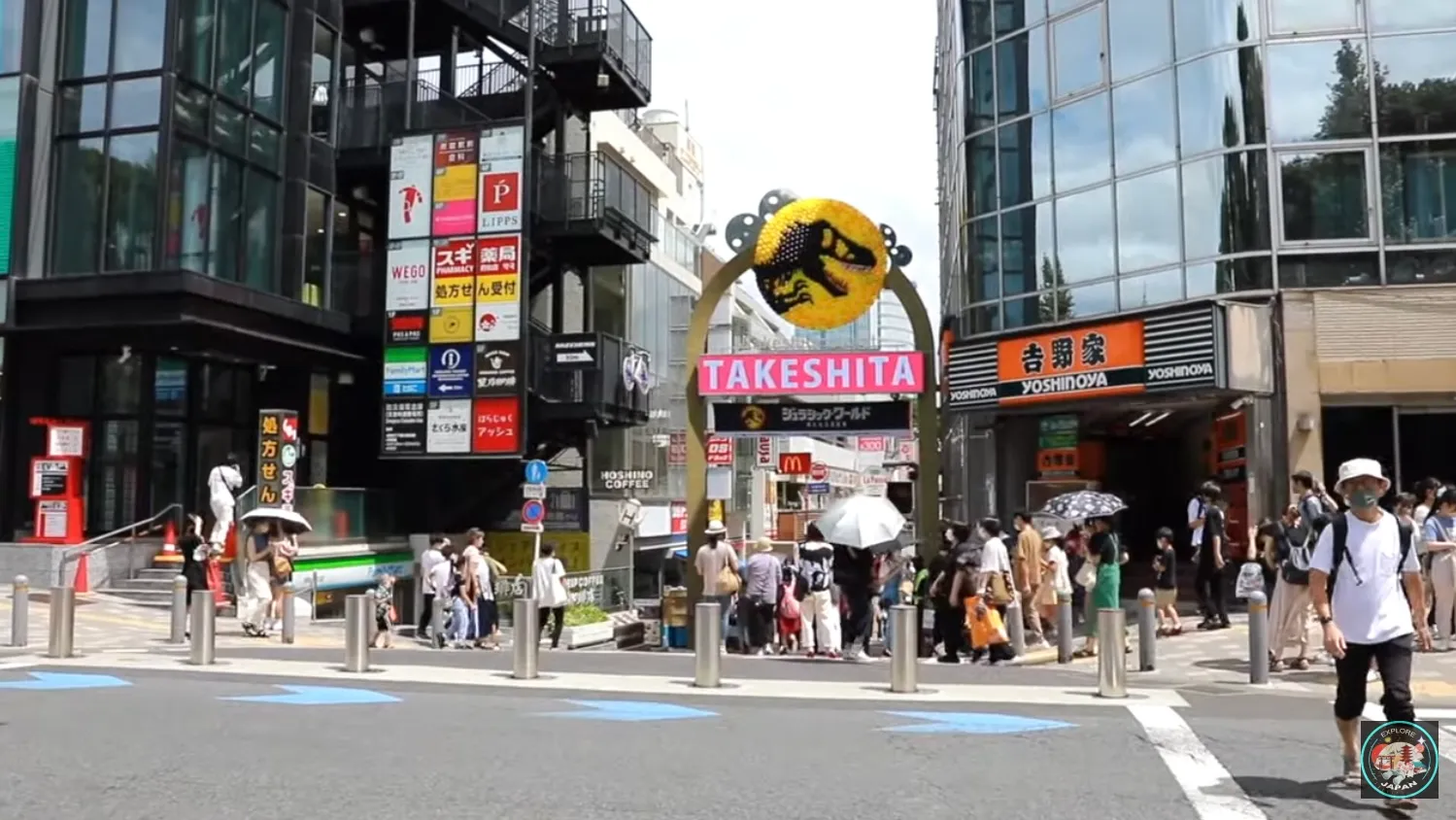
The neon entrance gate to Takeshita Street in Harajuku. Photo: japanvlogjp, Wikimedia Commons, CC BY-SA 4.0.
Stop 3: Omotesando and Cat Street
At the eastern end of Takeshita Street, turn right onto Meiji-dori and continue south to the grand intersection of Omotesando.
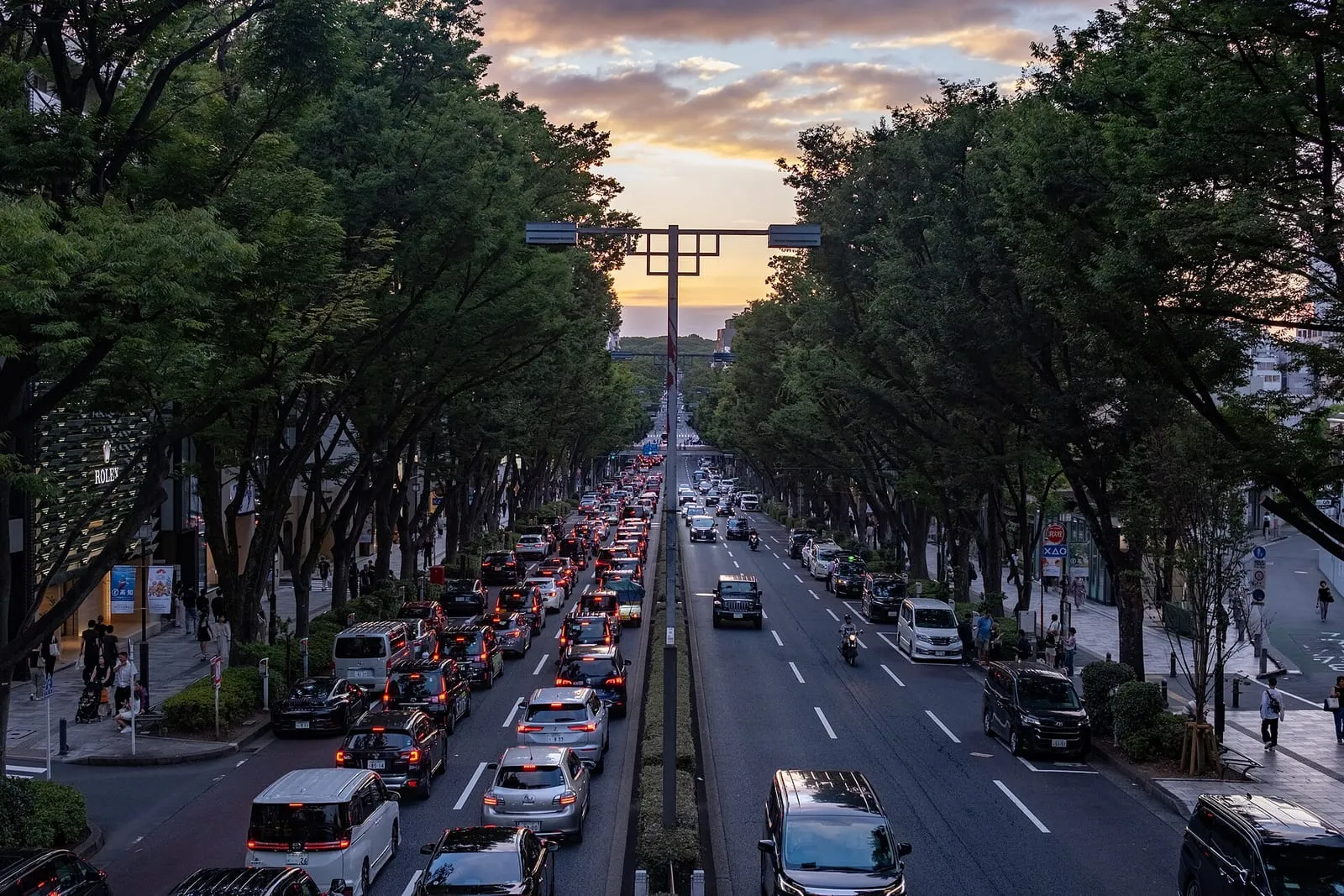
- Tokyo’s Architectural Showcase: Originally created in 1920 as the formal cedar-lined processional avenue (omote-sando) to Meiji Shrine, Omotesando was re-planted with majestic Japanese zelkova (keyaki) trees and developed into an open-air museum of contemporary architecture:
- Omotesando Hills: A 250-metre shopping complex designed by Pritzker laureate Tadao Ando, built with an interior spiral ramp matching the natural slope of the exterior avenue.
- Tod’s Omotesando: Designed by Toyo Ito, wrapped in a criss-crossing concrete lattice mimicking the branches of the zelkova trees outside.
- Prada Aoyama: Designed by Herzog & de Meuron, clad in diamond-faceted convex and concave glass prisms.
- Cat Street (Kyushibuyagawa Promenade): From the middle of Omotesando, duck into Cat Street. This winding, car-free pedestrian walkway was built over the culverted bed of the historic Shibuya River. It is lined with independent Japanese denim boutiques, bespoke vintage shops, sneaker stores, and specialty third-wave espresso cafes like Roastery by Nozy Coffee.
Stop 4: Shibuya Scramble Crossing
Follow Cat Street south until it emerges onto the wide avenues of Shibuya, converging at the world’s most famous pedestrian junction: Shibuya Crossing.
- The Scramble: Every two minutes, all vehicle traffic lights turn red simultaneously, releasing between 1,000 and 3,000 pedestrians to flood across five multi-directional zebra crossings beneath giant video billboards, neon advertising towers, and train overpasses.
- Hachiko Statue: Located in the plaza between the station’s Hachiko Exit and the crossing. The bronze statue commemorates the faithful Akita dog Hachiko, who met his master, Professor Ueno of Tokyo University, at the station every afternoon in the 1920s. After the professor died suddenly in 1925, Hachiko continued to return to the station at the exact arrival time every day for nine years until his death in 1935.
- Vantage points: Photograph the crossing from the 2nd-floor glass windows of the Qfront Starbucks, the open-air roof terrace of Mag’s Park atop Magnet by Shibuya 109 (¥1,500 with drink voucher), or the elevated 2nd-floor pedestrian skyway connecting Shibuya Station to Mark City.
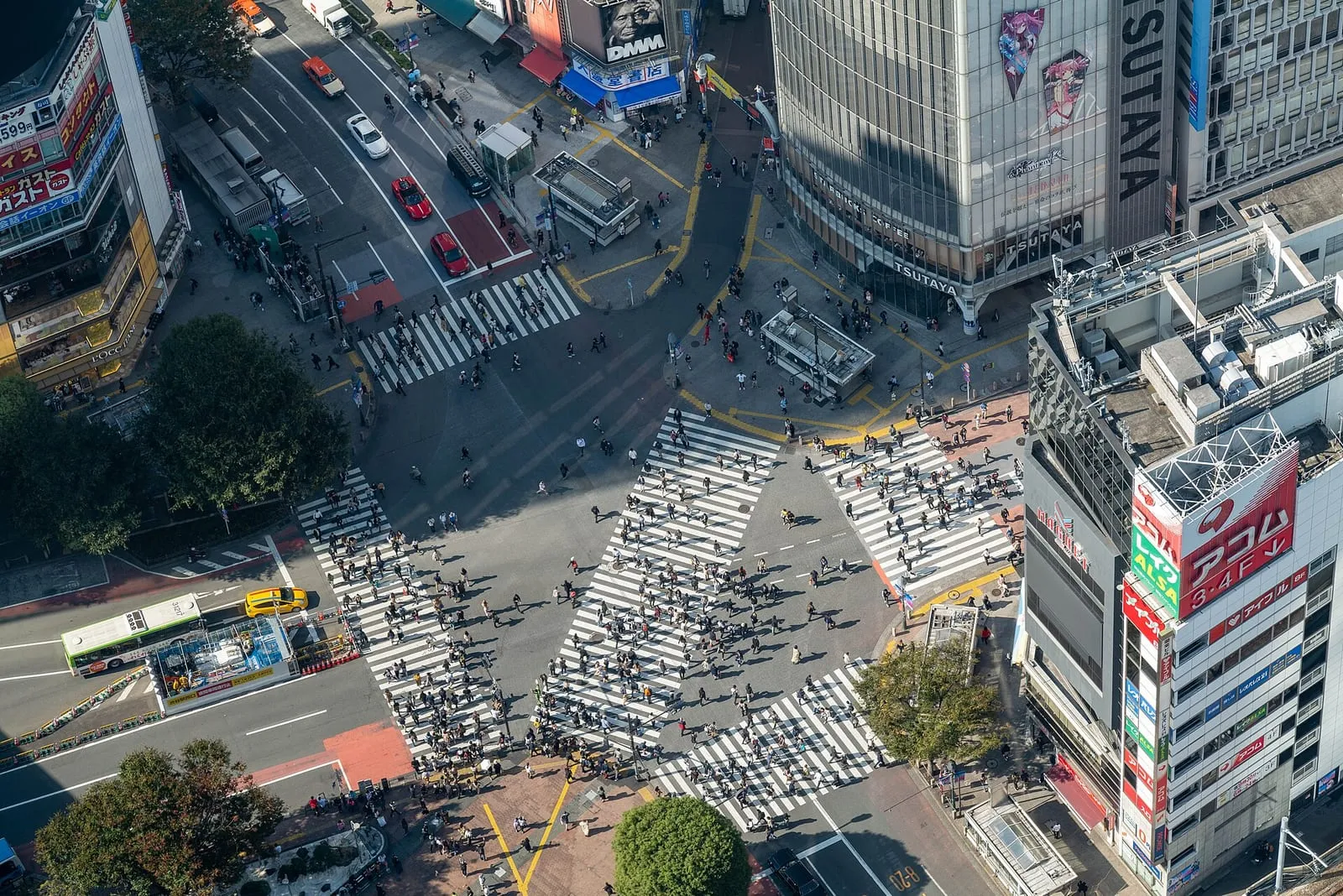
Pedestrians streaming across Shibuya Scramble Crossing in daylight. Photo: Real Estate Japan, Wikimedia Commons, CC BY 2.0.
Stop 5: Shibuya Sky at Shibuya Scramble Square
Finish the walking route by entering the Shibuya Scramble Square East Tower, directly connected to the railway station. Take the dedicated shuttle elevator up to the 14th floor to reach the entrance turnstiles of Shibuya Sky.
- The Experience: High-speed transitional elevators rise to the 46th-floor Sky Gallery and 47th-floor open-air Sky Stage at 229 metres. The 360-degree glass perimeter allows you to look straight down onto the crossing you just traversed on foot, across to the greenery of Yoyogi Park, and over to the Shinjuku skyscraper ridge.
- Sunset timing: Arriving roughly 45 minutes prior to official sunset gives you daytime panoramic vistas, twilight over Mount Fuji, and the transition into Tokyo’s evening neon cityscape.
- Ticketing: Advance online booking is essential (¥2,700 before 15:00, ¥3,400 from 15:00). All bags, loose coats, and hats must be placed in ¥100 refundable lockers on the 46th floor before ascending to the open roof deck.
Guided walking tours of western Tokyo
For travellers seeking historical and cultural interpretation, small-group guided tours provide rich background:
Tokyo: Meiji Shrine Walking Tour — Shinto & Imperial System
From ¥1,500 · 4.9 stars from 667 reviews · 1.5 hours
The Tokyo: Meiji Shrine Walking Tour — Shinto & Imperial Systemad explores the spiritual philosophies of Shinto, imperial court rituals, and the ecological design behind the sacred forest at Meiji Jingu.
Tokyo: Meiji Jingu Shrine and Shinto Culture Walking Tour
From ¥1,500 · 4.9 stars from 444 reviews · 2 hours
The Tokyo: Meiji Jingu Shrine and Shinto Culture Walking Tourad demonstrates proper purification procedures, decodes the meaning behind ema prayer plaques, and navigates the quietest paths through the shrine grounds.
Tokyo Pop Culture & Tradition Tour: Meiji Shrine to Harajuku
From ¥7,000 · 4.8 stars from 31 reviews · 2 hours
The Tokyo: Shinto & Pop Culture Tour, Meiji Shrine to Harajukuad bridges classical religious rituals and modern youth subcultures, guiding participants from the shrine forest directly into Takeshita Street’s fashion boutiques.
Where to go next
This walking itinerary forms the core of Day Two in our 3-day Tokyo itinerary.
To explore individual destinations on this walk in greater detail, consult our dedicated guides to Meiji Jingu, the Shibuya Crossing guide, and Shibuya Sky tickets. For luxury shopping along Omotesando, read our practical overview of tax-free shopping in Japan.
If you are choosing an accommodation base between western Tokyo hubs, read our comparison of Shinjuku or Shibuya and our neighbourhood guide on where to stay in Tokyo. For subway and train advice, read Tokyo public transport, and discover all attraction bookings on the Tokyo hub.
Common questions
How long is the walk from Meiji Jingu to Shibuya?
The direct walking route covers approximately 5.2 kilometres (3.2 miles). Without extended stops it takes about 75 minutes, but allowing 4 to 5 hours gives you time to wander the forested paths of Meiji Jingu, browse Takeshita Street, examine Omotesando's architecture, and reach Shibuya Sky for sunset.
What time should you start this walk?
Start at Meiji Jingu around 08:30 or 09:00. The shrine opens at sunrise and is calmest in the early morning. Takeshita Street's boutiques open around 10:30. Timing the walk this way brings you to Shibuya by late afternoon to watch the sunset from Shibuya Sky.
What are Meiji Jingu's opening hours?
Meiji Jingu opens at sunrise and closes precisely at sunset every day, with hours changing monthly: closing at 16:00 in December, 16:10 in November, 17:00 in March and September, and 18:30 in June. The grounds are free to enter.
Do you need advance tickets for this walk?
Only for Shibuya Sky. The shrine, Takeshita Street, Cat Street, and the scramble crossing are completely free public spaces. Tickets for Shibuya Sky (¥2,700 before 15:00, ¥3,400 from 15:00) require advance online reservations, released 14 days in advance.