In this guide
The Short Version: Hanoi’s Train Street—the single-track railway corridor between Hanoi Central Station (Ga Ha Noi) and Long Bien Bridge where residential houses stand less than 1.5 metres from the rails—is not an open attraction you can visit casually. The trackside cafes had their business licences revoked in September 2022, permanent police barricades close both ends, and walking on the live tracks is strictly prohibited. Hanoi’s Department of Tourism has instructed licensed operators not to lead tourists onto the tracks, so never pay unofficial touts who promise illegal access past the barriers. On 27 February 2026, the Ministry of Construction, Vietnam Railway Authority, and the Hanoi People’s Committee agreed to reduce passenger services and suspend freight across Long Bien Bridge. To experience Hanoi’s colonial railways legally and safely, visit Hoa Xa Cafe on Platform 1 inside Long Bien Railway Station or walk the pedestrian footway of Long Bien Bridge. Or book a tour: If you want an authorised cultural excursion that introduces Hanoi’s historic railway architecture alongside Old Quarter monuments, reserve the Hanoi City Highlights Walking Tourad (VND 699,800) or Hanoi: Street Food Tour with Train Street Visitad (VND 506,200).
Standing in the heart of Hanoi’s residential quarters, the narrow railway track cutting through residential living rooms has become one of Southeast Asia’s most photographed urban spectacles. Yet behind the dramatic social media images lies an active national railway corridor, a complex century of French colonial engineering, and an ongoing regulatory effort to balance resident livelihoods with rail safety.
History and engineering: the Trans-Indochina railway
The railway slicing through central Hanoi was born in the colonial era under Governor-General Paul Doumer. As part of the ambitious Chemins de fer de l’Indochine network, French engineers laid a single 1,000-millimetre metre-gauge track connecting Hanoi’s central terminus with the northern border town of Dong Dang and the eastern port of Hai Phong. The line officially opened in 1902 alongside the inauguration of the Paul Doumer Bridge (now Long Bien Bridge).
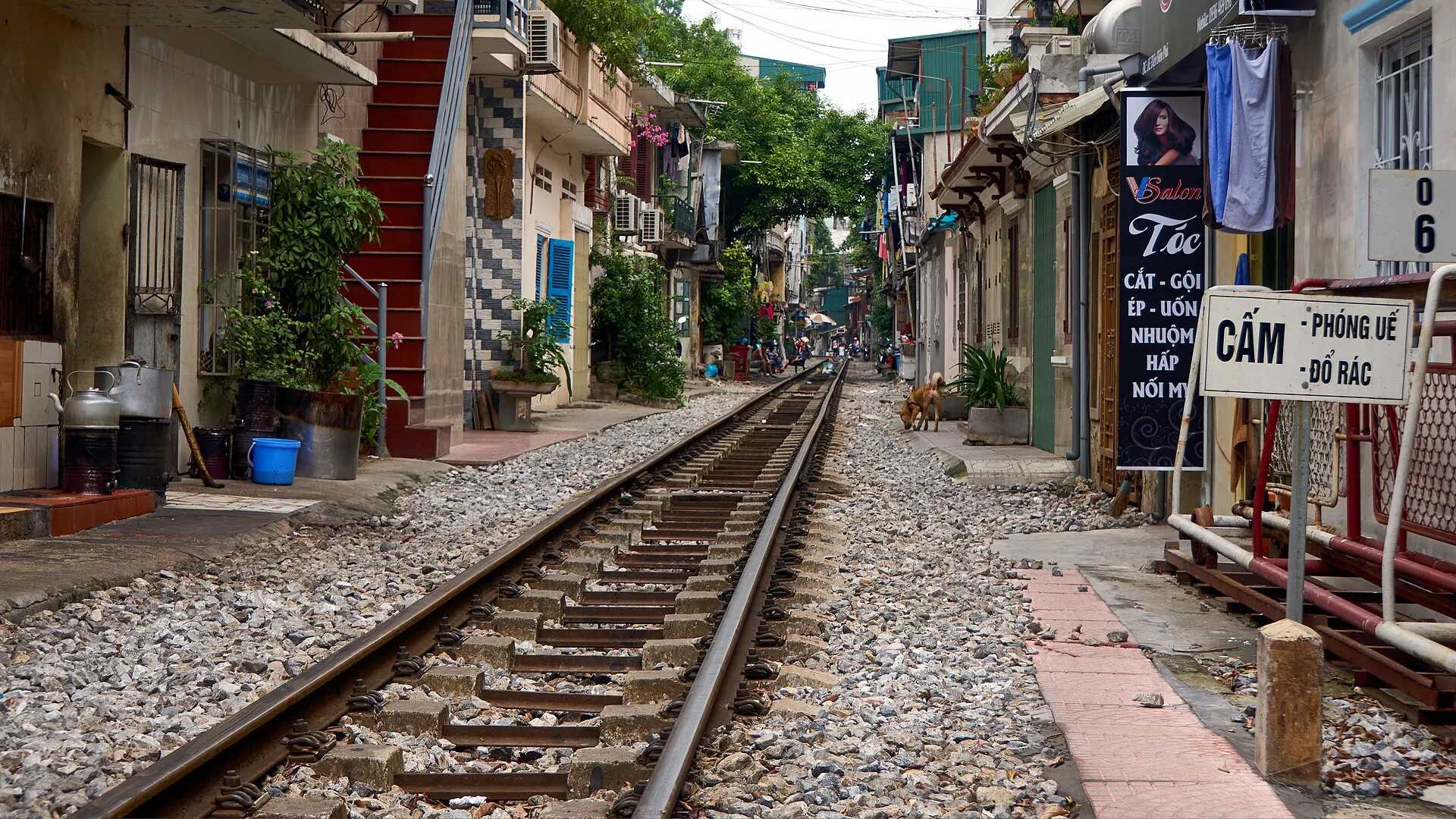
The narrow residential railway corridor on Hanoi’s Train Street. Photo: Radek Kucharski from Warsaw, Poland, Wikimedia Commons, CC BY 2.0.
When the railway was first laid, this land lay on the outer fringes of the imperial Thang Long citadel. Over the ensuing decades—particularly during the urban housing pressures of the 1960s and the post-war reconstruction of the 1980s—railway workers and families built narrow tube houses directly against the track right-of-way. In many sections, the clearance between the external walls of family kitchens and passing locomotives measures fewer than 1.5 metres.
For generations, residents treated the tracks as an extended courtyard:
- Families peeled vegetables, prepped morning broth, and washed laundry directly over the railway ties.
- Children played board games and rode bicycles between the steel rails, scattering whenever a distant locomotive horn sounded.
- The community operated on an internal clock keyed to the rumble of heavy diesel engines operated by Vietnam Railways (Duong sat Viet Nam).
The geography: North vs South Train Street
Hanoi’s urban railway spans two distinct geographical sections divided by the central passenger terminal (Ga Ha Noi):
| Railway section | Primary street coordinates | Historic character | Regulatory status |
|---|---|---|---|
| Northern section | Phung Hung & Tran Phu (Hoan Kiem district) | Dense tourist cafe corridor lined with colourful paper lanterns, painted murals, and coffee bars | Heavily barricaded with permanent police checkpoints; tourist access restricted |
| Southern section | Le Duan, Kham Thien & Alley 224 (Dong Da district) | Authentic working-class residential railway corridor with vegetable stalls and family living rooms | Quieter and less commercialised, but equally subject to track safety enforcement |
The northern section bordering the Old Quarter on Phung Hung Street gained international fame in 2017 when enterprising local homeowners opened miniature trackside coffee bars serving egg coffee and cold beer. By 2019, dozens of cafes lined both sides of the rails, squeezing low tables, plastic chairs, and photography props into the safety clearance corridor.
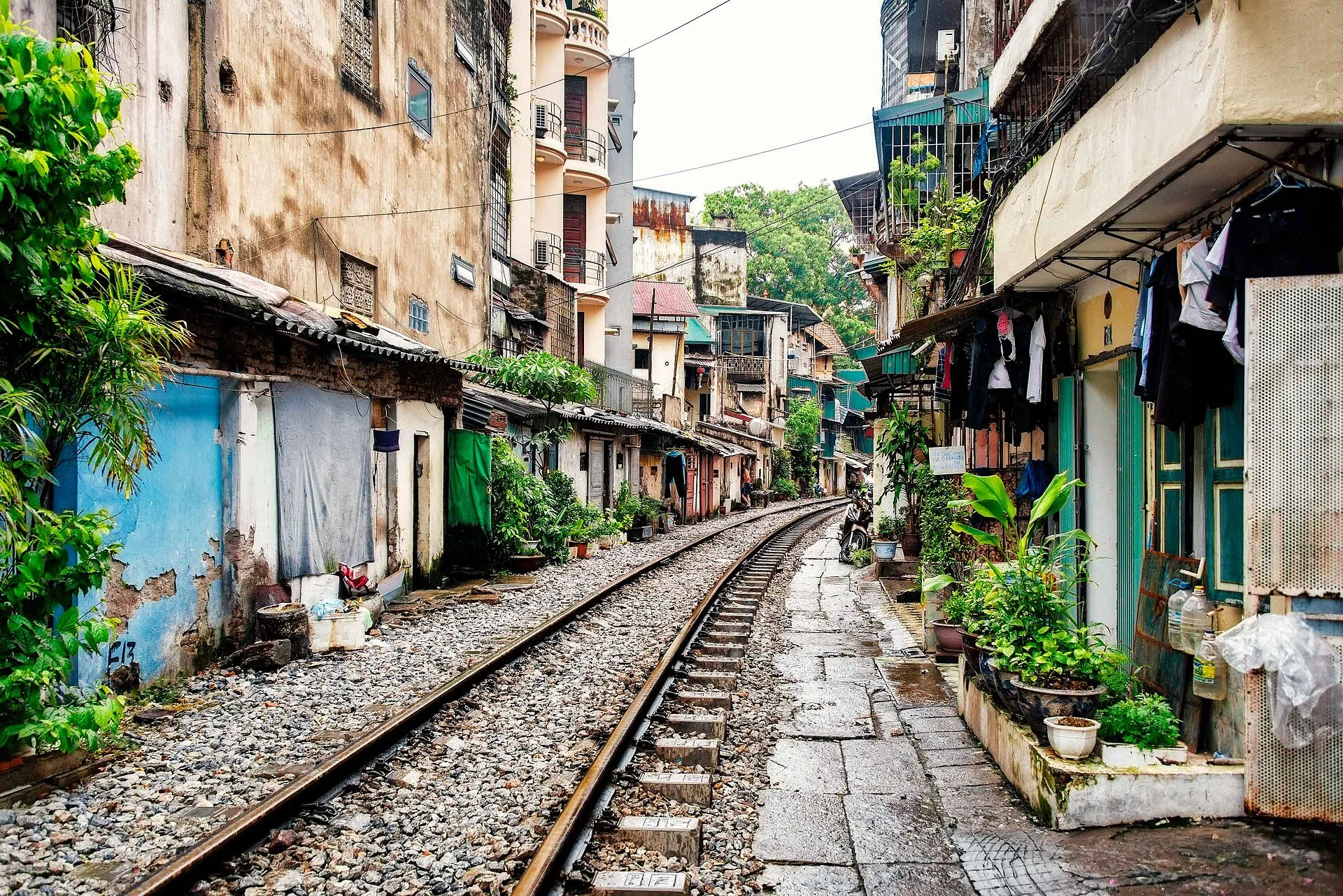
Colonial-era residences and laundry lines beside the railway tracks in daylight. Photo: Rod Waddington from Kergunyah, Australia, Wikimedia Commons, CC BY-SA 2.0.
Regulatory crackdowns: what changed, and why
The explosion of mass tourism created acute operational dangers for train drivers hauling freight and passenger coaches through the city. Locomotives frequently had to make emergency brake applications because visitors were posing on the tracks or failing to clear selfie sticks in time.
Under Article 48 of Vietnam’s Law on Railway Transport, maintaining an unobstructed railway safety corridor is mandatory. In response to mounting near-miss incidents, municipal and national transport authorities intervened:
- September 2022: The Hanoi People’s Committee and Hoan Kiem district authorities officially revoked all business licences for cafes operating within the railway safety perimeter. Steel crowd-control barriers and warning signs in Vietnamese and English were permanently erected at railway crossings along Tran Phu, Phung Hung, and Dien Bien Phu.
- 2023 & 2025 directives: The Hanoi Department of Tourism repeatedly issued official circulars instructing travel agencies and licensed tour guides not to bring tourist groups onto the railway tracks, threatening severe financial penalties and licence revocations for non-compliant companies.
- 27 February 2026 railway accord: The Ministry of Construction, Vietnam Railway Authority, and the Hanoi People’s Committee agreed on a long-term infrastructure restructuring. Under this agreement, passenger train operations through the central urban corridor and Long Bien Bridge are being systematically phased down, with freight operations suspended, redirecting major services to Gia Lam Station in the north and Hanoi Station in the south.
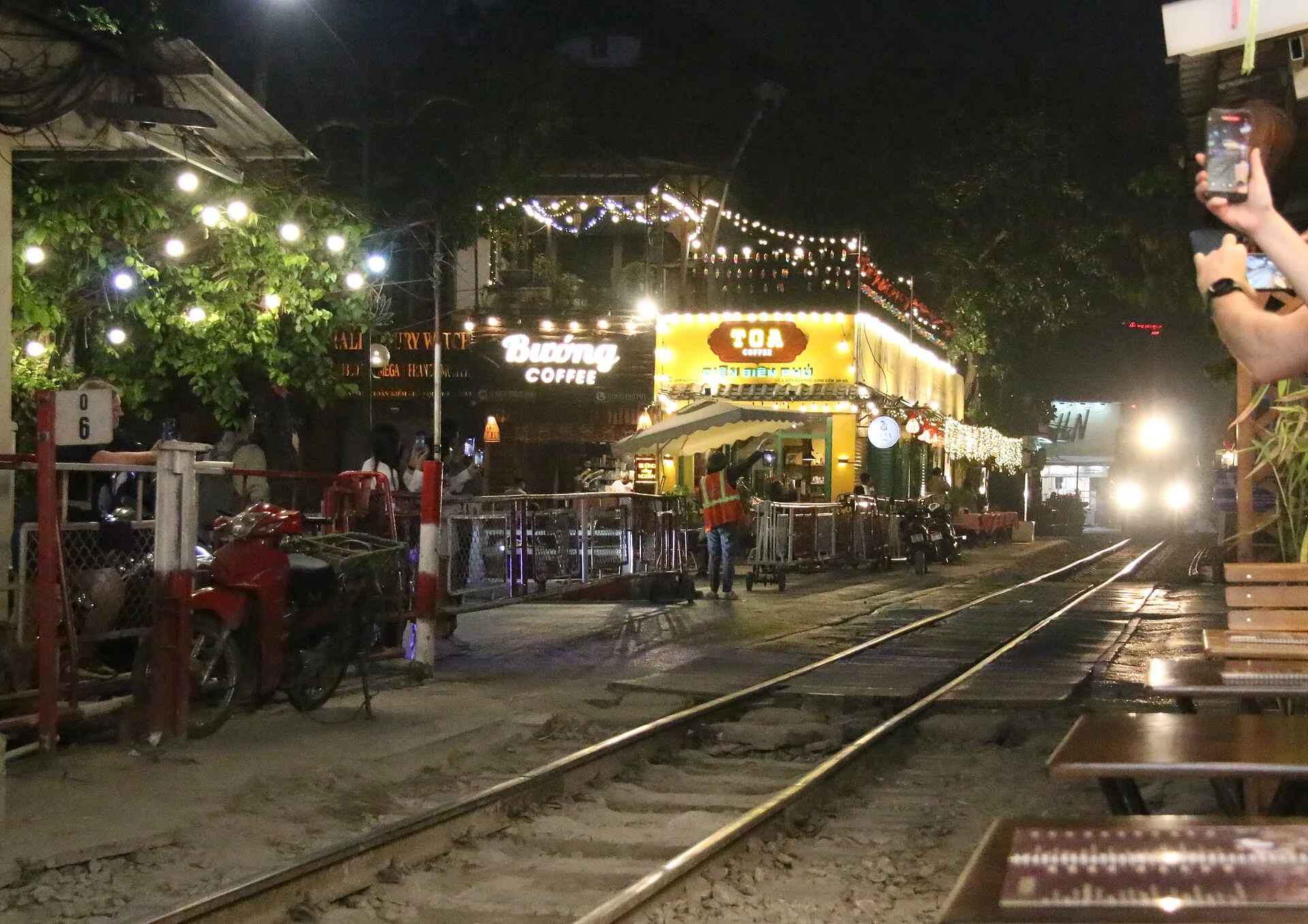
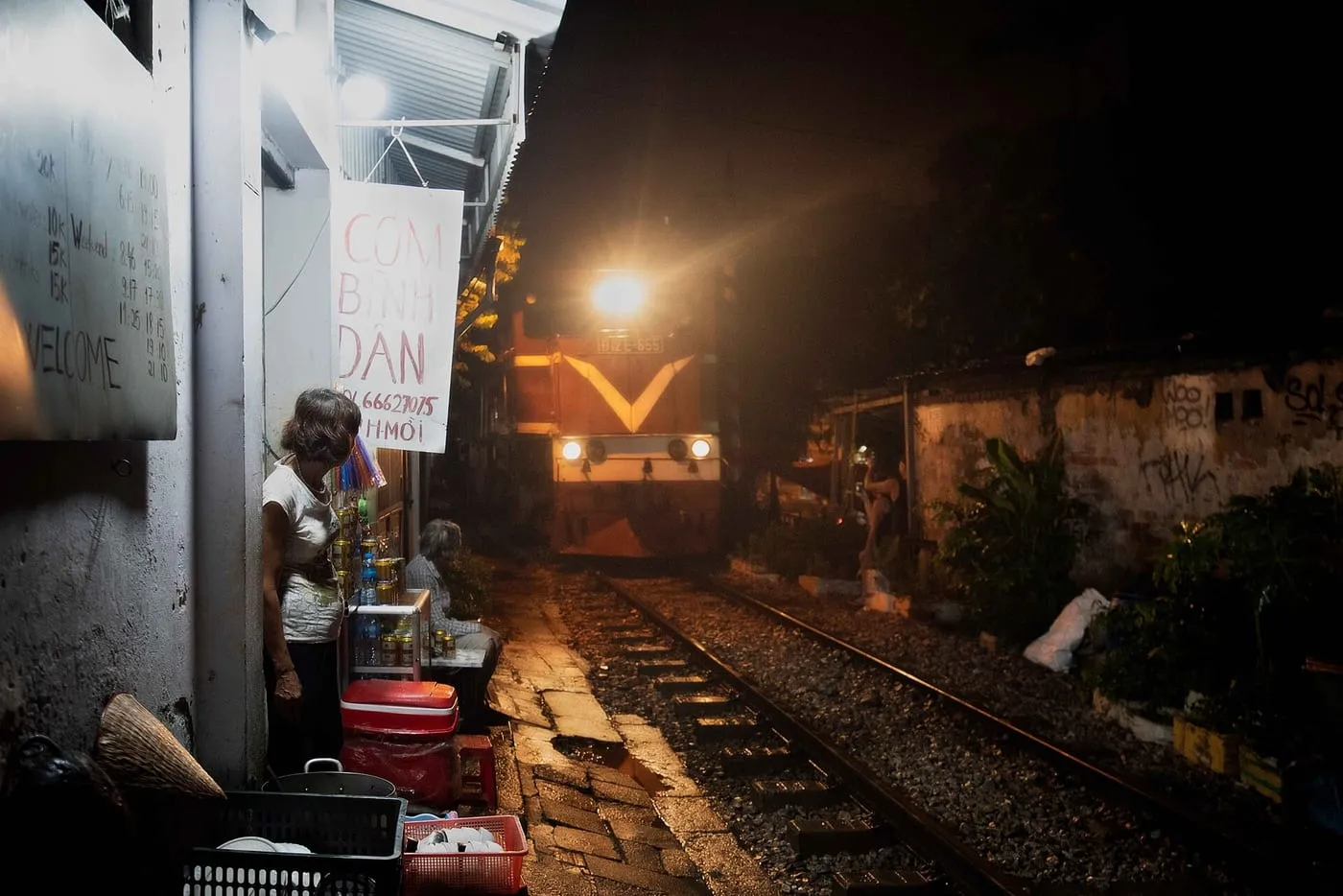
Trackside cafes with string lights at night as an approaching train illuminates the tracks. Photo: kitmasterbloke, Wikimedia Commons, CC BY 2.0.
Why published train timetables cannot be trusted
Online travel forums often circulate purported timetables for Train Street, listing specific passing times such as 15:30 on weekdays or 19:30 on weekends. Relying on these schedules is a recipe for frustration:
- Single-track operational bottlenecks: Vietnam’s North-South railway (the Reunification Express) is an undivided single-track system stretching 1,726 kilometres from Hanoi to Ho Chi Minh City. Long-distance trains frequently experience delays of 30 to 90 minutes due to train-crossing halts at rural passing loops.
- 2026 service curtailments: Following the 27 February 2026 municipal agreement, scheduled freight trains have been suspended from the urban corridor, and passenger services crossing Long Bien Bridge are running on reduced timetables.
- No fixed tourist timetable: Trains operate strictly according to national rail logistics managed by Vietnam Railways, not tourist observation schedules.
Safe and legal ways to experience Hanoi’s railways
Travellers who appreciate railway heritage do not need to sneak past police barricades. Hanoi offers several regulated, historic, and safe vantage points to see trains and historic infrastructure:
1. Cafe Hoa Xa at Long Bien Railway Station
The most legitimate trackside cafe in the capital was created by Vietnam Railways itself. Situated directly on Platform 1 inside the historic 1902 Long Bien Railway Station (Ga Long Bien), Cafe Hoa Xa (Ca phe Hoa Xa) operates with official municipal clearance:
- The cafe’s glass-walled indoor salon and secure outdoor seating area sit at a safe, legally mandated distance from the tracks.
- Guests can enjoy traditional Vietnamese drip coffee, coconut coffee, and herbal teas while watching passenger trains rumble past directly at eye level.
- Entry is through the station concourse at the foot of Long Bien Bridge (no touts or clandestine backdoors required).
2. Walking the Long Bien Bridge footway
Constructed by Dayde & Pille between 1899 and 1902, the cantilever iron framework of Long Bien Bridge spans the broad waters of the Red River. A dedicated pedestrian sidewalk flanks both sides of the central rail line:
- Visitors can walk across the bridge for free, observing the exposed steel trusses, French engineering rivets, and passing trains at close quarters.
- The morning light over the banana plantations and vegetable gardens on the Red River islands below offers unmatched photography opportunities.
3. Hanoi Central Railway Station (Ga Ha Noi)
Located at 120 Le Duan, Hanoi’s main railway terminal was originally completed in 1902. The station facade presents a striking architectural contrast: the two colonial yellow-stucco wings survived American bombing raids during the Vietnam War, while the central modernist concrete hall was rebuilt in 1976 following the reunification of the country. Visitors can enter the public concourse, inspect vintage train schedule boards, and purchase tickets for cross-country journeys at official ticket windows.
Guided tours covering railway heritage
These city tours cover Hanoi’s colonial railway history. Licensed guides are told not to take groups onto the tracks, so any Train Street stop is made from the street ends.
Hanoi City Highlights Walking Tour – Landmarks & History
From VND 699,800 · 5.0 stars from 206 reviews · 4.5 - 5 hours · Small group
Book the Hanoi City Highlights Walking Tourad to visit Hanoi’s primary architectural and cultural landmarks with an experienced local guide. The itinerary introduces the historic railway corridor from legal public vantage points alongside the Old Quarter guild streets, St. Joseph’s Cathedral, and traditional street food tastings.
Hanoi: Street Food Tour with Train Street Visit
From VND 506,200 · 4.9 stars from 127 reviews · 3 hours · Small group
Book the Hanoi Street Food Tour with Train Street Visitad for a food walk with egg coffee and noodle soups that passes the railway from the streets either side of it, not along the track.
Hanoi: Small-Group Street Food Walking Tour
From VND 556,800 · 4.8 stars from 2439 reviews · 3 hours · Foodie walking tour
Book the Hanoi Small-Group Street Food Walking Tourad to explore the rich culinary heritage of the merchant quarters adjacent to the railway corridor, visiting time-tested food stalls with a passionate culinary expert.
Practical rules for visitors
- Respect official barriers: The steel gates and police checkpoints on Phung Hung and Tran Phu are legal law-enforcement boundaries. Attempting to bypass them or arguing with municipal officers can result in fines.
- Ignore street touts: Unofficial individuals hanging around the barricades often claim they can walk you into a trackside cafe if you purchase an expensive drink. Participating in this encourages illegal operations and puts you at risk of being escorted out by local police.
- Never stand or pose between the rails: Railway lines in Vietnam carry heavy freight and passenger locomotives that cannot brake abruptly on wet or curved tracks.
- Continue your architectural discoveries with our Old Quarter and Hoan Kiem walking tour or explore the French mansions along our French Quarter and Ba Dinh walk.
- For overall travel planning and safety tips, read our comprehensive overview of is Hanoi safe and master guide to things to do in Hanoi.
Common questions
Is Hanoi Train Street open to tourists in 2026?
No. The trackside cafes had their business licences revoked by municipal authorities in September 2022, permanent steel barricades and police checkpoints guard the entry points, and walking along the live tracks is strictly prohibited under Vietnamese railway safety laws.
Can I book a Hanoi Train Street tour?
The Hanoi Department of Tourism has explicitly instructed all licensed travel agencies and tour operators not to organise tours to Train Street. Do not pay touts or unofficial guides who offer to sneak you past the barricades.
What time do trains pass through Train Street?
There is no dependable timetable for tourists. On 27 February 2026, the Ministry of Construction, Vietnam Railway Authority, and the Hanoi People's Committee agreed to reduce passenger services and suspend freight across the urban corridor and Long Bien Bridge. Published schedules are frequently delayed or cancelled.
Where can I safely and legally watch trains in Hanoi?
The best regulated option is Cafe Hoa Xa inside Long Bien Railway Station, opened by Vietnam Railways with approved safety clearance from the tracks. Walking the pedestrian footway of the historic Long Bien Bridge also offers spectacular views of passing trains over the Red River.