In this guide
💡 The Short Version: Founded in 1070 and home to Vietnam’s first national university, the Temple of Literature (Van Mieu - Quoc Tu Giam) is Hanoi’s temple of scholarship and Confucian heritage. Standard adult entry is 70,000 VND, with tickets purchased at the front entrance kiosk on Quoc Tu Giam street or verified on vanmieu.gov.vn. The complex is organised into five sequential courtyards along a sacred central axis, featuring the red Khue Van Pavilion (depicted on the 100,000 VND banknote) and the 82 stone turtle Doctor stelae inscribed on UNESCO’s Memory of the World Register. Plan 60 to 90 minutes to explore, hire the 50,000 VND audio guide, and ensure shoulders and knees are covered for entry into the inner worship sanctuaries. Or book a tour: when you want an evening light spectacle, the Temple of Literature Night Tour with 3D Mappingad (from VND 299,000, 4.8 stars from 22 reviews) covers the illuminated courtyards and sound show.
Historical significance: Vietnam’s first university
The Temple of Literature was constructed in autumn 1070 during the reign of Emperor Ly Thanh Tong. It was originally established as a temple dedicated to Confucius (Van Mieu), his four closest disciples, and the Duke of Zhou, honouring the moral principles of Confucian statecraft.
In 1076, Emperor Ly Nhan Tong founded the Imperial Academy (Quoc Tu Giam) on the grounds directly behind the temple, creating Vietnam’s first national university. For more than seven centuries, the academy educated the sons of royalty, high-ranking mandarins, and talented common scholars selected through fierce provincial examinations. Those who passed the rigorous triennial royal examinations earned the prestigious title of Tien Si (Doctor of Literature) and were appointed to govern the imperial civil administration.
Today, the complex remains an active pilgrimage site for Vietnamese students, who flock here in traditional Ao Dai robes before major examinations to pray for wisdom and scholastic success. Official opening schedules, historical documentation and festival dates are published by the monument management board at vanmieu.gov.vn.
Visitor summary and admission details
The table below outlines ticketing parameters, opening hours, and practical visiting logistics:
| Visitor item | Standard rate / Hours | Access details | Practical visiting advice |
|---|---|---|---|
| Adult Admission Ticket | 70,000 VND | Main ticket kiosks on Quoc Tu Giam street (vanmieu.gov.vn) | Cash or domestic bank cards; no advance online reservation needed |
| Reduced ticket | 35,000 VND | Ticket counter | Vietnamese students and visitors aged 60 and over, with a Vietnamese ID card; children under 16 are free |
| Opening Hours | 08:00 to 17:00 | Open 7 days a week (vanmieu.gov.vn) | Arrive at 08:00 or after 15:30 to avoid mid-day tour bus crowds |
| Night visit & 3D show | From 199,000 VND | Wednesday, Saturday and Sunday, 18:30 to 22:00 | Lit courtyards, traditional music, and projection mapping (vanmieu.gov.vn) |
| Audio guide rental | 50,000 VND | Counter inside first courtyard | Available in 8 languages (English, French, Vietnamese, Japanese, Korean, Spanish, German, Chinese) |
Ticketing
- Buying tickets: You can purchase entry tickets directly at the exterior ticket counters situated to the left of the main entrance gate (Dai Thanh Gate) on Quoc Tu Giam street. Lines move quickly, even during peak morning hours. Ticket regulations and concessions are confirmed at vanmieu.gov.vn.
- Night visit: The temple opens from 18:30 to 22:00 on Wednesdays, Saturdays and Sundays for an evening programme in the lit courtyards featuring digital 3D projection mapping onto the Thai Hoc facade. Tickets for the night experience are sold at the gate or booked via vanmieu.gov.vn.
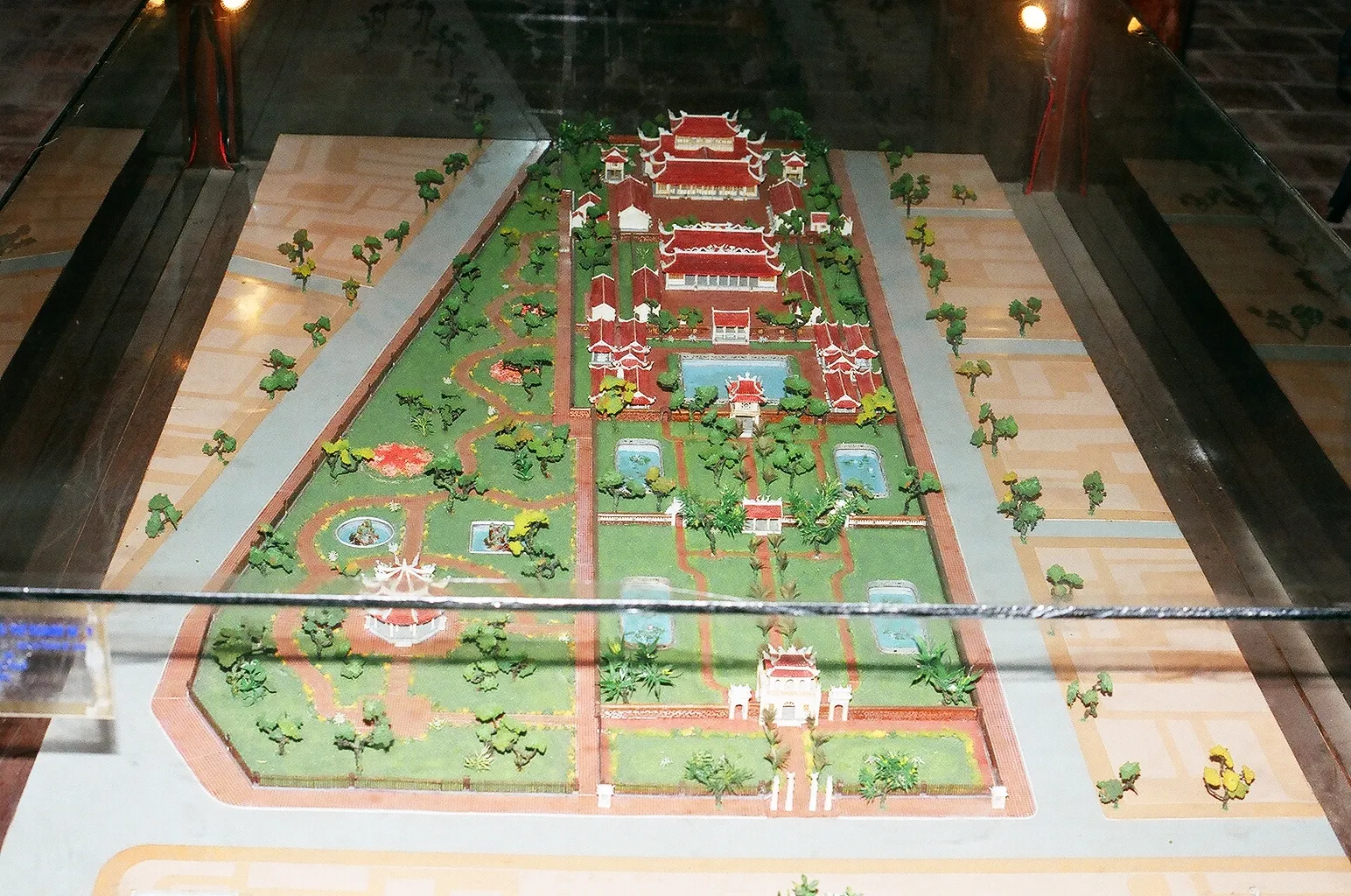
Temple of Literature layout model. Photo: Duyphuong (thảo luận), Wikimedia Commons, CC BY 3.0.
Tours and guided visits
An independent 70,000 VND ticket bought at the gate is the cheapest way to explore. Guided tours make sense when you want an evening light show with pre-booked access, or an art historian to decode Confucian symbols and scholar stelae.
Temple of Literature night tour with 3D mapping
From VND 299,000 · 4.8 stars from 22 reviews · 3 hours · evening light & sound show
Ha Noi: Van Mieu Temple of Literature Night Tour with 3D Showad: explores the five courtyards illuminated by atmospheric lanterns after dark. Includes entry, English commentary on Confucian scholarship, traditional musical performances on ancient instruments, and the headline 3D mapping projection onto the Thai Hoc ceremonial hall.
Temple of Literature and Hoa Lo Prison half-day tour
From VND 570,000 · 4.9 stars from 5 reviews · 3 hours · two headline landmarks
Hanoi: Temple of Literature & Hoa Lo Prison Half-Day Tourad: pairs the imperial scholarship of the Temple of Literature with the wartime history of Hoa Lo Prison Memorial, with admissions, hotel pickup, and an English-speaking guide included.
Hanoi city highlights walking tour
From VND 699,800 · 5 stars from 206 reviews · 4.5 to 5 hours · expert local guide
Hanoi City Highlights Walking Tour – Landmarks & Historyad: covers the Temple of Literature, the Imperial Citadel of Thang Long, and the Ba Dinh Complex, explaining dynastic architecture and colonial urban changes across the city.
Official ticket or tour: the prices side by side
Independent entry versus guided cultural experiences.
| Option | Official admission | Tour cost | What it covers |
|---|---|---|---|
| Standard daytime admission | 70,000 VND | — | Entry to all 5 courtyards, turtle stelae, and Thai Hoc hall (vanmieu.gov.vn) |
| Daytime entry with audio guide | 120,000 VND | — | Ticket plus handheld multi-language audio receiver |
| Official night visit | 199,000 VND | — | Evening admission and courtyard lighting (vanmieu.gov.vn) |
| Night tour with 3D mapping | Included | From VND 299,000 | Night access, guided narration, traditional music & 3D show |
| Temple of Literature & Hoa Lo Prison | Admissions included | From VND 570,000 | 3-hour guided walk covering both monuments |
| Full city highlights walking tour | Admissions included | From VND 699,800 | 4.5-hour tour of Temple of Literature, Citadel and Ba Dinh |
Walking the five sequential courtyards
The Temple of Literature is designed on a classical symmetrical layout covering 54,000 square metres, surrounded by ancient brick perimeter walls. Visitors proceed through five walled courtyards arranged along the sacred Central Path (Path of the Monarch), once reserved exclusively for the emperor.
The First Courtyard: The Path to Knowledge
Passing through the massive two-storey Great Portico (Van Mieu Mon), flanked by stone dragons and Chinese couplets, you enter the first courtyard.
- Atmosphere: Paved with ancient Bat Trang terracotta tiles and shaded by towering banyan and Bodhi trees, this courtyard represents the student’s entry into the tranquil world of contemplation.
- Dai Trung Mon: The Great Middle Gate stands at the courtyard’s far end, flanked by two smaller side gates: Thanh Duc Mon (Gate of Attaining Virtue) on the left and Dat Tai Mon (Gate of Accomplished Talent) on the right, reminding scholars that moral virtue and academic skill must develop in tandem.
The Second Courtyard: Khue Van Pavilion
Passing through the Dai Trung Mon brings you into the second courtyard, terminating at Hanoi’s most recognisable architectural landmark:
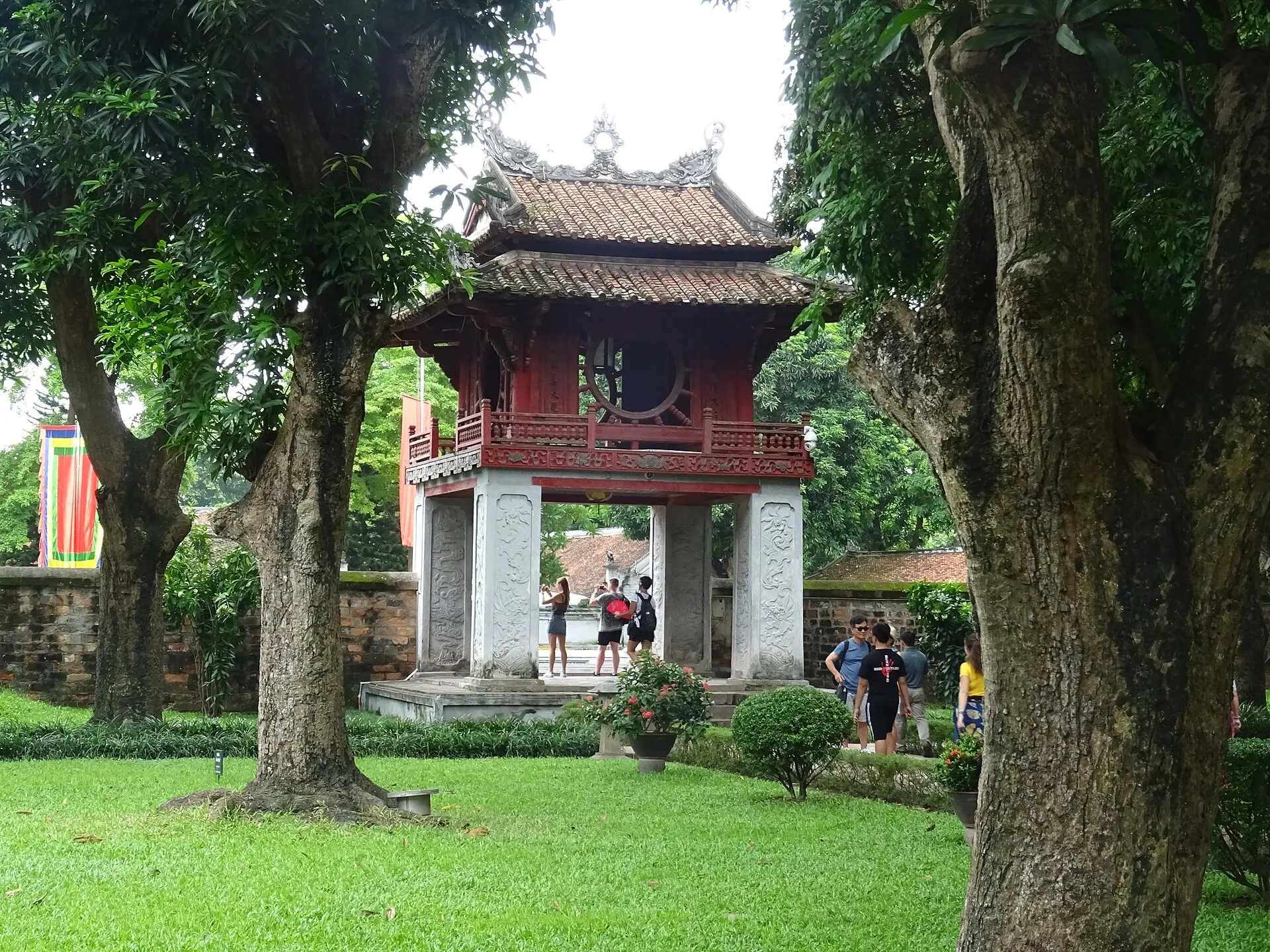
- Khue Van Cac (Pavilion of the Constellation of Literature): Built in 1805 during the Nguyen Dynasty, this unique two-storey timber pavilion features a red-painted upper wooden floor elevated on four square stone pillars. The wooden walls are pierced with four round sunburst windows, symbolising the radiating brilliance of literary arts. The square stone pillars represent the earth, while the circular windows represent the heavens.
- The 100,000 VND banknote: Inspect the green 100,000 VND banknote in your wallet; the reverse face features an intricate engraving of Khue Van Pavilion reflected across the water.
- Flanking gates: The pavilion is flanked by two arched gates: Suc Van Mon (Gate of Crystallised Literature) and Bi Van Mon (Gate of Magnified Literature).
The Third Courtyard: Well of Heavenly Clarity and the Turtle Stelae
Stepping beneath Khue Van Pavilion leads into the spiritual heart of the monument:
- Well of Heavenly Clarity (Thien Quang Tinh): A tranquil, square stone pool that reflects the sky above. In classical cosmology, the square shape of the pond (representing Earth) mirrors the circular windows of Khue Van Pavilion (representing Heaven), creating perfect cosmic harmony.
- The 82 Stone Doctor Stelae (Bia Tien Si): Flanking the pond on both sides stand two covered colonnades housing 82 weathered blue-stone stelae, each mounted on the back of a carved stone tortoise. The tortoise, one of Vietnam’s four holy beasts alongside the dragon, unicorn, and phoenix, represents longevity, endurance, and wisdom.
- UNESCO Memory of the World: Erected between 1484 and 1779 under the orders of Emperor Le Thanh Tong, the stelae record the names, birthplaces, and examination achievements of 1,307 scholars who earned doctorates across 82 royal examinations. The inscriptions honour academic meritocracy over hereditary privilege. The collection was officially inscribed on the UNESCO Memory of the World Register in 2011.
- Preservation rules: Historically, students rubbed the stone tortoises’ heads for examination luck, causing surface erosion. Today, low wooden barriers protect the stelae; visitors must not lean over railings or touch the stone carvings.
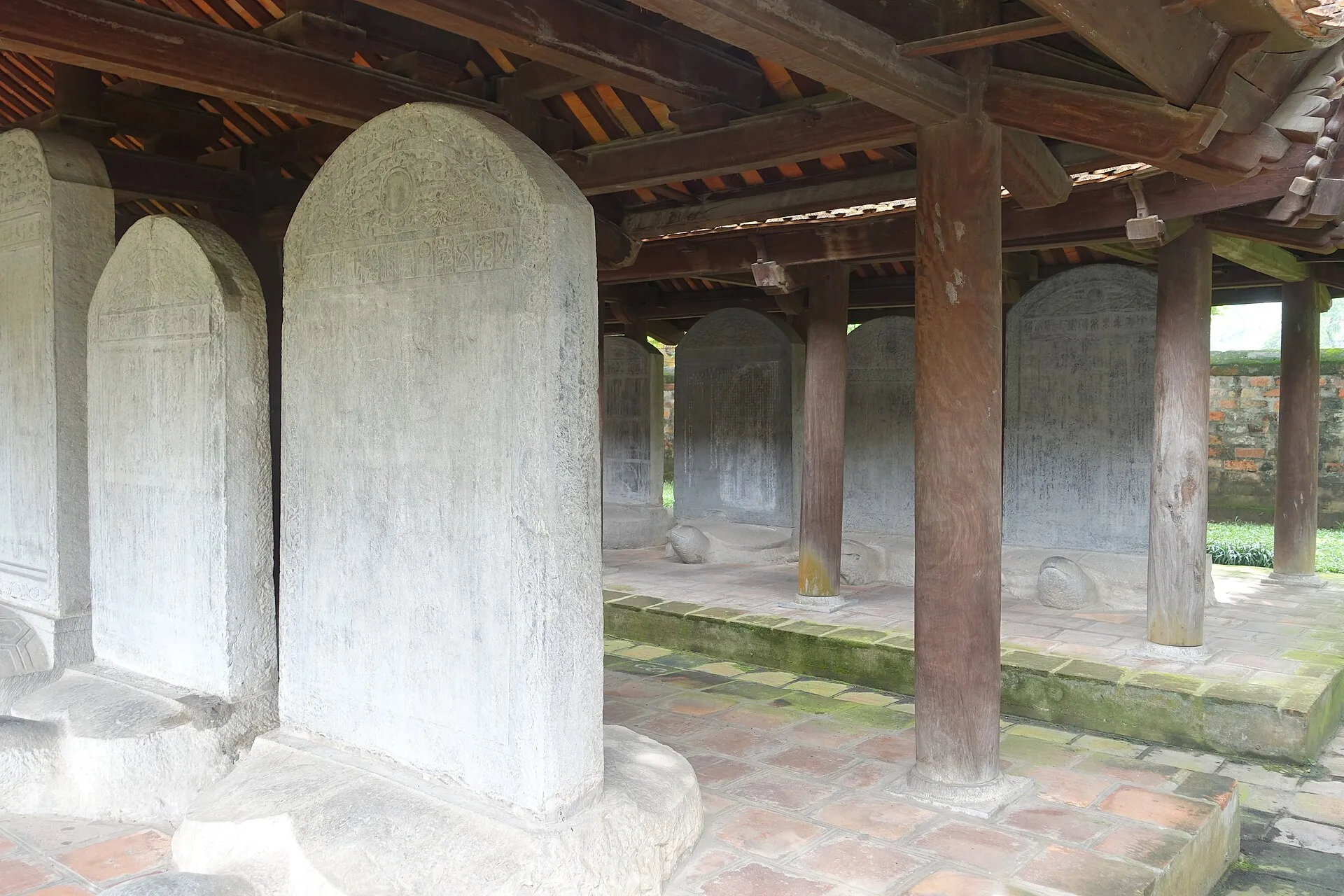
The 82 stone doctor stelae mounted on carved tortoises at the Temple of Literature. Photo: Daderot, Wikimedia Commons, CC0.
The Fourth Courtyard: The Ceremonial Sanctuary
Passing through the Gate of Great Success (Dai Thanh Mon), you enter the fourth courtyard, which served as the primary ceremonial precinct:
- Courtyard of the Sage: A spacious, brick-paved courtyard bordered on either side by the Eastern and Western Halls (Ta Vu and Huu Vu), which once housed altars honouring 72 prominent disciples of Confucius. Today, these wings contain museum gift shops, fine lacquerware, and calligraphy demonstration counters.
- Dai Thanh Hall (Sanctuary of Great Success): The timber ceremonial hall is supported by massive ironwood columns and capped with a curved-tile roof. Inside rests the primary altar to Confucius, flanked by his four foremost disciples: Yan Hui, Zengzi, Zisi, and Mencius.
- Altar of Chu Van An: Behind the main hall sits a sanctuary dedicated to Chu Van An (1292–1370), revered as the greatest teacher in Vietnamese history and headmaster of the Imperial Academy, celebrated for his unyielding integrity and dedication to education.
The Fifth Courtyard: Thai Hoc Hall (The Imperial Academy)
The final courtyard occupies the historic grounds of Quoc Tu Giam, which was destroyed by French artillery fire in 1946 and faithfully reconstructed in 2000 in honor of Hanoi’s millennium:
- The Front Hall: A two-storey traditional timber hall used for cultural symposiums, scholarly gatherings, and traditional musical performances featuring bronze bells, stone chimes, and traditional zithers (dan tranh).
- The Back Hall: The upper floor displays bronze statues and altars commemorating the three imperial monarchs who contributed most to the founding and development of the temple: Emperor Ly Thanh Tong (founder in 1070), Emperor Ly Nhan Tong (founder of the academy in 1076), and Emperor Le Thanh Tong (who initiated the Doctor stelae in 1484).
- The Imperial Drum and Bell: Two massive structures house the Great Bronze Bell (cast in 2000) and the ceremonial Great Drum, struck during major state occasions and national celebrations.
Student traditions and etiquette
The Temple of Literature is not merely an open-air museum, but a living cultural sanctuary:
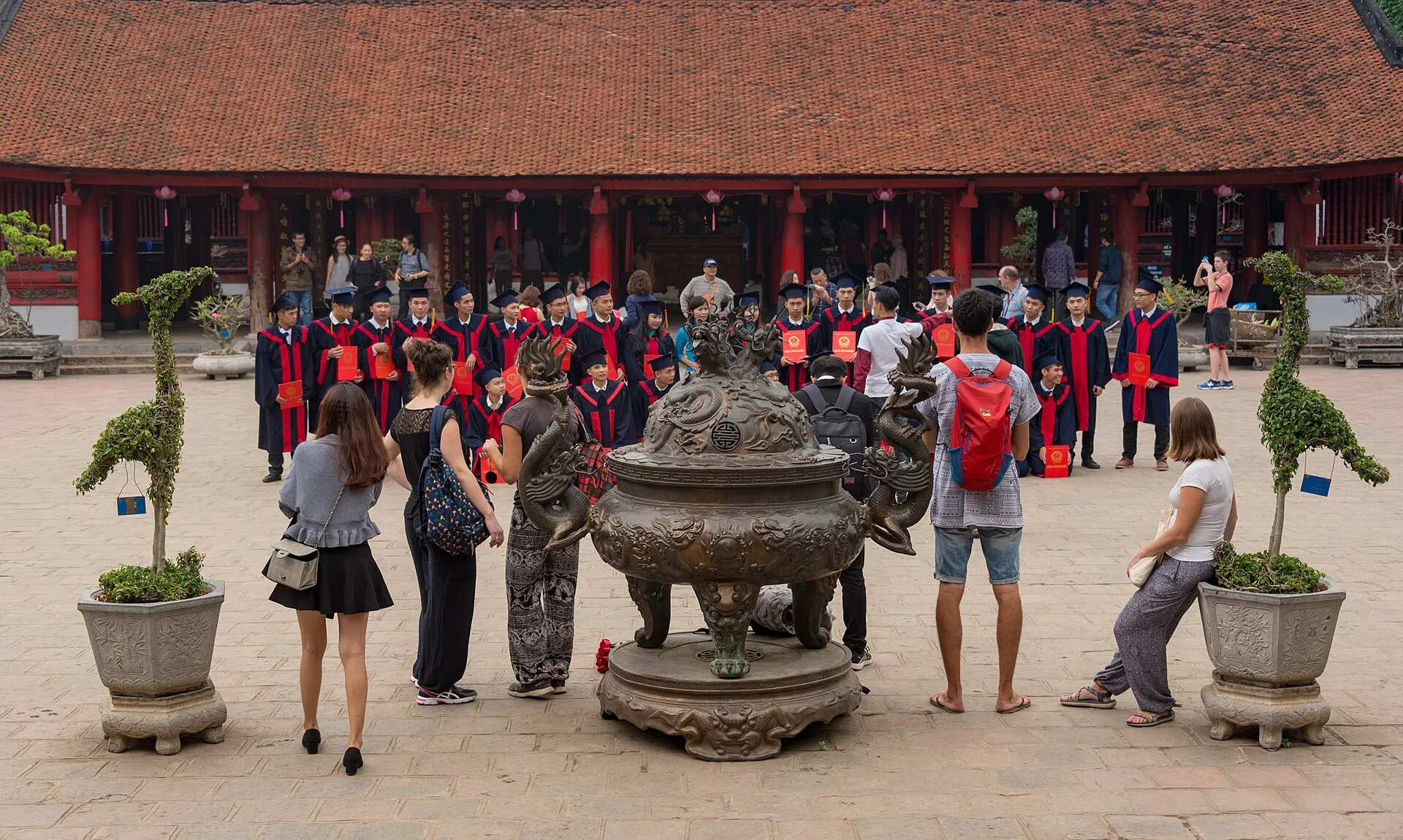
Graduation photos, Temple of Literature. Photo: xiquinhosilva, Wikimedia Commons, CC BY 2.0.
- Graduation photography season: Between October and December, and again in May, the courtyards fill with hundreds of graduating university and high school students dressed in elegant white Ao Dai tunics or academic gowns, taking commemorative class photographs.
- Exam prayers: During national university entrance examination weeks in early summer, thousands of anxious students gather before the Confucian altars with offerings of fruit, red sticky rice, and small change, praying for good fortune and high test scores.
- Calligraphy masters: In the garden courtyards and along the exterior walls on Pho Ong Do street (Calligraphy Street) during the Tet Lunar New Year festival, traditional calligraphers write auspicious Chinese and Nom characters on scarlet paper expressing wishes for Peace (An), Prosperity (Loc), and Wisdom (Tri).
- Visiting etiquette: Maintain respectful behaviour throughout the complex. Speak in lowered voices, refrain from sitting on ancient stone balustrades, and dress with modesty when entering the inner worship halls (vanmieu.gov.vn).
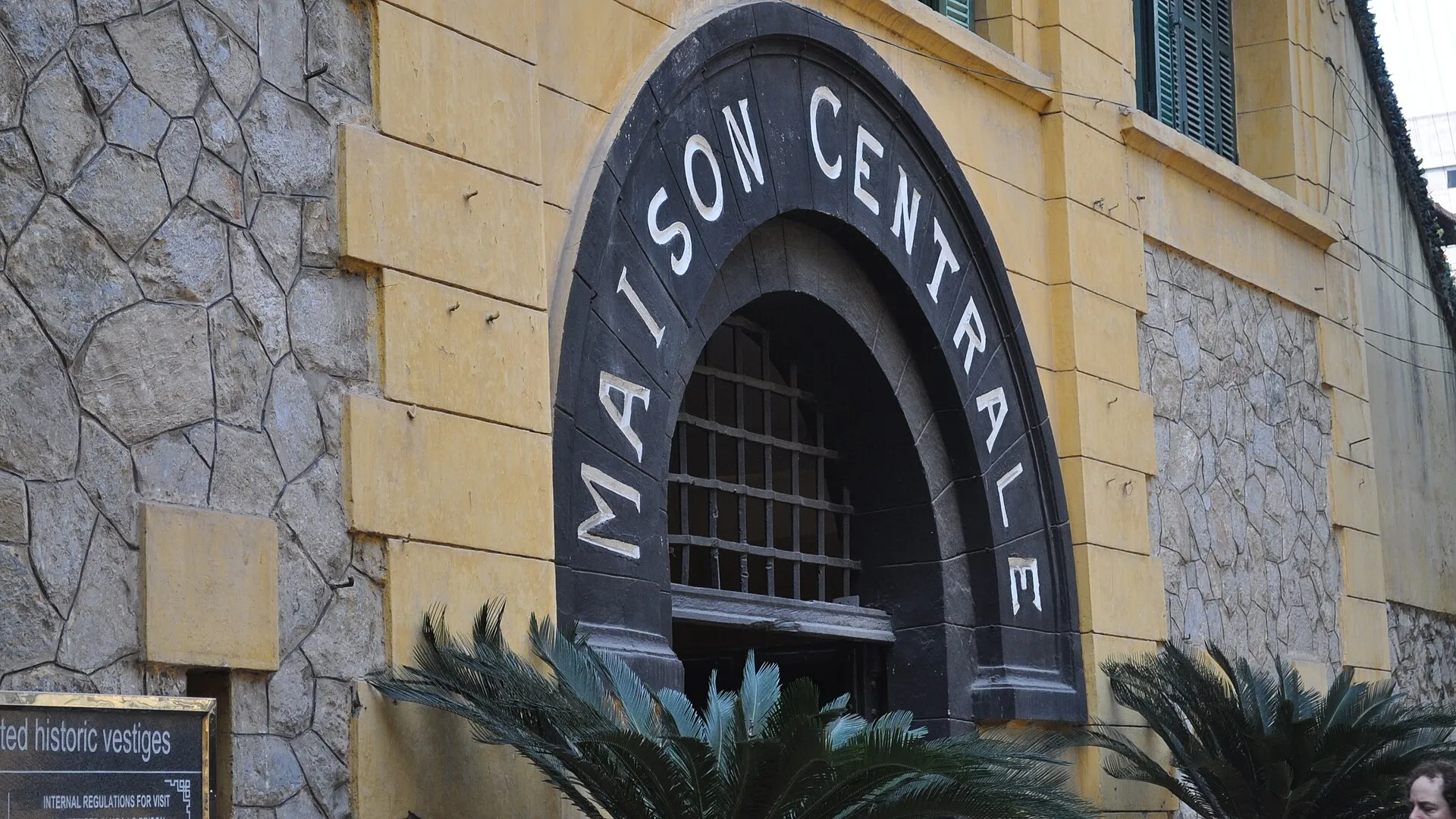
After touring the courtyards, you can easily walk to the nearby Imperial Citadel of Thang Long, visit the somber Hoa Lo Prison Memorial, or take a 10-minute taxi back to the Old Quarter.
More on temple dress and behaviour in Hanoi etiquette.
Common questions
How much does a ticket cost for the Temple of Literature?
Adult admission is 70,000 VND, bought at the kiosks beside the main entrance gate or verified online at vanmieu.gov.vn. Children under 16 enter free. Reduced tickets at 35,000 VND are for Vietnamese students and visitors aged 60 and over.
What are the opening hours of the Temple of Literature?
The complex is open daily from 08:00 to 17:00 (vanmieu.gov.vn). An evening 3D light experience operates from 18:30 to 22:00 on Wednesdays, Saturdays and Sundays.
What is the dress code for visiting the Temple of Literature?
While the outer garden courtyards are relatively casual, the inner shrines in the fourth and fifth courtyards are consecrated places of Confucian worship. Visitors must wear clothing covering the shoulders and knees. Hats and sunglasses must be removed when entering the ceremonial halls.
What is the famous red pavilion on the 100,000 VND banknote?
The Khue Van Cac (Pavilion of the Constellation of Literature), located in the second courtyard, is featured on the back of the green 100,000 VND banknote. Built in 1805, this red timber pavilion with its round sun-burst windows is the official municipal emblem of Hanoi.