In this guide
💡 The Short Version: Standard adult admission to the Vietnam Museum of Ethnology costs 40,000 VND, open Tuesday to Sunday from 08:30 to 17:30 (strictly closed on Mondays), confirmed at vme.org.vn. Located in Cau Giay roughly seven kilometres west of the Old Quarter, it is reached via a 25-minute Grab ride costing 70,000 to 100,000 VND or public bus route 14 for 8,000 VND. With its two-storey indoor galleries of textiles alongside an outdoor park of full-scale tribal longhouses and stilt dwellings, it provides invaluable context before taking trips to the northern highlands or rural craft villages. Or book a tour: when you want private vehicle transport out to Cau Giay and an English-speaking guide to interpret tribal customs, the Full-Day Hanoi Cultural Highlights Tourad (from VND 995,600, 4.6 stars from 195 reviews) includes the Museum of Ethnology alongside Old Quarter sights.
Vietnam is home to 54 officially recognised ethnic minority groups, ranging from the lowland majority Kinh people (Viet) to remote mountain populations inhabiting the rugged peaks of the Annamite Range and the Northern Highlands.
Situated in Cau Giay district, the Vietnam Museum of Ethnology (Bao Tang Dan Toc Hoc Viet Nam) is a research and public education institution developed in collaboration with French ethnologists and inaugurated by French President Jacques Chirac in 1997. It offers an engaging journey through tribal rituals, sacred ceremonies, traditional agricultural technologies, and indigenous architecture. Official research papers, exhibition updates, and opening announcements are published on vme.org.vn.
Admission fees and ticket pricing
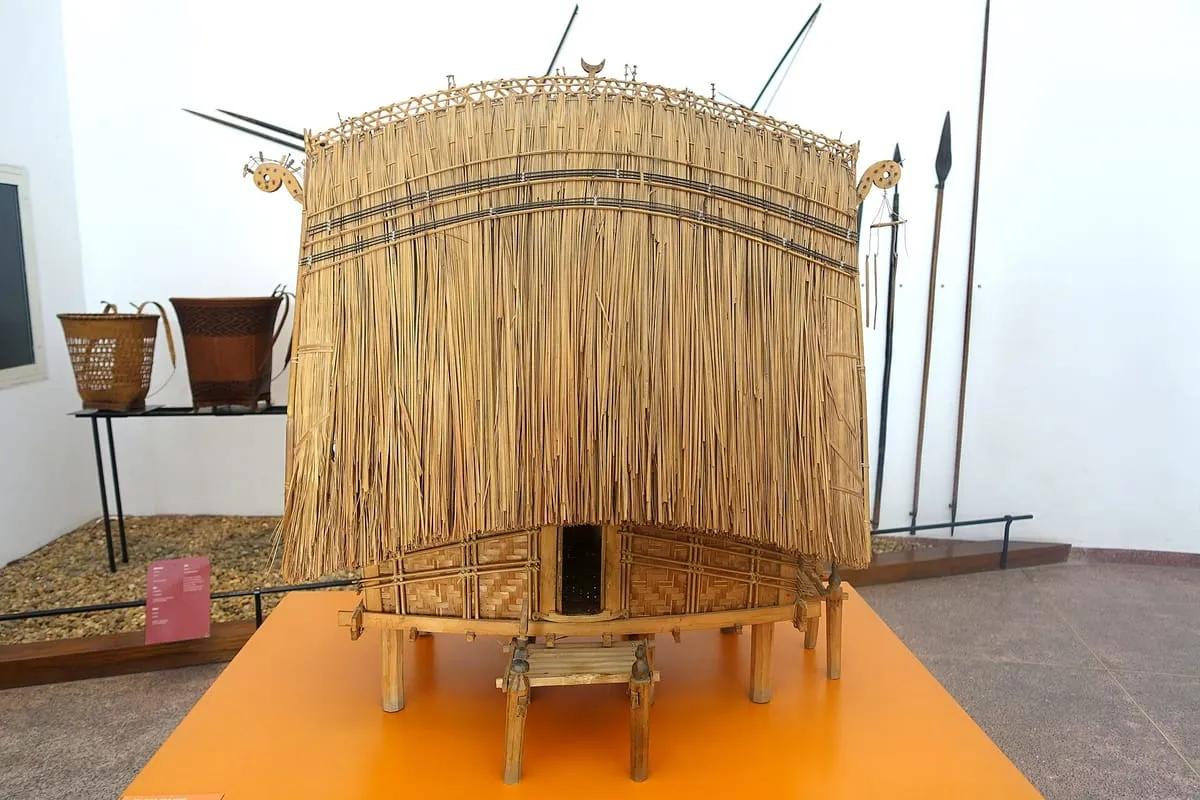
Bahnar communal Rong house. Photo: Gary Todd, Wikimedia Commons, CC0.
Admission tickets are purchased at the entry pavilion on Nguyen Van Huyen Road. Payment is accepted in cash (VND) or via domestic bank card. Rates and concessions are published at vme.org.vn.
| Ticket category | Price | Requirements | Inclusions |
|---|---|---|---|
| Adult visitor | 40,000 VND | Standard visitor admission (vme.org.vn) | Access to Trong Dong, Outdoor Park, and Canh Dieu building |
| University student | 20,000 VND | Valid student identification card | Full museum access across all galleries |
| Pupil (ages 6 to 16) | 10,000 VND | Proof of age upon request | Full museum access across all galleries |
| Child under 6 years | Free | Accompanied by a ticketed adult | Full museum access across all galleries |
| Official museum guide (English/French) | 150,000 VND | Indoor exhibition tour (booked at counter) | 45-minute specialist curator tour |
Additional service fees
- Outdoor architecture guided tour: 150,000 VND (English or French; covers the reconstructed tribal houses).
- Full indoor and outdoor guided tour: 250,000 VND (approx 90 minutes).
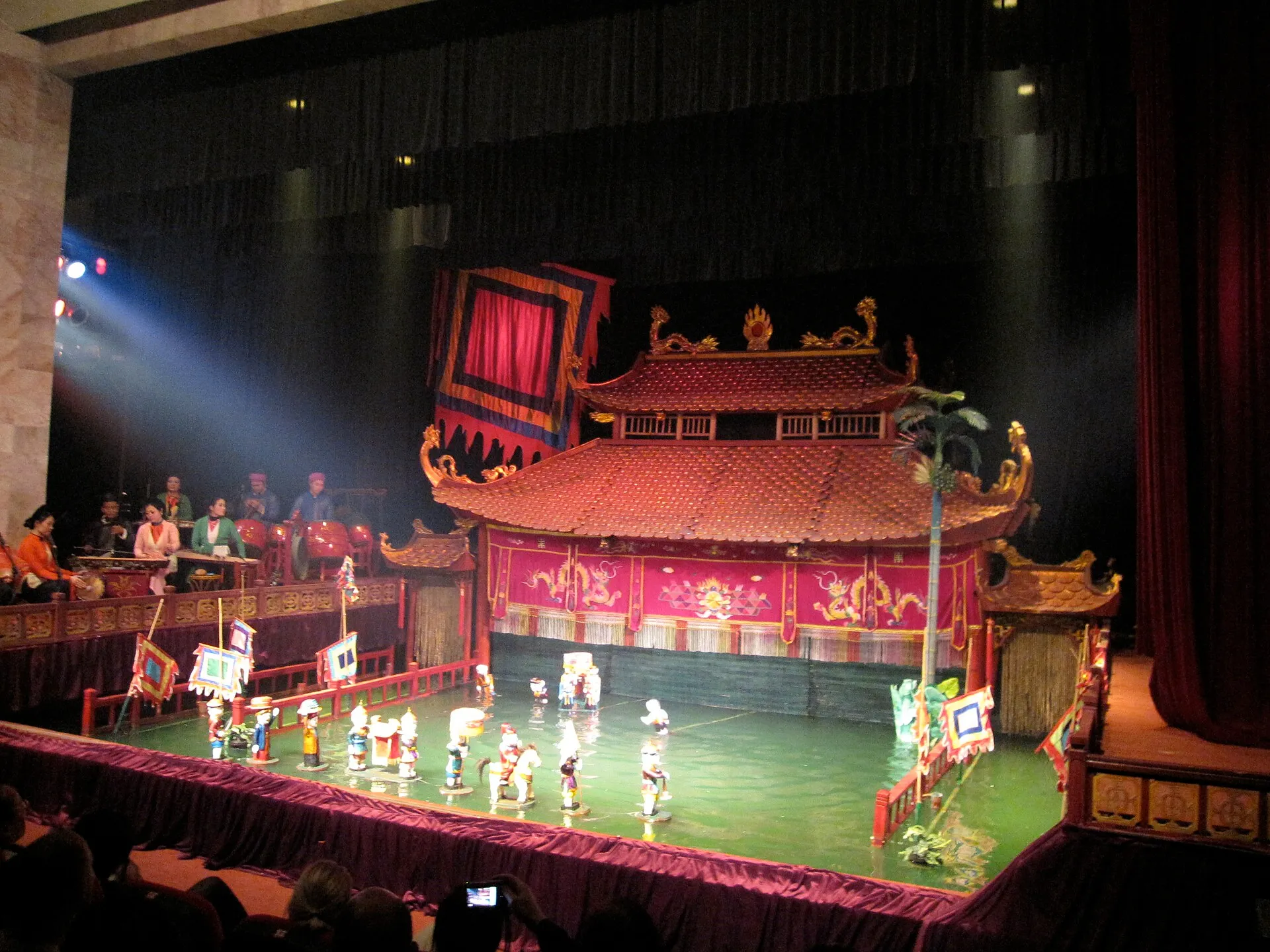
- Water puppet performance: 90,000 VND for adults (staged on select weekend afternoons by visiting village puppeteers at the garden pond, confirmed at vme.org.vn).
Opening hours and visiting logistics
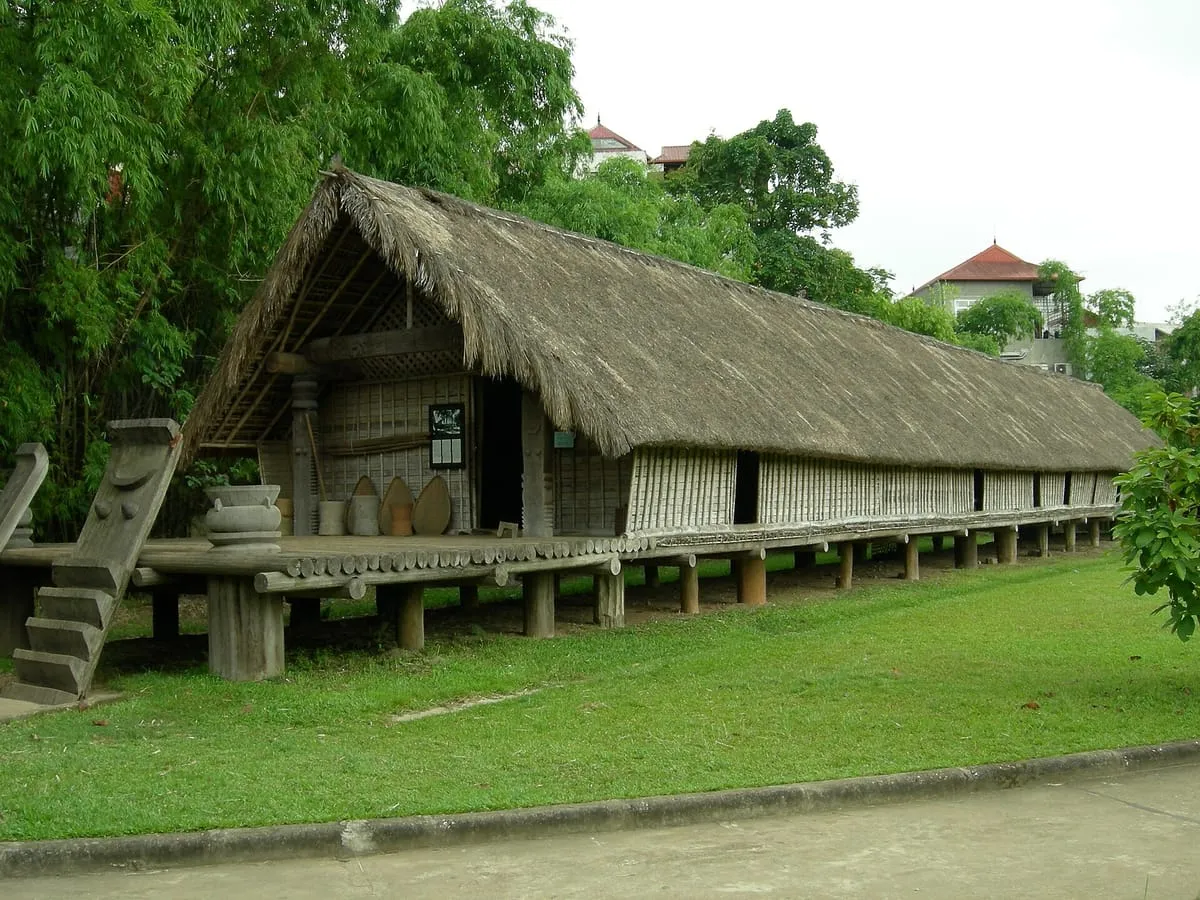
E De longhouse. Photo: Gary Todd, Wikimedia Commons, CC0.
- Tuesday to Sunday: 08:30 to 17:30 (ticket counter closes at 17:00, details on vme.org.vn).
- Mondays: Closed all day for research and preservation work.
- Lunar New Year (Tet): Closed across the official public holiday period.
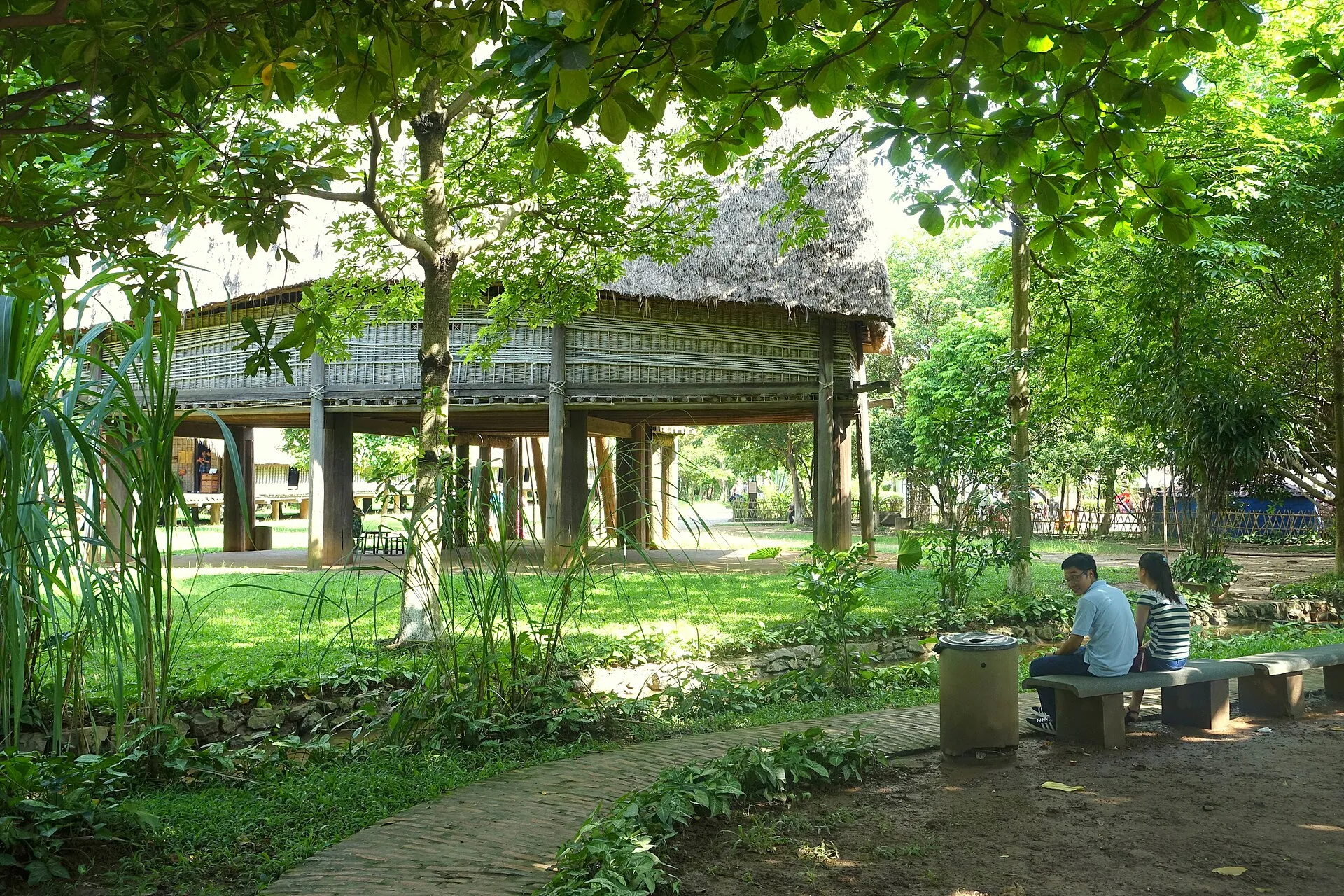
Expect to spend between two and three hours exploring the full site. The indoor galleries are air-conditioned, while the outdoor park features shaded walking paths winding through mature trees and water channels.
Tours and guided cultural visits
An independent 40,000 VND ticket at the door is ideal for self-paced visits. Because the museum is 7 kilometres west of the Old Quarter, guided city tours bundle air-conditioned transit with an expert guide who can explain the complexities of Vietnam’s 54 ethnic groups.
Full-day Hanoi city tour with lunch
From VND 995,600 · 4.6 stars from 195 reviews · 1 day · Ethnology Museum & temple circuit
Hanoi: Full-Day City Tour with Lunch and Optional Extrasad: an all-inclusive excursion that pairs the Vietnam Museum of Ethnology with the Temple of Literature and the Ho Chi Minh Mausoleum. Includes hotel pickup, English guide, museum tickets, and Vietnamese lunch.
Ho Chi Minh Complex and Ethnology Museum tour
From VND 840,000 · 6 hours · combined historical and tribal culture
Hanoi: Ho Chi Minh Complex and Ethnology Museum Tourad: focuses specifically on modern statehood at Ba Dinh and tribal cultural anthropology at the Museum of Ethnology, with round-trip vehicle transfers.
Full-day guided cultural landmarks tour
From VND 988,300 · 4 hours to 1 day · guided museum visits and transport
Hanoi: Full-Day Guided City Tour with Lunch & Entry Ticketsad: visits the outdoor longhouses at the Museum of Ethnology, Tran Quoc Pagoda on West Lake, and the Old Quarter, with all entry tickets covered.
Official ticket or tour: the prices side by side
Independent entry versus guided small-group tours.
| Option | Official admission | Tour cost | What it covers |
|---|---|---|---|
| Standard adult admission | 40,000 VND | — | Entry to Trong Dong, outdoor park & Canh Dieu wing (vme.org.vn) |
| Entry with official museum guide | 190,000 VND | — | Ticket plus 45-minute on-site curator tour |
| Full indoor/outdoor museum tour | 290,000 VND | — | Ticket plus 90-minute private specialist guide |
| Ho Chi Minh Complex & Ethnology tour | Admissions included | From VND 840,000 | 6-hour guided tour with private transport |
| Full-day city tour with lunch | Admissions included | From VND 995,600 | Full day with Ethnology Museum, Temple of Literature & lunch |
| Comprehensive landmarks tour | Admissions included | From VND 988,300 | Round-trip vehicle transfers, guide, and all entrance tickets |
How to get there from central Hanoi
The museum sits approximately 7 kilometres west of Hoan Kiem Lake on Nguyen Van Huyen Road.
Grab taxi or motorbike
The simplest transport method from your Old Quarter accommodation:
- GrabCar: 70,000 VND to 100,000 VND each way depending on traffic; journey time is roughly 25 to 35 minutes.
- GrabBike: 35,000 VND to 50,000 VND; journey time is 20 minutes.
Public bus
Hanoi’s municipal bus network provides an inexpensive alternative:
- Bus route 14: Board at the Dinh Tien Hoang stop next to Hoan Kiem Lake or along Trang Thi. Disembark at the Nguyen Khanh Toan stop, from where it is an easy 400-metre walk south along Nguyen Van Huyen Road to the entrance gates. Fare is 8,000 VND per passenger.
- Bus route 38: Departs near Hanoi Railway Station and the Temple of Literature, passing within walking distance of the museum.
The Trong Dong main building: 54 ethnic groups
The main indoor pavilion is shaped in the circular form of an ancient bronze Dong Son drum. Across two spacious floors, exhibits are arranged scientifically by ethnolinguistic family.
1. The Viet-Muong linguistic group
The ground floor begins with the lowland Viet (Kinh) majority and the Muong people of Hoa Binh province. Displays showcase:
- Water puppetry mechanics: Cutaway wooden puppets illustrating the bamboo rudder rods and wire linkages used at the Thang Long Water Puppet Theatre.
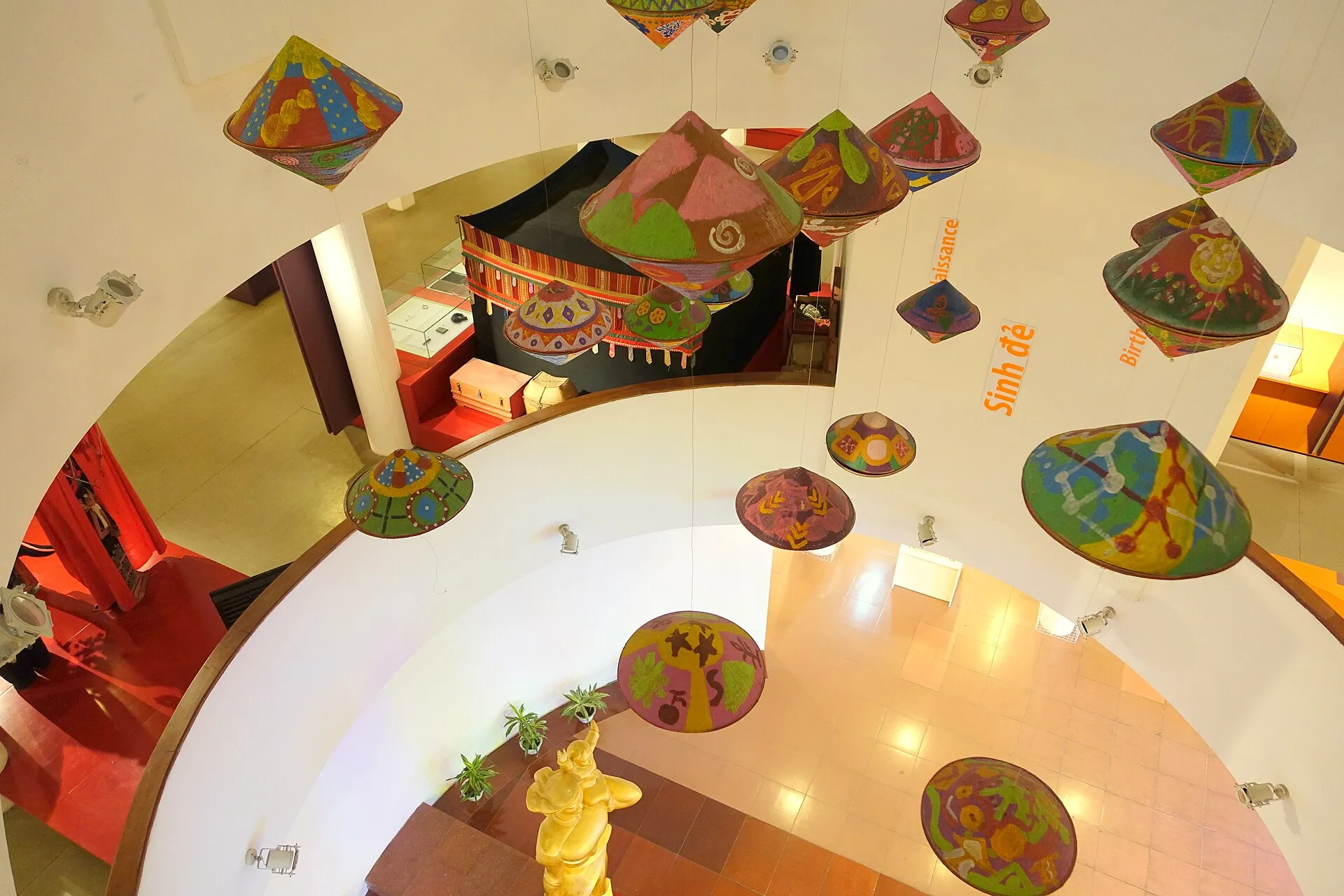
- Village agriculture: Traditional wooden ploughs, woven conical hats, and bamboo fish traps from the Red River Delta.
- Muong funeral ceremonies: Shamanic funeral robes, sacred burial banners, and bronze bells used in animist rites.
2. Tay, Thai, and Kadai groups
Covering the northwestern river valleys, this section highlights the intricate stilt-dwelling culture of the White Thai, Black Thai, and Tay peoples:
- Heavy wooden looms producing double-sided brocade textiles.
- Then musical instruments, including the gourd-resonated Dan Tinh lute used in spiritual possession rituals.
3. Mon-Khmer and Hmong-Dao mountain cultures
Moving to the upper floor, exhibits delve into the highland communities of the Sino-Tibetan and Austroasiatic linguistic groups:
- Hmong and Dao silver jewellery: Heavy cast silver torcs, dangling earrings, and ceremonial headpieces worn to ward off evil spirits and display family wealth.
- Batik and hemp processing: Indigo dye vats, wax drawing tools, and hemp looms from Sapa and Ha Giang. Visitors planning an onward journey to Sapa will find this gallery essential for identifying tribal dress in mountain markets.
- Shamanic ritual scrolls: Dao religious paper paintings depicting Taoist and animist pantheons, used during initiation ceremonies (Cap Sac).
4. Austronesian (Malayo-Polynesian) groups
Representing the matriarchal and matrilineal tribes of the Central Highlands, including the Ede, Gia Rai, and Cham:
- Elaborate funerary statues carved from tropical hardwoods.
- Royal Cham brocade silks, ceremonial pottery, and musical instruments.
The outdoor architectural park
Covering over two hectares of manicured gardens, the open-air park is the museum’s crowning achievement. Rather than building modern replicas, the museum invited village elders and indigenous craftsmen from distant provinces to dismantle genuine traditional structures, transport the timber and thatch to Hanoi, and rebuild them using ancestral techniques.
| Dwelling structure | Origin community | Key architectural features |
|---|---|---|
| Bahnar communal house (Nha Rong) | Kon Tum, Central Highlands | Soaring 19-metre thatched axe-blade roof raised on massive wooden stilts |
| Ede matriarchal longhouse (Nha Dai) | Dak Lak, Central Highlands | 42-metre-long timber home entered via carved female-breast ladders |
| Gia Rai tomb complex (Nha Mo) | Gia Lai, Central Highlands | Carved wooden totems illustrating fertility, birth, and mourning |
| Tay stilt house (Nha San) | Lang Son, Northern Vietnam | Elevated timber frame with central cooking hearth and weaving loom |
| Hmong wooden house | Ha Giang, Northern Highlands | Ground-level dwelling built from split pomu cedar shingles |
| Dao earthen house | Yen Bai, Northern Highlands | Thick rammed-earth walls built to retain warmth in mountain winters |
| Cham house | Ninh Thuan, South-Central Coast | Traditional multi-room brick and tile home with sacred ancestral granary |
Highlights of the outdoor park
The Bahnar communal house (Nha Rong)
The most dramatic structure on the grounds is the towering Nha Rong, measuring 19 metres in height. Resembling the blade of an axe cleaving the sky, this communal hall served as the judicial centre, sacred sanctuary, and gathering space for village men. Visitors can remove their shoes and climb the steep timber log staircase to inspect the massive mortise-and-tenon joinery and elevated bamboo flooring.
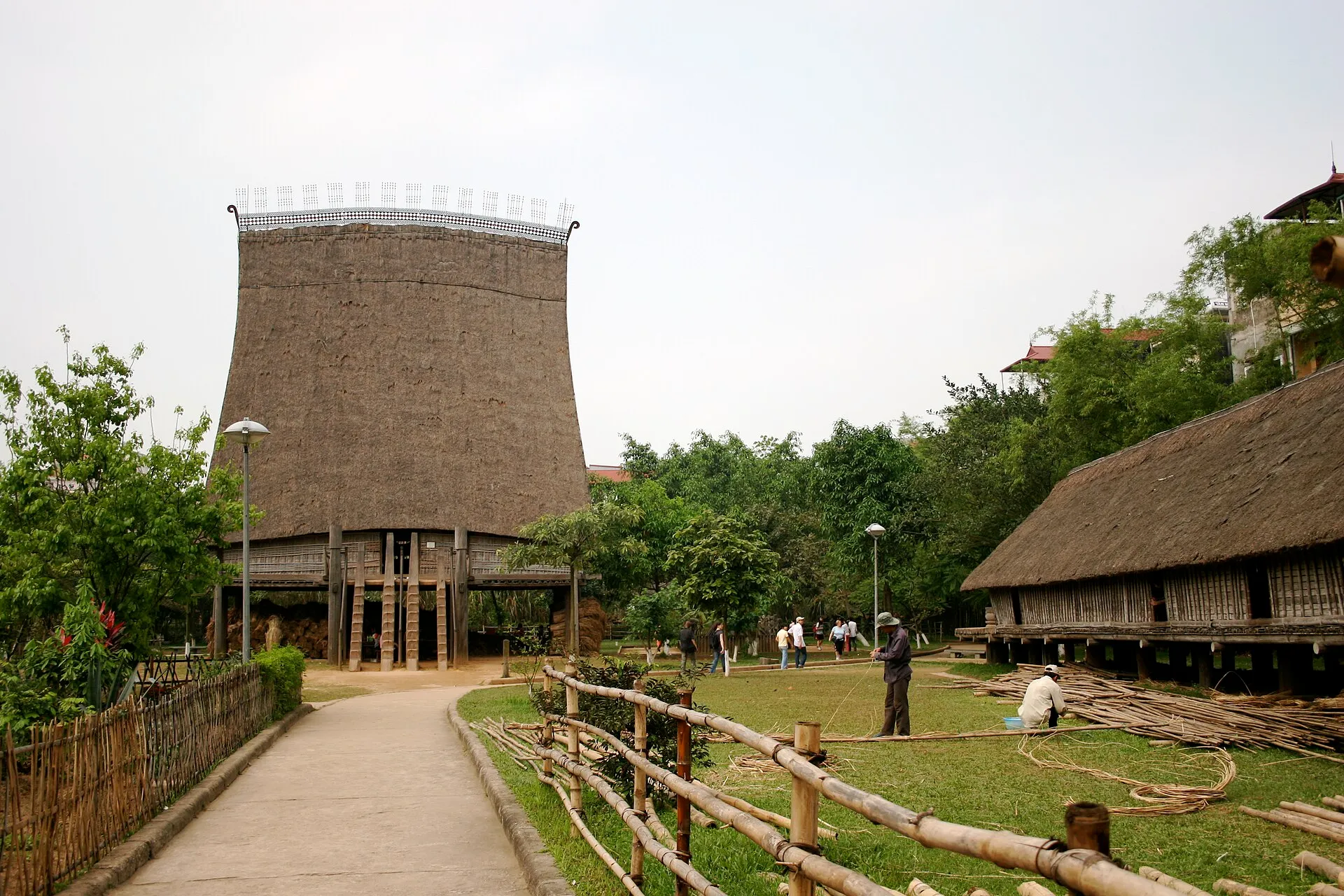
The tall Bahnar communal Rong house in the outdoor garden at the Museum of Ethnology. Photo: Nam-ho Park, Wikimedia Commons, CC BY 2.0.
The Ede matriarchal longhouse (Nha Dai)
The Ede trace inheritance, lineage, and property through the maternal line. The family longhouse expands lengthwise each time a daughter marries, sometimes reaching over 100 metres in length. The entrance features two hand-carved wooden stairs: the “female staircase” carved with two stylized breasts and a crescent moon for family members, and the “male staircase” for guests.
The Gia Rai funeral compound
Central Highland funerary traditions hold that the deceased wander the earth until a final tomb-abandonment ceremony (Le Bo Ma) releases their spirit to the ancestors. The reconstructed tomb is encircled by dozens of expressive wooden carvings depicting pregnant women, copulating figures, crying mourners, and village guardians carved from single tree trunks.
The Canh Dieu (Kite) building: Southeast Asian cultures
Housed in a separate modern pavilion shaped like a soaring kite, this wing broadens the museum’s focus to regional Southeast Asian heritage:
- Indonesian shadow puppetry: Intricate buffalo-hide wayang kulit puppets and bronze gamelan instruments.
- Regional textile traditions: Malaysian batik, Lao silk weavings, and Filipino basketry.
- Maritime and trade exhibits: Cross-cultural trade beads, ceramic jars, and ritual headgear illustrating centuries of regional migration across the South China Sea.
Combining your visit with other Hanoi sights
Because Cau Giay is outside the historic core, combine your museum trip with other sights on the western side of the capital:
- Pair with the Vietnamese Women’s Museum: While Ethnology covers architectural and tribal life across the country, the Vietnamese Women’s Museum in the French Quarter provides complementary insights into women’s wartime bravery and national marriage rites.
- Temple of Literature: On your return journey toward the Old Quarter, stop off at the 11th-century Temple of Literature to explore imperial Confucian heritage.
- Family exploration: With spacious grassy lawns and interactive houses to scramble inside, this is one of the best cultural excursions for families; see our dedicated guide to visiting Hanoi with kids.
- For a comprehensive overview of the city’s key attractions, check out our master roundup of things to do in Hanoi.
Common questions
How much is admission to the Vietnam Museum of Ethnology?
Standard adult admission costs 40,000 VND, bought at the gate or verified online at vme.org.vn. Higher education students with valid identification pay 20,000 VND, while school pupils aged 6 to 16 pay 10,000 VND. Children under six enter free.
What are the opening hours for the Museum of Ethnology in Hanoi?
The museum opens Tuesday to Sunday from 08:30 to 17:30 (vme.org.vn). Ticket sales end at 17:00. The museum is closed on Mondays and throughout official Lunar New Year (Tet) public holidays.
How do I get to the Vietnam Museum of Ethnology from the Old Quarter?
Located roughly 7 kilometres west of Hoan Kiem Lake in Cau Giay district, the easiest way to reach the museum is by booking a Grab ride (70,000 VND to 100,000 VND for a car; 35,000 VND for a motorbike). Alternatively, public bus route 14 departs near Hoan Kiem Lake for 8,000 VND.
What is the outdoor exhibition at the Vietnam Museum of Ethnology?
The museum's outdoor garden showcases ten full-scale architectural dwellings dismantled in their home villages across Vietnam and rebuilt on site by native artisans, including a 19-metre Bahnar communal house, an Ede longhouse, and a Gia Rai tomb complex.
How much time should I spend at the Vietnam Museum of Ethnology?
Plan for at least two to three hours. The museum covers three distinct areas: the indoor Trong Dong building dedicated to Vietnam's 54 ethnic groups, the outdoor architectural garden, and the Canh Dieu building showcasing Southeast Asian cultures.