One of 2 self-guided walks in Hanoi. See every walk.
In this guide
The Short Version: This 2.5-kilometre heritage walking tour takes 2.5 to 3 hours, leading you from the willow-shaded shores of Hoan Kiem Lake through the heart of Hanoi’s thousand-year-old Old Quarter. Cross the scarlet bridge to Ngoc Son Temple (50,000 VND), admire the neo-Gothic facade of St. Joseph’s Cathedral (free), browse traditional silk ateliers on Hang Gai, step inside the 19th-century Hanoi Ancient House (10,000 VND), pay respects at the ancient Bach Ma Temple (free), explore the busy stalls of Dong Xuan Market (free), and conclude at the 1749 brick archway of O Quan Chuong City Gate (free). For an architectural continuation through colonial boulevards and royal monuments, this walk links directly south to our French Quarter and Ba Dinh walking tour. Or book a tour: If you prefer navigating the historic 36 Guild Streets with an experienced local guide who handles all tickets and historical context, book the Hanoi City Highlights Walking Tourad (VND 699,800) or taste culinary specialities on the Hanoi: Small-Group Street Food Walking Tourad (VND 556,800).
The route
Map of the walk numbered stops in walking order
Open the whole route in Google Maps — all seven stops in walking order on your phone.
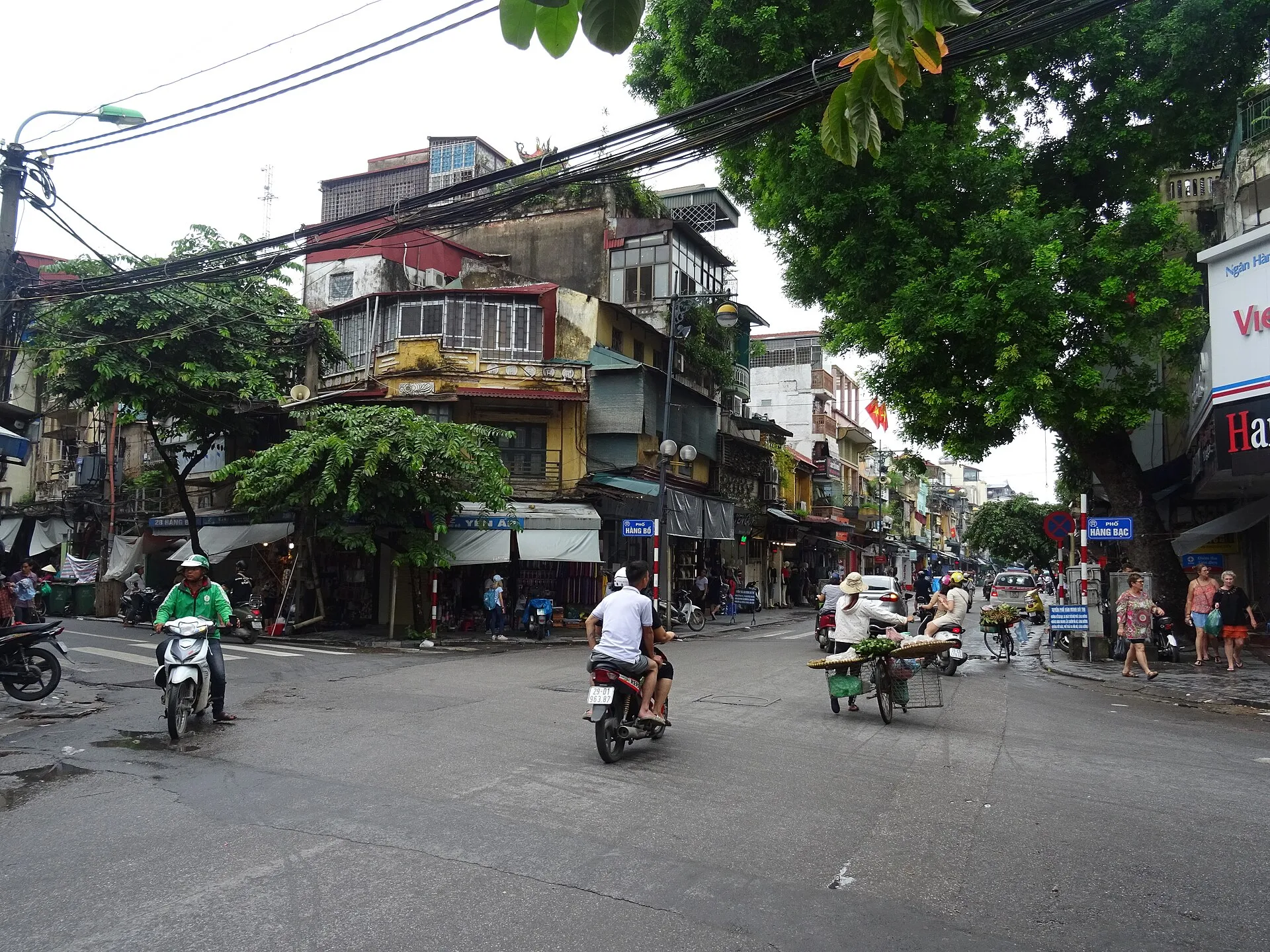
The Old Quarter (Pho Co) traces its origins to the 11th century, when King Ly Thai To established his imperial capital at Thang Long, officially documented by the Hanoi People’s Committee and the Vietnam National Authority of Tourism. Artisans and craft guilds clustered outside the eastern ramparts along the Red River, each street specialising in a specific trade. This self-guided route navigates the historic core at pedestrian level, weaving between atmospheric guild streets, historic shrines, and busy covered markets.
| Stop | Entry | Operating hours | Highlights & walking directions |
|---|---|---|---|
| 1. Hoan Kiem Lake & The Huc Bridge | 50,000 VND (temple) | Daily | Vermilion wooden bridge, Jade Island, and giant sacred turtle relic |
| 2. St. Joseph’s Cathedral (Nha Tho Lon) | Free | Outside 24h (mass times inside) | 1886 neo-Gothic twin bell towers facing a tree-lined cafe square |
| 3. Hang Gai (Silk Street) | Free | Daily 08:30 to 21:00 | Tailors, silk scarves, embroidery, and boutique souvenir galleries |
| 4. Hanoi Ancient House (87 Ma May) | 10,000 VND | Daily 08:00 to 17:00 | Restored 1890 traditional merchant tube house with central courtyard lightwells |
| 5. Bach Ma Temple (White Horse Temple) | Free | Tue–Sun 08:00 to 17:30 (closed Mon) | Hanoi’s oldest Taoist shrine (founded 1010) honouring the White Horse |
| 6. Dong Xuan Market | Free | Daily 06:00 to 18:00 | Three-storey 1889 colonial market hall filled with textiles, spices, and dried foods |
| 7. O Quan Chuong (Old City Gate) | Free | Open 24 hours | Sole surviving 1749 brick arched gate and watchtower from ancient Thang Long |
1. Hoan Kiem Lake & The Huc Bridge
50,000 VND · daily 07:00 to 18:00 · Dinh Tien Hoang Street, Hoan Kiem
Begin your walk on the northern promenade of Hoan Kiem Lake (Lake of the Restored Sword). In 15th-century folklore, Emperor Le Loi returned a magical sword (Thuan Thien) to a golden turtle deity in these waters after driving out Ming invaders, giving the lake its name.
Walk onto the curved scarlet-lacquered The Huc Bridge (Bridge of the Rising Light), which leads out across the water to Jade Island (Dao Ngoc). At the island’s centre sits Ngoc Son Temple (Temple of the Jade Mountain), built in the 18th century and dedicated to the Taoist scholar Van Xuong and 13th-century military hero Tran Hung Dao.
Inside the rear pavilion rests a glass display case housing the preserved body of a giant Rafetus swinhoei softshell turtle retrieved from the lake in 1968, weighing roughly 250 kilograms. To read about the folklore and surrounding parkland, consult our Ngoc Son Temple and Hoan Kiem Lake guide.
- Walking to Stop 2: Exit the island, cross back over the bridge, and turn left onto the lake pathway heading south. Walk 300 metres along Dinh Tien Hoang, turn right onto Hang Gai, take the immediate left onto Luong Van Can, and then right onto Hang Trong. After 200 metres, turn left down Nha Tho street until St. Joseph’s Cathedral opens ahead.
2. St. Joseph’s Cathedral (Nha Tho Lon)
Free · square open 24 hours (interior during mass) · 40 Nha Chung, Hoan Kiem
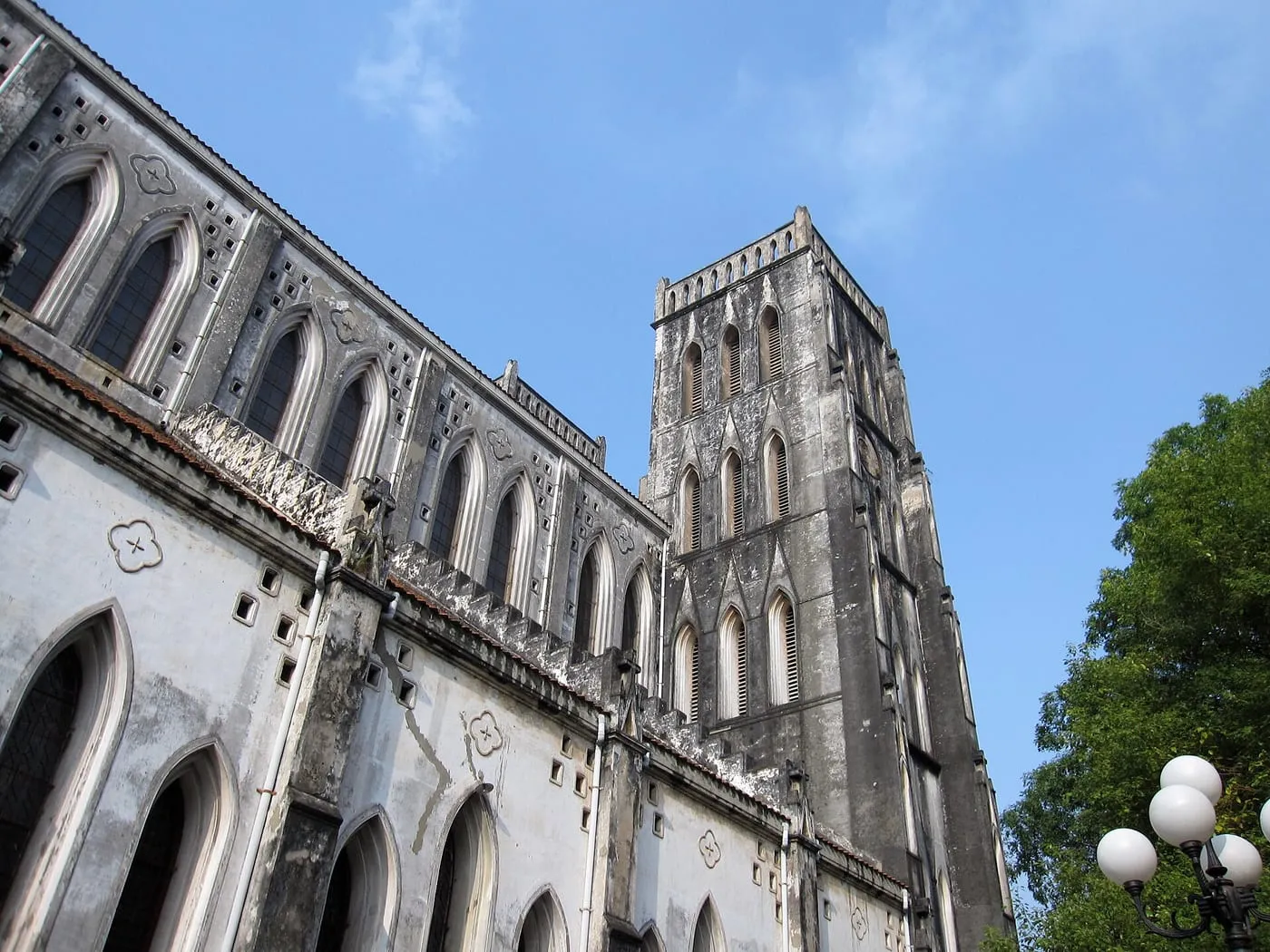
St. Joseph’s Cathedral. Photo: Gryffindor, Wikimedia Commons, CC BY-SA 3.0. Standing at the head of Nha Tho street, St. Joseph’s Cathedral (Nha Tho Lon) is Hanoi’s oldest church, consecrated on Christmas Day in 1886. Designed by French missionary architect Bishop Paul-François Puginier, the twin-towered building was modelled directly on Notre-Dame Cathedral in Paris.
The weathered exterior features stone slabs, pointed Gothic lancet windows, and a central stained-glass rose window. The church sits upon the former site of the 11th-century Bao Thien Pagoda, which was razed under French colonial administration to construct the cathedral complex.
The leafy plaza fronting the cathedral is a social hub lined with lemon-tea cafes (tra chanh) and coffee shops where patrons sit on low plastic stools. If you wish to view the interior ribbed vaulting and gilded altars, visit during scheduled daily masses. Read more in our St. Joseph’s Cathedral and parish guide.
- Walking to Stop 3: Return north along Nha Chung, cross Ly Quoc Su, and continue 250 metres northward along Ly Quoc Su street until you hit the busy east-west thoroughfare of Hang Gai. Turn right onto Hang Gai.
3. Hang Gai (Silk Street)
Free · daily 08:30 to 21:00 · Hang Gai Street, Hoan Kiem
Hang Gai is one of the most celebrated avenues in the Old Quarter, historically dedicated to the silk trade. While many guild streets have shifted their focus to tourist trinkets, Hang Gai retains its heritage as the centre of northern Vietnamese textiles and tailoring.
The street is lined with elegant boutiques displaying rolls of mulberry silk, hand-embroidered wall tapestries, cashmere scarves, and custom-made ao dai (the traditional flowing tunic worn over silk trousers). Notable stops include Khai Silk, Tan My Design (known for delicate hand embroidery passed down through four generations of women), and small tailors offering made-to-measure shirts within 24 to 48 hours.
Look above the shopfronts to notice the architectural contrast: slender 19th-century French shutters sit directly beneath classic Vietnamese curved clay roof tiles (ngoi am duong).
- Walking to Stop 4: Continue east along Hang Gai for 150 metres until it meets Hang Dao. Turn left onto Hang Dao, then take the second right onto Hang Bac (Silver Street). Follow Hang Bac for 200 metres to the intersection with Ma May, then turn left onto Ma May. Number 87 sits 50 metres up on your right.
4. Hanoi Ancient House (87 Ma May)
10,000 VND · daily 08:00 to 17:00 (lunch closure 12:00 to 13:30) · 87 Ma May, Hoan Kiem
The Hanoi Ancient House (Nha Co Ma May) offers a remarkably preserved window into 19th-century domestic life. Built around 1890, this traditional merchant dwelling exemplifies Hanoi’s famous “tube house” (nha ong) architecture. Because the dynastic imperial court taxed property based on the width of the street frontage, merchant houses were designed exceptionally narrow (typically 2 to 4 metres wide) but stretched backwards 20 to 60 metres.
Step across the wooden door threshold into a succession of rooms separated by open-air internal courtyards (gieng troi), which channel natural light and ventilation through the structure:
-
Ground floor front: The historic merchant shopfront, historically used for trading herbal medicine or textiles.
-
Internal courtyard: Paved with clay bricks, featuring decorative bonsai planters and ceramic water jars.
-
Upper floor: The ancestral worship room with an intricately carved lacquered altar, followed by traditional timber bedrooms and tea-drinking verandahs.
-
Walking to Stop 5: Continue north along Ma May for 120 metres until you reach the cross street of Hang Buom (Sail Street). Turn left onto Hang Buom and walk 150 metres west. Bach Ma Temple is located on the right-hand side at number 76.
5. Bach Ma Temple (White Horse Temple)
Free · Tue–Sun 08:00 to 17:30 (closed Mondays) · 76 Hang Buom, Hoan Kiem
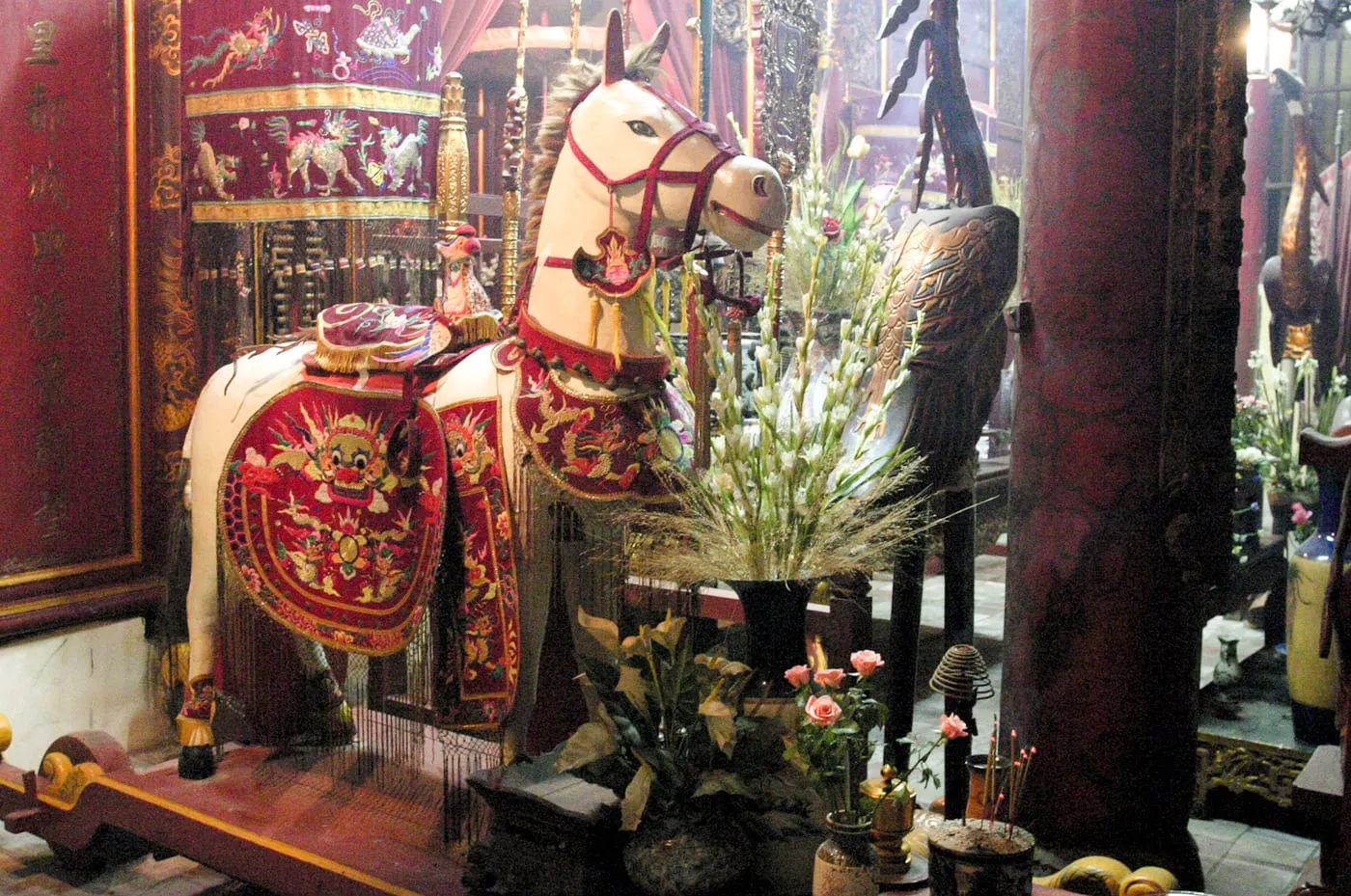
Bach Ma Temple. Photo: Greg Willis, Wikimedia Commons, CC BY-SA 2.0. Founded in 1010 by King Ly Thai To, Bach Ma Temple is the oldest Taoist sanctuary in the Old Quarter and one of the four sacred guardian shrines (Tu Tran) protecting the ancient citadel of Thang Long.
In the imperial chronicles, King Ly Thai To was unable to construct the defensive ramparts of his new citadel because the earthen walls repeatedly collapsed into the marshy soil. After praying at this shrine, a fiery white horse emerged from the temple, galloped across the ground leaving glowing hoofprints, and disappeared. The king ordered the walls constructed along the horse’s tracks, and the fortifications held firm. In gratitude, he dedicated the temple to the White Horse deity (Thanh Hoang Bach Ma).
Inside, a life-sized gilded white horse statue stands behind the primary altar beneath a timber roof supported by carved wooden brackets shaped like phoenixes and dragons. Incense coils hang from the beamed ceilings, casting fragrant smoke through the quiet interior. Modest dress covering shoulders and knees is mandatory.
- Walking to Stop 6: Exit the temple, continue west along Hang Buom for 80 metres, then turn right onto Hang Duong (Sugar Street). Continue straight north through the busy open-air market stalls along Dong Xuan street until the grand facade of Dong Xuan Market looms directly ahead.
6. Dong Xuan Market
Free · daily 06:00 to 18:00 · Dong Xuan Street, Hoan Kiem
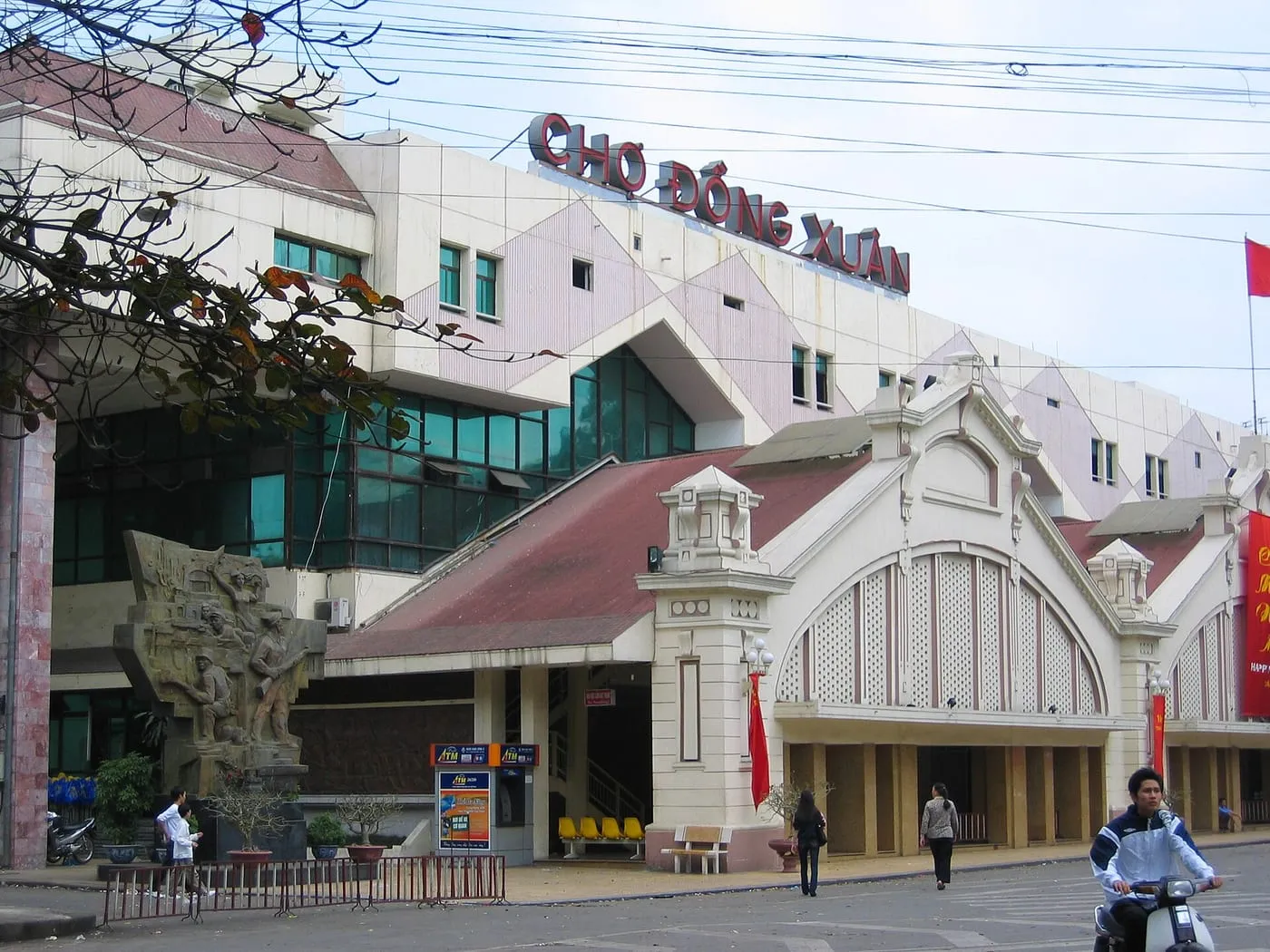
Presiding over the northern tip of the Old Quarter, Dong Xuan Market (Cho Dong Xuan) is the beating commercial heart of northern Vietnam. Commissioned by the French administration in 1889, the vast covered market hall is entered through a monumental five-bay arched facade constructed from yellow stone.
Wandering through the busy interior aisles reveals how northern Vietnam trades:
- Ground floor: Bins of dried seafood, medicinal herbs, whole lotus seeds, fermented shrimp paste, Vietnamese spices, and fresh tea leaves, alongside a lively food court serving steaming bowls of bun cha, snail noodles (bun oc), and sweet bean dessert soup (che).
- First & Second floors: High-density wholesale stalls stacked floor-to-ceiling with fabrics, silks, ready-made clothing, and luggage sold in bulk to regional traders.
Adjacent to the market runs Ngo Dong Xuan, a famous narrow alley known for concentrated, affordable street food stalls. To plan an evening return during the pedestrian weekend market, read our Dong Xuan Market and weekend night market guide.
- Walking to Stop 7: From the front entrance of Dong Xuan Market, walk south along Dong Xuan street for 70 metres, turn left onto Hang Khoai, and walk east 180 metres. Turn right onto Tran Nhat Duat, then take the immediate right onto O Quan Chuong. The massive brick city gate stands squarely across the intersection.
7. O Quan Chuong (Old City Gate)
Free · open 24 hours · Corner of Hang Chieu and Dao Duy Tu, Hoan Kiem
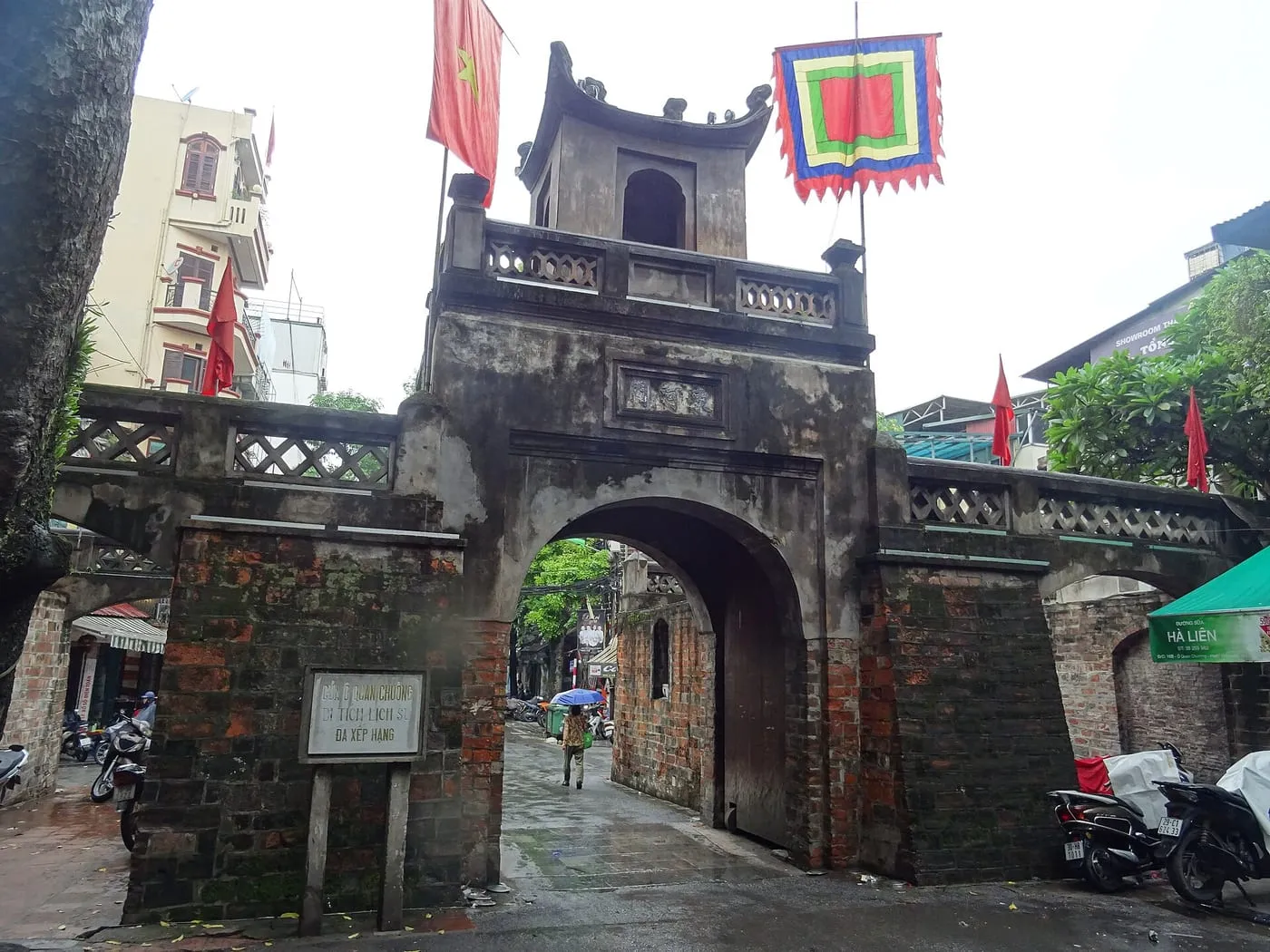
The sole surviving 1749 city gate of O Quan Chuong. Photo: Christophe95, Wikimedia Commons, CC BY-SA 4.0. Standing proudly across the junction of Hang Chieu and Dao Duy Tu, O Quan Chuong (the Old East Gate) is the sole surviving gate of the sixteen defensive gateways that once pierced the earthen and brick ramparts surrounding ancient Thang Long.
Erected in 1749 under King Le Hien Tong and rebuilt in 1817 under the Nguyen Dynasty, the fortress-like structure features:
- A large central vaulted archway designed for imperial processions and ox carts, flanked by two lower pedestrian side arches.
- A second-storey brick watchtower crowned with a traditional curved tiled roof and arched gun loops.
- A stone tablet affixed to the interior wall dating to 1881, bearing a municipal decree forbidding the gate guards from extorting money or goods from merchants entering the city.
The gate was named in honour of a courageous military commander (Quan Chuong) of the imperial guard who, alongside his 100 soldiers, fought to the death here on 20 November 1873 defending the gateway against invading French troops led by Francis Garnier.
Guided walking and food tours in the Old Quarter
While following this self-guided walking route is easy, joining an expert local guide unlocks hidden courtyard alleys, ancestral temple legends, and insider food tastings:
Hanoi City Highlights Walking Tour – Landmarks & History
From VND 699,800 · 5.0 stars from 206 reviews · 4.5 - 5 hours · Comprehensive walking tour
Book the Hanoi City Highlights Walking Tourad to experience the Old Quarter guild streets, Ngoc Son Temple, St. Joseph’s Cathedral, and Train Street with an English-speaking historian guide. Includes hotel pickup, all entry tickets, street snacks, and egg coffee.
Hanoi: Small-Group Street Food Walking Tour
From VND 556,800 · 4.8 stars from 2439 reviews · 3 hours · Top-rated foodie tour
Book the Hanoi Small-Group Street Food Walking Tourad to combine heritage sightseeing with 7 to 8 generous food tastings across the Old Quarter’s most authentic family-run stalls and hidden alleys.
Hanoi: Water Puppet Show Entry Ticket with Hotel Delivery
From VND 177,600 · 4.1 stars from 82 reviews · 1 hour · Skip ticket queues
Book the Water Puppet Show Entry Ticketad to secure reserved seating at the Thang Long Water Puppet Theatre on Hoan Kiem Lake, avoiding the long queues at the box office after completing your walk.
Where to head next
- Street food and coffee: You are now adjacent to Dao Duy Tu and Ta Hien, the culinary epicentre of the Old Quarter. Stop at Cafe Giang on Nguyen Huu Huan for an egg coffee, as detailed in our Hanoi egg coffee and cafe culture guide, or sample charcoal-grilled pork bowls using our best pho and bun cha in Hanoi recommendations.
- French Quarter continuation: Walk 15 minutes south through Hoan Kiem Lake to pick up Stop 1 of our French Quarter and Ba Dinh walking tour, taking in the Hanoi Opera House and colonial monuments.
- Evening entertainment: Book an evening performance at the Thang Long Water Puppet Theatre or relax with draft beer on Ta Hien Street.
Common questions
How long does the Old Quarter and Hoan Kiem walk take?
The walk covers approximately 2.5 kilometres. Walking at a relaxed pace with stops for temple visits, shophouse exploration, and photography takes between 2.5 and 3 hours.
What is the best time of day to do this walking tour?
Start at 08:30 or 09:00 in the morning to enjoy cooler temperatures and see temple courtyards before midday heat. Alternatively, late afternoon from 15:30 lets you finish around sunset as street food stalls fire up their braziers.
How much do the entries cost along this route?
Total sight entry fees along the entire walk are very modest: 50,000 VND for Ngoc Son Temple and 10,000 VND for the Hanoi Ancient House (60,000 VND per person). St. Joseph's Cathedral, Bach Ma Temple, Dong Xuan Market, and the O Quan Chuong gate are free to view.
What should you wear on this walk?
Wear modest clothing that covers both shoulders and knees, as this is strictly enforced when entering Ngoc Son Temple, St. Joseph's Cathedral, and Bach Ma Temple. Slip-on walking shoes are recommended as footwear must be removed in temple prayer halls.