In this guide
💡 The Short Version: Entry to the Vietnamese Women’s Museum costs 40,000 VND, open daily from 08:00 to 17:00 without Monday closures (baotangphunu.org.vn). Located at 36 Ly Thuong Kiet Street in the French Quarter, it sits within easy walking distance of Hoan Kiem Lake and Hoa Lo Prison Memorial. Renting the 50,000 VND audio guide is strongly advised, as it brings the four floors of wartime memoirs, ethnic marriage rituals, and traditional textile craft to life through first-person recorded testimonies. Or book a tour: when you want an expert guide to connect the stories of female wartime revolutionaries with French colonial history, the Women’s Museum and Hoa Lo Prison Walking Tourad (from VND 500,000, 4.8 stars from 17 reviews) pairs both sights in a four-hour walk.
In a capital known for monumental state institutions, the Vietnamese Women’s Museum (Bao Tang Phu Nu Viet Nam) stands out for its human scale and intimate storytelling. Established by the Vietnam Women’s Union in 1987 and thoroughly refurbished in 2010, this four-storey institution celebrates the multifaceted contributions of women across Vietnamese history, society, and domestic life.
Covering maternal traditions, female street commerce, armed resistance during the French and American wars, and intricate tribal textiles, it is widely regarded as one of the most compelling cultural museums in Southeast Asia. Exhibition catalogues and research projects are published on baotangphunu.org.vn.
Ticket prices and audio guide hire
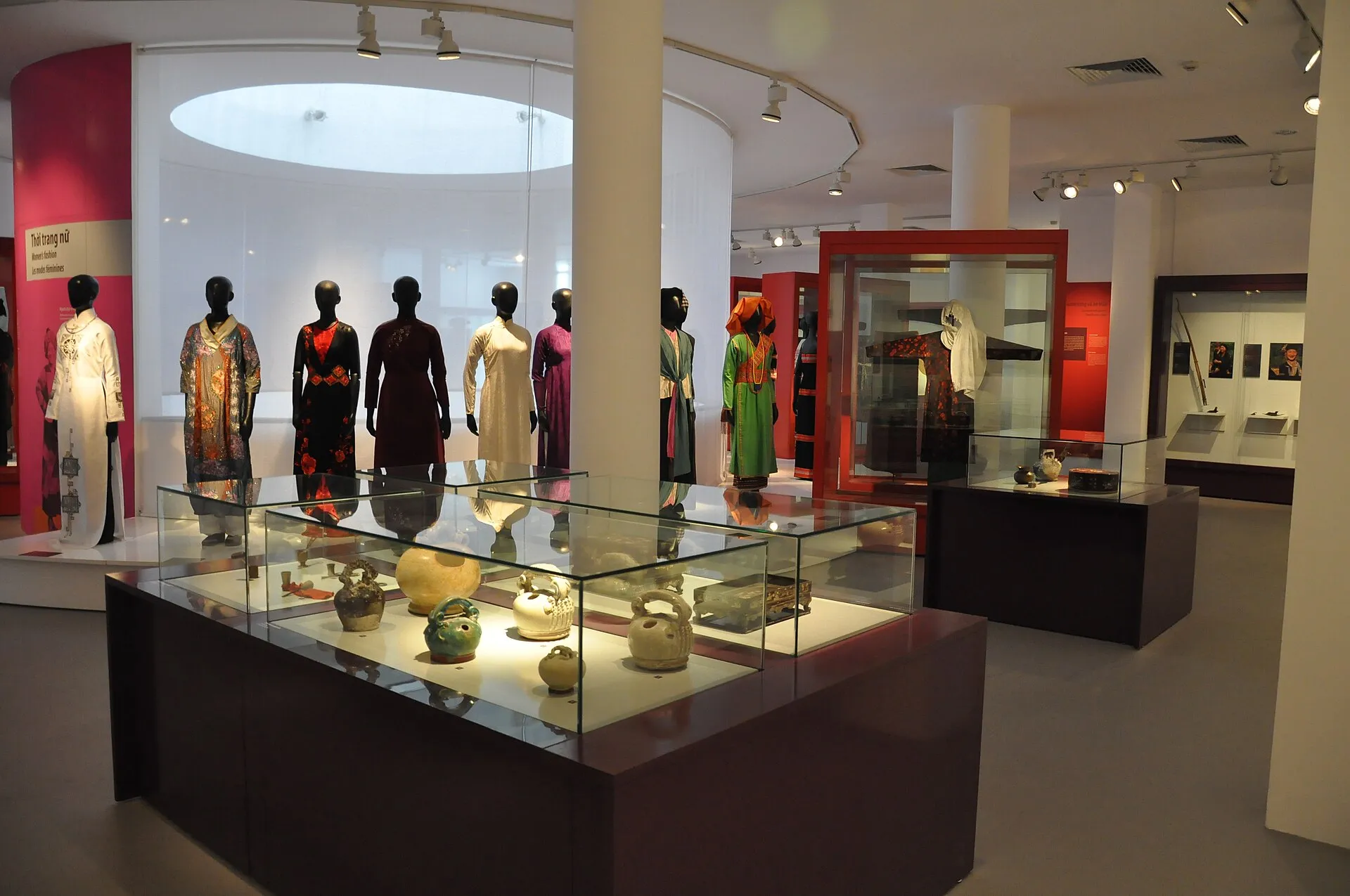
Fashion gallery, Vietnamese Women’s Museum. Photo: Gary Todd, Wikimedia Commons, CC0.
Tickets are sold at the glass-fronted reception desk inside the ground-floor foyer. Payment is accepted in cash (VND) and major bank cards. Official rates are maintained on baotangphunu.org.vn.
| Ticket or service | Cost | Terms and details |
|---|---|---|
| Standard adult admission | 40,000 VND | Full access to all four permanent exhibition floors (baotangphunu.org.vn) |
| Student ticket | 20,000 VND | Applicable with valid university student card |
| Child ticket | 10,000 VND | For children aged 6 to 15 |
| Child under 6 | Free | Accompanied by a ticketed adult |
| Multimedia audio guide | 50,000 VND | Available in English, French, Vietnamese, Japanese, Korean, and Spanish |
The audio guide
Renting the audio guide at the reception desk is worthwhile. Unlike dry institutional museum plaques, the audio tracks feature direct recordings, translations of personal diaries, wartime love letters, and oral histories collected from female veterans, village midwives, and street merchants.
Opening hours and visiting logistics
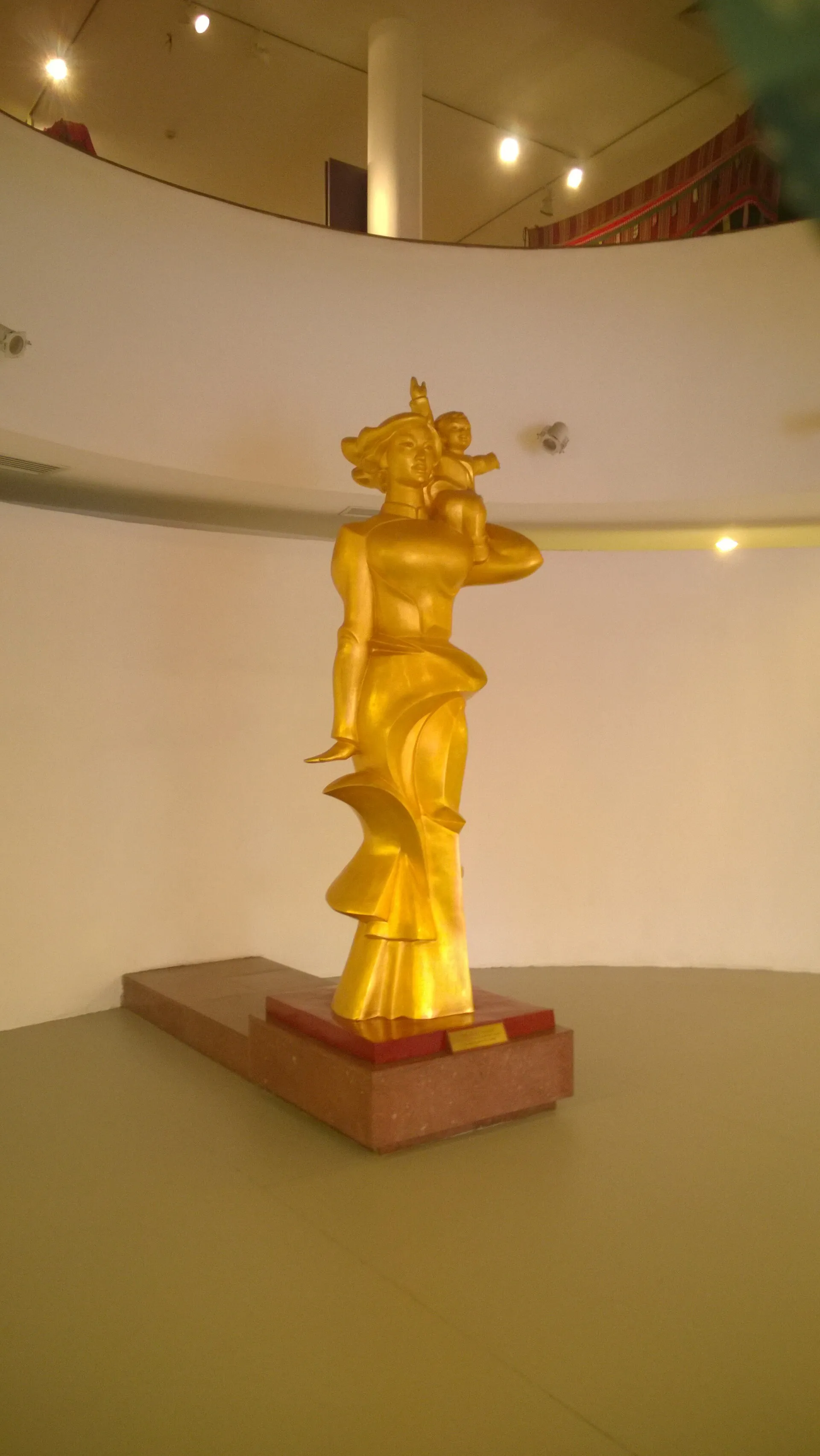
Atrium sculpture, Vietnamese Women’s Museum. Photo: Gary Todd, Wikimedia Commons, CC0.
- Opening hours: Daily from 08:00 to 17:00 (ticket desk closes at 16:30, confirmed on baotangphunu.org.vn).
- Days open: Seven days a week, Monday through Sunday.
- Midday closure: None. The museum remains open continuously through lunch.
- Location: 36 Ly Thuong Kiet, Hang Bai Ward, Hoan Kiem District.
The entire building is fully air-conditioned, with elevator access between all floors, making it an accessible and comfortable retreat during Hanoi’s humid summer afternoons.
Tours and guided cultural walks
An independent 40,000 VND ticket at the desk gives complete freedom to browse the exhibits. Joining a guided walking tour connects the museum’s social history with the nearby colonial architecture and prison memorials in the French Quarter.
Women’s Museum and Hoa Lo Prison walking tour
From VND 500,000 · 4.8 stars from 17 reviews · 4 hours · combined museum access
Hanoi: Women’s Museum and Hoa Lo Prison Walking Tourad: pairs the female revolutionaries detained at Hoa Lo Prison with the wartime and cultural galleries at the Vietnamese Women’s Museum, led by an English-speaking guide.
Women’s Museum, French Quarter & Hoa Lo tour
From VND 850,000 · 4 hours · colonial history & women’s narratives
Hanoi: Women’s Museum, French Quarter & Hoa Lo Walking Tourad: explores the leafy avenues of the French Quarter, examining colonial public buildings before exploring the Women’s Museum and the Maison Centrale cells.
Hanoi city highlights walking tour
From VND 699,800 · 5 stars from 206 reviews · 4.5 to 5 hours · central landmarks circuit
Hanoi City Highlights Walking Tour – Landmarks & Historyad: joins an expert local historian covering key cultural institutions, dynastic history, and central street life.
Official ticket or tour: the prices side by side
Independent entry versus guided cultural walking tours.
| Option | Official admission | Tour cost | What it covers |
|---|---|---|---|
| Standard adult admission | 40,000 VND | — | Entry to all 4 permanent exhibition floors (baotangphunu.org.vn) |
| Entry with audio guide | 90,000 VND | — | Admission plus multi-language audio receiver |
| Women’s Museum & Hoa Lo walking tour | Admissions included | From VND 500,000 | 4-hour guided tour covering both museums |
| Women’s Museum, French Quarter & Hoa Lo | Admissions included | From VND 850,000 | 4-hour tour adding colonial architectural commentary |
| Hanoi city highlights walking tour | Admissions included | From VND 699,800 | 4.5-hour broad city tour covering key monuments |
Floor-by-floor museum guide
The museum is organised around a bright central atrium dominated by the gilded statue Me Viet Nam (“Mother of Vietnam”), sculpted by artist Nguyen Phu Cuong, depicting a mother carrying her child aloft on her shoulder. The permanent exhibitions span four floors:
- Floor 4: Women’s Fashion and Ethnic Brocades
- Floor 3: Women in National History and Wartime Resistance
- Floor 2: Women in Family, Marriage and Daily Commerce
- Floor 1: Reception, Temporary Exhibitions and Museum Shop
Floor 2: Women in Family
This floor examines the societal and domestic milestones that define a woman’s life across Vietnam’s 54 ethnic groups.
Marriage and courtship rituals
Exhibits illustrate the remarkable diversity of marital customs:
- Matrilineal traditions: The Ede and Gia Rai communities of the Central Highlands, where women choose their husbands, inherit property, and bring their spouses to live in the maternal longhouse.
- Patrilineal customs: Elaborate wedding garments, silver dowry neckpieces, and negotiated betrothal baskets of the Hmong, Red Dao, and Black Thai peoples.
- Lowland Kinh weddings: The traditional red silk wedding tunic, betel nut gift boxes, and ceremonial tea trays used in Red River Delta marriage rites.
Motherhood and child-rearing
Displays explore fertility rituals, pregnancy taboos, and birth practices across rural Vietnam:
- Traditional wooden and woven bamboo baby cradles designed for stilt houses.
- Shamanic protective amulets and silver soul-locks (khoa via) placed on newborns to guard against mischievous spirits.
- Folk remedies using medicinal mountain herbs, steam baths, and dietary restrictions practised by new mothers.
Street commerce and shoulder poles
A dedicated wing honours Hanoi’s ubiquitous female street vendors. It documents the daily physical reality of women who wake at 03:00 to source vegetables, flowers, and produce from wholesale depots before walking dozens of kilometres through the city carrying 30-kilogram loads on bamboo shoulder poles (don ganh).
Floor 3: Women in History
This floor is the emotional core of the museum, documenting women’s courage during twentieth-century anti-colonial and liberation struggles against French and American forces.
The Long-Haired Army (Doi Quan Toc Dai)
Displays celebrate the female guerrilla movement in the Mekong Delta, led by General Nguyen Thi Dinh. Armed with wits, intelligence networks, and captured weapons, these village women organized strikes, disguised supply boats, and sabotaged military convoys.
The Truong Son Trail (Ho Chi Minh Trail)
Hundreds of thousands of young women volunteered for Youth Shock Brigades (Thanh Nien Xung Phong) along the Truong Son logistical supply line:
- Reconstructing bombed roads by hand under relentless aerial bombardment.
- Guiding military truck convoys through jungle passes with handheld white lanterns.
- Defusing unexploded ordnance with basic metal chisels and shovels.
Political prisoners and resilience
The exhibition displays poignant personal belongings created by female political prisoners detained at Con Dao island prison and Hanoi’s Hoa Lo Prison. These include secret communist party pledges sewn into cloth scraps, handcrafted hairpins fashioned from discarded wire, and clandestine poetry collections transcribed onto cigarette paper.
Heroic Mothers of Vietnam (Ba Me Viet Nam Anh Hung)
A solemn memorial honours mothers who sacrificed multiple children during the conflicts, featuring portraits and testimonies of women who lost husbands and all their offspring yet continued supporting local underground partisan units.
Floor 4: Women’s Fashion
The top floor presents a showcase of indigenous textile art, personal adornment, and the evolution of Vietnamese national dress.
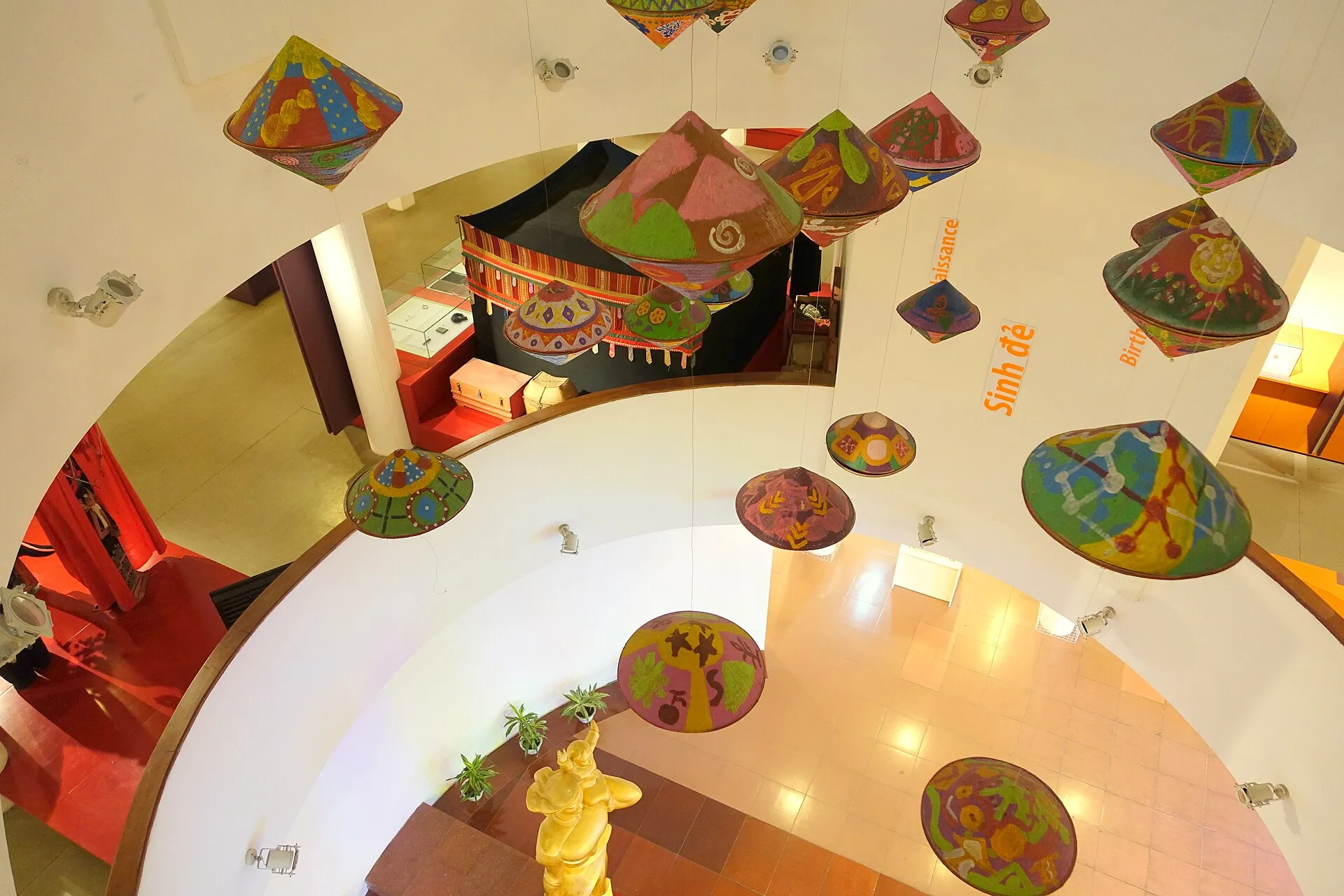
Traditional ethnic minority textiles on display at the Vietnamese Women’s Museum. Photo: Daderot, Wikimedia Commons, CC0.
Ethnic textile craftsmanship
Displays detail the time-intensive methods used by mountain craftswomen:
- Batik wax-resist printing: Red Dao and Hmong women applying molten beeswax with copper pens onto handspun hemp cloth.
- Natural indigo dyeing: Timber vats fermenting indigo leaves (cham) to achieve deep midnight-blue tones.
- Ikat weaving and brocade: Complicated backstrap and frame looms weaving geometric diamond and animal patterns that indicate tribal status.
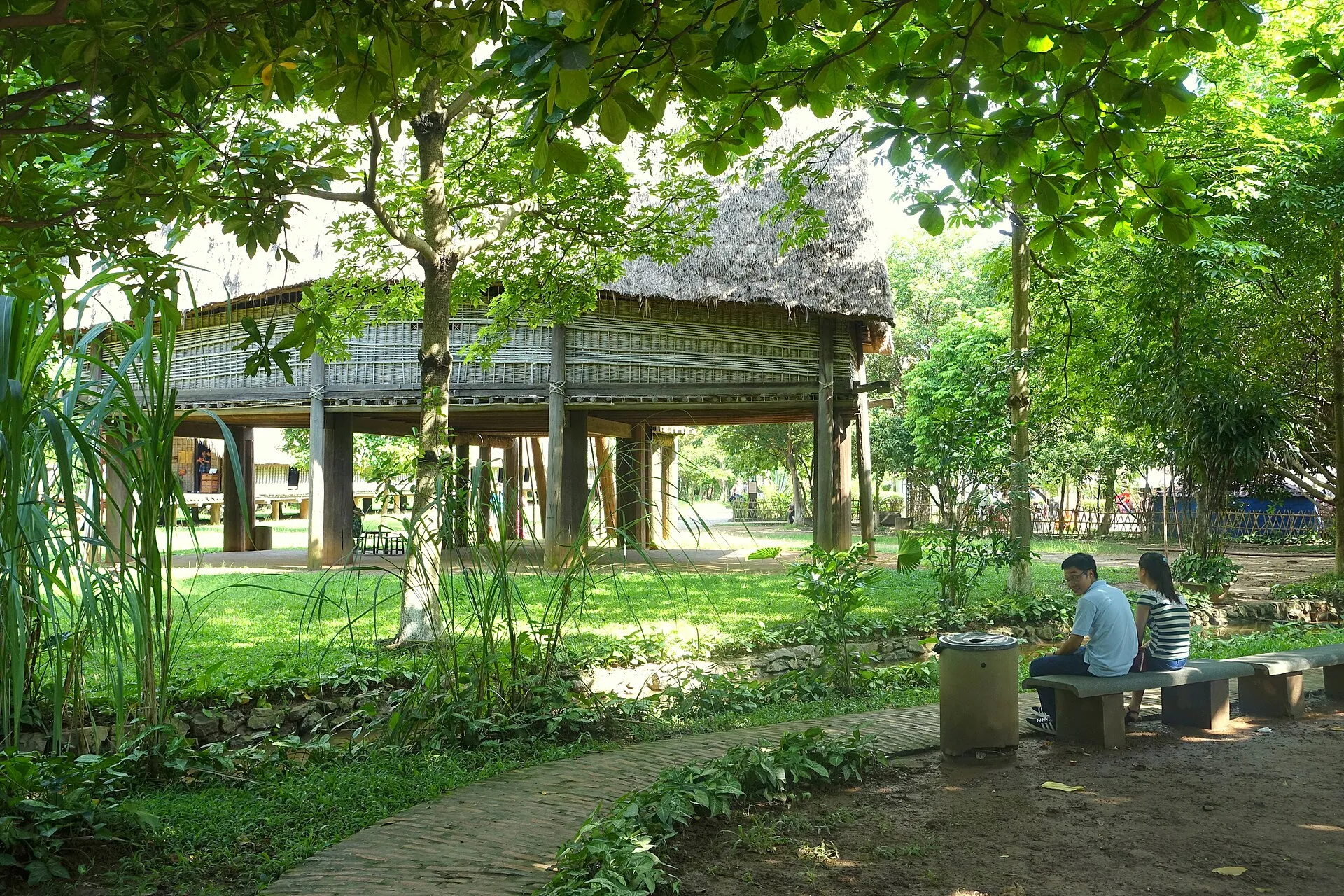
- Complement this collection with the architectural displays at the Vietnam Museum of Ethnology.
The evolution of the Ao Dai
The exhibition charts the transformation of the Vietnamese two-piece tunic from the four-panel tunic (ao tu than) worn by peasant women to the five-panel court gowns of the Nguyen dynasty, the 1930s French-influenced Lemur reforms, and contemporary couture designs seen at modern international fashion runways.
Combining your visit with surrounding attractions
Thanks to its position in the French Quarter, the Vietnamese Women’s Museum pairs smoothly with surrounding historical and architectural landmarks:
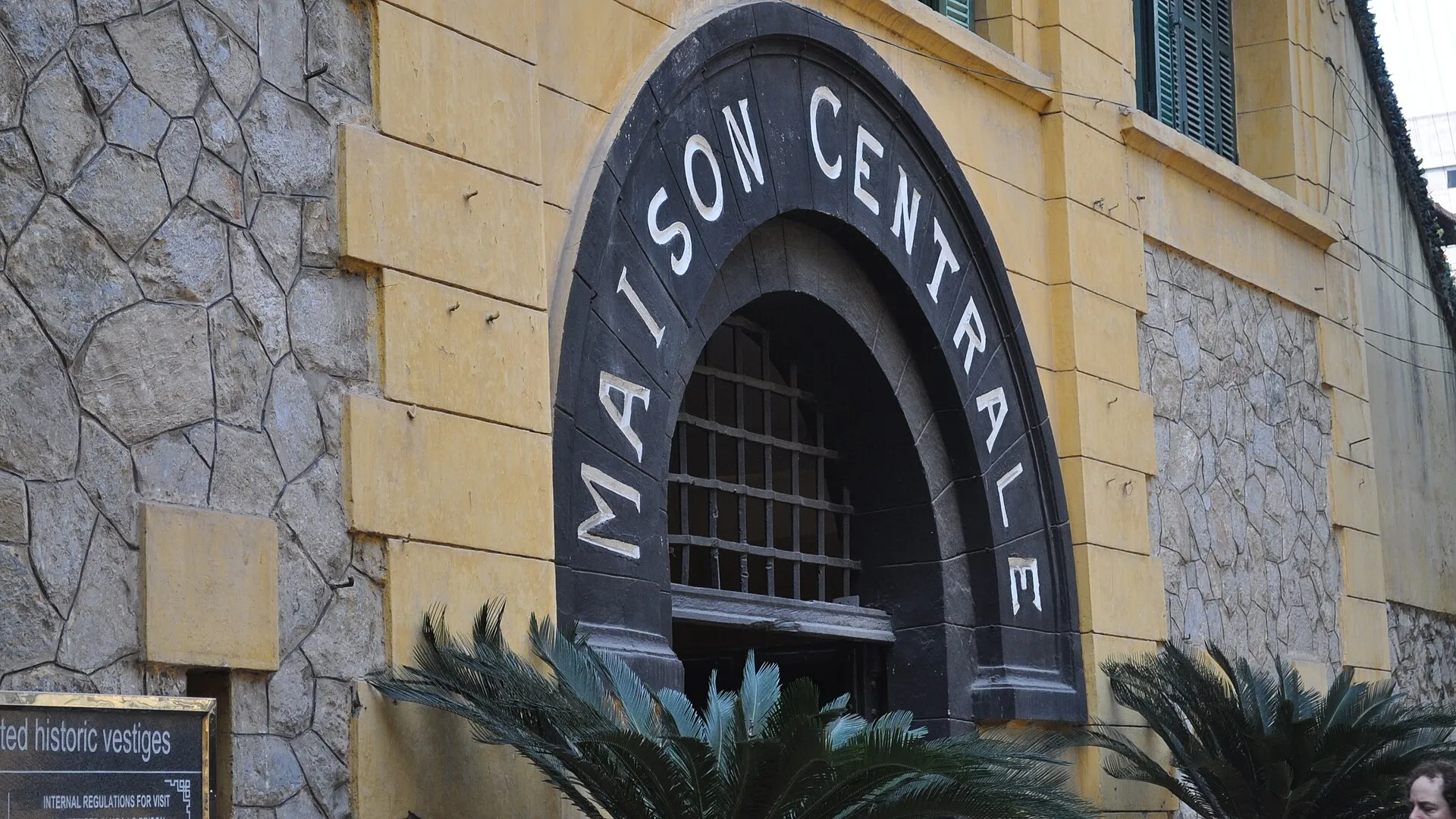
- Hoa Lo Prison Memorial: Walk 500 metres west along Ly Thuong Kiet to reach the preserved remains of Hoa Lo Prison, where anti-colonial revolutionaries and American prisoners of war were held.
- Hanoi Opera House: Stroll east along Ly Thuong Kiet toward August Revolution Square to admire the neoclassical Hanoi Opera House and French Quarter boulevards.
- St. Joseph’s Cathedral: Head north towards the Old Quarter along Nha Chung to explore St. Joseph’s Cathedral and sample lemon iced tea on low plastic stools.
- Culinary stops: The surrounding streets house excellent local eateries serving noodle dishes and coffee; consult our comprehensive guides to where to eat in Hanoi and the city’s unique egg coffee and cafe culture.
- For a complete itinerary overview, review our master list of things to do in Hanoi.
Common questions
How much is admission to the Vietnamese Women's Museum in Hanoi?
Standard adult admission costs 40,000 VND, bought at the counter or verified online at baotangphunu.org.vn. Students with valid identification pay 20,000 VND, while children under six enter free. Handheld audio guides are available in six languages for 50,000 VND.
What are the opening hours of the Vietnamese Women's Museum?
The museum is open daily from 08:00 to 17:00, including Mondays and weekends (baotangphunu.org.vn). Unlike many national museums in Hanoi, it does not close for lunch or on Mondays.
Where is the Vietnamese Women's Museum located?
It is located at 36 Ly Thuong Kiet Street in the French Quarter, approximately 500 metres south of Hoan Kiem Lake and a six-minute walk from Hoa Lo Prison Memorial.
What can visitors see inside the museum?
The museum is arranged over four thematic floors covering Women in Family (marriage customs, birth rituals, and street commerce), Women in History (anti-colonial resistance, wartime logistics, and guerrilla warfare), and Women's Fashion (ethnic brocades, silver ornaments, and the evolution of the ao dai).
How long should I plan for a visit to the Vietnamese Women's Museum?
Most visitors spend between 90 minutes and two hours. If you use the audio guide to listen to the recorded first-person accounts of wartime heroines and artisans, allow two to two and a half hours.