One of 2 self-guided walks in Hanoi. See every walk.
In this guide
The Short Version: This 3.5-kilometre historical walking tour takes 3 to 3.5 hours, showcasing Hanoi’s grand French-colonial neoclassical architecture, revolutionary monuments, and ancient scholarly foundations. Start at the 1911 Hanoi Opera House, pass the storied whitewashed wings of the Sofitel Legend Metropole Hanoi, examine bronze drums at the National Museum of Vietnamese History (40,000 VND), confront sombre history at Hoa Lo Prison Relic (50,000 VND), traverse the manicured lawns of Ba Dinh Square and Ho Chi Minh Mausoleum (free exterior), visit the lotus-shaped One Pillar Pagoda (free), and conclude within the quiet walled courtyards of the Temple of Literature (70,000 VND). To continue through the ancient merchant lanes of the north, connect directly to our Old Quarter and Hoan Kiem walking tour. Or book a tour: For a curated exploration of the colonial mansions and war-era landmarks with an expert guide, book the Hanoi French Quarter: Walking Tourad (VND 253,800) or the Hanoi City Highlights Walking Tourad (VND 699,800).
The route
Map of the walk numbered stops in walking order
Open the whole route in Google Maps — all seven stops in walking order on your phone.
In the late 19th and early 20th centuries, French colonial town planners transformed Hanoi by laying out broad, tree-lined boulevards, neoclassical administrative ministries, and expansive residential villas south and west of Hoan Kiem Lake. This self-guided itinerary explores this architectural legacy before crossing westward into Ba Dinh, the political nerve centre of modern Vietnam, and finishing at Vietnam’s oldest imperial academy.
| Stop | Entry | Operating hours | Highlights & walking directions |
|---|---|---|---|
| 1. Hanoi Opera House | Free exterior | Exterior 24 hours | 1911 Palais Garnier-inspired neoclassical landmark presiding over August Revolution Square |
| 2. Sofitel Legend Metropole Hanoi | Free entry | Daily 24 hours | Storied 1901 colonial luxury hotel where Charlie Chaplin stayed, featuring a preserved wartime bunker |
| 3. National Museum of Vietnamese History | 40,000 VND | Daily 08:00–12:00, 13:30–17:00 (closed 1st Mon) | 1932 Indochina-style building showcasing ancient Dong Son bronze drums and dynastic antiquities |
| 4. Hoa Lo Prison Relic (Maison Centrale) | 50,000 VND | Daily 08:00 to 17:00 | Preserved colonial penitentiary documenting political resistance and American POW history |
| 5. Ba Dinh Square & Ho Chi Minh Mausoleum | Free | Square 24h; Mausoleum mornings (Tue–Thu, Sat–Sun) | Monumental grey granite tomb and ceremonial grass parade ground where independence was declared |
| 6. One Pillar Pagoda (Chua Mot Cot) | Free | Daily 07:00 to 18:00 | 1049 Buddhist shrine shaped like a blooming lotus blossom balanced on a single stone column |
| 7. Temple of Literature (Van Mieu - Quoc Tu Giam) | 70,000 VND | Daily 08:00 to 17:00 | 1070 Confucian temple and site of Vietnam’s first national university with 82 stone doctor stelae |
1. Hanoi Opera House
Free exterior (performances ticketed separately) · August Revolution Square, 1 Trang Tien, Hoan Kiem
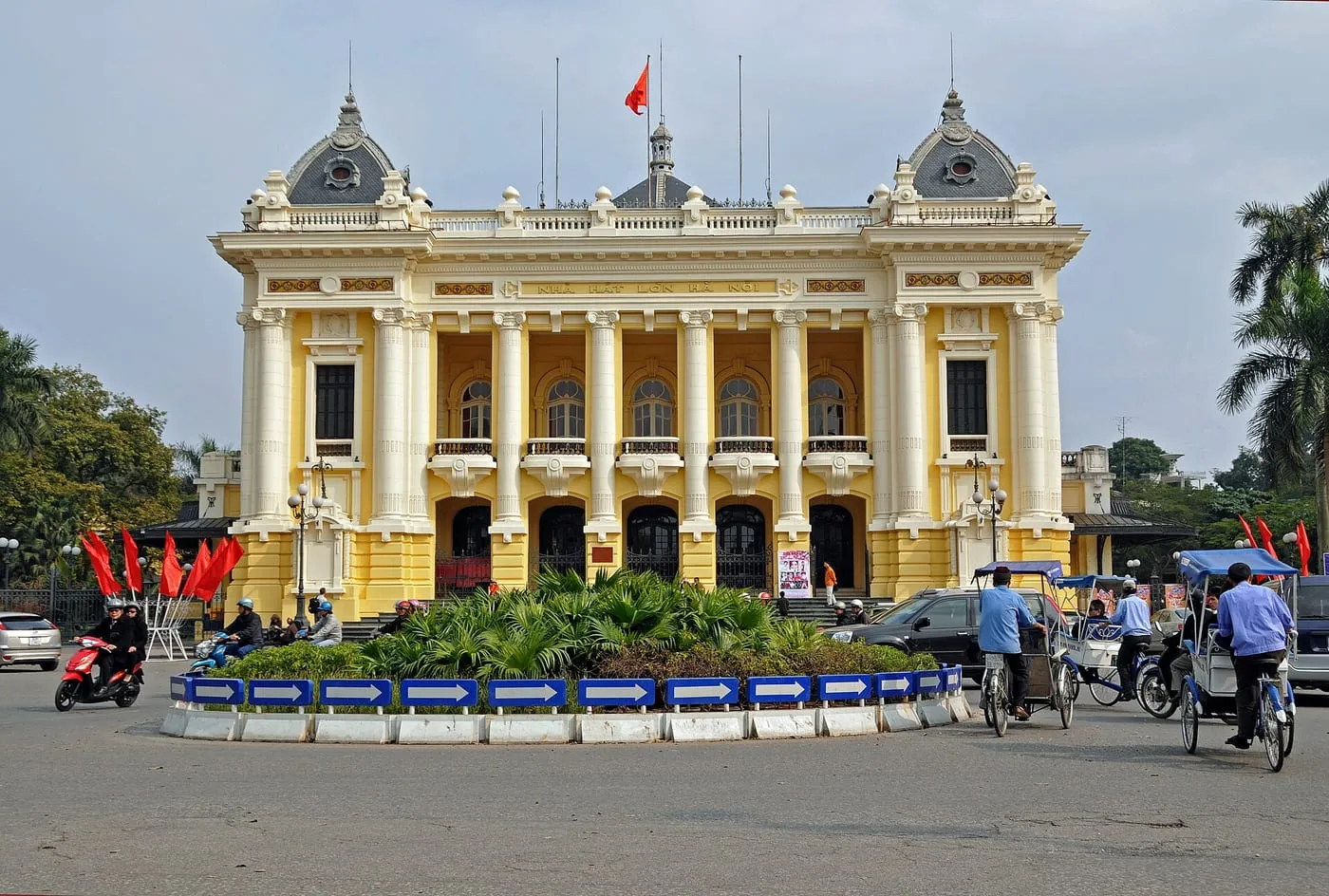
Commence your route at August Revolution Square (Quang Truong Cach Mang Thang Tam), presided over by the imposing Hanoi Opera House (Nha Hat Lon Ha Noi). Commissioned by the French colonial administration and completed in 1911 under architects Broyer and Harley, the building was modelled after the Palais Garnier in Paris.
The exterior exhibits classic French neoclassical elements: Corinthian columns, mansard slate roofs, wrought-iron balconies, and rich yellow-and-white stucco ornamentation. On 19 August 1945, the square in front of the Opera House was the gathering point for a mass demonstration organised by the Viet Minh, launching the August Revolution that brought independence to northern Vietnam.
While the auditorium interior is accessible primarily by attending an evening ballet, classical concert, or contemporary Vietnamese performance, the exterior terrace and staircase offer photography angles across the radiating boulevards. Detailed architecture and ticketing information can be found in our Hanoi Opera House and French Quarter guide.
- Walking to Stop 2: From the Opera House steps, walk 150 metres north-west along Ly Thai To street. The white colonial wings and green wooden shutters of the Metropole hotel appear on your right across the intersection with Le Phung Hieu.
2. Sofitel Legend Metropole Hanoi
Free to explore lobby and public gardens · 15 Ngo Quyen, Hoan Kiem
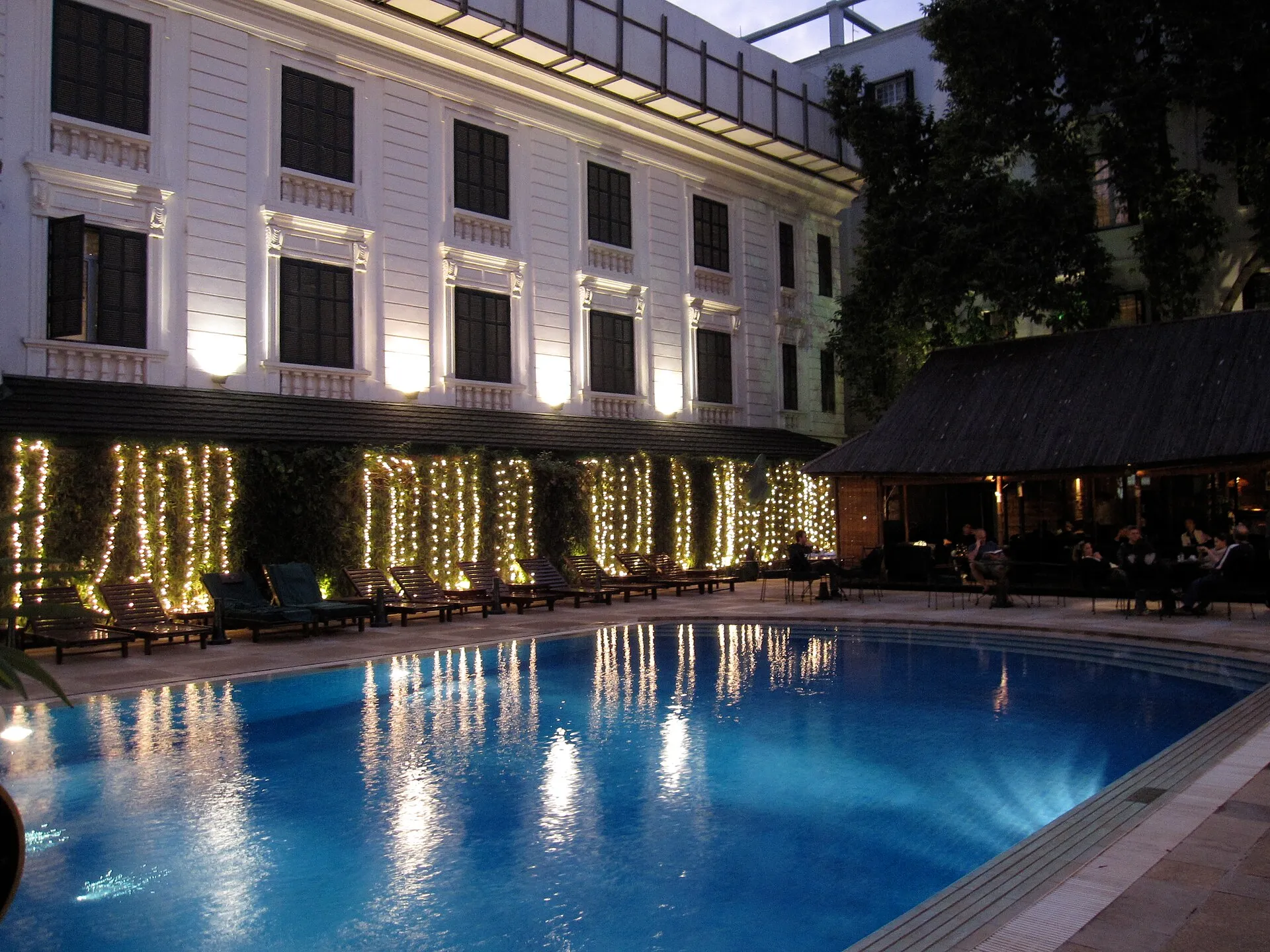
The courtyard and colonial wing of the Sofitel Legend Metropole at night. Photo: Gryffindor, Wikimedia Commons, CC BY-SA 3.0.
Opened in 1901 as the Grand Hôtel Métropole, the Sofitel Legend Metropole Hanoi is northern Vietnam’s most famous historic hotel. The property preserves two distinct architectural wings: the original colonial Metropole Wing featuring wrought-iron balconies, polished hardwood corridors, and louvered green shutters, and the contemporary Opera Wing across the central courtyard.
The hotel has hosted a distinguished list of international guests over more than a century, including Charlie Chaplin and Paulette Goddard (who honeymooned here in 1936), novelists Graham Greene and Somerset Maugham, and folk singer Joan Baez. In 2011, hotel engineers renovating the poolside Bamboo Bar rediscovered a long-sealed underground concrete bomb shelter where guests and foreign correspondents sheltered during the American air raids of 1972.
Step into the lobby to admire the vintage archival photographs and historical displays, or pause for a coffee at La Terrasse, a Parisian-style pavement cafe fronting Ngo Quyen street. For further hotel heritage insights, see our hotels in the Old Quarter and French Quarter guide.
- Walking to Stop 3: Return south along Ngo Quyen, turn left onto Trang Tien street, and walk 300 metres east past the Opera House roundabout along Pham Ngu Lao. Turn right onto Tran Quang Khai. The museum entrance sits at 1 Pham Ngu Lao.
3. National Museum of Vietnamese History
40,000 VND · daily 08:00–12:00, 13:30–17:00 (closed first Monday of every month) · 1 Pham Ngu Lao, Hoan Kiem
Housed in one of the most celebrated buildings in Southeast Asia, the National Museum of Vietnamese History (Bao Tang Lich Su Quoc Gia) was designed by French architect Ernest Hébrard and completed in 1932 as the École Française d’Extrême-Orient. Hébrard was the pioneer of the “Indochine” architectural style, intentionally blending French neoclassical structural frames with traditional Vietnamese elements: double-layered ventilation roofs, octagonal Chinese-style pagodas, overhanging eaves, and decorative louvres designed to naturally cool the interior without air conditioning.
The museum guides visitors through thousands of years of Vietnamese archaeology and history:
-
Dong Son Culture: Ancient bronze ceremonial drums dating from the 3rd to 1st centuries BCE, intricately cast with depictions of warriors, flying birds, and deer.
-
Imperial Dynasties: Sculpted sandstone deities from the Champa kingdom, gilded wooden Buddha statues from the Ly and Tran dynasties, and blue-and-white porcelain recovered from ancient maritime shipwrecks in the East Sea.
-
Walking to Stop 4: Head west on Pham Ngu Lao back to the Opera House, proceed straight along Trang Tien for 400 metres, cross the southern tip of Hoan Kiem Lake, and continue west on Trang Thi for 350 metres. Turn left onto Quan Su street, walk 200 metres, then turn right onto Hoa Lo. The formidable stone walls of Hoa Lo Prison will appear on your left.
4. Hoa Lo Prison Relic (Maison Centrale)
50,000 VND · daily 08:00 to 17:00 · 1 Hoa Lo, Tran Hung Dao, Hoan Kiem
Constructed by French colonial authorities between 1886 and 1901, Hoa Lo Prison was originally named Maison Centrale (Central House of Arrest), though the Vietnamese referred to it as Hoa Lo (“furnace” or “stove”, after the earthenware pottery shops previously on the street).
Occupying an entire city block at its peak, the fortress held thousands of Vietnamese political prisoners, trade unionists, and anti-colonial revolutionaries in harrowing conditions designed to crush dissent. During the Vietnam War, the facility was repurposed by the North Vietnamese government to hold captured American aviators, who nicknamed it the “Hanoi Hilton”.
Visitors navigate through preserved punishment blocks:
- Cachot (Solitary Confinement): Cramped, lightless damp cells where prisoners were confined with their legs locked into heavy iron ankle shackles (cum).
- The Guillotine Room: Preserving the original French guillotine used to execute condemned Vietnamese revolutionary leaders.
- Underground Sewer Tunnels: Tracing the daring escape of more than 100 political prisoners who sawed through iron sewer grates and crawled through waste channels to rejoin the resistance in 1945 and 1951.
- American POW wing: Housing flight suits, helmets, and personal items belonging to captured US pilots, including the flight uniform of naval aviator John McCain.
Consult our detailed visitor walkthrough in the Hoa Lo Prison memorial guide.
- Walking to Stop 5: From Hoa Lo, head west along Hai Ba Trung for 200 metres, turn right onto Le Duan, and walk north for 400 metres until reaching the major intersection at Tran Phu. Turn left onto Tran Phu and continue westward for 900 metres, passing the leafy embassies of the diplomatic quarter until the wide expanses of Ba Dinh Square open on your right. (Alternatively, take a 5-minute Grab ride for roughly 30,000 VND).
5. Ba Dinh Square & Ho Chi Minh Mausoleum
Free · grounds open daily; mausoleum mornings only (Tue–Thu, Sat–Sun, 08:00–11:00 in winter (11:30 at weekends), 07:30–10:30 in summer; closed Mon and Fri) · Hung Vuong Street, Ba Dinh
Ba Dinh Square (Quang Truong Ba Dinh) is the political and symbolic heart of modern Vietnam. It was on this expansive grass parade ground—measuring 320 metres long and divided into 240 neat green turf squares—that President Ho Chi Minh read Vietnam’s Declaration of Independence on 2 September 1945, establishing the Democratic Republic of Vietnam.
Dominating the western side of the square is the monumental Ho Chi Minh Mausoleum (Lang Chu Tich Ho Chi Minh). Inaugurated in 1975, the imposing 21.6-metre structure was constructed using grey granite brought from Da Nang and marble from across the nation, echoing the geometric design of Lenin’s Mausoleum in Moscow combined with traditional Vietnamese pavilion roofs.
If visiting during morning opening hours, foreign visitors may join the solemn single-file procession to view President Ho Chi Minh’s embalmed body resting in an illuminated glass sarcophagus in the central burial chamber.
-
Etiquette: Strict decorum is enforced by military honour sentries. Visitors must dress modestly with shoulders and knees covered, remove hats and sunglasses, keep hands out of pockets, maintain absolute silence, and refrain from taking photographs inside the vault.
-
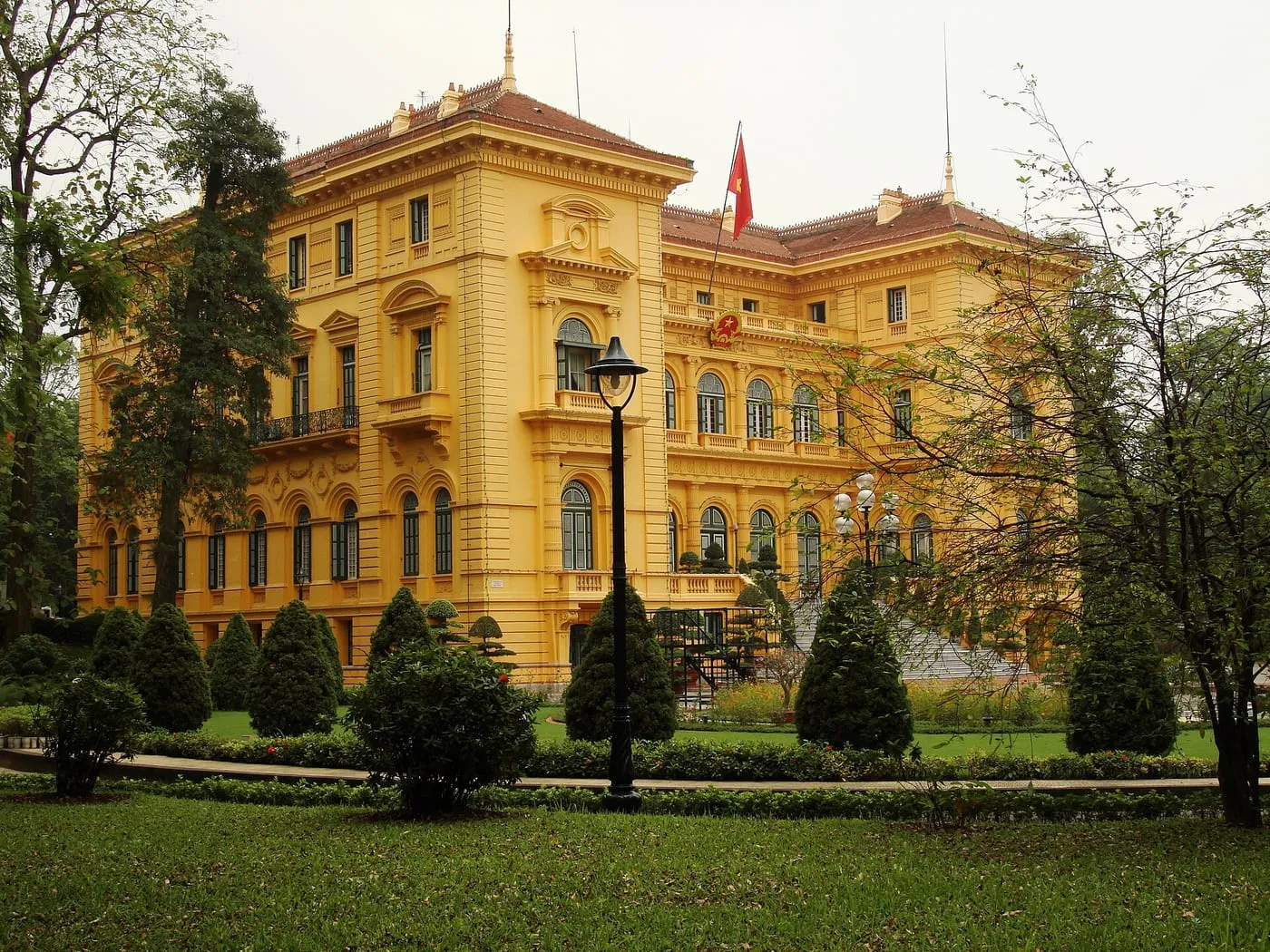
Surrounding grounds: Directly behind the mausoleum lie the lush presidential botanical gardens, the brilliant yellow Presidential Palace (built in 1906 for the French Governor-General of Indochina), and Ho Chi Minh’s humble teak-wood Stilt House (Nha San), where he chose to live and work from 1958 until his death in 1969. Detailed opening days and rules are explained in our Ho Chi Minh Mausoleum and Ba Dinh complex guide.
-
Walking to Stop 6: From the rear gardens of the Ho Chi Minh Presidential Complex, follow the paved pedestrian path leading toward the Ho Chi Minh Museum. The One Pillar Pagoda sits immediately between the stilt house exit and the museum entrance.
6. One Pillar Pagoda (Chua Mot Cot)
Free · daily 07:00 to 18:00 · Ong Ich Khiem Street, Ba Dinh
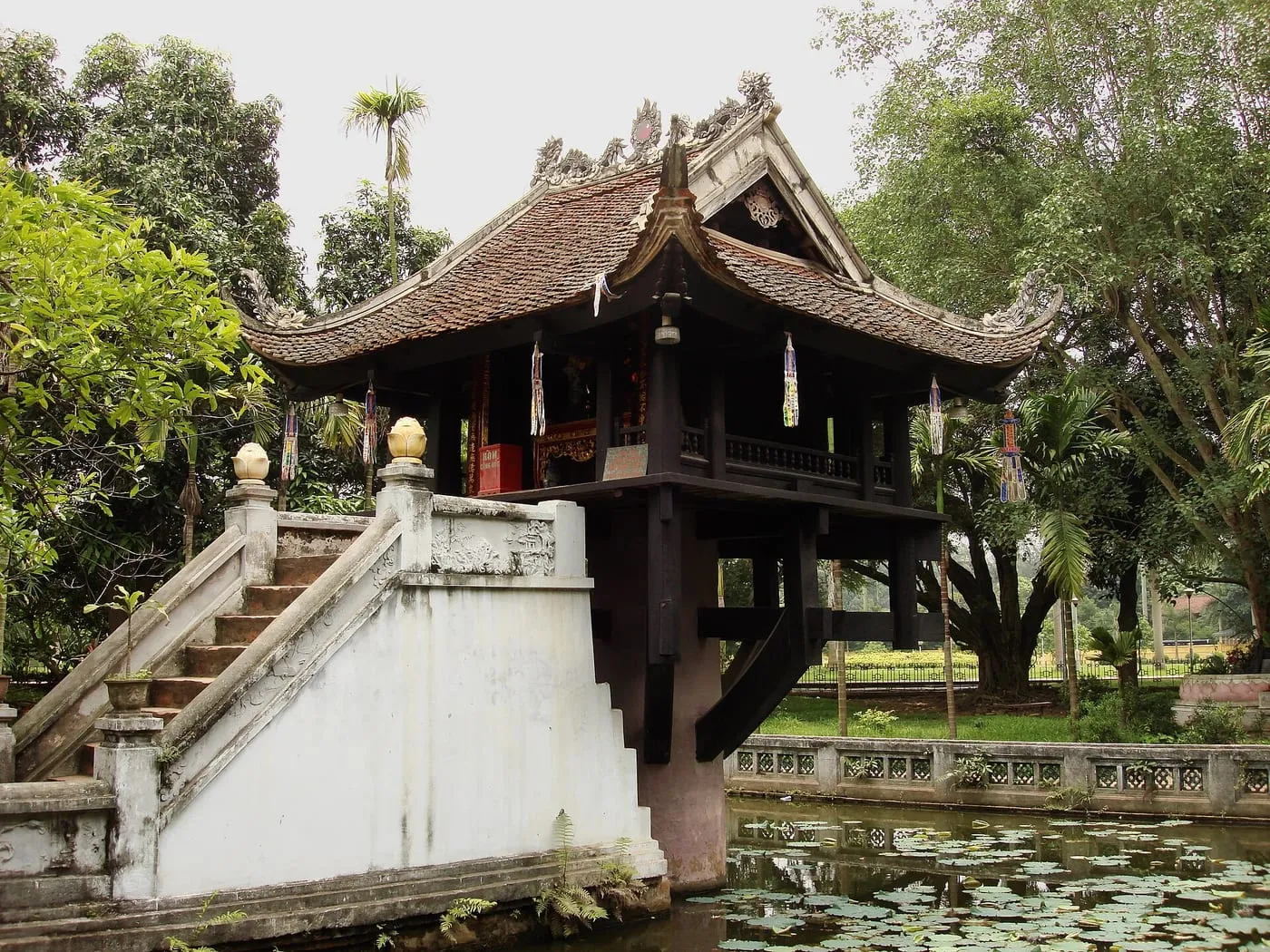
The wooden shrine of the One Pillar Pagoda above its lotus pond. Photo: Jorge Láscar from Australia, Wikimedia Commons, CC BY 2.0. Standing in a tranquil square lotus pond, the One Pillar Pagoda (Chua Mot Cot, formally Dien Huu Tu) is a national landmark.
In the royal annals, King Ly Thai To (who ruled from 1028 to 1054) was childless and dreamed that the Bodhisattva Avalokiteshvara (Quan Am) appeared seated on a blooming lotus blossom, handing him a male infant. Shortly thereafter, the king married a peasant girl who bore him a son. To express his gratitude, the emperor ordered the construction of a pagoda in 1049 designed like an open lotus blossom emerging from the water—the Buddhist symbol of purity rising from worldly mud.
The tiny timber shrine rests atop a single circular stone pillar measuring 1.25 metres in diameter. While French colonial troops blew up the original structure before withdrawing from Hanoi in 1954, it was rebuilt with meticulous historical accuracy in 1955. Visitors climb a short flight of stone steps to light incense before the gilded statue of Quan Am.
- Walking to Stop 7: From the One Pillar Pagoda, walk south along Ong Ich Khiem for 150 metres to Le Hong Phong street. Turn left onto Le Hong Phong, walk 200 metres, then turn right onto Chu Van An. Continue south along Chu Van An for 350 metres until it intersects with Nguyen Thai Hoc. Cross Nguyen Thai Hoc and proceed 150 metres south along Van Mieu street until the ancient entrance gate of the Temple of Literature appears on your right.
A French colonial yellow-stucco villa in the Ba Dinh quarter. Photo: Maryam Laura Moazedi, www.moazedi.org, Wikimedia Commons, CC BY-SA 3.0.
7. Temple of Literature (Van Mieu - Quoc Tu Giam)
70,000 VND · daily 08:00 to 17:00 · 58 Quoc Tu Giam, Dong Da
Conclude your historic walking route at the Temple of Literature (Van Mieu), northern Vietnam’s Confucian temple and the site of its first national university and the cradle of its intellectual history. Founded in 1070 by King Ly Thanh Tong, the complex was expanded in 1076 to establish the Quoc Tu Giam (Imperial Academy), recognised as Vietnam’s first national university, which educated mandarins, princes, and scholars for over 700 years.
The walled complex is divided into five serene, sequential courtyards:
- The First & Second Courtyards: Landscaped gardens shaded by ancient banyans and frangipani trees, featuring the two-storey red timber Khue Van Pavilion (Constellation of Literature Pavilion), built in 1805.
- The Third Courtyard: Centred on the square Well of Heavenly Clarity (Thien Quang Tinh), bordered on both sides by 82 monumental stone tortoises bearing inscribed doctoral stelae (Bia Tien Si). Carved between 1442 and 1779, these stelae record the names, birthplaces, and royal test scores of 1,307 doctoral graduates who passed the rigorous triennial imperial examinations.
- The Fourth Courtyard: The Great House of Ceremonies (Dai Bai Duong), home to grand incense altars and statues honouring Confucius and his four primary disciples.
- The Fifth Courtyard: The rebuilt grounds of the Imperial Academy (Thai Hoc), exhibiting ancient royal school bells, bronze drums, and portraits of historic headmasters such as Chu Van An.
For complete visitor details, photography guidelines, and ticket prices, read our comprehensive Temple of Literature guide.
Guided architectural and historic tours
Navigating between the French Quarter, Ba Dinh, and Dong Da with an architectural specialist offers deep insights into colonial urban planning and Vietnamese revolutionary history:
Hanoi French Quarter: Walking Tour
From VND 253,800 · 4.8 stars from 25 reviews · 2.5 hours · Heritage walk
Book the Hanoi French Quarter: Walking Tourad for a structured walking exploration covering the Opera House, the Metropole, Trang Tien boulevard, and French neoclassical administrative palaces.
Hanoi City Highlights Walking Tour – Landmarks & History
From VND 699,800 · 5.0 stars from 206 reviews · 4.5 - 5 hours · Small group
Book the Hanoi City Highlights Walking Tourad to connect the French Quarter, Ba Dinh, and the Old Quarter into a seamless guided half-day experience with museum entry tickets and street food included.
Hanoi: French Quarter Walking Tour
From VND 1,328,000 · 4.7 stars from 12 reviews · 3.5 hours · In-depth tour
Book the Hanoi French Quarter Walking Tourad for a detailed architectural examination of Indochinese and Art Deco villas, complete with historical commentary from a local scholar.
Where to head next
- Refreshment: Walk 5 minutes north of the Temple of Literature to Pho Cuong on Hang Muoi or relax in the open garden cafes along Nguyen Thai Hoc.
- Old Quarter return: Catch a 10-minute Grab car (around 35,000 VND) back to Hoan Kiem Lake, or stroll through the artisan shopping streets outlined in our Old Quarter and Hoan Kiem walking tour.
- Evening plans: Enjoy a bowl of fragrant noodle soup using our guide to the best pho and bun cha in Hanoi or discover top dining enclaves in where to eat in Hanoi.
Common questions
How long does the French Quarter and Ba Dinh walk take?
The walking distance is approximately 3.5 kilometres. Walking comfortably with museum visits, monument photography, and courtyard exploration takes between 3 and 3.5 hours.
What are the total entry fees along this walking route?
Core paid admissions total 160,000 VND per person: 40,000 VND for the National Museum of Vietnamese History, 50,000 VND for Hoa Lo Prison Relic, and 70,000 VND for the Temple of Literature. The Opera House, Metropole exterior, and Ba Dinh Square are free.
Can you visit the Ho Chi Minh Mausoleum during this walk?
The mausoleum interior is open only in the morning, Tuesday to Thursday, Saturday and Sunday: 08:00 to 11:00 from 1 November to 31 March (to 11:30 on Saturdays, Sundays and public holidays) and 07:30 to 10:30 from 1 April to 31 October. It is closed on Mondays and Fridays. If you walk in the afternoon, you can still see the granite facade, Ba Dinh Square and the One Pillar Pagoda from the public grounds.
Where does the route start and end?
The walk begins at August Revolution Square in front of the Hanoi Opera House in the French Quarter and concludes at the historic courtyards of the Temple of Literature in Dong Da district.