In this guide
💡 The Short Version: Hoa Lo Prison Memorial—historically named Maison Centrale by French colonial administrators and dubbed the “Hanoi Hilton” by American prisoners of war—is a wartime museum on Hoa Lo Street. Standard daytime admission is 50,000 VND, purchased directly at the ticket kiosk on Hoa Lo Street or verified at hoalo.vn, open daily from 08:00 to 17:00. The museum is divided into two distinct historical chapters: the harsh colonial detention of Vietnamese political revolutionaries (featuring stone communal sleeping benches with leg irons, solitary confinement dungeons, and an original guillotine) and the detention of downed American pilots during the Vietnam War, including flight suits and items belonging to Lieutenant Commander John McCain. Or book a tour: when you want an expert historian to decode the colonial prison blocks and American POW history, the Hoa Lo Prison and Little Paris walking tourad (from VND 1,161,100, 5 stars from 124 reviews) pairs the prison with French Quarter architecture.
History of Maison Centrale and the Hanoi Hilton
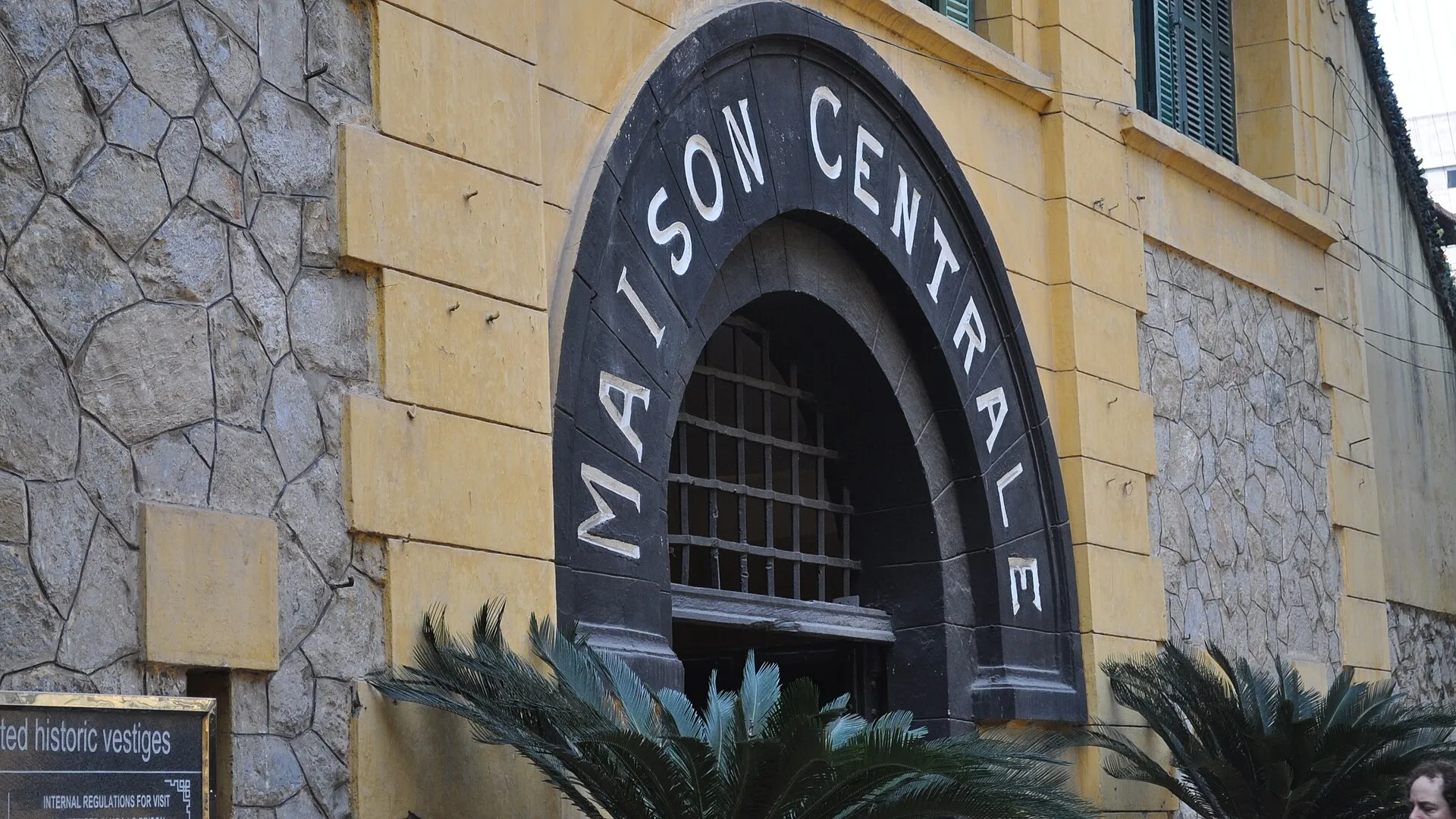
Constructed by the French colonial government between 1886 and 1896 on the site of the historic pottery-making village of Phu Khanh (Hoa Lo translates literally as “Earthen Stove” or “Furnace”), the prison was officially named Maison Centrale (“Central House of Detention”).
- Colonial repression: Designed to hold approximately 450 inmates, the facility routinely held more than 2,000 prisoners in squalid, overcrowded conditions during peak anti-colonial uprisings in the 1930s, 1940s, and 1950s. Hundreds of leading Vietnamese nationalist and communist figures were imprisoned, tortured, or executed here; many who survived later served as senior leaders of the independent Vietnamese state.
- The “Hanoi Hilton” era: Between 1964 and 1973, the facility served as the primary detention camp for captured American military aviators. Inmates included future US Senator and presidential candidate John McCain, whose naval A-4 Skyhawk aircraft was shot down over Hanoi’s Truc Bach Lake in October 1967, and James Stockdale, the highest-ranking naval officer held in the prison.
- The modern museum: Following the demolition of the outer walls in 1993, the preserved gatehouse and internal punishment wings opened as a national historical relic, offering contrasting perspectives on colonial anti-imperialist struggles and wartime aviation history. Official archive records and memorial events are documented on hoalo.vn.
Ticket prices and opening hours
The table below outlines ticketing prices, visiting schedules, and tour options:
| Experience | Price (VND) | Opening hours | Booking & practical details |
|---|---|---|---|
| Daytime admission | 50,000 VND | Daily 08:00 to 17:00 | Buy at the front ticket window (hoalo.vn); children under 16 free |
| Audio guide rental | 50,000 VND | Daily 08:00 to 16:00 | Available in English, French, Vietnamese, Japanese; handheld receiver |
| Sacred Night tour | 399,000 VND | Friday, Saturday & Sunday, 19:00 to 20:30 | Theatrical night tour; advance booking required on hoalo.vn |
Daytime admission
- Ticketing process: The ticket office is located on the pavement to the left of the yellow entrance archway on Hoa Lo Street. Queues are generally modest and move swiftly. Official rates and concessions are detailed at hoalo.vn.
- Duration of visit: Allow between 60 and 90 minutes to explore the indoor galleries, outdoor courtyard memorials, and punishment cells.
- Audio guide: Available at the counter for 50,000 VND, offering recorded testimonies from former prisoners and detailed historical accounts of escapes and trials.
The communal cell block with iron leg stocks inside Hoa Lo Prison. Photo: David McKelvey from Brisbane, Australia, Wikimedia Commons, CC BY 2.0.
Tours and guided historical visits
Independent daytime entry is 50,000 VND at the gate. A guided tour connects the prison’s dark history with the surrounding French Quarter institutions and the Temple of Literature.
Hoa Lo Prison and Little Paris walking tour
From VND 1,161,100 · 5 stars from 124 reviews · 3 to 3.5 hours · French Quarter and prison history
Hoa Lo Prison and Little Paris in Hanoiad: pairs an in-depth guided exploration of Hoa Lo Prison with a walking tour of the French Quarter, contrasting French colonial civic grandeur with the harsh reality of Maison Centrale.
Women’s Museum and Hoa Lo Prison walking tour
From VND 500,000 · 4.8 stars from 17 reviews · 4 hours · combined museum access
Hanoi: Women’s Museum and Hoa Lo Prison Walking Tourad: pairs the female revolutionaries detained at Hoa Lo with the broader social and wartime history at the Vietnamese Women’s Museum, with admissions and guided narration included.
Temple of Literature and Hoa Lo Prison tour
From VND 570,000 · 4.9 stars from 5 reviews · 3 hours · two headline landmarks
Hanoi: Temple of Literature & Hoa Lo Prison Half-Day Tourad: combines the Confucian scholarship of the Temple of Literature with the wartime memorial at Hoa Lo Prison, including hotel pickup and expert commentary.
Official ticket or tour: the prices side by side
Independent entry versus guided historical tours.
| Option | Official admission | Tour cost | What it covers |
|---|---|---|---|
| Standard daytime ticket | 50,000 VND | — | Entry to all cell blocks, guillotine, and American POW wing (hoalo.vn) |
| Entry with audio guide | 100,000 VND | — | Ticket plus multi-language audio headset |
| Official Sacred Night tour | 399,000 VND | — | Theatrical evening experience with re-enactments (hoalo.vn) |
| Women’s Museum & Hoa Lo tour | Admissions included | From VND 500,000 | 4-hour guided walk covering both museums |
| Temple of Literature & Hoa Lo | Admissions included | From VND 570,000 | 3-hour guided visit covering both major sites |
| Hoa Lo & Little Paris tour | Admissions included | From VND 1,161,100 | 3.5-hour in-depth historical tour of prison and French Quarter |
Key exhibits and memorials
The museum layout leads visitors along a chronological pathway through the preserved French colonial prison buildings:
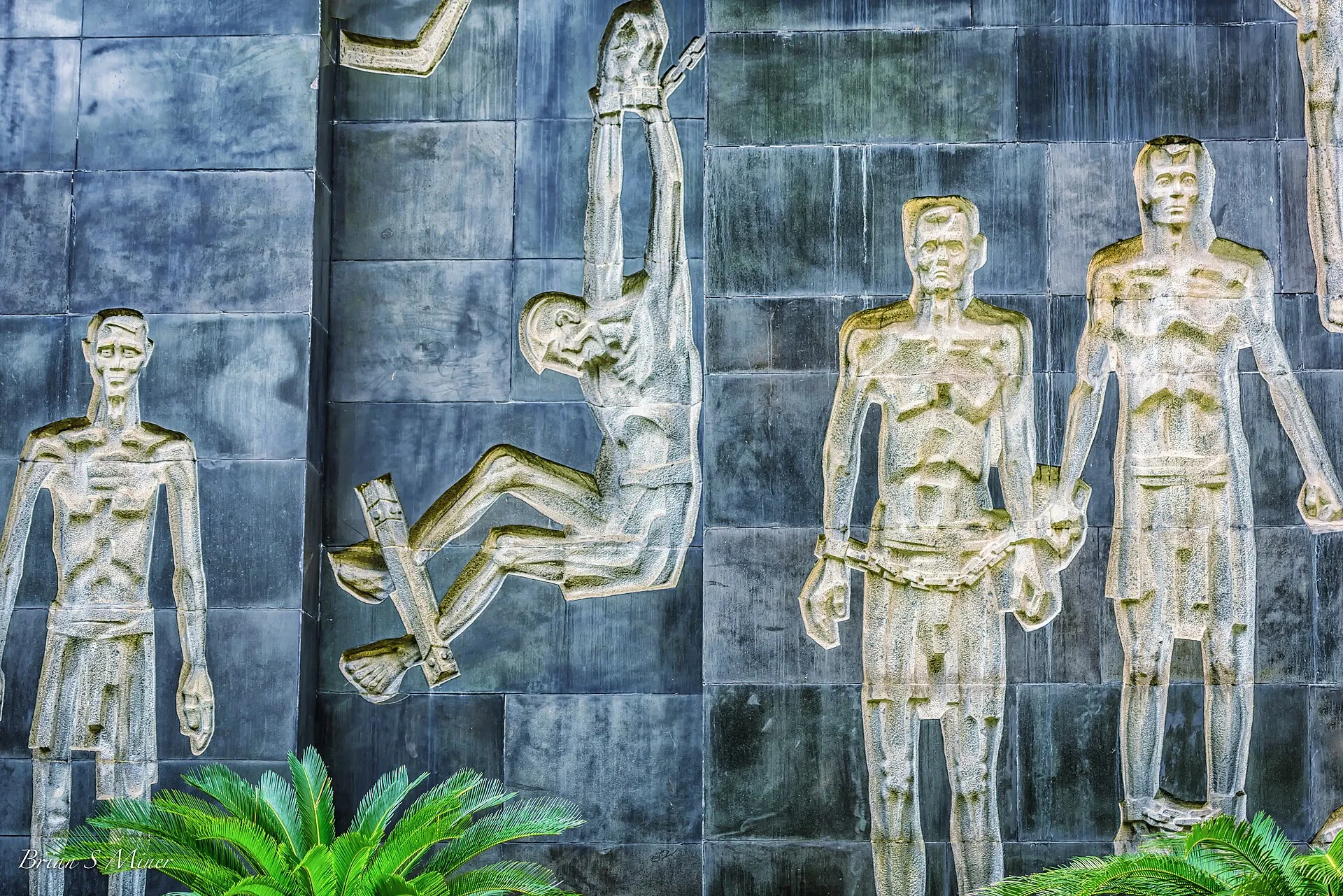
Prisoner relief, Hoa Lo Prison. Photo: cloud.shepherd, Wikimedia Commons, CC BY 2.0.
The Colonial Era: Collective Cells and Leg Irons
The tour begins inside the collective detention wards (Cachot) for male political prisoners:
- The stone sleeping platforms: Long, sloping concrete benches where dozens of prisoners were forced to lie shoulder-to-shoulder with their ankles locked into iron shackle bars bolted across the stone. Mannequins recreate the cramped, agonizing conditions endured by inmates for months on end.
- Sanitation and disease: The exhibits document the tropical heat, dampness, and severe lack of medical care, which led to widespread dysentery, malaria, and malnutrition.
- Female prisoners’ wing: Further along the corridor sits the women’s collective cell, detailing the detention of female revolutionaries, several of whom gave birth while confined inside the prison walls.
The Solitary Confinement Block (The Dungeons)
Stepping into the punishment wing reveals the narrow, claustrophobic cells known as Cachot:
- Conditions: Pitch-black, windowless isolation chambers with slanted concrete floors, designed so that wastewater flowed back beneath the prisoner. Inmates deemed rebellious were locked here in total darkness on reduced rations of rice and salt.
- The psychological toll: The exhibition highlights the mental fortitude required by political prisoners to maintain hope and discipline through isolation.
The Original French Guillotine
In a central gallery stands a grim artefact of colonial judicial power:
- The guillotine machine: A preserved wooden and steel execution frame, manufactured in France and transported to Indochina to execute Vietnamese independence fighters.
- Historical context: Displays document the executions of prominent revolutionaries, including leaders of the Yen Bai mutiny in 1930. Nearby cases exhibit the personal belongings, handwritten farewell letters, and photographs of condemned patriots.
The Underground Sewer Escape
One of the most remarkable stories depicted in the museum is the clandestine escape through the municipal drainage network:
- The August 1945 escape: As the Japanese occupation of Indochina collapsed at the end of World War II, political prisoners loosened the heavy iron grating covering a stormwater drainpipe in the prison courtyard. More than 100 revolutionary prisoners squeezed through the narrow, foul-smelling subterranean sewers beneath the city streets, emerging outside the walls to join the August Revolution.
- The 1951 escape: In December 1951, another group of 17 death-row prisoners made a daring Christmas night escape through the same drainage channels. A cutaway section of the brick drainpipe is illuminated for visitors to examine.
The American POW Wing
The final indoor wing presents the period from 1964 to 1973, when American aviators were detained following air raids over northern Vietnam:
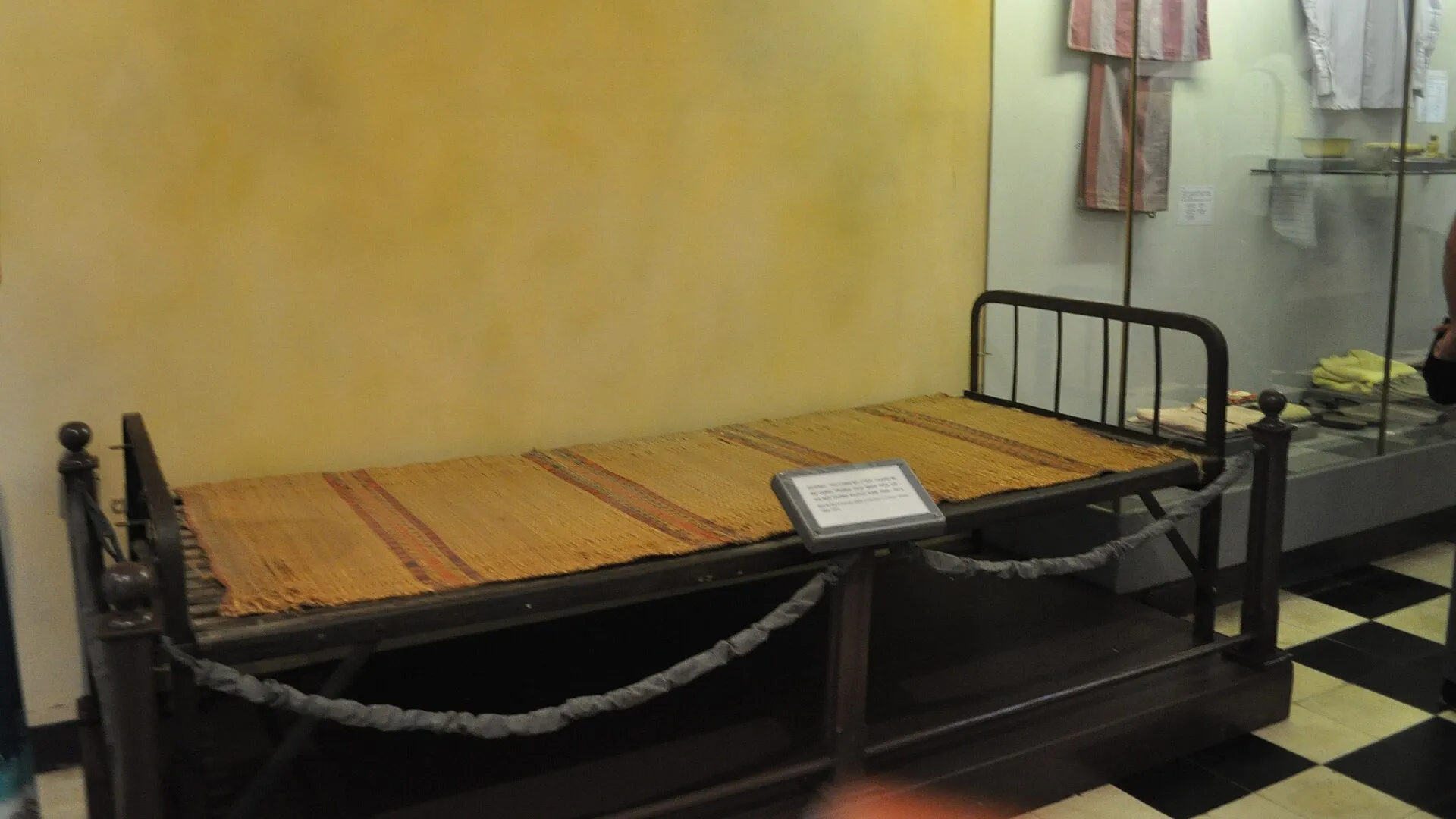
Prison bed on display, Hoa Lo Prison. Photo: David McKelvey from Brisbane, Australia, Wikimedia Commons, CC BY 2.0.
- John McCain’s flight suit and parachute: Displays include the original flight suit, boots, parachute harness, and helmet worn by Lieutenant Commander John McCain when his aircraft was struck by a surface-to-air missile over Hanoi in 1967. Photographs show his rescue from Truc Bach Lake by local villagers and subsequent medical treatment in a military hospital.
- Daily life displays: Glass cases contain personal items, chess sets carved from soap and wood, musical instruments, Christmas celebration photographs, and letters exchanged with families through the International Red Cross.
- Operation Homecoming: The exhibition concludes with photographs of the March 1973 release and repatriation of 591 American prisoners following the signing of the Paris Peace Accords, alongside documentation of post-war reconciliation between Vietnam and the United States.
The Memorial Garden and Banyan Tree
Exiting the cell corridors brings you into a somber outdoor courtyard centred around a towering almond tree (banyan tree):
- The lifeline of prisoners: Inmates secretly harvested the leaves, bark, and nuts of this tree to use as herbal remedies for stomach ailments and to carve into pen holders and chess pieces.
- The Memorial Wall: A black marble monument inscribed with the names of Vietnamese patriots who perished within the prison walls, where visitors can pause to place incense sticks and reflect.
Visitor etiquette and emotional context
Hoa Lo Prison is a somber place of national mourning and reflection:
- Attire: While casual streetwear is acceptable, visitors are requested to dress respectfully. Extremely short shorts, bare midriffs, and beachwear are discouraged (hoalo.vn).
- Behaviour: Speak softly, silence mobile ringtones, and do not use flash photography inside the dimly lit cellblocks.
- Children: Parents with young children should note that the realistic mannequins in leg irons, the guillotine display, and the dark dungeon corridors can be distressing for sensitive viewers.
Located in the French Quarter on the edge of the Old Quarter, Hoa Lo Prison can be easily combined with visits to the Temple of Literature, St. Joseph’s Cathedral, or an evening walk around Hoan Kiem Lake.
Common questions
How much are tickets to Hoa Lo Prison and do I need to book in advance?
Admission is 50,000 VND a person, paid at the ticket booth beside the main entrance gate on Hoa Lo Street or verified at hoalo.vn. Children under 16 enter free, and Vietnamese students and seniors pay half.
What are the daytime opening hours for Hoa Lo Prison?
Hoa Lo Prison is open every day from 08:00 to 17:00, holidays and Tet included (hoalo.vn).
Why was Hoa Lo Prison called the Hanoi Hilton?
During the Vietnam War from 1964 to 1973, North Vietnam used the prison to house captured American military personnel, predominantly shot-down air force and navy pilots. The American prisoners sarcastically nicknamed the penitentiary the 'Hanoi Hilton' as an ironic reference to the luxury hotel chain.
How much of the original prison still stands today?
The majority of the sprawling French colonial prison complex was demolished in the mid-1990s to make way for the Somerset Grand commercial and apartment tower. However, the southeastern gatehouse, detention blocks, solitary confinement cells, and execution grounds were preserved and converted into the current historic memorial museum.