In this guide
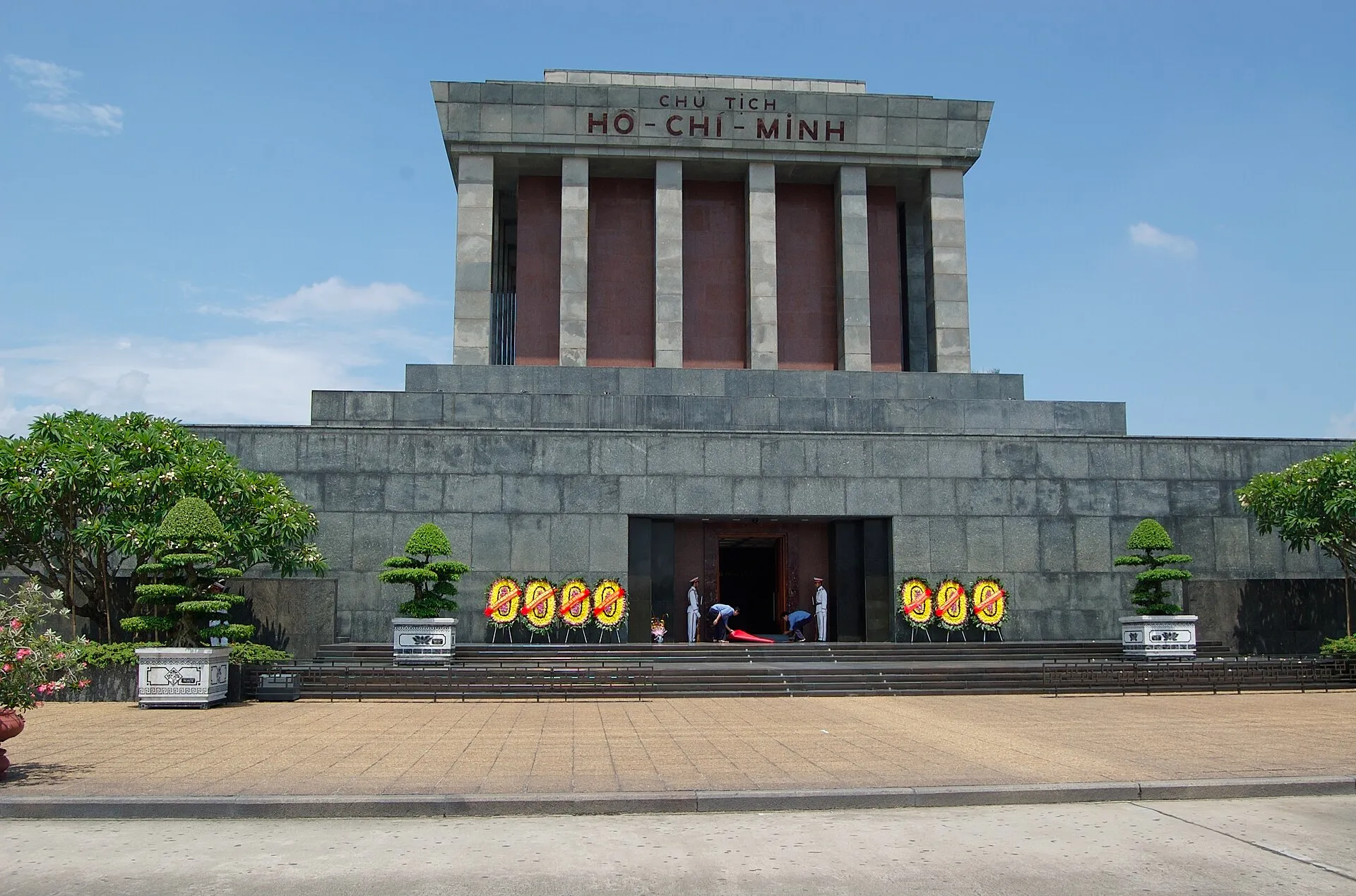
💡 The Short Version: The Ho Chi Minh Mausoleum is where the preserved body of Ho Chi Minh lies in state inside a grey granite monument on Ba Dinh Square. Entry is free, in the morning only: 08:00 to 11:00 from 1 November to 31 March (to 11:30 on Saturdays, Sundays and public holidays) (07:30 to 10:30 from 1 April to 31 October), Tuesday, Wednesday, Thursday, Saturday and Sunday (closed Mondays and Fridays), confirmed on bqllang.gov.vn. Shoulders and knees must be covered, hats removed, silence kept. Cameras and bags are checked into the free deposit counter before you enter the queue. Afterwards, 40,000 VND buys entry to the Presidential Palace grounds and Stilt House (ditichphuchutich.gov.vn), and the One Pillar Pagoda is free. Or book a tour: when you want an English-speaking guide to navigate the security protocols, morning queues and political history, the Hanoi City Highlights Walking Tourad (from VND 699,800, 5 stars from 206 reviews) guides you through Ba Dinh Square and the monuments.
Overview of the Ba Dinh Complex
Ba Dinh Square is the political epicentre of modern Vietnam. On 2 September 1945, President Ho Chi Minh stood upon a wooden podium here before hundreds of thousands of citizens to read the Proclamation of Independence, establishing the Democratic Republic of Vietnam.
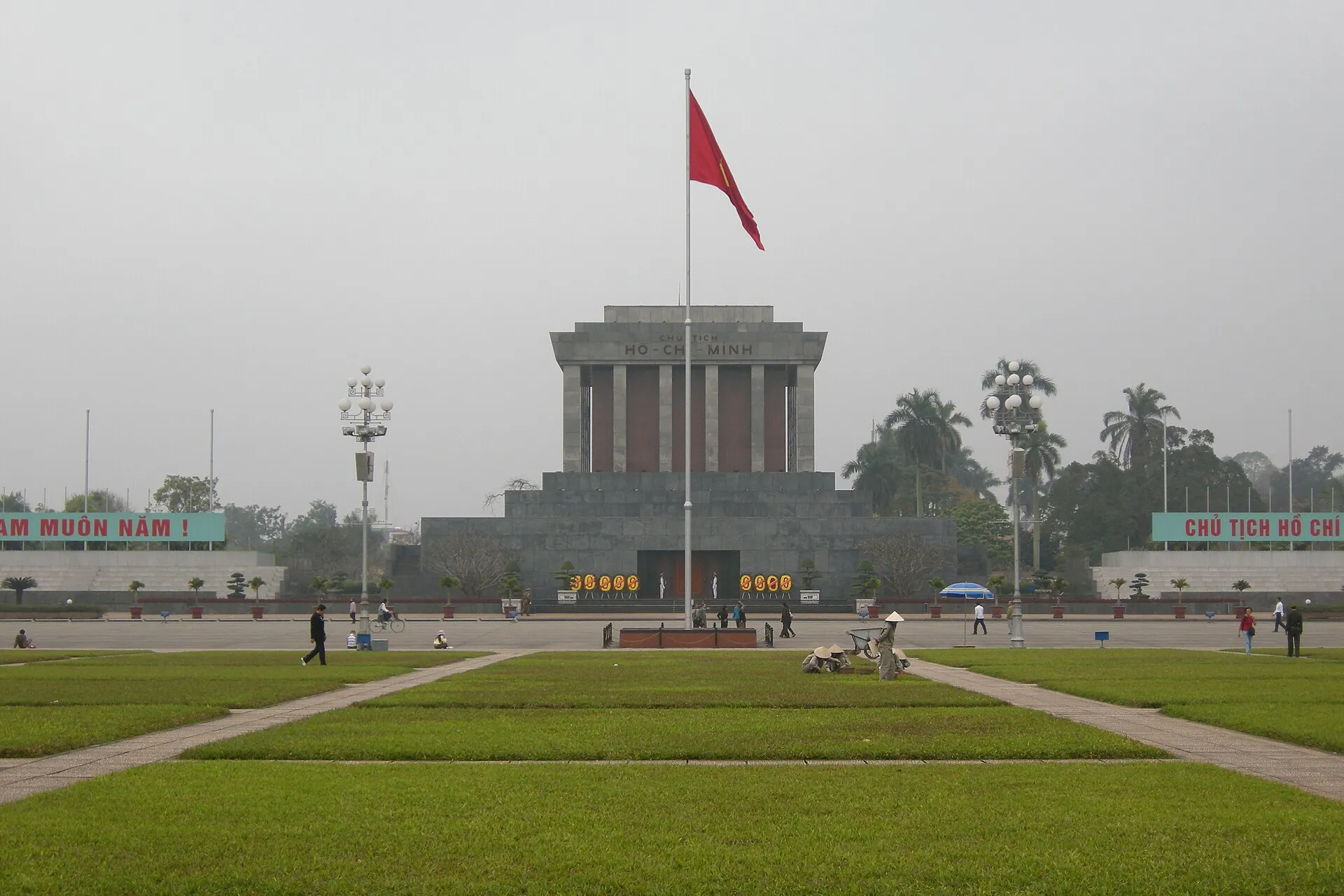
Ba Dinh Square. Photo: Vyacheslav Argenberg, Wikimedia Commons, CC BY 4.0.
Today, the square is lined with 240 manicured grass squares and flanked by monumental civic institutions. The broader complex encompasses five primary historical attractions:
- The Ho Chi Minh Mausoleum (Lang Chu Tich Ho Chi Minh): The imposing Soviet-influenced granite mausoleum where President Ho Chi Minh lies in state (bqllang.gov.vn).
- Ba Dinh Square: The ceremonial esplanade, home to national military parades and daily flag ceremonies.
- The Presidential Palace Historical Site: The French colonial Governor-General’s residence and the wooden Stilt House (Nha San) where Ho Chi Minh lived from 1958 until his death in 1969 (ditichphuchutich.gov.vn).
- The One Pillar Pagoda (Chua Mot Cot): An 11th-century Buddhist pagoda built atop a single stone column rising from a lotus pond.
- The Ho Chi Minh Museum: A modernist museum detailing Ho Chi Minh’s life and the global anti-colonial movement (baotanghochiminh.vn).
Admission fees and operating hours
Planning your visit requires coordinating the varying schedules of each monument across the Ba Dinh complex:
| Attraction | Admission fee | Opening days & hours | Key visiting guidelines |
|---|---|---|---|
| Ho Chi Minh Mausoleum | Free | Tue, Wed, Thu, Sat, Sun: 08:00 to 11:00, to 11:30 at weekends and on holidays (Nov to Mar) / 07:30 to 10:30 (Apr to Oct); closed Mon & Fri (bqllang.gov.vn) | Morning only; strict dress code; no cameras or phones in chamber |
| Presidential Palace Grounds & Stilt House | 40,000 VND | Daily 07:30 to 11:00 and 13:30 to 16:00 (summer) / 08:00 to 11:00 and 13:30 to 16:00 (winter) (ditichphuchutich.gov.vn) | Ticket kiosk at palace gate; self-guided garden walk |
| One Pillar Pagoda | Free | Daily 07:00 to 18:00 | Active place of worship; modest dress required |
| Ho Chi Minh Museum | 40,000 VND | Daily 08:00 to 12:00 and 14:00 to 16:30; closed Mon & Fri afternoons (baotanghochiminh.vn) | Lockers available in lobby; air-conditioned galleries |
| Ba Dinh Square Flag Ceremony | Free | Daily at 06:00 (Raising) and 21:00 (Lowering) | Open-air ceremonial military parade by the Honor Guard |
Tours and guided Ba Dinh visits
Visiting the Mausoleum independently is free, but queues can take 45 to 60 minutes on weekend mornings. Guided walking tours combine Ba Dinh with the surrounding imperial monuments and provide valuable cultural context.
Hanoi city highlights walking tour
From VND 699,800 · 5 stars from 206 reviews · 4.5 to 5 hours · Ba Dinh complex & Old Quarter
Hanoi City Highlights Walking Tour – Landmarks & Historyad: joins an expert local guide through Ba Dinh Square, the exterior grounds of the Presidential Palace, the One Pillar Pagoda, and onward to the Imperial Citadel of Thang Long.
Full-day Hanoi city tour with lunch
From VND 995,600 · 4.6 stars from 195 reviews · 1 day · Mausoleum, museums & lunch
Hanoi: Full-Day City Tour with Lunch and Optional Extrasad: comprehensive coach circuit that covers the Ho Chi Minh Complex, the Temple of Literature, and the Vietnam Museum of Ethnology, with traditional lunch and admission tickets included.
City sightseeing motorbike tour
From VND 860,100 · 4.9 stars from 220 reviews · 3 to 4 hours · Ba Dinh & West Lake circuit
Hanoi: City Sightseeing Motorbike Tourad: ride pillion behind a licensed local driver through Ba Dinh Square, past the French colonial embassies, and around West Lake to Tran Quoc Pagoda.
Official ticket or tour: the prices side by side
Independent visits versus guided tours.
| Option | Official admission | Tour cost | What it covers |
|---|---|---|---|
| Mausoleum & Ba Dinh Square | Free | — | Entry to burial chamber and ceremonial square (bqllang.gov.vn) |
| Palace grounds & Stilt House | 40,000 VND | — | Self-guided walk through gardens and Ho Chi Minh’s home (ditichphuchutich.gov.vn) |
| Ho Chi Minh Museum | 40,000 VND | — | Entry to modern biographical museum (baotanghochiminh.vn) |
| City highlights walking tour | Admissions included | From VND 699,800 | Guided exploration of Ba Dinh, Citadel, and Old Quarter |
| City sightseeing motorbike tour | Admissions included | From VND 860,100 | 4-hour motorbike circuit with Ba Dinh, West Lake, and lunch |
| Full-day coach tour with lunch | Admissions included | From VND 995,600 | Coach transport, Mausoleum, Ethnology Museum, and meal |
Visiting the Mausoleum: rules and chamber etiquette
Constructed between 1973 and 1975 using dark grey granite from Da Nang and native timber, marble, and stone gathered from across Vietnam, the Mausoleum stands 21.6 metres high overlooking Ba Dinh Square. Despite Ho Chi Minh’s personal request to be cremated and have his ashes scattered across the country, the government elected to preserve his body for the nation.
Entering the inner chamber is a dignified experience that follows strict protocol:
- Security and queue entry: The entry point for the public queue is located at 17 Le Hong Phong street or 8 Hung Vuong street. Join the queue early, ideally by 07:30, to avoid the extensive lines of domestic school groups, military veterans, and rural tour groups. Updates on queue openings are posted on bqllang.gov.vn.
- Baggage and electronic security screening: You must pass through airport-style metal detectors. Handbags, daypacks, telephoto cameras, and video recording devices must be checked into the complimentary military baggage holding room. You will be given a plastic numbered claim token to retrieve your items on the opposite side of the complex.
- Dress code enforcement: Your attire must be respectful. Both men and women must wear shirts with sleeves (shoulders fully covered) and trousers, jeans, or skirts that fall below the knees. Spaghetti tops, sheer fabrics, shorts, and caps or hats are forbidden. Guards turn away non-compliant visitors.
- Inner chamber solemnity: Visitors walk two-by-two in a steady, unbroken procession through dim, marble-lined corridors into the climate-controlled central hall. In the centre, the body of Ho Chi Minh rests in a glass sarcophagus, illuminated by soft amber lighting and flanked by four armed soldiers in crisp white uniforms.
- Conduct: You must keep moving at a slow, continuous walking pace. Maintain absolute silence. Do not cross your arms, place hands in pockets, chew gum, or attempt to take photographs. Stopping or pointing is not permitted. The circuit through the chamber takes roughly two minutes before exiting into the sunlight of the palace gardens.
The Presidential Palace and Stilt House
Upon exiting the Mausoleum, follow the paved walkway leading directly into the Presidential Palace Historical Site (ticket booth: 40,000 VND, details on ditichphuchutich.gov.vn).
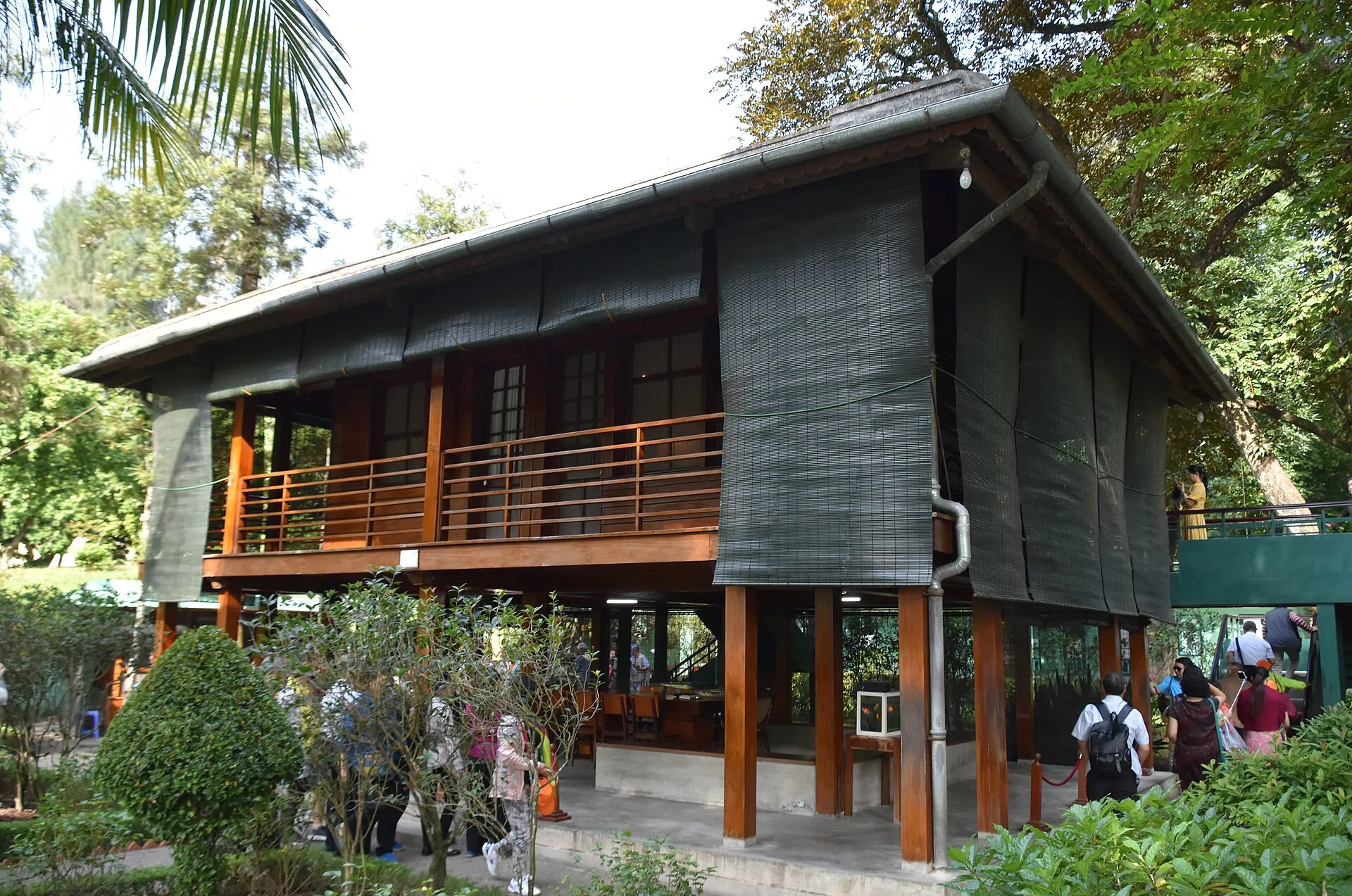
Ho Chi Minh’s stilt house. Photo: Richard Mortel from Riyadh, Saudi Arabia, Wikimedia Commons, CC BY 2.0.
- The Presidential Palace (Phu Chu Tich): Built between 1900 and 1906 for the French Governor-General of Indochina, this yellow neoclassical palace features Italian Renaissance pediments, grand staircases, and wrought-iron balconies. Ho Chi Minh declined to live inside the residence, viewing it as a symbol of colonial rule. He used the palace exclusively for formal diplomatic receptions. The interior remains closed to the public, but visitors can photograph the exterior from the palm-lined driveway.
- House No. 54: The single-storey yellow outbuilding where Ho Chi Minh lived and worked from 1954 to 1958, containing his personal library, writing desk, and simple furnishings.
- The Stilt House (Nha San): In May 1958, a traditional wooden house on stilts—modelled on the ethnic minority dwellings of the northern Viet Bac highlands where he spent his revolutionary years—was constructed beside a carp pond. The open-air ground floor served as an outdoor meeting room with wicker chairs and a telephone, while the upper floor consists of two small rooms: a study and a bedroom with a simple wooden bed and rush mat.
- The Carp Pond and Gardens: The surrounding gardens are shaded by century-old mango trees, jasmine blossoms, and rare cypress trees. Ho Chi Minh regularly fed the large golden carp in the pond; visitors can pause along the wooden jetty to view the fish surfacing.
The One Pillar Pagoda (Chua Mot Cot)
Located immediately adjacent to the exit of the Stilt House garden path, the One Pillar Pagoda is a historic Buddhist monument.
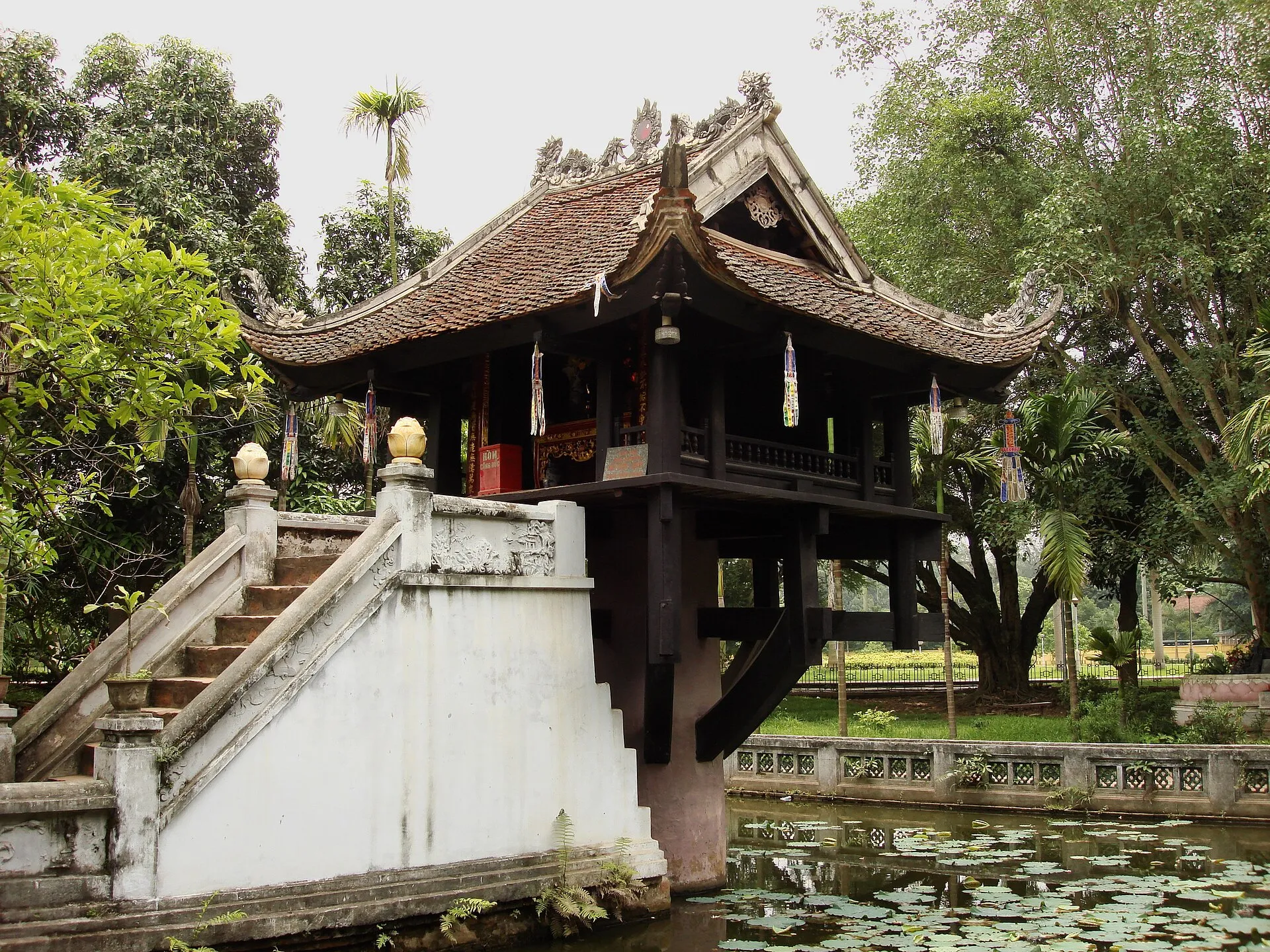
One Pillar Pagoda. Photo: Jorge Láscar from Australia, Wikimedia Commons, CC BY 2.0.
- Origins: Built in 1049 during the reign of Emperor Ly Thai Tong. In the historic annals, the childless emperor dreamed that the Bodhisattva Avalokiteshvara (Quan Am) handed him a baby son while seated upon a lotus blossom. When an heir was born shortly after, the grateful emperor ordered a wooden shrine built atop a single stone column rising from a square lotus pool, designed to resemble a blooming lotus flower.
- Destruction and reconstruction: The original pagoda was blown up by retreating French forces in 1954 before their withdrawal from Hanoi. The structure was reconstructed using historic records and original stone remnants.
- Visiting: Climb the short stone staircase to the shrine altar, where locals pray for fertility, health, and family prosperity. Dress respectfully, as this remains an active place of Buddhist worship.
The Ho Chi Minh Museum
Situated just beyond the One Pillar Pagoda, this concrete structure was completed in 1990 to commemorate the centenary of Ho Chi Minh’s birth (baotanghochiminh.vn).
- Exhibition design: The museum approaches biography through bold modernist architecture, symbolic artistic installations, and evocative gallery spaces. Displays depict Ho Chi Minh’s travels across France, the UK, the United States, and the Soviet Union, alongside broader struggles against global colonialism.
- Visiting tips: Admission is 40,000 VND. Allow approximately one hour to explore the galleries. The building is fully air-conditioned, making it a pleasant mid-day refuge during Hanoi’s humid summer months.
The daily flag ceremonies
If your schedule permits, return to Ba Dinh Square to witness the military ceremony of the daily national flag parades:
- Flag raising (06:00 in summer, 06:30 in winter): A contingent of 34 ceremonial soldiers from the High Command of the Ho Chi Minh Mausoleum Guard (representing the original 34 members of the Vietnam Armed Propaganda Unit for National Liberation) march from behind the mausoleum to the accompaniment of martial bugle calls. The national red flag with its gold star is hoisted to the top of the 29-metre flagpole as the national anthem, Tien Quan Ca, echoes across the square.
- Flag lowering (21:00 nightly): The square’s loudspeakers request silence as the guard regiment marches out once more to lower the banner with solemn precision. The lawns are softly illuminated, making this a peaceful evening walk.
Combine your visit to Ba Dinh with a tour of the historic Temple of Literature, a stop at the Imperial Citadel of Thang Long, or explore our recommendations for where to stay in Hanoi.
More on dress and behaviour in Hanoi etiquette.
Common questions
What are the opening hours for the Ho Chi Minh Mausoleum?
The Mausoleum is open Tuesday, Wednesday, Thursday, Saturday and Sunday mornings only: 08:00 to 11:00 from 1 November to 31 March (to 11:30 on Saturdays, Sundays and public holidays), and 07:30 to 10:30 from 1 April to 31 October. It is closed all day on Mondays and Fridays (bqllang.gov.vn).
Is there an entrance fee to visit the Ho Chi Minh Mausoleum?
Entry to the Ho Chi Minh Mausoleum and Ba Dinh Square is completely free for all domestic and international visitors. However, if you tour the adjacent Presidential Palace grounds and Stilt House, an admission ticket of 40,000 VND is required at the garden kiosk.
What is the dress code for entering the Mausoleum?
The dress code is strictly enforced by military guards. Both men and women must have their shoulders and knees fully covered. Tank tops, sleeveless shirts, shorts, mini-skirts, and hats are prohibited. Guards turn away anyone dressed immodestly at the security checkpoint.
Can I bring cameras and bags inside the Ho Chi Minh Mausoleum?
No cameras, smartphones, or video equipment are permitted inside the inner burial chamber. All bags and large cameras must be handed over at the free military baggage deposit counter before entering the queuing walkway. You can collect your belongings upon exiting onto the Presidential Palace grounds.
When does the annual maintenance closure happen?
The Mausoleum closes once a year for restoration of the preserved body, usually in autumn for about two months; in 2026 it was closed from 4 September to 2 November. Official closure announcements are published on bqllang.gov.vn.