One of 3 self-guided walks in Tokyo. See every walk.
In this guide
💡 The Short Version: This 6.9-kilometre self-guided walking route connects Tokyo’s historic downtown (shitamachi) across three distinct neighbourhoods: from the 7th-century Buddhist halls of Senso-ji in Asakusa, through the cultural grounds of Ueno Park and the Tokyo National Museum (¥1,000, closed Mondays), to the preserved post-war merchant lanes of Yanaka Cemetery and Yanaka Ginza. Almost the entire route is free to explore. Senso-ji’s main hall opens at 06:00 (06:30 between October and March), making early morning the ideal time to beat temple crowds before walking west toward Ueno. Or book a tour: travellers wanting guided historical context on Asakusa’s origins can join the Tokyo: Asakusa and Sensoji Walking Tourad (from ¥2,000, 4.9 stars from 1,055 reviews) for the first leg of the route. All prices are in Japanese yen (¥).
Walking route overview and schedule
This walk charts the historical evolution of Tokyo’s eastern lowlands. While western districts like Shinjuku and Shibuya were transformed into commercial skyscrapers after the 1960s, eastern Tokyo preserves the physical layout, temples, and small-business character of the merchant classes who populated Edo.
Map of the walk numbered stops in walking order
Open the route in Google Maps — all waypoints mapped in sequence for walking navigation on your mobile device.
| Stop | Distance from start | Adult admission | Opening hours | Highlights |
|---|---|---|---|---|
| 1. Senso-ji & Nakamise | 0 km (Start) | Free | Grounds open 24/7; Main Hall 06:00–17:00 | Kaminarimon lantern, Hozomon gate, five-storey pagoda, incense burner |
| 2. Ueno Park & Shinobazu | 2.8 km | Free | Public park open daily | Shinobazu lotus pond, Bentendo temple, Saigo Takamori statue |
| 3. Tokyo National Museum | 4.1 km | ¥1,000 | 09:30–17:00 (Closed Mondays) | Samurai armour, National Treasure swords, Jomon pottery, ukiyo-e prints |
| 4. Yanaka Cemetery | 5.3 km | Free | Open daily during daylight | Shaded paths, cherry trees, tomb of the last shogun Tokugawa Yoshinobu |
| 5. Yanaka Ginza | 6.9 km (Finish) | Free | Shops typically 10:30–18:00 | Yuyake Dandan steps, menchi-katsu croquettes, street crafts |
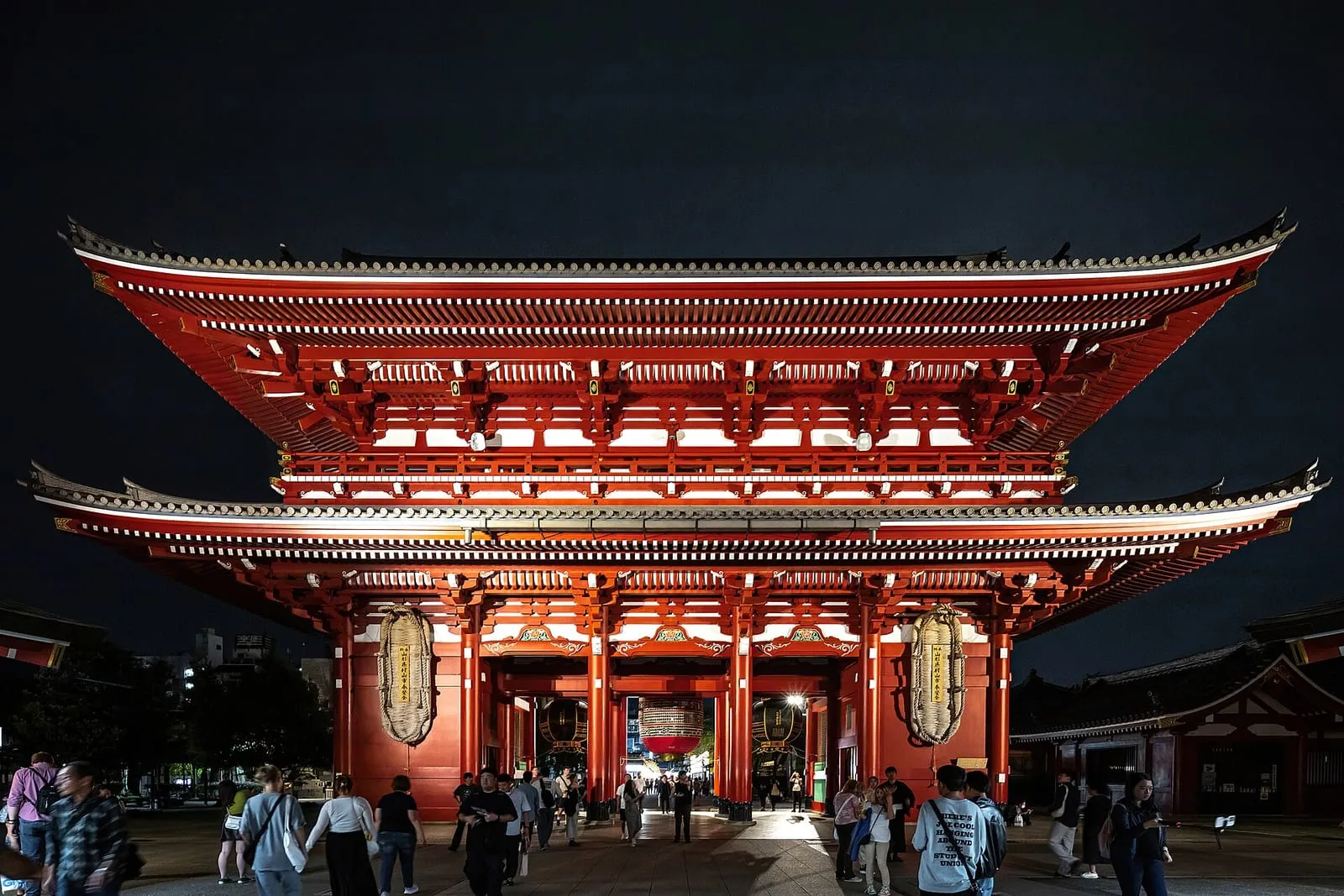
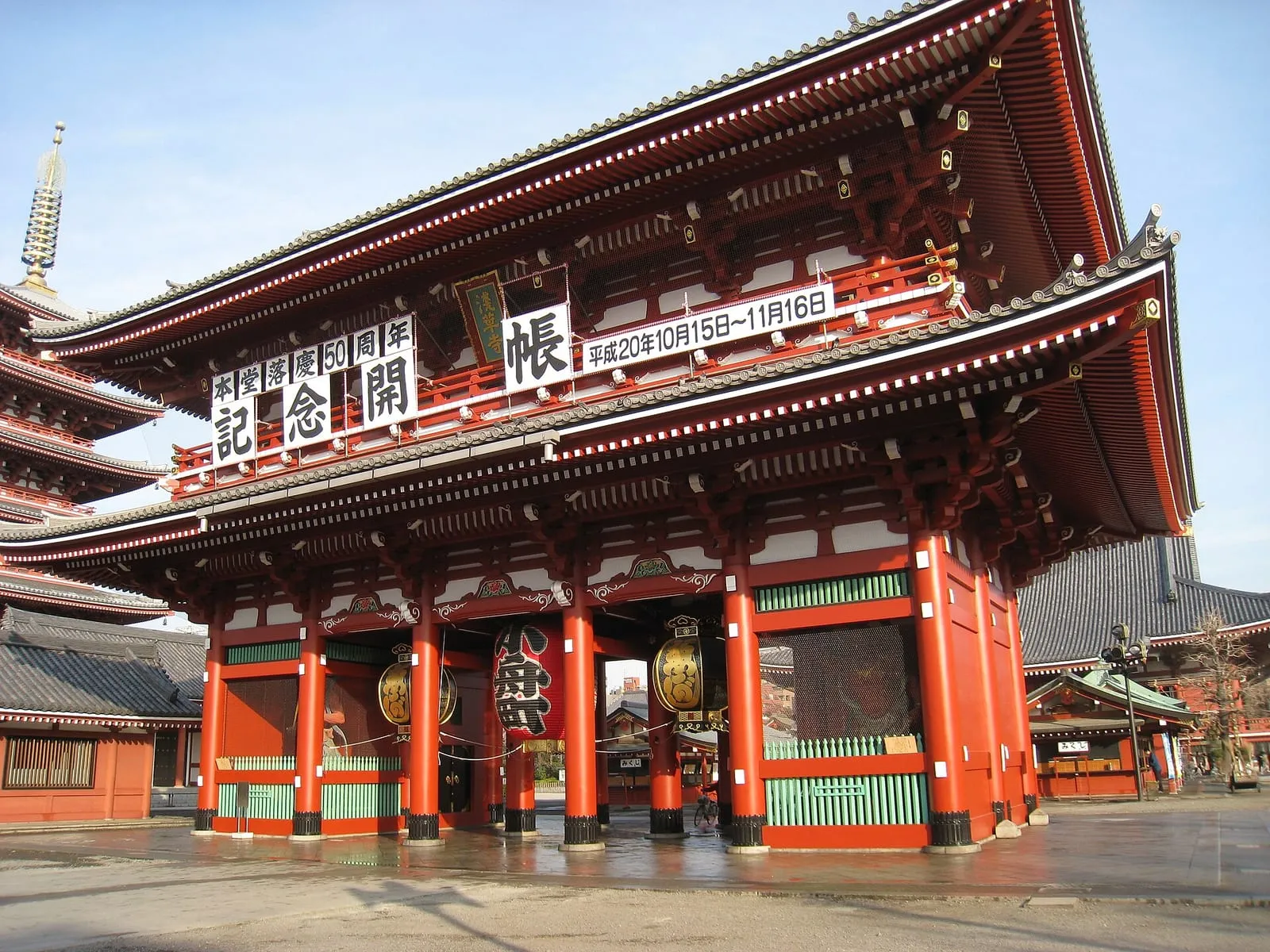
The massive red Hozomon gate at Senso-ji illuminated in the evening. Photo: Supanut Arunoprayote, Wikimedia Commons, CC BY 4.0.
Stop 1: Senso-ji and Nakamise-dori in Asakusa
Begin at Asakusa Station (served by the Tokyo Metro Ginza Line, Toei Asakusa Line, and Tobu Skytree Line). Step out to the landmark Kaminarimon (Thunder Gate), the outer entrance to Senso-ji, Tokyo’s oldest temple, founded in 628 AD.
- Kaminarimon: Flanked by massive timber statues of the Shinto wind god Fujin and thunder god Raijin, the gate suspends a celebrated 700-kilogram red paper lantern donated by Konosuke Matsushita, founder of Panasonic.
- Nakamise-dori: A 250-metre paved approach lined with 89 specialty heritage stalls that have operated under shogunate concession since the early 1700s. Sample hot ningyo-yaki (small sponge cakes filled with sweet red bean paste and stamped in the shapes of pagodas and lanterns), freshly pressed senbei rice crackers, and kaminari-okoshi puffed rice sweets.
- The Central Precinct: Pass through the two-storey Hozomon Gate, noted for two giant 4.5-metre waraji straw sandals hung to ward off demons, to reach the Main Hall (Hondo). Wash hands at the dragon water fountain (temizuya), bathe your head in healing smoke from the central incense burner (jokoro), and view the five-storey pagoda rising 53 metres into the sky.
Walking from Asakusa to Ueno (2.2 km)
From the west gate of Senso-ji, walk west along Kaminarimon-dori and Asakusa-dori toward Ueno. En route, you can make a brief five-minute detour north into Kappabashi Kitchen Town (Kappabashi Dogugai), Tokyo’s specialized restaurant supply district. Spanning nearly a kilometre, over 170 wholesale shops sell hand-forged Japanese chef knives, cast-iron nambu tekki teapots, lacquerware, and hyper-realistic vinyl wax food models (sampuru) displayed in restaurant windows.
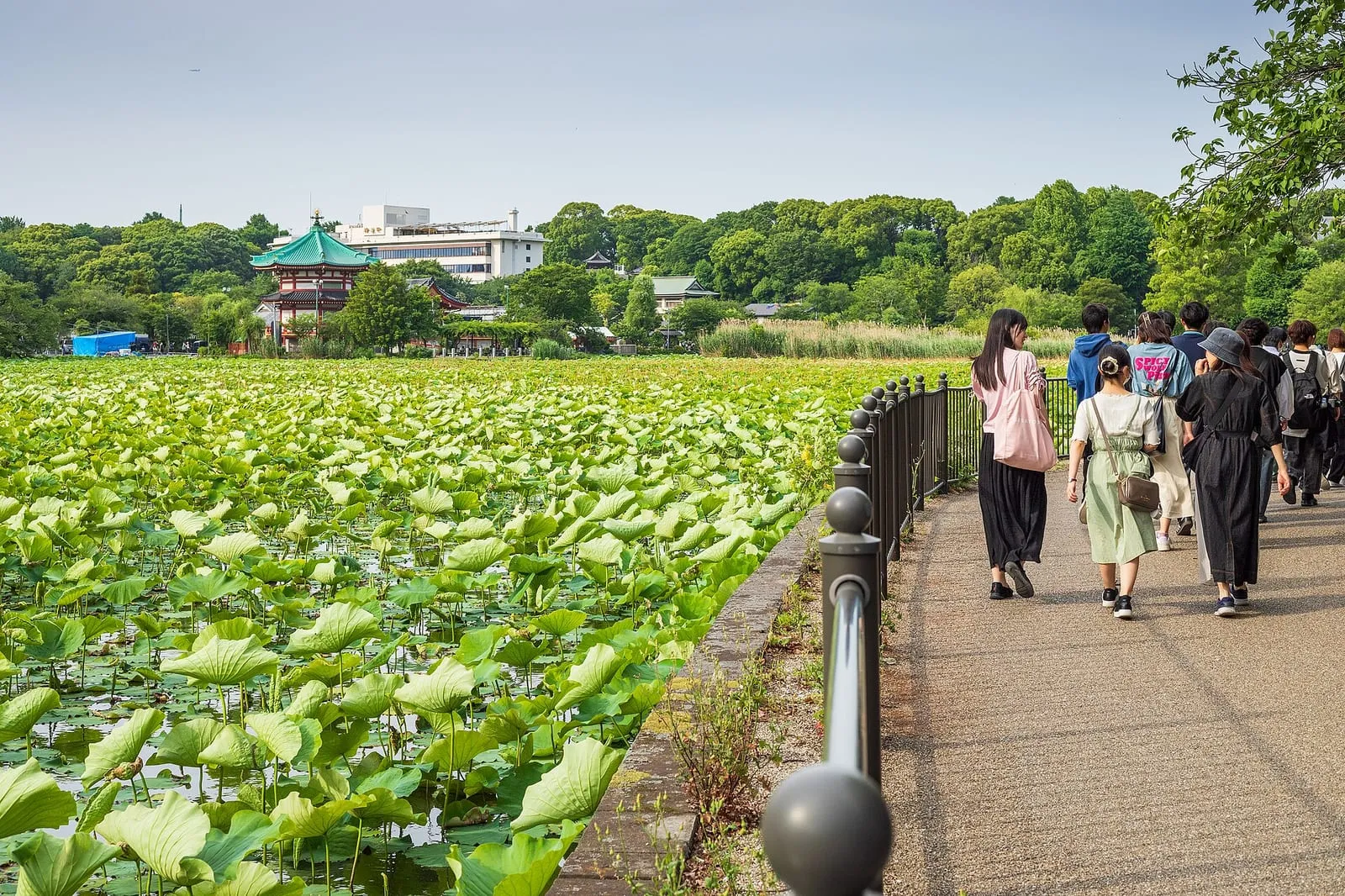
Summer lotus vegetation covering Shinobazu Pond in Ueno Park with Bentendo temple hall. Photo: Ximonic (Simo Räsänen), Wikimedia Commons, CC BY-SA 4.0.
Stop 2: Ueno Park (Ueno Onshi Koen)
Cross the broad thoroughfares at Ueno Station to enter Ueno Park, established in 1873 as one of Japan’s first Western-style municipal parks. The plateau originally belonged to Kaneiji, a vast Buddhist monastery built to protect Edo Castle from evil spiritual influences from the northeast, largely destroyed during the 1868 Battle of Ueno.
- Saigo Takamori Statue: Near the south entrance stands the famous bronze statue of Saigo Takamori, the influential samurai leader who helped overthrow the shogunate during the Meiji Restoration, depicted in simple kimono walking his hunting dog.
- Shinobazu Pond: A natural pond divided into three zones: a boat-rental basin, a sanctuary for cormorants and waterfowl, and the vast lotus pond. On an island in the center stands Bentendo, an octagonal temple dedicated to the Buddhist-Shinto water goddess Benzaiten.
- Ueno Toshogu Shrine: Built in 1627 and dedicated to Tokugawa Ieyasu. Miraculously surviving 19th-century civil war, the 1923 earthquake, and World War II, it retains its gold-leaf Karamon Chinese gate and an approach lined with fifty towering bronze lanterns donated by feudal daimyos.
Stop 3: The Tokyo National Museum (TNM)
Positioned at the northern end of Ueno Park’s central plaza, the Tokyo National Museum is Japan’s oldest and largest museum, founded in 1872. It houses over 120,000 cultural artifacts, including 89 National Treasures:
- Honkan (Japanese Gallery): A majestic 1937 building designed in the “Imperial Crown” style. Displays chronologically trace Japanese art history through samurai swords, katana blades, daimyo battle armor, gold-leaf lacquerware, Noh theater masks, and masterpieces of ukiyo-e woodblock printing by Hokusai and Hiroshige.
- Heiseikan: Dedicated to ancient Japanese archaeology. Highlights include prehistoric Jomon period cord-marked pottery dating back over 10,000 years, earthenware flame-rimmed pots, and unglazed terracotta haniwa tomb figures (notably the famous Haniwa Warrior in Keiko Armor).
- Gallery of Horyuji Treasures: An elegant modern structure housing over 300 7th- and 8th-century gilded bronze Buddhist sculptures and ceremonial banners donated by Nara’s historic Horyuji temple in 1878.
- Practical Information: Adult admission is ¥1,000 (free for visitors aged 17 and under or 70 and over). Open 09:30 to 17:00 (extended to 20:00 on Fridays and Saturdays). Closed on Mondays (or Tuesday if Monday is a national holiday). Suitcases and wheeled luggage are not permitted in exhibition galleries; free coin lockers are located near the ticket entrance.
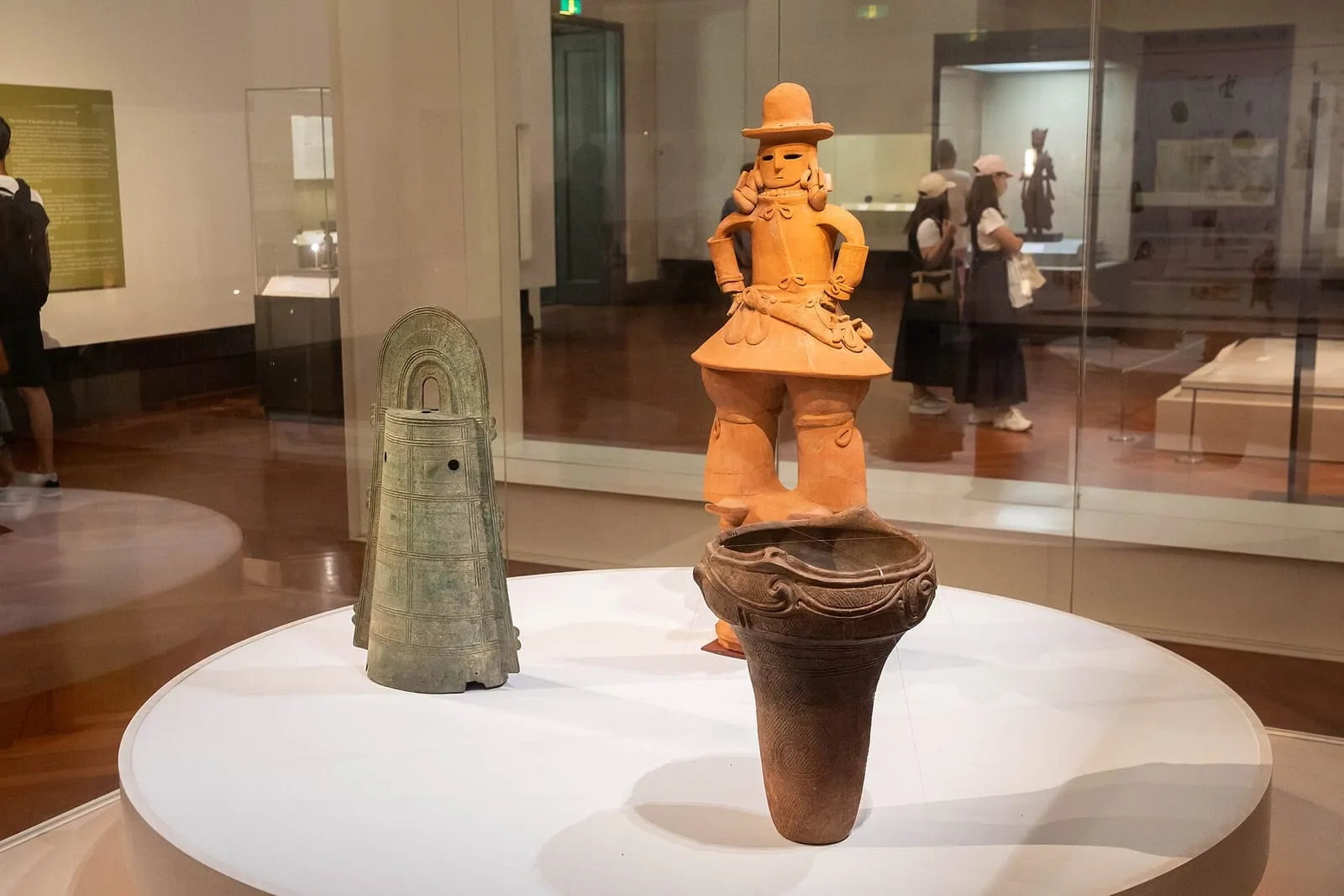
Ancient bronze and terracotta artefacts inside the Tokyo National Museum. Photo: Dick Thomas Johnson, Wikimedia Commons, CC BY 2.0.
Stop 4: Yanaka Cemetery (Yanaka Reien)
Exiting the north side of Ueno Park past the Tokyo University of the Arts (Geidai), cross Kototoi-dori into the tranquil district of Yanaka. Established in 1872, Yanaka Cemetery covers ten hectares of tree-shaded gravel lanes.
- Historical significance: The cemetery houses the tombs of over 7,000 notable Japanese figures, including Tokugawa Yoshinobu, the fifteenth and final shogun of Japan, whose fenced Shinto-style tomb contrasts with the Buddhist grave monuments around it.
- Atmosphere: Wide pathways are lined with centuries-old cryptomeria and Japanese cherry trees (sakura), creating an avenue of blossoms in spring and cool shade in summer. The cemetery is renowned for resident stray cats cared for by local neighbourhood associations.
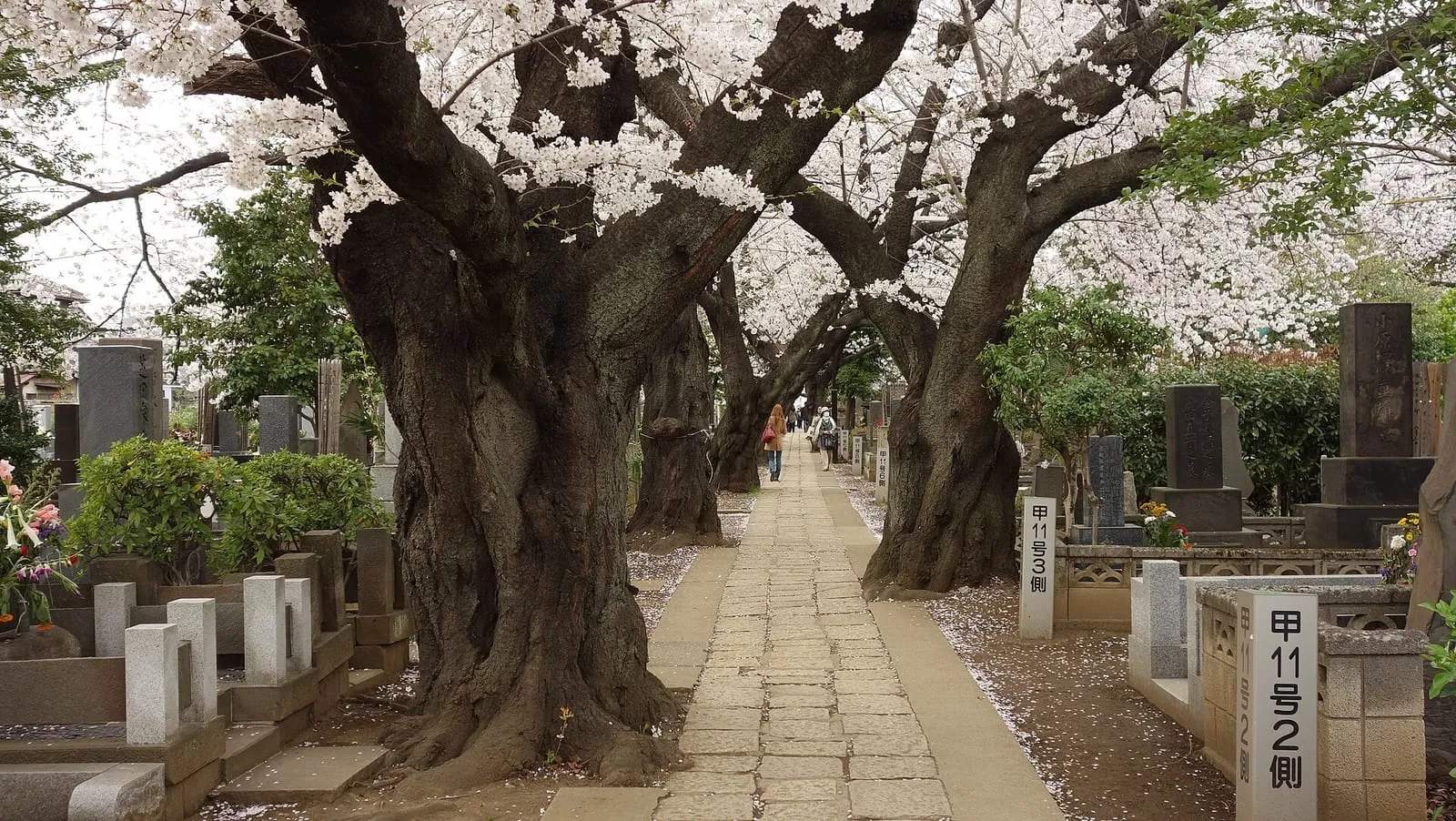
A quiet tree-lined path through historic Yanaka Cemetery. Photo: Ka23 13, Wikimedia Commons, CC BY-SA 4.0.
Stop 5: Yanaka Ginza and Yuyake Dandan
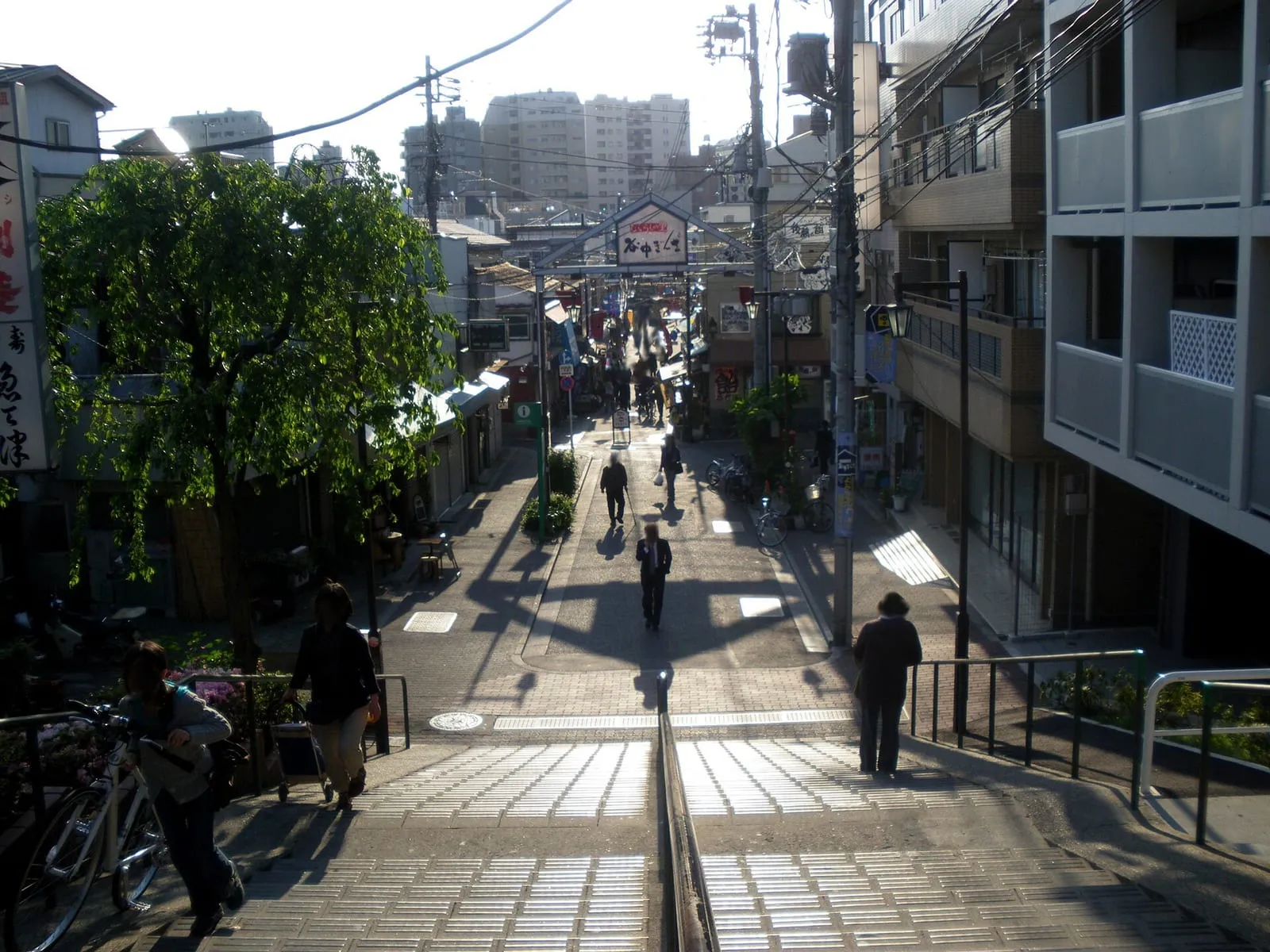
From the northern gate of the cemetery, walk through the historic residential alleys of Yanaka past old wooden shopfronts, artisan studios, and small neighbourhood shrines to reach the top of Yuyake Dandan (“Sunset Steps”).
- The Sunset Steps: This stone staircase descends directly into the western entrance of Yanaka Ginza. The steps earned their name because they provide a panoramic view of the pedestrian shopping street silhouetted against the setting evening sun.
- Yanaka Ginza: A compact 175-metre open-air pedestrian bazaar with roughly 60 independent family shops. Yanaka miraculously escaped both the 1923 Great Kanto Earthquake and the air raids of World War II, preserving an authentic Showa-era neighbourhood atmosphere.
- Local specialties: Stand in line at Niku no Suzuki or Niku no Sato for hot, freshly fried menchi-katsu (crispy panko-breaded minced beef cutlets seasoned with onions, roughly ¥250), sample grilled yakitori skewers, and browse traditional papercrafts and cat-themed porcelain wares.
- Finishing the walk: From the bottom of the steps, walk five minutes east to Nippori Station. Nippori is a major transport junction on the JR Yamanote Line, JR Keihin-Tohoku Line, and the Keisei Main Line (offering the Keisei Skyliner express running straight to Narita Airport in 36 minutes).
Guided walking tours of the district
Joining a guided walking tour offers bilingual historical commentary on Tokyo’s merchant traditions and samurai rivalries.
Tokyo: Asakusa and Sensoji Walking Tour
From ¥2,000 · 4.9 stars from 1,055 reviews · 2 hours
The Tokyo: Asakusa and Sensoji Walking Tourad is the benchmark introduction to the starting stop of this walk. The guide explains the Buddhist iconography of Kaminarimon, navigates the traditional merchant history of Nakamise-dori, and demonstrates proper purification rituals at Senso-ji’s central shrine.
Tokyo: Asakusa Walking Tour with Sensoji Temple Visit
From ¥3,500 · 4.8 stars from 2,026 reviews · 2 hours
The Tokyo: Asakusa Walking Tour with Sensoji Temple Visitad combines temple architectural history with an exploration of Asakusa’s historic theater alleys and backstreets.
Tokyo: Asakusa & Sensoji 2-Hour Walking Tour
From ¥2,000 · 4.9 stars from 351 reviews · 2 hours
The Tokyo: Asakusa & Sensoji 2-Hour Walking Tourad provides a concise small-group walk focusing on the local legends of the Sumida River fishermen and the founding of Senso-ji.
Where to go next
If you finish at Nippori in the late afternoon, take the JR Yamanote Line south to Akihabara or Tokyo Station, or west to Shinjuku for dinner.
To explore individual stops on this walk in greater depth, consult our dedicated guide to Senso-ji Temple and Asakusa and our comprehensive survey of Tokyo’s museums. For seasonal blossom timing in Ueno Park, read our guide to cherry blossom in Tokyo.
If you are planning multi-day sightseeing circuits, this walk forms the morning core of Day One in our 3-day Tokyo itinerary. Master subway tickets and Suica IC cards with Tokyo public transport, find nearby restaurant recommendations in where to eat in Tokyo, and explore the Tokyo hub for complete trip planning.
Common questions
How long is the Asakusa, Ueno, and Yanaka walk?
The complete walking route covers approximately 6.9 kilometres (4.3 miles). At a steady pace without long breaks it takes roughly two hours to walk, but allowing 4 to 6 hours gives you ample time to tour Senso-ji, browse Ueno Park, spend two hours inside the Tokyo National Museum, and sample street snacks in Yanaka Ginza.
Where does the walking route begin and end?
The walk starts at Senso-ji Temple in Asakusa (accessible via Asakusa Station on the Tokyo Metro Ginza Line and Toei Asakusa Line) and concludes at the Yanaka Ginza shopping street, located a five-minute walk from Nippori Station on the JR Yamanote Line.
Which day of the week should you avoid for this walk?
Avoid Mondays. The Tokyo National Museum and the National Museum of Western Art in Ueno Park are closed on Mondays (if Monday is a national holiday, they open on Monday and close on Tuesday instead). Many independent craft shops and food vendors in Yanaka Ginza also close on Mondays.
Are the attractions on this walk free to enter?
Senso-ji temple grounds, Ueno Park, Yanaka Cemetery, and Yanaka Ginza are completely free to explore. General collection admission to the Tokyo National Museum costs ¥1,000 for adults (free for visitors under 18 or aged 70 and over).