One of 4 self-guided walks in Osaka. See every walk.
In this guide
The Short Version: This 4.2 km self-guided walking route connects the historic contrasts of southern Osaka. You start amid the retro Showa streetscapes of Shinsekai beneath Tsutenkaku Tower, stroll through the narrow kushikatsu alley of Janjan Yokocho, cross green lawns in Tennoji Park, explore 1,400-year-old Shitennoji Temple, and finish on the 60th-floor glass deck of Abeno Harukas 300 at sunset. Allow four to five hours at a relaxed pace.
Southern Osaka offers a fascinating juxtaposition of eras: from the 6th-century Buddhist sanctity of Shitennoji to the 1950s working-class nostalgia of Shinsekai, culminating in the ultra-modern 300-metre glass monolith of Abeno Harukas. Walking between them reveals leafy traditional stroll gardens and lively food alleys that few car-bound visitors experience.
The route
Map of the walk numbered stops in walking order
Open the route in Google Maps — all five stops sequenced for walking navigation.
| Stop | Admission | Opening hours |
|---|---|---|
| 1. Tsutenkaku Tower and central Shinsekai | 1,500 yen | Tower 09:00 to 21:45; shops open from 10:30 |
| 2. Janjan Yokocho Arcade | Free | Arcade open 24 hours; food stalls 10:30 to 21:00 |
| 3. Tennoji Park and Keitakuen Garden | Park free; garden 150 yen | Park 7:00 to 22:00; garden 9:30 to 17:00 (closed Mondays) |
| 4. Shitennoji Temple | Grounds free; complex 300 yen | Gates open 8:30 to 16:30 (summer) / 16:00 (winter) |
| 5. Abeno Harukas 300 Observatory | 2,000 yen | 9:00 to 22:00 daily (last entry 21:30) |
1. Tsutenkaku Tower and central Shinsekai
Begin at Ebisucho Station on the Osaka Metro Sakaisuji Line (Exit 3). As you step out, the 108-metre steel framework of Tsutenkaku Tower rises directly ahead.
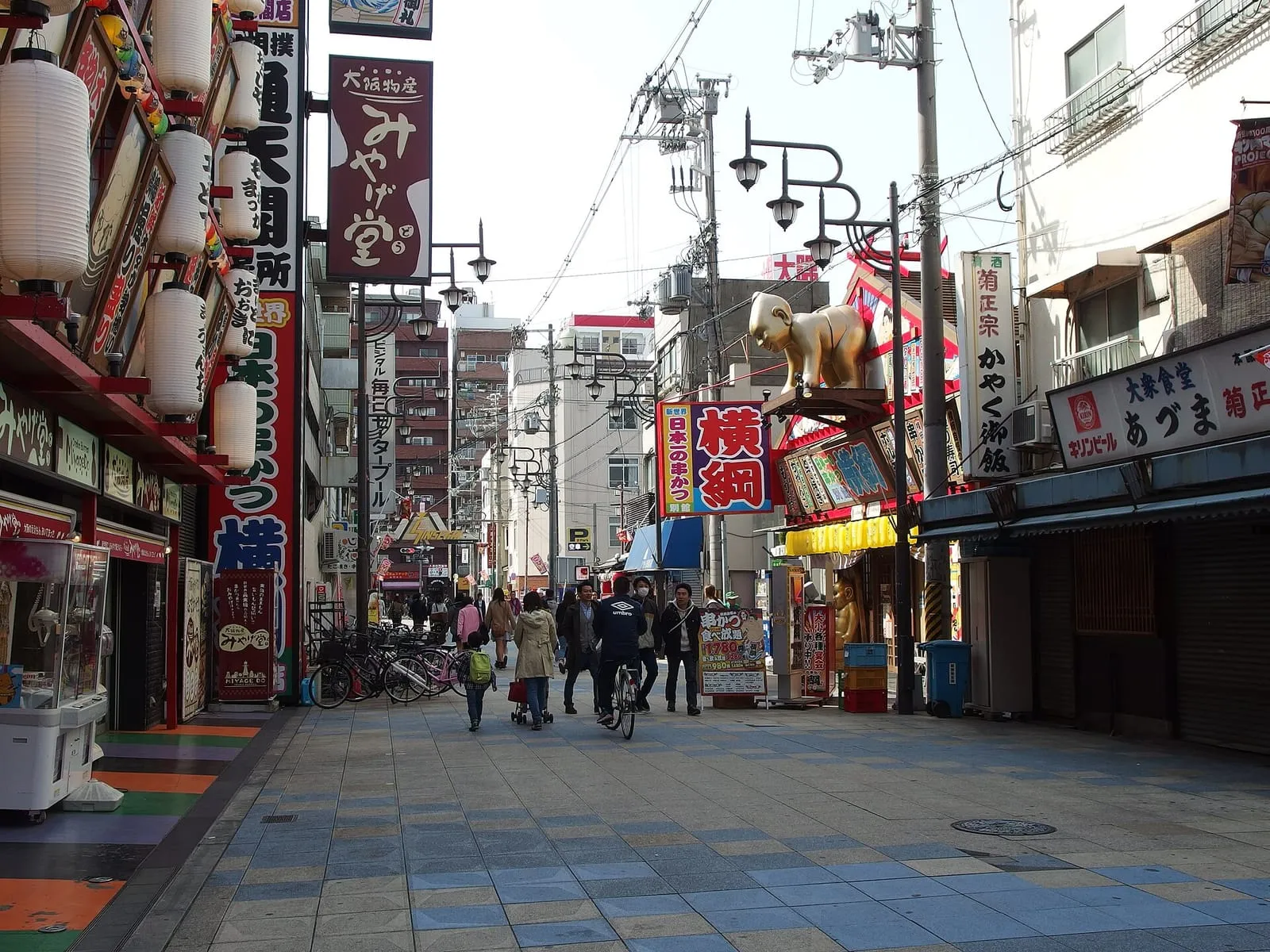
A Shinsekai street hung with lanterns and shop signs, with a few people walking. Photo: Guilhem Vellut, Wikimedia Commons, CC BY 2.0.
Originally constructed in 1912 and rebuilt in 1956 after wartime dismantling, Tsutenkaku remains Osaka’s proudest local symbol. Head down to the basement concourse to purchase a general admission ticket (1,500 yen for adults, 800 yen for children) to ride the elevator up to the 5th floor Golden Observatory. Rub the soles of the golden Billiken statue for luck and gaze out over the low-slung roofs of south Osaka. Thrill-seekers can try the Tower Slider (1,100 yen, on top of deck admission), a spiral stainless-steel tube that slides you from the third floor down to the basement in 10 seconds.
After leaving the tower, wander through the central plaza of Shinsekai, admiring the oversized blowfish lanterns, giant daruma figures, and retro game parlours.
2. Janjan Yokocho Arcade
Walk south from Tsutenkaku into Janjan Yokocho (officially Nansen-yokocho), a covered shopping lane just 2.5 metres wide and 130 metres long.
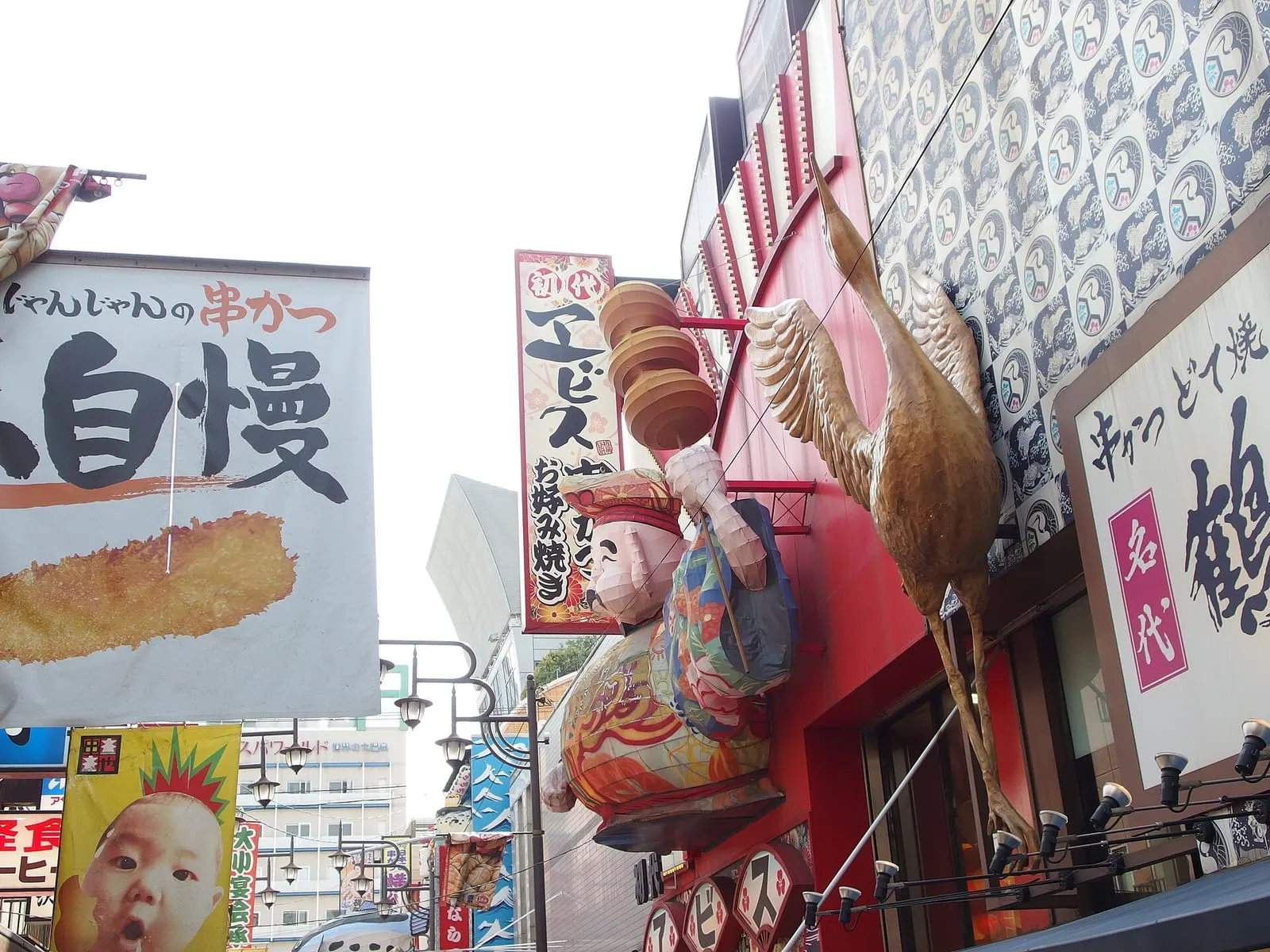
Kushikatsu restaurant signs on a Shinsekai street, including a giant skewer banner. Photo: Guilhem Vellut, Wikimedia Commons, CC BY 2.0.
This narrow corridor earned its nickname in the early 20th century from the rhythmic jan-jan strumming of shamisen lutes played by geisha and bar hostesses to attract manual workers. Today, it is lined with standing bars, traditional shogi (Japanese chess) parlours where elders study wooden game boards through storefront windows, and some of the kushikatsu counters.
Stop for an early lunch at Yaekatsu (closed Thursdays · cash only) or Tengu (closed Mondays · cash only), ordering skewers of beef (gyukatsu), quail eggs (uzura), and lotus root (renkon), alongside a bowl of rich simmered beef tendon (doteyaki).
⚠️ Remember the kushikatsu etiquette: Communal sauce tubs are placed on the counter. Dip each freshly fried skewer only once (nido-zuke kinshi). Never dip a bitten skewer back into the sauce. Use raw cabbage leaves to ladle extra sauce if required.
For a deeper look into skewers and dining rules, consult our Shinsekai kushikatsu guide.
3. Tennoji Park and Keitakuen Garden
Exit the south end of Janjan Yokocho, cross the pedestrian walkway, and enter Tennoji Park.
The western half of the park, known as Tenshiba, is a modern green lawn lined with open-air cafes, bakeries, and craft beer terraces. It provides a peaceful, open environment after the packed alleys of Shinsekai.
Within the park grounds sits Keitakuen Garden, a traditional Japanese stroll garden donated to the city in 1926 by the Sumitomo merchant family:
- Admission: 150 yen for adults; free for junior high and younger.
- Hours: 9:30 to 17:00 (last entry 16:30); closed Mondays (or Tuesday if Monday is a holiday).
Designed by master landscape architect Ogawa Jihei VII, Keitakuen features a winding path around a central pond fed by running streams, miniature hills, stepping stones, and Japanese black pines. From across the pond, you can capture reflections of Abeno Harukas rising above the garden trees.
4. Shitennoji Temple
Leave Tennoji Park by its northeast gate and walk 10 minutes north along Tanimachi-suji to reach Shitennoji Temple, founded in 593 AD by Prince Shotoku. Recognized as Japan’s first officially administered Buddhist temple, it presents a strict symmetrical Asuka-period design.
Enter through the great stone torii gate (Ishino Torii, dating to 1294) and stroll past the turtle pond to the walled Central Complex (Chushin Garan, 500 yen admission). Remove your shoes to climb the spiralling interior staircase of the 39-metre Five-Storey Pagoda, which enshrines sacred Buddhist relics, before viewing the golden Guze Kannon statue inside the main hall (Kondo).
If visiting in spring or summer, pay an extra 300 yen to walk through the serene Gokurakujodo Garden, which depicts the Buddhist Western Paradise with streams, lotuses, and arched bridges.
5. Abeno Harukas 300 Observatory
From Shitennoji’s south gate, walk 12 minutes south along Tanimachi-suji to Tennoji Station and enter Abeno Harukas, which held the title of Japan’s tallest skyscraper at 300 metres upon its completion.
Take the high-speed glass elevator from the 16th floor up to the Harukas 300 observation deck spanning the 58th, 59th, and 60th floors:
- Admission: 2,000 yen for adults, 1,200 yen for junior/senior high students, 700 yen for elementary school children.
- Hours: 9:00 to 22:00 daily (last admission 21:30).
The top floor (60F) is an enclosed 360-degree glass corridor floating 288 metres above ground level. On a clear evening, the view extends west across Osaka Bay to the Akashi Kaikyo Bridge, north over Osaka Castle and Umeda, and east to the mountains of Yoshino. The 58th floor features an open-air wooden deck garden where you can sip green tea or local craft beer as the neon grid of Osaka lights up below.
For complete ticketing details and fast-pass options, see our dedicated guide to Abeno Harukas 300 tickets. From Tennoji Station, the Midosuji Line whisks you back to Namba or Dotonbori in just 6 minutes, where you can follow the Dotonbori and Shinsaibashi walk or explore where to eat in Osaka. If comparing historic neighbourhood walks across Japan, see the Asakusa, Ueno and Yanaka walk in Tokyo.
From Tennoji, the Midosuji Line runs north to Namba, where the Namba and Kuromon Market walk starts at Namba Yasaka Shrine.
Common questions
How long does the Shinsekai and Tennoji walk take?
The walking route covers about 4.2 km. Expect to spend 3.5 to 5 hours depending on whether you ascend Tsutenkaku Tower, explore Shitennoji's pagoda and gardens, and visit the Abeno Harukas 300 observation deck.
What is closed on Mondays on this route?
Keitakuen Garden inside Tennoji Park is closed on Mondays (or Tuesday if Monday is a public holiday). Shitennoji Temple grounds, Tsutenkaku Tower, and Abeno Harukas 300 are open every day of the week.
Where does the walk start and finish?
The walk begins at Ebisucho Station outside Tsutenkaku Tower in Shinsekai and finishes at Tennoji Station, directly below the Abeno Harukas skyscraper.
Can you eat lunch during this walk?
Yes. The route passes directly through Janjan Yokocho and central Shinsekai, the heartland of kushikatsu (deep-fried skewers). Famous counters like Yaekatsu, Tengu, and Kushikatsu Daruma line the arcade.