In this guide
The Short Version: Tsutenkaku Tower is the beating heart of Shinsekai (“New World”), Osaka’s colourful retro entertainment quarter. The 108-metre steel lattice tower features observation decks (1,500 yen for adults, 800 yen for children, open 09:00 to 21:45), the famous Billiken good-luck statue whose feet you rub, and the Tower Slider (1,100 yen, on top of deck admission), a 60-metre spiral tube slide down to the basement. Shinsekai itself is famous for kushikatsu (deep-fried skewers) in covered alleys like Janjan Yokocho, where the cardinal rule is never double-dip in shared sauce. Take the Sakaisuji Line to Ebisucho Station or walk five minutes from Dobutsuen-mae Station.
Rising above the low-rise tenement alleys of southern Osaka, Tsutenkaku Tower translates poetically as “the tower reaching to heaven”. The district around it, Shinsekai, was laid out in 1912 as an ambitious amusement development: its northern half drew inspiration from Paris with an Eiffel Tower replica built over an Arc de Triomphe archway, while its southern half mimicked New York’s Coney Island with the Luna Park fairground.
After the original tower suffered a fire in 1943 and was dismantled for wartime steel, the local community rebuilt Tsutenkaku in 1956. The new 108-metre steel tower was designed by Tachu Naito, the structural engineer who also created Tokyo Tower (see Tokyo Tower tickets). Today, Shinsekai preserves an atmospheric Showa-era streetscape unlike anywhere else in Japan.
Visiting Tsutenkaku Tower: tickets and decks
The tower’s ticketing desk and entrance are accessed via the basement concourse (B1 floor), reachable by stairs or elevator beneath the tower base.
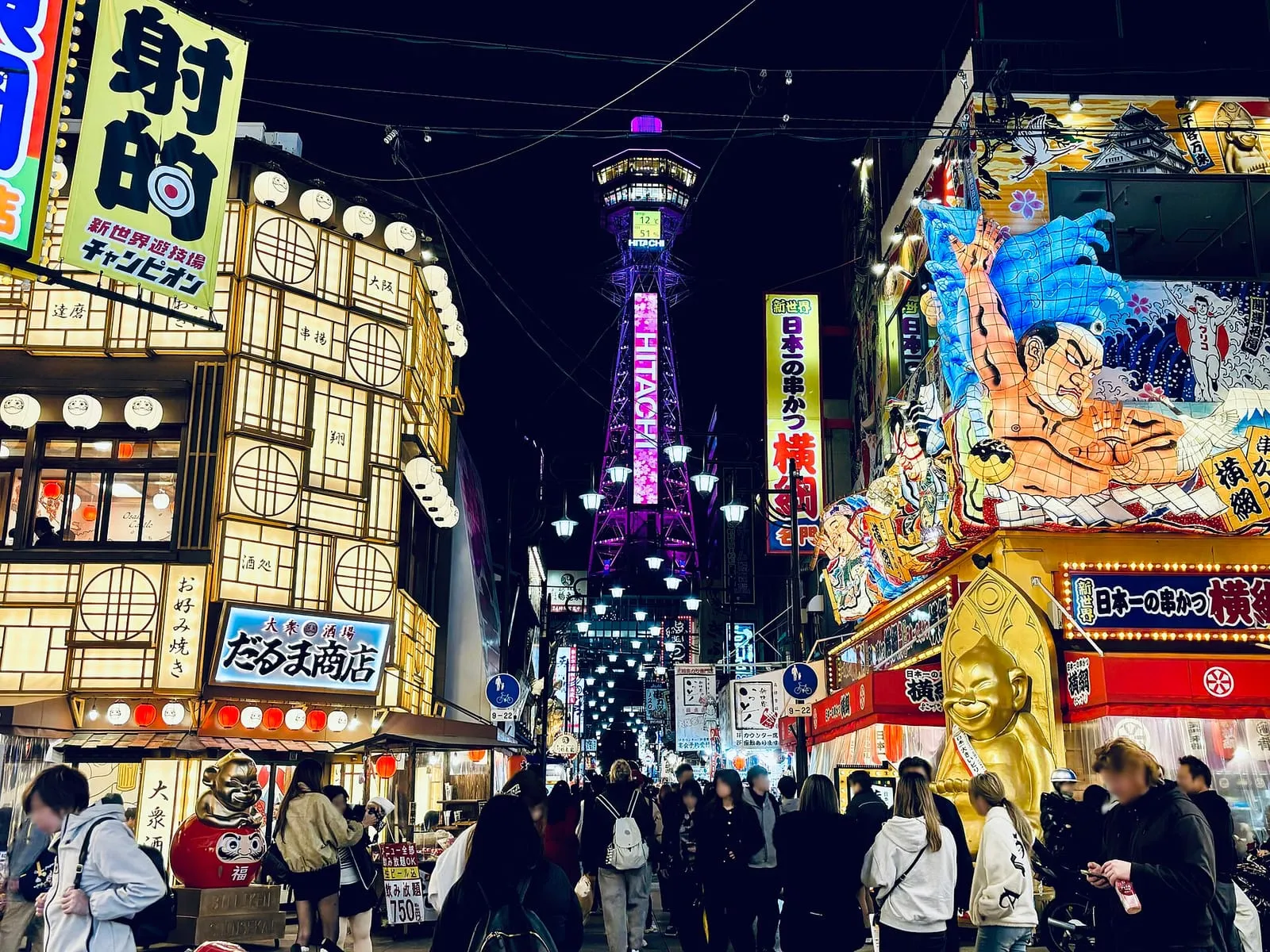
Tsutenkaku Tower lit purple at the end of a Shinsekai street of neon signs and crowds. Photo: Sakai Yayoi, Wikimedia Commons, CC0.
| Attraction / Deck | Adult ticket (age 15+) | Child ticket | Operating hours |
|---|---|---|---|
| General Observatory (4F & 5F) | 1,500 yen | 800 yen (ages 5 to 14) | 09:00 to 21:45 (last entry 21:15) |
| Special Outdoor Deck (Tenbo Paradise) | Sold as a set with the general deck ticket | Sold as a set with the general deck ticket | 09:00 to 21:45 (last entry 21:35) |
| Tower Slider (Spiral slide 3F to B1) | 1,100 yen (ages 15 to 65) | 600 yen (ages 7 to 14) | 09:30 to 20:30 (last entry 20:00); deck ticket extra |
| Dive & Walk (Outdoor tethered drop) | 3,000 yen (ages 15 to 65) | 2,000 yen (ages 9 to 14) | 10:10 to 20:00 (last entry 19:15); deck ticket extra |
The general observatory ticket covers the indoor observation decks on the 4th and 5th floors:
- 5th Floor (Golden Observatory): Decorated in glittering gold leaf reminiscent of Toyotomi Hideyoshi’s golden tea room, offering panoramic views south over Tennoji Park and north toward Dotonbori. The central figure here is the carved wooden statue of Billiken.
- Special Outdoor Deck (Tenbo Paradise): A platform atop the tower’s crown, 94.5 metres above ground. It offers an open-air balcony with glass flooring sections overlooking the skyline.
- The Tower Slider: Added to the tower exterior in 2022, this 60-metre spiral stainless-steel tube sends riders sliding from the third-floor balcony down to basement floor B1 at a 30-degree incline in roughly 10 seconds. Sliders wear protective helmets and sit in specialized friction bags.
The tower exterior features neon and LED weather forecasts on its crown: a white light signifies fair weather, orange indicates cloudy skies, and blue signals rain.
Or book tickets online
Book the Osaka Tsutenkaku Tower Admission Ticketad{rel=“sponsored nofollow noopener”} online to skip the counter queue and head straight to the observation decks.
Rubbing the feet of Billiken
The mascot of Shinsekai is Billiken, known throughout Osaka as the “God of Things as They Ought to Be”. Originally created in 1908 by American art teacher and illustrator Florence Pretz in Missouri, the whimsical elf-like deity with pointed ears and a mischievous smile became a worldwide sensation before Luna Park installed a wooden replica in Osaka in 1912.
When the park closed, the original statue disappeared, but a replacement was carved in 1979 and installed on the 5th floor of Tsutenkaku Tower. Local lore says that, because Billiken’s arms are too short to reach the soles of his own feet, visitors who rub his upturned feet with both hands and make a wish receive good fortune and prosperity. Over decades of eager hands, Billiken’s wooden soles have worn into deep concave hollows.
Exploring Shinsekai and Janjan Yokocho
Shinsekai is best explored on foot, pairing historic sights with street food.
- Janjan Yokocho (Nansenyokocho): A narrow 130-metre covered shopping arcade running south of Tsutenkaku. Its name derives from the jan-jan strumming sound of shamisen lutes played by bar hostesses in the early 20th century to lure dockers and day labourers. Today the arcade is packed with standing bars, kushikatsu counters, and open-fronted shogi (Japanese chess) and go clubs where elderly masters ponder board moves over green tea.
- Retro Arcades and Smartball: Shinsekai houses classic Showa-era game parlours. At Smartball New Star, you can play traditional smartball (a horizontal mechanical pinball game from the 1950s) for 100 yen per tray of glass marbles.
- Giant Shopfront Sculptures: Walking the main streets reveals oversized three-dimensional signs: giant blowfish lanterns, smiling Billiken statues, and towering daruma dolls guarding restaurant thresholds.
Kushikatsu: what to eat and the double-dipping rule
Shinsekai is the undisputed birthplace of kushikatsu (also called kushiage): bite-sized skewers of meat, seafood, and vegetables coated in a light batter and panko breadcrumbs, flash-fried in hot oil until golden and crisp.
Originating in 1929 at Kushikatsu Daruma to feed hungry local labourers with cheap, calorie-dense bites, kushikatsu is served across dozens of lively counter shops.
Essential skewer varieties include:
- Gyukatsu: Tender diced beef skewer (the classic order)
- Butabara: Pork belly and Welsh onion
- Uzura: Boiled quail eggs with a creamy yolk
- Renkon: Crunchy lotus root
- Beni Shoga: Pickled red ginger, a distinctive Osaka speciality with a pungent, tangy bite
Accompanying your skewers is doteyaki, beef tendon braised for hours in sweet white miso, mirin, and dashi, simmered in massive bubbling iron pans on the front counters.
⚠️ The cardinal rule of kushikatsu: No double dipping (nido-zuke kinshi). Traditional kushikatsu counters place a communal rectangular stainless-steel tub of thin, tangy Worcestershire-based dipping sauce directly in front of seated diners. Because multiple guests share this sauce container, you must dip your freshly fried skewer only once before biting. Never return a bitten skewer to the sauce tray. If you need additional sauce after taking a bite, pick up a piece of the free raw cabbage provided in bowls on the counter, use the cabbage leaf like a spoon to scoop sauce from the tub, and drip it over your skewer.
For a full breakdown of skewers, top counters, and sauce techniques, see the Shinsekai kushikatsu guide.
Where to eat in Shinsekai
- Kushikatsu Daruma Shinsekai Sohonten: 2-3-9 Ebisu-higashi, Naniwa-ku · 11:00 to 22:30 daily · from 140 yen per skewer. The 1929 birthplace of kushikatsu, marked by a scowling chef statue holding crossed skewers outside.
- Yaekatsu: 3-4-13 Ebisu-higashi (Janjan Yokocho) · 10:30 to 20:30, closed Thursdays · cash only. Famous for its egg-rich batter that puffs lightly around prawns and beef skewers, and rich doteyaki.
- Tengu: 3-4-12 Ebisu-higashi (Janjan Yokocho) · 10:30 to 21:00, closed Mondays · cash only. Directly opposite Yaekatsu; seats diners at a horseshoe counter serving thick, deeply caramelized miso tendon skewers.
How to get to Shinsekai
- Osaka Metro Sakaisuji Line: Ride to Ebisucho Station and take Exit 3. You emerge directly facing the northern approach to Tsutenkaku Tower.
- Osaka Metro Midosuji Line: Ride to Dobutsuen-mae Station and take Exit 1 or 5. Walk 5 minutes north through Janjan Yokocho to reach Tsutenkaku.
- JR West & Nankai Electric Railway: Ride to Shin-Imamiya Station. Exit the east gate and walk 6 minutes north into central Shinsekai.
- Walking onward: You can easily connect Shinsekai to nearby cultural landmarks. Walk 10 minutes east into Tennoji Park to visit Shitennoji Temple, or head south to take the high-speed lift up Abeno Harukas 300 Observatory. For the full walking itinerary through this area, follow the Shinsekai and Tennoji walk.
Common questions
How much are tickets to Tsutenkaku Tower?
Admission to the observation deck costs 1,500 yen for adults (age 15 and over) and 800 yen for children aged 5 to 14, rising to 1,800 yen and 900 yen from 30 December 2026 to 3 January 2027. The open-air Tenbo Paradise deck is sold only as a set with the general deck ticket. The Tower Slider costs 1,100 yen for adults and 600 yen for children aged 7 to 14, on top of deck admission.
What is the Tower Slider at Tsutenkaku?
The Tower Slider is a spiral tubular slide attached to the outside of the tower. Riders slide down from the third floor at an elevation of 22 metres to the basement floor B1 in about 10 seconds, sliding through a 60-metre stainless-steel tube.
What is Shinsekai famous for?
Shinsekai is known for its Showa-era retro streetscapes, Tsutenkaku Tower, the Billiken good-luck statue, nostalgic smartball arcades, and kushikatsu: deep-fried skewered meat, seafood, and vegetables served with communal dipping sauce.
Which metro station is closest to Tsutenkaku Tower?
Ebisucho Station on the Osaka Metro Sakaisuji Line is the closest: Exit 3 puts you directly at the northern gate of Shinsekai. Dobutsuen-mae Station (Midosuji and Sakaisuji lines) and Shin-Imamiya Station (JR and Nankai lines) are a 5-minute walk south.