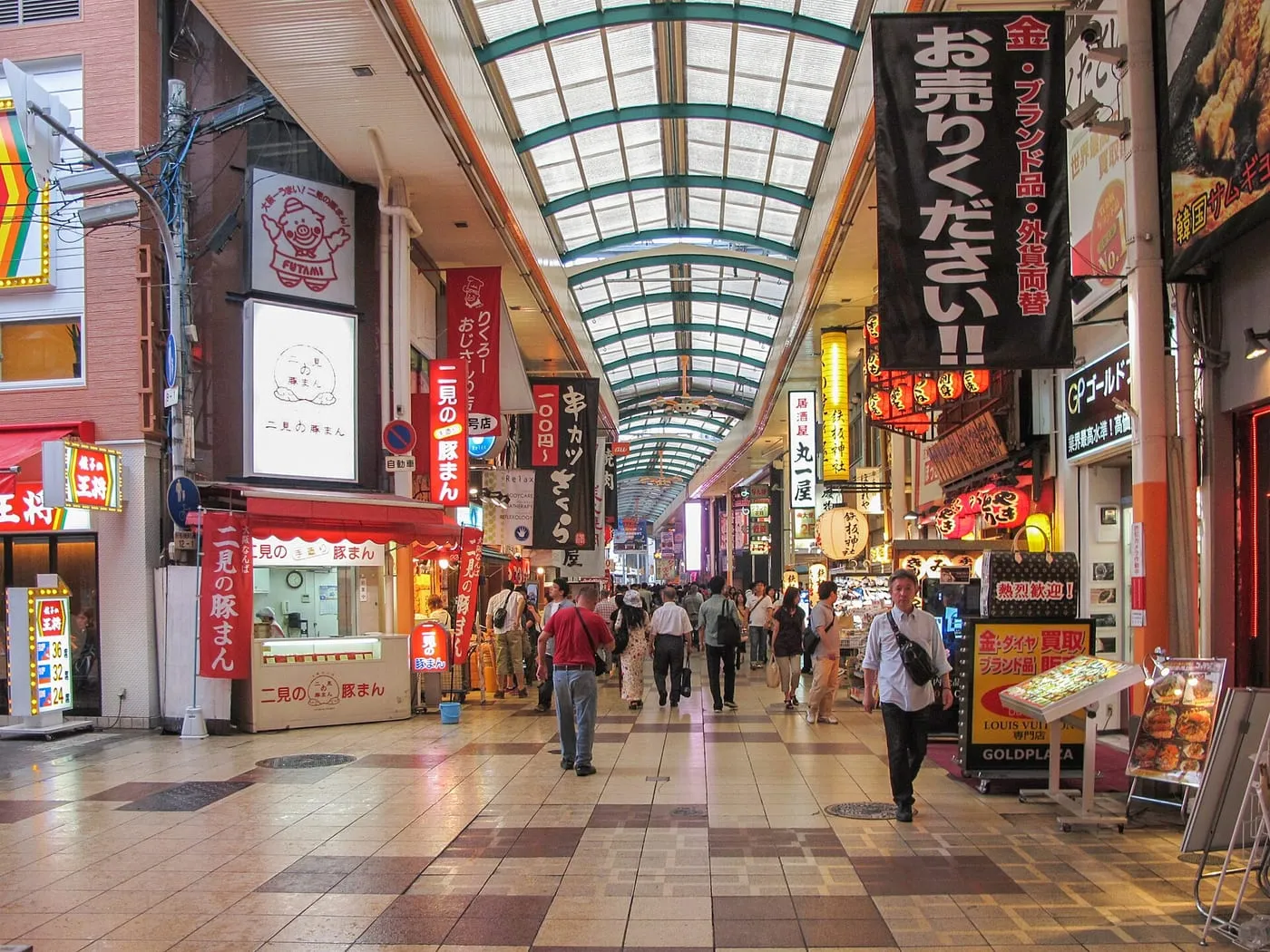
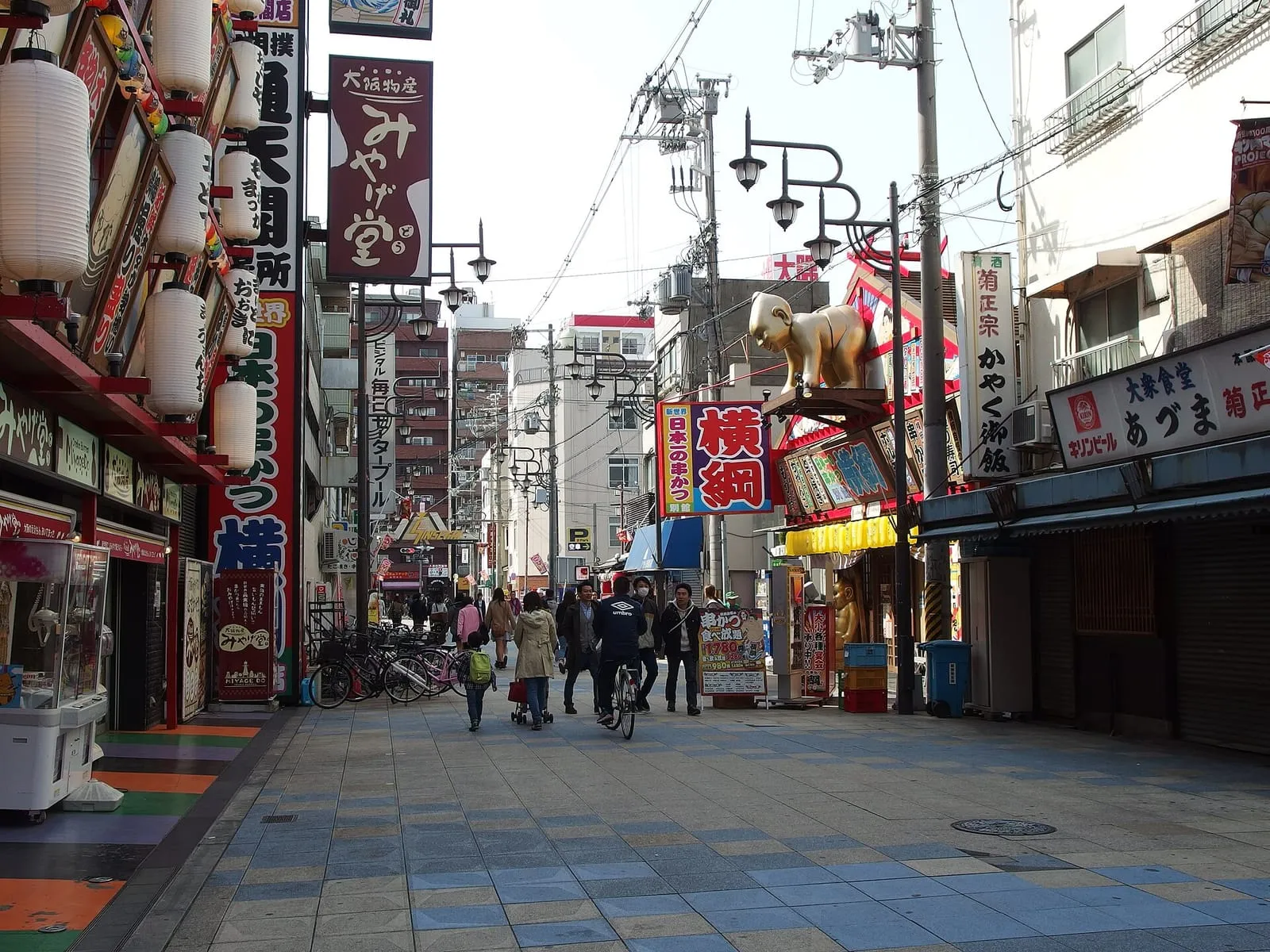
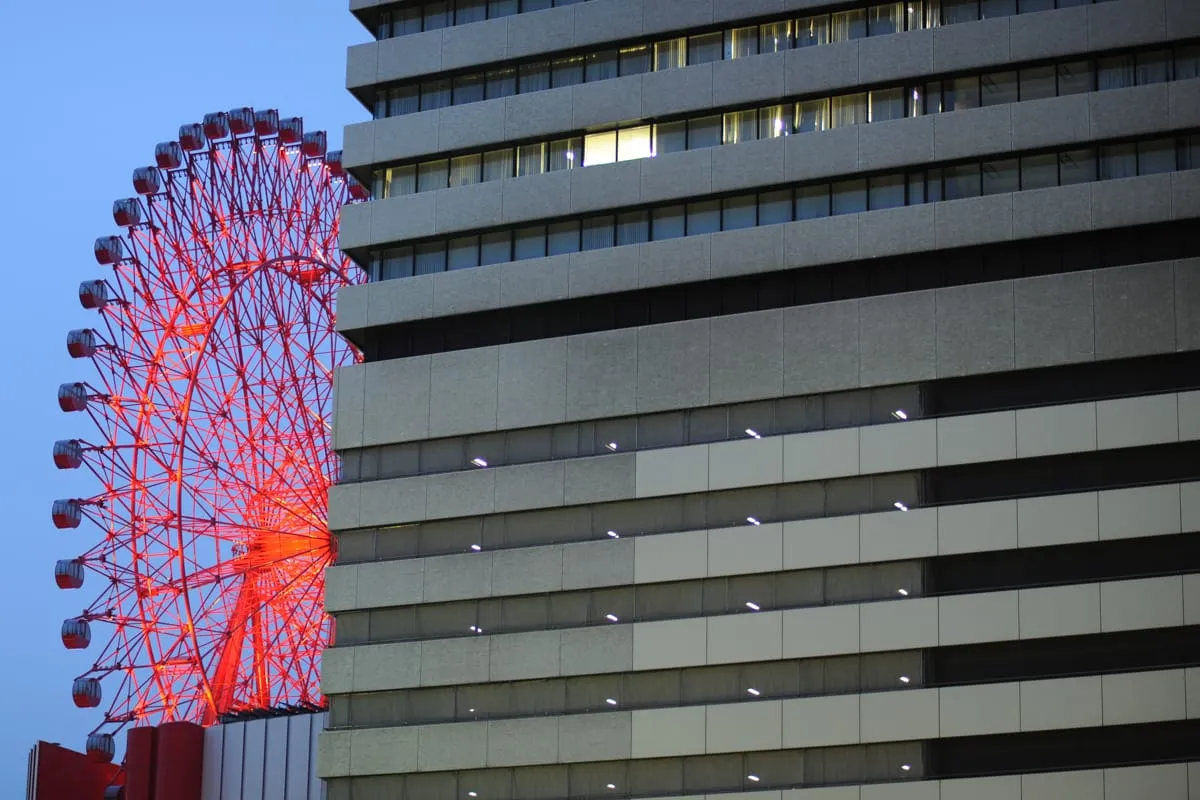
One of 4 self-guided walks in Osaka. See every walk.
In this guide
The Short Version: This 3.5 km self-guided walk guides you through the neon-lit, kinetic core of Osaka’s Minami district. Starting from Shinsaibashi-suji shopping arcade, you explore the street art and youth fashion of America-mura, photograph the Glico Running Man on Ebisu Bridge, feast on octopus balls along the Tombori Riverwalk, and finish among lantern-lit flagstones at Hozenji Temple and Hozenji Yokocho. Allow three hours in the late afternoon as the neon ignites.
Osaka’s Minami (South) district is the city’s traditional entertainment engine, dating back to 1612 when merchant Yasui Doton invested his personal fortune to dig a navigable canal linking regional rivers. In the Edo period, Dotonbori became the legal home of five kabuki theatres and puppet playhouses (bunraku). Today, it is an electrifying corridor of street food stalls, giant mechanical shopfront signs, and covered shopping avenues.
The route
Map of the walk numbered stops in walking order
Open the route in Google Maps — all stops ordered for walking directions directly on your phone.
| Stop | Admission | Opening hours |
|---|---|---|
| 1. Shinsaibashi-suji shopping arcade | Free | Shops typically open 10:00 or 11:00 to 20:30 |
| 2. America-mura and Triangle Park | Free | Boutiques open 11:00 to 20:00; takoyaki from 11:00 |
| 3. Ebisu Bridge and the Glico Running Man | Free | Public bridge open 24 hours; neon lights from sunset to midnight |
| 4. Dotonbori Canal and Tombori Riverwalk | Free; cruises 1,200 yen | Boardwalk open 24 hours; stalls trade 11:00 to late |
| 5. Hozenji Temple and Hozenji Yokocho | Free | Grounds open 24 hours; restaurants 17:00 to 23:00 |
| 6. Kamigata Ukiyoe Museum | 500 yen | 11:00 to 18:00 (last entry 17:30); closed Mondays |
1. Shinsaibashi-suji shopping arcade
Begin your walk at Shinsaibashi Station (Osaka Metro Midosuji and Nagahori Tsurumi-ryokuchi lines). Take Exit 2 or 5 and step directly into Shinsaibashi-suji Shopping Street, a covered 600-metre pedestrian arcade with a retail history dating to the 17th century.
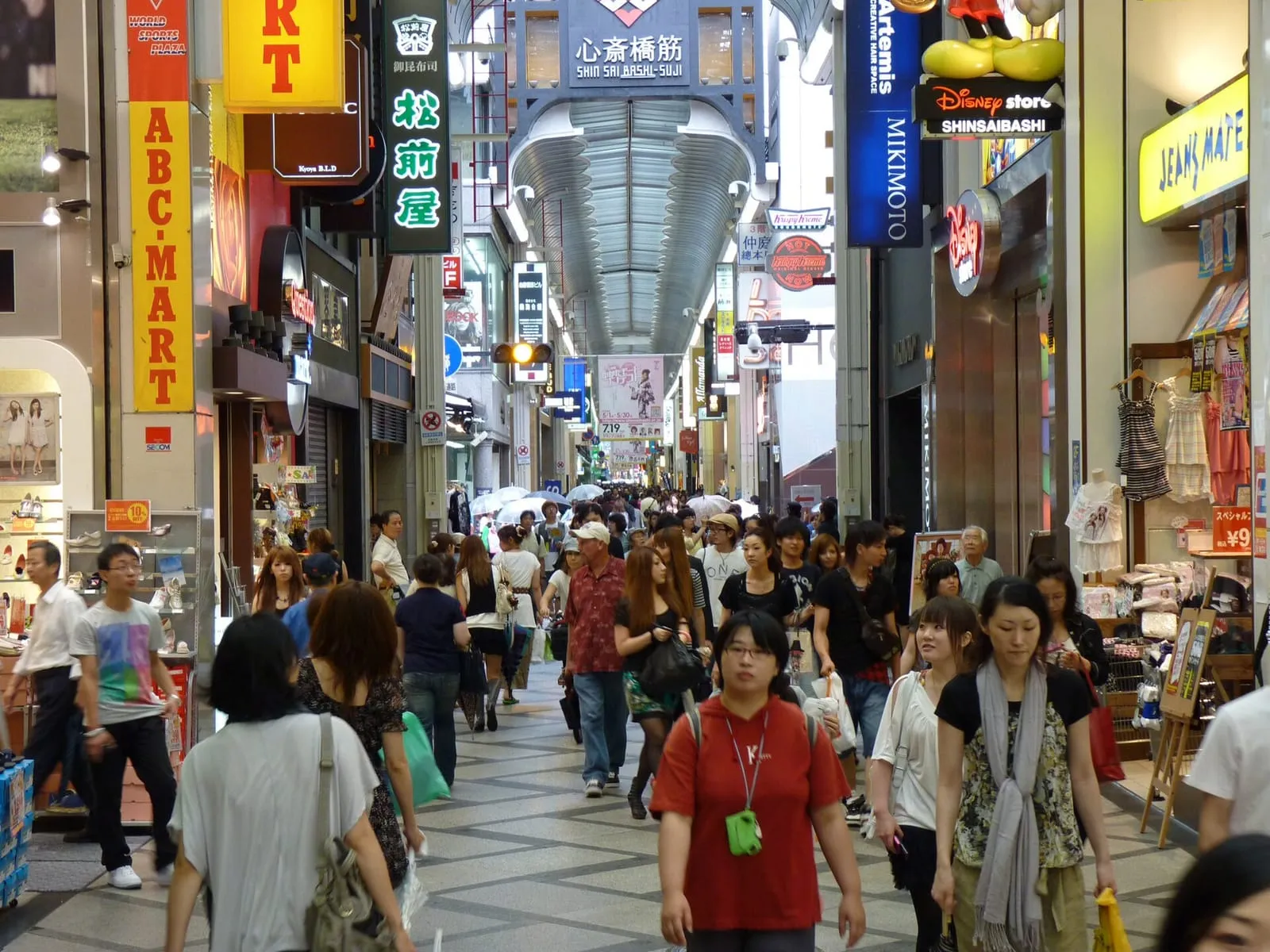
Shoppers filling the covered Shinsaibashi-suji arcade by day, with shop signs on both sides. Photo: Francisco Restivo, Wikimedia Commons, CC BY 2.0.
The street is packed with Japanese department stores, including the flagship Daimaru Shinsaibashi with its preserved Art Deco stone facade, interspersed with fashion boutiques, cosmetics retailers, and traditional kimono suppliers. The glass roof shields shoppers from rain and summer sun, and the arcade bustles with steady pedestrian traffic throughout the day.
2. America-mura and Triangle Park
Turn west off Shinsaibashi-suji and cross Mido-suji boulevard into America-mura (commonly abbreviated to Amemura). In the 1970s, warehouses in this quarter began importing American vintage clothing, Hawaiian shirts, and vinyl records, transforming Amemura into western Japan’s centre for youth street culture, comparable to Harajuku in Tokyo (see the Meiji, Harajuku and Shibuya walk).
At the district’s centre is Sankaku Koen (Triangle Park), a small concrete plaza where skateboarders and students gather. Facing the park is the original outlet of Kogaryu Takoyaki (2-18-4 Nishishinsaibashi · 11:00 to 20:00 daily). Kogaryu pioneered serving piping-hot takoyaki drizzled with Japanese mayonnaise and sweet dashi sauce (from 500 yen for 8 pieces), served on thin wooden boats to eat on the park benches.
3. Ebisu Bridge and the Glico Running Man
Head south toward Dotonbori Canal to cross Ebisu Bridge (Ebisubashi). This wide pedestrian footbridge is Osaka’s prime meeting point, where thousands gather each evening to pose mirroring the posture of the world-famous Glico Running Man.
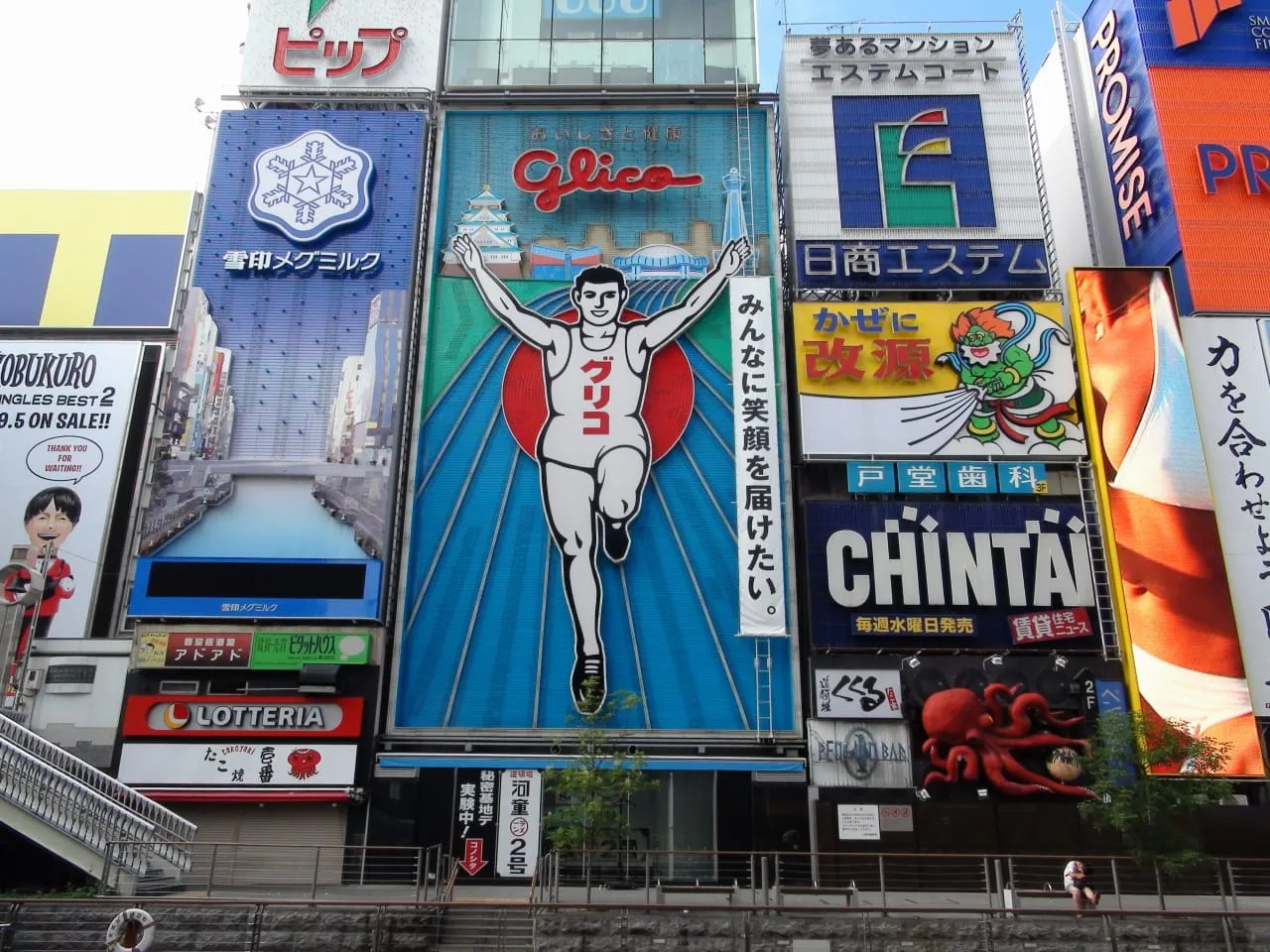
The Glico Running Man billboard and neighbouring signs at Dotonbori. Photo: Sakaori, Wikimedia Commons, CC BY-SA 3.0.
The giant billboard—depicting an athlete crossing a finish line with arms raised on a blue running track—was first erected here in 1935 by confectionery maker Ezaki Glico. The current sixth-generation sign features over 140,000 energy-efficient LEDs that animate cyclical backgrounds featuring famous Osaka landmarks from sunset until midnight.
4. Dotonbori Canal and Tombori Riverwalk
Step down the stone stairs from Ebisu Bridge onto the Tombori Riverwalk, a wooden-decked promenade flanking both sides of the canal.
Looking upward reveals Dotonbori’s famous oversized kinetic shopfront sculptures:
- Kani Doraku: A giant 8-metre mechanical red crab with moving legs and claws above the flagship seafood restaurant.
- Kukuru Dotonbori: A massive red octopus clinging to the facade above steam-shrouded takoyaki griddles.
- Don Quijote Dotonbori: The towering discount store featuring the yellow, oval-shaped Ebisu Ferris wheel (Dotonbori Ferris Wheel Ebisu Tower, 600 yen per ride) wrapped around the building facade.
If your feet are tired, board the Tombori River Cruise (1,200 yen adults, 400 yen children), a 20-minute guided boat trip down the canal departing from the riverwalk docks outside Don Quijote every 30 minutes.
5. Hozenji Temple and Hozenji Yokocho
Slip southward away from the loud neon strip into Hozenji Yokocho, a pair of narrow, parallel stone-paved alleys only 2.7 metres wide and 80 metres long. Lined with dark-wood facades, sliding paper doors, and red paper lanterns, this secluded enclave preserves the atmosphere of pre-war merchant Osaka.
At the heart of the alleyways stands Hozenji Temple, a modest Buddhist temple founded in 1637. Its central attraction is Mizukake Fudo, a weathered stone statue of Fudo Myo-o (the Immovable Wisdom King). Rather than lighting incense, worshippers scoop ladles of water from the stone well and splash it over the statue while making a prayer. Decades of constant dousing have enveloped the deity and his attendants in a thick, velvety coat of vibrant green moss.
6. Kamigata Ukiyoe Museum
Directly opposite the entrance to Hozenji Temple stands the Kamigata Ukiyoe Museum, the only museum in the world with a permanent exhibition dedicated specifically to Kamigata woodblock prints.
While Tokyo’s Edo ukiyoe prints heavily featured idealized portraits of geisha and kabuki actors, Osaka’s Kamigata artists prioritized realism and psychological depth, portraying kabuki actors with unvarnished human expression and theatrical intensity.
- Admission: 500 yen adults, 300 yen high school and university students, 200 yen children.
- Hours: 11:00 to 18:00 (last entry 17:30); closed Mondays.
From Hozenji Yokocho, you are only a two-minute walk from Namba Station. To continue exploring southern Osaka on foot, link up directly with the Namba and Kuromon Market walk, which explores the kitchen market and giant lion shrine just south of here. For dinner recommendations around Dotonbori, consult our comprehensive guide on where to eat in Osaka and our roundup of the best takoyaki and okonomiyaki in Osaka.
The Midosuji Line from Namba runs north to Umeda, where the Umeda and Nakazakicho walk starts at the Umeda Sky Building.
Common questions
How long does the Dotonbori and Shinsaibashi walk take?
The walking route is about 3.5 km. Plan for 2.5 to 3.5 hours to take in the shops, photo stops, street food stalls, and the quiet stone alleys of Hozenji Yokocho.
What is the best time of day to do this walk?
Late afternoon transitioning into evening is best: around 16:30 to 19:30. Shinsaibashi shops are fully open, and as dusk falls, Dotonbori's famous neon billboards and the Glico Running Man illuminate the canal.
Is the Dotonbori canal walk free?
Walking the pedestrian streets, crossing Ebisu Bridge, and visiting Hozenji Temple are completely free. The Tombori River Cruise costs 1,200 yen for adults, and the Kamigata Ukiyoe Museum costs 500 yen.
Where does the walk start and finish?
The walk starts at Shinsaibashi Station on the Osaka Metro Midosuji Line, heads west through America-mura, crosses Ebisu Bridge into Dotonbori, and concludes in Hozenji Yokocho beside Namba Station.