In this guide
The Short Version: Kushikatsu (deep-fried meat, seafood, and vegetable skewers) is southern Osaka’s defining comfort food. Born in the working-class quarter of Shinsekai in 1929, skewers are coated in fine panko breadcrumbs, flash-fried until crisp, and submerged in a communal tub of Worcestershire-based dipping sauce. The cardinal rule of kushikatsu dining is no double dipping (nido-zuke kinshi): dip your skewer once before your first bite, and use raw cabbage leaves as a spoon if you need more sauce. Top historic spots include Kushikatsu Daruma, Yaekatsu, and Tengu.
While Tokyo serves refined panko-crusted pork cutlets as tonkatsu (see where to eat in Tokyo), Osaka skewers everything from beef to quail eggs and pickled ginger onto bamboo sticks, flash-frying them into affordable, bite-sized street food.
The heartland of kushikatsu is Shinsekai, the retro Showa-era entertainment district clustered around Tsutenkaku Tower. In 1929, Mrs. Katsue Sakai, the founder of Kushikatsu Daruma, began threading scrap cuts of beef onto bamboo skewers, coating them in thick batter, and frying them in beef tallow. This created an economical, hot, and filling meal for the day labourers and port workers of south Osaka.
The golden rule: no double dipping (nido-zuke kinshi)
Every traditional kushikatsu bar in Osaka displays warning placards in multiple languages proclaiming: “No Double Dipping!” (Nido-zuke kinshi).
On traditional counters, diners share a communal stainless-steel rectangular tub filled with thin, dark dipping sauce (a blend of Japanese Worcestershire sauce, soy sauce, dashi, and mirin). Because multiple guests use the same sauce container throughout the day, strict hygiene etiquette must be followed:
- Dip once before the first bite: When your freshly fried skewer is placed on your metal tray, plunge the entire skewer into the sauce container once, ensuring an even coating. Lift the skewer, let excess sauce drip back into the container for two seconds, and take your bite.
- Never return a bitten skewer to the sauce: Once the food or the bamboo stick has touched your mouth, teeth, or lips, it must never enter the communal sauce tub again.
- Use raw cabbage as a sauce spoon: Every counter provides bowls of crisp, raw green cabbage leaves free of charge. If you take a bite of your skewer and decide you need more sauce, take an unbitten piece of cabbage, dip it into the sauce tub like a ladle, and use it to drip sauce over your skewer.
- Never double-dip your cabbage: Just like skewers, once you bite into a piece of cabbage, that leaf must never touch the communal sauce again.
- Used skewers go in the cylinder: When you finish a skewer, drop the bare bamboo stick into the tall bamboo cylinder or ceramic mug (kushitate) provided on the counter. Staff count the wooden sticks at the end of your meal to calculate the bill.
Note on modern adjustments: In some venues, individual squeeze bottles or personal ceramic ramekins of sauce have been introduced, but the traditional stainless-steel communal vat remains standard across Shinsekai’s historic institutions.
Anatomy of a kushikatsu meal
Kushikatsu is light, airy, and non-greasy when fried correctly. Good shops use finely ground panko breadcrumbs—resembling coarse flour rather than chunky Western breadcrumbs—which form a paper-thin, crisp seal around the ingredients without absorbing excess oil. Many masters fry in a combination of vegetable oil and beef tallow (heshi) for enhanced fragrance.
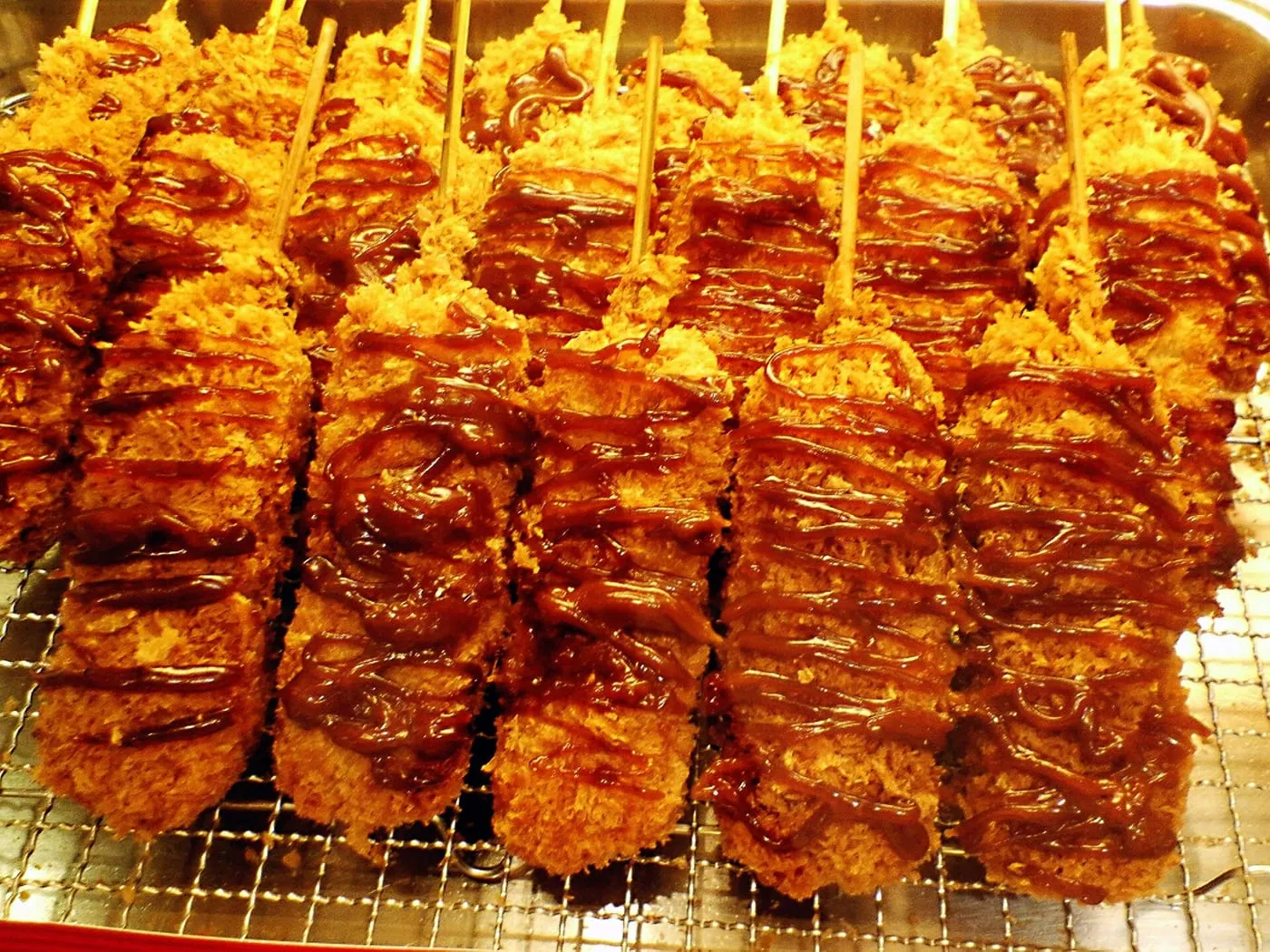
Deep-fried kushikatsu skewers glazed with sauce on a draining rack. Photo: OiMax, Wikimedia Commons, CC BY 2.0.
Essential skewers to order:
- Gyukatsu (Kushi-katsu): Tender diced beef. In Osaka, ordering “kushikatsu” without specifying an ingredient gets you this classic beef skewer (typically 120 yen to 150 yen).
- Butabara: Succulent pork belly alternating with pieces of Japanese leek.
- Uzura: Hard-boiled quail eggs coated in batter; the egg white turns firm while the yolk stays creamy (120 yen).
- Renkon: Thick slice of crunchy lotus root with a nutty, earthen flavour (120 yen to 150 yen).
- Beni Shoga: A large slice of red pickled ginger. A uniquely Osaka speciality with a pungent, spicy, and acidic kick that cuts through fried fat.
- Ebi: Whole king prawn with tail, fried until the shell is sweet and crunchy (300 yen to 500 yen).
- Cheese / Camembert: Gooey melted cheese wrapped in a crisp crust.
- Asparagus: A whole spear of green asparagus flash-fried until tender (200 yen to 250 yen).
The essential side: Doteyaki
No kushikatsu session in Shinsekai is complete without doteyaki (typically 350 yen to 450 yen for 3 skewers).
Pieces of beef sinew and tendon (suji) are simmered for hours in large bubbling cast-iron cauldrons on the front counter with white Kyoto miso, mirin, sake, and dashi. The tendon dissolves into melt-in-the-mouth, collagen-rich morsels coated in sweet, sticky miso glaze, garnished with chopped scallions and a sprinkle of shichimi togarashi (seven-spice chilli).
Raw cabbage: not just a sauce spoon
The bowls of raw green cabbage leaves served at every seat are not merely a vehicle for sauce. Raw cabbage contains high levels of glutamine and vitamin U (S-methylmethionine), which protects the stomach lining and aids digestion when eating deep-fried food. Osakans crunch on raw cabbage leaves between skewers to refresh the palate.
The top kushikatsu bars in Shinsekai
Kushikatsu Daruma Shinsekai Sohonten
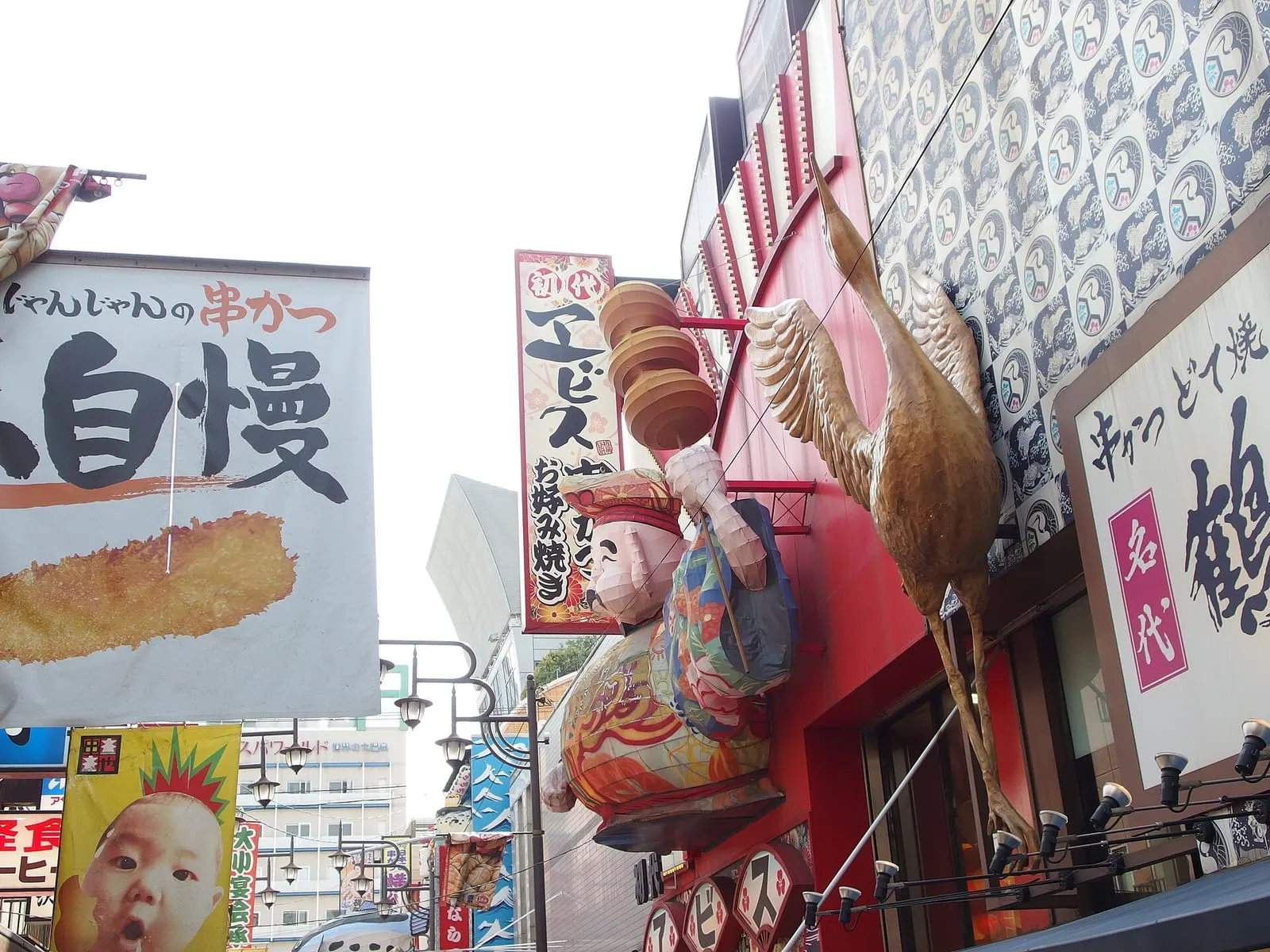
Kushikatsu restaurant signs on a Shinsekai street, including a giant skewer banner. Photo: Guilhem Vellut, Wikimedia Commons, CC BY 2.0.
2-3-9 Ebisu-higashi, Naniwa-ku · Open daily 11:00 to 22:30 · Cards and cash · Daruma site
- The vibe: The 1929 birthplace of kushikatsu. Look for the famous three-dimensional statue of founder Katsue Sakai’s grimacing, scowling face brandishing two crossed skewers above the doorway. The interior is a compact 12-seat wooden counter.
- What to order: The Shinsekai Set (9 skewers plus doteyaki, 1,600 yen), featuring beef, prawn, quail egg, sausage, and lotus root.
- The deciding factor: The original batter recipe is fried in refined beef tallow, creating an exceptionally crisp, golden shell with zero greasiness.
Yaekatsu
3-4-13 Ebisu-higashi (Janjan Yokocho) · Open 10:30 to 20:30, closed Thursdays · Cash only
- The vibe: Located in the narrow, lantern-lit arcade of Janjan Yokocho. Yaekatsu occupies two facing shopfronts and consistently draws a queue of local devotees and travellers waiting along the centre of the alley.
- What to order: Beef skewers (3 skewers for 450 yen), fresh tiger prawn (ebi, 500 yen), and tender boiled octopus skewers, alongside their acclaimed white-miso doteyaki (3 skewers for 450 yen).
- The deciding factor: Yaekatsu adds whipped egg and grated mountain yam into its batter mixture, yielding an airy, slightly puffed crust that provides a satisfying contrast to the tender meat.
Tengu
3-4-12 Ebisu-higashi (Janjan Yokocho) · Open 10:30 to 21:00, closed Mondays · Cash only
- The vibe: Situated directly opposite Yaekatsu in Janjan Yokocho, Tengu offers a quintessential Showa-era drinking atmosphere. Diners sit around a horseshoe-shaped counter watching gigantic iron pans of beef tendon simmer on the counter edge.
- What to order: Gyukatsu beef skewers (120 yen each), boiled quail eggs (120 yen), and skewers of miso-glazed doteyaki (120 yen).
- The deciding factor: The skewers are slightly larger and heartier than at Yaekatsu, and prices remain remarkably budget-friendly, making it a staple for traditional bar-crawlers.
Kushikatsu Echigoya
2-4-5 Ebisu-higashi, Naniwa-ku · Open 11:00 to 21:00, closed Wednesdays · Cash only
- The vibe: A quieter, family-run counter tucked a few paces off the main neon thoroughfares of Shinsekai.
- What to order: Seasonal vegetable skewers, including shiitake mushrooms, Japanese sweet potato, and fresh seasonal asparagus.
- The deciding factor: Less crowded than Daruma or Yaekatsu, Echigoya offers meticulous frying technique where the natural flavour of seasonal vegetables shines through the light panko crust.
Kushikatsu Oumi
2-3-18 Ebisu-higashi, Naniwa-ku · Open daily 11:00 to 22:00 · Cards and cash · Oumi site
- The vibe: A multi-level restaurant offering both counter seating and rooftop terrace tables directly facing the illuminated steel spire of Tsutenkaku Tower.
- What to order: The Oumi Special Assortment (10 skewers, 1,800 yen), featuring seasonal seafood and Camembert cheese skewers.
- The deciding factor: The rooftop terrace provides a nighttime photo backdrop in Shinsekai while you enjoy cold beer and hot skewers.
How to plan your visit
Shinsekai’s kushikatsu bars open early, with most counters welcoming guests by 10:30 or 11:00 in the morning. Visiting between 11:30 and 14:00 or after 17:30 means encountering queues at popular spots like Yaekatsu and Tengu; arriving in mid-afternoon (14:30 to 16:30) allows you to walk straight into most counters without waiting.
Pair your meal with a visit to the top of Tsutenkaku Tower or follow the complete Shinsekai and Tennoji walk, which guides you from the skewers of Janjan Yokocho through Tennoji Park to the historic grounds of Shitennoji Temple. For a complete citywide guide to dining, explore where to eat in Osaka.
Common questions
What is the no double dipping rule in kushikatsu?
The rule of nido-zuke kinshi means you must dip your freshly fried skewer into the communal sauce container only once before taking a bite. Because the sauce tray is shared between all diners, dipping a skewer that has touched your mouth is strictly prohibited.
How do you add more sauce to a kushikatsu skewer after biting it?
Take an unbitten leaf of the free raw cabbage provided on the counter, dip the cabbage into the communal sauce tub like a spoon, and drizzle the sauce over your skewer. Never dip cabbage that you have already bitten.
What is kushikatsu made of?
Kushikatsu consists of bite-sized pieces of beef, pork, chicken, seafood (prawn, squid, scallop), and vegetables (lotus root, onion, asparagus, pickled red ginger) skewered on bamboo sticks, coated in fine panko breadcrumbs, and flash-fried in hot oil.
Where was kushikatsu invented in Osaka?
Kushikatsu was invented in 1929 by Katsue Sakai, the founder of Kushikatsu Daruma in Shinsekai, as an inexpensive, quick, and calorie-rich meal for local manual labourers and dockers.