In this guide
The Short Version: Founded in 593 AD by Prince Shotoku, Shitennoji is Japan’s oldest officially administered Buddhist temple. The vast outer precincts are free to explore, while the inner walled Central Complex (500 yen) houses a climbable five-storey pagoda and the main hall (Kondo). Do not miss the tranquil Gokurakujodo stroll garden (300 yen) or the massive antique and craft flea market held on the 21st and 22nd of each month. Take the Tanimachi Line to Shitennoji-mae Yuhigaoka Station, a five-minute walk from the north gate.
While Tokyo’s premier temple Senso-ji in Asakusa was founded in 645 AD, Osaka’s Shitennoji predates it by half a century. Established in 593 AD by Prince Shotoku (Shotoku Taishi)—the imperial regent who championed the introduction of Buddhism to ancient Japan—Shitennoji was dedicated to the Shitenno, the Four Heavenly Kings of Buddhist cosmology who guard the world against evil.
Though fires, typhoons, and Second World War air raids destroyed the wooden halls multiple times across the centuries, the complex has always been meticulously reconstructed to its original 6th-century Asuka-period blueprint.
Ticket prices and opening hours
The outer temple precinct, cemetery, and turtle ponds are open to the public daily without an entry ticket. Tickets are purchased at separate kiosks at the gates of the three enclosed sections.
| Section | Adult admission | Student admission (High school / Uni) | Junior / Elementary |
|---|---|---|---|
| Outer Temple Grounds | Free | Free | Free |
| Central Complex (Chushin Garan) | 500 yen | 300 yen | Free |
| Gokurakujodo Garden | 300 yen | 200 yen | 200 yen |
| Treasure House (Homotsu-kan) | 500 yen | 300 yen | Free |
Grounds gates open from 8:30 to 16:30 between April and September, and from 8:30 to 16:00 between October and March. The Gokurakujodo Garden stops admitting visitors 30 minutes before closing time.
Central Temple Complex (Chushin Garan)
The heart of Shitennoji demonstrates the classic “Shitennoji-style” temple layout (garan), derived directly from early Chinese and Korean Buddhist architecture. The buildings are aligned along a strict south-to-north axis enclosed by a roofed cloister corridor:
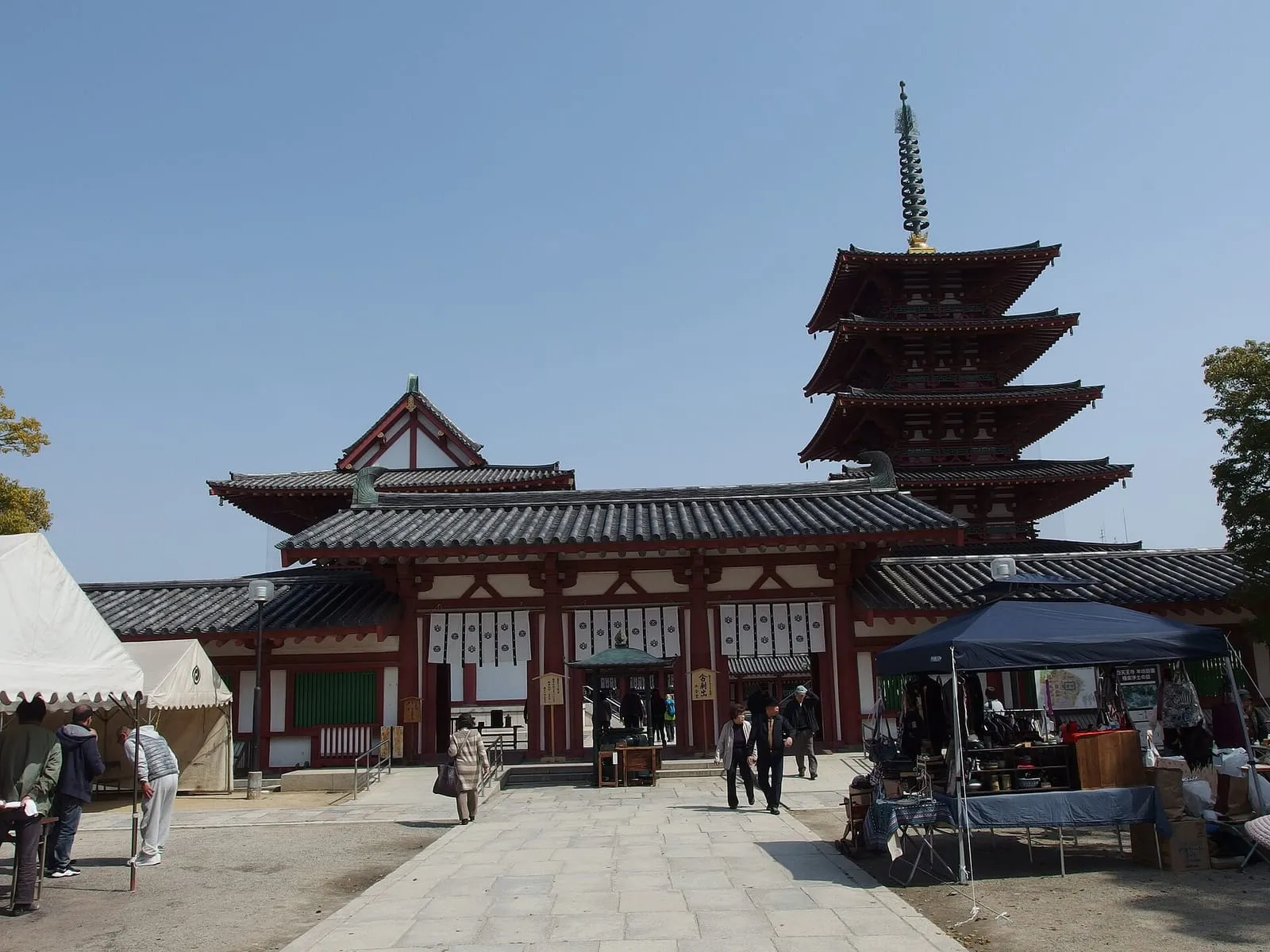
The five-storey pagoda and a red-timbered hall at Shitennoji, with market stalls in the foreground. Photo: Guilhem Vellut, Wikimedia Commons, CC BY 2.0.
- Chumon (Middle Gate): Flanked by two fierce red Nio guardian statues protecting the sanctuary from malicious spirits.
- Gojuno-to (Five-Storey Pagoda): Rising 39 metres, this elegant vermilion pagoda can be climbed inside via a narrow, spiralling staircase. Visitors can ascend past memorial plaques to reach the upper chamber, which houses sacred Buddhist relics. Remove your shoes at the entrance.
- Kondo (Main Golden Hall): The sacred sanctuary enshrining Prince Shotoku’s patron deity, the Guze Kannon (Bodhisattva of Compassion), flanked by statues of the Four Heavenly Kings. Murals depicting the life of the historical Buddha decorate the interior walls.
- Kodo (Lecture Hall): The gathering space where monks studied Buddhist scriptures, containing monumental statues of Amida Buddha and the Eleven-Headed Kannon.
Gokurakujodo Garden
Tucked away in the northeastern corner of the temple grounds, the Gokurakujodo Garden represents the Western Pure Land of Amida Buddha.
Designed during the early Edo period, this traditional Japanese stroll garden (chisen kaiyushiki teien) is arranged around two natural spring-fed ponds: Rurikou-no-ike and Gokuraku-no-ike. Stone lanterns, wooden footbridges, weeping willows, cherry trees, and Japanese maples frame gentle streams. In early summer, bright irises and lotus blossoms cover the pond surfaces, offering a quiet counterpoint to the busy temple avenues.
Stone Torii and the Turtle Pond
- Ishino Torii (Stone Gate): Standing at the western approach since 1294, this weathered granite torii is one of the oldest existing stone torii gates in Japan. It illustrates the syncretic fusion of Shinto and Buddhist traditions (shinbutsu shugo), serving as the symbolic western portal leading toward the Buddhist Pure Land.
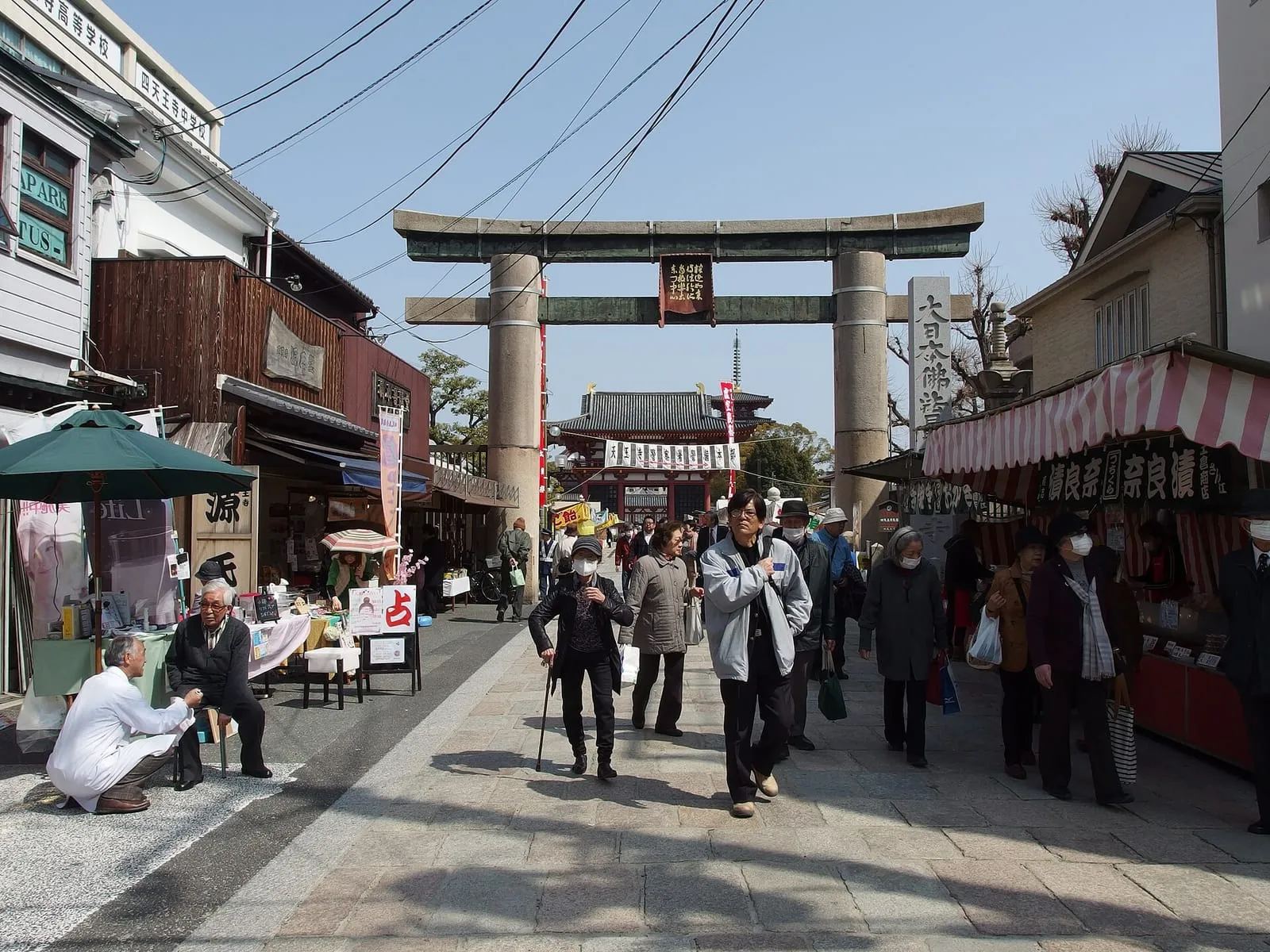
The stone torii on the approach to Shitennoji, with market stalls along the street. Photo: Guilhem Vellut, Wikimedia Commons, CC BY 2.0.
- Kame-no-ike (Turtle Pond): Just inside the western entrance, stone platforms in this large rectangular pond are crowded with hundreds of basking Japanese pond turtles and red-eared sliders. Visitors often gather on the stone bridge to watch them.
- Rokujido Hall: Standing above the pond, this National Important Cultural Property features a stone stage (Ishi Butai) where ancient court dance and music (bugaku) has been performed since the Heian period.
The monthly flea market (21st and 22nd)
If your travel dates coincide with the 21st or 22nd of any month, Shitennoji hosts one of Osaka’s largest open-air flea markets (Daishi-e and Taishi-e), commemorating the memorial days of Kobo Daishi and Prince Shotoku.
Over 300 market vendors set up stalls along the temple avenues from 8:30 to 16:00:
- Vintage kimono and fabrics: Second-hand silk kimono, haori jackets, obi sashes, and indigo-dyed cotton textiles.
- Antiques and ceramics: Lacquerware boxes, tea ceremony utensils, iron kettles (tetsubin), retro Showa-era toys, and vintage calligraphy scrolls.
- Street food stalls: Freshly griddled takoyaki, piping-hot yakisoba, dango rice dumplings, and sweet roasted sweet potatoes.
Prices at the market are negotiable, particularly toward mid-afternoon on the 22nd.
How to get to Shitennoji
- Subway: Take the Osaka Metro Tanimachi Line to Shitennoji-mae Yuhigaoka Station. Take Exit 4 and walk 5 minutes south down the approach street to enter through the North Gate.
- Tennoji Station: If arriving on the JR Yamatoji Line, JR Osaka Loop Line, or Osaka Metro Midosuji Line, walk 12 minutes north from Tennoji Station’s north exit through the park to the South Gate.
- Connecting walks: Shitennoji forms stop 4 on the Shinsekai and Tennoji walk, which links Tsutenkaku Tower and Janjan Yokocho directly to the temple and onwards to Abeno Harukas 300 Observatory. For another significant historic religious site in Osaka, visit Sumiyoshi Taisha Shrine in the city’s southwest.
Common questions
Is Shitennoji Temple free to visit?
The spacious outer temple grounds and stone torii gate are completely free to enter at any time of day. Paid tickets are required only for the walled Central Temple Complex (500 yen, free on the 21st and 22nd of each month), the Gokurakujodo Garden (300 yen), and the Treasure House (500 yen).
Why is Shitennoji Temple historically significant?
Founded in 593 AD by Prince Shotoku, Shitennoji is recognized as Japan's first officially administered Buddhist temple, established when Buddhism was initially adopted by the imperial court.
When is the Shitennoji flea market held?
The temple flea market takes place on the 21st and 22nd of every month, commemorating Kobo Daishi and Prince Shotoku. Hundreds of stalls sell antiques, vintage kimono, ceramics, tools, and traditional street snacks.
How do you get to Shitennoji Temple?
Take the Osaka Metro Tanimachi Line to Shitennoji-mae Yuhigaoka Station (Exit 4), which is a 5-minute walk north of the temple. Alternatively, Tennoji Station (JR, Midosuji, and Tanimachi lines) is a 12-minute walk south.