In this guide
The Short Version: Known as Japan’s kitchen (Tenka no Daidokoro), Osaka is defined by its culture of kuidaore—eating until you drop. This guide covers restaurants across Dotonbori, Namba, Umeda, Shinsekai, Fukushima, and Tennoji. Head to Wanaka or Kukuru for takoyaki, Mizuno or Kiji for teppan okonomiyaki, Daruma or Yaekatsu for kushikatsu, Usami-tei Matsubaya for the historic birthplace of kitsune udon, Moeyo Mensuke for duck ramen, and Sora Tsuruhashi for charcoal-grilled horumon.
In Edo-period Japan, Osaka earned the title Tenka no Daidokoro (the Nation’s Kitchen) as the central trading port where rice, kombu kelp, and seafood from across Japan were gathered, auctioned, and processed. That commercial abundance created a discerning dining public and perfected the clear, umami-rich kelp dashi that underpins western Japanese cooking.
Below, the restaurants are arranged by category and neighbourhood. For each, the entry gives what to order, what the dining room is like, and the practical factor that determines whether you should visit.
How to eat in Osaka: practical rules
- Cash: Traditional teppan griddles, ramen ticket machines, and kushikatsu counters in Janjan Yokocho operate on cash only. Keep 1,000 yen notes and 100 yen coins ready. Seven Bank ATMs inside 7-Eleven accept international bank cards.
- Tipping: Tipping is not practised anywhere in Osaka. If you leave money on a counter, staff will run into the street to return it.
- Otoshi: Traditional izakayas typically serve a small appetiser (otoshi) when you sit down, charging 300 yen to 500 yen per person in place of a seating fee.
- Kushikatsu dipping rule: Communal sauce containers on counters are shared between customers. Dip your skewer once only (nido-zuke kinshi). Never dip a bitten skewer back into the shared tub. Use free raw cabbage leaves as a spoon to transfer extra sauce.
Takoyaki: octopus balls
Takoyaki is Osaka’s signature soul food: crisp-skinned spherical wheat batter dumplings filled with tender boiled octopus, red pickled ginger, and tempura scraps, brushed with sweet sauce and kewpie mayonnaise, and dusted with dancing bonito flakes.
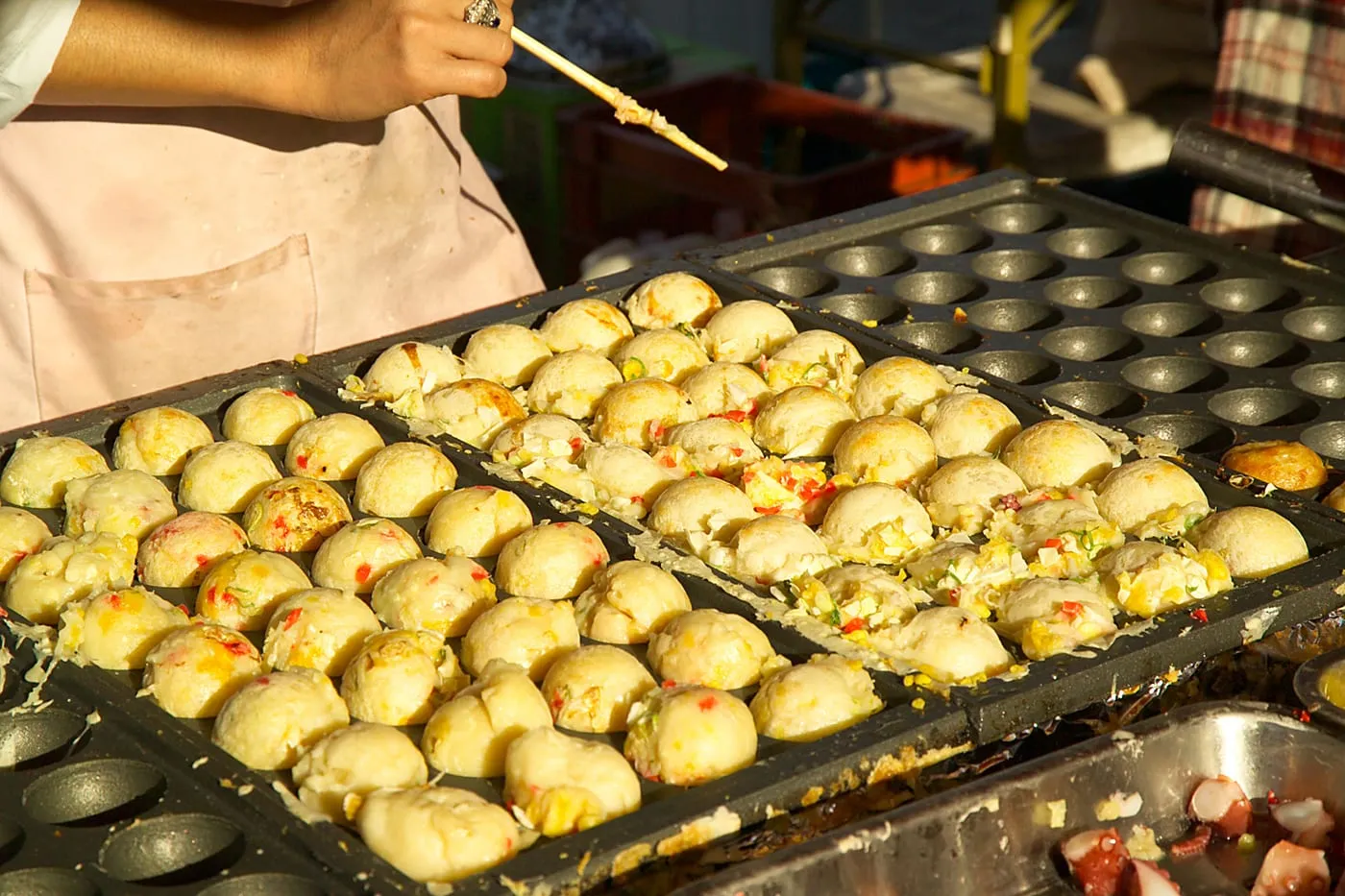
Takoyaki being turned with metal picks on an iron griddle. Photo: Fg2, Wikimedia Commons, Public domain.
Takoyaki Doraku Wanaka Sennichimae
Namba · 11-19 Nanbasennichimae, Chuo-ku · Open daily 10:00 to 21:00 · Cash and IC cards · Wanaka site
- What to order: The Oiri plate (700 yen for 8 pieces), which offers a four-flavour tasting set: sweet brown sauce, soy sauce with green scallions, spicy salt, and the rotating seasonal special. If on the go, order Tako-sen (250 yen), two takoyaki squished between a pair of crunchy pink shrimp crackers.
- What it’s like: An energetic open-fronted street stall next to Namba Grand Kagetsu comedy theatre. You order at the counter watching chefs juggle dozens of balls across six sizzling copper griddles, then take your paper boat into the two-storey indoor seating area at the back.
- The deciding factor: The dashi flavour in the batter is exceptionally rich, producing a paper-thin exterior that gives way to a creamy, molten centre.
Dotonbori Kukuru Konamon Museum
Dotonbori · 1-6-12 Dotonbori, Chuo-ku · Open Monday to Friday 11:00 to 22:00, Saturday and Sunday 10:00 to 22:00 · Cards and cash · Kukuru site
- What to order: Bikkuri Takoyaki (surprising takoyaki, 1,200 yen for 8 pieces), featuring giant octopus tentacles protruding theatrically from the dumpling shells, splashed with white wine on the griddle.
- What it’s like: Located beneath a colossal three-dimensional red octopus sculpture extending out over the Dotonbori canal walkway. The basement level offers a seated dining counter, while the upper floor hosts a food museum and hands-on takoyaki workshops.
- The deciding factor: The octopus pieces here are significantly larger than at neighbouring stalls, cut fresh daily with a firm, tender bite.
Kogaryu Honten
Shinsaibashi / America-mura · 2-18-4 Nishishinsaibashi, Chuo-ku · Open daily 11:00 to 20:00 · Cash only · Kogaryu site
- What to order: Sauce Mayo takoyaki (500 yen for 8 pieces) or Negipon (600 yen), takoyaki buried beneath a mountain of chopped green scallions and splashed with citrus ponzu.
- What it’s like: A pure takeaway counter on the corner of Triangle Park in America-mura. There is no indoor seating; diners balance their paper trays on the concrete benches of the park alongside local skateboarders and shoppers.
- The deciding factor: Kogaryu pioneered the pairing of Japanese mayonnaise with takoyaki in the 1970s. Their custom apple-cider-vinegar mayonnaise is lighter and sweeter than standard Kewpie.
Aizuya Umeda
Umeda · Umeda 3-2-136, Kita-ku (inside Eki Marche Osaka, JR Osaka Station) · Open daily 10:00 to 22:00 · Cards and cash · Aizuya site
- What to order: Original Ganso Takoyaki (650 yen for 12 bite-sized pieces) or Rajioyaki (750 yen for 12 pieces), filled with stewed beef tendon and konjac jelly.
- What it’s like: A tidy, 10-seat counter tucked inside the Eki Marche retail concourse directly beneath JR Osaka Station.
- The deciding factor: Aizuya is the historical inventor of takoyaki, founded in 1935. Uniquely, their balls are served plain with zero sauce and zero mayonnaise—the dashi, soy, and beef stock are concentrated inside the batter itself.
Okonomiyaki: savoury teppan pancakes
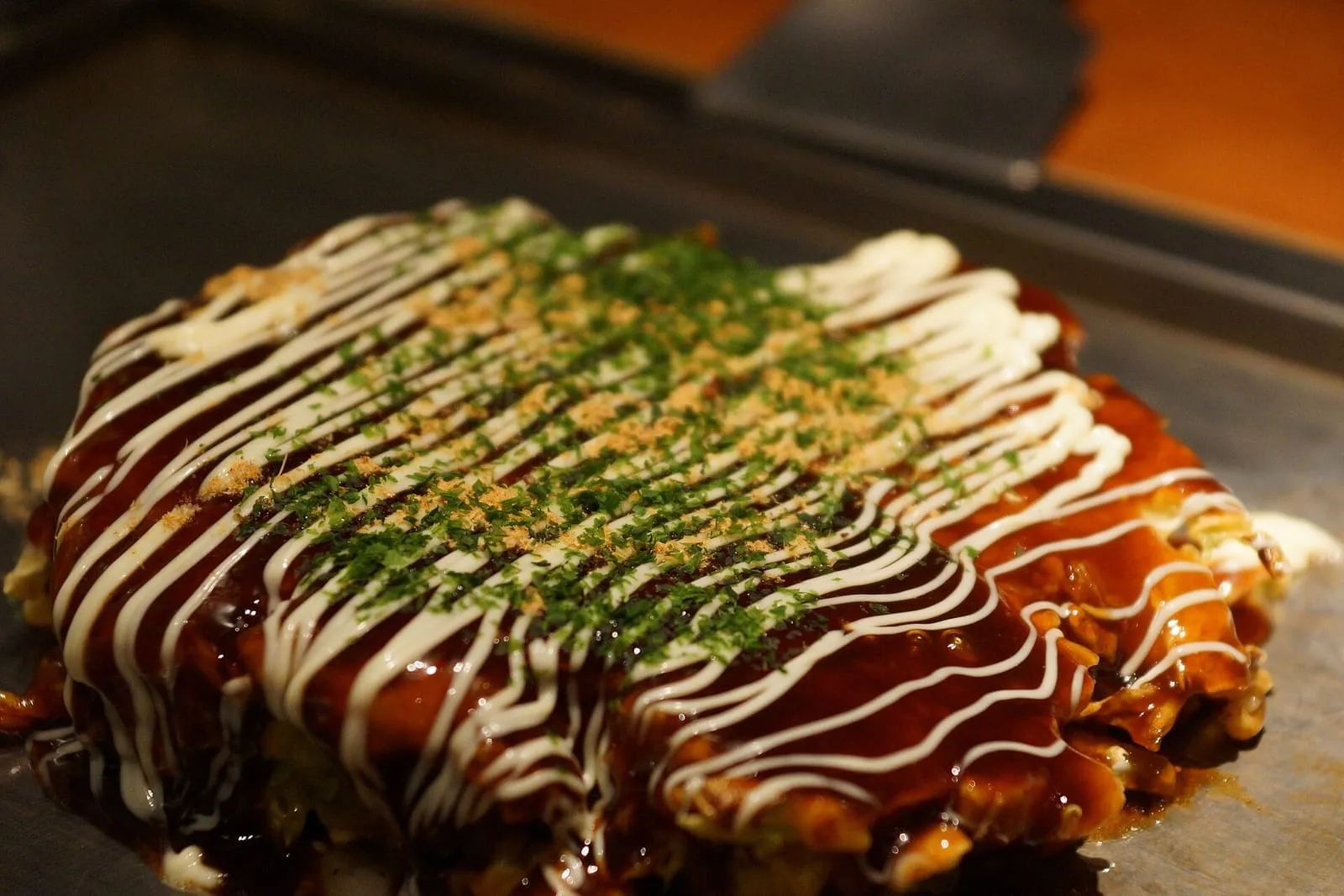
Osaka-style okonomiyaki blends finely shredded cabbage, grated mountain yam (nagaimo), egg, and dashi into a thick batter that cooks on flat teppan griddles before being painted with rich brown okonomiyaki sauce, Japanese mayonnaise, seaweed powder (aonori), and bonito flakes.
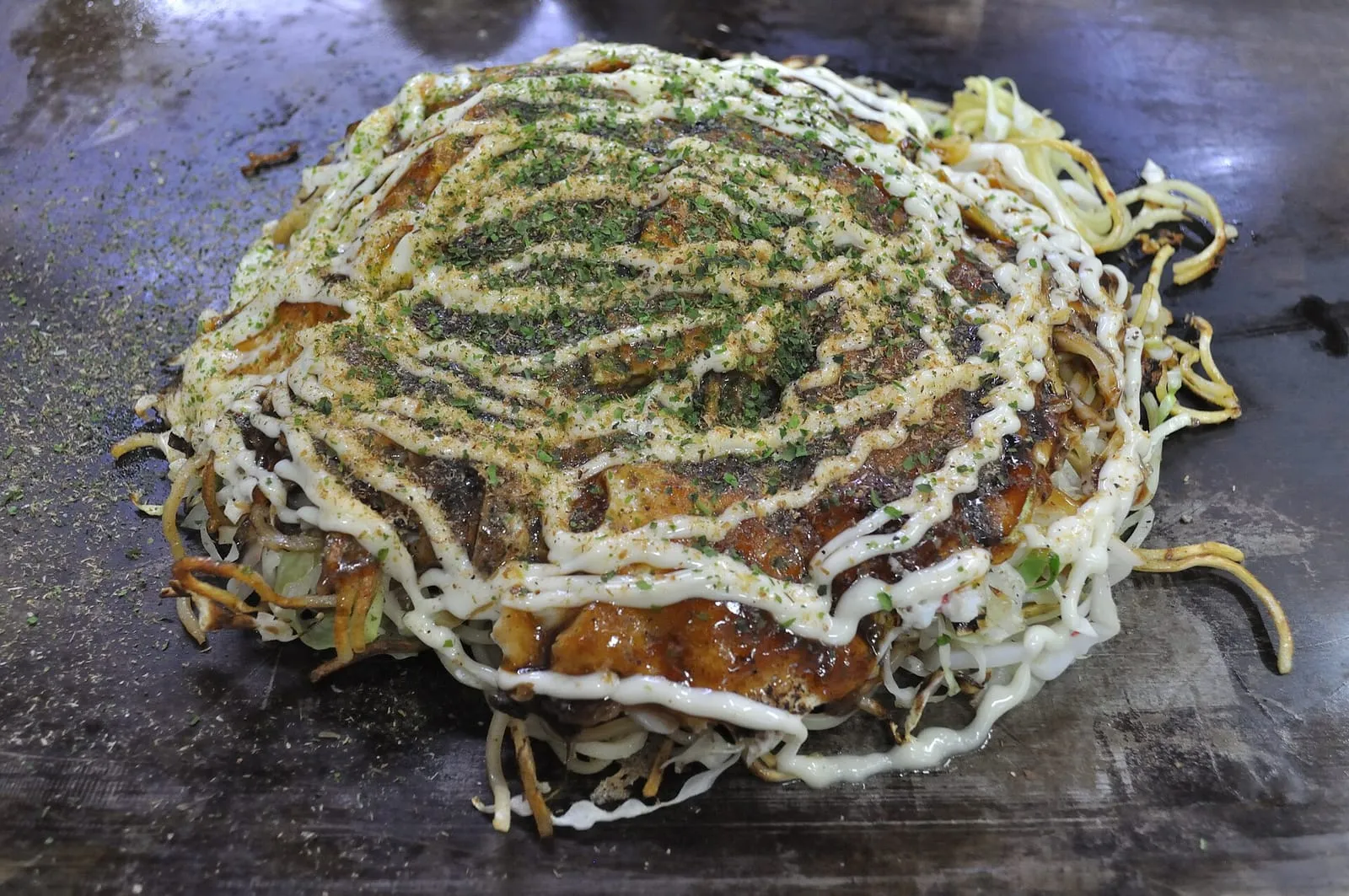
A modan-yaki, an okonomiyaki piled with yakisoba, striped with mayonnaise on a teppan. Photo: Ocdp, Wikimedia Commons, CC0.
Mizuno
Dotonbori · 1-4-15 Dotonbori, Chuo-ku · Open daily 11:00 to 21:30 · Cash only · Mizuno site
- What to order: Yamaimo-yaki (1,700 yen), an okonomiyaki made with 100% grated mountain yam rather than wheat flour, griddled with thick pork belly slices, fresh scallops, and succulent prawns.
- What it’s like: A family-run teppan restaurant operating since 1945. Diners sit around a ground-floor teppan counter watching chefs flip pancakes directly onto their personal hotplate.
- The deciding factor: Queues regularly exceed 45 minutes along the street, but staff take your order while waiting in line, and the yam-only pancake has an impossibly fluffy, custardy texture.
Kiji Umeda
Umeda · 9-20 Kakuda-cho, Kita-ku (Shin Umeda Shokudogai 1F/2F) · Open 11:30 to 21:30, closed Sundays · Cash only
- What to order: Modan-yaki (modern okonomiyaki, 1,000 yen), which layers thick yakisoba noodles bound with beaten egg and pork belly into the centre of the pancake.
- What it’s like: A cramped, atmospheric 15-seat nook in the noisy warren of Shin Umeda Shokudogai beneath the railway tracks. Master chef Sugimoto presides over the sizzling griddle with infectious warmth, greeting guests like old friends.
- The deciding factor: The incorporation of shiso leaf and peppery dashi adds a peppery edge to the rich noodles in the modan-yaki, the pancake topped with yakisoba.
Ajinoya
Namba · 1-7-16 Nanba, Chuo-ku · Open Tuesday to Sunday 11:00 to 22:00, closed Mondays · Cards and cash · Ajinoya site
- What to order: The Ajinoya Mix (1,600 yen), laden with pork, squid, shrimp, and octopus, paired with a plate of griddled Yakisoba (1,200 yen) made with thick, springy noodles.
- What it’s like: A multi-storey, brightly lit restaurant just around the corner from Osaka Shochikuza theatre, Each booth has its own sunken teppan plate.
- The deciding factor: The proportion of shredded cabbage to batter is higher here than at rival shops, yielding an airy, light pancake that doesn’t feel heavy even after a full meal.
Fukutaro
Namba / Sennichimae · 2-5-2 Sennichimae, Chuo-ku · Open Monday to Friday 17:00 to 23:00, Saturday and Sunday 12:00 to 23:00 · Cards and cash · Fukutaro site
- What to order: Suji Negiyaki (1,380 yen), an okonomiyaki variation made almost exclusively of green scallions (negi) and slow-braised sweet beef tendon (suji), brushed with light soy sauce and lemon juice rather than sweet brown sauce.
- What it’s like: A long, curved 30-seat horse-shoe teppan counter where everyone faces the chefs. The smell of searing scallions and soy permeates the room.
- The deciding factor: Fukutaro specialises in negiyaki, the thin pancake heaped with spring onion. The tender gelatinous beef tendon melts smoothly against the crisp, charred onions.
Kushikatsu: deep-fried skewers
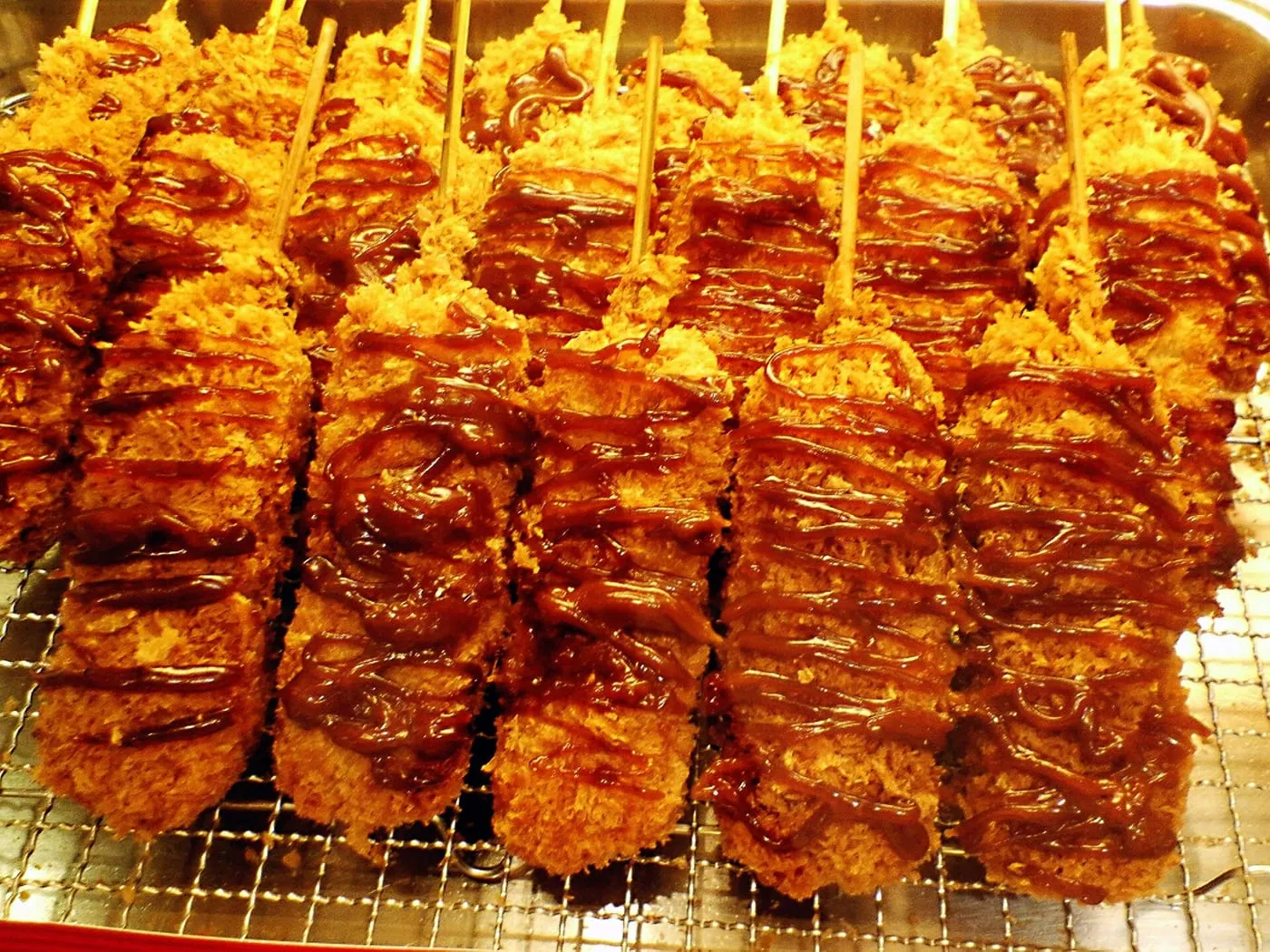
Born in 1929 in Shinsekai, kushikatsu consists of meat, seafood, and vegetables skewered on bamboo sticks, dusted in fine panko breadcrumbs, flash-fried in hot oil, and dipped into savoury sauce.
Ganso Kushikatsu Daruma Shinsekai Sohonten
Shinsekai · 2-3-9 Ebisu-higashi, Naniwa-ku · Open daily 11:00 to 22:30 · Cards and cash · Daruma site
- What to order: The Shinsekai Set (9 skewers, 1,600 yen), featuring classic beef skewer (ganso kushikatsu), natural prawn, quail egg, asparagus, chicken meatball, and lotus root, alongside a bowl of miso-braised beef tendon (doteyaki).
- What it’s like: The original 1929 birthplace of kushikatsu, marked by a giant statue of an angry chef brandishing crossed skewers above the door. Seating is around a tight, bustling 12-seat wooden counter.
- The deciding factor: The batter is microscopic and feather-light, fried in pure beef tallow to produce a crisp, non-greasy crunch.
Yaekatsu
Shinsekai / Janjan Yokocho · 3-4-13 Ebisu-higashi, Naniwa-ku · Open 10:30 to 20:30, closed Thursdays · Cash only
- What to order: Skewered beef cutlets (3 skewers for 450 yen), fresh tiger prawn (ebi, 500 yen), and tender boiled octopus skewers, paired with a bowl of doteyaki (3 skewers for 450 yen) simmered with sweet Kyoto white miso.
- What it’s like: A beloved counter institution that occupies two facing storefronts inside Janjan Yokocho. Diners sit shoulder-to-shoulder on round vinyl stools as veteran fry cooks pull bubbling skewers straight from sizzling oil vats.
- The deciding factor: Yaekatsu adds beaten egg and yam to its batter, causing the crust to puff softly around the ingredients while retaining a golden crispness.
Tengu
Shinsekai / Janjan Yokocho · 3-4-12 Ebisu-higashi, Naniwa-ku · Open 10:30 to 21:00, closed Mondays · Cash only
- What to order: Gyukatsu beef skewers (120 yen each), boiled quail eggs (120 yen), and giant skewers of miso-glazed doteyaki (120 yen).
- What it’s like: Directly across the arcade from Yaekatsu, Tengu features an atmospheric horseshoe wooden counter where patrons sip draft beer and cold sake while watching enormous iron vats of beef tendon bubble on the counter edge.
- The deciding factor: Skewers are slightly thicker and heartier than at Yaekatsu, and prices remain exceptionally economical, making it a favourite among local regulars.
Kitsune udon: born in Osaka
Thick, chewy wheat flour udon noodles swimming in a pristine, golden broth made from Rishiri kombu kelp and dried bonito flakes, topped with a large rectangular piece of sweet, simmered fried tofu (aburaage).
Usami-tei Matsubaya
Minami-senba / Shinsaibashi · 3-8-1 Minamisenba, Chuo-ku · Open 11:00 to 19:00, closed Sundays and public holidays · Cash only · Matsubaya site
- What to order: The Original Kitsune Udon (650 yen) or Ojiya Udon (850 yen), which serves udon noodles and a bowl of rice cooked together in the same piping-hot clay pot broth.
- What it’s like: A tranquil, historic neighbourhood noodle shop founded in 1893. The dining room features dark timber tables, paper lanterns, and calligraphy scrolls, offering a calm contrast to the nearby Shinsaibashi shopping arcade.
- The deciding factor: Usami-tei Matsubaya is the birthplace of kitsune udon. In 1893, founder Usami Matsutaro started serving sweet fried tofu as a side dish for his udon; customers began sliding the tofu directly into their broth, creating the recipe now eaten across Japan.
Dotonbori Imai
Dotonbori · 1-7-22 Dotonbori, Chuo-ku · Open 11:30 to 21:30, closed Wednesdays · Cards and cash · Imai site
- What to order: The classic Kitsune Udon (950 yen) with two pieces of thick fried tofu, or Nabeyaki Udon (1,850 yen) served bubbling in an iron pot with chicken, shiitake mushrooms, and tempura prawn.
- What it’s like: A stunning multi-storey oasis of serenity standing right in the middle of neon-drenched Dotonbori. The entrance features green bamboo stalks, stone paving, and a traditional Japanese tiled roof.
- The deciding factor: Imai’s broth is renowned throughout Japan for its clarity and depth, brewed exclusively with Hokkaido Rishiri kombu and aged bonito flakes without artificial additives.
Ramen: classic Osaka bowls
While Tokyo leans toward dark soy sauce and Kyushu toward cloudy pork bone, Osaka offers distinct ramen interpretations ranging from sweet Napa cabbage broths to rich garlic-heavy bowls and refined duck chashu.
Kinryu Ramen Dotonbori
Dotonbori · 1-7-26 Dotonbori, Chuo-ku · Open 24 hours daily · Cash only (ticket machine)
- What to order: Standard Ramen (800 yen) or Chashu-men (1,050 yen) with extra sliced roast pork.
- What it’s like: An open-air, low-ceiling street corner counter marked by a giant three-dimensional green dragon writhing across the facade. Diners buy tickets at an automated machine and sit cross-legged on tatami mat platforms facing the street.
- The deciding factor: Open 24 hours every day, Kinryu is a late-night stop. Bowls of tonkotsu-chicken broth come with unlimited free self-serve sides of spicy garlic chives, kimchi, and crushed garlic.
Dotonbori Kamukura Sennichimae
Namba / Sennichimae · 1-7-25 Sennichimae, Chuo-ku · Open 10:00 to 07:00 next morning daily · Cash and IC cards (ticket machine) · Kamukura site
- What to order: Oishii Ramen (delicious ramen, 790 yen) or Tamago Ramen (with seasoned boiled egg, 920 yen).
- What it’s like: A bright, immaculate open kitchen where chefs in tall French-style white toque hats prepare bowls behind a pristine counter.
- The deciding factor: The broth was created in 1986 by a former French chef. Rather than heavy pork grease, the clear golden soup is infused with piles of sweet, simmered Napa cabbage, giving it a uniquely refreshing, savoury-sweet profile.
Moeyo Mensuke
Fukushima · 5-12-21 Fukushima, Fukushima-ku · Open Tuesday to Saturday 11:30 to 15:00 and 17:30 to 21:00, Sunday 11:30 to 16:00, closed Mondays · Cash only (ticket machine)
- What to order: Kishu Kamo Soba (Kishu duck ramen with seasoned egg, 1,150 yen) or Golden Shellfish Soba (hamaguri clam ramen, 1,100 yen).
- What it’s like: A minimalist 10-seat wooden counter in the hip culinary district of Fukushima. Jazz music plays in the background as chefs plate delicate bowls using wooden tweezers.
- The deciding factor: One of Osaka’s top-rated contemporary ramen shops. The broth pairs rich Kishu duck bones with aromatic soy sauce, topped with seared duck breast, roasted scallions, and thin bamboo shoots. Queues form 30 minutes before opening.
Yakiniku and Horumon: charcoal grilled beef
Osaka is the Japanese spiritual home of horumon (variety meats and offal), popularized by Korean immigrant communities in the Tsuruhashi district.
Sora Tsuruhashi
Tsuruhashi · 2-4-27 Shimosanbashicho, Tennoji-ku · Open Wednesday to Monday 17:00 to 23:00 (from 11:30 on weekends), closed Tuesdays · Cards and cash · Sora site
- What to order: Harami (beef skirt, 800 yen), Hoso (small intestine, 550 yen), Tsura-mi (beef cheek, 650 yen), and their signature sweet-spicy dipping sauce with a bowl of cold reimen noodles.
- What it’s like: Located in the smoky maze of Tsuruhashi’s Korean town. Seating is on round metal stools around small personal gas and charcoal tabletop grills beneath extraction hoods.
- The deciding factor: Portions are served in small, accessible plates with over 30 different cuts of beef and pork available.
Matsusaka Beef Yakiniku M Dotonbori
Dotonbori · 1-1-19 Nanba, Chuo-ku · Open daily 17:00 to 23:00 · Cards and cash · Yakiniku M site
- What to order: The Matsusaka Beef Tasting Course (from 8,500 yen per person), featuring five distinct cuts of A5-grade marbled Matsusaka wagyu beef.
- What it’s like: An upscale, private-room dining sanctuary nestled near Hozenji Yokocho, with dark wood screens and personal smoke-free charcoal grills.
- The deciding factor: M specializes exclusively in whole-carcass purchases of Matsusaka beef—one of Japan’s top three wagyu brands—offering rare prime cuts at reasonable prices compared to Tokyo steakhouses. Advance reservations via TableCheck are recommended.
Master izakayas, seafood and casual dining
Izakaya Toyo
Kyobashi · 3-2-26 Higashinodamachi, Miyakojima-ku · Open Tuesday, Wednesday, Friday 13:00 to 19:00, Saturday 12:00 to 19:00, closed Monday, Thursday, Sunday · Cash only
- What to order: The Tuna Cheek Set (maguro hoho-niku, 2,000 yen), freshly seared tuna cheek, fatty tuna sashimi (chutoro), and sea urchin (uni) with salmon roe (ikura).
- What it’s like: An open-air standing bar (tachinomi) situated on a gritty car park edge in Kyobashi. The charismatic owner, Toyo-san, cheerfully sears giant tuna fillets with a roaring hand-held blowtorch while dipping his bare hands in ice water to turn the meat.
- The deciding factor: World-renowned street dining energy, exceptionally generous seafood platters, and cold draft beer served from self-serve coolers.
Meishu Sakadokoro Banya
Namba / Ura-Namba · 2-11-30 Nanbanaka, Naniwa-ku · Open Monday to Saturday 17:00 to 23:00, closed Sundays · Cash only
- What to order: The chef’s seasonal sashimi platter (from 1,500 yen) and regional Kansai sake flights chosen by the master to match your dishes.
- What it’s like: An intimate, atmospheric wooden counter izakaya in the backstreets of Ura-Namba. Walls are lined with handwritten wooden sake plaques and seasonal market specials.
- The deciding factor: A true sake connoisseur’s haven with dozens of hard-to-find unpasteurized (namazake) sakes served at precise temperatures alongside impeccably fresh market fish.
Harukoma Sushi
Tenjinbashi · 5-5-2 Tenjinbashi, Kita-ku · Open 11:00 to 21:30, closed Tuesdays · Cash only
- What to order: Fatty tuna (otoro, 500 yen for 2 pieces), grilled eel (unagi, 400 yen), and salmon belly (salmon toro, 350 yen).
- What it’s like: A bustling, no-nonsense sushi counter inside Tenjinbashi-suji Shopping Street (Japan’s longest covered shopping arcade). Chefs shout orders across a refrigerated glass counter stacked with glistening fish fillets.
- The deciding factor: The fish cuts are cut double the thickness of standard Tokyo nigiri, offering good value for money without formal omakase pricing.
Kappo Kigawa
Hozenji Yokocho · 1-7-7 Dotonbori, Chuo-ku · Open Tuesday to Sunday 12:00 to 14:00 and 17:00 to 22:00, closed Mondays · Cards accepted · Advance reservation required
- What to order: The evening seasonal Kappo tasting menu (from 18,000 yen), celebrating seasonal Naniwa vegetables, Akashi sea bream, and seasonal dashi bowls.
- What it’s like: The flagship temple of Osaka-style kappo dining, founded in 1965 in the flagstone alley of Hozenji Yokocho. Diners sit at an L-shaped hinoki cypress counter conversing directly with master chefs as dishes are prepared to order.
- The deciding factor: Unlike rigid Kyoto kaiseki, Osaka kappo dining is informal, lively, and and tailored to guest preferences.
Hanakujira Honten
Fukushima · 2-8-2 Fukushima, Fukushima-ku · Open daily 16:30 to 23:00 · Cash only
- What to order: Simmered daikon radish (150 yen), soft-boiled egg (150 yen), cabbage rolls (300 yen), and Saezuri (simmered whale tongue, 700 yen).
- What it’s like: A cult open-fronted 10-seat counter beneath clear plastic curtains in Fukushima. A massive copper vat of steaming dashi bubbles on the counter, releasing an irresistible aroma of kombu and bonito.
- The deciding factor: The daikon radishes simmer for hours until they absorb the broth completely and cut effortlessly with wooden chopsticks.
Gyukatsu Motomura Namba
Namba · 3-3-1 Namba, Chuo-ku · Open daily 11:00 to 22:00 · Cards and cash
- What to order: The Gyukatsu Set with Barley Rice and Grated Yam (130g beef cutlet, 1,930 yen; 260g double cutlet, 2,760 yen).
- What it’s like: A cosy basement counter where each seat is equipped with a personal miniature stone hotplate fuelled by a tea light.
- The deciding factor: Tender beef sirloin is coated in fine breadcrumbs and flash-fried for only 60 seconds, leaving the meat rare inside. You sear each slice on your stone grill to your desired doneness before dipping in wasabi soy or mountain yam.
Torikizoku Dotonbori
Dotonbori · 1-6-15 Dotonbori, Chuo-ku (Com’s Building 3F) · Open daily 17:00 to 05:00 next morning · Cards and cash · Torikizoku site
- What to order: Torikizoku-yaki (skewered chicken thigh in sweet tare sauce), chicken meatballs with melted cheese (tsukune cheese), and draft beer.
- What it’s like: An energetic, multi-table yakitori chain with wooden booth partitions and touchscreen digital ordering tablets in English.
- The deciding factor: Born in Osaka in 1985, Torikizoku operates on a uniform flat-price menu where every single dish and drink costs exactly 370 yen (including tax). It is reliable, tasty, and open until the early morning hours.
Comparing Osaka and Tokyo dining
While dining in Tokyo often emphasizes specialized single-dish counters and formal omakase reservations (see where to eat in Tokyo), Osaka dining is fundamentally social, boisterous, and centred around the communal grill. Exploring our dedicated guides on the best takoyaki and okonomiyaki in Osaka and the Shinsekai kushikatsu guide will prepare you for the counter meals.
Common questions
What dishes must you eat in Osaka?
Osaka's defining regional dishes are takoyaki (battered octopus balls), okonomiyaki (savoury cabbage pancake), kushikatsu (deep-fried skewered meats and vegetables), kitsune udon (thick wheat noodles with sweet fried tofu), and horumon (grilled beef and pork offal).
What is kuidaore in Osaka food culture?
Kuidaore translates literally as 'eat until you drop' or 'ruin yourself through dining'. It reflects Osaka's historic merchant-class passion for spending lavishly on delicious food rather than on appearances.
Do Osaka restaurants accept credit cards?
Department store restaurants and larger chains accept cards and IC transit cards (like Icoca and Suica). However, street stalls in Dotonbori, historic okonomiyaki teppans, and Janjan Yokocho kushikatsu bars often take cash only.
Do you need to book restaurants in Osaka in advance?
Street stalls, ramen counters, and kushikatsu spots do not take reservations; you join a physical queue. High-end kappo, kaiseki, and top yakiniku venues like Matsusaka Beef M require reservations days or weeks ahead via TableCheck or hotel concierges.