In this guide
💡 The Short Version: Admission to the UNESCO-listed Imperial Citadel of Thang Long costs 100,000 VND a person and it is open every day, 08:00 to 17:00 (hoangthanhthanglong.vn). It sits at 19C Hoang Dieu in Ba Dinh. The ticket covers the main imperial sector, with the Doan Mon south gate, the carved 15th-century Kinh Thien stone dragons and the underground D67 bunker used by General Vo Nguyen Giap, and the excavation pits across Hoang Dieu street. On Fridays and Saturdays at 19:00 a night tour runs for 300,000 VND. Or book a tour: when you want an expert historian to navigate the 1,000-year dynastic relics and subterranean military command rooms, the Hanoi City Highlights Walking Tourad (from VND 699,800, 5 stars from 206 reviews) includes the citadel alongside Ba Dinh landmarks.
Occupying a compound in the Ba Dinh administrative district, the Imperial Citadel of Thang Long (Hoang Thanh Thang Long) was the political and military nerve centre of Vietnam for 13 uninterrupted centuries.
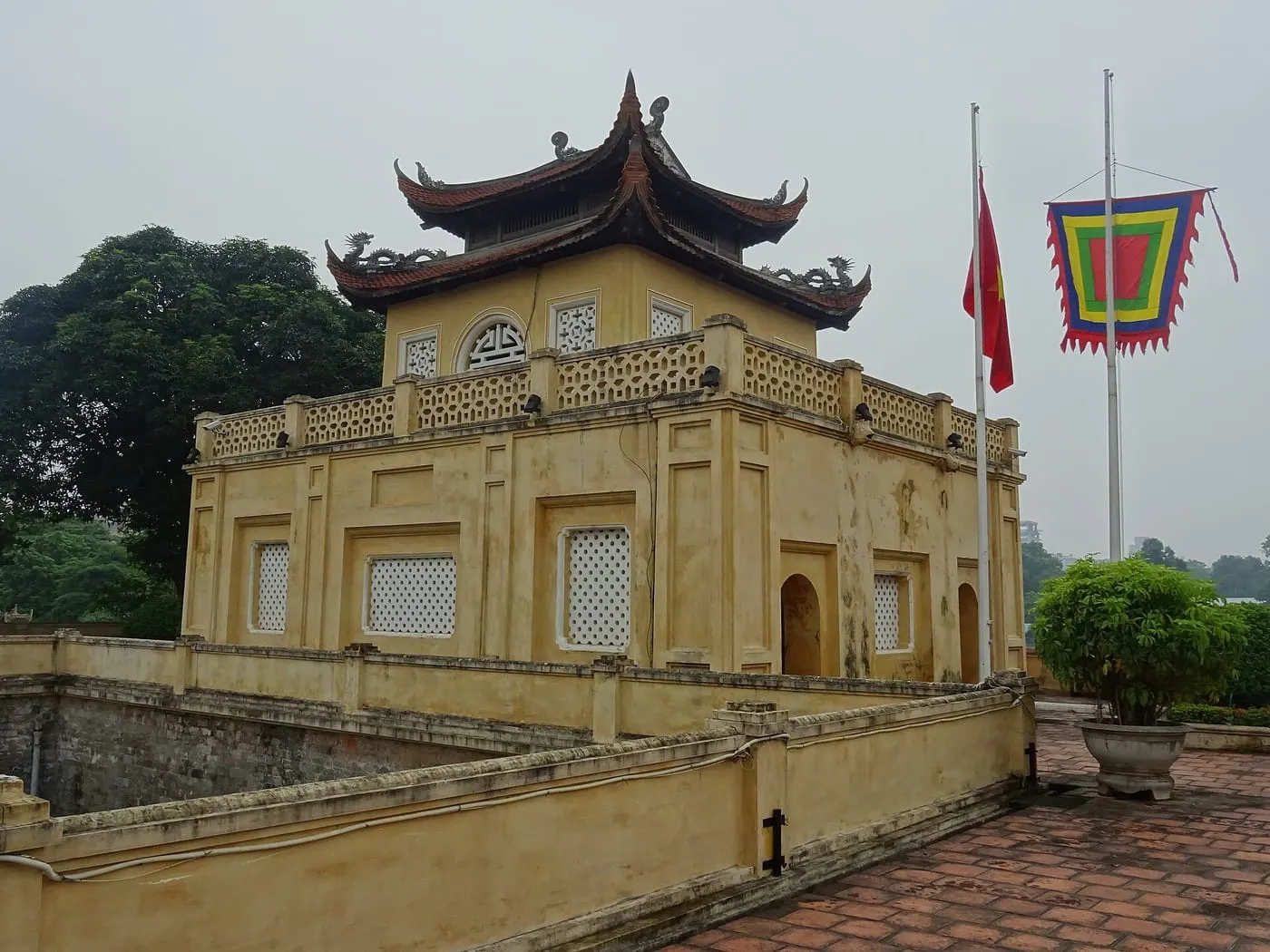
Founded in 1010 by King Ly Thai To when he transferred the royal capital from Hoa Lu to Thang Long (“Ascending Dragon”), this UNESCO World Heritage site showcases architectural and archaeological relics spanning Chinese Tang dynasty commanderies, royal imperial courts, French colonial military bastions, and subterranean headquarters from the Vietnam War. Archaeological reports, exhibition schedules and opening details are published on hoangthanhthanglong.vn.
Ticket prices and admission options
Tickets are purchased at the visitor entrance booth at 19C Hoang Dieu Street. Keep your paper ticket safely in hand, as staff scan it a second time when you cross the street to explore the archaeological excavation zone.
| Ticket category | Price | Target audience | Inclusions |
|---|---|---|---|
| Standard admission | 100,000 VND | Vietnamese and international visitors (hoangthanhthanglong.vn) | Access to 19C Hoang Dieu and 18 Hoang Dieu excavation sector |
| Concession ticket | 50,000 VND | Students and visitors 60 and over with ID | Full access across both sectors |
| Children under 15 | Free | Accompanied by adult | Full access across both sectors |
| Night tour (“Decoding the Imperial Citadel”) | 300,000 VND | Friday and Saturday evenings; half price under 12, free under 5 | 90-minute theatrical tour from 19:00 (hoangthanhthanglong.vn) |
The weekend night tour
On Fridays and Saturdays at 19:00 the citadel runs a guided night tour of about 90 minutes. Book through the citadel’s official site, hoangthanhthanglong.vn, or on +84 848 455 222.
Opening hours and visiting details
- Opening: Every day from 08:00 to 17:00 (hoangthanhthanglong.vn).
- Main entrance: 19C Hoang Dieu Street, Dien Bien Ward, Ba Dinh District.
- Excavation entrance: 18 Hoang Dieu Street (directly across from the main exit).
Plan for a visit of roughly two hours to navigate the outdoor grounds, exhibition galleries, and the subterranean bunker network.
Tours and guided citadel walks
The 100,000 VND ticket at the gate is the simplest option for independent exploration. Guided walking tours add expert historical context covering royal court rituals, archaeological finds, and the secret Politburo command bunker.
Hanoi city highlights walking tour
From VND 699,800 · 5 stars from 206 reviews · 4.5 to 5 hours · expert local guide
Hanoi City Highlights Walking Tour – Landmarks & Historyad: covers the Imperial Citadel of Thang Long alongside the Temple of Literature and the Ba Dinh Complex, connecting the dynastic history with French colonial urban architecture.
1,000-year Hanoi landmarks and four quarters tour
From VND 1,310,000 · 5 stars from 2 reviews · 3.5 to 7.5 hours · in-depth dynastic history
Hanoi Landmarks: 1000-Year History & Culture in 4 Quartersad: walks the imperial grounds of Thang Long, examining the Le Dynasty stone dragons and excavation pits with a cultural specialist before exploring the Old Quarter trade guilds.
Full-day Hanoi monuments tour with lunch
From VND 995,600 · 4.6 stars from 195 reviews · 1 day · comprehensive monuments circuit
Hanoi: Full-Day City Tour with Lunch and Optional Extrasad: an air-conditioned circuit that stops at the Imperial Citadel, the Vietnam Museum of Ethnology, and Tran Quoc Pagoda, with traditional lunch included.
Official ticket or tour: the prices side by side
Independent entry versus guided historical tours.
| Option | Official admission | Tour cost | What it covers |
|---|---|---|---|
| Official standard admission | 100,000 VND | — | 19C Hoang Dieu compound, D67 bunker, and 18 Hoang Dieu excavations (hoangthanhthanglong.vn) |
| Official weekend night tour | 300,000 VND | — | 90-minute evening tour with traditional performances (hoangthanhthanglong.vn) |
| City highlights walking tour | Admissions included | From VND 699,800 | 4.5-hour guided tour of Citadel, Temple of Literature, and Ba Dinh |
| 1,000-year dynastic history tour | Admissions included | From VND 1,310,000 | 3.5 to 7.5 hours with specialist guide covering Thang Long and guilds |
| Full-day coach tour with lunch | Admissions included | From VND 995,600 | Citadel, Ethnology Museum, lunch, and air-conditioned transit |
Key architectural and historical highlights
The citadel is entered from the south, leading visitors through an axis that matches the ancient layout of imperial capitals across East Asia.
1. Hanoi Flag Tower (Cot Co Ha Noi)
Standing 33.4 metres tall (41 metres including the national flag pole), this monumental octagonal brick tower was erected between 1805 and 1812 under Emperor Gia Long of the Nguyen Dynasty. Because the French military repurposed it as a communications watchtower during colonial rule, it survived the demolitions that flattened most of the surrounding royal palaces in the late 19th century. Today, it stands proudly within the grounds of the adjacent Military History Museum.
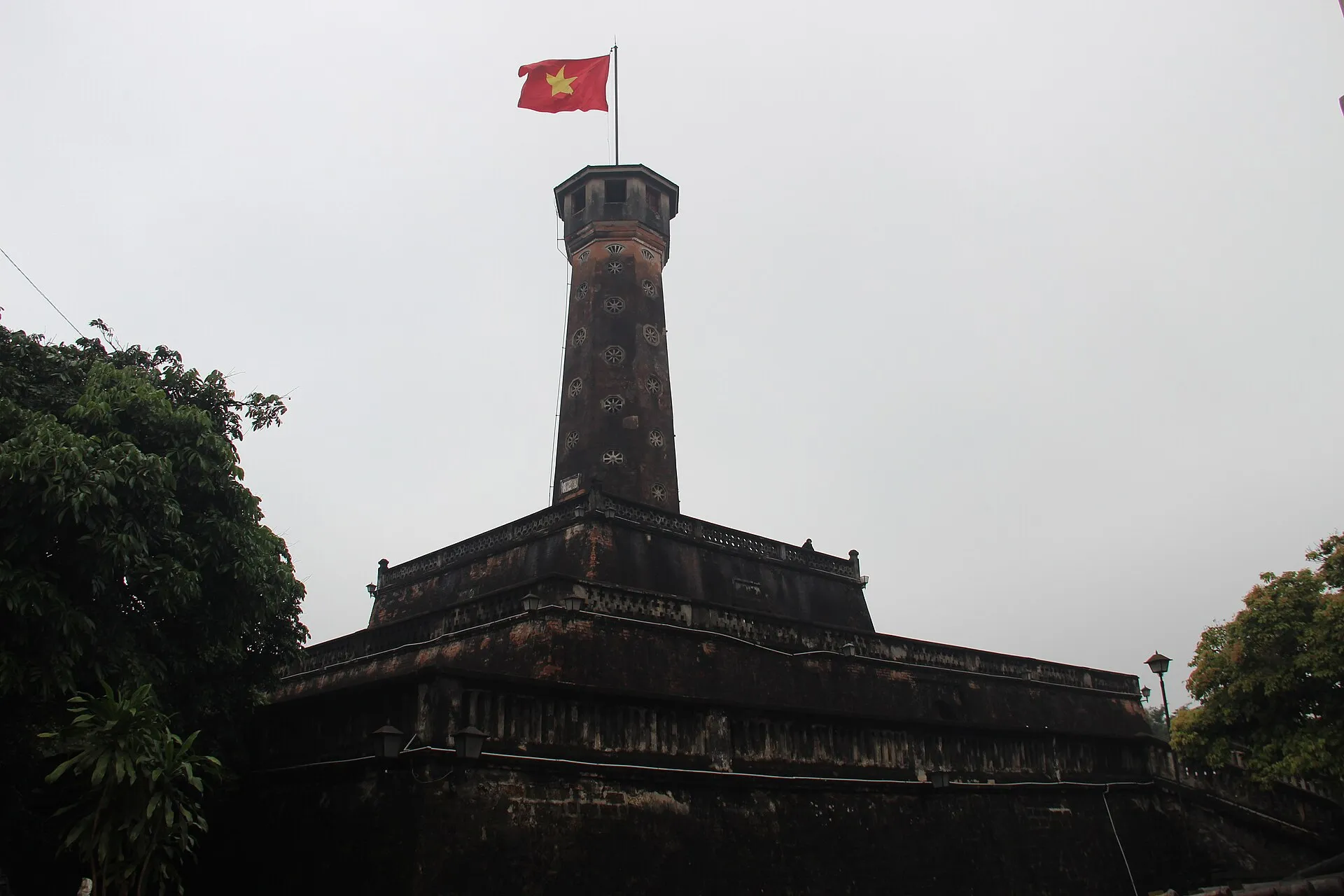
Hanoi Flag Tower. Photo: Gary Todd from Xinzheng, China, Wikimedia Commons, CC0.
2. Doan Mon (South Gate)
Built during the Le Dynasty (15th century) from solid square bricks, Doan Mon was the principal ceremonial southern portal into the Forbidden City (Cam Thanh). It features five arched stone gates: the wide central arch was reserved exclusively for the Emperor, while lateral gates were used by high-ranking mandarins and imperial guards.
Visitors can climb the interior stone steps to the second-storey viewing pavilion to enjoy views across the grand courtyard and the distant Flag Tower.
3. Kinh Thien Palace Foundation and Stone Dragons
At the centre of the royal citadel lies the elevated stone foundation of Kinh Thien Palace, where imperial coronations, foreign ambassador receptions, and grand national assemblies took place.
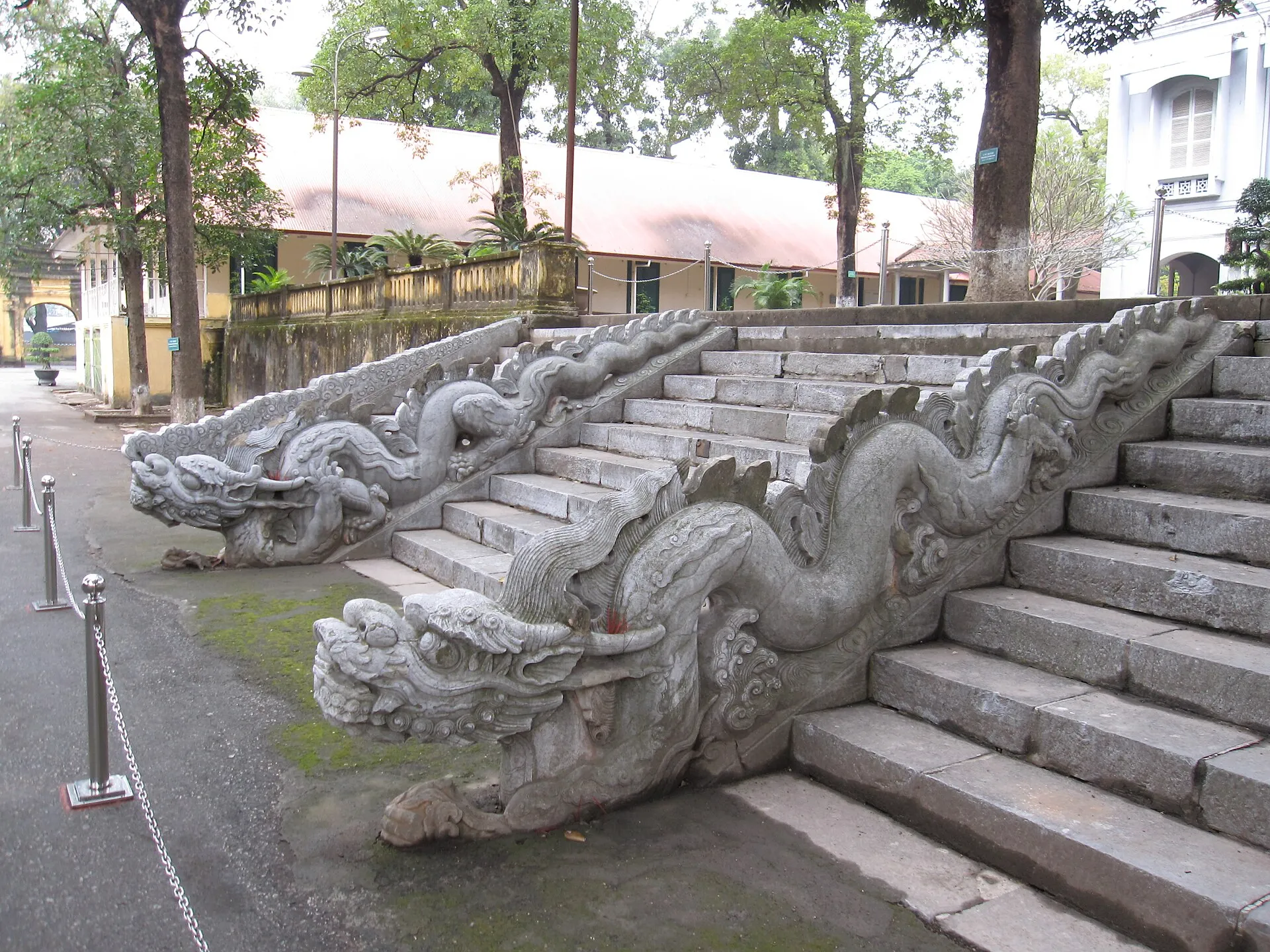
Dragon steps, Kinh Thien Palace. Photo: Gryffindor, Wikimedia Commons, CC BY-SA 3.0.
Although the French demolished the wooden palace hall in 1886 to construct a colonial artillery headquarters, the monumental stone staircase remains intact. Flanking the steps is a pair of 15th-century stone dragons (rong da), carved from monolithic green stone with cloud scrolls, fiery manes, scaly coiled bodies, and fierce clawed talons that represent imperial power during the early Le era.
4. Hau Lau (Princess Pavilion)
Situated north of Kinh Thien Palace, this multi-tiered pagoda-like pavilion (Lau Cong Chua) was where concubines, imperial princesses, and royal women resided. Reconstructed by the French after fire damage, it features yellow stucco walls, intricate wood carving, and decorative curved eaves.
5. French Colonial Military Headquarters
Throughout the late 19th and early 20th centuries, French colonial forces turned the imperial citadel into an army artillery garrison known as Caserne de l’Infanterie. Several grand two-storey yellow administrative buildings remain across the lawns, displaying colonial French shuttered balconies, brick cellars, and military memorabilia.
6. Subterranean D67 Bunker and General Giap’s Command Room
Behind the colonial administrative buildings lies House D67, constructed in 1967 as a bomb-proof military command post for the General Staff of the Vietnam People’s Army and the Central Military Commission.
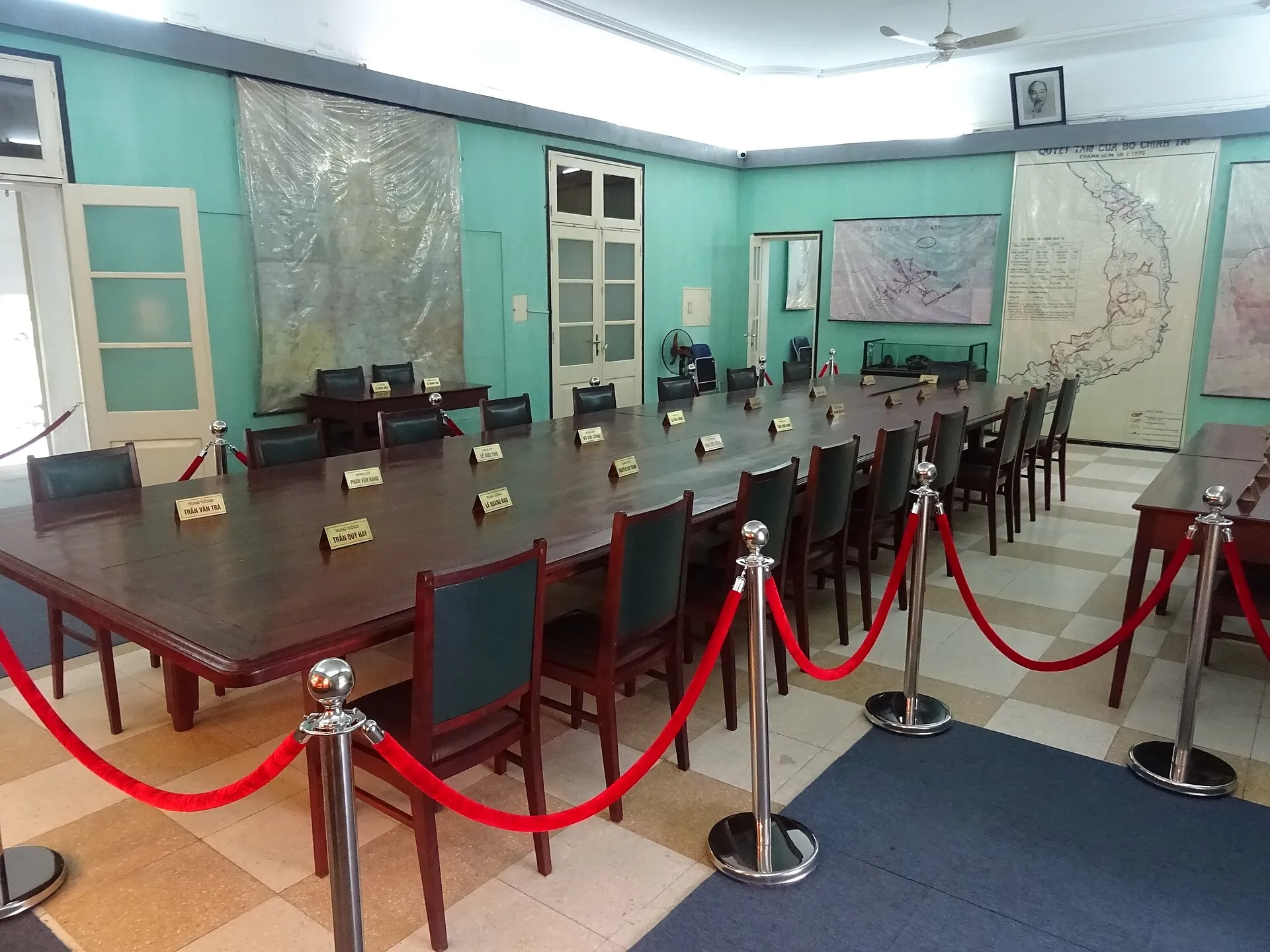
D67 House meeting room. Photo: Christophe95, Wikimedia Commons, CC BY-SA 4.0.
A discreet reinforced blast door leads down a flight of concrete stairs into a subterranean bunker situated ten metres below ground level:
- Built with 60-centimetre-thick reinforced concrete walls designed to resist direct hits from 250-pound aircraft bombs.
- Complete with airtight anti-chemical blast doors, independent ventilation filtering systems, and heavy copper-shielded telecommunications equipment.
- The underground war room preserves the central conference table, swivel chairs, red military field telephones, and large acetate-covered maps marked with tactical troop movements from the 1968 Tet Offensive and the 1975 Spring Offensive.
- Adjacent is the personal field office used by Commander-in-Chief General Vo Nguyen Giap.
18 Hoang Dieu archaeological excavation site
Across the street from the main exit gate lies the 18 Hoang Dieu excavation sector, included in your admission ticket (hoangthanhthanglong.vn).
Unearthed in 2002 during initial ground clearing for the National Assembly building, this four-hectare site constitutes one of Southeast Asia’s most significant archaeological finds. Excavations revealed stratified cultural strata stacked like a layer cake across thirteen centuries:
| Historical dynasty | Approximate era | Excavated archaeological evidence |
|---|---|---|
| Tang Dynasty (Dai La era) | 7th to 9th centuries | Wooden drainage conduits, lotus tile roofs, and brick foundations |
| Ly and Tran Dynasties | 11th to 14th centuries | Terracotta dragon and phoenix roof ornaments, stone pillar bases, and glazed celadon bowls |
| Le and Mac Dynasties | 15th to 18th centuries | Cobalt-blue underglaze porcelain, imperial coin caches, and decorative brick pathways |
| Nguyen Dynasty | 19th century | Earthen ramparts, bronze cannon shot, and royal administrative stonework |
Raised timber walkways allow visitors to look directly into deep excavation pits where ancient brick drainage systems and royal water wells remain preserved in the ground.
Transport and nearby attractions
The Imperial Citadel is located at 19C Hoang Dieu Street in Ba Dinh, easily accessible by walking or taxi:
- Walking from Ba Dinh Complex: The citadel sits a ten-minute walk east of the Ho Chi Minh Mausoleum and Ba Dinh Complex.
- Temple of Literature: Located roughly one kilometre south along Hoang Dieu and Nguyen Thai Hoc; an easy 15-minute stroll to the historic Temple of Literature.
- Hoa Lo Prison: Walk 1.5 kilometres southeast to explore wartime judicial history at Hoa Lo Prison Memorial.
- West Lake and Tran Quoc Pagoda: Head north along Hoang Dieu and Thanh Nien causeway to reach the shoreline of Tran Quoc Pagoda and West Lake.
- For a curated walking route covering this historic district, explore our self-guided French Quarter and Ba Dinh walk.
Common questions
How much are tickets to the Imperial Citadel of Thang Long?
Admission is 100,000 VND a person for Vietnamese and international visitors, bought at the gate or verified online at hoangthanhthanglong.vn.
What are the opening hours of the Imperial Citadel?
The citadel is open every day of the week from 08:00 to 17:00, Mondays included (hoangthanhthanglong.vn).
What does the Imperial Citadel ticket include?
The 100,000 VND ticket covers the citadel grounds at 19C Hoang Dieu, including the Doan Mon gate, the Kinh Thien dragon steps and the D67 bunker, and the 18 Hoang Dieu excavation site across the road.
What is the D67 bunker at the Imperial Citadel?
Built in 1967 with 60-centimetre-thick reinforced concrete walls, the underground D67 bunker served as the secret wartime headquarters for the General Staff of the Vietnam People's Army, where General Vo Nguyen Giap and the Politburo planned major campaigns during the American War.
Why is the Imperial Citadel of Thang Long a UNESCO World Heritage site?
Inscribed in 2010 to mark Hanoi's 1,000th anniversary, the citadel represents thirteen centuries of continuous political power, showing overlapping architectural and cultural layers from Chinese rule through the Ly, Tran, and Le dynasties to French colonial and modern military eras.