In this guide
💡 The Short Version: Our judgement, not a ranking: pick Barcelona for three days of Gaudí’s houses, the Gothic Quarter and a city beach, with the Sagrada Família and Park Güell booked ahead. Pick Madrid for two days of art and the Old Town on foot: the Prado, the Reina Sofía and the Royal Palace, with free hours at the first two. With five or six days, do both: the high-speed train takes about 2 hours 30 minutes, from €19 each way. Both are in Spain, so the price level is the same: the difference is in the entries and the tax, from €73 for Barcelona’s three main bookings against €59 for Madrid’s four, and a tourist tax of €7 a night at a 3-star in Barcelona against none in Madrid. Or book a tour: a guide with entry is from €47 for the Sagrada Família and €25 for Park Güell in Barcelona, and from €36 for the Royal Palace in Madrid.
⚠️ Book the Sagrada Família and Park Güell, and plan Madrid round its closed days. Sagrada Família tickets go on sale roughly two months ahead, for one time and in your name, and a late arrival is not let in. Park Güell sells timed slots up to three months ahead: you must enter within 30 minutes of yours, and once you leave you cannot go back in. In Madrid the Reina Sofía is shut on Tuesdays, and Mondays close the Descalzas Reales, the Cerralbo and the Temple of Debod, while the Prado and the Royal Palace stay open. Barcelona’s Picasso Museum is shut on Mondays.
Barcelona and Madrid side by side
Prices are the operators’ adult rates in euros. Each row links to the city’s own guide for the detail.
| Barcelona | Madrid | |
|---|---|---|
| What to book | Sagrada Família €26, on sale roughly two months ahead, in your name; Park Güell €18, up to three months ahead; Casa Batlló or La Pedrera from €29 each; Picasso Museum €12 online | Prado €15; Reina Sofía €12; Thyssen €14; Royal Palace €18; the Paseo del Arte card €32.80 covers the first three, against €41 separately |
| Free entry | Children: under-13s are free at Casa Batlló and under-12s at La Pedrera | Prado 18:00 to 20:00 Monday to Saturday; Reina Sofía 19:00 to 21:00 on a free ticket booked online; Thyssen Monday 12:00 to 16:00. The Royal Palace’s free slot is for EU citizens, residents and Latin American citizens only |
| Closed days | Picasso Museum on Mondays; the Sagrada Família and Park Güell open every day | Reina Sofía on Tuesdays; on Mondays the Descalzas Reales, the Cerralbo, the Sorolla and the Temple of Debod, and the Thyssen opens only 12:00 to 16:00 |
| Public transport | T-casual €13 for 10 journeys in zone 1, one person only; single €2.90; the Hola Barcelona card from €12.50 for 24 hours | Metro single €1.50 to €2.00; 10-trip ticket €7.30 on a €2.50 Multi card; Tourist Travel Pass €10.30 for a day; the centre is walkable |
| Airport to the centre | Aerobús €7.75, 30 to 35 minutes to Plaça Catalunya, 24 hours; taxi metered, with a €21 minimum from the airport | Exprés Aeropuerto bus €5.00, 30 to 40 minutes to Atocha, 24 hours; taxi a fixed €33 inside the M-30 |
| Tourist tax | €7.00 per adult per night at a 3-star or below, €8.40 at a 4-star, €12.00 at a 5-star, for up to seven nights; under-17s exempt | None; the city’s tourism councillor said in July 2026 that it does not plan one |
| Evenings | Flamenco set shows of 40 to 75 minutes from €27; tapas at counters in neighbourhood bars; drinking in the street is restricted | Flamenco in hour-long shows from €31; tapas bar to bar, a drink and a small plate at each |
| Football | Camp Nou tour €28: the club museum and a view over the rebuilding works | Bernabéu tour from €37 for one date and time, non-refundable |
| How many days | Our judgement: three; the three-day plan is the Sagrada Família and Passeig de Gràcia, Park Güell and the Gothic Quarter, then Montjuïc and the beach | Our judgement: two; Madrid in one or two days is the Royal Palace and Prado, then the Retiro, Thyssen and Reina Sofía |
| Day trips | Montserrat about 1½ hours each way; Girona 1 hour 19; Sitges 31 to 37 minutes; Tarragona 1 hour 9 | Toledo and Segovia about 30 minutes each by train; Mondays close El Escorial, the Toledo Alcázar and the Aranjuez palace |
| Best season | Highs of 25°C in June and 28°C in July and August; September and October are the wettest months, at 81 and 91 mm | Highs of 16.3 to 26.4°C from March to May and in September and October; 32.1°C in July; October is the wettest month at 60 mm |
Both cities shut their big museums on 25 December and 1 January, the Prado, the Royal Palace, the Reina Sofía and the Picasso Museum among them, and the Sagrada Família opens 9:00 to 14:00 on 25 and 26 December and 1 and 6 January. Barcelona at Christmas and Christmas in Madrid have the markets, the lights and the holiday hours.
Book a tour instead
A guided tour puts the guide and, where the row says so, the entry in one purchase. Prices are GetYourGuide’s lowest “from” prices for one adult.
| City | From | Tour |
|---|---|---|
| Barcelona | €47 | Sagrada Família skip-the-line guided tourad with entry |
| Barcelona | €25 | Park Güell guided tour with skip-the-line entryad |
| Barcelona | €56.10 | Tapas walking tour with food, wine and historyad, 3 hours |
| Barcelona | €39 | Montserrat tour with the cogwheel train, the Black Madonna and a wineryad |
| Madrid | €25.11 | Welcome to Madrid guided walking tourad, 2½ hours; no museum ticket |
| Madrid | €36 | Royal Palace skip-the-line guided tourad with entry |
| Madrid | €48.56 | Prado guided tourad with the ticket included |
| Madrid | €85 | Tapas and wine tasting tour with a local guidead, 3 hours |
| Madrid | €40.60 | Segovia and Toledo tour with the Alcázar and the Cathedralad, 12 hours |
For a visit on your own, the official tickets are cheaper than the tours: the Sagrada Família is €26 and the Prado €15, and the Prado is free in its last two hours. The exception is Park Güell, where the guided tour with entry is cheaper than the park’s own ticket (€18) and its own guided tour (€17) together.
Which city for whom
Each pick below is our judgement, built on the figures in the table.
A first visit: Barcelona with three days, Madrid with two
Barcelona asks for the more planning. The Sagrada Família and Park Güell each need a booked time, Casa Batlló or La Pedrera on Passeig de Gràcia is a third, and the three-day plan spreads them over three days with the Gothic Quarter and Montjuïc between. Madrid fits into two days: the one-or-two-day plan puts the Royal Palace at 10:00, the Prado in the afternoon and tapas and flamenco in the evening, and a second day adds the Retiro, the Thyssen and the Reina Sofía. Madrid asks for less: the Bernabéu tour is for one date and time, and a flamenco show needs the evening booked.
Art lovers: Madrid
Madrid puts the Prado, the Reina Sofía, where Guernica hangs on floor 2, and the Thyssen within walking distance of one another, and the Paseo del Arte card is €32.80 for the three against €41 separately. The free hours are the bigger saving: the Prado from 18:00 and the Reina Sofía from 19:00 cost nothing for any nationality. Barcelona’s counterpart is architecture rather than a gallery: the Modernisme walk runs 3.3 km down Passeig de Gràcia past Casa Batlló and La Pedrera to Casa Vicens, and the Picasso Museum is in the Gothic Quarter and El Born, closed on Mondays.
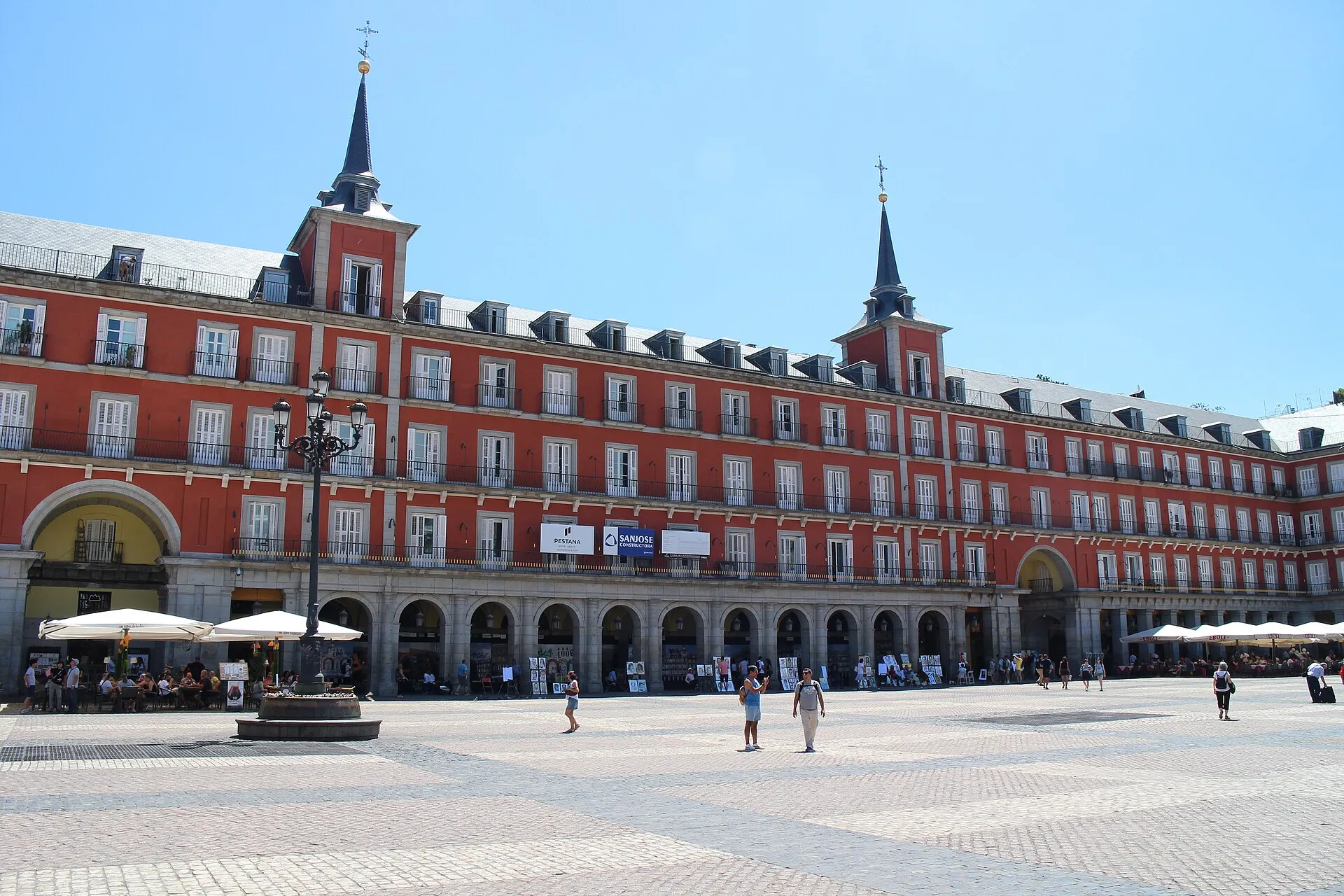
The Plaza Mayor, Madrid. Photo: Suicasmo, Wikimedia Commons, CC BY-SA 4.0.
A beach or a summer trip: Barcelona
Barcelona is on the sea, and the hotels near the beach run from Barceloneta to Diagonal Mar. Its July and August highs are 28°C by day and 20°C at night, against 32.1°C in Madrid in July. Madrid’s mild months are March to May and September to October, with highs of 16.3 to 26.4°C, and August in Madrid is when its hotels are emptiest, with 63.6% of rooms filled in 2025.
Evenings: Madrid for bar to bar, Barcelona for a set show
Madrid’s evening is a route: tapas bar to bar, a drink and a small plate at each, and an hour of flamenco from €31. Barcelona sells flamenco as a set show of 40 to 75 minutes from €27, and its tapas bars mostly take no reservations. One rule differs: Barcelona’s civic ordinance restricts drinking alcohol in the street and other public spaces, so take the drink on a terrace or inside a bar, not a can on a bench.
A tight budget: the same country, so compare the entries and the tax
Barcelona and Madrid share Spain’s price level, so a country figure cannot separate them, and what moves the bill is smaller. Madrid’s four main bookings come to €59, or €50.80 with the Paseo del Arte card, and the Prado and the Reina Sofía can be free; Barcelona’s three come to from €73. Barcelona’s tourist tax is €7 per adult per night at a 3-star and €8.40 at a 4-star, and a couple spending four nights in a 4-star hotel pays €67.20 on top of the room; Madrid has none. The airport run is €7.75 on Barcelona’s Aerobús against €5.00 on Madrid’s Exprés, and a Barcelona T-casual is €13 for 10 journeys against €7.30 for Madrid’s 10-trip ticket plus the €2.50 card. Our judgement: Madrid for a tight budget, and Barcelona where the beach and the Gaudí houses are the point.
Doing both: the train, the days and where to stay
The high-speed train is the reason to do both. It runs between Barcelona-Sants and Madrid Atocha or Chamartín in about 2 hours 30 minutes on the fastest direct trains, and Ouigo sells the route from €19 each way at ouigo.com in November 2026. From Barcelona’s airport, the R2 Nord train from Terminal 2 reaches Sants in 17 to 20 minutes (Barcelona airport to the city); at the other end, the Exprés bus from Madrid’s airport stops at Atocha (Madrid airport to the city).
Our judgement for five or six days is three in Barcelona and two in Madrid, with a third in Madrid for Toledo or Segovia, about 30 minutes by train each. Do Barcelona first and move on a Monday: the Picasso Museum is shut that day in Barcelona, while the Prado, the Royal Palace and the Reina Sofía are open in Madrid, and the Thyssen has its free midday window. Fly into one city and out of the other where the flights allow, so you do not have to go back.
For a first visit, stay in Barcelona’s Gothic Quarter or the Eixample, both on the Aerobús route (where to stay in Barcelona, hotels near the Sagrada Família). In Madrid, stay round the Puerta del Sol and Gran Vía, or in the Barrio de las Letras beside the Prado (where to stay in Madrid, hotels near the Puerta del Sol). For what to book in each city, see Barcelona and Madrid; for the weather month by month, see where to go each month; for two other pairs of cities side by side, see Rome vs Florence and Prague vs Budapest.
Common questions
Is Barcelona or Madrid better for a first trip to Spain?
Our judgement: Barcelona for three days, because the Sagrada Família, Park Güell and Casa Batlló each need a booking, with the Gothic Quarter and the beach to fill the rest. Madrid for two days, because the Royal Palace, the Prado and the Reina Sofía are close together and two of the three have free hours. With five or six days, do both.
Is Barcelona or Madrid cheaper?
They share one country, so there is no price-level gap to point to, and the difference is in entries and tax. Madrid's Prado (€15), Reina Sofía (€12), Thyssen (€14) and Royal Palace (€18) come to €59, or €50.80 with the Paseo del Arte card, and the Prado and Reina Sofía are free in their last hours. Barcelona's Sagrada Família (€26), Park Güell (€18) and Casa Batlló (from €29) come to from €73. Barcelona also adds a tourist tax of €7 per adult per night at a 3-star hotel; Madrid has none.
How long is the train from Barcelona to Madrid?
About 2 hours 30 minutes on the fastest direct high-speed trains, between Barcelona-Sants and Madrid Atocha or Chamartín. Ouigo sells the route from €19 each way at ouigo.com in November 2026.
Is there a tourist tax in Barcelona and Madrid?
Barcelona has one: from 1 April 2026 to 31 March 2027 it is €7.00 per adult per night at a 3-star hotel or below, €8.40 at a 4-star, €12.00 at a 5-star and €9.50 in a tourist flat, for up to seven nights, with under-17s exempt. It rises on 1 April 2027. Madrid has none, and its tourism councillor said in July 2026 that it does not plan one.
Can you drink in the street in Barcelona?
Barcelona's civic ordinance restricts drinking alcohol in the street and other public spaces, so take a drink on a bar or restaurant terrace rather than carrying a can or bottle. At La Mercè's fire run, the council's advice is to carry no alcohol or glass.
How many days do you need in Barcelona and in Madrid?
Our judgement: three in Barcelona and two in Madrid, with a third day in Madrid for Toledo or Segovia. Barcelona has a three-day plan and Madrid a one-or-two-day plan on this site.