One of 2 self-guided walks in Barcelona. See every walk.
In this guide
💡 The Short Version: Start at Plaça de Catalunya and finish at the El Born market: 2.2 km, about 30 minutes of walking, and 5 to 6 hours with the tickets. Walk it Tuesday to Saturday. On Mondays the Picasso Museum, the Plaça del Rei museum and El Born are closed, and on Sundays the cathedral’s tourist visit runs only from 14:00 to 17:00. Book the Picasso Museum online: its capacity is limited. Be at El Born by 16:00 for the English tour of the excavated streets. Or book a tour: Side Routes’ small-group Gothic Quarter and El Born walkad (from £16.83, 2 hours) covers the same streets with a guide.
The route
Map of the walk numbered stops in walking order
Open the whole route in Google Maps - all the stops in walking order, set to walking directions, which is the version to put on your phone.
The route follows the line of Roman Barcino: down from the 19th-century square to the gate of the Roman wall, past the forum where the city’s two main streets crossed, then east over Via Laietana to the merchants’ street of Montcada and the church of the Ribera quarter. Prices are the adult rate in euros from each operator.
| Stop | Entry (adult) | Open |
|---|---|---|
| 1. Plaça de Catalunya | Free | Always |
| 2. Plaça Nova and the Roman gate | Free | Always |
| 3. Barcelona Cathedral | €16 tourist visit | Monday to Friday 9:30 to 18:30, Saturday to 17:15, Sunday 14:00 to 17:00 |
| 4. Plaça de Sant Jaume | Free | Always |
| 5. The Temple of Augustus | Free | Monday 10:00 to 14:00, Tuesday to Saturday 10:00 to 19:00, Sunday 10:00 to 20:00 |
| 6. Plaça del Rei | Square free; museum €7.30; free on Sundays from 15:00 | Tuesday to Saturday 10:00 to 19:00, Sunday 10:00 to 20:00; closed Mondays |
| 7. Carrer de Montcada and the Picasso Museum | Street free; museum €12 online | Tuesday to Sunday 10:00 to 19:00 until 29 March 2027; closed Mondays |
| 8. Santa Maria del Mar | €8 | Monday to Saturday 10:00 to 18:00, Sunday 13:00 to 18:00 |
| 9. El Born Centre de Cultura i Memòria | Hall free; guided tour of the site €4.20 | March to October 10:00 to 20:00, November to February 10:00 to 19:00; closed Mondays |
Walk it with a guide
A guide adds the stories and finds the route for you. Prices are GetYourGuide’s lowest “from” prices, per person.
- Barcelona Small Group Walking Tour: Gothic and Old Quarterad, by Side Routes: from £16.83, 4.9 stars from 259 reviews, 2 hours. It covers the Gothic Quarter and El Born, with Santa Maria del Mar and the Picasso Museum among its stops, and meets at Passeig de Picasso 13, beside the Parc de la Ciutadella.
- Barcelona: Gothic Quarter Walking Tour with 10+ Sightsad, by Carpe Diem Tours: from £19, 4.9 stars from 534 reviews, 2 hours, in English. It meets at Plaça del Vuit de Març and takes in Els Quatre Gats, the cathedral and Plaça de Sant Felip Neri.
- Barcelona: Old Town and Gothic Quarter Walking Tourad, by In Out Barcelona Tours: from £15.30, 4.8 stars from 1,896 reviews, 2.5 hours, with a longer option of up to 4. It adds La Rambla and the Boqueria market to the Gothic Quarter.
Food tours in Barcelona compares the tapas walks that cover the same streets.
1. Plaça de Catalunya
Free · metro L1 and L3, FGC and Rodalies trains · the Aerobús from the airport ends here
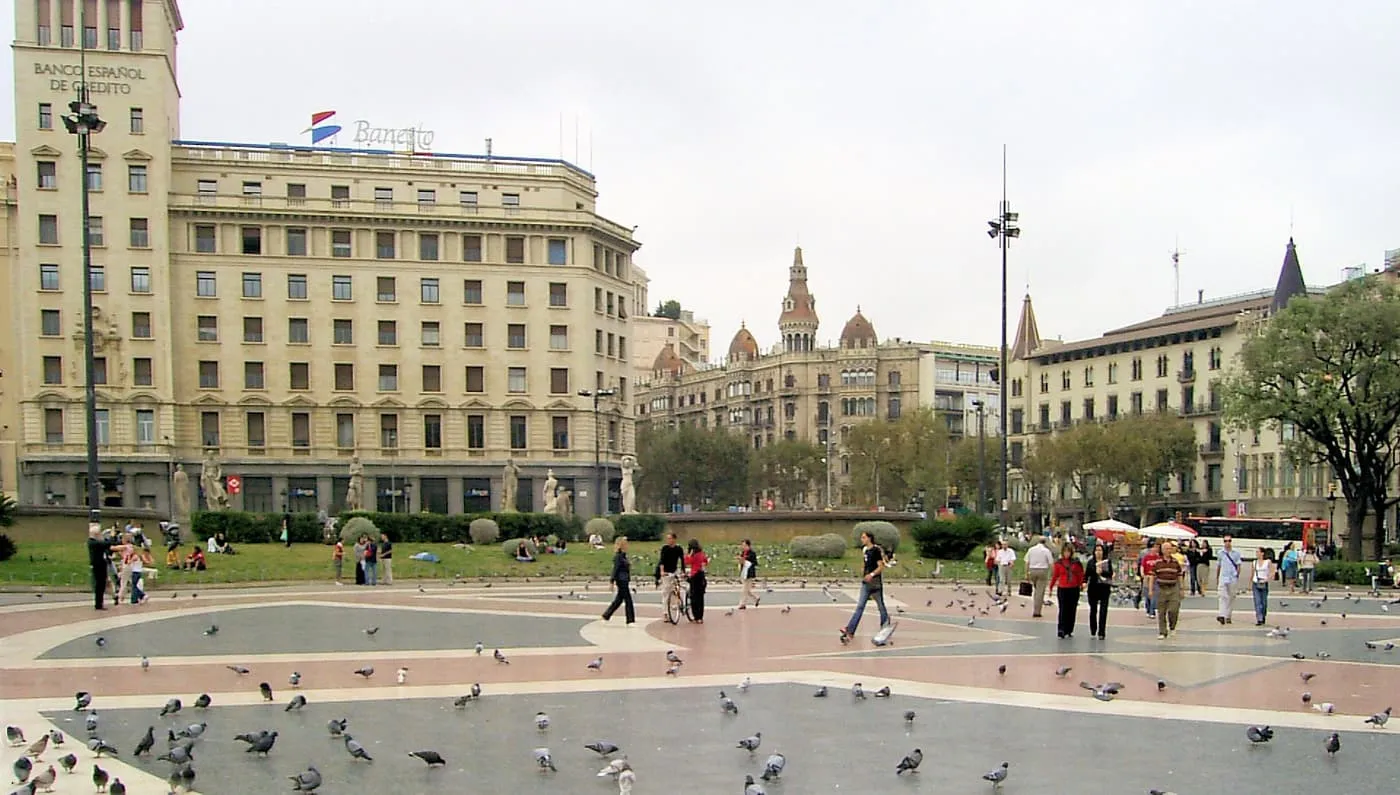
Plaça de Catalunya. Photo: Rauenstein, Wikimedia Commons, CC BY-SA 3.0.
The square is where the old walled city and the 19th-century Eixample meet. It was laid out in 1902 and remodelled for the 1929 International Exposition, which added the metro station. Passeig de Gràcia, La Rambla, Rambla de Catalunya and Portal de l’Àngel all start from it.
Leave by Portal de l’Àngel, the pedestrian shopping street that runs out of the square, and follow it and Carrer dels Arcs to Plaça Nova: 560 m. The Aerobús is €7.75 single from the airport and stops here: see Barcelona airport to the city centre.
2. Plaça Nova and the Roman gate
Free · always open · Carrer dels Arcs, beside the cathedral
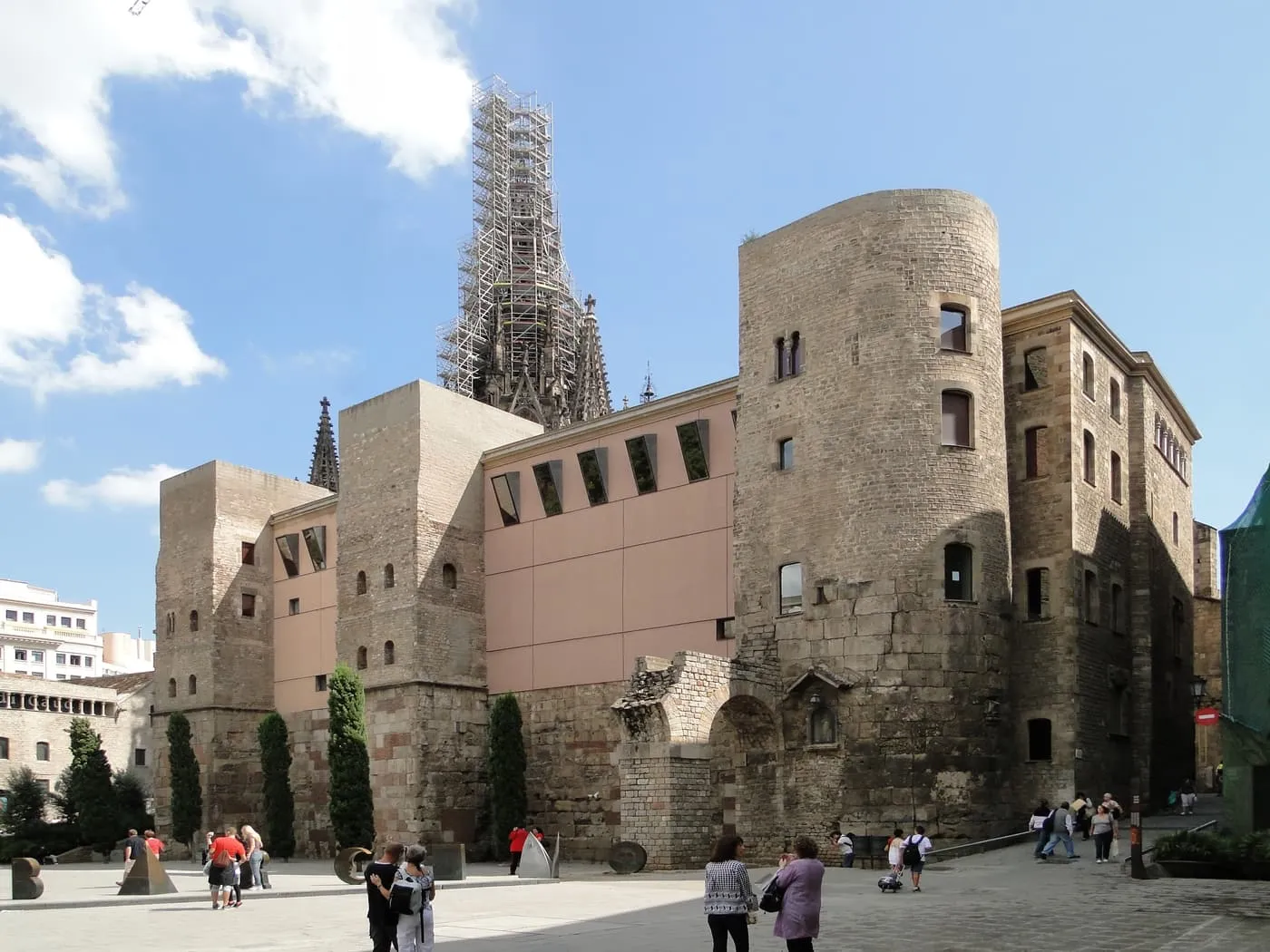
The Roman gate towers on Plaça Nova. Photo: Bernard Gagnon, Wikimedia Commons, CC BY-SA 3.0.
Barcino, the Roman colony founded between 15 and 10 BC, was walled on a perimeter of 1.5 km round about 10 hectares, and this was its Praetoria gate. Two of its towers survive, with a stretch of the wall and an arch of the aqueduct that carried water into the city. The Dean’s House and the Archdeacon’s House were later built onto this part of the wall.
On the square, a frieze of engraved plaster along the front of the Col·legi d’Arquitectes reproduces Picasso drawings of popular scenes. The building, by Xavier Busquets Sindreu, went up between 1958 and 1962.
3. Barcelona Cathedral
€16 for the tourist visit, €14 for students under 26 · Monday to Friday 9:30 to 18:30, last entry 17:45 · Saturday to 17:15 · Sunday 14:00 to 17:00
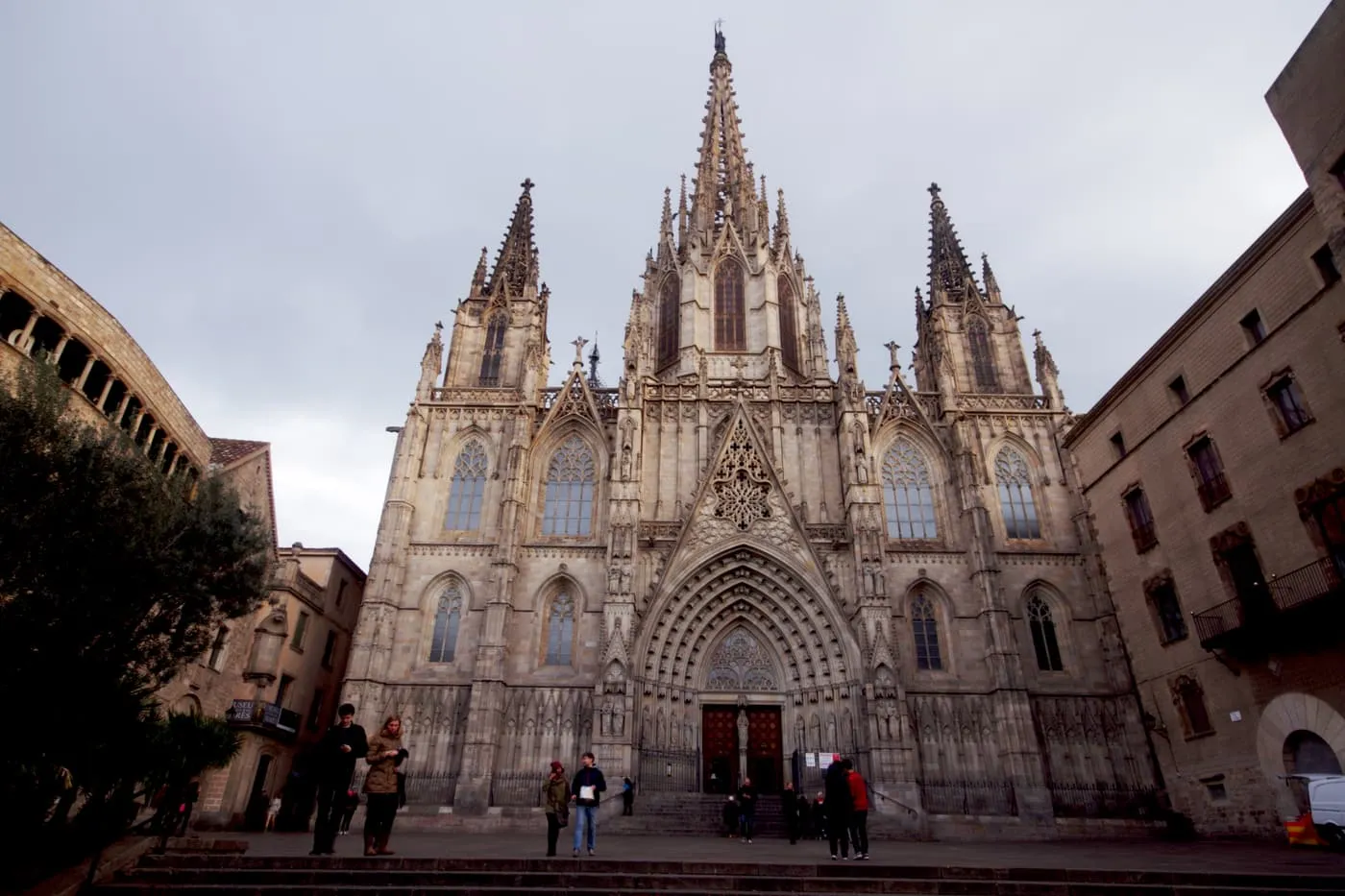
The façade of Barcelona Cathedral. Photo: José Luiz, Wikimedia Commons, CC BY-SA 3.0.
Construction of the Gothic cathedral began on 1 May 1298 and was virtually finished by the middle of the 15th century; the cloister dates from 1448. The façade and the two side towers are 19th-century work to plans inspired by a 15th-century design, completed in 1913 with the central lantern.
- What the visit covers: the cathedral floor and the cloister, the choir with its stalls painted with the shields of the knights of the Golden Fleece, who met in Barcelona in 1519, the chapter hall, which is a small museum, and a lift to the roof from the Chapel of the Innocent Saints, beside the Sant Iu door.
- The cloister has a pond with 13 white geese.
- Sundays and religious holidays: the tourist visit runs only from 14:00 to 17:00, last entry 16:30, and the morning has Mass. Saturdays close the visit at 17:15, with the last entry at 16:30.
- Tickets are sold online at tickets.catedralbcn.org; hours are on the cathedral’s visiting hours page.
Carrer del Bisbe, along the cathedral’s side, leads to Plaça de Sant Jaume in about 250 m.
4. Plaça de Sant Jaume
Free · the Palau de la Generalitat and the Casa de la Ciutat are the working seats of the Catalan government and Barcelona’s council
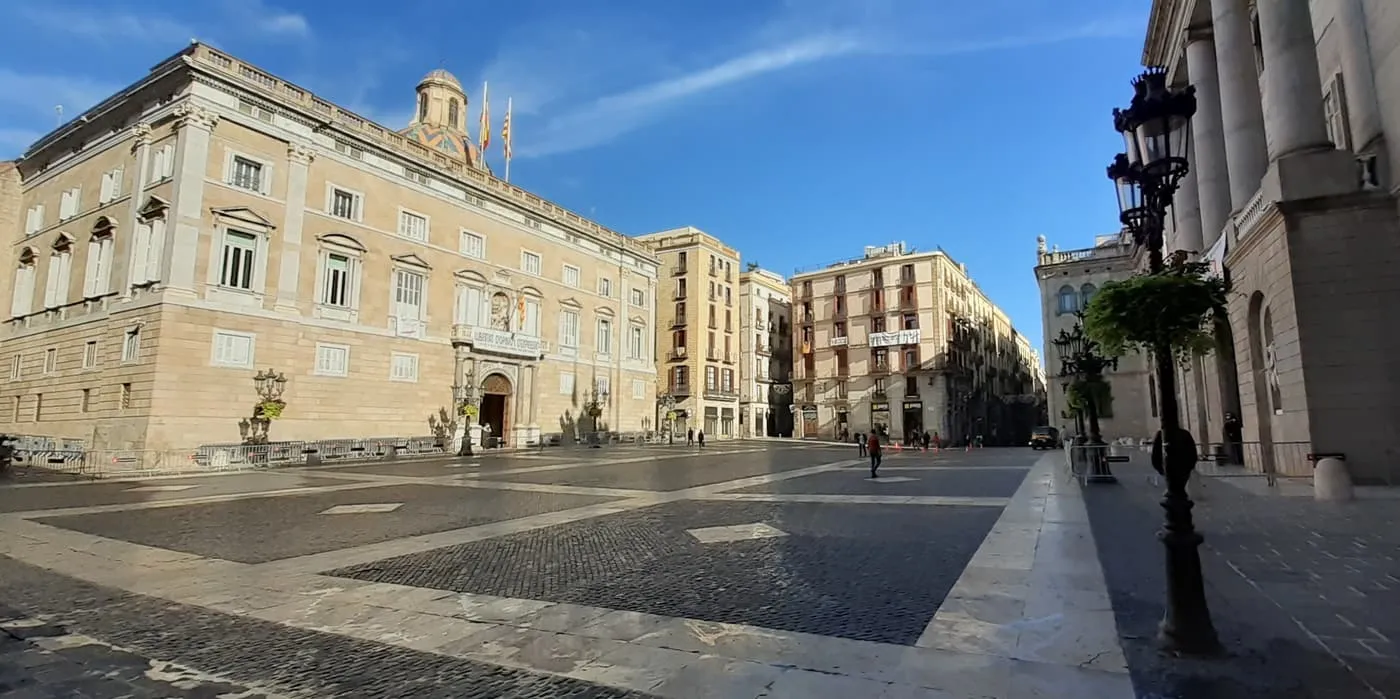
Plaça de Sant Jaume. Photo: Herodotptlomeu, Wikimedia Commons, CC BY-SA 4.0.
The square sits on the Roman forum, where Barcino’s two main streets crossed: the decumanus ran along what are now Carrer del Bisbe and Carrer de la Ciutat, and the cardo along Carrer de la Llibreteria and Carrer del Call. It took its present shape in the 1820s, when the church of Sant Jaume was pulled down.
Facing each other across it are the Palau de la Generalitat and the Casa de la Ciutat. The Generalitat’s front on the square is Renaissance, begun in 1597 to a design by Pere Blai, with four smooth Roman columns of the 2nd century flanking its main door. Its Gothic side is the one you passed on Carrer del Bisbe. The Casa de la Ciutat has a Gothic front on Carrer de la Ciutat by Arnau Bargués, from 1399, and a neoclassical front on the square by Josep Mas i Vila, from 1847.
Carrer del Paradís leaves the square and reaches the temple in about 115 m.
5. The Temple of Augustus
Free · Monday 10:00 to 14:00 · Tuesday to Saturday 10:00 to 19:00 · Sunday 10:00 to 20:00 · last entry 30 minutes before closing · Carrer del Paradís 10
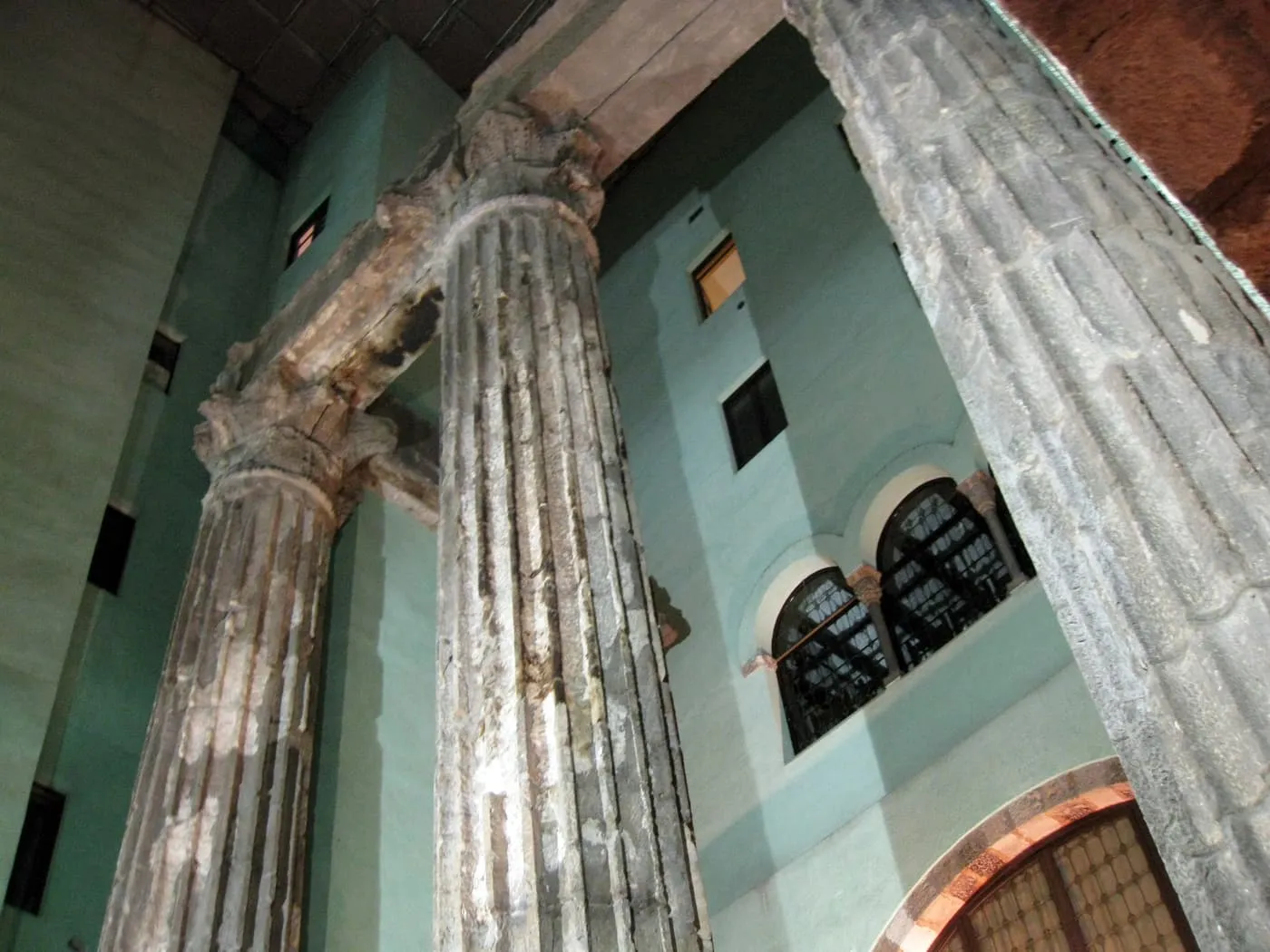
The columns of the Temple of Augustus. Photo: Enfo, Wikimedia Commons, CC BY-SA 3.0.
The temple stood at the top of Mons Taber, the small hill the colony was built on, on the axis of the forum, and the Barcelona City History Museum (MUHBA) dates it to the 1st century BC. Four columns with striated shafts and Corinthian capitals survive, with part of the architrave and the podium. They stand inside the headquarters of the Centre Excursionista de Catalunya, a hiking club whose first flat on Carrer del Paradís, in 1878, was level with three of the capitals. In the remodelling that Lluís Domènech i Montaner, a club member, finished in 1905, the columns were left fully visible inside the building; in the mid-20th century Adolf Florensa added a fourth column that had stood for a time in Plaça del Rei.
The entrance is the club’s street door. It is a MUHBA site, so it closes on 1 January, 1 May, 24 June and 25 December.
6. Plaça del Rei
Museum €7.30 · Tuesday to Saturday 10:00 to 19:00 · Sunday 10:00 to 20:00 · closed Mondays · free on Sundays from 15:00 and on the first Sunday of the month · last entry 45 minutes before closing
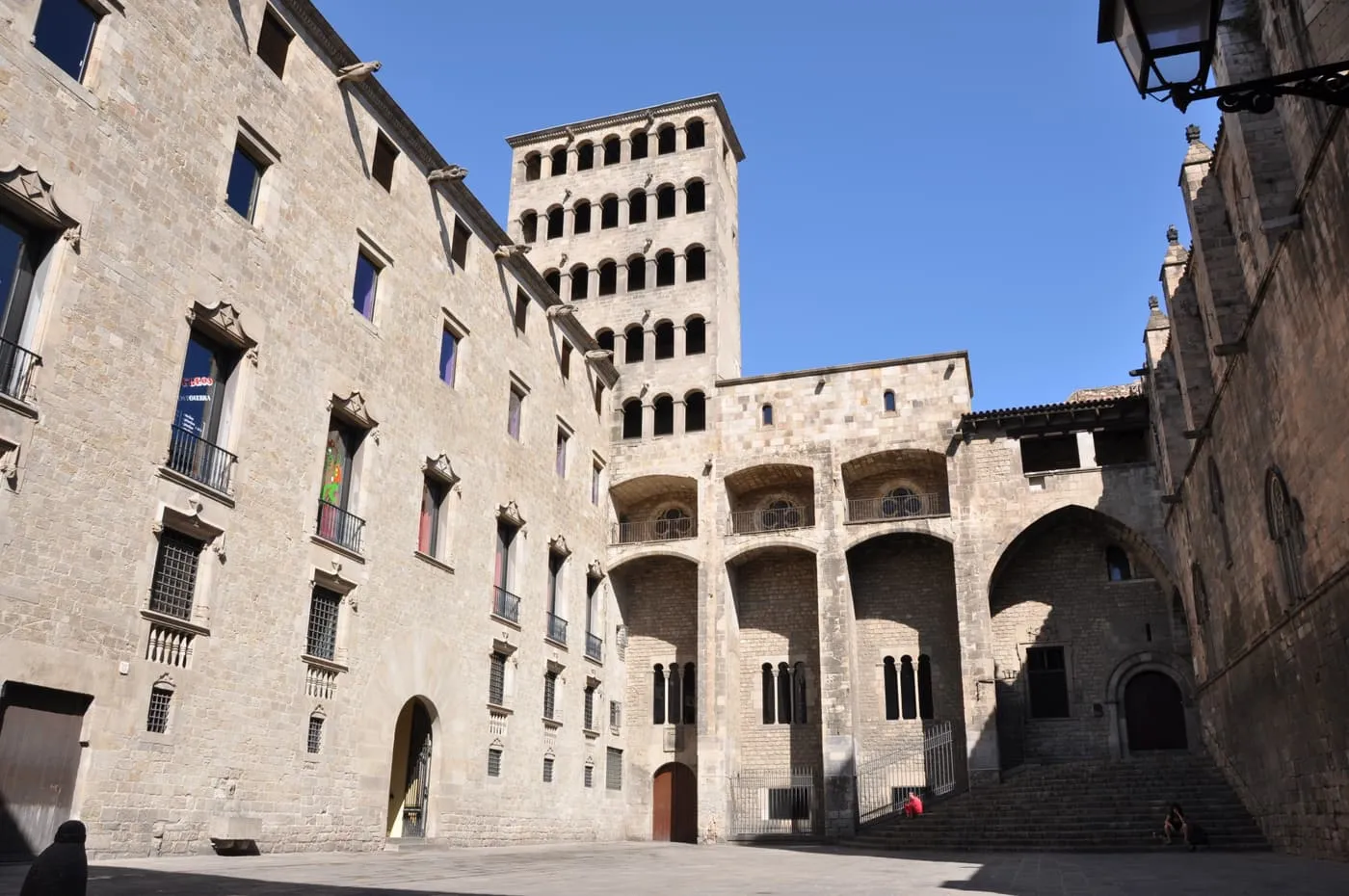
Plaça del Rei. Photo: Catalan Art & Architecture Gallery, Wikimedia Commons, CC BY-SA 2.0.
The medieval royal palace stands over the remains of Roman and Visigothic Barcelona, and the museum takes you under it. The underground tour walks along Roman streets beside the city wall, through a laundry and a dye house of the 2nd century, a fish-salting factory of the 3rd that made garum, and a winery, to the bishops’ complex of baptistery, residence and cruciform church. Above ground are the Saló del Tinell, the Chapel of Santa Àgata and Casa Padellàs, a 16th-century palace moved here from Carrer Mercaders.
- One ticket, other sites. The €7.30 ticket also admits you to the Via Sepulcral, the Domus d’Avinyó, the Domus de Sant Honorat, El Call, the Vil·la Joana and the Refugi 307, each with its own hours on the MUHBA site.
- Closed on 1 January, 1 May, 24 June and 25 December.
- Free: under 16s, the first Sunday of every month and every Sunday from 15:00.
Carrer dels Comtes and Baixada de la Llibreteria lead down to Via Laietana. Cross it and follow Carrer de la Princesa and Carrer de la Barra de Ferro to Carrer de Montcada: 480 m.
7. Carrer de Montcada and the Picasso Museum
€12 online, €13 at the ticket office · Tuesday to Sunday 10:00 to 19:00 until 29 March 2027 · closed Mondays · Carrer de Montcada 15-23
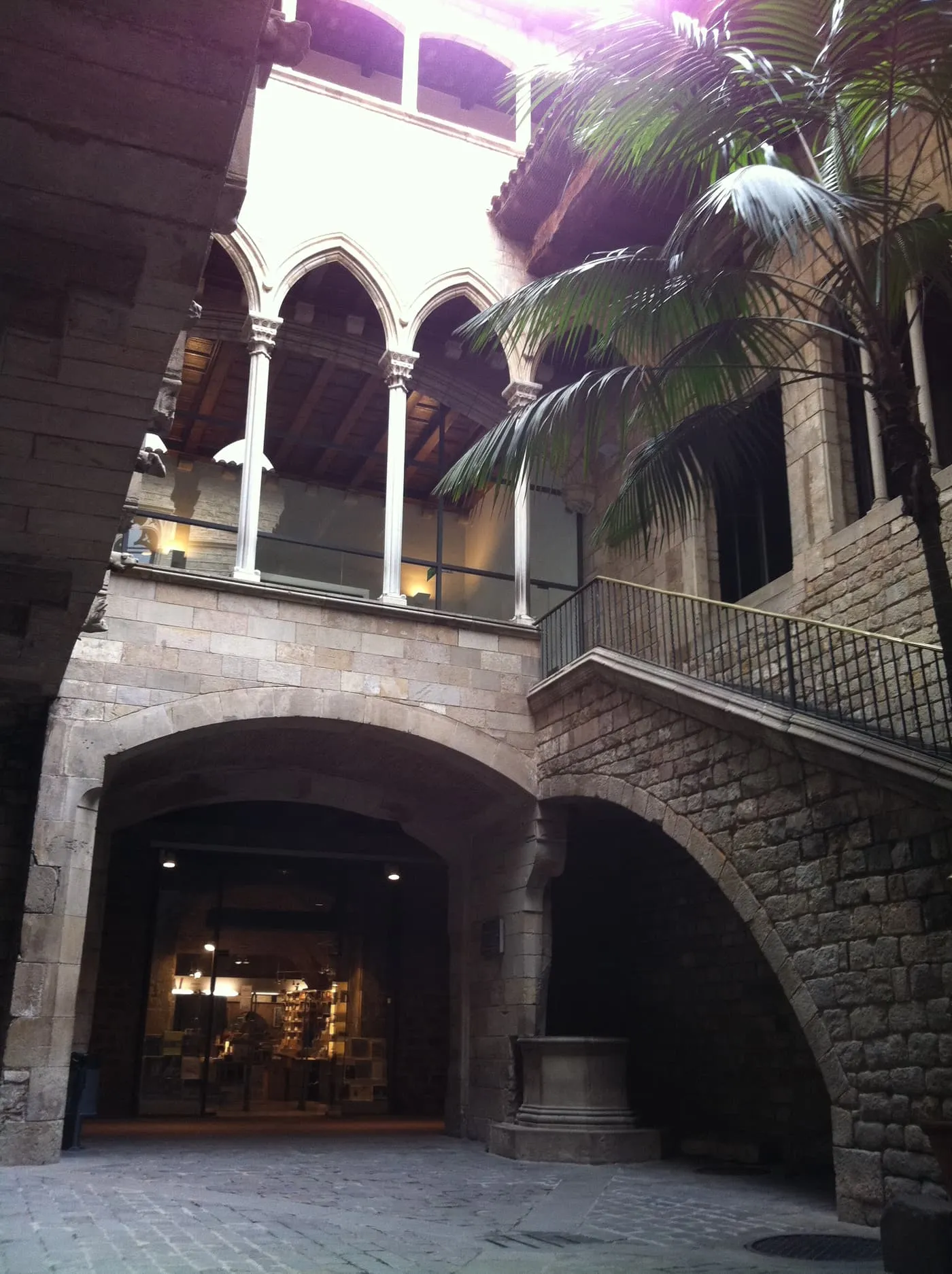
The courtyard of the Palau Aguilar, part of the Picasso Museum. Photo: Kippelboy, Wikimedia Commons, CC BY-SA 3.0.
Montcada was a street of merchants’ houses, and the Picasso Museum occupies five of its palaces, dating from the 13th to the 15th century: large town houses round a courtyard, with an open outdoor stair to the main floor. The museum opened in 1963 on the strength of the collection of Picasso’s friend and secretary Jaume Sabartés, and it now holds around 5,000 pieces, centred on his early work from Málaga, A Coruña, Barcelona, Madrid and Horta de Sant Joan.
- Book online: the museum has limited capacity, and the ticket office stops selling 30 minutes before closing.
- Free slots, with a reservation: the first Sunday of each month and Thursday from 16:00 to 19:00. Reservations open four days before, from 10:00.
- Hours change from 31 March to 27 September 2027: Tuesday, Wednesday and Sunday 9:00 to 20:00, Thursday to Saturday 9:00 to 21:00.
- Closed on Mondays, 1 January and 25 December; 10:00 to 14:00 on 24 and 31 December.
The museum’s site has the booking. The street has lunch on it: see where to eat.
Follow Carrer de Montcada to its end and Carrer dels Sombrerers to Santa Maria del Mar: 240 m.
8. Santa Maria del Mar
€8 for the church, galleries, crypt, towers and roof terraces · Monday to Saturday 10:00 to 18:00 · Sunday 13:00 to 18:00 · last admission 17:30 · free to enter outside those hours
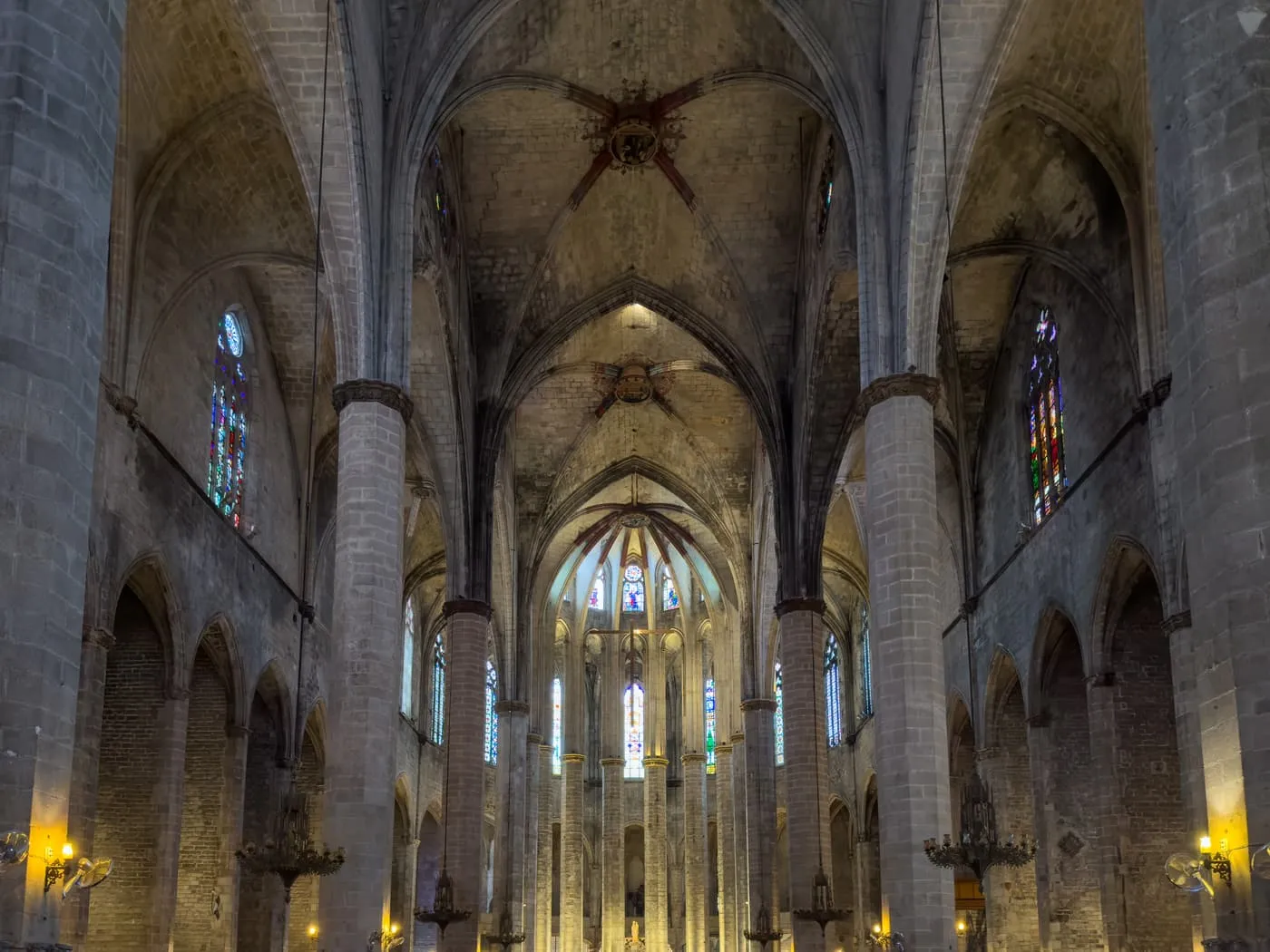
The nave of Santa Maria del Mar. Photo: Kent Wang, Wikimedia Commons, CC BY-SA 4.0.
Building began in 1329 and finished in 54 years, quick for a church this size. The Ribera was the sailors’, fishermen’s and merchants’ quarter, and the stone came from Montjuïc, carried up by the bastaixos, the dockers’ guild. Three naves with 33 chapels stand on slim octagonal pillars, so the whole church is visible from almost anywhere in it. The fire of 1936 destroyed part of the Baroque altarpiece and several windows.
- The roof terraces are on three levels, more than 33 m up, with a close view of the rose window and the gargoyles. Children under 8 are not allowed up the towers or on the terraces, and the climb is by stairs. The basilica can close them in bad weather.
- Tickets are sold online and at the ticket office. Photography is allowed throughout the visit.
- Fossar de les Moreres, the square beside the church’s east end, is built over the cemetery where the defenders of Barcelona were buried after the siege of 1714. An eternal flame burns at the memorial.
The basilica’s visiting page has the hours. Passeig del Born leads to the old market: 260 m.
9. El Born Centre de Cultura i Memòria
Hall free · guided tour of the excavated site €4.20 · exhibitions €3 · March to October 10:00 to 20:00 · November to February 10:00 to 19:00, Sundays and holidays to 20:00 · closed Mondays · Plaça Comercial 12
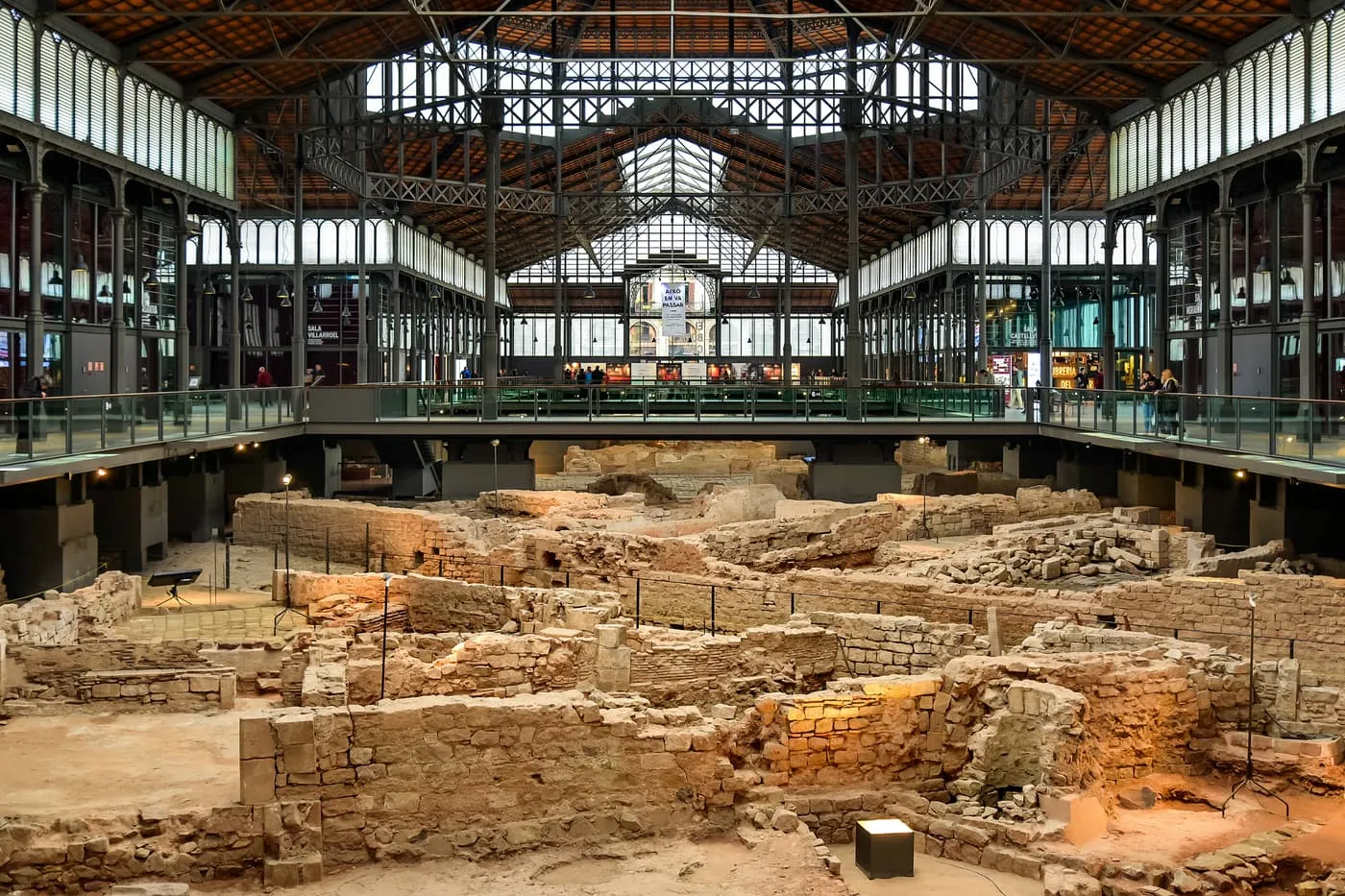
The El Born hall over the excavated site. Photo: Jorge Franganillo, Wikimedia Commons, CC BY 2.0.
The Born market opened in 1876 as a retail market and became a wholesale fruit and vegetable market in 1921, until it closed in 1971. Excavation under the iron hall found the quarter that the city’s fall to the troops of Philip V on 11 September 1714 sealed: sections of up to nine streets, from the 42 destroyed to clear ground for the citadel, and the remains of about sixty houses on 11 blocks. Walking into the building costs nothing, but going down to the site is by guided tour.
- Tours of the site in English run Tuesday to Sunday at 16:00, €4.20; Spanish and Catalan tours run at other times. The MUHBA page has the schedule and the booking.
- Last entry 30 minutes before closing. Closed on 1 January, 1 May, 24 June and 25 December; on 26 December it closes at 14:30.
The nearest metro stops are Jaume I and Barceloneta, both on L4 and both 550 m away.
Where to eat
El Xampanyet
Carrer de Montcada 22 · Monday 19:00 to 23:00 · Tuesday to Friday 12:00 to 15:30 and 19:00 to 23:00 · Saturday 12:00 to 15:30 · closed Sundays
A standing bar open since 1929 that spills onto the street. Order cava by the glass and the baked potato with sobrassada, a soft cured sausage, and aioli. It takes no reservations.
Bar del Pla
Carrer de Montcada 2 · Monday to Thursday 12:00 to 23:00 · Friday and Saturday 12:00 to midnight
A marble-topped bar with a natural wine list, serving all day. Order the Iberian ham croquettes and the mushroom carpaccio. It is at the start of Montcada, before the museum.
Cal Pep
Plaça de les Olles 8 · Monday 19:30 to 23:30 · Tuesday to Friday 13:00 to 15:45 and 19:30 to 23:30 · Saturday 13:15 to 15:45 and 19:30 to 23:30 · closed Sundays
A counter with no menu: ask what came in that morning. Order the tortilla, the tuna tartare and the trifásico of fried whitebait, squid and prawns. It is 250 m from Santa Maria del Mar, on the way to the Born. Where to eat in Barcelona ranks more places by how many sources name them.
The best day to go
| Day | What changes on the route |
|---|---|
| Monday | Closed: the Picasso Museum, the Plaça del Rei museum and El Born. The Temple of Augustus opens only from 10:00 to 14:00. The cathedral and Santa Maria del Mar are open |
| Tuesday to Saturday | All open. The Picasso Museum’s free slot is on Thursday from 16:00 to 19:00, by reservation. The cathedral closes at 17:15 on Saturdays |
| Sunday | The cathedral’s tourist visit runs only from 14:00 to 17:00, and Santa Maria del Mar opens at 13:00. The Plaça del Rei museum is free from 15:00, and on the first Sunday of the month the Picasso Museum is free by reservation: 1 November, 6 December 2026 and 3 January 2027 |
The timing that works, Tuesday to Saturday: be at the cathedral when it opens at 9:30, reach Plaça del Rei by 11:00, lunch on Montcada, and be in the Picasso Museum at 13:30. Santa Maria del Mar takes the middle of the afternoon, with the last admission at 17:30, and El Born is at 16:00 for the English tour. On a Sunday, start at about 13:30 for the cathedral at 14:00, then take the temple and Plaça del Rei, which is free from 15:00, and reach Santa Maria del Mar before its last admission at 17:30. The Picasso Museum fits better on a Tuesday to Saturday, or on a free first Sunday.
What closes:
- 1 January, 1 May, 24 June and 25 December: the Plaça del Rei museum, the Temple of Augustus and El Born. The Picasso Museum closes on 1 January and 25 December, and on 24 and 31 December it is open from 10:00 to 14:00.
- From 1 November: El Born closes at 19:00 on weekdays and Saturdays, until the end of February.
- Religious holidays: the cathedral follows its Sunday hours.
What does not close: the streets, the squares, Plaça Nova and Plaça de Sant Jaume. A Monday still makes a good walk: the cathedral, the Roman towers, the forum, the temple until 14:00 and Santa Maria del Mar are all open. Only the Picasso Museum, the Plaça del Rei museum and El Born are missing.
Getting there and back
- To the start: Plaça de Catalunya has metro L1 and L3, the FGC and Rodalies trains, and the Aerobús from the airport. See Barcelona metro tickets for the T-casual.
- From the end: Jaume I and Barceloneta metro stations, both on L4, are 550 m from El Born; Arc de Triomf, on L1, is 900 m.
- In reverse: the route works from El Born back to Plaça de Catalunya, but the cathedral then comes late in the afternoon, when its last entry is at 17:45.
What to do with the rest of the day
- Passeig de Gràcia, which also starts at Plaça de Catalunya: the Modernisme walk goes from the square past Casa Batlló and La Pedrera to Casa Vicens in Gràcia. Casa Batlló or La Pedrera compares the two houses.
- A Modernista concert hall, the Palau de la Música, is 500 m from Plaça Nova: Palau de la Música tickets.
- The whole trip: one day in Barcelona and 3 days in Barcelona build the days round the bookings, and what to book before you go to Barcelona has the rest of the tickets.
Common questions
How long is the Gothic Quarter and El Born walk?
2.2 km from Plaça de Catalunya to the El Born Centre de Cultura i Memòria, measured along the streets: about 30 minutes of walking, and 5 to 6 hours with the cathedral, the Plaça del Rei museum, the Picasso Museum and Santa Maria del Mar. At a stroll, without going inside anything, it takes about an hour.
Is the Gothic Quarter and El Born walk free?
The streets, Plaça de Catalunya, Plaça Nova, Plaça de Sant Jaume, the Temple of Augustus and the hall of the El Born market cost nothing. The cathedral's tourist visit is €16, the Plaça del Rei museum €7.30, the Picasso Museum €12 online, Santa Maria del Mar €8 with its towers and roof terraces, and the guided tour of the excavated streets at El Born €4.20.
What do I need to book for the Gothic Quarter and El Born?
The Picasso Museum, online: capacity is limited, and its free Thursday and first-Sunday slots can be reserved from four days before. The cathedral, the Plaça del Rei museum and Santa Maria del Mar sell tickets online as well as at the door.
Which day is best for the Gothic Quarter and El Born walk?
Tuesday to Saturday. On Mondays the Picasso Museum, the Plaça del Rei museum and El Born are closed, and the Temple of Augustus opens only from 10:00 to 14:00. On Sundays the cathedral's tourist visit runs only from 14:00 to 17:00.
Can you go inside the Roman temple in the Gothic Quarter?
Yes, and it is free. Four columns of the Temple of Augustus stand in a courtyard at Carrer del Paradís 10, which you enter from the street: Monday 10:00 to 14:00, Tuesday to Saturday 10:00 to 19:00 and Sunday 10:00 to 20:00, with the last entry 30 minutes before closing.
Is Santa Maria del Mar free to enter?
Outside its visiting hours the basilica is free to enter. During them, Monday to Saturday 10:00 to 18:00 and Sunday 13:00 to 18:00, with the last admission at 17:30, the €8 ticket covers the church, the museum space in the galleries, the crypt, the towers and the roof terraces.
.jpg)