In this guide
💡 The Short Version: There is no single best month, so choose by what you want. March to May and September to October have mean daily highs of 16.3 to 26.4°C. July is the hottest, at 32.1°C, and December the coldest, at 10.0°C. October is the wettest month, at 60 mm, and it rains on 59 days a year. Hotels were fullest in October (84.4% of rooms in 2025) and May, and emptiest in January and August (63.6%). Holy Week is 19 to 28 March 2027, San Isidro is Saturday 15 May, and the Christmas lights burn from late November to 6 January. Or book a walk: the Welcome to Madrid Guided Walking Tourad is from €25.11 for 2.5 hours.
Madrid month by month
Highs and lows are the mean daily maximum and minimum in °C, and rain is the monthly total in mm with the number of days with 1 mm or more. The weather is AEMET’s averages for 1981 to 2010 at the Retiro station, in the middle of the city (AEMET). Daylight is the length of the day on the 15th, calculated for Madrid’s coordinates. The hotel column is the share of rooms occupied in 2025, from INE’s hotel survey of the city of Madrid, which counts hotels only.
| Month | High / low | Rain | Daylight | Hotels full | What changes |
|---|---|---|---|---|---|
| October 2026 | 19.4 / 10.7 | 60 mm, 6.9 days | 11.2 h | 84.4% | The fullest month for hotels. The clocks go back on Sunday 25 October |
| November 2026 | 13.5 / 6.3 | 58 mm, 6.5 days | 10.0 h | 79.9% | The Festival de Otoño, 6 to 26 November. The Plaza Mayor Christmas market opens in late November |
| December 2026 | 10.0 / 3.6 | 51 mm, 6.8 days | 9.3 h | 69.0% | The lights, the market, the lottery draw on 22 December and New Year’s Eve. The sun sets at about 17:51 on 21 December |
| January 2027 | 9.8 / 2.7 | 33 mm, 5.7 days | 9.6 h | 63.6% | One of the two emptiest months. The Three Kings parade on 5 January, and a holiday on 6 January |
| February 2027 | 12.0 / 3.7 | 34 mm, 5.2 days | 10.6 h | 70.3% | |
| March 2027 | 16.3 / 6.2 | 25 mm, 4.1 days | 11.9 h | 73.9% | ARCOmadrid, 3 to 7 March. Holy Week from 19 March, and the clocks go forward on Easter Sunday, 28 March |
| April 2027 | 18.2 / 7.7 | 45 mm, 6.7 days | 13.2 h | 78.2% | The Mutua Madrid Open from 19 April to 2 May |
| May 2027 | 22.2 / 11.3 | 50 mm, 7.3 days | 14.4 h | 80.9% | San Isidro, with the local holiday on Saturday 15 May. The wettest month of spring |
| June 2027 | 28.2 / 16.1 | 21 mm, 3.4 days | 15.0 h | 78.0% | Madrid Pride is expected to start on 30 June |
| July 2027 | 32.1 / 19.0 | 12 mm, 1.7 days | 14.8 h | 70.7% | The hottest month. Pride is expected to run to 4 July, with the march on Saturday 3 July |
| August 2027 | 31.3 / 18.8 | 10 mm, 1.7 days | 13.8 h | 63.6% | One of the two emptiest months for hotels. The partial eclipse on 2 August, and a holiday on Monday 16 August |
| September 2027 | 26.4 / 15.4 | 22 mm, 3.3 days | 12.5 h | 79.6% | The Formula 1 Spanish Grand Prix at MADRING, 10 to 12 September |
The weather in numbers
- Heat. July is the hottest month, with a mean daily high of 32.1°C, then August at 31.3°C and June at 28.2°C. In 2026 the Retiro station reached 39.5°C on 23 June, 39.4°C on 7 July and 38.1°C on 13 August, with 17, 26 and 21 tropical nights, where the temperature stays above 20°C, in June, July and August (AEMET’s Madrid bulletins for June, July and August). AEMET reported on 9 September that Spain’s summer of 2026 averaged 24.5°C, the hottest since records began in 1961, with 61 heat-wave days (Euronews).
- Cold. December has the lowest mean daily high, at 10.0°C, and January the lowest mean low, at 2.7°C. In January frost falls on 6.2 days and snow on 1.0 day on average.
- Rain. 421 mm a year, on 59.4 days of 1 mm or more. October is the wettest month at 60 mm, then November (58 mm) and December (51 mm). July (12 mm) and August (10 mm) are the driest.
- Sunshine. July has 355 hours of sunshine and December 124.
- Daylight. From 9 h 17 on 21 December, with sunrise at about 08:34 and sunset at about 17:51, to 15 h 04 on 21 June, with sunrise at about 06:44 and sunset at about 21:48.
- Clocks. They go back on Sunday 25 October 2026 and forward on Sunday 28 March 2027.
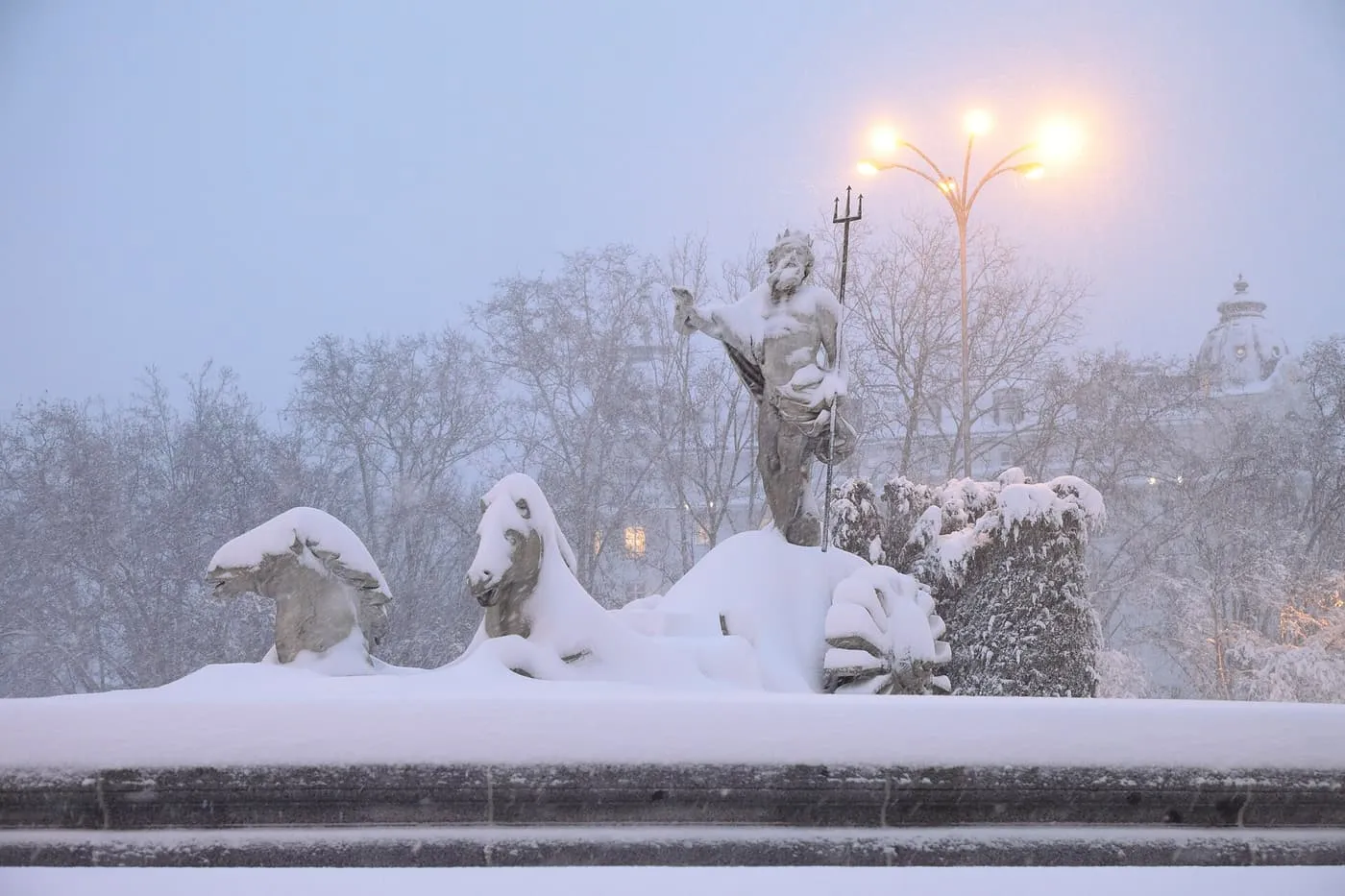
The Fuente de Neptuno under snow. Photo: Javier Pérez Montes, Wikimedia Commons, CC BY-SA 4.0.
Dates that shape a visit
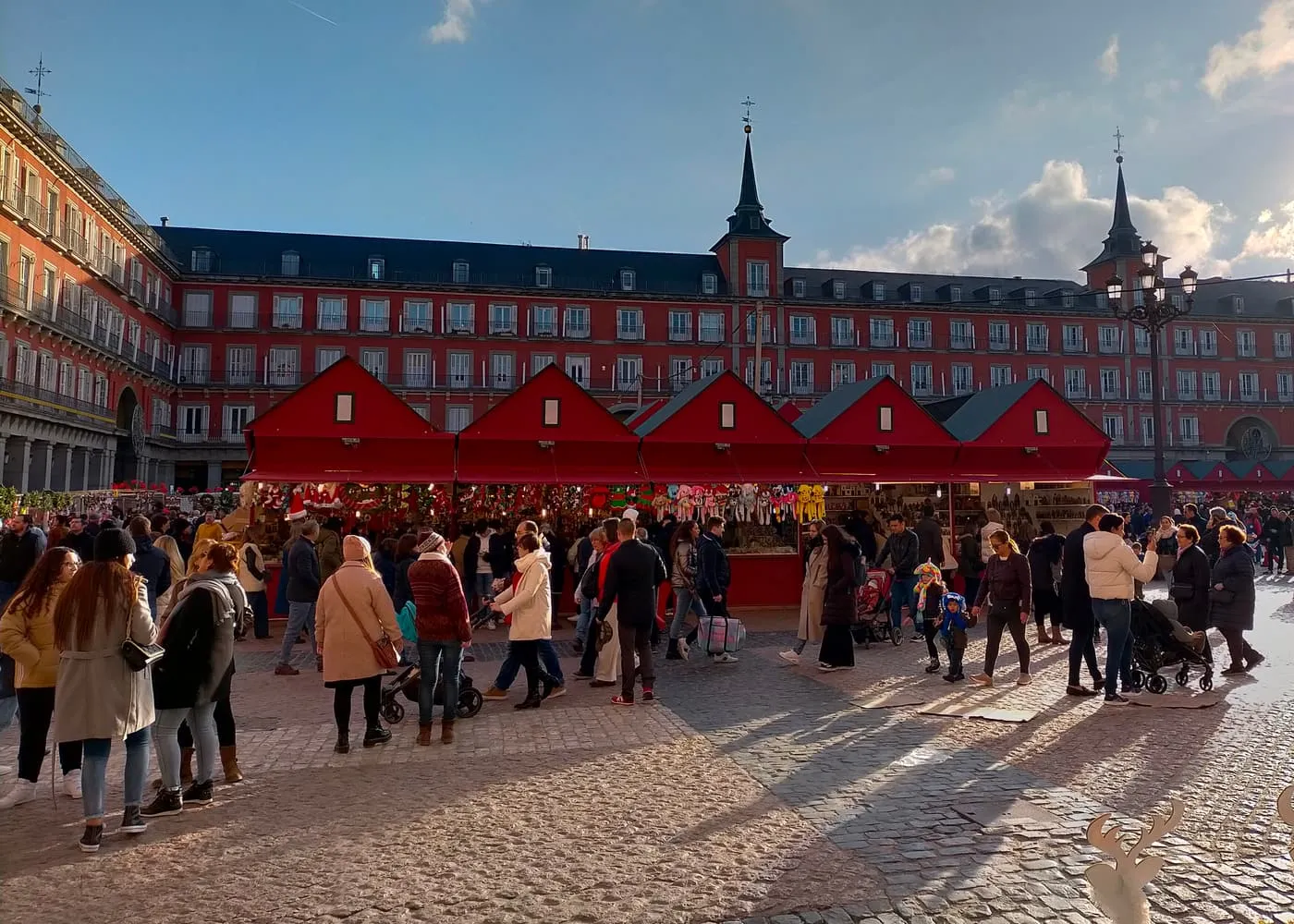
- Christmas. The Plaza Mayor market from late November to 31 December, and the lights from late November to 6 January 2027: see Christmas in Madrid 2026. The grapes at midnight are in New Year’s Eve in Madrid, and the parade on 5 January in the Three Kings parade.
- ARCOmadrid. 3 to 7 March 2027 at IFEMA (esMadrid).
- Holy Week. 19 to 28 March 2027, from the Viernes de Dolores to Easter Sunday. Holy Thursday, 25 March, and Good Friday, 26 March, are public holidays, and so is 19 March, San José. Most of the processions pass through the Puerta del Sol (esMadrid).
- Mutua Madrid Open. 19 April to 2 May 2027 at the Caja Mágica (esMadrid).
- San Isidro. The city’s patron saint, on Saturday 15 May 2027, a local holiday. The fiestas run from the first days of May to the 16th, and the official programme is published at the beginning of May (esMadrid).
- Madrid Pride. esMadrid lists the proclamation on Wednesday 30 June 2027 in the Plaza Pedro Zerolo in Chueca, and the big march is expected on Saturday 3 July, with the dates still to be confirmed (esMadrid).
- The eclipse. The total solar eclipse of 2 August 2027 crosses the south of Spain, entering over the Strait of Gibraltar, and the Instituto Geográfico Nacional says Europe’s only totality is in Spain. Madrid sees a partial eclipse (IGN).
- August. Monday 16 August is a holiday. See Madrid in August.
- The Formula 1 Spanish Grand Prix. 10 to 12 September 2027 at MADRING. The 2026 race drew 353,000 spectators over three days (esMadrid).
- Hotels. The fullest and emptiest months are in the table above, and the dates that fill the city are in where to stay in Madrid.
Which month for what
- Walking weather. March to May, with highs of 16.3 to 22.2°C, and September to October, with highs of 26.4°C and 19.4°C.
- The fewest rainy days. July and August, at 1.7 days each.
- The quietest hotels. January and August, at 63.6% of rooms.
- The fullest hotels. October, at 84.4%, and May, at 80.9%.
- Long evenings. June, with 15 h of daylight on the 15th and sunset at about 21:46.
- Short days. December, with 9.3 hours and sunset at about 17:51 on 21 December.
- Indoors in the heat. The Prado, the Royal Palace and the free museum hours: see free things to do in Madrid.
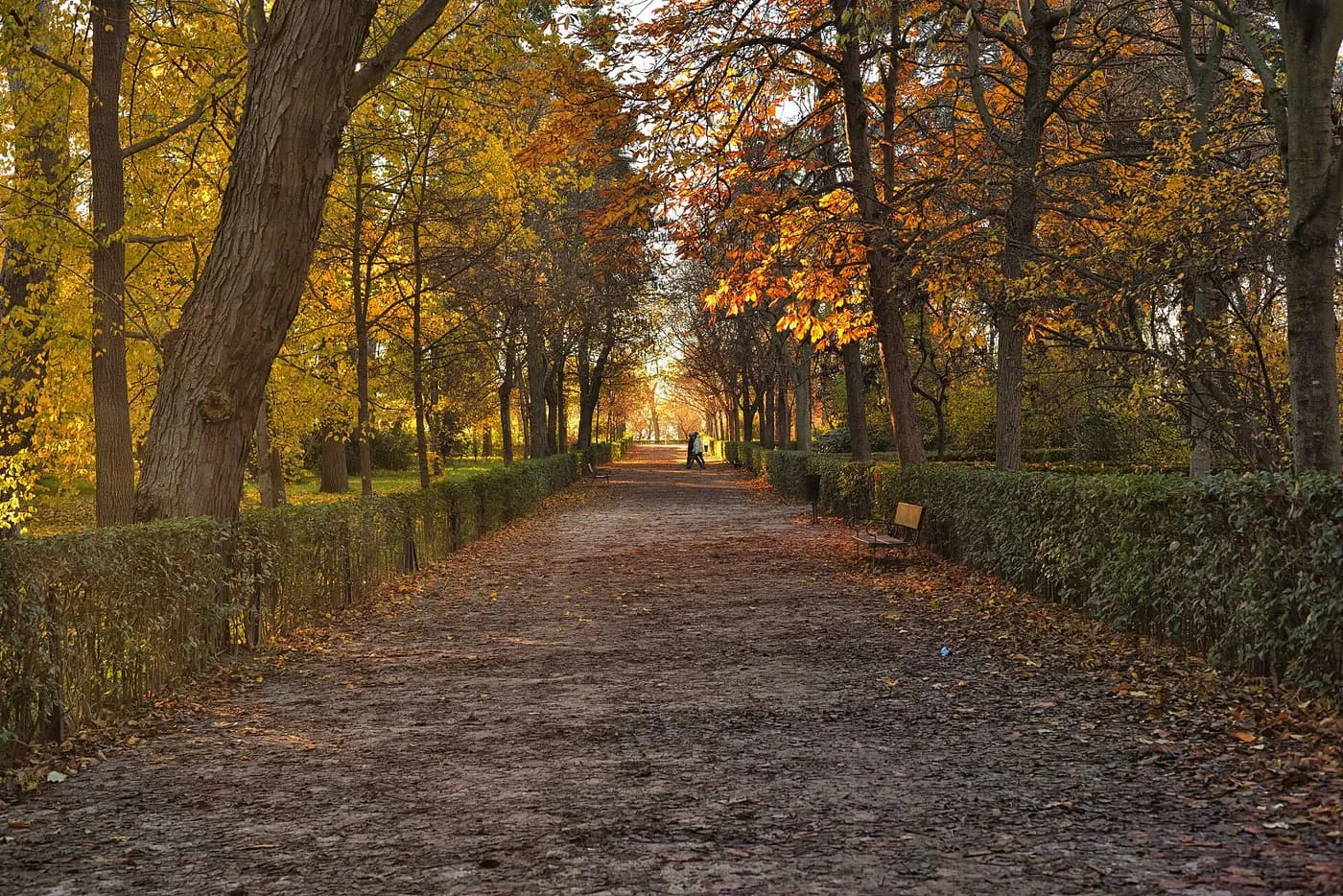
An avenue in the Retiro in autumn. Photo: Javier Perez Montes, Wikimedia Commons, CC BY-SA 4.0.
Plan the rest
Where to stay in Madrid compares the areas and hotels near the Puerta del Sol lists the closest. Once you have your dates, Madrid in one or two days fits the sights round the closed days. Where to eat in Madrid covers the meals, and what to book before you go to Madrid has the hours for every sight. For the way in, see Madrid airport to the city and Madrid public transport. Day trips from Madrid covers the trips out. For the same question in other cities, see the best time to visit Seville and the best time to visit Barcelona.
Common questions
What is the best month to visit Madrid?
It depends on what you want. March to May and September to October have mean daily highs between 16.3°C and 26.4°C. July is the hottest month, with a high of 32.1°C and rain on 1.7 days. December is the coldest, with a high of 10.0°C. October is the wettest month, with 60 mm, and May the wettest of spring, with 50 mm.
How hot does Madrid get in summer?
AEMET's Retiro averages for 1981 to 2010 give July a mean daily high of 32.1°C and August 31.3°C. In 2026 the Retiro station reached 39.5°C on 23 June, 39.4°C on 7 July and 38.1°C on 13 August, with 17, 26 and 21 tropical nights in June, July and August. Spain's summer of 2026 was the hottest since records began in 1961, according to AEMET.
How cold is Madrid in winter?
December has a mean daily high of 10.0°C and a low of 3.6°C, and January 9.8°C and 2.7°C, with frost on 6.2 days and snow on 1.0 day in January on average. On 21 December the sun rises at about 08:34 and sets at about 17:51.
How many days does it rain in Madrid?
On 59.4 days a year, counting days with 1 mm or more, and 421 mm falls in total. October is the wettest month, with 60 mm, then November with 58 mm and December with 51 mm. July and August are the driest, with 12 and 10 mm.
When are Madrid's hotels fullest?
In 2025 October was fullest, with 84.4% of rooms occupied, then May at 80.9%, November at 79.9% and September at 79.6%, according to INE's hotel survey of the city. January and August were the emptiest, both at 63.6%.
When are Holy Week and San Isidro in 2027?
Holy Week runs from 19 to 28 March 2027, with Holy Thursday on 25 March and Good Friday on 26 March both holidays. San Isidro, the city's patron saint, is on Saturday 15 May 2027, a local holiday.