In this guide
💡 The Short Version: St Peter’s Church (Svētā Pētera baznīca) has a spire 123.25 metres tall and an electric lift to an open-air viewing platform at 72 metres, with views over the Old Town, the Daugava and the city beyond. A combined tower and church ticket is sold at the ticket desk inside the western portal at Reformācijas laukums 1. Or book a tour: an Old Town walking tour with a local guidead from €15 stops at St Peter’s Church, and a walking tour with the Līvu Square observation deckad from €19 adds a second viewpoint, so you can compare views before paying for the tower lift.
⚠️ Purchase the combined tower ticket at the door. The standard ticket covers both the nave exhibitions and the lift. The lift takes small groups, so expect a queue on clear weekend afternoons.
Tickets
Tickets are sold at the main entrance desk on Reformācijas laukums, for cash or contactless card.
Guided walks that include St Peter’s
Tower tickets are sold at the church. These Old Town walks pass it, priced at GetYourGuide’s lowest “from” price per person.
Old Town walking tour
From €15 · 4.7 stars from 1,451 reviews · 2 hours · Town Hall, House of the Black Heads, St Peter’s Church
A local guide covers the Old Town’s history, with St Peter’s Church among the stops. Old Town walking tour on GetYourGuidead
Old Town walk with the Līvu Square observation deck
From €19 · 4.7 stars from 36 reviews · 2 hours · viewpoint over Līvu Square
A walk through the narrow streets of the Old Town that ends with a view over Līvu Square and the city’s church spires. Old Town walk with Līvu Square observation deck on GetYourGuidead
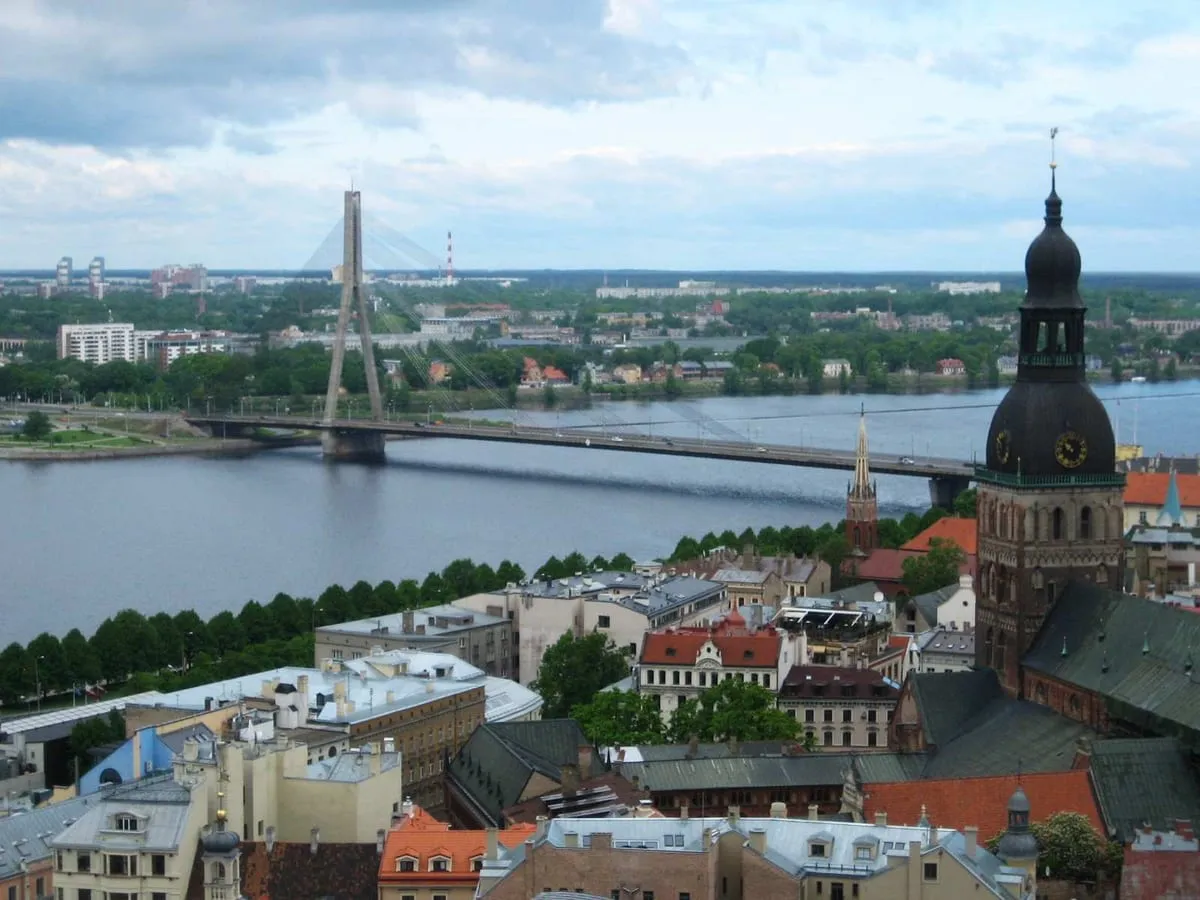
The 72-metre tower platform and viewing gallery
The spire is 123.25 metres tall. The viewing platform is on the second gallery level, 72 metres above ground.
You do not climb the spire on foot:
- The stairs: After showing your ticket in the nave, follow the signs up a short flight of stone stairs and an interior walkway to the lift lobby on the second level.
- The lift: A steel lift operated by church attendants runs up through the hollow core of the rebuilt metal tower. The ride takes about forty seconds.
- The gallery: The viewing deck is an open-air gallery around the spire, with safety grilles round the perimeter. Photograph through the wire openings.
The gallery is exposed, so it is colder and windier at 72 metres than at street level. Gusts off the Baltic can be sharp even in summer; in spring, autumn and winter bring a windproof jacket and gloves, and keep a strap on your camera.
From the balustrade:
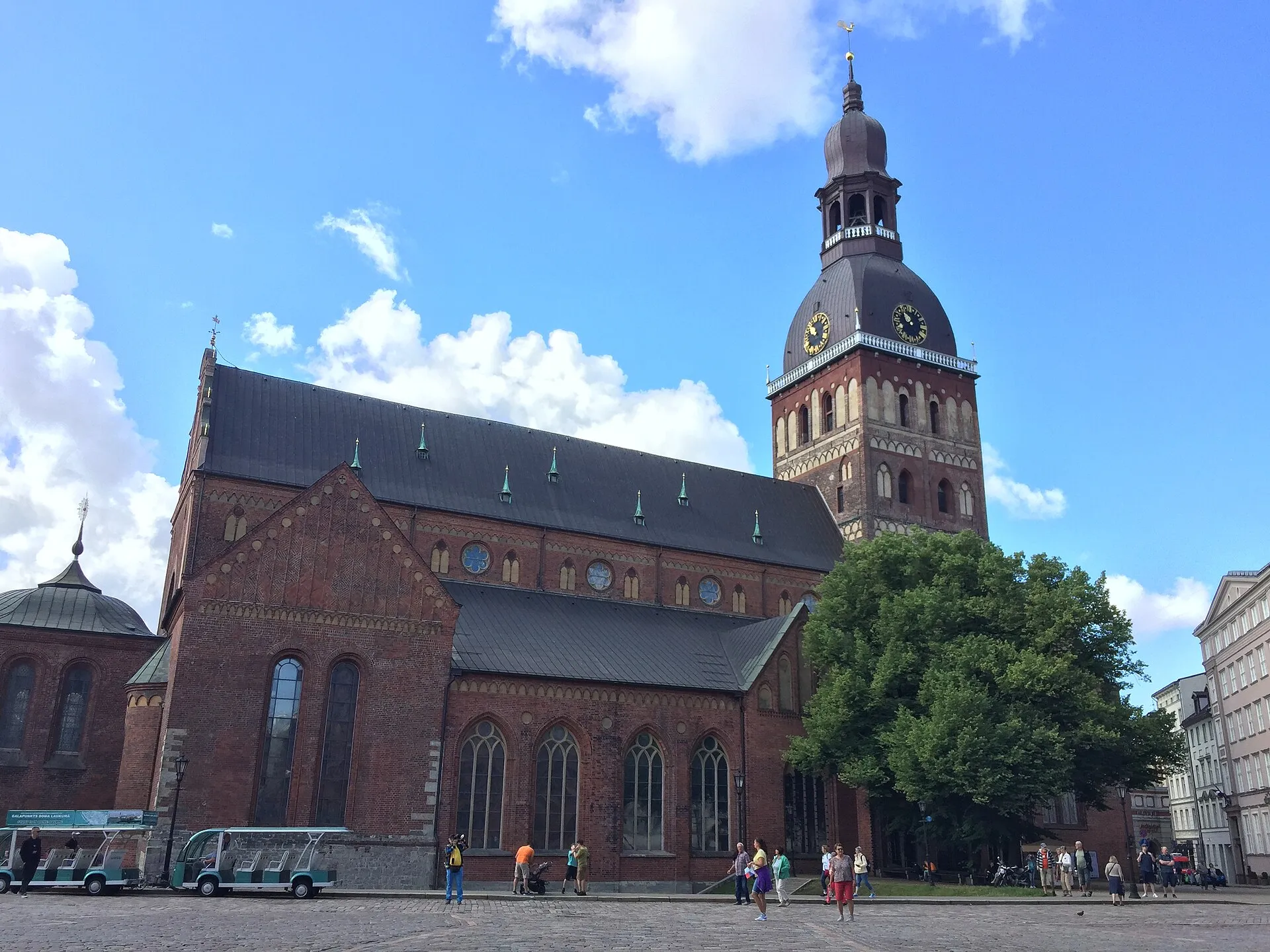
- North: The rooftops of Old Riga run towards the square belfry of Riga Dome Cathedral and the docks where passenger ferries leave for Stockholm.
- West: Directly below is Town Hall Square with the House of the Black Heads, then the Daugava, crossed by the Akmens Bridge (Stone Bridge) and the cable-stayed Vanšu Bridge. Beyond the river is the glass peak of the National Library of Latvia (the Castle of Light).
- South: Downstream are the lattice arches of the Railway Bridge, the Riga Radio and TV Tower on Zaķusala Island (368 metres), and the five arched roofs of Riga Central Market.
- East: The green belt of Bastion Hill and the City Canal opens out, with the travertine obelisk and gilded stars of the Freedom Monument.
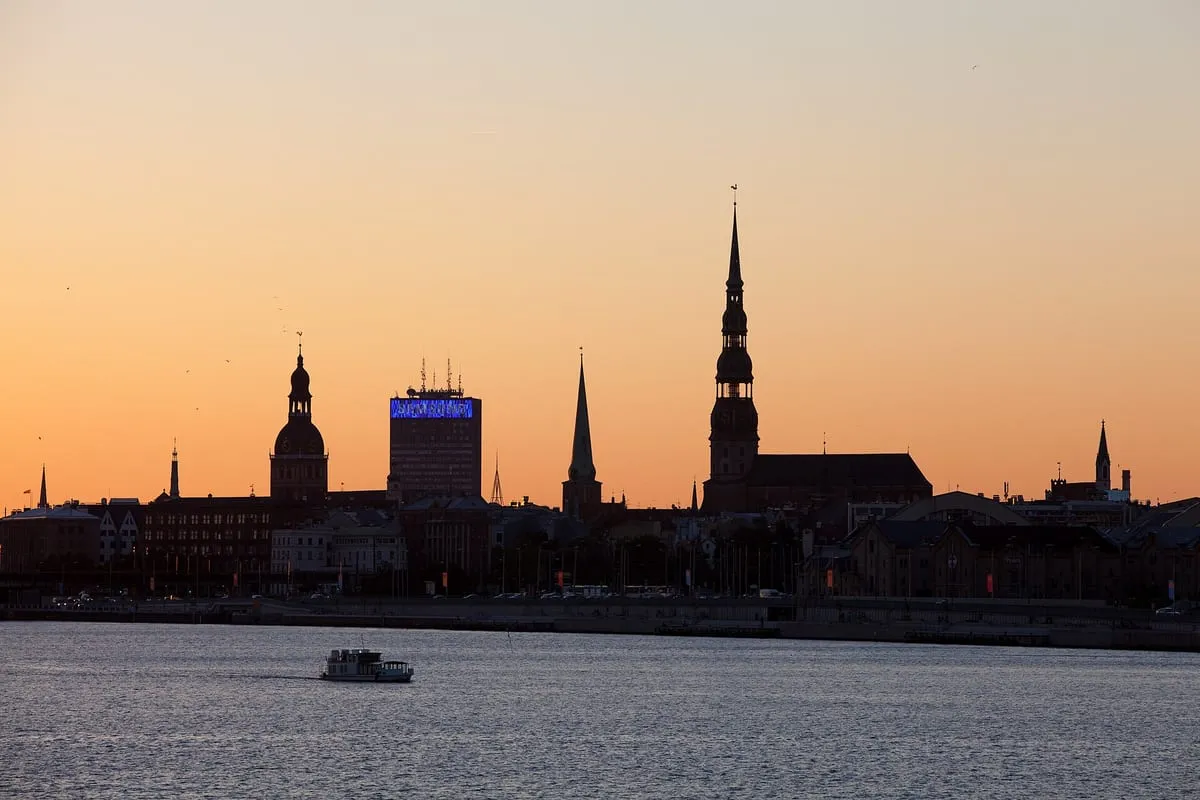
History of the church, fires and the golden rooster
St Peter’s has been the church of Riga’s burghers and merchants since the 13th century, in contrast to the Dome Cathedral, which belonged to the Archbishop.
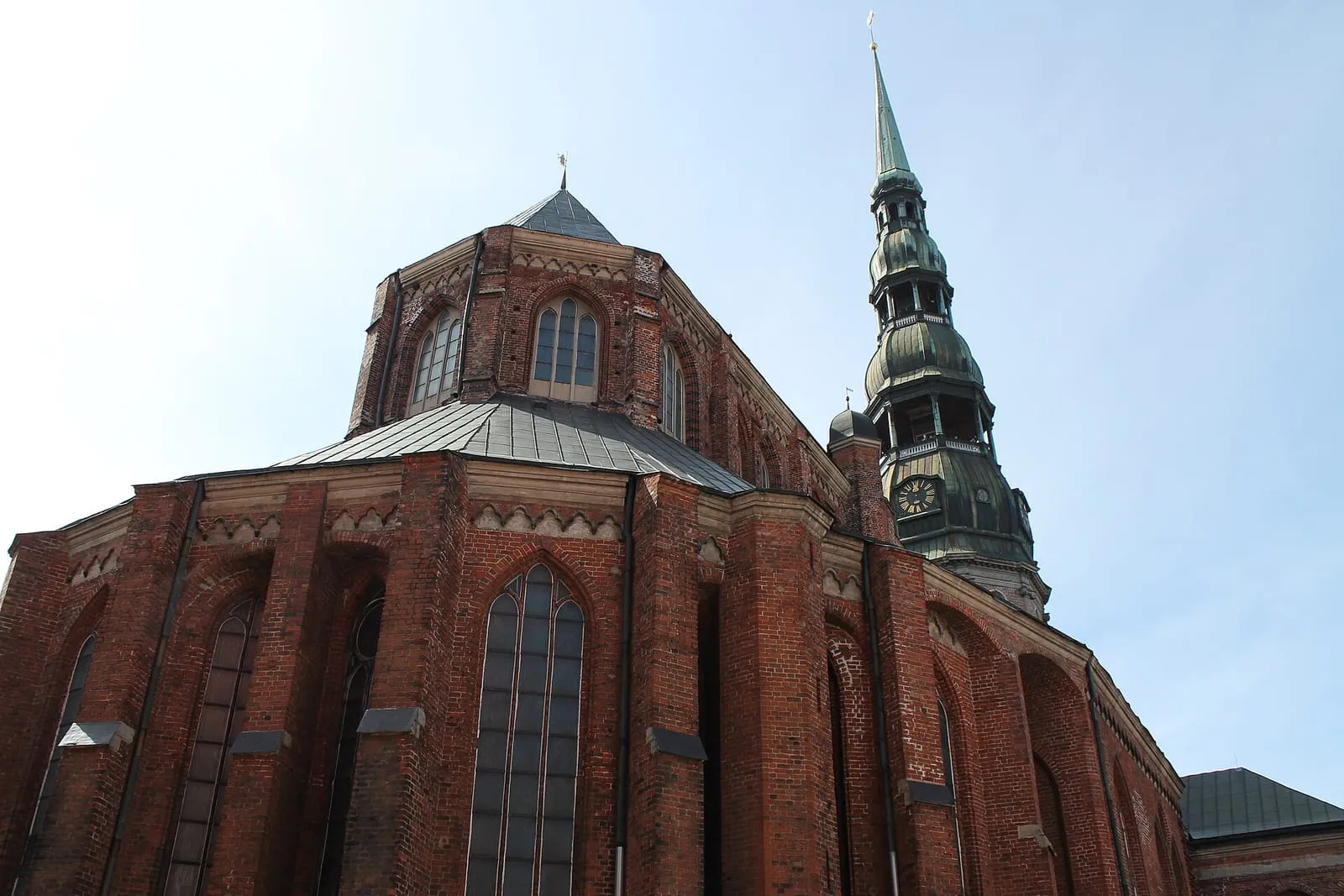
The original wooden church was first mentioned in chronicles in 1209. In the early 15th century builders from Rostock rebuilt it as a three-aisled Gothic basilica with a limestone and brick choir apse. The tower has burned down more than once:
- 1666: The earliest wooden spire collapsed, damaging surrounding houses.
- 1690: Master builder Jēkabs Josts erected a 64.5-metre baroque timber steeple, said to be the highest wooden structure in Europe.
- 1721: Lightning struck the wooden spire and set it ablaze. Legend has it that Tsar Peter the Great, who had captured Riga eleven years earlier, helped fight the fire. The tower burned down regardless, and Peter ordered it rebuilt to its original baroque drawings, a project finished in 1746.
- 1941: On 29 June 1941, artillery fire in the German assault on Riga hit the church. The wooden tower caught fire and fell into the nave, collapsing the vaulted roofs and gutting the interior.
Restoration began under Soviet direction in 1954. Between 1967 and 1973 a welded steel framework replaced the old timber beams, and the exterior was clad in green copper sheets. The viewing lift entered service in 1973, and restoration of the interior finished in 1983.
The legend of the Golden Cockerel
The top of the spire is crowned by a golden rooster weathercock (Pēterbaznīcas gailis), an emblem of Riga. The present weathercock is the seventh in the church’s history. It weighs 158 kilograms, measures over two metres across, and was hoisted to the summit on 21 August 1970 to mark the reconstruction.
By maritime tradition, one side of the cockerel was gilded and the other painted black. When the golden side faced the harbour, incoming skippers knew the winds would let them into the mouth of the Daugava. When the black side turned towards the sea, adverse winds meant they should anchor in the roads.
A second tradition is the master builder’s toast. When a new spire was finished, the master climbed to the top, straddled the rooster, drank a goblet of wine to the prosperity of Riga, and threw the glass down into the square. The number of pieces it broke into foretold how many centuries the tower would stand. In 1746 the builder Johann Wülbern’s goblet landed on a straw-filled hay cart and did not break; in 1970 the architect Pēteris Saulītis repeated the rite, and his glass shattered into hundreds of shards on the cobbles.
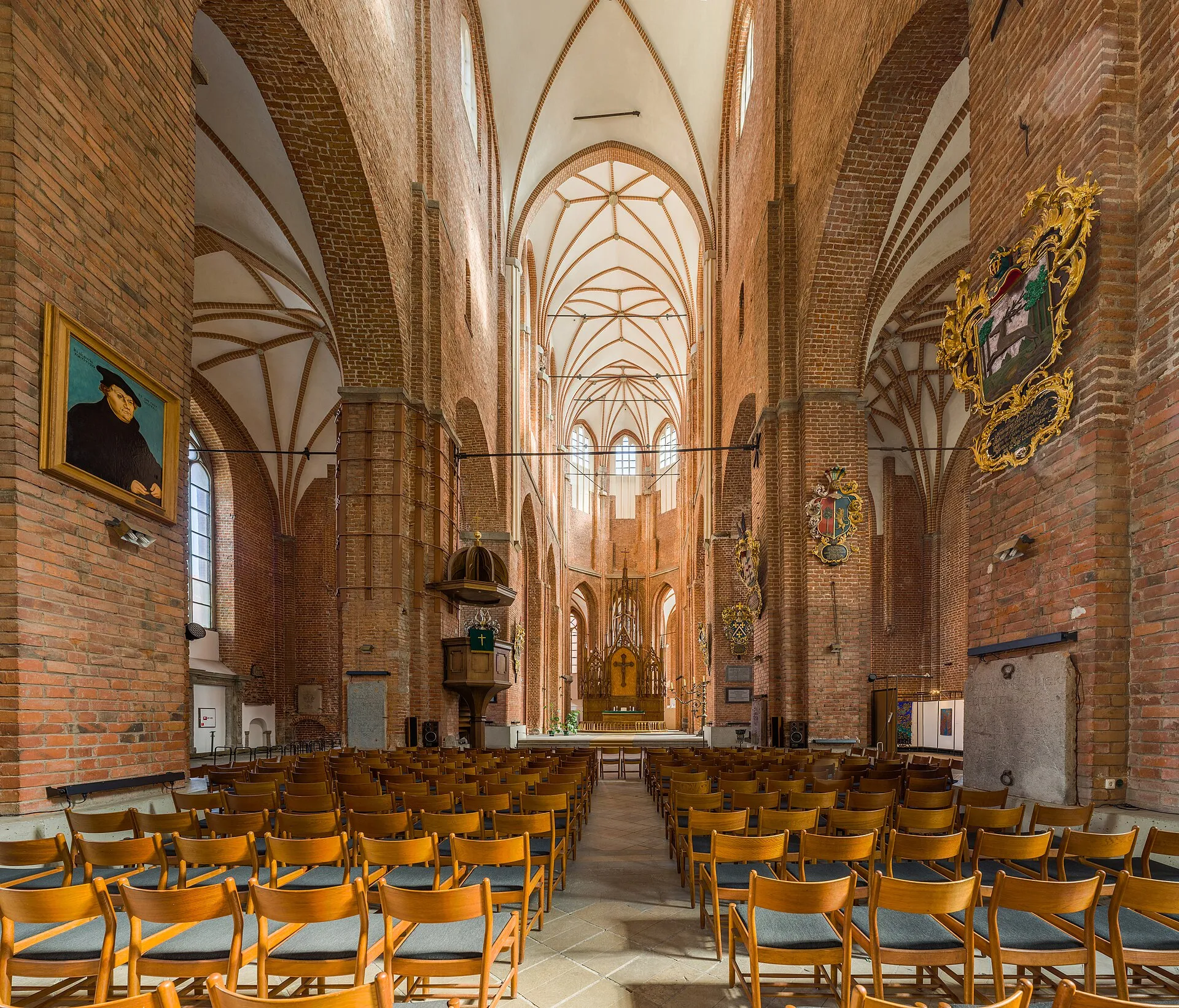
Interior highlights and the seven-branched candelabrum
The church lost its baroque pulpits and organ casework in the Second World War, but the red-brick basilica still holds:
- The seven-branched bronze candelabrum: Cast in 1596 by the metalfounder Hans Meyer for the Riga City Council, it is 3.1 metres tall. It was evacuated to Poland during the Second World War, returned to Riga by the German government in March 2012, and stands in the transept.
- Epitaphs and stone carvings: In the side aisles, conservators have reassembled limestone and sandstone burial plaques, coat-of-arms reliefs and timber carvings saved from merchant guild family vaults.
- Exhibitions: The nave hosts temporary exhibitions of contemporary Latvian sculpture, textiles, painting and photography.
- The Bremen Town Musicians: Outside the eastern apse, on Skārņu iela, is a bronze sculpture of the donkey, dog, cat and rooster stacked on each other’s backs. The German artist Christa Baumgärtel made it, and Riga’s twin city of Bremen presented it in 1990. Rubbing the animals’ snouts is said to bring good luck, and rubbing the rooster at the top is said to grant wishes.
Getting there and neighbourhood connections
St Peter’s Church is at Reformācijas laukums 1 in Vecrīga, beside Skārņu iela and Grēcinieku iela.
- On foot: An 8 to 10-minute walk from Riga Central Railway Station (Rīgas Pasažieru stacija) and the International Bus Station (Rīgas Starptautiskā autoosta). From Town Hall Square, walk east for two minutes.
- Public transport: The nearest tram stops are 11. novembra krastmala and Grēcinieku iela on tram routes 1 and 3, about 200 metres away along the Daugava embankment. See the Riga public transport guide for fares and tickets.
What to visit next
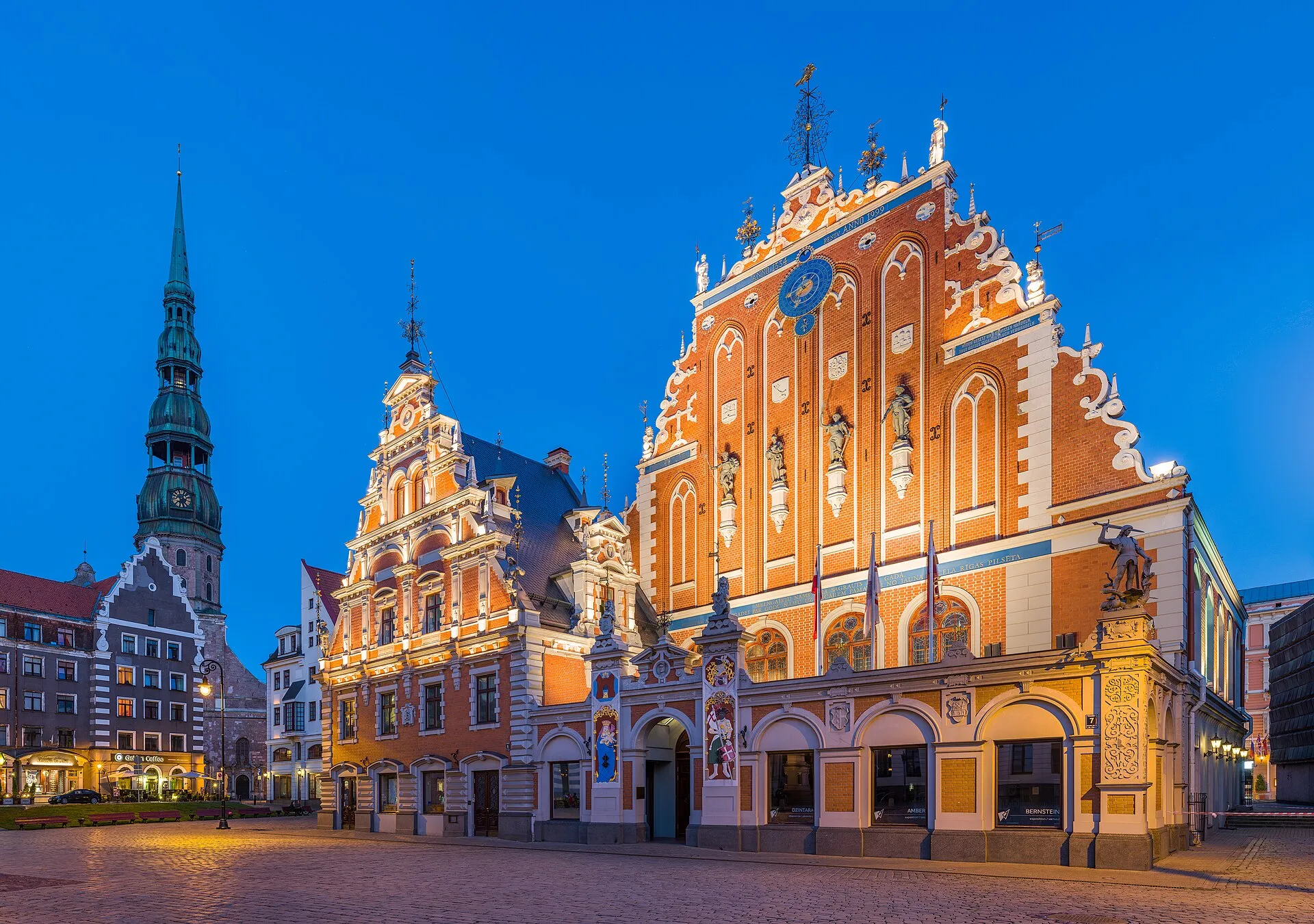
- House of the Black Heads: Less than 150 metres away across Town Hall Square, with guild reception halls and 14th-century brick cellars.
- Riga Dome Cathedral: A six-minute walk north through the Old Town for the Walcker organ and Romanesque cloister.
- Riga Castle and the Three Brothers: North-west, the Three Brothers houses and the seat of the Latvian presidency.
- Free things to do in Riga: Other viewpoints, park promenades and medieval courtyards that cost nothing to enter.
- Riga in one or two days: A two-day walking circuit through Vecrīga that includes the tower.
Common questions
Where do you buy tickets for the St Peter's Church tower?
At the ticket desk inside the western portal. One ticket covers the tower lift and the church interior.
Is there a lift up the tower?
Yes. An electric lift takes visitors to the second open-air gallery, 72 metres up. You climb a short flight of stone steps from the ground floor to the lift lobby first.
When was St Peter's Church built?
The church was first mentioned in written records in 1209. After repeated fires, lightning strikes and artillery fire on 29 June 1941, the metal tower and the church interior were rebuilt between 1967 and 1983.
Where is St Peter's Church located?
At Reformācijas laukums 1 in the Old Town (Vecrīga), about 150 metres east of Town Hall Square and the House of the Black Heads.