In this guide
💡 The Short Version: The Three Brothers (Trīs brāļi) on Mazā Pils iela are three medieval stone houses dating from the late 15th to late 17th centuries. Nearby Riga Castle (Rīgas pils) on Castle Square houses both the office of the President of Latvia and the reopened medieval Castrum of the National History Museum of Latvia. The Latvian Museum of Architecture inside Number 19 is free to enter Monday to Friday 09:00 to 17:00 (closed weekends). Or book a tour: an Old Town walking tour with a local guidead is sold on GetYourGuide.
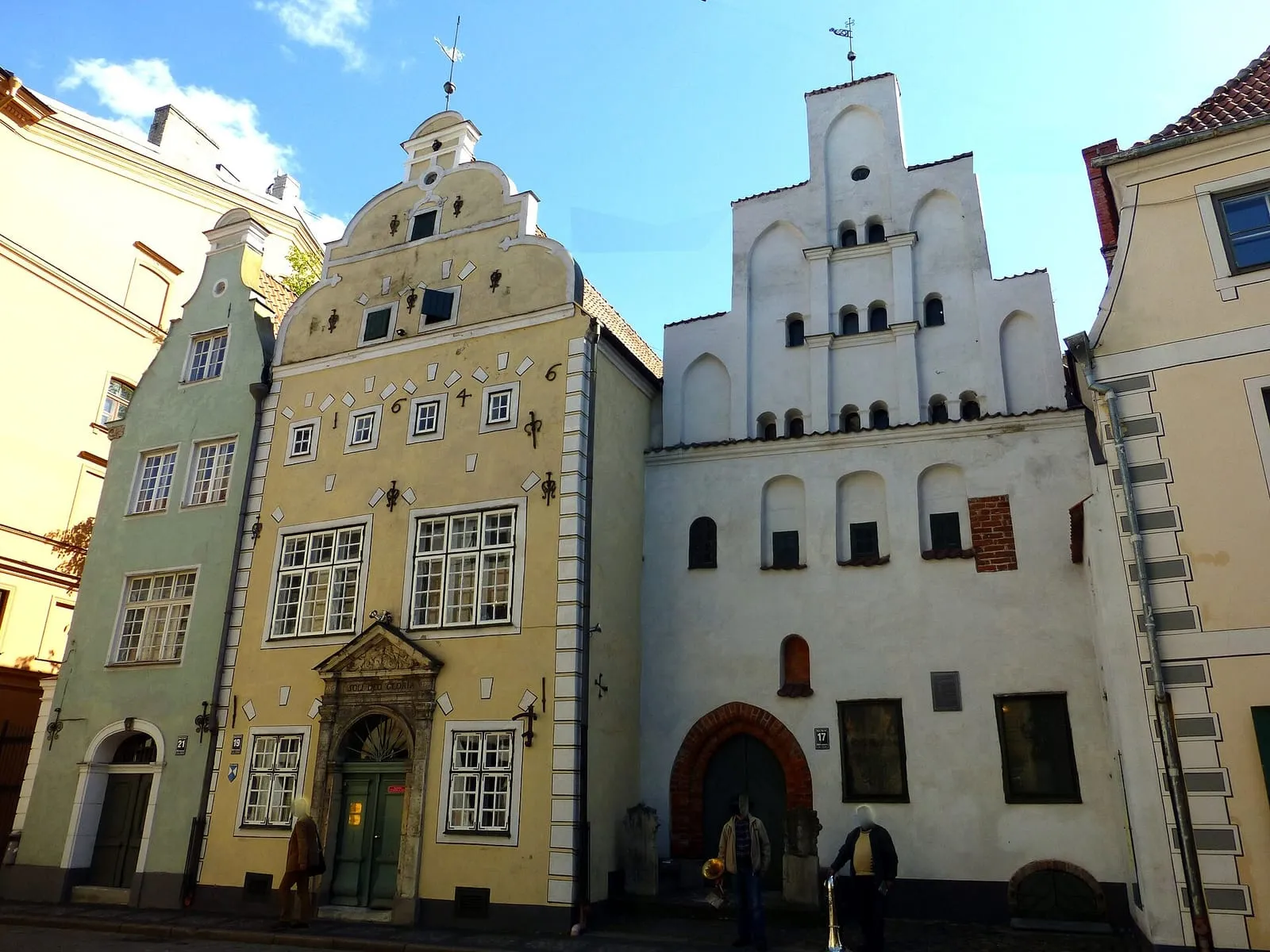
⚠️ The museum in Number 19 is open on weekdays only. Numbers 17 and 21 are offices and not open to visitors. Walking from Number 17 to Number 21 takes you from 15th-century Gothic through 1646 Dutch Mannerism to late-17th-century Baroque.
The Three Brothers: medieval houses on Mazā Pils iela
The Three Brothers stand shoulder to shoulder on cobbled Mazā Pils iela, houses that escaped the fires and rebuilding that reshaped much of Old Riga.
Number 17 Mazā Pils iela: Late Gothic (circa 1490)
The white building on the far right was built around 1490:
- Defensive character: Built in the Hanseatic period, when burghers wanted homes that could be defended in civil unrest, the facade has thick limestone ashlar masonry, a crow-stepped gable, and tiny upper-storey window slits that kept heat in and intruders out.
- The entrance portal: The front door is framed by a low Gothic pointed stone arch and flanked by two granite porch benches (soliņi). Carved into the stone are house marks (namu zīmes), the merchant’s heraldic signature.
- Interior layout: Behind the portal lay a single ground-floor hall (diele) with an open corner hearth for cooking and heating. Sleeping quarters were on a small timber mezzanine gallery, and the unheated attic floors were warehouse lofts served by a winch projecting from the gable peak.
Number 19 Mazā Pils iela: Dutch Mannerism (1646)
The middle, pale-yellow building was built in 1646, in Swedish-ruled Riga:
- Mannerist gable: Under strong Dutch Renaissance influence, the facade has scrolled gables, stone volutes, carved obelisks and pilasters framing symmetrically placed leaded glass windows.
- The portal inscription: Above the main door, a sculpted stone doorway carries the Latin inscription Soli Deo Gloria (“Glory to God alone”) and the date 1646.
- Latvian Museum of Architecture: Number 19 houses the Latvian Museum of Architecture (Latvijas Arhitektūras muzejs). Admission is free. The ground-floor gallery has rotating displays of historical Baltic drawings, urban master plans and contemporary Latvian architecture.
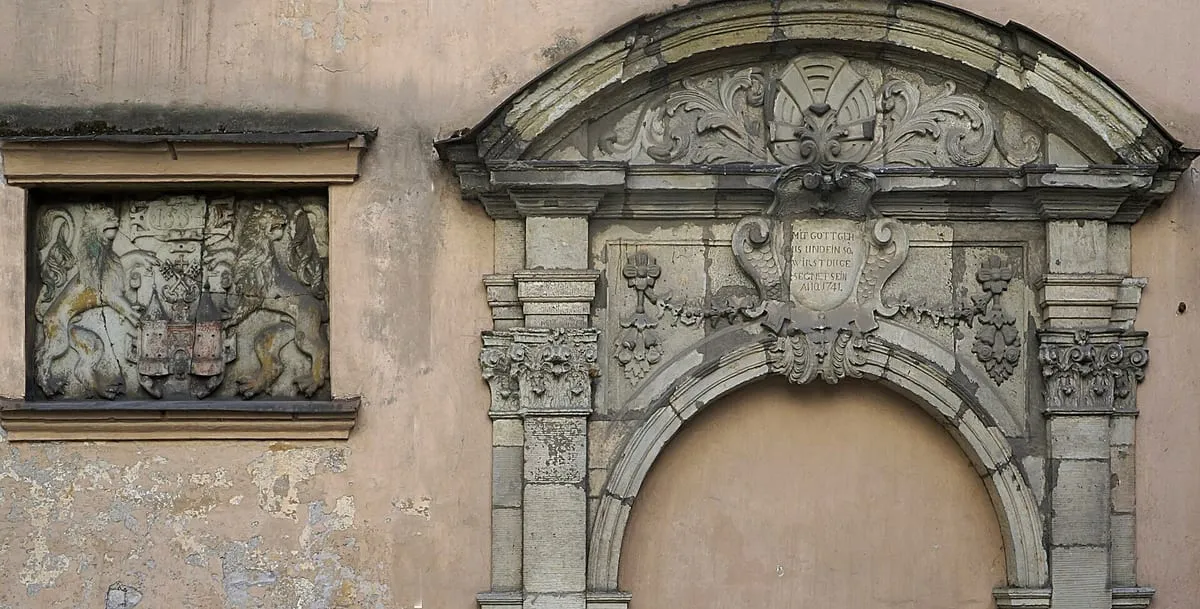
- The courtyard lapidarium: Through the corridor, the rear courtyard holds an outdoor lapidarium of stone portal fragments, merchant house crests and a stone coat of arms of Riga carved in relief in 1554.
Number 21 Mazā Pils iela: Baroque (Late 17th Century)
The slender, pale-green building on the far left represents the late-17th-century Baroque era:
- The narrow plot: By the late 1600s, building plots inside Riga’s walls were scarce and costly, and Number 21 stands on a very narrow strip.
- Baroque curve: The facade is topped by a curved Baroque gable, with rounded window frames, festoons and a carved mask above the attic loading bay, meant to ward off evil spirits.
Riga Castle: fortress of the Livonian Order and Presidential seat
Two minutes’ walk north from the Three Brothers is Pils laukums (Castle Square) and the yellow walls of Riga Castle (Rīgas pils).
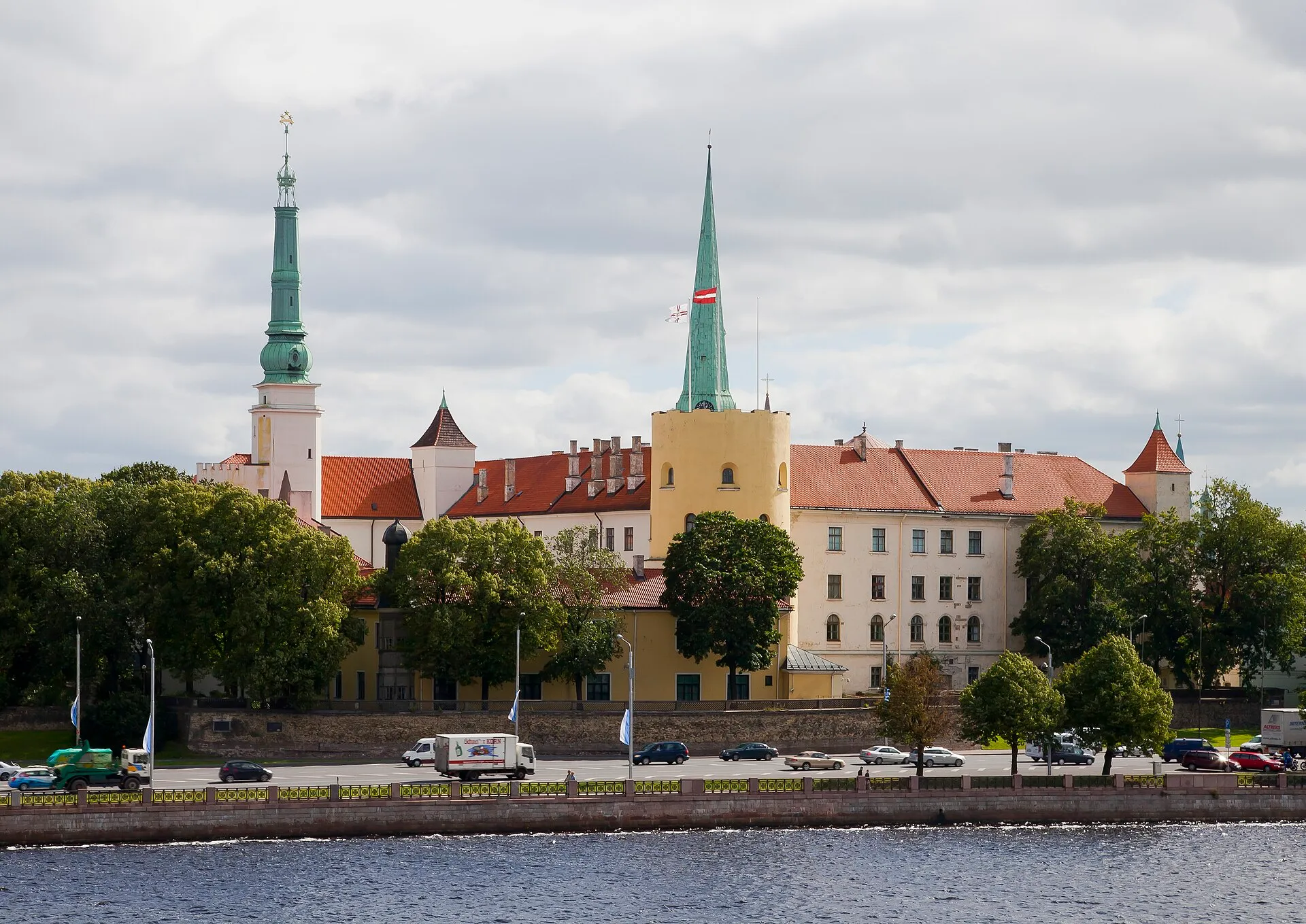
History of the fortress
Riga Castle was founded in 1330 after an armed struggle between the citizens of Riga and the Teutonic Knights of the Livonian Order. The burghers had levelled the Order’s original inner-city stronghold (Wittenstein Castle); the knights won and forced the townspeople to build a new fortress outside the city ramparts, on the banks of the Daugava River.
In 1484 the townspeople rebelled again, and Riga’s civic militia besieged the castle for seven months, demolishing its towers with catapults and cannon fire. When the Livonian Order regained control of the city in 1491, Grand Master Wolter von Plettenberg compelled the citizens to rebuild the fortress. Master builder Nilss from Westphalia supervised the work between 1497 and 1515, adding cylindrical corner gun towers built to resist artillery.
Over subsequent centuries, the castle served as the seat of royal governors representing Poland-Lithuania (1561–1621), the Swedish Empire (1621–1710) and Imperial Russia (1710–1917).
The Northern Wing: Presidential Residence
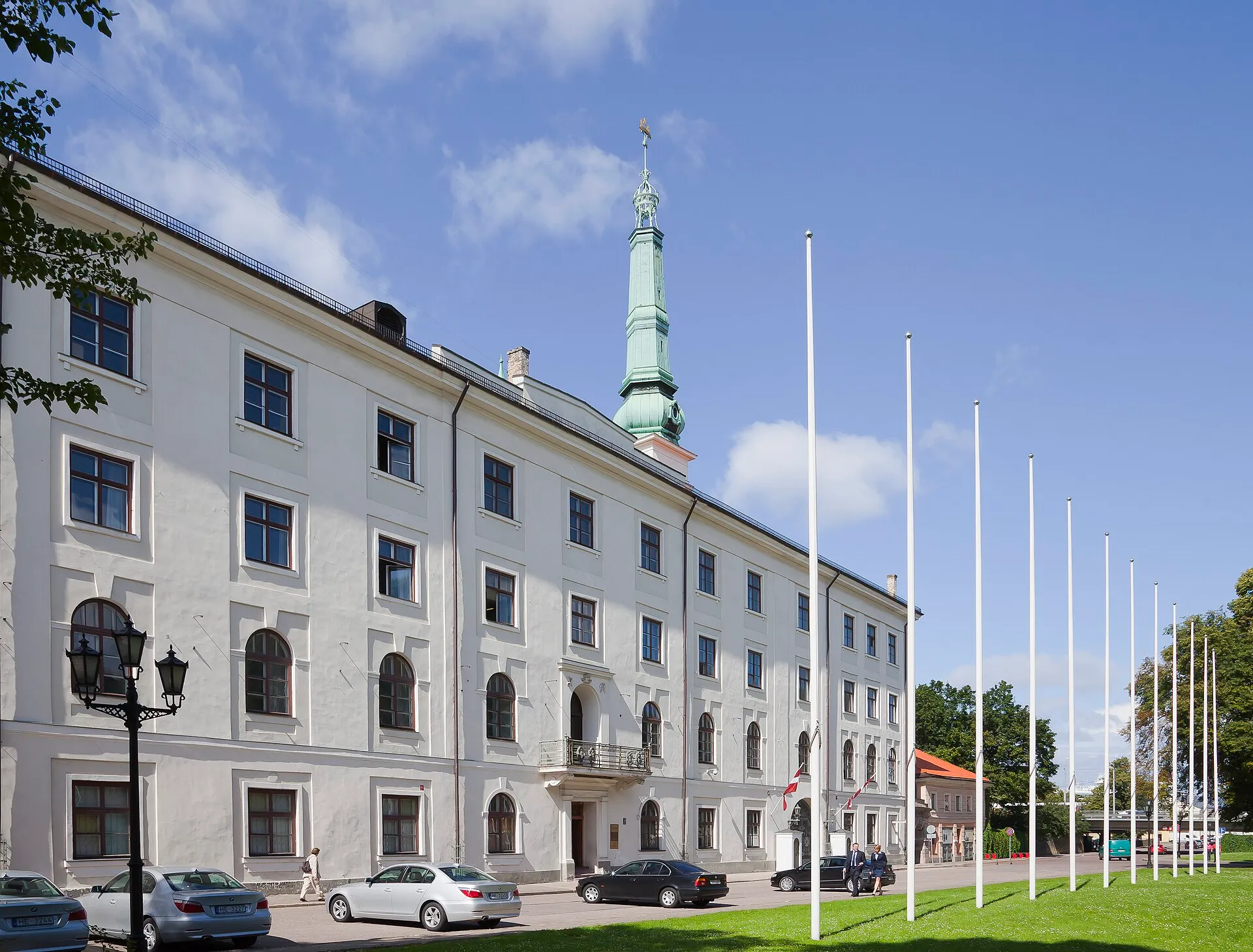
Following the founding of the independent Republic of Latvia in 1918, Riga Castle became the official residence of the Head of State. First President Jānis Čakste established his workplace here in 1922.
Today, the northern neoclassical wing houses the Chancery of the President of Latvia (Latvijas Valsts prezidents):
- The Holy Spirit Tower: The round south-western corner tower (Svētā Gara tornis) rises over the Daugava. The national flag of Latvia flies permanently from its mast; when the President is in residence or present in the country, the personal Presidential Standard (a white flag bearing the Latvian coat of arms divided into four quadrants) flies alongside it.
- Guard of Honour: Uniformed soldiers stand sentry outside the main presidential carriage portal on Castle Square. The state rooms (including the White Hall and Ambassadorial Credentials Room) are closed to the public, but the exterior can be seen from the square.
The Southern Wing: National History Museum of Latvia (LNVM)
The southern wing is the original medieval convent house (Castrum), with a square central courtyard, vaulted refectory, chapel and dormitories. A fire in June 2013 damaged the castle, and Latvian conservators restored it over eleven years.
The restored Castrum is run by the National History Museum of Latvia (Latvijas Nacionālais vēstures muzejs - lnvm.lv):
- Exhibition highlights: The origins of the Baltic tribes, Livonian Order armour and weapons, Hanseatic trade artefacts, and the architectural history of the castle’s restored Gothic chapel and hypocaust cellars.
- Hours: Tuesday to Sunday 10:00 to 18:00 (closed Mondays).
Castle Square and the surrounding alleys
Castle Square (Pils laukums) is an open square lined with trees and two churches:
- Church of Our Lady of Sorrows (Sāpju Dievmātes baznīca): Directly opposite the castle gate, this pale-blue and white church with a classicist spire was completed in 1785. It was the first stone Roman Catholic church allowed in Riga after the Protestant Reformation, built with the authorisation of Emperor Joseph II of Austria and Empress Catherine the Great of Russia.
- Anglican Church of the Holy Redeemer (Anglikāņu baznīca): Just west towards the riverbank at Anglikāņu iela 2, this red-brick neo-Gothic church was built between 1857 and 1859 for British merchants and seamen trading timber and flax in Riga. Local tradition says it stands on British soil brought to Riga as ship ballast.
- Mazā Pils and Klostera iela: The narrow alleys connecting the castle to Riga Dome Cathedral are lined with restored merchant granaries and quiet residential doorways.
Practical visiting logistics
- Location: The Three Brothers are at Mazā Pils iela 17–21; Riga Castle is at Pils laukums 3. Both are in the north-western part of Vecrīga.
- Walking directions: From Dome Square (Doma laukums), walk north down Zirgu iela or Jēkaba iela for two minutes to reach Mazā Pils iela. Continue straight along Mazā Pils iela to emerge directly into Castle Square.
- Accessibility: Mazā Pils iela and Castle Square are paved with granite cobbles. The ground floor of the Museum of Architecture is accessible; the cellars of Riga Castle have stone steps.
What to see next
- Riga Dome Cathedral: Two minutes south, for the Walcker organ and the Romanesque cloister.
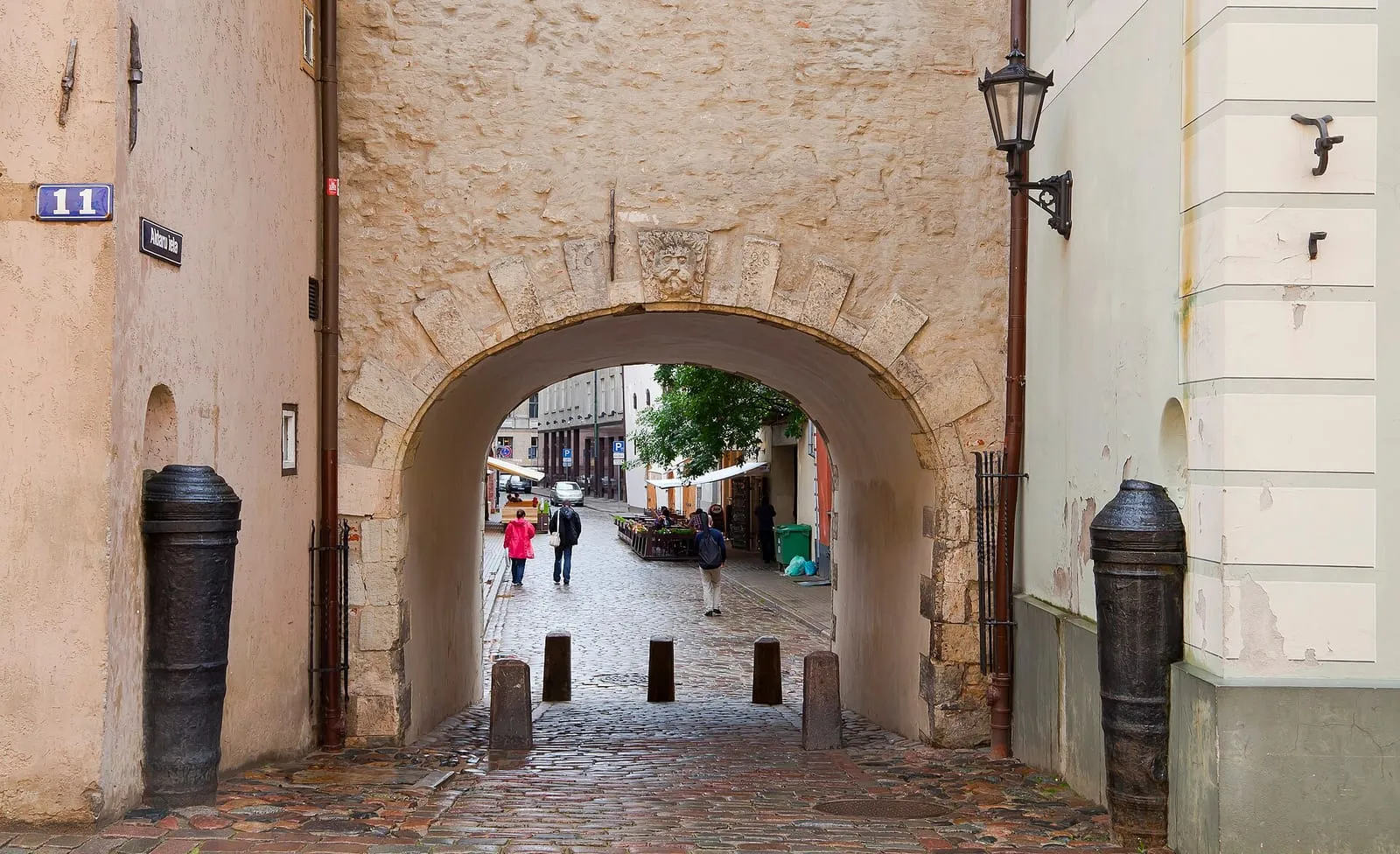
- Free things to do in Riga: The nearby Swedish Gate on Torņa iela and walks along the old bastion ramparts.
- House of the Black Heads: Five minutes south across Town Hall Square, a merchant guildhall with ballrooms.
- St Peter’s Church Tower: A lift rises 72 metres for views of Riga Castle and the Daugava River.
- Riga in one or two days: The full walking circuit linking Vecrīga’s medieval monuments.
Common questions
Can you go inside the Three Brothers in Riga?
Yes. Number 19 houses the Latvian Museum of Architecture (Latvijas Arhitektūras muzejs) and the State Inspection for Heritage Protection. Entry to the exhibition room and courtyard is free of charge, open Monday to Friday from 09:00 to 17:00 (closed on weekends). Numbers 17 and 21 are administrative offices and private premises.
What are the Three Brothers in Riga?
The Three Brothers (Trīs brāļi) are a row of three medieval stone houses side by side at Mazā Pils iela 17, 19 and 21. Each house illustrates a different architectural era: Late Gothic (15th century), Dutch Mannerism (17th century) and Baroque (late 17th century).
Can you visit Riga Castle?
Yes. The southern wing (the medieval convent and Castrum) houses the National History Museum of Latvia (LNVM), open Tuesday to Sunday 10:00 to 18:00 (closed Mondays). The northern wing serves as the official workplace of the President of Latvia and is not open to the public.
Why are they called the Three Brothers?
According to local legend, the three adjacent townhouses were built over several generations by three brothers of the same merchant family.
Where are the Three Brothers located?
On Mazā Pils iela (Little Castle Street) numbers 17, 19 and 21 in Old Riga, roughly two minutes' walk north of Riga Dome Cathedral.