In this guide
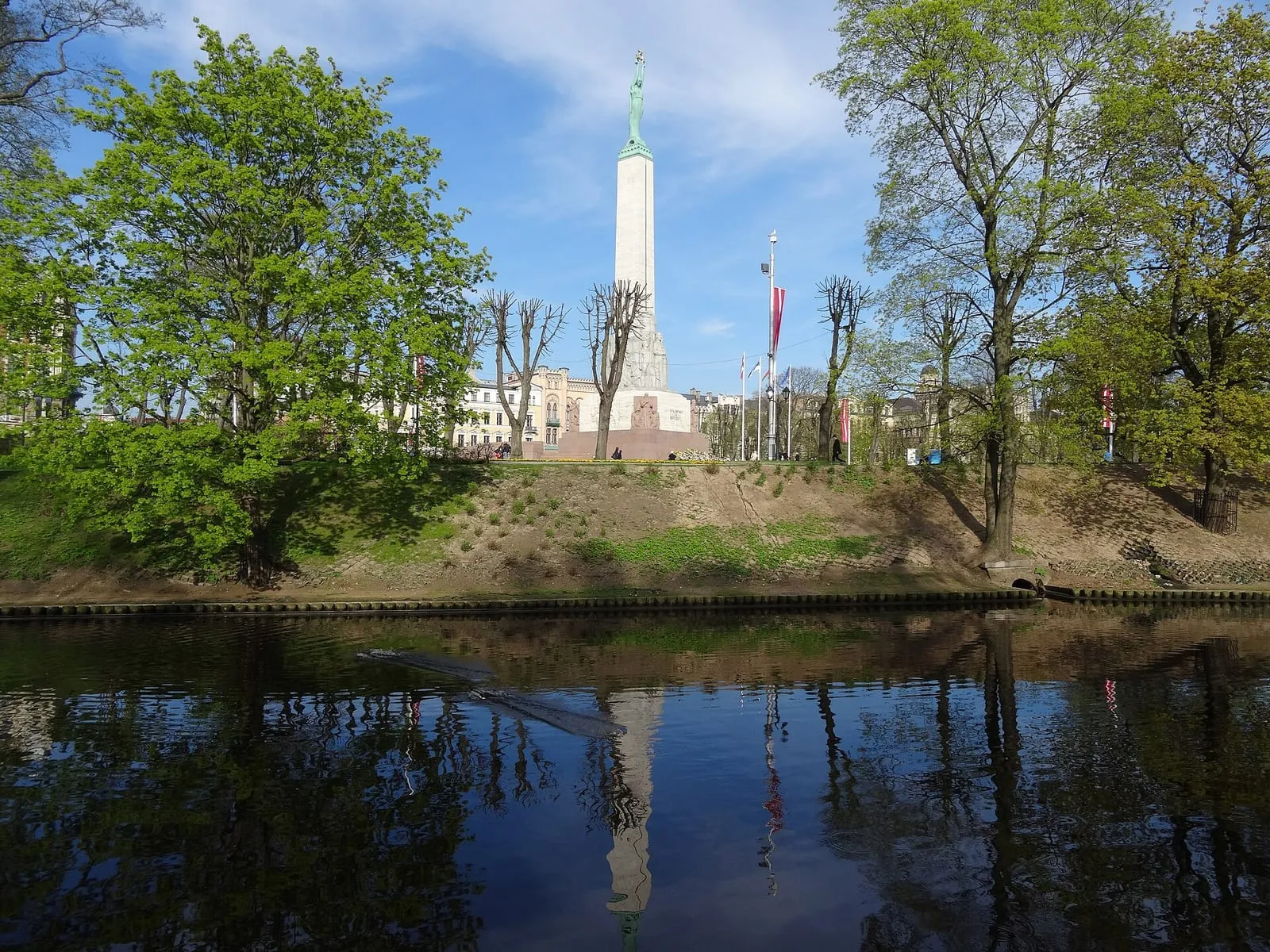
💡 The Short Version: The Freedom Monument (Brīvības piemineklis) is Latvia’s national freedom memorial, a 42.7-metre red granite and travertine obelisk crowned by the copper figure of Liberty holding three gilded stars, inscribed Tēvzemei un Brīvībai (“For Fatherland and Freedom”). It stands between Vecrīga and the central boulevards, with an hourly changing of the guard from 09:00 to 18:00 daily. Next to it is Bastejkalns (Bastion Hill), a park along the City Canal with footbridges, stone cascades and the canal boat pier. Both the monument and park are free to visit 24/7. Or book a tour: a heated historic canal boat tourad is sold on GetYourGuide.
⚠️ Watch the changing of the guard on the hour. Arrive five minutes before the hour, between 09:00 and 18:00, to get a clear view of the march across the plaza. Afterwards, cross the footbridge into Bastejkalns to see the January 1991 memorial stones near the canal cascade.
The Freedom Monument: architecture and symbolism
Standing at the head of Brīvības bulvāris (Freedom Boulevard), the monument marks the historic transition between the medieval alleys of Old Riga and the expansive 19th-century boulevard ring.
Unveiled on 18 November 1935—the seventeenth anniversary of the proclamation of the Republic of Latvia—the monument was designed by the Latvian sculptor Kārlis Zāle and the architect Ernests Štālbergs. It was paid for by public subscriptions from Latvian citizens, farmers and overseas émigré communities.
The monument is 42.7 metres tall and has three tiers:
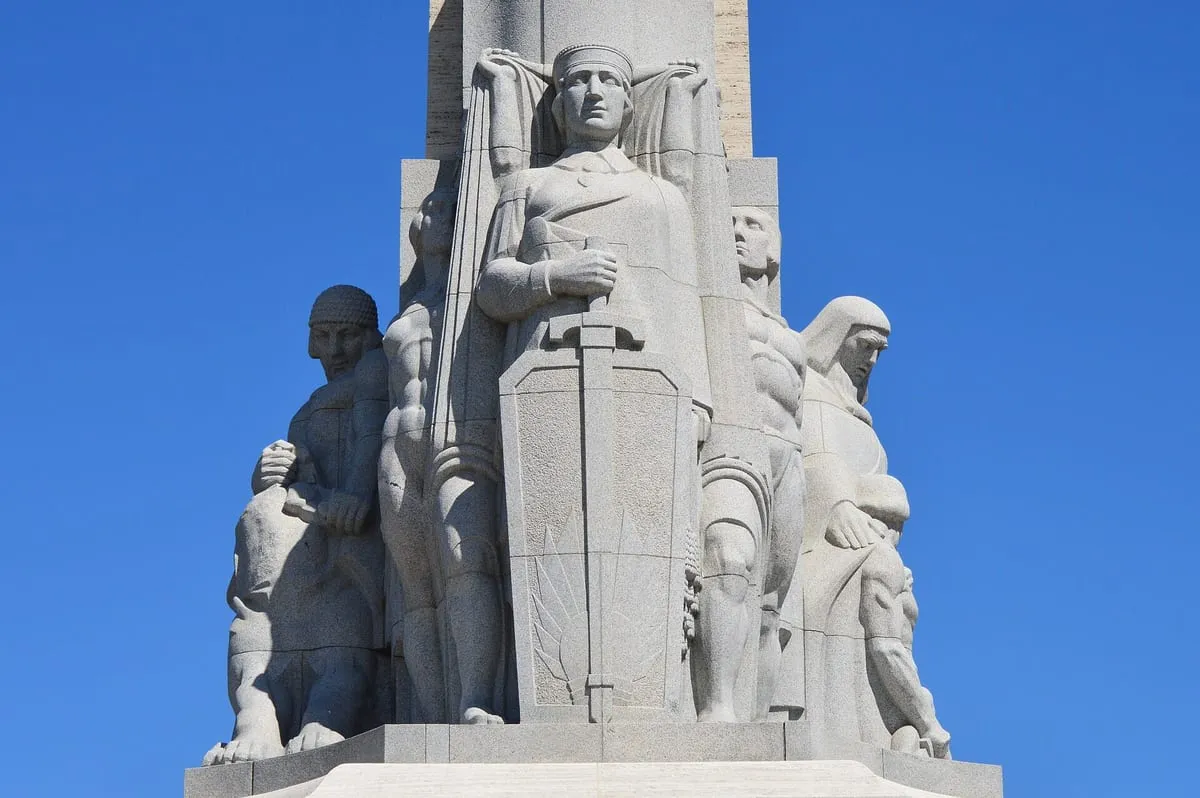
- The granite base: The travertine and red Finnish granite pedestal carries fifty-six sculpted figures in thirteen relief groups. They depict Latvian values, labour and history, including Work, Guards of the Fatherland, Family, and mythical heroes such as Lāčplēsis (the Bearslayer) breaking the jaw of a monster and the pagan seer Vaidelotis.
- The War of Independence reliefs: Upper friezes show the Latvian War of Independence (1918–1920), including battles against the Bermontian forces and the Red Army, and the gilded inscription Tēvzemei un Brīvībai (For Fatherland and Freedom).
- The travertine obelisk and Liberty: A 19-metre column of grey Italian travertine carries a nine-metre patinated copper statue of a young woman personifying Liberty, known in Latvian as Milda.
Milda and the three gilded stars
Liberty holds three gilded five-pointed copper stars above her head.
They represent the three historic regions that united to form the republic in 1918:
- Kurzeme (Courland): The western province and former duchy (including the southern region of Zemgale).
- Vidzeme: The central and northern region, including the Gauja River valley and Riga.
- Latgale: The eastern, mainly Catholic province, bordered by Lake Lubāns and the Daugava River.
The Guard of Honour: changeover times and protocol
Two armed sentries from the Honour Guard Company of the Staff Battalion of the Latvian National Armed Forces (Nacionālie bruņotie spēki) stand watch at the foot of the monument:
- Change of Guard: The full ceremonial changing of the guard occurs daily every hour on the hour between 09:00 and 18:00. The relief guard marches down the central axis from the guardhouse behind the monument.
- Patrol: Every thirty minutes between changeovers, the two sentries step down from their podiums and march a 40-metre patrol across the granite perimeter before returning to attention.
- Weather: Sentries stand post in summer heat, rain and light snow; the guard is withdrawn if temperatures drop below -10°C or in severe gales.
Stay outside the marked chain perimeter and do not climb the plinth; municipal police nearby enforce this.
Bastejkalns and the City Canal park belt
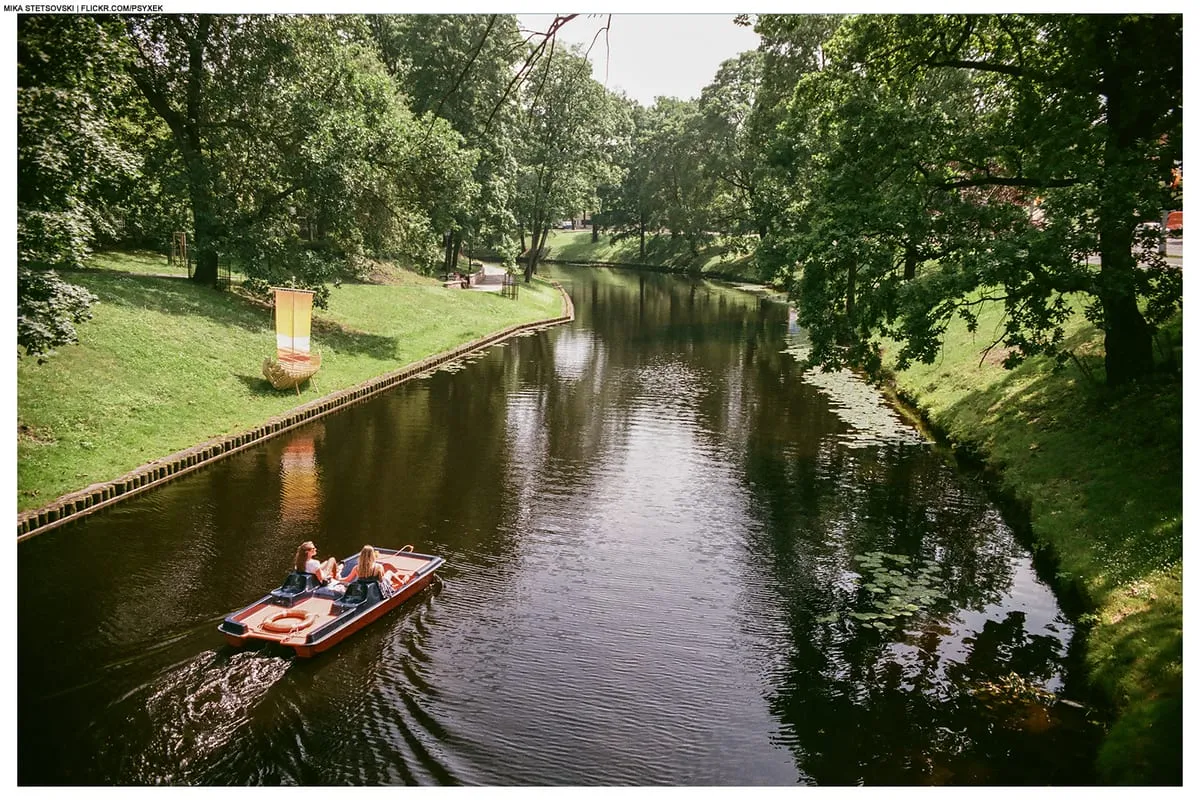
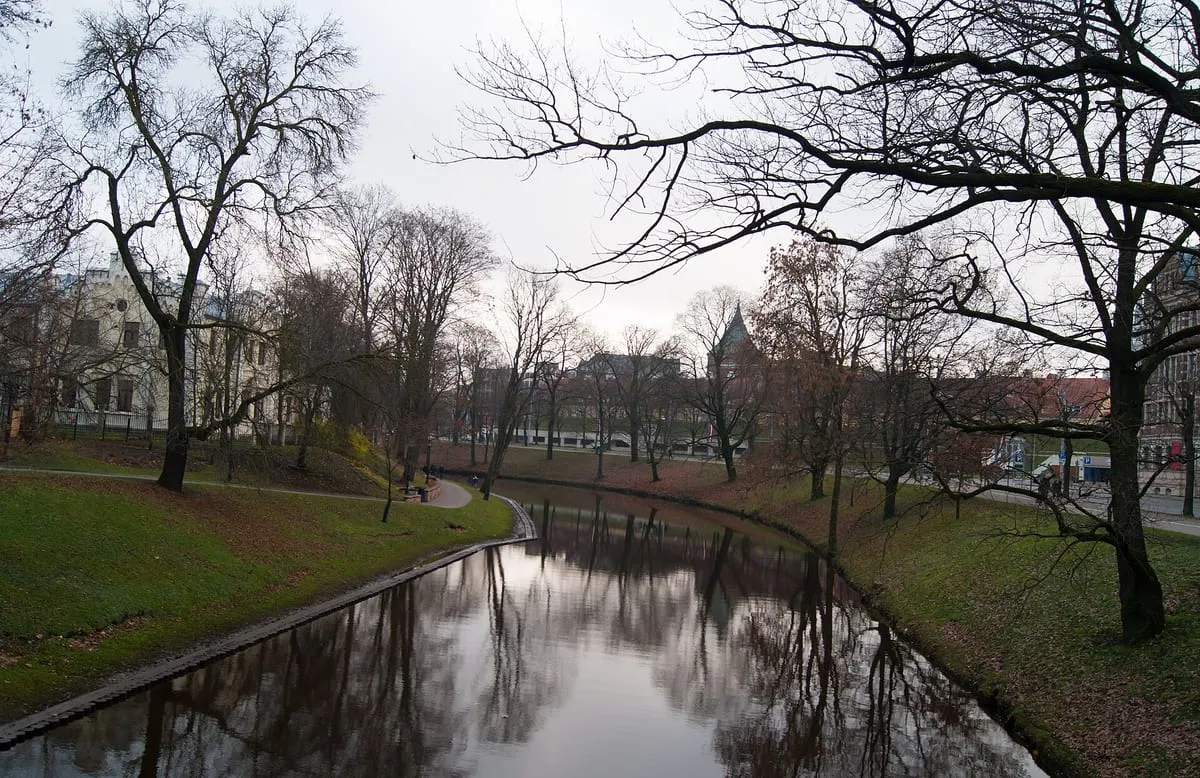
Directly bordering the Freedom Monument to the west lies Bastejkalns (Bastion Hill), a park of lawns, gravel paths, willows and waterways.
History of Bastion Hill
For over two centuries, this site was occupied by the Sand Bastion (Smilšu bastions), an earthen fortress redoubt erected by Swedish military engineers in the 17th century to defend Riga’s main gate against Russian assault.
Between 1857 and 1863, following the Crimean War, Tsar Alexander II authorized the demolition of Riga’s military fortification perimeter. The defensive moats were transformed into the serpentine City Canal (Pilsētas kanāls), while surplus earth and rubble from the ramparts were heaped up into an artificial 15-metre mound christened Bastejkalns.
In 1879, Riga’s city garden director Georg Kuphaldt redesigned the hill as an English-style park. He introduced:
- Stone grottoes, water cascades and Alpine rock gardens.
- Curved gravel promenades lined with foreign deciduous trees, including Manchurian walnuts and Dutch lindens.
- Arched stone footbridges over the canal, where wedding couples traditionally fix engraved brass padlocks.
The Barricades Memorial of January 1991
Rough-hewn red granite marker stones stand in the lawns along the canal slopes.
They commemorate 20 January 1991. As the Soviet Union fractured, Soviet special police forces (OMON) attacked the nearby Latvian Ministry of the Interior on Raiņa bulvāris. In the crossfire across Bastejkalns, five people were fatally wounded: schoolboy Edijs Riekstiņš, police officers Vladimirs Gomanovičs and Sergejs Konoņenko, and internationally acclaimed documentary filmmakers Andris Slapiņš and Gvido Zvaigzne, who were filming the battle. The stones mark the spots where they fell.
Canal boat cruises from Bastejkalns
Wooden launches run circuits of the City Canal in the warm season. The operator Riga by Canal (rigabycanal.lv) sold 2026 tickets valid until about 31 October for its canal route and about 16 November for its other route.
- Departure point: The main pier is on the canal bank at the foot of Bastejkalns, two minutes’ walk from the Freedom Monument.
- The fleet: Traditional timber boats, including the historic launch Darling (built in 1907), and electric wooden boats such as Maria, Rebeka and Laima.
- The route: The circuit takes 50 to 60 minutes. The boat passes beneath stone road bridges, past the Latvian National Opera and the railway embankment, then through the lock into the Daugava River, with views of the Old Town skyline, Riga Castle and the cable-stayed Vanšu Bridge before returning to the canal.
- Tickets: Adult and child tickets are sold at the canal pier kiosk, or can be booked online in advance in summer.
Practical visiting tips and nearby connections
- Location: Brīvības bulvāris at Aspazijas bulvāris / Raiņa bulvāris, on the eastern edge of Vecrīga.
- On foot: Three minutes’ walk east from Livu Square (Līvu laukums), and five minutes from Riga Central Station.
- Public transport: Tram lines 1, 3 and 11 stop at Nacionālā opera or Aspazijas bulvāris, directly across from the park. Numerous bus and trolleybus routes stop along Merķeļa iela and Brīvības bulvāris. See our Riga public transport guide for ticketing rules.
- National holidays: On 4 May (Restoration of Independence Day) and 18 November (Proclamation Day), crowds lay flowers at the monument’s base in the national colours of maroon and white. On 11 November (Lāčplēsis Day), there are evening candle processions through the park.
What to see next
- Latvian National Opera and Ballet: On the southern edge of Bastejkalns, this neoclassical building stages opera and ballet.
- Free things to do in Riga: The adjoining Esplanāde park and other free sights.
- Latvian National Museum of Art: Five minutes’ walk north through Esplanāde, for Baltic art.
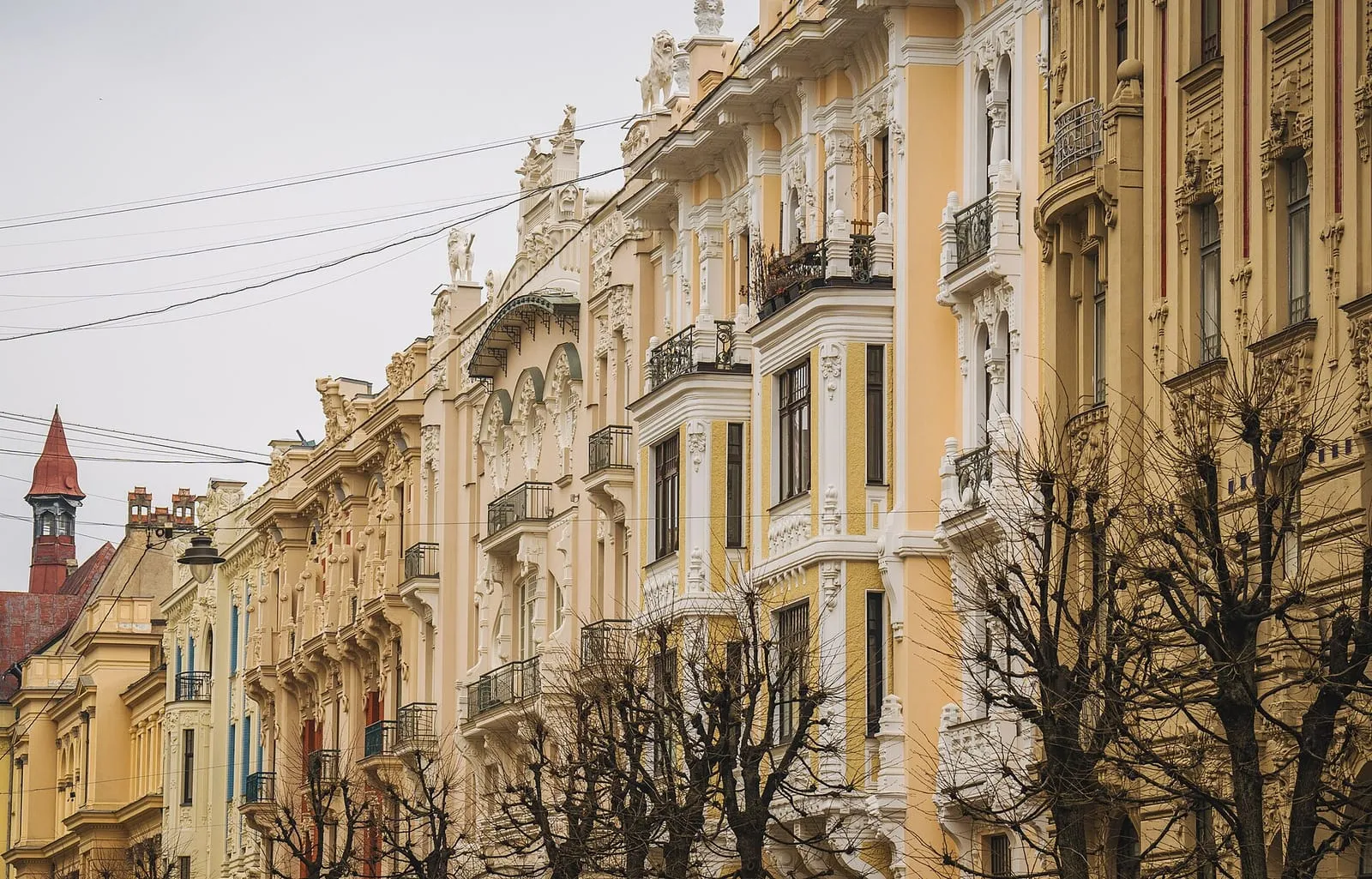
- Riga Art Nouveau Quarter on Alberta iela: Ten minutes’ walk north, for the early-20th-century apartment facades.
- St Peter’s Church Tower: Return west into Old Riga to view the Freedom Monument from the 72-metre spire gallery.
Common questions
What does the Freedom Monument in Riga represent?
Unveiled in 1935, the Freedom Monument (Brīvības piemineklis) honours the soldiers who fell during the Latvian War of Independence (1918–1920). The 42.7-metre obelisk is crowned by the copper figure of Liberty ('Milda') holding aloft three gilded stars symbolising the historical regions of Latvia: Kurzeme, Vidzeme and Latgale.
When does the changing of the guard happen at the Freedom Monument?
The ceremonial changeover of the Guard of Honour takes place daily every hour on the hour between 09:00 and 18:00. The sentries patrol every thirty minutes. The guard is mounted by the Staff Battalion of the National Armed Forces and is withdrawn below -10°C or in severe gales.
How much does it cost to visit the Freedom Monument and Bastejkalns?
Visiting both the Freedom Monument and Bastejkalns park is entirely free of charge. Sightseeing boat trips along the City Canal departing from the pier below Bastion Hill are sold at the pier.
What is Bastejkalns in Riga?
Bastejkalns (Bastion Hill) is a 19th-century landscaped park built over the demolished earthwork ramparts of Riga's Swedish-era fortifications. It has artificial waterfalls, winding paths, willows and the City Canal (Pilsētas kanāls).
How did the Freedom Monument survive the Soviet occupation?
While Soviet authorities considered demolishing the monument after the 1940 occupation and post-war reoccupation, prominent figures—including famed Soviet sculptor Vera Mukhina, who was born in Riga—defended its artistic merit. Instead of dynamiting it, Soviet authorities banned laying flowers and forbade patriotic commemorations.