In this guide
💡 The Short Version: Walking on the sloping marble roof of the Oslo Opera House (Operahuset) is free, unticketed, and open 24 hours a day. Snøhetta designed the building to look like an iceberg rising from Bjørvika, and you can walk from the shoreline up to its 32-metre summit. The public foyer is open Monday to Saturday 11:00 to 16:00 and Sunday 12:00 to 16:00. Weekend 50-minute guided backstage tours cost NOK 180 for adults and NOK 105 for children (15% discount with the Oslo Pass). Or book a tour: a 1.5-hour scenic fjord cruisead on an electric ship from NOK 430 covers the inner Oslofjord from the water.
⚠️ The marble is slippery when wet or frosted. From November to April, freezing drizzle can ice the sloping ramps. Wear shoes with rubber lugged soles or slip-on ice cleats and keep to the gritted central paths.
Visiting the roof, foyer and backstage tours
The Opera House is home to the Norwegian National Opera and Ballet (Den Norske Opera & Ballett). Performances need tickets bought well ahead, but the roof and the main foyer are free:
| Activity | Ticket cost | Timetable | Practical details |
|---|---|---|---|
| Roof Walk | Free | Open 24/7 all year | Accessible via outdoor pedestrian ramps |
| Foyer & Box Office | Free | Mon–Sat 11:00–16:00, Sun 12:00–16:00 | Extended hours on evening performance nights |
| English Guided Tour (Adult 26+) | NOK 180 | Sat & Sun at 12:00 and 13:00 | 50 minutes; pre-booking recommended |
| English Guided Tour (Child 4–16) | NOK 105 | Sat & Sun at 12:00 and 13:00 | Children under 4 enter free |
| English Guided Tour (Oslo Pass) | NOK 153 | Sat & Sun at 12:00 and 13:00 | 15% discount applied at booking |
- Tour ticket release schedule: guided backstage tour tickets go on sale every Tuesday morning for the coming weekend on the official Opera website. Tours are capped at 25 people and cover stage technology, costume workshops and rehearsal spaces.
- Summer events: the roof and the foyer host open-air performances, choral festivals and other events through the summer.
The architectural roof walk
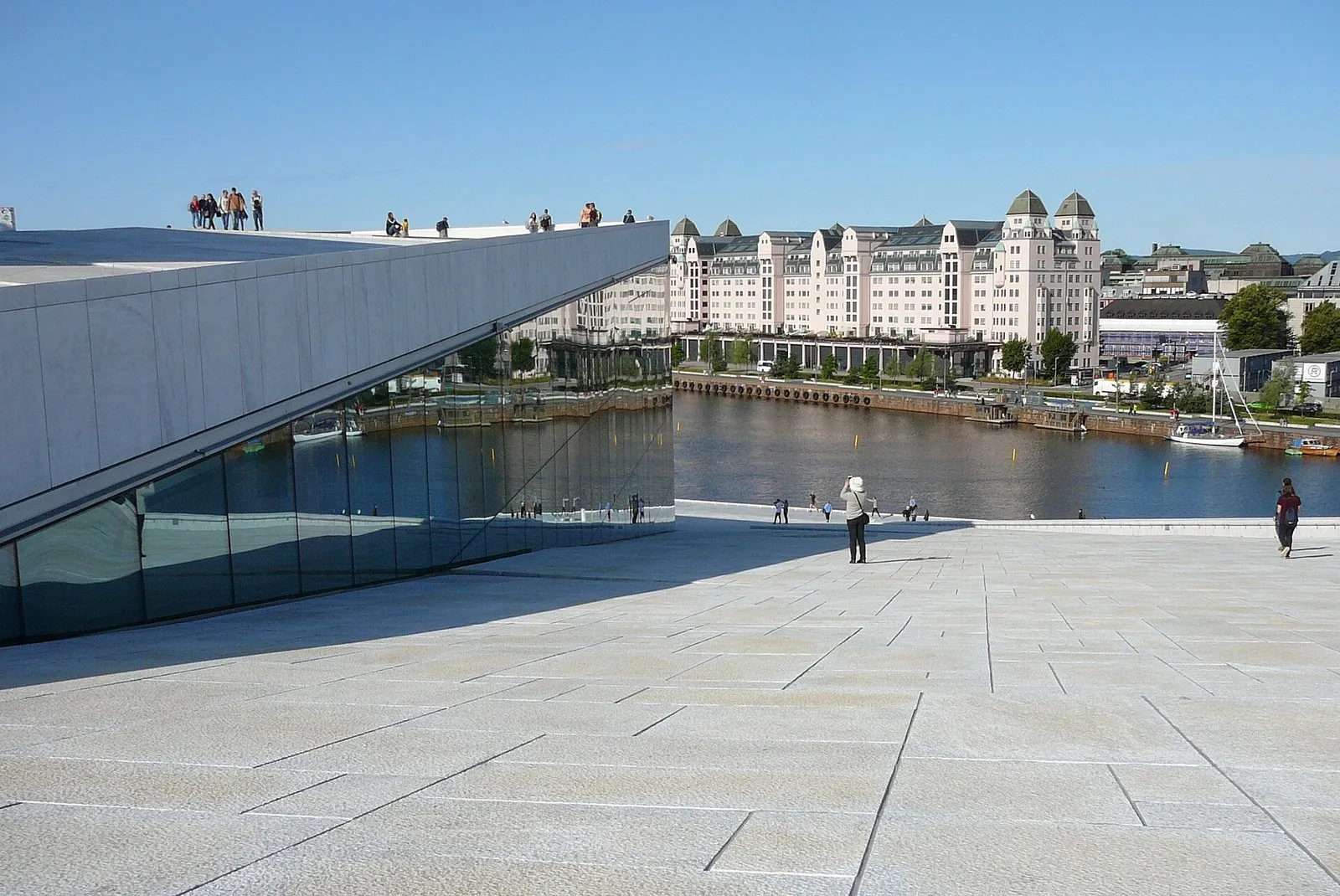
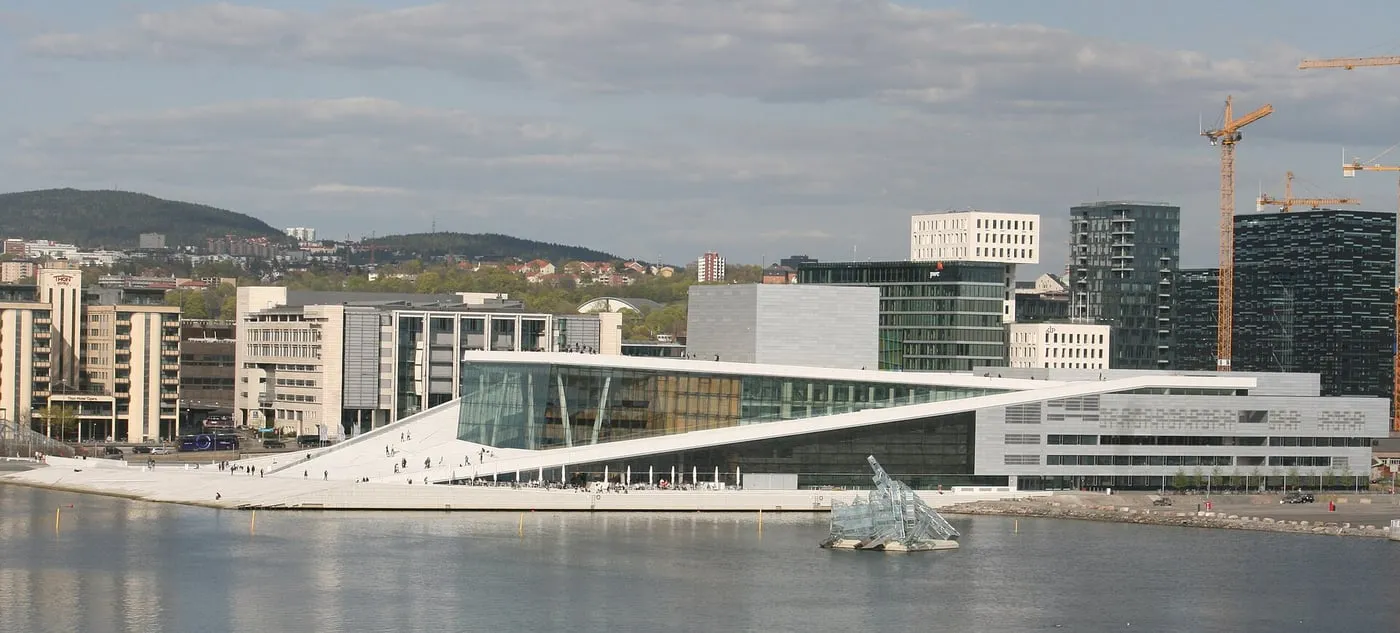
Snøhetta won the international competition for Norway’s first national opera house in 2000. It was completed in April 2008 at a cost of 4.4 billion kroner. The architects wanted a public landscape rather than a monument for ticket holders, a “carpet of stone” you can climb:
- Marble: the exterior uses about 36,000 custom-cut stone slabs. The walking surfaces are white La Facciata marble from Carrara, Italy, bush-hammered or honed for grip. The vertical sections and parapets have embossed aluminium panels by the Norwegian artists Løvaas & Wagle.
- The ascent: from the quayside the marble rises at a 12-degree gradient. Broad ramps wrap the 1,369-seat Main Auditorium, with glass windows looking down into the foyers.
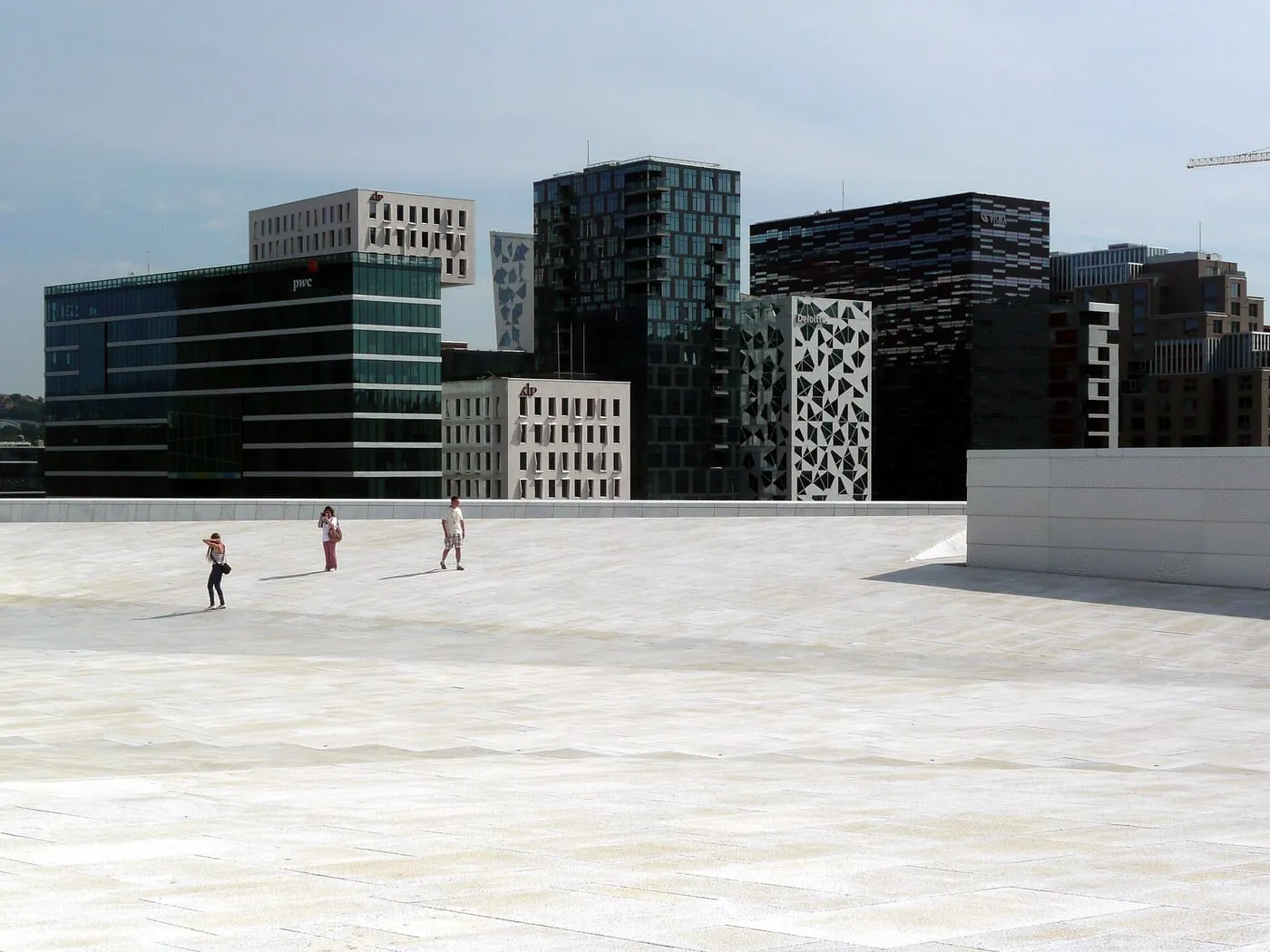
- Summit (32 metres): the flat terrace crowns the fly tower and has 360-degree views of Bjørvika bay, the tilted aluminium tower of MUNCH, the Barcode towers, the forested Ekeberg hills and the ramparts of Akershus Fortress across the harbour.
The floating sculpture: She Lies
About 60 metres off the southern facade, She Lies is a floating sculpture by the Italian artist Monica Bonvicini, unveiled in 2010:
- Materials and scale: 12 by 17 metres and 16 metres tall, mirror-finish stainless steel and translucent glass panels on a concrete pontoon.
- Friedrich reference: the jagged form reinterprets Caspar David Friedrich’s 1824 painting The Sea of Ice (Das Eismeer), which shows polar ice floes colliding.
- Rotation: the pontoon pivots on a central mooring and turns with the tides and wind.
Inside the public foyer
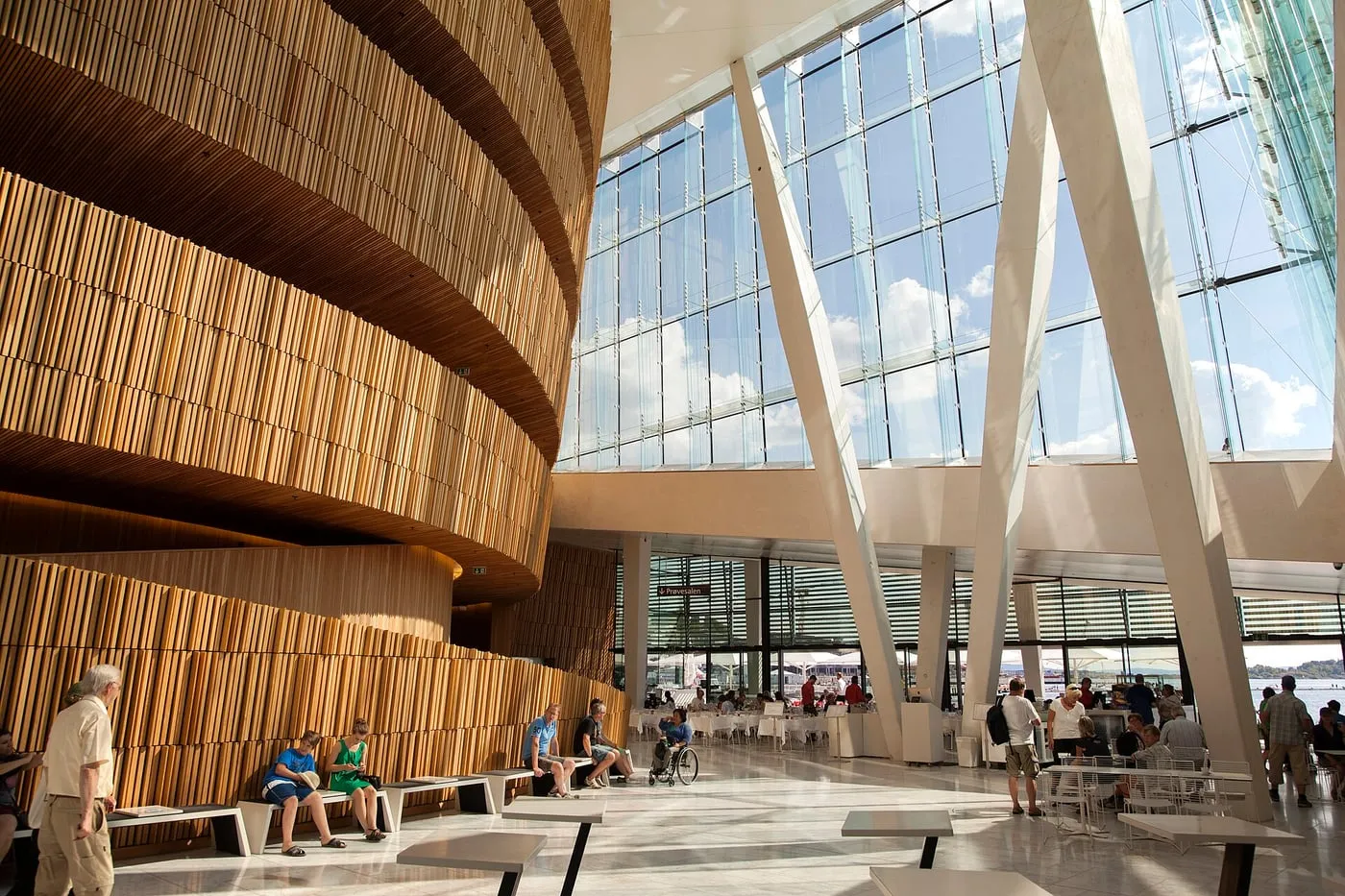
You do not need an opera ticket to enter the main foyer in daytime:
- The Wave Wall: a curved wall of solid German oak wraps around the core of the Main Auditorium. The wood was treated with ammonia vapour to give it a warm cognac colour against the cool marble and glass outside.
- Glass facade: the main glass wall rises 15 metres above the timber floors, held by slim steel frames and glass fins so little blocks the view of the harbour.
- Olafur Eliasson’s cloakroom: the Danish-Icelandic artist made The Other Wall, four large perforated wall structures around the cloakroom, lit from within by computer-controlled white LEDs.
- Workshop windows: glass corridors along the eastern ground-floor facade look into rehearsal rooms, scenery studios, wig-making salons and costume workshops, where over 600 craftspeople, musicians and stage technicians work.
Dining, cloakrooms and practical facilities
- Brasserie Sanguine: in the glass foyer overlooking the waterfront, serving shrimp smørbrød (open sandwiches), fish soup and seasonal lunch platters daily from 12:00 to 20:00, later on performance evenings.
- Havsmak: a small fine-dining room with multi-course seafood tasting menus and Nordic wines, open Tuesday to Saturday evenings.
- Lockers: the cloakroom lockers in the lower concourse take 10-krone coins or free plastic tokens from reception. Large suitcases cannot come inside; use the left-luggage lockers in Oslo Central Station (Oslo S), 350 metres north.
- Toilets: in the basement near the cloakrooms, step-free.
Getting there and neighbourhood connections
- Address: Kirsten Flagstads plass 1, 0150 Oslo.
- On foot from Oslo S: leave by the southern glass doors (by the Flytoget platforms), cross the footbridge over Dronning Eufemias gate and walk down Christian Frederiks plass. It is 400 metres, about 5 minutes.
- By tram: routes 13 and 19 stop at Bjørvika (200 metres) or Dronningens gate (300 metres).
- By bus: lines 30, 31, 54 and 81 stop along Dronning Eufemias gate.
- Bicycles: Oslo Bysykkel racks and other bike stands are on Operagata, directly north of the building.
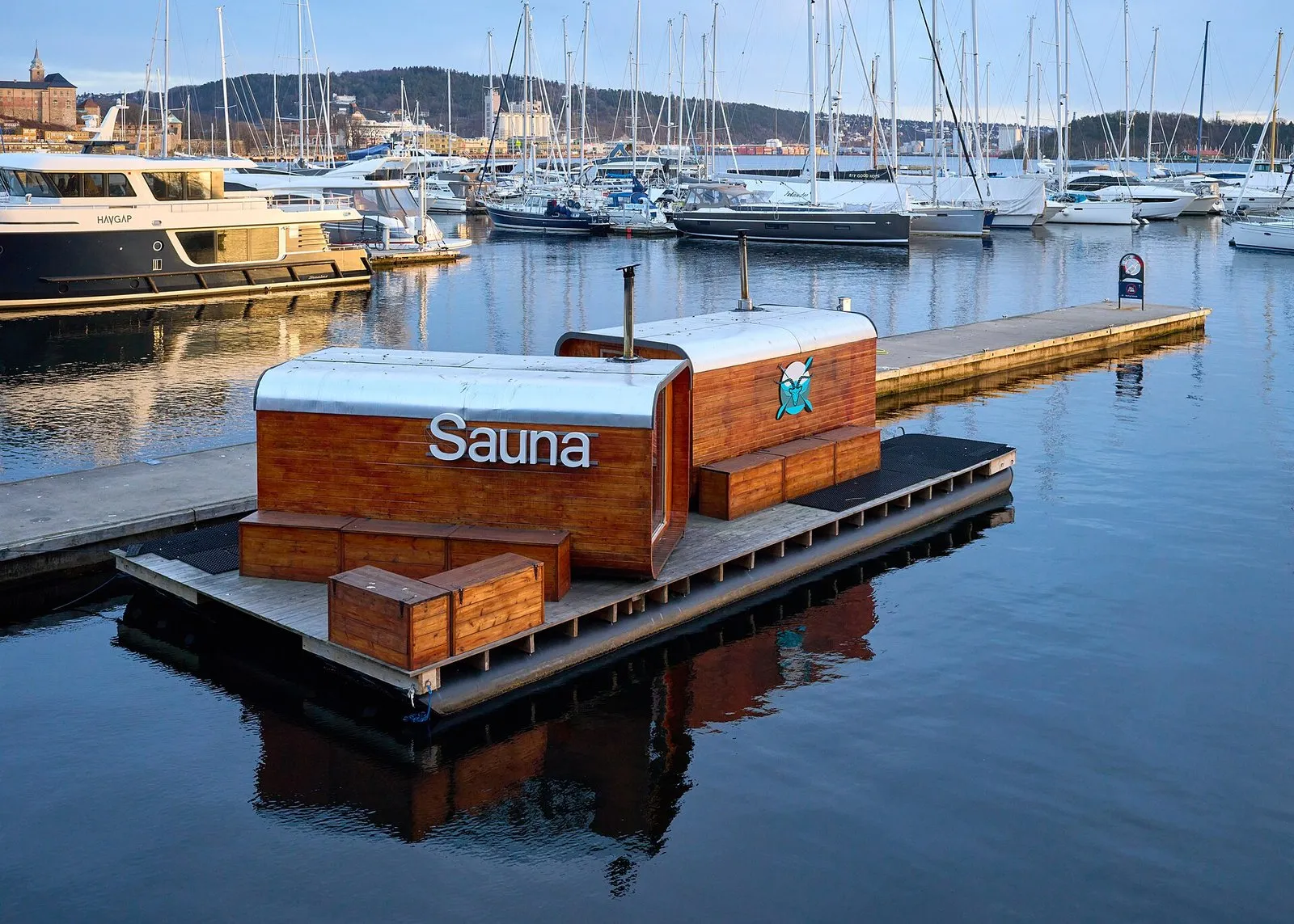
The Opera House is the western edge of the Bjørvika cultural quarter. MUNCH is across the footbridge, and the floating saunas in Oslo at Sukkerbiten and Langkaia are good for warming up after the cold waterfront. See also 3 days in Oslo and where to stay in Oslo.
Common questions
Is walking on the Oslo Opera House roof free?
Yes. The marble roof is a public space open 24 hours a day, every day, with no ticket needed.
Can you go inside the Oslo Opera House without a performance ticket?
Yes. The glass-fronted public foyer is open Monday to Saturday 11:00 to 16:00 and Sunday 12:00 to 16:00, and stays open until the intervals on show nights. Entry is free.
How much are guided tours of the Oslo Opera House?
English-language guided tours take place on Saturdays and Sundays, lasting 50 minutes. Tickets cost NOK 180 for adults and NOK 105 for children. Oslo Pass holders receive a 15% discount.
Are there restaurants inside the Oslo Opera House?
Yes. Brasserie Sanguine serves lunch and dinner daily in the foyer from 12:00 to 20:00, and the seafood restaurant Havsmak opens for dinner Tuesday to Saturday.
Who designed the Oslo Opera House and what is it built from?
The Norwegian firm Snøhetta designed it, and it was completed in 2008. The exterior is clad in 36,000 slabs of white Carrara marble and white granite; inside, an undulating oak wall wraps the auditorium.