In this guide
💡 The Short Version: Adult admission to the Fram Museum (Frammuseet) costs NOK 180, children and students pay NOK 70, and Oslo Pass holders enter completely free. The museum on the Bygdøy peninsula is built around Fram, the wooden ship that Fridtjof Nansen took furthest north and Roald Amundsen took to Antarctica for his South Pole expedition. You can climb on board and go below deck. It is open every day of the year, 10:00 to 17:00 in winter and 09:30 to 18:00 in summer. Combined tickets with the neighbouring Kon-Tiki Museum are sold at the admissions desk. Or book a tour: the Oslo Discovery Tourad from NOK 1,050 is a 5.5-hour guided bus tour of Holmenkollen, Vigeland Park, the Fram Museum and either the Folk Museum or the Kon-Tiki Museum, with two museum entries included, so you skip the bus to Bygdøy and the separate tickets.
⚠️ The Viking Ship Museum on Bygdøy remains closed until late 2027. It is being expanded into the Museum of the Viking Age, so the Oseberg and Gokstad ships cannot be seen on Bygdøy. For Viking gold and weapons, go to the Historical Museum in central Oslo.
Ticket prices
Buy tickets at the entrance or in advance on the official Fram Museum site. Advance tickets are not tied to a time slot:
| Ticket type | Price (frammuseum.no) |
|---|---|
| Adult | NOK 180 |
| Child | NOK 70 |
| Oslo Pass | Free |
- Oslo Pass value: the Fram Museum (NOK 180) and the Kon-Tiki Museum (NOK 180) sit next to each other on Bygdøynes, so a morning there is NOK 360 in tickets before the ferry; the Oslo Pass covers both.
- Accessibility: ramped galleries give wheelchair users views of the ship’s exterior, but the gangways, companionway ladders and lower berths inside the 1892 vessel are not wheelchair accessible.
Tours that include the Fram Museum
Discovery tour with two museums
From NOK 1,050 · 4.7 stars from 428 reviews · 5½ hours · guided bus tour
Oslo: Oslo Discovery Tour with 2 Museums Includedad covers the Holmenkollen ski jump, Vigeland Sculpture Park, the Fram Museum and either the Norwegian Folk Museum or the Kon-Tiki Museum.
Grand city tour with a fjord cruise
From NOK 1,500 · 4.7 stars from 711 reviews · 7½ hours · guided bus tour and boat
Oslo: Grand City Sightseeing Tour by Bus with Fjord Cruisead adds a fjord cruise to the same route: Holmenkollen, Vigeland Park, the Fram Museum, and the Folk Museum from May to September or the Kon-Tiki Museum from October to April.
Private Fram Museum tour
From NOK 1,740 · 5 stars from 2 reviews · 2 hours · private guide
Skip-the-line Fram Museum Oslo Private Tour with Ticketsad comes with fast-track tickets and a private guide who takes you through the polar ship’s cabins, lounges and engine room.
The engineering of the Fram
Fram (“Forward”) was built in Larvik in 1892 by the naval architect Colin Archer for Fridtjof Nansen’s plan to freeze a ship into the Arctic pack ice and drift across the polar sea:
- The rounded hull: a ship trapped in pack ice is normally crushed. Archer gave Fram a wide, shallow, rounded hull with no protruding keel, so the squeezing ice pushed it upwards onto the floe, like an almond squeezed out of its shell.
- Timber framing: the hull has three layers of greenheart oak, pitch pine and pitch-soaked Norwegian oak, up to 80 centimetres thick, with heavy transverse beams and diagonal knees in the hold.
- Insulated quarters: the crew bulkheads were lined with reindeer hair, cork shavings, linoleum and felt, with a small paraffin stove for winters when it fell below -50°C outside.
Fram carried three expeditions:
- Fridtjof Nansen (1893–1896): drifted across the Arctic Ocean for nearly three years, reaching 85°55’N. Nansen and Hjalmar Johansen then left on foot with dogs and skis and reached 86°14’N, the furthest north anyone had been at the time.
- Otto Sverdrup (1898–1902): explored and mapped over 260,000 square kilometres of the Canadian Arctic archipelago.
- Roald Amundsen (1910–1912): switched the destination to Antarctica and set up a base at the Bay of Whales, from which Amundsen and four companions reached the South Pole on 14 December 1911.
The boarding experience and exhibition halls
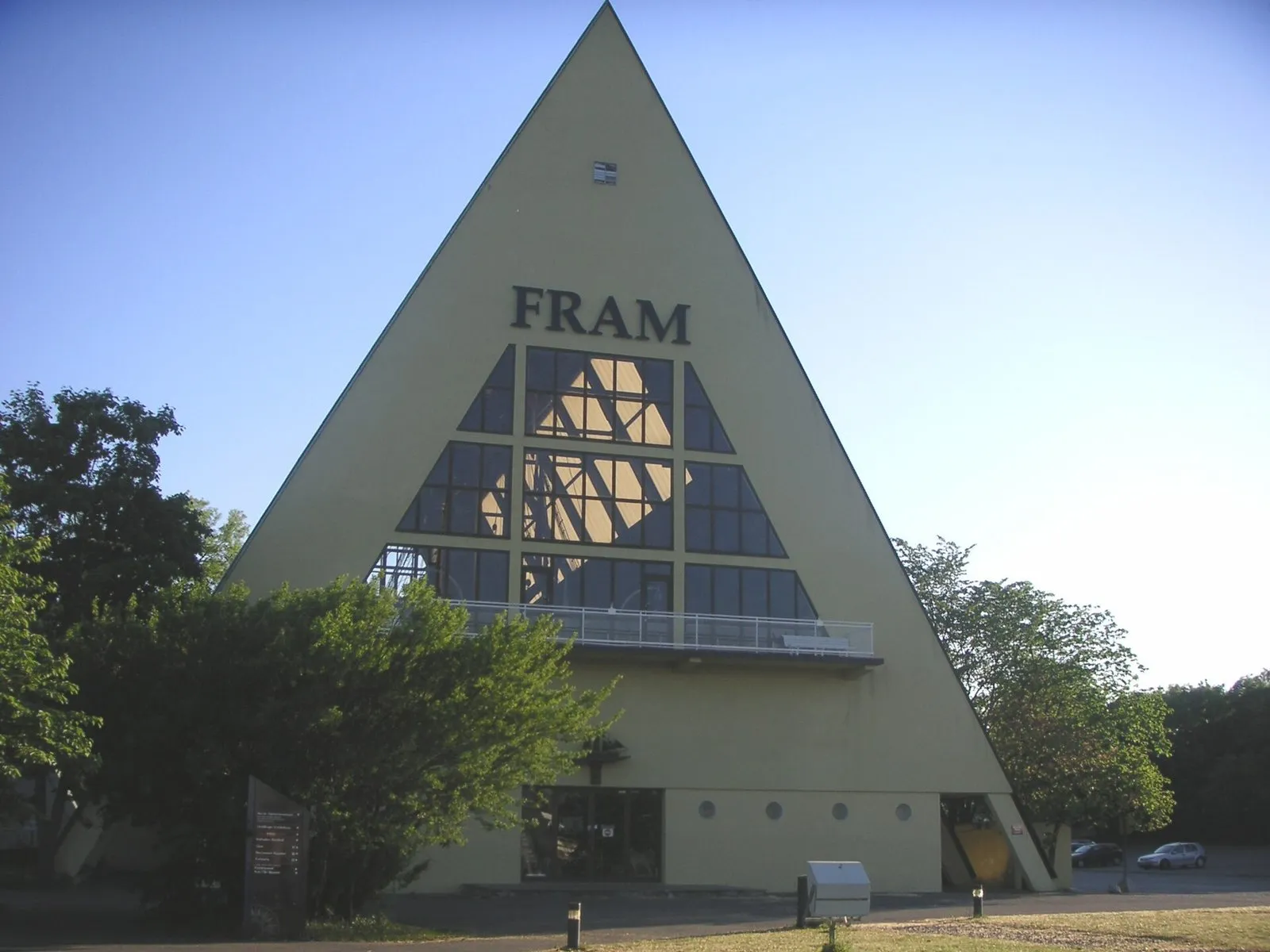
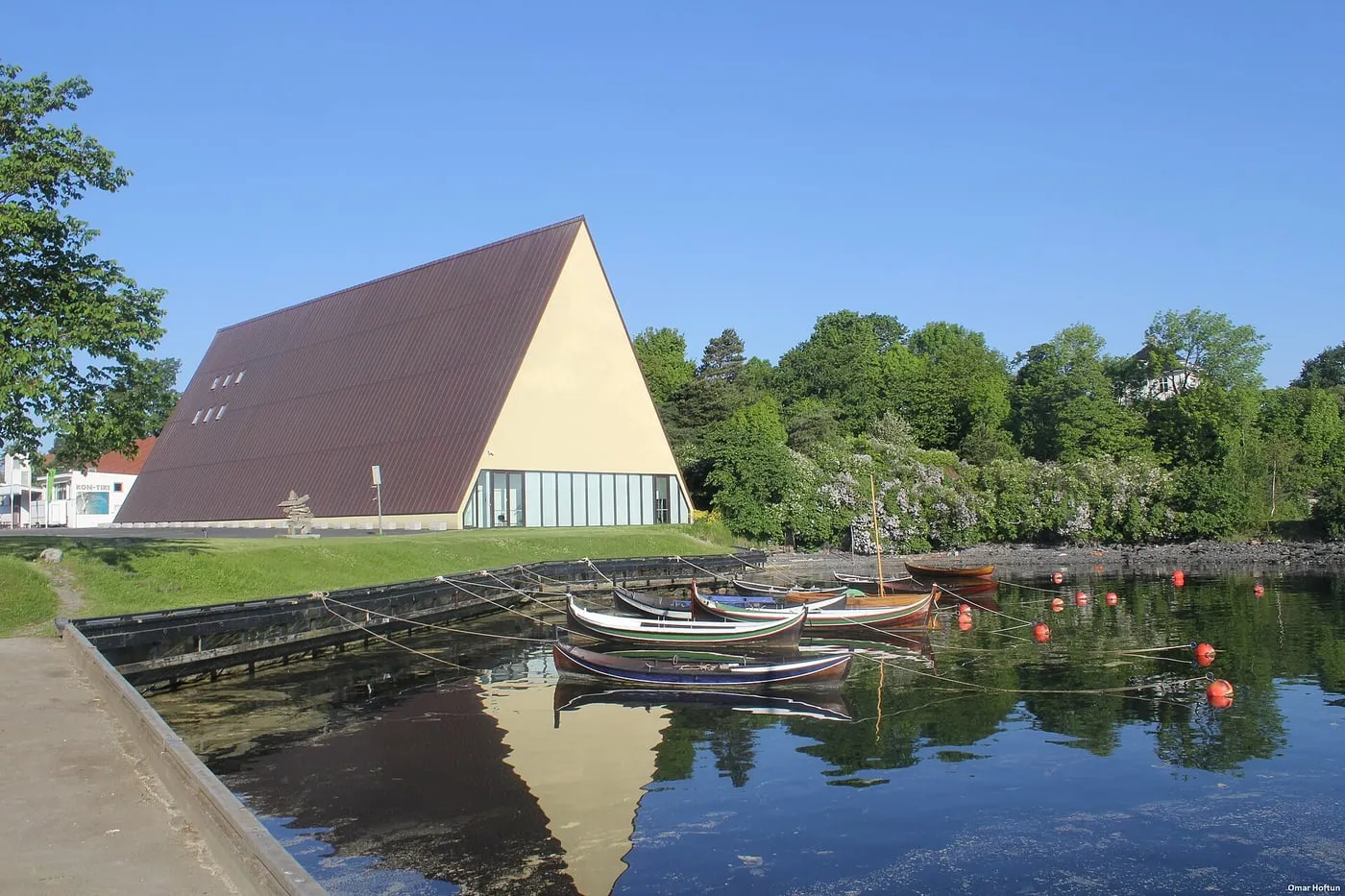
You walk up through a triangular building that wraps around the hull, past the copper sheathing, and cross a gangway onto the deck:
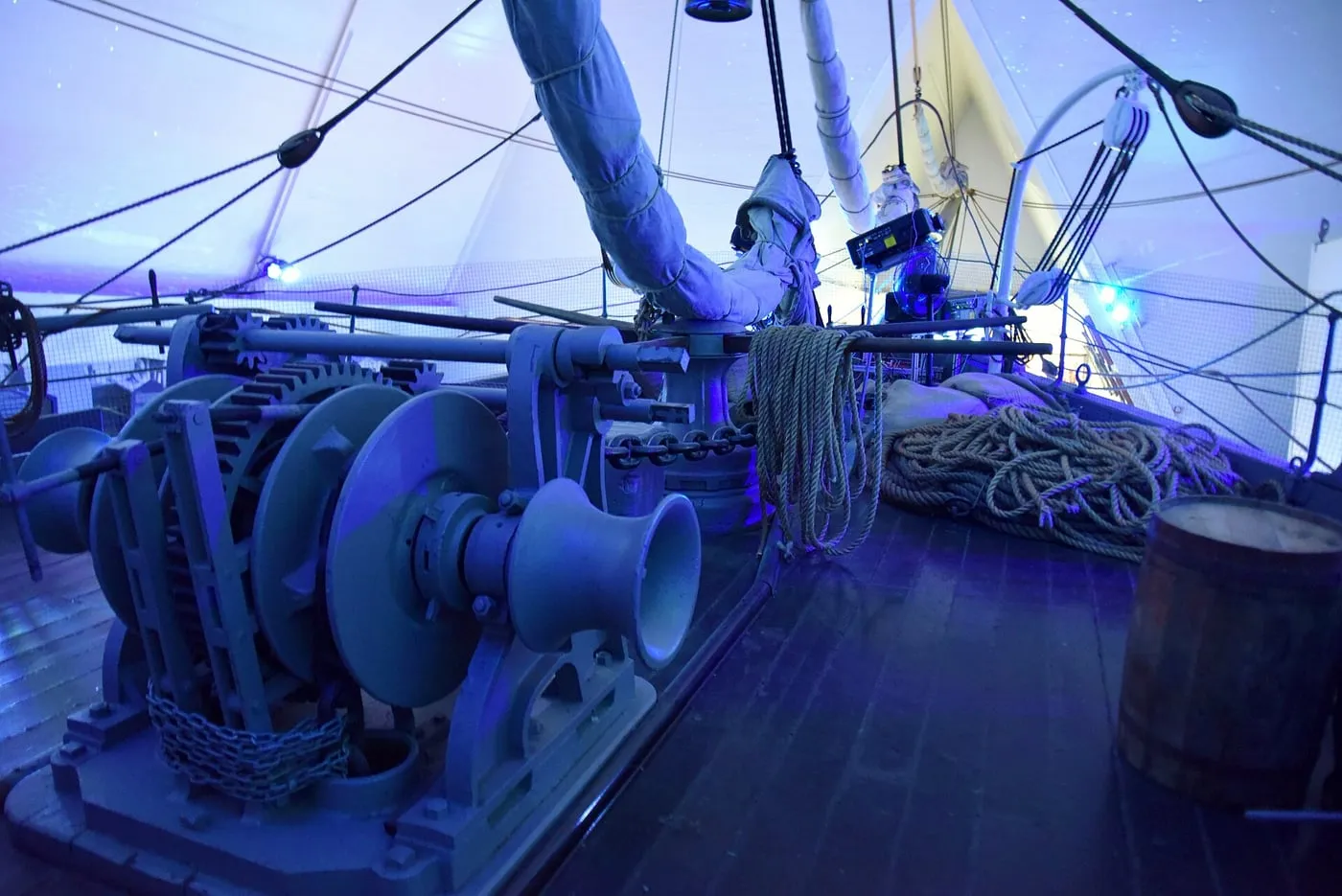
- The weather deck: stand at the wheel under the masts and rigging while a 270-degree projection on the walls shows Arctic blizzards, breaking ice floes and the aurora.
- The Officers’ Saloon: go down the companionway to the wood-panelled mess, with the round dining table, upright German piano, bookshelves and kerosene lamps.
- Crew cabins: the small cabins of Nansen, Amundsen and Sverdrup, with woollen blankets, brass thermometers, charts and diaries.
- Galley and engine room: the cast-iron stove where the cook melted snow and prepared seal meat, pemmican and cloudberry preserves, and below it the 220-horsepower triple-expansion steam engine and the diesel machinery fitted for Amundsen’s Antarctic voyage.
The Gjøa building and polar flight simulator
An underground gallery connects the main hall to the Gjøa Building, built in 2013:
- Gjøa (the Northwest Passage): Roald Amundsen’s 70-foot converted herring sloop, the first vessel to sail through the Northwest Passage, between 1903 and 1906. You view it from mezzanine walkways.
- Trapped in Ice simulator: a refrigerated chamber at -10°C with creaking ice sounds and a cold blast.
- 4D flight simulator: Amundsen’s 1925 attempt to fly to the North Pole in a Dornier Wal N25 flying boat, with motion seats, wind and archive footage.
Opening hours and seasonal schedule
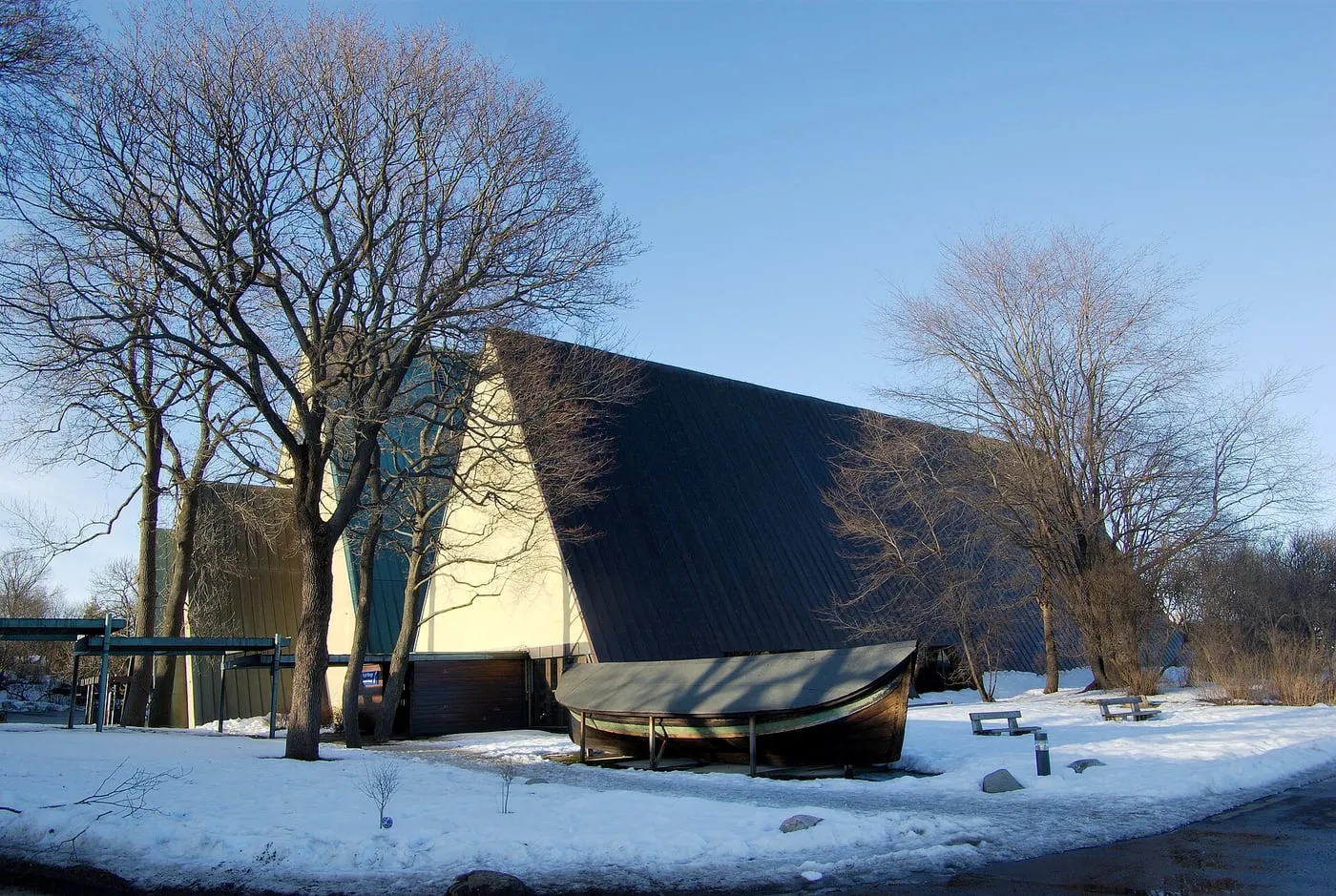
The Fram Museum is open 365 days a year:
| Period | Opening hours | Notes |
|---|---|---|
| 1 October to 30 April | 10:00 to 17:00 daily | Standard winter schedule |
| 1 May to 30 September | 09:30 to 18:00 daily | Extended summer hours |
- Christmas: it opens on 24, 25, 26 and 31 December and 1 January, when most city museums are shut.
- Time needed: allow 2 to 2.5 hours for both ships, the underground galleries and the simulators.
Getting to Bygdøy: bus 30 versus the summer ferry
The museum is at Bygdøynesveien 39 on the eastern tip of the Bygdøy peninsula.
1. Ruter Bus 30 (year-round)
- Departures: every 8 to 10 minutes from Oslo Central Station (Jernbanetorget), Nationaltheatret and Solli plass to the Bygdøynes terminus outside the museum.
- Tickets: Zone 1 on public transport in Oslo. A single in the Ruter app is NOK 46; 24-hour and 7-day Ruter passes and the Oslo Pass cover it. From Nationaltheatret it takes about 18 minutes.
2. Bygdøy passenger ferry (seasonal)
- Route: Båtservice boats leave from Rådhusbrygge 3 (City Hall Pier 3) behind City Hall, stop at Dronningen (for the Folk Museum) and end at Bygdøynes. The crossing takes 12 minutes.
- Season: daily from mid-April to late September.
- Fares: this is a private service, not part of Ruter. Ruter single and period tickets are not valid, so buy tickets separately. It is free with the Oslo Pass.
Next door is Thor Heyerdahl’s balsa raft at the Kon-Tiki Museum, and 15 minutes’ walk north is the medieval Gol Stave Church in the open-air Norsk Folkemuseum. See also 3 days in Oslo.
Common questions
How much are tickets to the Fram Museum in Oslo?
Standard adult admission is NOK 180, children aged 6 to 17 and students pay NOK 70, and seniors pay NOK 140. A family ticket for two adults and up to five children costs NOK 400. Oslo Pass holders enter free.
Can you go inside the ship at the Fram Museum?
Yes. You can walk the deck and go below to the wood-panelled mess saloon, expedition cabins, galley stove, laboratory and engine hold.
When is the Fram Museum open?
The Fram Museum is open every day of the year, including Christmas Day. From 1 October to 30 April hours are 10:00 to 17:00, and from 1 May to 30 September hours are 09:30 to 18:00.
How do you get to the Fram Museum from central Oslo?
Ruter bus 30 runs year-round from Jernbanetorget and Nationaltheatret straight to the Bygdøynes terminus outside the museum doors. In summer a separate Bygdøy ferry departs from City Hall Pier 3.