In this guide
💡 The Short Version: Admission to the National Museum (Nasjonalmuseet) costs NOK 220 for adults, NOK 100 for visitors under 25, and NOK 120 for students under 30. Under-18s enter free, as do Oslo Pass holders who present their pass at the desk. The slate-clad building is at Vestbanen beside Aker Brygge and holds Edvard Munch’s 1893 The Scream in Room 60. Galleries open Tuesday and Wednesday 10:00 to 20:00, Thursday to Sunday 10:00 to 17:00, and remain closed on Mondays. Or book a tour: a National Museum entry ticketad is sold on GetYourGuide at NOK 220, and a 2-hour Oslo highlights walkad from NOK 264 passes the museum with Akershus Fortress and City Hall, so the sights around it are planned for you.
⚠️ The museum is closed on Mondays. It also closes on 24, 25 and 26 December, 31 December and 1 January. MUNCH is open seven days a week, so use it for Mondays.
Ticket prices and admission options
Buy tickets on the official Nasjonalmuseet site or at the counters in the Vestbanen entrance hall. Online tickets carry an entry date and skip the queue at the busy mid-morning hours:
| Ticket category | Price | Verification requirements |
|---|---|---|
| Adult | NOK 220 | Standard entry |
| Young adult (18–25) | NOK 100 | Passport or photo ID |
| Student (under 30) | NOK 120 | Valid student union card |
| Child (under 18) | Free | Age verification may be requested |
| Oslo Pass | Free | Scan pass barcode at the desk |
| Museum member | Free | Annual membership card |
| Disabled companion / Carer | Free | Valid accompanying carer pass |
- Oslo Pass: holders of an Oslo Pass enter free. No online slot is needed: show the QR code on your phone at the information desk to get an entry badge.
- Combined ticket: there is no joint ticket with the MUNCH Museum. A 24-hour or 48-hour Oslo Pass covers both museums and all public transit.
Tickets and a walk past the museum
National Museum entry ticket
From NOK 220 · 4.7 stars from 225 reviews · entry ticket
Oslo: National Museum of Norway Entry Ticketad is an entry ticket to the museum, Norway’s largest collection of art, architecture and design.
Essential highlights walk
From NOK 264 · 4.4 stars from 22 reviews · 2 hours · walking tour
Oslo Essential Highlights Tourad runs from Oslo Central Station and Deichman Bjørvika to the Opera House, the Barcode towers, Akershus Fortress, City Hall and the National Museum.
The Munch Room: The Scream in Room 60
Room 60 on the second floor is the museum’s Munch room. The MUNCH Museum in Bjørvika holds the artist’s estate of over 26,000 items; the National Museum owns the works the state acquired in his productive years.
The room shows eighteen major works by Edvard Munch:
- The Scream (Skrik, 1893): tempera and crayon on cardboard (91 x 73.5 cm), the earliest painted version of the motif. The industrialist Olaf Schou donated it to the National Gallery in 1910.
- The “Madman” inscription: in the upper left corner of the red sky, a faint pencil inscription reads “Kan kun være malet af en gal Mand!” (“Can only have been painted by a madman!”). It was long suspected to be vandalism by a hostile viewer, but infrared reflectography and handwriting analysis, completed in 2020, showed that Munch himself wrote it, after hostile reviews of an 1895 Kristiania exhibition.
- The 1994 theft: on 12 February 1994, the opening day of the Winter Olympics in Lillehammer, thieves put a ladder against a window of the former National Gallery, cut the picture off the wall in 50 seconds and left a note reading “Thanks for the poor security”. Police recovered it undamaged three months later in a sting at a coastal hotel.
- Madonna (1894–95): Munch’s sensual portrayal of female ecstasy and motherhood, framed by red and black halos.
- The Dance of Life (Livets dans, 1899–1900): a large canvas of youth in white, passion in scarlet and old age in black on a moonlit beach.
- Girls on the Pier (Pikene på broen, 1901) and Ashes (Aske, 1894): early examples of Munch’s treatment of anxiety, grief and sexual tension.
Photography without flash is allowed in Room 60. Guards keep a queue moving in front of The Scream at peak midday hours.
Layout: 86 rooms and 6,500 exhibits
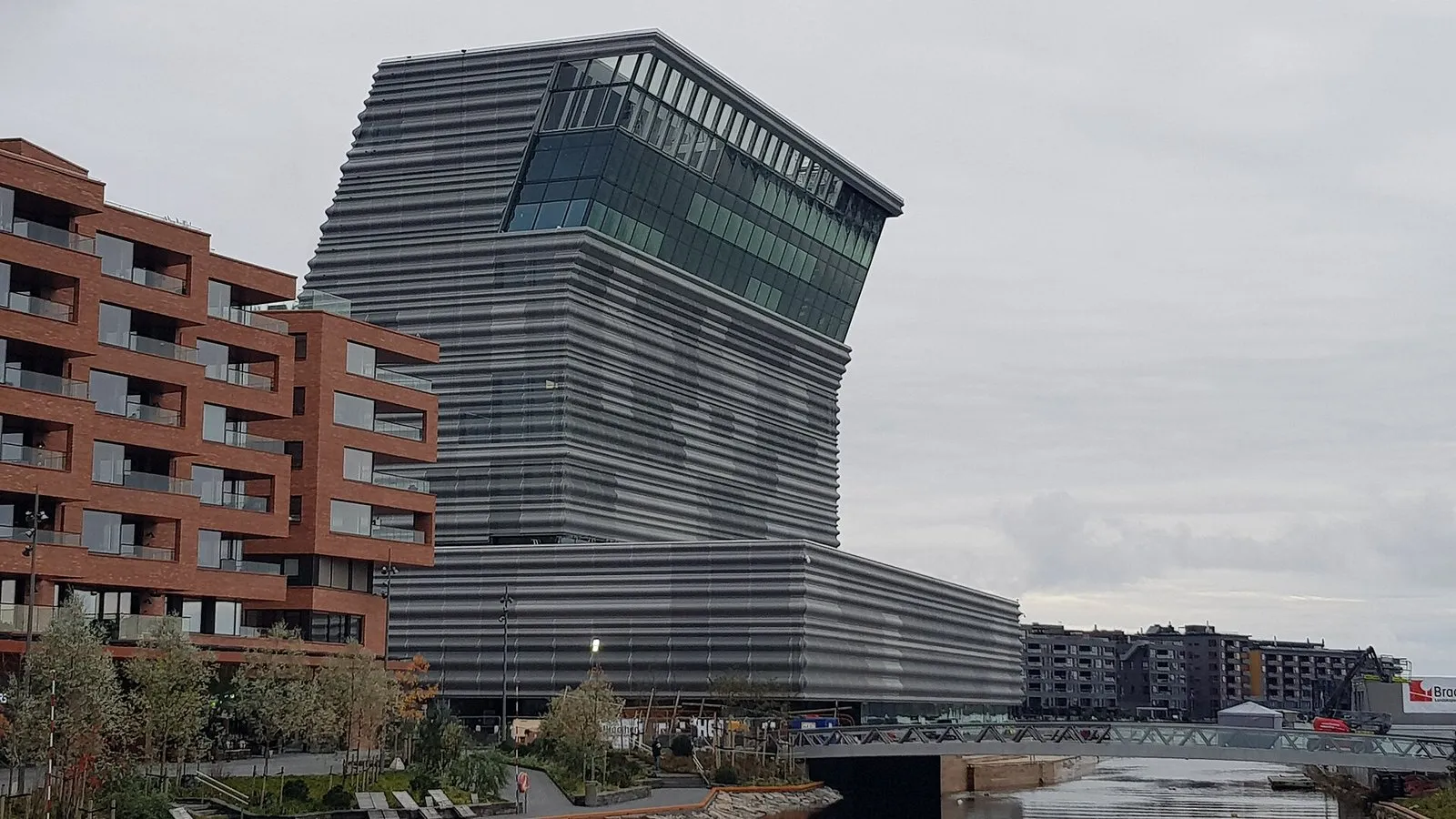
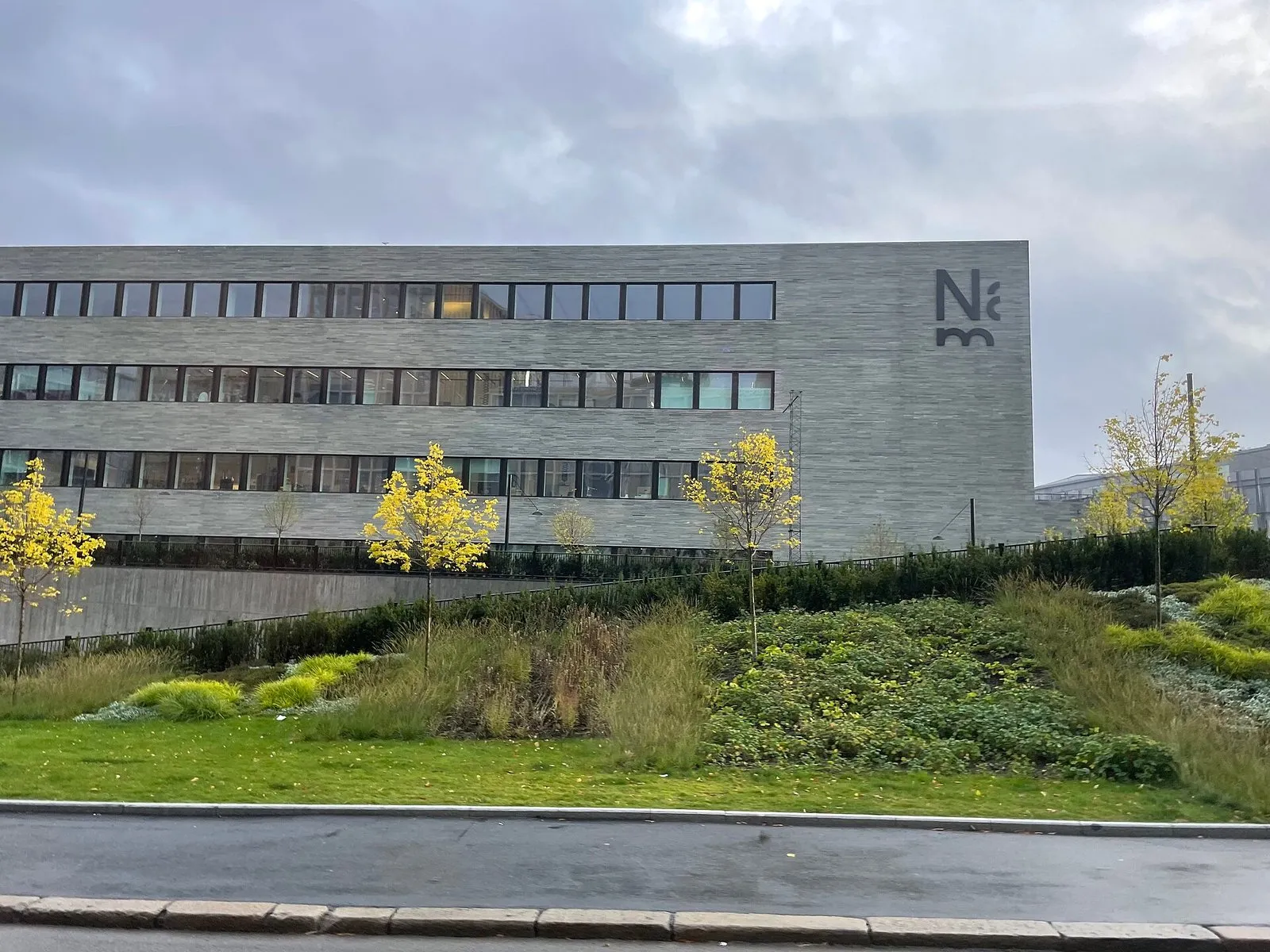
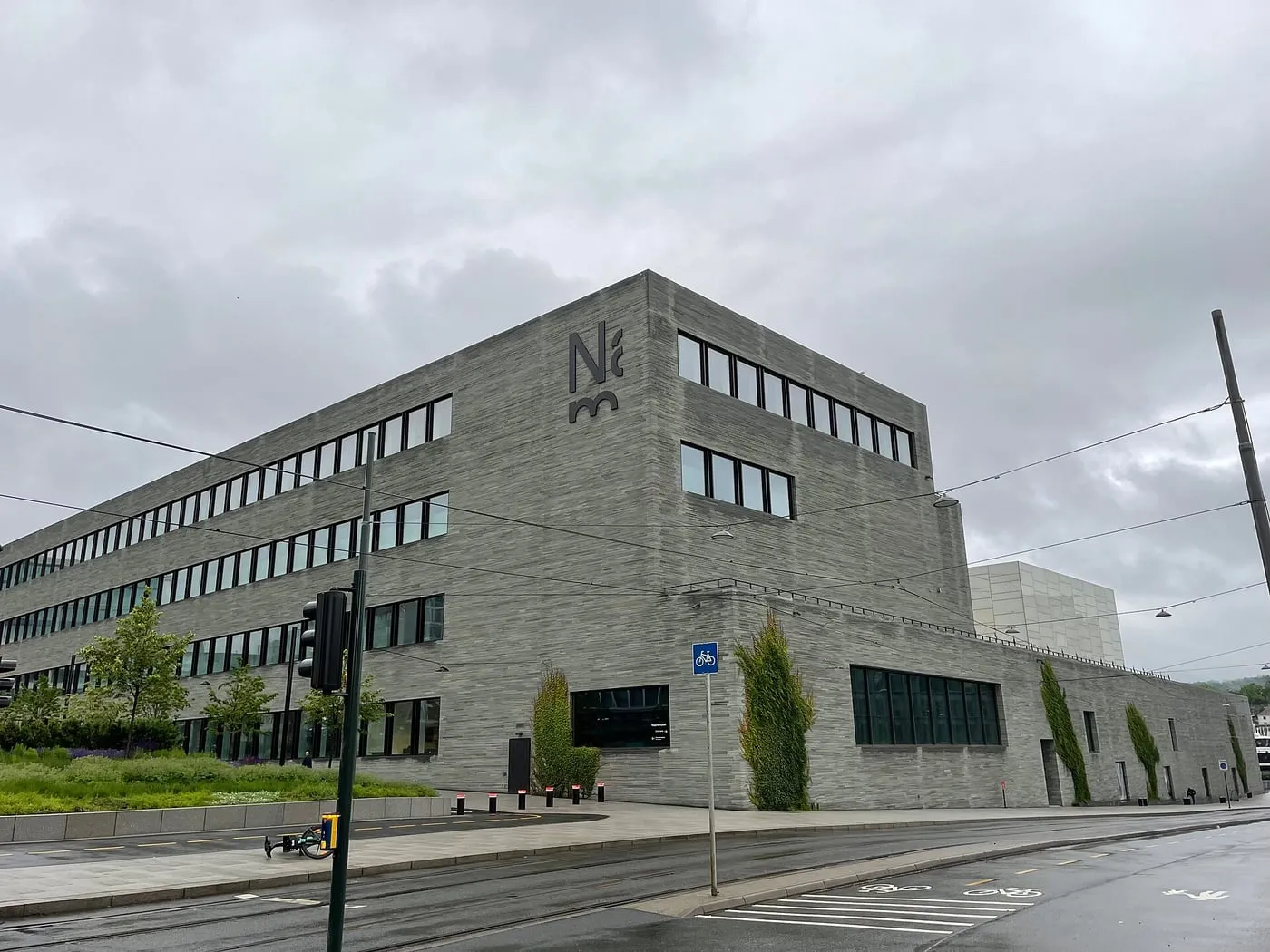
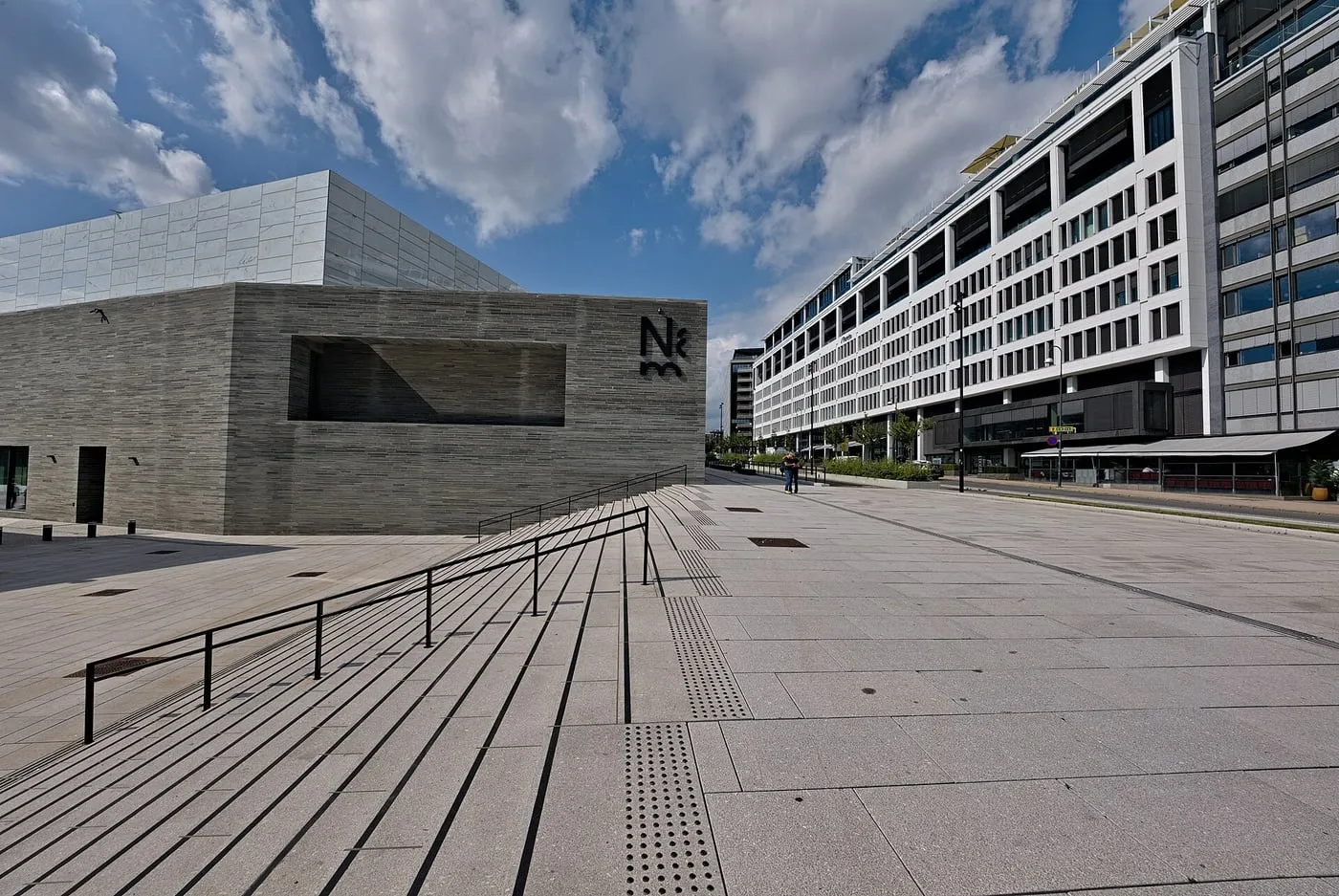
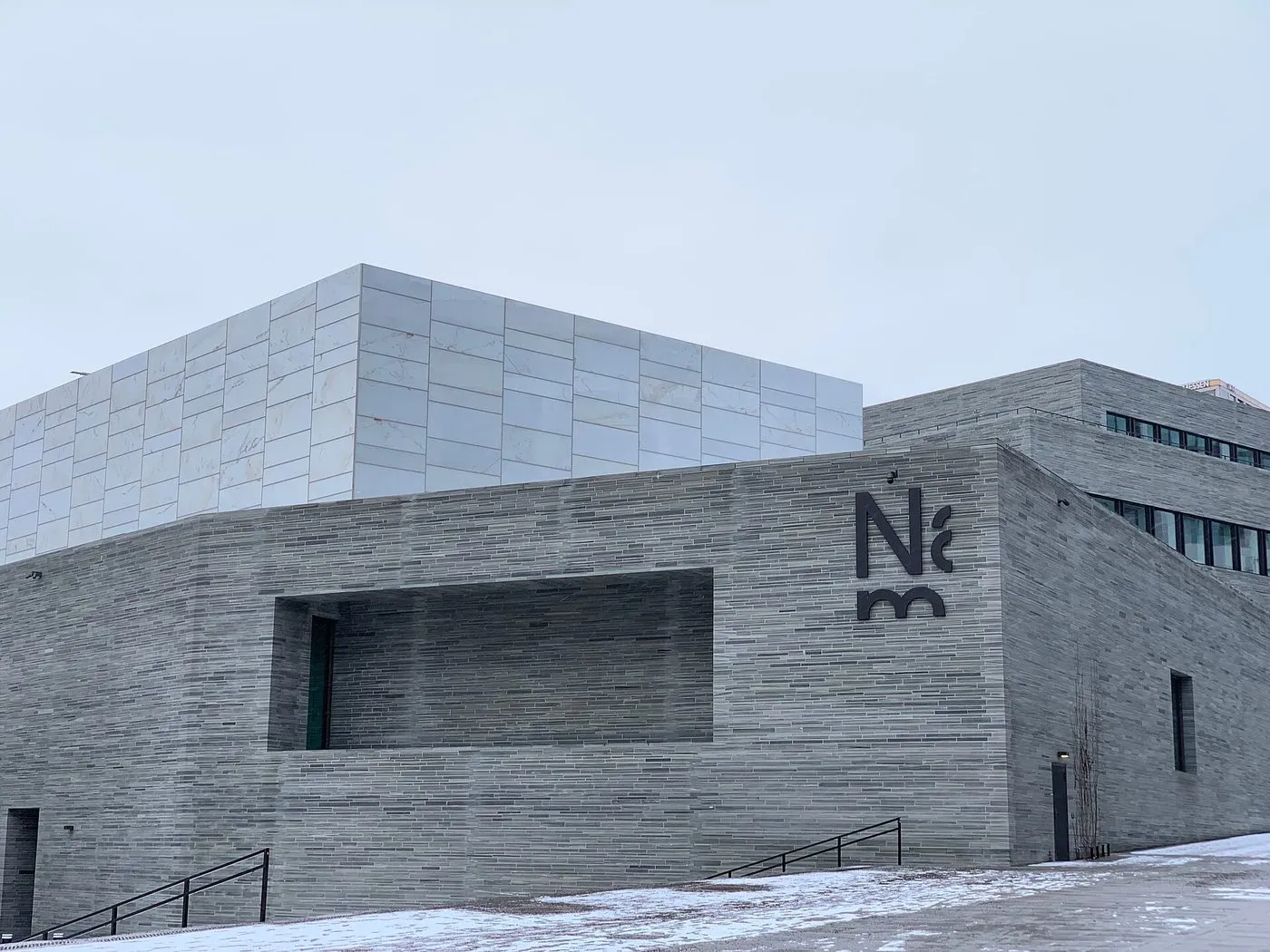
The museum opened in June 2022 in a building by the German architects Kleihues + Schuwerk. It covers 54,600 square metres and describes itself as the largest art museum in the Nordic countries; it brought the former National Gallery, Museum of Decorative Arts and Design, and Museum of Contemporary Art under one roof. The facade is Norwegian Oppdal slate.
Floor 1: Decorative arts, design and royal heritage
The first floor covers design, craft and material culture from antiquity to the present:
- The Baldishol Tapestry (Room 1): one of the few surviving Romanesque tapestries, woven in wool in eastern Norway around 1180. Only fragments survive, showing April (a seed sower) and May (a mounted knight).
- Porcelain and silver: seventeenth-century Meissen porcelain, Danish royal tableware and Norwegian filigree silver drinking horns.
- Royal court gowns: ceremonial dresses worn by Queen Maud and Queen Sonja, from Parisian workshops to Oslo designers.
- Scandinavian modernism: furniture by Arne Jacobsen, Hans Wegner and the Norwegian designer Grete Prytz Kittelsen.
Floor 2: Fine art from the Renaissance to 1945
The second floor has paintings, sculpture and drawings in chronological order through 45 galleries:
- European masters (Rooms 48–55): Renaissance devotional panels, Dutch Golden Age still lifes, and canvases by Lucas Cranach the Elder, El Greco, Claude Lorrain and Rembrandt.
- Norwegian romanticism: mountain panoramas by J.C. Dahl, Thomas Fearnley and Peder Balke, and Adolph Tidemand and Hans Gude’s folk scene Bridal Procession on the Hardangerfjord (1848).
- The Fairy Tale Room: a wood-panelled salon of original watercolours by Theodor Kittelsen and Erik Werenskiold, with forest trolls, water spirits (Nøkken) and other folklore.
- Nineteenth-century realism: Christian Krohg’s Albertine in the Police Doctor’s Waiting Room, about the exploitation of working-class women in Kristiania.
- Harald Sohlberg: Winter Night in the Mountains (Vinternatt i Rondane, 1914), a work the National Museum says has been called Norway’s “national painting”.
Floor 3: The Light Hall (Lyshallen)
The Light Hall (Lyshallen) is a 2,400-square-metre rooftop pavilion for major temporary exhibitions. Its walls are thin translucent marble sheets laminated between glass, which let in soft daylight by day and glow over Pipervika harbour at night.
Opening hours and visiting strategy
| Day | Opening hours | Recommended arrival |
|---|---|---|
| Monday | Closed all day | Plan Bygdøy or MUNCH instead |
| Tuesday & Wednesday | 10:00 to 20:00 | Arrive after 16:30 for quiet rooms |
| Thursday to Sunday | 10:00 to 17:00 | Arrive at 10:00 sharp |
- Evening visits: The museum is open late on Tuesday and Wednesday, from 17:00 to 20:00. School groups and coach tours leave by mid-afternoon, so Room 60 is much quieter.
- Audio guide app: Download the free Nasjonalmuseet Visitor Guide app before you arrive. It has English commentary on over 200 works, floor plans and 45-minute highlights routes. Wi-Fi is free in all galleries.
Practical logistics: cloakroom, cafes and access
Cloakroom and bag rules
Handbags larger than A4 (about 30 x 21 cm) are not allowed in the galleries:
- Free lockers: Down the stone staircase on floor -1, the cloakroom has automated lockers that you set with your own 4-digit code. They take rucksacks, umbrellas and winter coats.
- Suitcases: No locker fits a large suitcase. Leave rolling bags in the lockers at Oslo Central Station before you walk over.
- Water bottles: Bottles of any kind, even empty or sealed, are not allowed in the exhibition halls. There are free water fountains and rest areas beside the toilets on each floor.
Dining and shops
- Bollebar: off the entrance courtyard, selling cardamom and cinnamon buns baked on site.
- Kafé: a cafeteria on floor 1 serving open sandwiches (smørbrød), seasonal vegetable soups and coffee.
- Museum Shop: art books, Norwegian wool throws, jewellery and design objects.
How to get there
The museum is at Brynjulf Bulls plass 3, behind the old Vestbanen railway station at the entrance to Aker Brygge:
- By tram: route 12 stops in front of the building at Aker Brygge.
- By metro: all T-bane lines (1 to 5) stop at Nationaltheatret. Take the southern “Ruseløkkveien / Vika” exit and walk downhill along Dronning Mauds gate for 4 minutes (350 metres).
- By train: regional Vy trains and Flytoget stop at Nationaltheatret, so you can come from Oslo Airport Gardermoen without changing at Oslo S.
- On foot: 5 minutes from Oslo City Hall (Rådhuset) or 15 minutes along Karl Johans gate.
Aker Brygge’s waterfront promenade is next door, and Akershus Fortress and Castle is across the harbour basin. See also where to stay in Oslo and public transport in Oslo.
Common questions
How much are tickets to the National Museum in Oslo?
Standard adult admission is NOK 220, visitors aged 18 to 25 pay NOK 100, and tertiary students under 30 pay NOK 120. Children under 18 enter free, and Oslo Pass holders collect complimentary tickets at the entrance.
Is The Scream at the National Museum in Oslo?
Yes. The 1893 version, in tempera and crayon on cardboard, hangs in Room 60 of the permanent collection. The separate MUNCH museum in Bjørvika shows other versions.
When is the National Museum in Oslo open?
Tuesday and Wednesday from 10:00 to 20:00, and Thursday to Sunday from 10:00 to 17:00. The museum is closed on Mondays throughout the year.
Can I bring a bag into the National Museum?
Only handbags smaller than A4 are allowed in the exhibition halls. Rucksacks, suitcases, umbrellas and coats go in the free digital lockers on floor -1.
Is there a pushchair policy at the National Museum?
Strollers up to 100 cm long and 75 cm wide are allowed on all gallery levels. Larger prams can be left in the cloakroom, which also has free loan buggies.